Have you ever wondered whether to write oftentimes as one word or often times as two? Although they look similar, these expressions don’t work the same way in everyday English. Oftentimes is a recognized adverb that means often, frequently, or on many occasions.
For example, you might say, “Oftentimes, people learn more from their mistakes than their successes.” By contrast, often times is generally not the preferred spelling when you want to express frequency. In most sentences, writing often or oftentimes sounds clearer and more natural.
However, the words often and times can appear next to each other when they serve separate grammatical purposes, such as in “How often times have you visited?”—although “How many times have you visited?” is more natural.
Quick Answer :
The simplest answer is this:
Oftentimes is an adverb that means often, frequently, or many times. It is written as one word.
Often times consists of two separate words. In this construction, often is an adverb and times is a plural noun. It can be grammatically correct when you are literally talking about repeated occasions or instances.
For example:
- Oftentimes, people forget to check their messages.
- I have visited that place often times. — This can occur, but it is usually less natural than “many times” or “often.”
- There were often times when I felt uncertain. — Here, “times” means occasions, so the two-word construction has a different grammatical function.
In ordinary writing, if you want to say “frequently,” “regularly,” or “many times,” use oftentimes or, more simply, often.
What Does “Oftentimes” Mean?
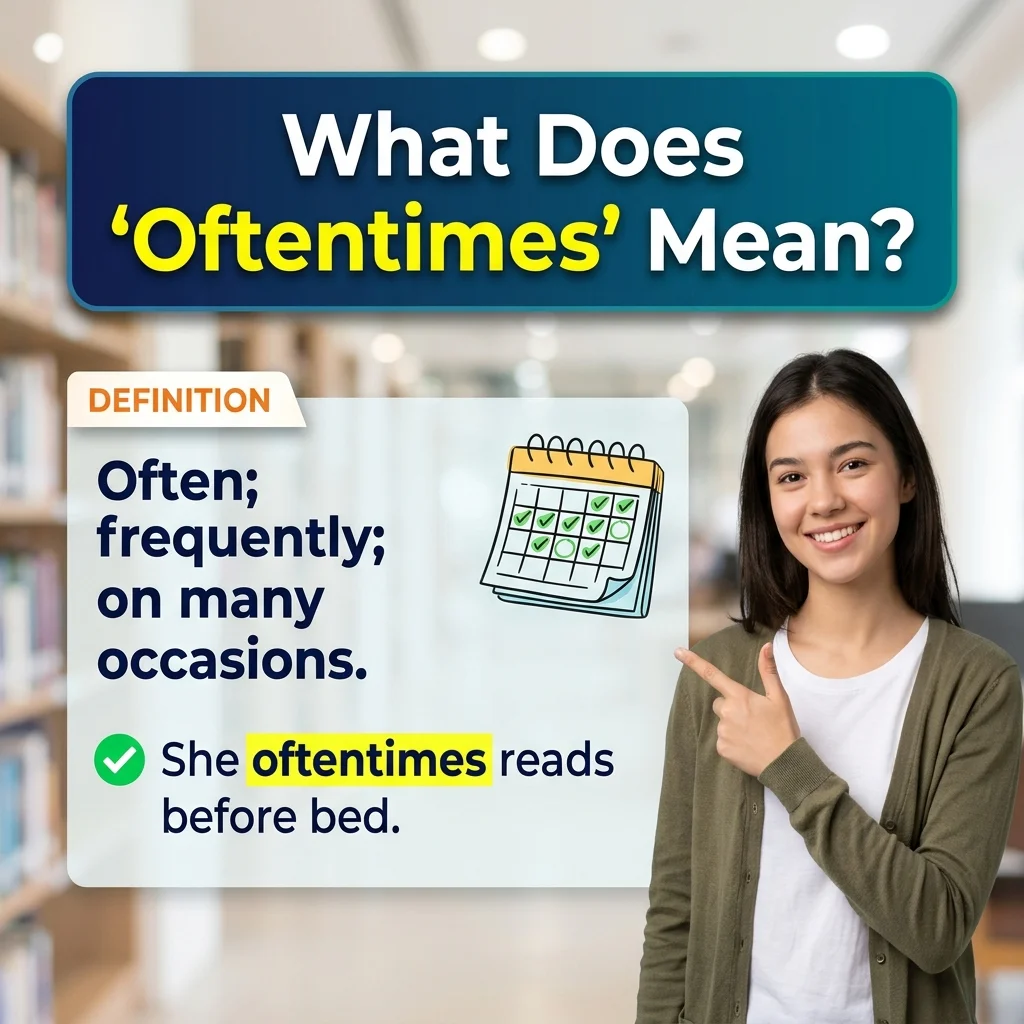
Oftentimes is an adverb that means often, frequently, or on many occasions.
It describes something that happens repeatedly or regularly, although not necessarily every time.
For example:
- Oftentimes, children learn quickly through play.
- Oftentimes, small mistakes can lead to bigger problems.
- People oftentimes underestimate how important sleep is.
In each sentence, oftentimes tells us how frequently something happens.
Is “Oftentimes” a Real Word?
Yes. Oftentimes is a legitimate English word.
It is not a spelling mistake, and it is not simply an informal internet expression. It has a long history in English and is recognized in standard dictionaries.
However, often is usually the simpler and more common choice in modern everyday English.
Compare:
- Oftentimes, we forget the value of simple things.
- Often, we forget the value of simple things.
Both are grammatically correct. The second sentence is shorter and usually sounds more natural.
Is “Oftentimes” One Word?
Yes.
When you use oftentimes as an adverb meaning “often,” it should normally be written as one word:
Correct: oftentimes
Incorrect for this meaning: often times
This is one of the most important spelling points to remember when discussing oftentimes vs often times.
What Does “Often Times” Mean?

The expression often times contains two separate words:
- often — an adverb
- times — a plural noun
When used this way, times usually means occasions, instances, or situations.
For example:
There were often times when I wanted to give up.
Here, “times” means “occasions.” You could replace the phrase with:
There were many occasions when I wanted to give up.
This is different from using oftentimes as a single adverb.
Why Do People Write “Often Times”?
People sometimes write often times when they intend to use oftentimes.
For example:
Often times, people make this mistake.
The writer probably means:
Oftentimes, people make this mistake.
Or, more naturally:
Often, people make this mistake.
Therefore, if your intended meaning is simply “frequently,” writing oftentimes or often is generally better.
Oftentimes vs Often Times: Main Difference
The biggest difference is grammatical.
| Expression | Word Type | Meaning | Typical Use |
| oftentimes | Adverb | Often; frequently | Describes how frequently something happens |
| often times | Adverb + noun | Often occurring occasions/times | Used when “times” means occasions |
| often | Adverb | Frequently | Most common and simple choice |
Consider these examples:
Oftentimes, people change their minds.
Here, “oftentimes” means “frequently.”
Now consider:
There were often times when people changed their minds.
Here, “times” refers to occasions.
The sentences may look similar, but their grammatical structures are different.
Oftentimes vs Often: Are They the Same?
In most contexts, oftentimes and often have essentially the same meaning.
Both can describe something that happens frequently.
For example:
- Oftentimes, students feel nervous before an exam.
- Often, students feel nervous before an exam.
Both sentences communicate the same basic idea.
However, often is generally more concise and more common in modern English.
When Should You Use “Often”?
Use often when you want your writing to be simple, direct, and natural.
For example:
- I often read before bed.
- She often visits her parents.
- We often eat dinner together.
- They often arrive early.
These sentences sound natural and straightforward.
When Can “Oftentimes” Be Useful?
Oftentimes can be useful when you want a slightly more formal, literary, or emphatic tone.
For example:
Oftentimes, success requires patience and persistence.
This sounds somewhat more deliberate than:
Often, success requires patience and persistence.
Neither is wrong.
Is “Often Times” Grammatically Correct?
It can be grammatically correct, but only when times is functioning as a separate noun.
For example:
There were often times when I felt lonely.
Here, “times” means occasions.
Another example:
I remember often times when we would sit outside and talk for hours.
However, if you are using often times simply to mean “frequently,” it is generally better to use often or oftentimes.
For example:
Less preferred:
Often times, people overlook small details.
Better:
Oftentimes, people overlook small details.
Even simpler:
Often, people overlook small details.
Why “Oftentimes” Is Usually the Better Choice
If you are deciding between oftentimes vs often times, the one-word form is usually the correct choice when the meaning is “often.”
This is because oftentimes functions as a single adverb.
Think of it like this:
often + times → oftentimes
Although English contains many expressions that remain separate words, oftentimes has developed into an established single word.
Similar examples include:
- sometimes
- nowadays
- meanwhile
- everywhere
- therefore
Of course, these words do not have exactly the same history or grammatical structure, but they demonstrate that English frequently combines words into established forms.
Oftentimes Meaning in Simple English
If you want to understand oftentimes in the simplest possible way, remember:
Oftentimes = often = frequently = on many occasions
Examples:
Oftentimes, people learn from their mistakes.
Meaning:
People frequently learn from their mistakes.
Another example:
Oftentimes, the simplest solution is the best one.
Meaning:
Frequently, the simplest solution is the best one.
Another:
She oftentimes works late.
Meaning:
She often works late.
Often Times Meaning in Simple English
When often times is written as two words, think:
often + occasions
For example:
There were often times when I felt nervous.
This means:
There were many occasions when I felt nervous.
Here, times is not simply part of an adverb. It is a noun referring to occasions.
This distinction can help you decide which spelling to use.
Examples of “Oftentimes” in Sentences
Here are several examples of oftentimes used correctly.
Example 1
Oftentimes, people judge situations before knowing all the facts.
Meaning: People frequently judge situations without having complete information.
Example 2
Oftentimes, patience produces better results than rushing.
Meaning: Patience frequently produces better results.
Example 3
She oftentimes reads books before going to sleep.
Meaning: She often reads books before sleeping.
Example 4
Oftentimes, experience teaches lessons that books cannot.
Meaning: Experience frequently teaches valuable lessons.
Example 5
Small changes can oftentimes make a significant difference.
Meaning: Small changes can frequently make a significant difference.
Example 6
Oftentimes, people discover their strengths during difficult situations.
Meaning: People frequently discover their strengths during challenging situations.
Example 7
He oftentimes forgets where he left his keys.
Meaning: He frequently forgets where he left his keys.
Example 8
Oftentimes, good communication prevents unnecessary conflict.
Meaning: Good communication frequently prevents unnecessary conflict.
Examples of “Often Times” as Two Words
Now look at examples where often times is used as two separate words.
Example 1
There were often times when I wanted to quit.
Here, “times” means occasions.
Example 2
We had often times discussed the importance of planning.
This construction is possible, although another wording may sound more natural.
Example 3
There are often times when silence is better than speaking.
Here, “times” means situations or occasions.
Example 4
I remember often times when my parents encouraged me.
Again, “times” means occasions.
Example 5
There have been often times when the weather changed suddenly.
The phrase refers to occasions when something happened.
However, in many of these examples, you can make the sentence more natural by restructuring it:
There have been many times when the weather changed suddenly.
This is usually clearer.
“Oftentimes” vs “Often Times” in Formal Writing
When writing professionally, academically, or for a website, clarity should be your priority.
If you mean “frequently,” you can use:
- often
- frequently
- oftentimes
Of these choices, often is usually the simplest.
For example:
Often, customers prefer simple solutions.
This is concise and professional.
You could also write:
Oftentimes, customers prefer simple solutions.
This is grammatically correct but slightly more wordy.
Avoid using often times merely because it looks like a natural combination of “often” and “times.”
Common Mistakes With Oftentimes and Often Times
Understanding common errors can help you avoid them in your own writing.
Mistake 1: Writing “Often Times” When You Mean “Often”
Incorrect or less preferred:
Often times, people forget their passwords.
Better:
Oftentimes, people forget their passwords.
Or simply:
Often, people forget their passwords.
Mistake 2: Assuming “Oftentimes” Is Incorrect
Some people believe that oftentimes is not a real English word.
That is incorrect.
Oftentimes is a recognized English adverb.
However, because often is more common and simpler, some writers prefer it.
Mistake 3: Using “Oftentimes” Too Frequently
Although oftentimes is correct, repeating it throughout an article can make your writing feel unnecessarily repetitive.
For example:
Oftentimes, students struggle. Oftentimes, they become frustrated. Oftentimes, they give up.
A better version might be:
Often, students struggle. As a result, they may become frustrated and eventually give up.
Using varied wording makes your writing smoother.
Mistake 4: Confusing “Times” With an Adverb
Remember that times is normally a noun.
For example:
There were difficult times in my life.
Here, “times” refers to periods or occasions.
It is not functioning as part of the adverb oftentimes.
Spelling Tip: Oftentimes or Often Times?
Here is an easy spelling rule:
If you mean “frequently,” use “oftentimes” or “often.”
If “times” means separate occasions, it can remain two words.
For example:
Oftentimes, I work from home.
Here, “oftentimes” means “frequently.”
But:
There were often times when I worked from home.
Here, “times” means occasions.
Easy Memory Trick
Ask yourself:
Can I replace the phrase with “frequently”?
If yes, oftentimes is usually the appropriate one-word choice.
For example:
Oftentimes, people make mistakes.
Replace it:
Frequently, people make mistakes.
The meaning remains the same.
Now consider:
There were often times when people made mistakes.
Replacing the phrase with “frequently” would change the structure:
There were frequently when people made mistakes.
That does not work.
This tells you that times is functioning as a noun in the original sentence.
Oftentimes vs Often Times vs Sometimes
It is also useful to compare oftentimes with sometimes.
Oftentimes
Means something happens frequently.
Oftentimes, I walk to work.
Sometimes
Means something happens on some occasions but not regularly.
Sometimes, I walk to work.
The frequency is different.
For example:
- often = frequently
- oftentimes = frequently
- sometimes = on some occasions
- rarely = not frequently
- never = at no time
These words help express different levels of frequency.
Oftentimes vs Often Times in American English
Oftentimes is used in American English and is widely understood by English speakers.
You may encounter it in:
- blogs
- articles
- books
- speeches
- conversations
- professional writing
However, often remains more common in everyday English.
The phrase often times may also appear, particularly when “times” means occasions.
Therefore, American English does not require you to avoid oftentimes. It is a legitimate word.
Is “Oftentimes” Formal or Informal?
Oftentimes can work in both formal and informal contexts.
However, its tone may feel somewhat more literary or deliberate than often.
Compare:
I often think about that experience.
and:
I oftentimes think about that experience.
The first sounds more natural in ordinary conversation.
The second is grammatically correct but may sound more formal or old-fashioned depending on the context.
For most modern writing, often is an excellent choice.
Can You Start a Sentence With “Oftentimes”?
Yes.
There is nothing grammatically wrong with beginning a sentence with oftentimes.
For example:
Oftentimes, success takes longer than expected.
Another example:
Oftentimes, people focus on problems instead of solutions.
The comma after oftentimes is commonly used when it functions as an introductory adverb.
You can also place it elsewhere:
People oftentimes focus on problems instead of solutions.
Both structures are possible.
Where Should “Oftentimes” Be Placed in a Sentence?
Like many adverbs of frequency, oftentimes can appear in different positions.
At the Beginning
Oftentimes, people make decisions based on emotions.
Before the Main Verb
People oftentimes make decisions based on emotions.
After the Subject
People oftentimes misunderstand the situation.
The best position depends on the sentence and the rhythm of your writing.
In many cases, often sounds more natural in the middle of the sentence:
People often misunderstand the situation.
Is “Oftentimes” Better Than “Often”?
Not necessarily.
There is no universal rule saying that oftentimes is better than often.
In fact, often is usually the more concise and natural choice.
Choose oftentimes when it fits the tone or when you want a slightly more emphatic style.
For example:
Simple:
People often forget to appreciate what they have.
More deliberate:
Oftentimes, people forget to appreciate what they have.
Both are correct.
When to Use “Often” Instead
For beginner-friendly, professional, and concise writing, often is usually the safest choice.
Use often in:
- everyday conversations
- emails
- school assignments
- business writing
- instructions
- short articles
- casual messages
For example:
We often communicate through email.
This is clean and natural.
When to Use “Oftentimes”
Use oftentimes when you want to emphasize repeated occurrence or create a slightly more formal or literary tone.
For example:
Oftentimes, the lessons we learn from failure are more valuable than those we learn from success.
The word fits naturally in this more reflective sentence.
When “Often Times” Is the Right Choice
Use often times when times clearly means occasions.
For example:
There were often times when I questioned my decision.
Here, you are talking about occasions.
You could also write:
There were many times when I questioned my decision.
In fact, many times may be more natural.
Another example:
There are often times when people need a little extra support.
Again, “times” means occasions.
A Simple Comparison
Consider these three sentences:
1. I often exercise.
Meaning: I exercise frequently.
2. I oftentimes exercise.
Meaning: I exercise frequently.
3. There are often times when I exercise alone.
Meaning: There are many occasions when I exercise alone.
The first two have essentially the same meaning. The third has a different grammatical structure.
Common Search Questions About Oftentimes vs Often Times
People frequently search for answers to questions such as:
- Is oftentimes one word?
- Is often times grammatically correct?
- Is oftentimes formal?
- Should I use often or oftentimes?
- What does oftentimes mean?
- What is the difference between often times and oftentimes?
- Can I use oftentimes in academic writing?
- Is oftentimes proper English?
Let’s answer these questions clearly.
Is “Oftentimes” One Word or Two?
Oftentimes is one word when it is used as an adverb meaning “often” or “frequently.”
Example:
Oftentimes, people overlook small details.
Is “Often Times” Wrong?
Not always.
Often times can be grammatically correct when times is a separate noun meaning occasions.
Example:
There were often times when I felt uncertain.
However, if you simply mean “frequently,” use often or oftentimes instead.
Which Is More Correct: Oftentimes or Often Times?
If you mean “frequently,” oftentimes is the standard one-word spelling.
However, often is usually more common and concise.
If times means occasions, often times can be grammatically appropriate.
Is “Oftentimes” Professional?
Yes. Oftentimes is a standard English word and can be used in professional writing.
However, many professional writers prefer often because it is shorter and more direct.
Is “Oftentimes” the Same as “Often”?
Yes, in most contexts.
Both mean that something happens frequently.
For example:
She often visits her grandmother.
She oftentimes visits her grandmother.
The basic meaning is the same.
Can I Use “Oftentimes” in an Essay?
Yes.
For example:
Oftentimes, historical events influence the way societies develop.
However, do not use it simply to make your essay sound more sophisticated. Often may be more natural.
Good academic writing focuses on clarity rather than complicated vocabulary.
Is “Often Times” More Common Than “Oftentimes”?
In modern standard usage, often is generally more common than either construction.
When writers intend the adverb meaning “frequently,” oftentimes is the established one-word form.
Often times is generally appropriate only when times is functioning independently as a noun.
Can “Oftentimes” Be Used in the Middle of a Sentence?
Yes.
For example:
People oftentimes underestimate the importance of preparation.
This is grammatically correct.
However, often may sound more natural:
People often underestimate the importance of preparation.
How Do You Remember the Difference?
Use this simple rule:
Oftentimes = frequently.
Often times = often + occasions.
If you can replace the entire expression with frequently, choose oftentimes or often.
If times means occasions, keep it separate.
Quick Test
Sentence:
Oftentimes, people change their opinions.
Can you replace “oftentimes” with “frequently”?
Frequently, people change their opinions.
Yes. So oftentimes works.
Now:
There were often times when people changed their opinions.
Here, “times” means occasions. So the two-word construction has a separate grammatical purpose.
Final Difference Between Oftentimes and Often Times
The difference between oftentimes vs often times becomes much easier once you focus on meaning and grammar.
Oftentimes is one word and functions as an adverb. It means often, frequently, or on many occasions.
Often times is two words. In this construction, often modifies the noun times, which refers to occasions or instances.
If you simply want to say that something happens frequently, choose:
often
or:
oftentimes
If you are talking about particular occasions, often times may be grammatically possible, although alternatives such as many times or there are times when can often make the sentence clearer.
For most everyday and professional writing, often is the easiest choice. It is concise, natural, and widely understood.
The key is not to treat oftentimes and often times as interchangeable spellings. They can perform different grammatical jobs.
Once you remember “oftentimes = frequently” and “often times = often + occasions,” choosing the correct form becomes much easier.
FAQs
Is oftentimes one word?
Yes. Oftentimes is normally written as one word when it means “often” or “frequently.”
Is often times grammatically correct?
It can be correct when times is a separate plural noun meaning occasions. If you simply mean “frequently,” use often or oftentimes.
Which is better, often or oftentimes?
Often is generally more common, concise, and natural. Oftentimes is also correct and can add a slightly more formal or literary tone.
Does oftentimes mean frequently?
Yes. Oftentimes means often, frequently, or on many occasions.
Can I use oftentimes at the beginning of a sentence?
Yes. For example: “Oftentimes, people learn valuable lessons from their mistakes.”
Is oftentimes formal English?
Oftentimes is standard English, although it can sound more formal, literary, or deliberate than the simpler word often.
Should I write “often times” or “oftentimes”?
If you mean “frequently,” write oftentimes or, preferably in many cases, often. Use often times when “times” is a separate noun meaning occasions.
Is “often times” a spelling mistake?
Not automatically. It depends on the sentence. If the writer means “frequently,” often times is usually better written as oftentimes or often.
Can oftentimes and often be used interchangeably?
In most sentences where they mean “frequently,” yes. For example, “People often make mistakes” and “People oftentimes make mistakes” have essentially the same meaning.
What is the easiest way to remember oftentimes vs often times?
Remember: oftentimes = frequently. If times means actual occasions, it can remain a separate word.
Is oftentimes acceptable in SEO content?
Yes. It is a standard English word. However, SEO content should prioritize natural language and reader clarity rather than repeatedly using a particular variation.
What is the simplest alternative to oftentimes?
The simplest alternative is often. Other alternatives include frequently, regularly, and many times, depending on the sentence.
Conclusion
Understanding oftentimes vs often times is mainly about recognizing the difference between an established adverb and a phrase containing a separate noun. Oftentimes is one word when you mean “often” or “frequently.” Often times can be two words when times refers to occasions or instances.
If you are unsure which form to choose, ask yourself whether you mean “frequently.” If the answer is yes, use often or oftentimes. For most modern writing, often is the simplest and most natural option. If you are referring to specific occasions, then times may need to remain a separate noun.

Michael Collins is a skilled writer who creates clear, practical, and reader-friendly content. He focuses on language, grammar, word meanings, and everyday expressions, making complex topics simple to understand.