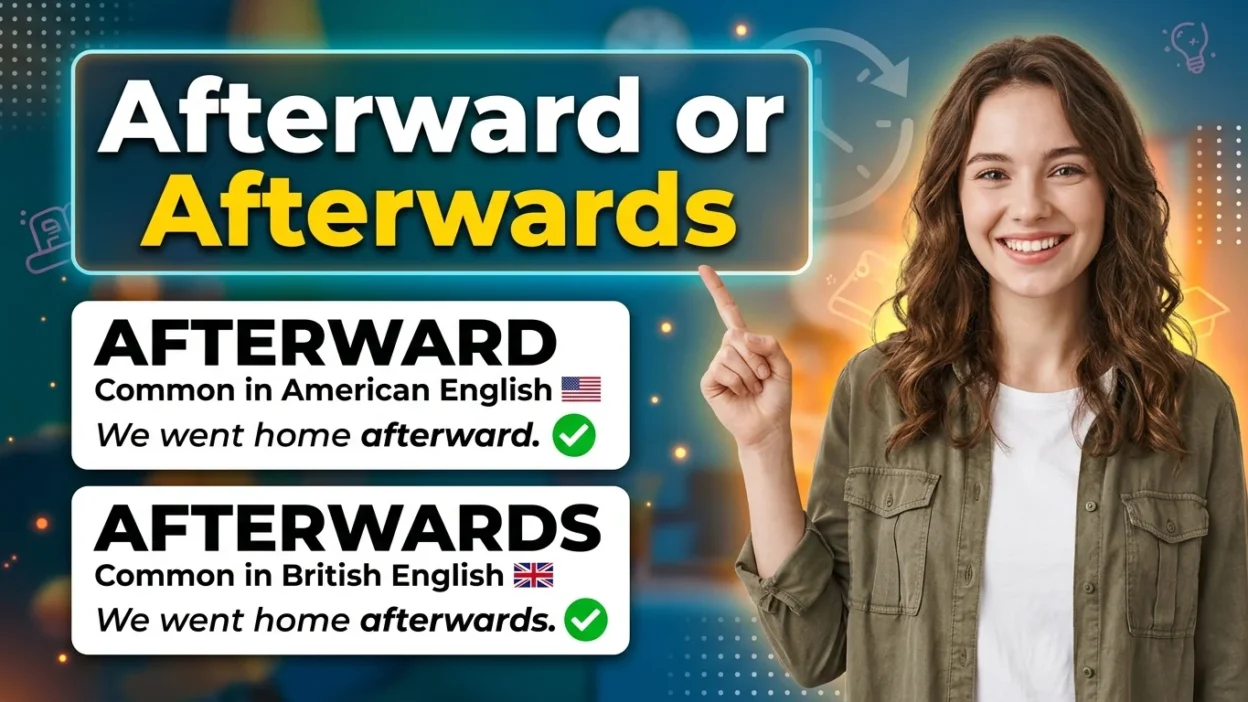
Have you ever paused while writing because you weren’t sure whether to use afterward or afterwards? You’re not alone. Both spellings are correct, and they share the same meaning: at a later time or after something has happened.
The main difference comes down to regional preference. Afterward is more common in American English, while afterwards is preferred in British English. For example, an American writer might say, “We finished dinner and watched a movie afterward.”
A British writer might write, “We finished dinner and watched a movie afterwards.” Both sentences are grammatically correct. In this guide, you’ll learn how to use each word, understand the difference between American and British usage, and explore practical examples for everyday conversations, school assignments, and professional writing.
What Does Afterward Mean?

Afterward is an adverb that means later, after that, or at a later time.
It is used when you want to describe something that happens following another event, action, or situation.
For example:
- We went to a restaurant afterward.
- She called me afterward.
- He apologized afterward.
- I felt much better afterward.
- They discussed the problem afterward.
In each sentence, “afterward” refers to something that happened after a previous event.
Simple Definition of Afterward
The easiest way to remember the meaning of afterward is:
Afterward = later = after that
Consider this example:
I finished my homework and watched television afterward.
Here, watching television happened after finishing the homework.
Another example is:
She had an important meeting and went home afterward.
The word “afterward” tells us that she went home after the meeting.
What Does Afterwards Mean?

Afterwards is also an adverb meaning later, after that, or following an event.
Its meaning is essentially the same as “afterward.”
For example:
- We went for coffee afterwards.
- She felt tired afterwards.
- He apologized afterwards.
- They talked about it afterwards.
- I realized my mistake afterwards.
There is no major difference in meaning between afterward and afterwards.
The important distinction is mainly related to regional English preferences.
Simple Definition of Afterwards
You can remember:
Afterwards = later = after that
For example:
We watched a movie and went out for dinner afterwards.
This means that dinner happened after watching the movie.
Afterward or Afterwards: Are Both Correct?
Yes. Both “afterward” and “afterwards” are grammatically correct.
You can use either one when you mean “later” or “after that.”
For example:
I will call you afterward.
and
I will call you afterwards.
Both sentences are correct.
The difference is mostly a matter of English variety and personal writing preference.
In general:
- Afterward is especially common in American English.
- Afterwards is especially common in British English.
- Both forms are understood widely in modern English.
- Neither form is grammatically wrong.
This means you usually do not need to worry that choosing one will make your sentence incorrect.
What Is the Difference Between Afterward and Afterwards?
The biggest difference between afterward and afterwards is regional usage rather than meaning.
| Word | Meaning | Common Preference | Example |
| Afterward | Later; after that | American English | We talked afterward. |
| Afterwards | Later; after that | British English | We talked afterwards. |
Both words perform the same grammatical function.
For example:
She went home afterward.
She went home afterwards.
There is no meaningful difference in what these sentences communicate.
Is Afterwards More Correct Than Afterward?
No.
“Afterwards” is not more correct than “afterward,” and “afterward” is not more correct than “afterwards.”
Both are standard English.
Your choice can depend on:
- Your preferred variety of English
- Your audience
- The style of the publication
- Consistency within your writing
If you are writing primarily for an American audience, afterward may feel more natural. If you are writing for a British audience, afterwards may feel more natural.
Afterward vs. Afterwards in American English
Afterward is commonly preferred in American English.
For example:
We went to the park afterward.
She called her mother afterward.
I regretted my decision afterward.
They discussed the issue afterward.
Although “afterwards” is also understood and used by American speakers, “afterward” is often the more typical choice.
If your website, blog, or publication follows American English, using afterward consistently can make your writing feel more natural.
Examples in American English
Here are several examples:
- I went shopping afterward.
- We talked about the movie afterward.
- She took a short nap afterward.
- He apologized afterward.
- They cleaned the room afterward.
- I felt relaxed afterward.
- We went home afterward.
- She called me afterward.
- He understood the situation afterward.
- They celebrated afterward.
Afterward vs. Afterwards in British English
Afterwards is particularly common in British English.
For example:
We went to the pub afterwards.
She spoke to her teacher afterwards.
They went home afterwards.
I felt tired afterwards.
In British English, “afterward” is still understandable and can be used, but “afterwards” is often the more familiar choice.
Examples in British English
- We went for a walk afterwards.
- She called me afterwards.
- He explained everything afterwards.
- They had dinner afterwards.
- I felt much better afterwards.
- We discussed the problem afterwards.
- She went home afterwards.
- He apologized afterwards.
- They laughed about it afterwards.
- We watched television afterwards.
When Should You Use Afterward?
Use afterward when you want to say that something happens later or after a previously mentioned event.
It is especially useful when the sequence of events is important.
For example:
First, we had dinner. We went for a walk afterward.
The word “afterward” connects the second action to the first action.
Another example:
She completed the interview and called her friend afterward.
Here, calling the friend happened after completing the interview.
Afterward at the Beginning of a Sentence
“Afterward” can appear at the beginning of a sentence.
For example:
Afterward, we went home.
Afterward, she called her parents.
Afterward, I realized what had happened.
When “afterward” starts a sentence, it is often followed by a comma.
Afterward in the Middle of a Sentence
You can also place “afterward” after the main action.
For example:
We went home afterward.
She felt better afterward.
They discussed the issue afterward.
This position is very common.
Afterward at the End of a Sentence
“Afterward” frequently appears at the end of a sentence.
Examples:
We talked afterward.
I apologized afterward.
She called me afterward.
They went out afterward.
This is natural and grammatically correct.
When Should You Use Afterwards?
Use afterwards in the same situations where you could use “afterward.”
For example:
We went home afterwards.
This means:
We went home later or after that.
You can also place “afterwards” at different points in a sentence.
Afterwards at the Beginning
Afterwards, we went home.
Afterwards in the Middle
We afterwards discussed the problem.
This structure is grammatically possible, although it can sound less natural in everyday English.
Afterwards at the End
We discussed the problem afterwards.
This is a very natural construction.
Afterward and Afterwards Have the Same Meaning
One of the easiest ways to understand these words is to remember that their meanings are essentially identical.
Compare:
I went to the store afterward.
and:
I went to the store afterwards.
Both mean that the speaker went to the store later or after something previously mentioned.
Another pair:
She apologized afterward.
She apologized afterwards.
Again, the meaning remains the same.
Therefore, the choice between them is usually not about grammar but about style, regional preference, and consistency.
Common Uses of Afterward and Afterwards
Both words can be used in many everyday situations.
Talking About Daily Activities
I went to work and had lunch afterward.
We went shopping and had dinner afterwards.
Talking About Events
The guests left afterward.
Everyone stayed for coffee afterwards.
Talking About Conversations
We discussed the problem afterward.
She explained everything afterwards.
Talking About Feelings
I felt nervous afterward.
He felt relieved afterwards.
Talking About Decisions
She realized that she had made the right decision afterward.
They understood the consequences afterwards.
Afterward vs. Then
“Afterward” and “then” can sometimes appear in similar contexts, but they are not always interchangeable.
Then generally indicates the next point in a sequence.
Afterward specifically emphasizes that something happens after another event.
Compare:
I finished my work, then I went home.
I finished my work and went home afterward.
Both are correct, but “afterward” strongly emphasizes the relationship between the two events.
Examples
First, we had breakfast. Then we went shopping.
First, we had breakfast. We went shopping afterward.
Both sentences describe the same basic sequence.
Afterward vs. Later
“Afterward” and “later” can also have similar meanings, but they are not always identical.
Later means at a time after the current or previously mentioned time.
Afterward usually means after a specific event or action.
For example:
I will call you later.
This means sometime in the future.
But:
I finished the meeting and called you afterward.
Here, “afterward” specifically connects the phone call to the meeting.
Easy Way to Remember the Difference
Think of:
Later = at a future time
Afterward = after something
Examples:
I will see you later.
I will see you afterward.
The second sentence normally requires a context explaining what will happen first.
Afterward vs. After
These words are related but are used differently.
After can function as a preposition, conjunction, adverb, or adjective depending on the sentence.
For example:
We went home after dinner.
Here, “after” is followed by a noun phrase.
But:
We went home afterward.
Here, “afterward” stands alone as an adverb.
Compare:
We went home after the meeting.
We went home afterward.
The first sentence identifies what happened before going home. The second assumes that context is already known.
Can You Use Afterward Without Saying What Happened Before?
Yes, if the previous context already makes the meaning clear.
For example:
The movie was excellent. We talked about it afterward.
The first sentence provides the context. The reader knows that “afterward” refers to the time after watching the movie.
Another example:
She finished her exam. Afterwards, she went home.
Because the previous sentence mentions the exam, “afterwards” is clear.
Common Mistakes With Afterward and Afterwards
Although these words are simple, learners sometimes make mistakes when using them.
Mistake 1: Thinking One Is Incorrect
Some people believe that either “afterward” or “afterwards” is wrong.
That is incorrect.
Both are standard English words.
Correct:
We went home afterward.
Correct:
We went home afterwards.
Mistake 2: Using Both Together
Do not write:
We went home afterward afterwards.
This repeats the same idea unnecessarily.
Choose one:
We went home afterward.
or:
We went home afterwards.
Mistake 3: Confusing Afterwards With After Words
The spelling afterwards may look like “after words,” but it is a single adverb.
Correct:
We talked afterwards.
Incorrect:
We talked after words.
Unless you literally mean words that came after other words, “after words” is not the correct spelling.
Mistake 4: Adding an Unnecessary Preposition
Avoid constructions that unnecessarily repeat the meaning.
For example:
Afterward after the meeting, we went home.
A clearer sentence would be:
After the meeting, we went home.
or:
We went home afterward.
Mistake 5: Using “Afterward” When a Noun Is Needed
Remember that “afterward” is an adverb.
You can say:
We talked afterward.
But you normally would not say:
We talked afterward the meeting.
Instead, say:
We talked after the meeting.
Or:
We talked afterward.
Spelling Tips for Afterward and Afterwards
The spelling difference is very small.
Afterward
A-F-T-E-R-W-A-R-D
It ends with -ward.
Afterwards
A-F-T-E-R-W-A-R-D-S
It adds an s at the end.
A simple memory trick is:
Afterward = one form
Afterwards = afterward + s
Do not confuse “afterwards” with “after words.”
Is Afterward One Word?
Yes.
Afterward is normally written as one word.
Correct:
We talked afterward.
Not:
We talked after ward.
Similarly, afterwards is written as one word.
Correct:
We talked afterwards.
Is Afterward Formal or Informal?
“Afterward” is suitable for both formal and informal writing.
You can use it in:
- Emails
- Essays
- Academic writing
- Blog posts
- Conversations
- Business communication
- Reports
- Everyday messages
For example:
We will review the results afterward.
This works well in a professional context.
In casual conversation, you might also say:
We can talk about it afterward.
Both are perfectly natural.
Is Afterwards Formal or Informal?
“Afterwards” can also be used in both formal and informal contexts.
For example:
The committee reviewed the proposal and discussed it afterwards.
This can work in professional writing.
Similarly:
We grabbed some food afterwards.
is perfectly natural in casual conversation.
The choice is generally more about regional preference than formality.
Examples of Afterward in Sentences
Here are several examples to help you understand the word.
- We went home afterward.
- She called me afterward.
- I felt tired afterward.
- He apologized afterward.
- They discussed the event afterward.
- We had coffee afterward.
- She realized her mistake afterward.
- I took a short walk afterward.
- They celebrated afterward.
- He explained everything afterward.
- We watched a movie afterward.
- She went shopping afterward.
- I felt much better afterward.
- They cleaned the house afterward.
- We talked about the problem afterward.
Examples of Afterwards in Sentences
Here are equivalent examples using “afterwards.”
- We went home afterwards.
- She called me afterwards.
- I felt tired afterwards.
- He apologized afterwards.
- They discussed the event afterwards.
- We had coffee afterwards.
- She realized her mistake afterwards.
- I took a short walk afterwards.
- They celebrated afterwards.
- He explained everything afterwards.
- We watched a movie afterwards.
- She went shopping afterwards.
- I felt much better afterwards.
- They cleaned the house afterwards.
- We talked about the problem afterwards.
Notice how the meaning stays the same.
Afterward or Afterwards in Questions
Both forms can be used in questions.
Examples with “afterward”:
What did you do afterward?
Where did you go afterward?
Did you talk to her afterward?
Examples with “afterwards”:
What did you do afterwards?
Where did you go afterwards?
Did you talk to her afterwards?
Again, both are correct.
Afterward or Afterwards in Negative Sentences
Both words work naturally in negative sentences.
Examples:
I did not see him afterward.
I did not see him afterwards.
She never called me afterward.
She never called me afterwards.
There is no significant grammatical difference.
Afterward or Afterwards With Future Events
You can use either word when discussing something that will happen after another future event.
For example:
We will discuss the results afterward.
Or:
We will discuss the results afterwards.
The surrounding context makes it clear what event will happen first.
For example:
We will finish the meeting and discuss the results afterward.
This is completely natural.
Afterward or Afterwards With Past Events
Both words are extremely common when discussing past events.
For example:
We finished dinner and went for a walk afterward.
Or:
We finished dinner and went for a walk afterwards.
Both are correct.
How to Choose Between Afterward and Afterwards
If you are unsure which word to use, follow these simple guidelines.
Choose Afterward If:
- You prefer American English.
- Your audience primarily uses American English.
- Your style guide prefers the shorter form.
- You want a concise adverb.
Choose Afterwards If:
- You prefer British English.
- Your audience primarily uses British English.
- Your writing style commonly uses words ending in “-wards.”
- You want to follow the regional convention.
Most Important Rule
Do not switch randomly between the two forms without a reason.
Consistency is useful, especially in longer articles.
If you start with:
We talked afterward.
There is no need to suddenly write:
We went home afterwards.
Although both are correct, choosing one style throughout your article can create a more consistent voice.
Afterward and Afterwards: Quick Comparison
| Feature | Afterward | Afterwards |
| Part of speech | Adverb | Adverb |
| Meaning | Later; after that | Later; after that |
| Grammar | Correct | Correct |
| American English | Very common | Also used |
| British English | Used | Very common |
| Meaning difference | None in normal usage | None in normal usage |
| Can start a sentence? | Yes | Yes |
| Can end a sentence? | Yes | Yes |
| Formal writing | Yes | Yes |
| Informal writing | Yes | Yes |
Which One Should You Use in an Article?
If you are writing an English-language article, either one is acceptable.
However, it is helpful to know your target audience.
For an American audience, afterward may sound more natural.
For a British audience, afterwards may sound more natural.
If your audience is international, either form is generally understood.
The most important thing is to use the word naturally rather than forcing it into sentences.
Which One Is More Common?
Usage varies by region.
In American English, afterward is generally the more common preferred form.
In British English, afterwards is generally more common.
This does not mean one is grammatically superior. It simply reflects different regional conventions.
Similar differences occur with other English words, such as:
- toward / towards
- backward / backwards
- forward / forwards
- afterward / afterwards
These pairs often have regional preferences but remain understandable across English varieties.
Related Words: Toward and Towards
The relationship between afterward/afterwards is similar to toward/towards.
Both forms are accepted.
For example:
She walked toward the door.
She walked towards the door.
Likewise:
We talked afterward.
We talked afterwards.
These variations demonstrate that English sometimes allows different forms with essentially the same meaning.
Tips for Better Grammar When Using Afterward or Afterwards
To use these words confidently, remember a few simple rules.
1. Remember the Meaning
Both mean:
later or after that.
2. Check Your Audience
American audience? “Afterward” is often a natural choice.
British audience? “Afterwards” is often a natural choice.
3. Keep Your Writing Consistent
If you choose one form, use it consistently where practical.
4. Do Not Overuse the Word
Use “afterward” or “afterwards” when it genuinely helps clarify the sequence of events.
5. Read the Sentence Naturally
If the sentence sounds natural when spoken, it is probably a good construction.
Frequently Asked Questions
Is “afterward” grammatically correct?
Yes. Afterward is a grammatically correct adverb meaning “later” or “after that.” It is especially common in American English.
Is “afterwards” grammatically correct?
Yes. Afterwards is also grammatically correct. It means the same thing as “afterward” and is especially common in British English.
Is there a difference between afterward and afterwards?
There is generally no difference in meaning. Both mean “later” or “after that.” The main difference is regional preference and style.
Is afterward American or British?
“Afterward” is especially common in American English, although British speakers also use it.
Is afterwards British or American?
“Afterwards” is especially common in British English, although American speakers understand and use it as well.
Can I use afterward at the end of a sentence?
Yes. This is very common.
For example:
We went home afterward.
Can I use afterwards at the beginning of a sentence?
Yes.
For example:
Afterwards, we went home.
Is “afterwards” more correct than “afterward”?
No. Neither is more grammatically correct. Both are standard English forms.
Can I use both afterward and afterwards in the same article?
Yes, but it is generally better to choose one preferred form and use it consistently unless there is a specific reason to vary your wording.
Which is better for American English?
Afterward is generally the more common choice in American English.
Which is better for British English?
Afterwards is generally the more common choice in British English.
Is afterward formal English?
Yes. “Afterward” can be used in formal, academic, professional, and informal writing.
Is afterwards informal?
No. “Afterwards” is not inherently informal. It can be used in both formal and informal writing.
Can afterward mean “later”?
Yes.
For example:
I will call you afterward.
Here, “afterward” means at a later time, specifically after the relevant event.
Can afterwards start a sentence?
Yes.
For example:
Afterwards, they returned home.
Should I write “after words” or “afterwards”?
If you mean “later” or “after that,” write afterwards as one word.
For example:
We talked afterwards.
“After words” would have a different literal meaning involving words.
Final Thought :
Afterward and afterwards are adverbs that mean essentially the same thing: later, after that, or following an event. The main difference is regional preference. “Afterward” is particularly common in American English, while “afterwards” is particularly common in British English.
If you are writing for an American audience, afterward is usually a safe and natural choice. If you are writing for a British audience, afterwards may sound more familiar. For international readers, either form works well.

Michael Collins is a skilled writer who creates clear, practical, and reader-friendly content. He focuses on language, grammar, word meanings, and everyday expressions, making complex topics simple to understand.


