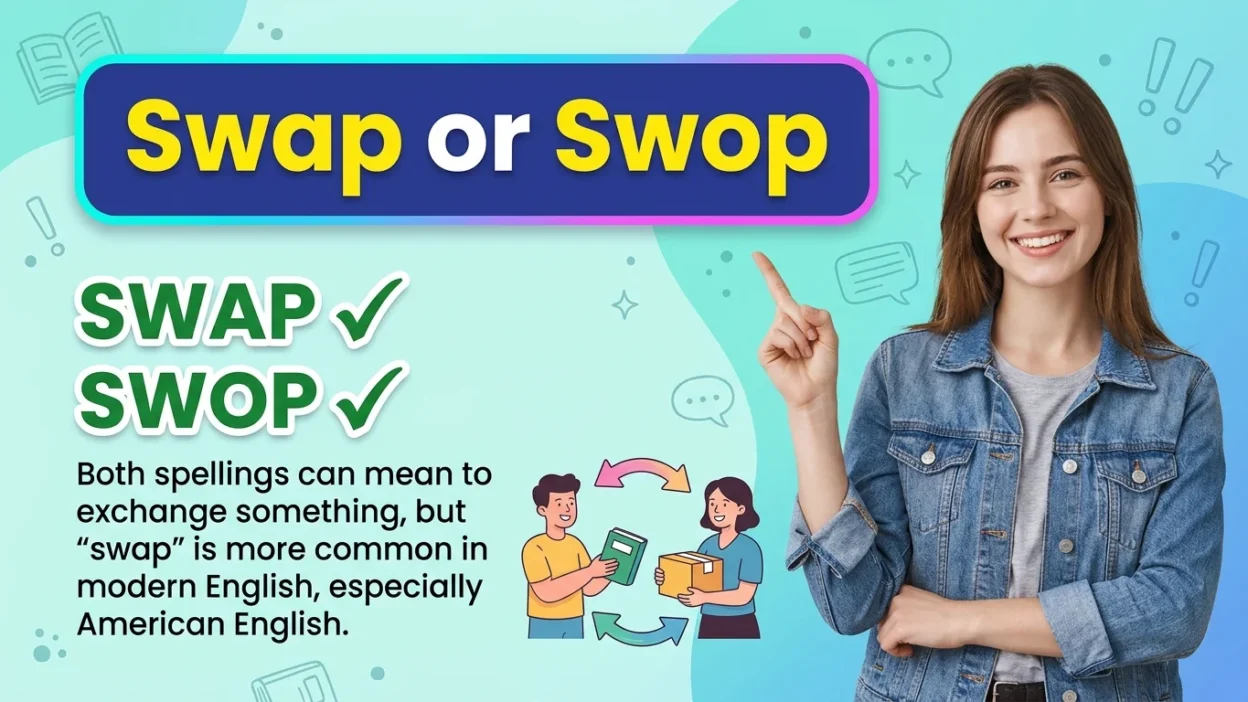
Have you ever wondered whether swap or swop is the correct spelling? Both forms are accepted in English, and they share the same meaning: to exchange one thing for another.
However, swap is the standard and more widely preferred spelling, especially in American English, while swop is mainly used as an alternative in British English. For example, you can swap seats with a friend, swap gifts during the holidays, or swap one ingredient for another when cooking.
Although both spellings can be correct, choosing the right one depends on your audience and writing style. In this guide, you’ll learn the difference between swap and swop, explore their meanings with simple examples, and discover which spelling to use in formal writing, everyday conversations, and professional content.
What Does “Swap” Mean?

Swap means to exchange one thing for another. It can be used when two people exchange objects, responsibilities, positions, ideas, or even places.
For example:
- I want to swap my blue shirt for a black one.
- Can we swap seats?
- They decided to swap gifts.
- I will swap my Friday shift with you.
The word swap is extremely common in modern English and works naturally in both casual and formal contexts.
Swap as a Verb
When swap is used as a verb, it means to exchange something.
For example:
Can we swap books after class?
Here, one person gives one book and receives another in return.
More examples include:
- Sarah swapped her old phone for a newer model.
- We can swap recipes if you want.
- They swapped seats during the journey.
- I need to swap my working day with a colleague.
- The children swapped toys during the game.
The verb can appear in different tenses:
| Tense | Example |
| Present | I swap books with my friend. |
| Present continuous | I am swapping books with my friend. |
| Past | I swapped books yesterday. |
| Present perfect | I have swapped my seat. |
| Future | I will swap my seat tomorrow. |
Swap as a Noun
Swap can also be used as a noun. In this case, it refers to an exchange.
For example:
We made a swap at the market.
Here, “swap” is the thing or event involving an exchange.
Other examples:
- That was a fair swap.
- We arranged a book swap at school.
- The two players made a swap.
- I got this jacket in a clothes swap.
- The exchange was a useful swap for both sides.
What Does “Swop” Mean?

Swop has essentially the same basic meaning as swap: to exchange one thing for another.
For example:
Would you like to swop seats?
This sentence means the same thing as:
Would you like to swap seats?
The important point is that swop is a variant spelling, not a completely different word with a different meaning.
However, swop is much less common than swap in contemporary English. If you are unsure which spelling to use, swap is generally the best choice.
Swop as a Verb
Like swap, swop can function as a verb.
Examples:
- We decided to swop seats.
- She wants to swop her dress for another one.
- They swopped books.
- Can I swop this item for a different size?
The grammar works in the same way as swap.
Swop as a Noun
Swop can also be used as a noun to describe an exchange.
For example:
We made a swop at the local market.
Again, this has essentially the same meaning as:
We made a swap at the local market.
The difference is primarily one of spelling, usage, and frequency rather than meaning.
Swap or Swop: Do They Mean the Same?
Yes, swap and swop generally mean the same thing.
Both words can describe the act of exchanging one thing for another.
For example:
- Swap your seat with me.
- Swop your seat with me.
Both sentences communicate the idea of exchanging seats.
However, they are not equally common.
Swap is the standard and overwhelmingly more common spelling in modern English. Swop is recognized as a variant, particularly in British usage, but it is much less frequently used.
If you are writing for a broad international audience, swap is usually the better option.
Swap vs. Swop: Quick Comparison
| Feature | Swap | Swop |
| Meaning | Exchange one thing for another | Exchange one thing for another |
| Part of speech | Verb and noun | Verb and noun |
| Commonness | Very common | Less common |
| Modern usage | Standard choice | Variant spelling |
| British English | Common | Also used, but less common |
| American English | Common | Rare |
| Formal writing | Preferred | Usually avoided in favor of “swap” |
| Meaning difference | No significant difference | No significant difference |
The key takeaway is simple: swap and swop generally have the same meaning, but swap is much more common and widely accepted.
Why Is “Swap” More Common Than “Swop”?
Language changes naturally over time. Some spellings become more popular because they are used more frequently in books, newspapers, education, business, technology, and everyday communication.
Today, swap is the spelling most English speakers expect to see.
You are likely to encounter phrases such as:
- swap ideas
- swap seats
- swap clothes
- swap numbers
- swap gifts
- swap shifts
- swap stories
- swap recipes
- swap houses
- swap items
The spelling swop exists, but it is much less common.
This means that choosing swap can make your writing look more natural to a wider audience.
Is “Swop” Correct English?
Yes, swop is a legitimate English word.
It is not automatically a spelling mistake.
However, just because a word is correct does not mean it is equally common in every context. Swop is a less common variant of swap.
For example:
They decided to swop cars.
This sentence can be understood perfectly.
But:
They decided to swap cars.
sounds much more natural to most modern English speakers.
Therefore, if your goal is clear, conventional, and broadly understood English, swap is normally the preferred spelling.
Is “Swap” American or British English?
Swap is used in both American and British English.
It is not restricted to one variety of English.
For example, American speakers commonly say:
Can we swap seats?
British speakers also commonly say:
Can we swap seats?
The word is therefore useful for international English.
Swop, on the other hand, is more strongly associated with British English and is relatively uncommon in American English.
If you are writing content for readers from different countries, swap is the safest choice.
Is “Swop” British English?
Yes, swop is recognized in British English, although it is much less common than swap.
You may encounter it in British writing or informal speech, but most modern readers will be more familiar with swap.
For example:
Let’s swop places.
is understandable.
But:
Let’s swap places.
is the more usual version.
This does not mean that “swop” is wrong. It simply means that its frequency and familiarity are lower.
Swap or Swop in American English
When writing American English, swap is clearly the better choice.
For example:
I want to swap my old laptop for a new one.
This sounds natural.
Using swop may look unusual to many American readers.
Therefore, if your target audience is primarily American, choose swap.
Swap or Swop in British English
British English accepts both swap and swop, but swap remains the more common choice.
For modern British writing, there is generally no need to replace swap with swop.
For example:
We decided to swap our seats.
is completely natural British English.
The alternative:
We decided to swop our seats.
is also understandable but less common.
Swap as a Verb: Common Examples
The easiest way to understand swap is to see it in everyday sentences.
Swapping Seats
Can we swap seats? I cannot see the screen from here.
This means two people exchange their seats.
Swapping Clothes
The sisters often swap clothes.
This means they exchange or share clothing.
Swapping Gifts
The children swapped gifts during the party.
They exchanged gifts with each other.
Swapping Shifts
Could you swap shifts with me on Friday?
This means one person wants to exchange their scheduled work shift with another person.
Swapping Ideas
We spent an hour swapping ideas.
Here, the word does not necessarily mean a physical exchange. The people are sharing and exchanging ideas.
Swop as a Verb: Common Examples
Although less common, swop can be used in the same types of sentences.
Example 1
Shall we swop seats?
Meaning:
Shall we exchange seats?
Example 2
They swopped their books after class.
Meaning:
They exchanged their books after class.
Example 3
I would like to swop this shirt for a larger size.
Meaning:
I would like to exchange this shirt for a larger size.
Example 4
We swopped stories about our travels.
Meaning:
We exchanged or shared stories about our travels.
Swap or Swop in Everyday Conversation
In casual conversation, swap is far more likely to appear.
Imagine two friends discussing their plans:
“I don’t like my seat.”
“We can swap if you want.”
This sounds completely natural.
Using swop would still be understandable:
“We can swop if you want.”
But it may sound less familiar or more regional to some readers.
That is one reason swap is the better default.
Swap or Swop in Formal Writing
For formal writing, swap is generally preferable.
This includes:
- Academic writing
- Business communication
- Website content
- Reports
- Professional emails
- Educational material
- Instructions
For example:
Employees may swap shifts with manager approval.
This is clear and professional.
Using swop is not necessarily grammatically incorrect, but it can appear unusual depending on the audience.
When there is no reason to use the less common variant, choosing the familiar spelling usually improves readability.
Common Phrases With “Swap”
Here are some common expressions using swap:
Swap Places
To exchange positions or locations.
Let’s swap places.
Swap Seats
To exchange seats.
Can we swap seats?
Swap Clothes
To exchange clothing.
The friends decided to swap clothes.
Swap Stories
To share or exchange stories.
We sat together and swapped stories.
Swap Ideas
To exchange ideas.
The team met to swap ideas.
Swap Shifts
To exchange work schedules.
I need to swap shifts with someone.
Swap Numbers
To exchange phone numbers.
We swapped numbers before leaving.
Swap Gifts
To exchange gifts.
They swapped gifts at Christmas.
Swap Roles
To exchange responsibilities or positions.
The two employees agreed to swap roles for the day.
Common Phrases With “Swop”
Because swop has the same basic meaning, many of the same expressions are possible.
For example:
- swop seats
- swop places
- swop clothes
- swop gifts
- swop stories
- swop ideas
- swop shifts
- swop items
However, swap is much more common in all these expressions.
What Is the Difference Between Swap and Exchange?
This is another useful distinction.
Swap and exchange can often mean the same thing, but their style is slightly different.
Swap tends to sound more informal and conversational.
Exchange can sound more formal or neutral.
Compare:
We swapped books.
with:
We exchanged books.
Both are correct.
Another example:
Can I swap this shirt for another size?
This sounds natural in everyday conversation.
Can I exchange this shirt for another size?
This sounds slightly more formal and is especially common in retail situations.
What Is the Difference Between Swap and Trade?
Swap and trade can also overlap.
Both can describe exchanging things, but trade often suggests a more deliberate transaction.
For example:
I swapped my sandwich for his dessert.
This sounds casual.
They traded cars.
This can suggest a more substantial transaction.
In some contexts, the words are interchangeable, but not always.
Does Swap Always Mean an Equal Exchange?
No. A swap does not necessarily have to be perfectly equal in value.
For example:
I swapped my old phone for a newer phone and paid some extra money.
The central idea is still an exchange.
Similarly:
She swapped her afternoon shift for my morning shift.
The two shifts may not have identical conditions, but they are being exchanged.
Therefore, swap focuses on the act of exchanging rather than guaranteeing equal value.
Can You Swap People?
Yes, but context matters.
You can use swap when people exchange roles, positions, or responsibilities.
For example:
The two players swapped positions.
This means they exchanged their positions.
You can also say:
We swapped partners for the next activity.
This means the people changed partners.
However, when discussing people themselves, it is often clearer to describe exactly what is being exchanged.
Can You Swap Ideas?
Yes.
Swap ideas is a common expression.
It means to share or exchange ideas with another person or group.
For example:
We met after work to swap ideas about the new project.
Here, nobody is physically handing an idea to someone else. The phrase describes the sharing of thoughts and suggestions.
Other examples include:
- swap opinions
- swap advice
- swap information
- swap stories
- swap experiences
Common Mistakes With Swap and Swop
Because these words look almost identical, learners sometimes make mistakes.
Mistake 1: Assuming Swop Is a Completely Different Word
Some learners believe swop has a different meaning from swap.
That is generally incorrect.
They are variants with essentially the same meaning.
Mistake 2: Thinking Swop Is Always Incorrect
Swop is not necessarily incorrect.
It is a recognized variant spelling.
However, it is less common, so swap is usually the better choice.
Mistake 3: Using Swop in American English
Although readers may understand it, swop is unusual in American English.
For American audiences, use swap.
Mistake 4: Confusing Swap With Swat
These words are completely different.
- Swap = exchange
- Swat = hit or strike, often quickly
For example:
I want to swap seats.
and:
I tried to swat the fly.
They have completely different meanings.
Mistake 5: Confusing Swap With Sweep
These are also different words.
- Swap = exchange
- Sweep = clean or move across an area
For example:
Let’s swap books.
versus:
I need to sweep the floor.
Spelling Tips for Remembering “Swap”
If you often forget which spelling to use, remember this simple rule:
When in doubt, choose SWAP.
It is the more common spelling and works naturally in both British and American English.
A useful memory trick is:
Swap = Standard choice
This is not a strict grammatical rule, but it is a practical writing tip.
Is “Swop” a Spelling Mistake?
Not necessarily.
If you see swop in a dictionary, article, or British text, it does not automatically mean the writer made a mistake.
It is a recognized variant.
However, context matters. If you are writing for a general audience, swap is usually clearer because more readers are familiar with it.
Think of it this way:
Swap = common and standard
Swop = less common variant
Swap or Swop: Which One Should You Use?
For most situations, use swap.
Choose swap when:
- You are writing for an international audience.
- You are writing in American English.
- You are writing professional content.
- You are writing an educational article.
- You want the most familiar spelling.
- You are unsure which spelling to choose.
You may encounter or use swop when:
- You are following a British usage style.
- The context specifically uses that spelling.
- You are quoting or preserving someone’s original wording.
- You prefer the variant and your audience understands it.
Still, for most modern writing, swap is the safest option.
Swap or Swop in Text Messages
In texting, swap is much more likely to appear.
For example:
Wanna swap seats?
or:
Can we swap shifts?
You could technically write:
Wanna swop seats?
but it is much less common.
Since texting often favors familiar and quick language, swap is the natural choice for most speakers.
Swap or Swop in Social Media
The same general rule applies to social media.
You might see:
Let’s swap outfits!
Swap your favorite recipes below!
Want to swap books?
These examples sound natural and engaging.
The spelling swop may appear occasionally, but it is not normally the first choice.
Swap or Swop in Business English
In business communication, swap is the preferred spelling.
For example:
The two departments agreed to swap responsibilities.
Employees can swap shifts with prior approval.
The companies agreed to swap certain assets.
In specialized financial contexts, swap is also a well-established technical term. For example, financial professionals use expressions such as interest rate swap and currency swap.
This is another reason why swap is the much more recognizable spelling.
Swap or Swop in Academic Writing
Academic writers generally prefer swap when the concept of exchanging something needs to be described.
For example:
Participants were asked to swap their assigned materials.
The word is simple and clear.
If the writing is particularly formal, exchange may sometimes be preferable:
Participants were asked to exchange their assigned materials.
The best choice depends on the context and desired tone.
Examples: Swap vs. Swop
Here are several pairs of examples.
Example 1
Swap:
Can we swap seats?
Swop:
Can we swop seats?
Meaning: Exchange seats.
Example 2
Swap:
They swapped clothes.
Swop:
They swopped clothes.
Meaning: They exchanged clothes.
Example 3
Swap:
I want to swap this shirt for a larger one.
Swop:
I want to swop this shirt for a larger one.
Meaning: Exchange the shirt for another size.
Example 4
Swap:
We swapped ideas during the meeting.
Swop:
We swopped ideas during the meeting.
Meaning: We exchanged ideas.
Example 5
Swap:
Can you swap shifts with me?
Swop:
Can you swop shifts with me?
Meaning: Can you exchange work shifts with me?
In every pair, the basic meaning remains the same.
Swap, Swop, or Exchange: Which Is Best?
The three words can sometimes be used in similar situations, but they have different levels of formality and frequency.
| Word | Typical style | Meaning |
| Swap | Common, conversational | Exchange |
| Swop | Less common variant | Exchange |
| Exchange | Neutral/formal | Give one thing and receive another |
For everyday English, swap is usually the most natural.
For formal contexts, exchange may sometimes be better.
Swop is correct in certain varieties and contexts but is generally less common.
Why Choosing the Right Spelling Matters
Using the most familiar spelling can make your writing easier to understand.
This is particularly important for:
- Blog articles
- Website content
- School assignments
- Professional documents
- Marketing copy
- Emails
- Social media posts
If your audience includes people from different English-speaking countries, swap is a strong choice because it is widely recognized.
Good writing is not only about being technically correct. It is also about being clear and natural for your readers.
People Also Ask: Swap or Swop
Is “swap” and “swop” the same thing?
Yes. Swap and swop generally have the same meaning: to exchange one thing for another. The main difference is that swap is much more common.
Which is correct, swap or swop?
Both can be correct. Swap is the standard and more widely used spelling, while swop is a less common variant.
Is “swop” proper English?
Yes. Swop is a recognized English variant of swap, although it is considerably less common.
Is swap American or British?
Swap is used in both American and British English. It is a common English word internationally.
Do British people say “swop”?
Some British speakers and writers use swop, but swap is also very common and is generally the safer modern choice.
Should I use swap or swop in an essay?
Use swap unless you have a specific reason to use swop. Swap is more familiar and widely accepted.
Is swop a British spelling of swap?
Swop is commonly associated with British English, but it is better described as a variant spelling rather than a completely separate British version of the word.
Can swap be a noun?
Yes. For example:
That was a fair swap.
Here, swap is a noun meaning an exchange.
Can swop be a noun?
Yes. Swop can also function as a noun, although this usage is much less common than swap.
What is the past tense of swap?
The past tense is swapped.
Example:
We swapped seats yesterday.
Notice the double p before -ed.
What is the past tense of swop?
The past tense is generally swopped.
Example:
They swopped books after class.
Is “swap” more common than “swop”?
Yes. Swap is significantly more common in modern English and is the preferred choice for most general writing.
Final Verdict:
So, swap or swop do they mean the same? Yes, in most contexts they do. Both words describe the act of exchanging one thing for another, and both can work as nouns or verbs. The major difference is not meaning but frequency, spelling preference, and regional usage.
Swap is the clear winner for everyday modern English. It is common in American and British English, widely understood internationally, and appropriate for everything from casual conversations to professional writing. Swop is a valid but much less common variant, particularly associated with British English.

Daniel Carter is a passionate writer who creates clear, helpful, and easy-to-understand content. He focuses on language, grammar, word meanings, and everyday expressions, helping readers find simple answers to common questions.


