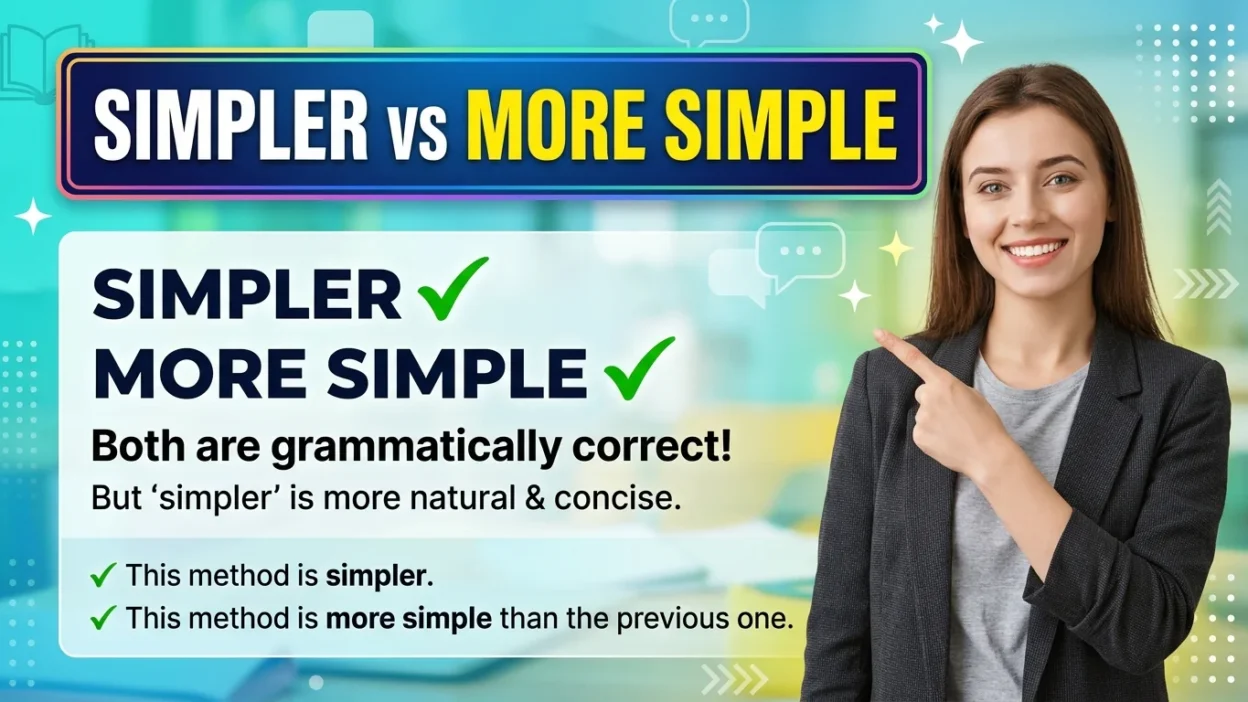
Choosing between simpler and more simple might seem confusing, especially when both expressions appear in English writing. The good news is that both forms are grammatically correct, but one usually sounds more natural.
Simpler is the standard comparative form of simple and is generally the preferred choice in everyday conversations, academic writing, and professional content. More simple is also acceptable, although writers use it less often in many contexts.
For example, you would typically say, “This explanation is simpler than the previous one,” rather than “This explanation is more simple than the previous one.” However, the best choice can depend on sentence structure, emphasis, and personal writing style.
What Does Simple Mean?
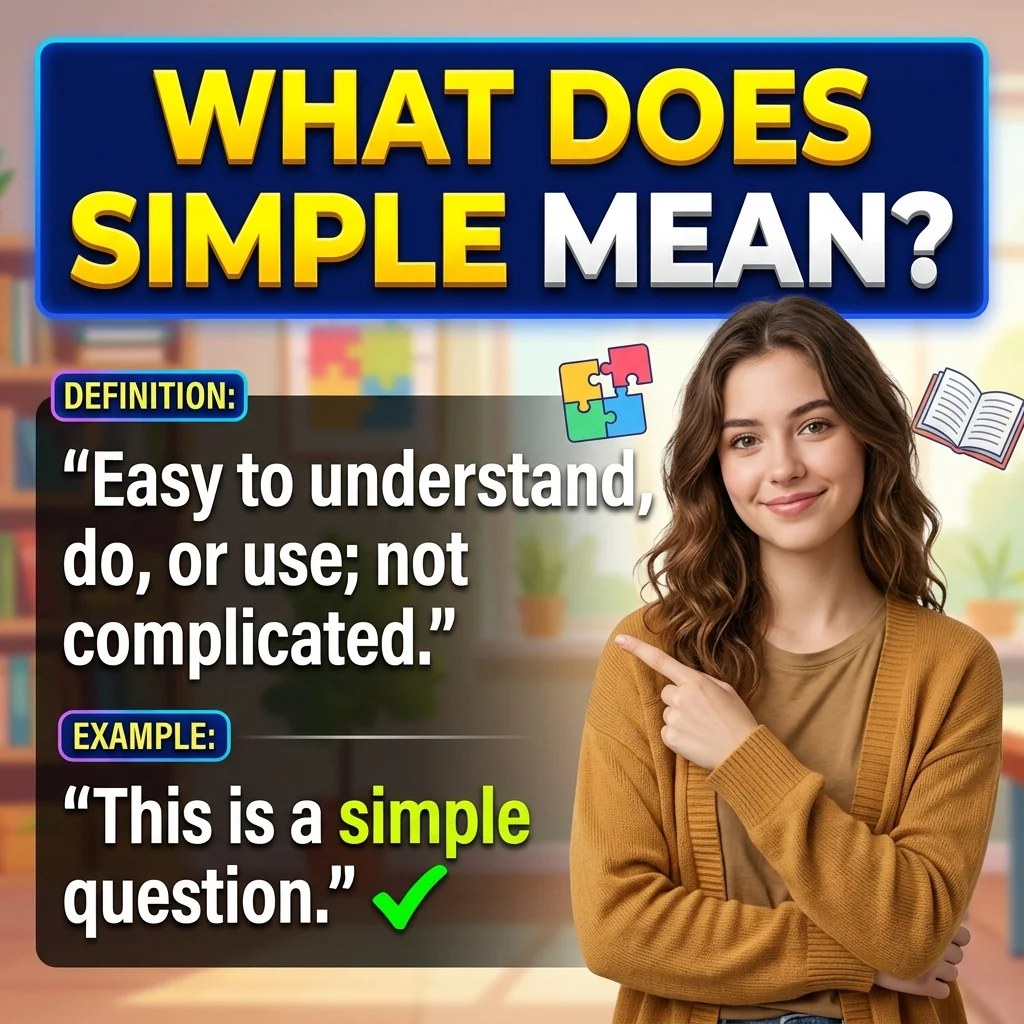
Before comparing simpler and more simple, it is important to understand the adjective simple.
Simple generally means something that is easy to understand, easy to do, uncomplicated, or not elaborate.
For example:
- This is a simple question.
- She gave me a simple answer.
- The instructions are simple.
- He lives a simple life.
- We need a simple solution.
The exact meaning of simple depends on the context.
For example, if you say:
“This exercise is simple.”
you probably mean that the exercise is easy to understand or complete.
If you say:
“She prefers simple clothes.”
you mean that her clothes are not complicated, elaborate, or heavily decorated.
When comparing two things, English requires a comparative adjective.
That brings us to simpler and more simple.
What Does Simpler Mean?
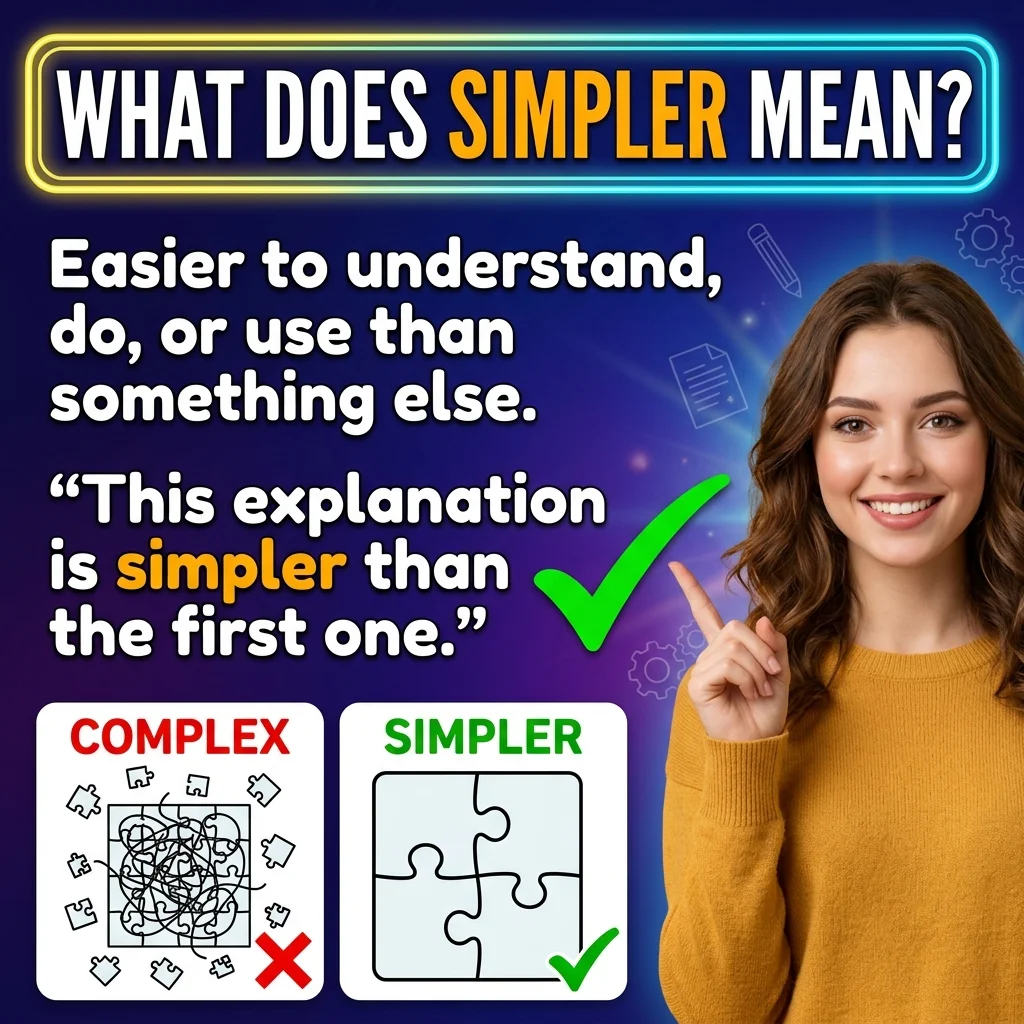
Simpler is the standard comparative form of the adjective simple.
It means less complicated, easier, or more straightforward than something else.
The basic structure is:
simple → simpler
For example:
- This method is simpler than the old one.
- The second explanation is simpler.
- We need a simpler solution.
- This design looks simpler and cleaner.
- Her instructions were much simpler than mine.
In each sentence, simpler compares one thing with another or suggests a reduction in complexity.
Simpler Meaning
The word simpler can mean:
- easier to understand
- less complicated
- less difficult
- more straightforward
- less elaborate
- easier to use
- easier to explain
For example:
“Can you give me a simpler explanation?”
This means:
“Can you give me an explanation that is easier to understand?”
Why Is “Simpler” So Common?
English commonly forms the comparative of short adjectives by adding -er.
Examples include:
- small → smaller
- fast → faster
- slow → slower
- clean → cleaner
- bright → brighter
- simple → simpler
Therefore, simpler follows a familiar English pattern.
What Does More Simple Mean?
More simple is also grammatically possible.
It consists of:
more + simple
It has essentially the same basic comparative meaning: something is more simple or less complicated compared with another thing.
For example:
“We need a more simple explanation.”
This sentence can be understood, but many native speakers would naturally say:
“We need a simpler explanation.”
So the issue is not that more simple is always grammatically incorrect. The issue is that simpler is usually the more natural and preferred choice.
More Simple Meaning
Depending on context, more simple can mean:
- less complicated
- easier
- more straightforward
- less elaborate
- closer to a basic form
For example:
“The new system is more simple than the previous system.”
This sentence is understandable and can be grammatically acceptable, but:
“The new system is simpler than the previous system.”
sounds more natural to most English speakers.
Simpler vs More Simple: The Main Difference
The biggest difference between simpler and more simple is not usually their basic meaning. Both can express comparison.
The difference is mainly usage, style, emphasis, and naturalness.
| Form | Meaning | Commonness | Example |
| Simpler | Less complicated or easier | Very common | This method is simpler. |
| More simple | Less complicated or easier | Less common | We need a more simple approach. |
In everyday English, simpler is generally the better choice.
For example:
Natural:
This explanation is simpler than the first one.
Less natural:
This explanation is more simple than the first one.
The second sentence is not necessarily impossible, but the first one is much more idiomatic.
Is Simpler or More Simple Correct?
Both forms can occur in English, but simpler is generally the preferred comparative form.
If you are an English learner and you need to choose between the two, simpler is usually the safest choice.
Consider these examples:
- This book is simpler than that one.
- The instructions are simpler now.
- Can you find a simpler solution?
- We need a simpler way to explain this.
- This design is simpler and more practical.
These sentences sound natural and clear.
When Should You Use Simpler?
Use simpler when you simply want to compare two things and say that one is less complicated.
For example:
“This method is simpler than the previous method.”
Or:
“Her explanation was simpler than mine.”
Or:
“I need a simpler answer.”
In ordinary conversation and general writing, simpler should normally be your first choice.
When Can More Simple Be Used?
Although simpler is usually preferred, more simple can sometimes be useful.
One reason is that writers may want to emphasize more as part of a broader comparison.
For example:
“The new process is more simple and more efficient.”
However, even here, many speakers would prefer:
“The new process is simpler and more efficient.”
More simple may also appear when a writer wants to avoid ambiguity, create a specific rhythm, or contrast “simple” with another adjective.
Consider:
“The design became more simple and more elegant.”
This is grammatically understandable, although simpler and more elegant would usually sound more natural.
Simpler Is Usually the Better Choice
If you are writing an essay, blog post, email, school assignment, or professional document, simpler is usually the better choice when making a basic comparison.
For example:
❌ The instructions are more simple than before.
✅ The instructions are simpler than before.
Another example:
❌ We need a more simple solution.
✅ We need a simpler solution.
And:
❌ This explanation is more simple for beginners.
✅ This explanation is simpler for beginners.
Using simpler makes your writing concise and natural.
Why Do We Say Simpler?
The adjective simple is commonly treated as a short adjective that can take the -er comparative ending.
The pattern is:
simple → simpler → simplest
Examples:
- simple
- simpler
- simplest
For comparison:
This lesson is simple.
This lesson is simpler than the previous one.
This is the simplest lesson in the course.
The same pattern appears with many adjectives:
- clever → cleverer → cleverest
- narrow → narrower → narrowest
- quiet → quieter → quietest
- gentle → gentler → gentlest
- simple → simpler → simplest
There can be variation in English depending on the adjective and dialect, but simpler is firmly established and widely used.
Simple, Simpler, and Simplest
It is helpful to understand all three forms.
Simple
Simple is the positive form.
Example:
This is a simple explanation.
It describes something without making a comparison.
Simpler
Simpler is the comparative form.
Example:
This is a simpler explanation than the previous one.
It compares two things.
Simplest
Simplest is the superlative form.
Example:
This is the simplest explanation I can give.
It identifies the thing that is easiest or least complicated among a group or within a situation.
The basic pattern is:
simple → simpler → simplest
Examples of Simpler in Sentences
Here are several natural examples using simpler.
Example 1
This method is simpler than the old method.
Meaning: The new method is less complicated.
Example 2
Can you explain it in simpler words?
Meaning: Can you use easier words?
Example 3
We need a simpler solution.
Meaning: We need a solution that is less complicated.
Example 4
The second version is much simpler.
Meaning: The second version has less complexity.
Example 5
Her explanation made the topic simpler.
Meaning: Her explanation made the topic easier to understand.
Example 6
This app has a simpler interface.
Meaning: The interface is easier or less complicated to use.
Example 7
Life became simpler after he changed his routine.
Meaning: His life became less complicated.
Example 8
The teacher gave us a simpler example.
Meaning: The example was easier to understand.
Examples of More Simple in Sentences
Although more simple is less common, you may encounter it.
Example 1
We need a more simple way to organize the information.
This can be understood as a request for a less complicated method.
However, “a simpler way” would usually be more natural.
Example 2
The design became more simple over time.
This is understandable, but “The design became simpler over time” is generally more natural.
Example 3
They wanted a more simple explanation.
Again, “They wanted a simpler explanation” is normally preferable.
Example 4
The process is more simple than it was before.
A more natural version would usually be:
The process is simpler than it was before.
These examples show an important point: more simple can occur, but simpler is usually the normal comparative choice.
Simpler vs More Simple in Everyday English
In everyday conversations, simpler is strongly preferred.
Imagine someone asks:
“Can you explain this?”
You might answer:
“Sure. Let me give you a simpler explanation.”
You would rarely need to say:
“Let me give you a more simple explanation.”
The first version sounds shorter, smoother, and more natural.
Similarly:
“Is there a simpler way to do this?”
is more natural than:
Therefore, if your goal is natural conversational English, choose simpler in most cases.
Simpler vs More Simple in Formal Writing
The same general preference applies to formal writing.
For example:
“The researchers developed a simpler method for analyzing the data.”
This is concise and professional.
Compare it with:
“The researchers developed a more simple method for analyzing the data.”
The second sentence is understandable, but it can sound unnecessarily wordy.
Good writing often favors the shorter comparative form when it is standard and clear.
Can “More Simple” Ever Sound Better?
Yes, although such situations are less common.
English is flexible, and speakers sometimes choose more simple for stylistic reasons.
For example, a writer might want to emphasize the adjective itself:
“The goal is not to make the system simpler but to make it more simple and accessible.”
Here, the writer may be deliberately contrasting more simple with another construction.
However, this is a stylistic choice rather than the normal rule for everyday comparison.
If you are unsure, choose simpler.
Common Mistakes With Simpler vs More Simple
English learners often make a few mistakes when using these forms.
Mistake 1: Thinking More Simple Is Always Wrong
Some learners believe more simple is always grammatically incorrect.
That is too strict.
More simple can occur in English, but simpler is generally more natural for ordinary comparisons.
Mistake 2: Using Both Forms Together
Avoid:
❌ more simpler
This combines two comparative forms.
You should use either:
✅ simpler
or:
✅ more simple
Never:
❌ more simpler
For example:
❌ This explanation is more simpler.
✅ This explanation is simpler.
Mistake 3: Using Simpler Without a Clear Comparison
A comparative adjective often compares one thing with another, either explicitly or implicitly.
For example:
“This version is simpler than the old one.”
The comparison is obvious.
But simpler can also be used when the comparison is understood from context:
“Can you make it simpler?”
The implied comparison is with the current version.
Mistake 4: Using “Simpleer”
The correct spelling is:
simpler
Not:
❌ simpleer
When -er is added to simple, the final e is not repeated.
So:
simple + er = simpler
Mistake 5: Confusing Simpler With Easiest
Simpler is comparative.
Simplest is superlative.
For example:
This explanation is simpler than that one.
But:
This is the simplest explanation.
Use simpler when comparing two or more things.
Use simplest when identifying the least complicated option among a group.
Simpler vs Simplest
The difference is straightforward.
Simpler
Used for comparison:
This book is simpler than that book.
Simplest
Used for the highest degree:
This is the simplest book in the series.
More examples:
- This question is simpler than the previous one.
- This is the simplest question on the test.
- Her explanation is simpler than mine.
- Her explanation is the simplest of all.
Simpler Than: The Most Common Structure
One of the most common structures is:
simpler + than
Examples:
This approach is simpler than the previous one.
Mathematics is sometimes simpler than people think.
The new instructions are simpler than the old instructions.
This solution is simpler than the alternative.
When making a direct comparison, simpler than is extremely natural.
A Simpler Way
The phrase “a simpler way” is very common in English.
Examples:
Is there a simpler way to solve this problem?
I found a simpler way to explain the idea.
We need a simpler way to organize these files.
She showed me a simpler way to prepare the report.
This phrase is especially useful in professional, educational, and conversational English.
In Simpler Words
Another common expression is:
“in simpler words”
It means explaining something using easier language.
For example:
Can you explain this in simpler words?
You can also say:
Can you put that in simpler terms?
Both expressions are natural.
Examples
Please explain the rule in simpler words.
The teacher explained the theory in simpler terms.
Could you describe the process in simpler language?
These phrases are particularly useful when communicating with beginners.
A Simpler Explanation
A simpler explanation means an explanation that is easier to understand.
For example:
I understand the basic idea, but I need a simpler explanation.
Or:
Can you give me a simpler explanation of this grammar rule?
This is much more natural than:
Can you give me a more simple explanation?
Simpler Grammar Examples
Let’s look at examples related specifically to English grammar.
Example 1
The second sentence is simpler than the first.
Example 2
This grammar rule has a simpler explanation.
Example 3
Can you give me a simpler example?
Example 4
There is a simpler way to remember this rule.
Example 5
The teacher used simpler language for beginners.
Example 6
This explanation makes the difference simpler to understand.
These examples demonstrate how frequently simpler works naturally in educational English.
Simpler vs More Simple: Quick Comparison
| Question | Answer |
| Is “simpler” correct? | Yes. |
| Is “more simple” possible? | Yes, in some contexts. |
| Which is more common? | Simpler. |
| Which should beginners normally use? | Simpler. |
| Can we say “more simpler”? | No. |
| What is the superlative of simple? | Simplest. |
| What does simpler mean? | Less complicated or easier. |
| Is “simpler than” natural? | Yes, very natural. |
| Is “more simple than” always wrong? | No, but it is often less natural. |
| Is “simpleer” correct? | No. |
How to Choose Between Simpler and More Simple
When you are writing a sentence, ask yourself one simple question:
Am I simply comparing two things?
If the answer is yes, simpler will usually be the best choice.
For example:
This method is simpler than the other method.
If you are deliberately emphasizing more or using a special stylistic construction, more simple may be possible.
But unless you have a specific reason to use it, simpler is the natural choice.
Simple Rule to Remember
Here is an easy rule for English learners:
When comparing something that is simple, normally use “simpler.”
Think of:
Simple → Simpler → Simplest
Examples:
- simple idea
- simpler idea
- simplest idea
This pattern will work in most everyday situations.
Is “Simpler” More Grammatically Correct Than “More Simple”?
It is better to say that simpler is the standard and more idiomatic comparative form, rather than saying that more simple is always grammatically wrong.
English allows some flexibility in comparative constructions.
However, if a teacher, editor, or English learner asks which form they should normally use, the answer is:
Use “simpler.”
For example:
The new system is simpler than the old one.
This is natural, concise, and grammatically sound.
Does Simpler Mean Easier?
Often, yes.
Depending on context, simpler can mean easier.
For example:
This explanation is simpler.
can mean:
This explanation is easier to understand.
However, simple and easy are not always exact synonyms.
Something can be simple in structure but difficult to complete.
For example:
The instructions are simple, but the task is physically difficult.
So use the words according to the intended meaning.
Simpler Can Mean Less Complicated
One of the most important meanings of simpler is less complicated.
For example:
We need a simpler design.
This does not necessarily mean the design is easier for someone to perform. It may mean that the design has fewer elements or less complexity.
Similarly:
The new system is simpler.
could mean it has fewer steps or is easier to understand.
Simpler Can Mean More Straightforward
Sometimes simpler means more direct or straightforward.
For example:
Let’s find a simpler explanation.
This may mean:
Let’s explain the idea in a more direct way.
Another example:
There must be a simpler solution.
This suggests that the current solution is unnecessarily complicated.
Why Concise English Often Prefers Simpler
One reason simpler is so common is that English generally favors concise expressions.
Compare:
a simpler solution
with:
a more simple solution
The first expression has fewer words and flows more naturally.
This does not mean shorter is always better, but when two forms communicate the same idea, the more established and concise form is often preferred.
Examples: Correct or Incorrect?
Let’s test some sentences.
Sentence 1
This explanation is simpler than the previous one.
Correct.
Sentence 2
This explanation is more simple than the previous one.
Possible, but less natural in ordinary English.
Sentence 3
This explanation is more simpler than the previous one.
Incorrect.
Sentence 4
Can you make this simpler?
Correct and natural.
Sentence 5
Can you make this more simple?
Possible, but usually less natural.
Sentence 6
This is the simplest solution.
Correct.
Sentence 7
This is the most simplest solution.
Incorrect.
The correct form is:
This is the simplest solution.
Common Expressions With Simpler
Here are some useful phrases that native speakers commonly use:
- a simpler way
- a simpler solution
- a simpler explanation
- a simpler answer
- simpler language
- simpler words
- a simpler method
- a simpler design
- a simpler process
- a simpler approach
- a simpler system
- a simpler version
- a simpler example
- a simpler choice
- a simpler option
Example Sentences
Is there a simpler way to do this?
We need a simpler solution.
Please use simpler language.
The updated version has a simpler design.
I need a simpler explanation.
She chose the simpler option.
Simpler in Professional English
In business and professional writing, simpler is often useful when discussing processes, systems, or communication.
Examples:
We need a simpler process for handling customer requests.
The new software provides a simpler way to manage projects.
Our goal is to create a simpler customer experience.
The company introduced a simpler payment process.
These sentences are clear and professional.
Simpler in Academic English
Academic writing can also use simpler when comparing theories, explanations, models, or methods.
For example:
The researchers developed a simpler model.
This theory provides a simpler explanation of the results.
The second method is simpler than the first.
However, academic writers should always choose the word that accurately communicates their intended meaning.
Simpler in Everyday Conversation
You will hear simpler frequently in casual English.
Examples:
Can you make it simpler?
Is there a simpler way?
Let’s keep things simpler.
I want something simpler.
This version is much simpler.
These expressions sound natural and conversational.
Tips for Remembering Simpler vs More Simple
Here are a few easy tips.
Tip 1: Remember the Three Forms
Memorize:
simple → simpler → simplest
Tip 2: Use Simpler for Normal Comparisons
When you want to say “less complicated,” use:
simpler
Tip 3: Never Say More Simpler
Avoid double comparatives.
❌ more simpler
✅ simpler
Tip 4: Never Spell It Simpleer
The correct spelling is:
✅ simpler
Tip 5: When Unsure, Choose Simpler
For most everyday English situations, simpler is the safest and most natural option.
Frequently Asked Questions
Is “simpler” grammatically correct?
Yes. Simpler is the standard comparative form of simple and is widely used in everyday and formal English.
Is “more simple” grammatically correct?
Yes, more simple can occur in English, but it is generally less common and less natural than simpler for ordinary comparisons.
Which is better: simpler or more simple?
Simpler is generally better and more natural when you simply want to compare two things.
Can I say “more simpler”?
No. More simpler is considered a double comparative and should be avoided.
Use:
“This is simpler.”
not:
“This is more simpler.”
What is the comparative form of simple?
The usual comparative form is simpler.
The pattern is:
simple → simpler
What is the superlative form of simple?
The standard superlative form is simplest.
The pattern is:
simple → simpler → simplest
Is “simpleer” a correct spelling?
No. The correct spelling is simpler.
You do not write simpleer.
Should I use “simpler” in an essay?
Yes. Simpler is perfectly appropriate in essays when it accurately expresses your meaning.
For example:
“The author provides a simpler explanation of the concept.”
Is “simpler than” correct?
Yes. Simpler than is one of the most common comparative structures.
Example:
“This method is simpler than the previous method.”
Can simpler mean easier?
Yes. In many contexts, simpler can mean easier to understand, use, or complete. However, the exact meaning depends on context.
Is “more simple” wrong in American English?
Not necessarily. It can be found in American English, but simpler is generally the more natural comparative form.
Is “simpler” better than “more simple” for beginners?
Yes. If you are learning English, it is easiest to remember:
simple → simpler → simplest
Use simpler for normal comparisons.
Which sounds more natural: “a simpler way” or “a more simple way”?
“A simpler way” sounds more natural in most situations.
For example:
“There must be a simpler way to solve this problem.”
Can I use simpler without “than”?
Yes. A comparative adjective does not always need an explicit than phrase.
For example:
“Can you make the explanation simpler?”
The comparison is understood from the context.
Is “the simpler” correct?
Yes. The simpler can be used when choosing between options or referring to the less complicated one.
For example:
“Of the two methods, the simpler one is better.”
What is the easiest way to remember this grammar rule?
Remember:
Simple → simpler → simplest
And avoid:
more simpler
That simple rule will prevent most mistakes.
Final Thought :
When deciding between simpler vs more simple, the best general rule is to choose simpler. Simpler is the standard comparative form of simple, and it is widely used in conversations, professional writing, academic writing, and everyday English.
More simple is not automatically incorrect, but it is less common and can sound awkward when simpler would express the same idea more naturally. In most situations, phrases such as “a simpler solution,” “a simpler explanation,” “a simpler way,” and “simpler than” are the best choices.

Emily Parker is a dedicated writer who enjoys creating clear, useful, and easy-to-understand content. She focuses on language, grammar, word meanings, and everyday expressions to help readers find simple and reliable answers.


