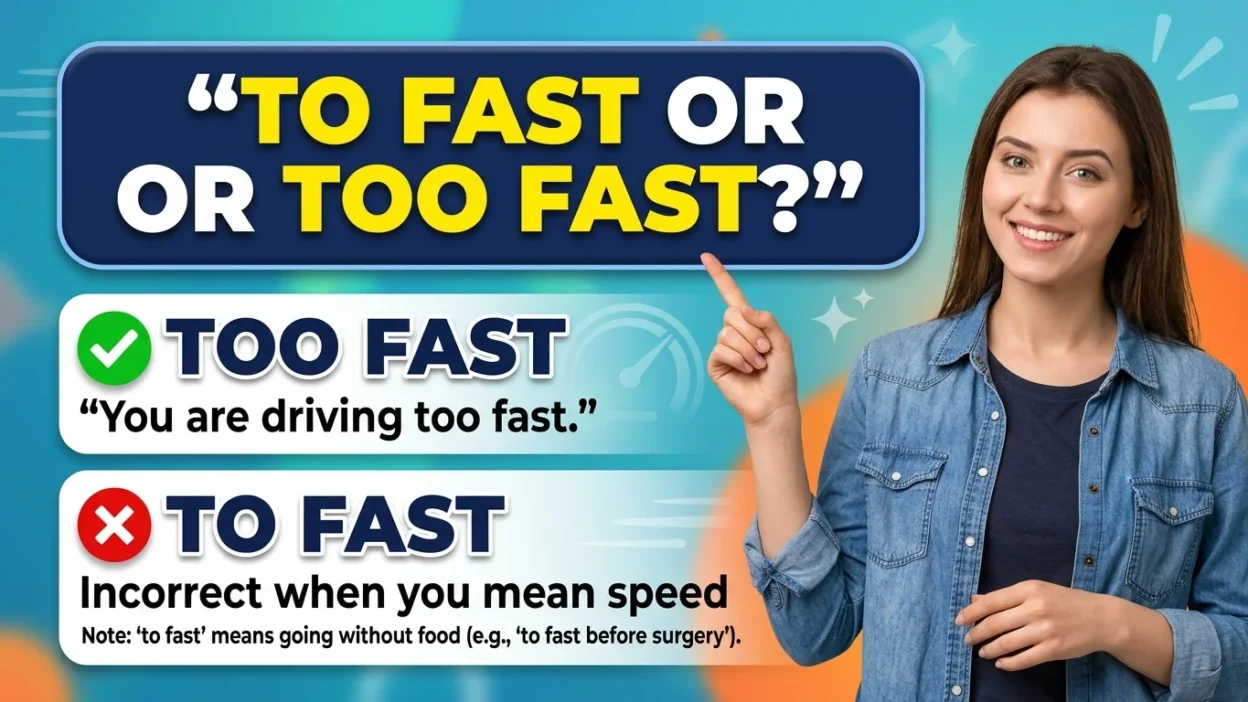
Have you ever typed “to fast” and wondered whether you need an extra o? This small spelling difference can change the meaning of your sentence completely. Too fast is the correct expression when you describe something moving, happening, or progressing at an excessive speed.
For example, you might say, “You’re driving too fast,” or “Time goes by too fast.” However, to fast can also be grammatically correct when fast acts as a verb meaning to abstain from food for a period. For instance, “She plans to fast before her medical test.”
Understanding the context makes it easy to choose the right phrase. In this guide, you’ll learn the difference between to fast and too fast, explore simple examples, and discover practical tricks to avoid common grammar mistakes.
To Fast or Too Fast: The Quick Answer
The correct phrase depends on the meaning you want to express.
- Too fast = faster than necessary, suitable, comfortable, or safe.
- To fast = the infinitive form of the verb “fast,” meaning to avoid eating for a period of time.
Here are two simple examples:
The car is going too fast.
This means the car is moving at an excessive speed.
I decided to fast for one day.
This means the person decided to avoid eating for one day.
So, if you are talking about speed, you usually need “too fast.”
If you are talking about the action of fasting, you may use “to fast.”
What Does “Too Fast” Mean?
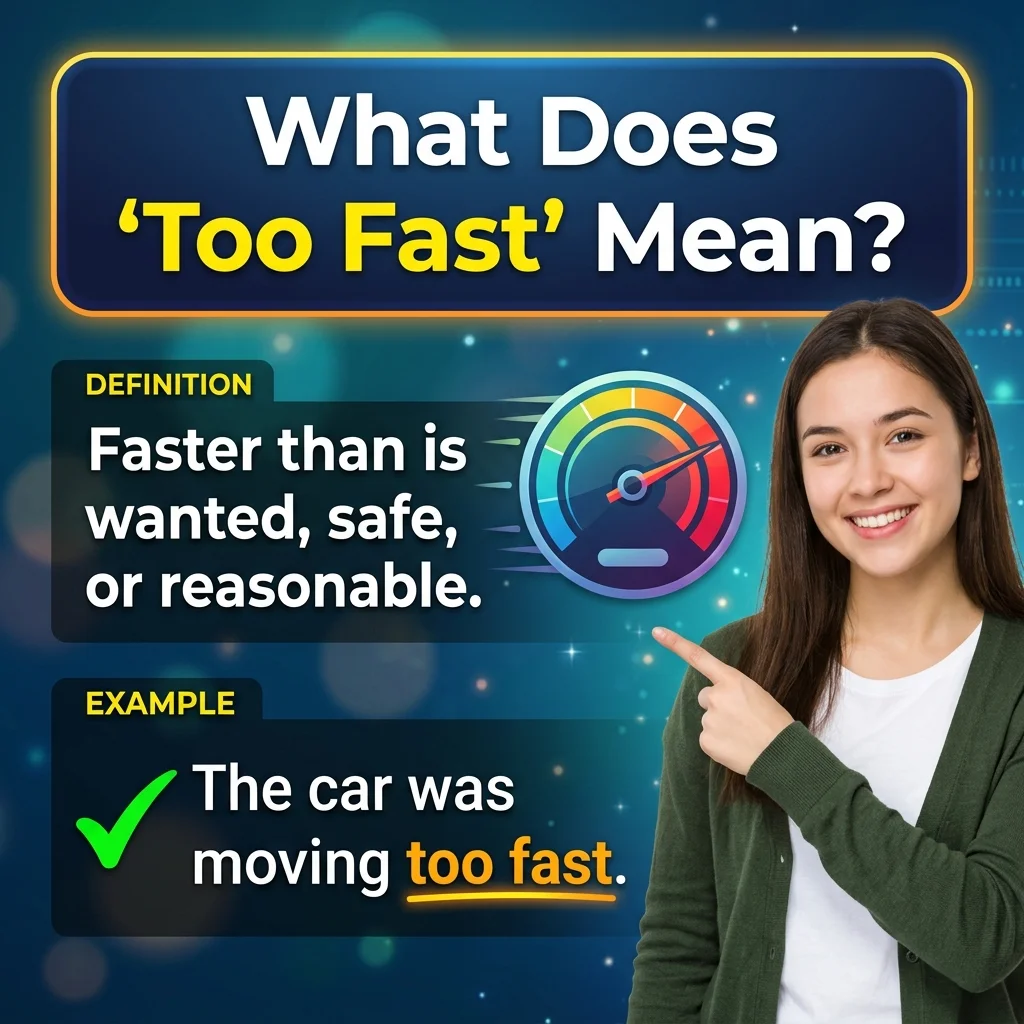
“Too fast” is an expression used when something happens at a speed that is greater than what is appropriate, comfortable, expected, or safe.
The word “too” is important because it means more than is desirable or necessary.
The word “fast” describes speed.
Together, “too fast” means at an excessive speed.
For example:
- You are walking too fast.
- The teacher is speaking too fast.
- This car is going too fast.
- The video is playing too fast.
- Time is passing too fast.
In each sentence, “too fast” describes something happening at a speed that is considered excessive or difficult to manage.
Examples of “Too Fast”
Consider these examples:
1. You are driving too fast.
The driver is going faster than is safe or appropriate.
2. She talks too fast.
She speaks at a speed that may be difficult for other people to understand.
3. The children ran too fast.
They ran faster than expected or necessary.
4. This computer is working too fast for the program.
The speed is greater than what is suitable for the situation.
5. Time is going too fast.
This means time seems to be passing very quickly.
What Does “To Fast” Mean?
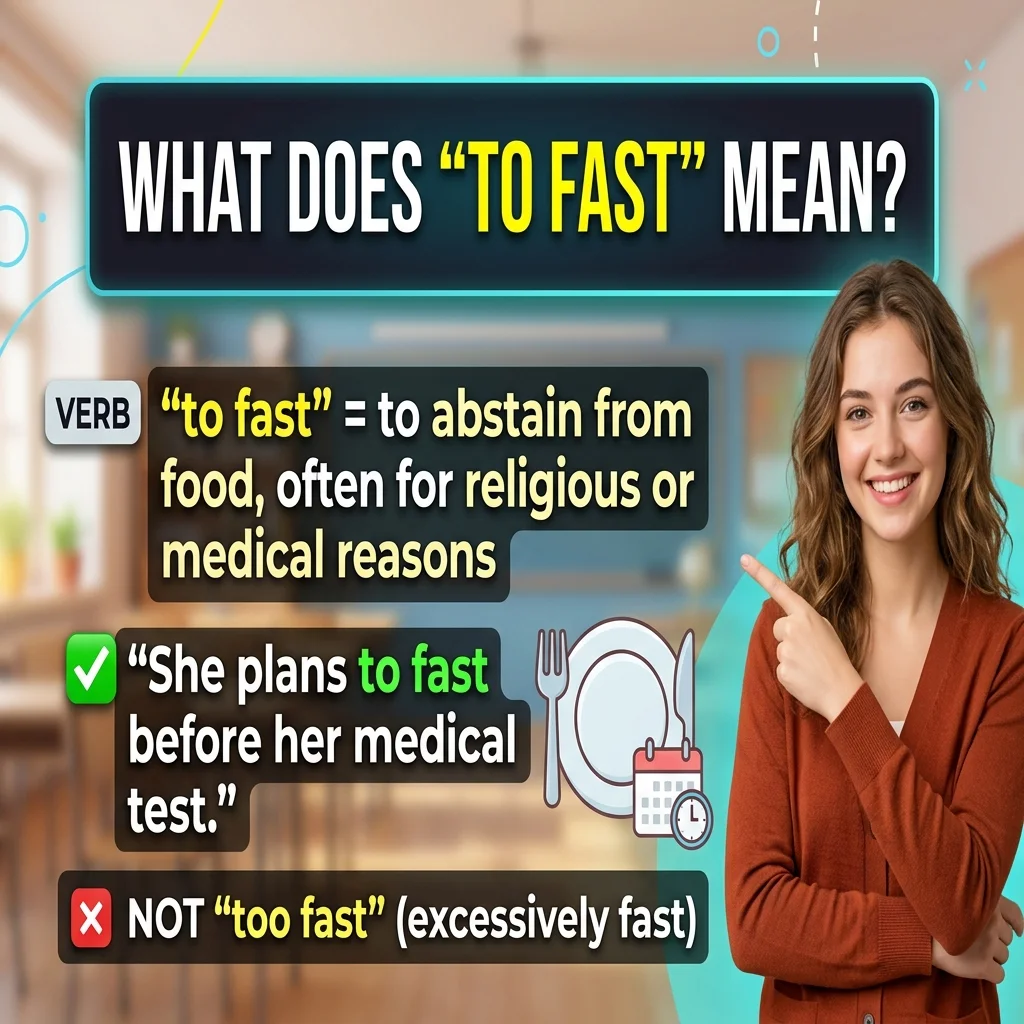
“To fast” is different from “too fast.”
Here, “to” is usually an infinitive marker placed before the verb “fast.”
The verb “fast” means to deliberately avoid food for a period of time.
For example:
- I want to fast tomorrow.
- She decided to fast during the day.
- They plan to fast for a week.
- He needs to fast before the procedure.
In these sentences, “to fast” does not describe speed.
Instead, it describes the action of fasting.
Examples of “To Fast”
1. I want to fast tomorrow.
Here, “to fast” means to avoid eating tomorrow.
2. She decided to fast for religious reasons.
The phrase describes her decision to avoid food.
3. They plan to fast during the month.
“To fast” refers to the practice of fasting.
4. He wants to fast before sunrise.
Again, “fast” is being used as a verb.
5. I am learning how to fast safely.
The word “fast” refers to avoiding food, not moving quickly.
To Fast vs. Too Fast: Main Difference
The easiest way to remember the difference is to focus on the meaning.
| Phrase | Meaning | Example |
| Too fast | Faster than necessary or appropriate | You are driving too fast. |
| To fast | To avoid eating for a period | I decided to fast tomorrow. |
The spelling changes the meaning completely.
“Too” Means Excessive
When “too” means more than necessary or desirable, it is often used before an adjective or adverb.
Examples:
- too fast
- too slow
- too expensive
- too difficult
- too loud
- too quickly
- too late
For example:
The train is moving too fast.
“To” Often Introduces a Verb
The word “to” is commonly used before the base form of a verb.
Examples:
- to run
- to walk
- to eat
- to sleep
- to study
- to fast
For example:
I want to fast tomorrow.
Here, “to” introduces the verb “fast.”
Why Do People Confuse “To Fast” and “Too Fast”?
One major reason is pronunciation.
In everyday English, “to” and “too” can sound very similar. This makes it easy to confuse them when writing.
For example, when someone says:
“The car is going too fast.”
A beginner may hear the sentence and later write:
“The car is going to fast.”
That spelling is incorrect because the intended meaning is excessive speed.
The same problem happens with other word pairs:
- to / too
- there / their / they’re
- your / you’re
- its / it’s
- then / than
Learning the meaning and grammatical role of each word is the best way to avoid these mistakes.
When Should You Use “Too Fast”?
Use “too fast” when you want to say that something is happening at an excessive speed.
It can describe:
- Driving
- Running
- Walking
- Speaking
- Reading
- Learning
- Moving
- Changing
- Developing
- Passing
“Too Fast” With Movement
The car is going too fast.
The motorcycle was moving too fast.
You are walking too fast.
The child ran too fast for me to catch him.
In these examples, “fast” describes speed, while “too” indicates excess.
“Too Fast” With Speaking
You can also use “too fast” when someone speaks quickly.
Please speak slowly. You are talking too fast.
This means the speaker’s speed makes understanding difficult.
“Too Fast” With Reading
You are reading too fast.
This can mean someone is reading at a speed that prevents proper understanding.
“Too Fast” With Change
“Too fast” does not always refer to physical movement.
For example:
Technology is changing too fast.
This means technological changes are happening more quickly than the speaker considers manageable or comfortable.
When Should You Use “To Fast”?
Use “to fast” when fast is functioning as a verb meaning to avoid food for a period of time.
Common structures include:
- want to fast
- need to fast
- decide to fast
- plan to fast
- choose to fast
- begin to fast
- continue to fast
- learn to fast
Examples
I want to fast tomorrow.
She decided to fast for a day.
He plans to fast during the month.
They chose to fast together.
You may need to fast before certain tests or procedures.
The meaning comes from the verb fast, not from speed.
“To Fast” and “Too Fast” in Everyday Sentences
Let’s compare similar-looking sentences.
Example 1
Incorrect for speed:
You are driving to fast.
Correct:
You are driving too fast.
The sentence is about driving speed, so “too fast” is required.
Example 2
Correct:
I want to fast tomorrow.
Here, the speaker wants to avoid eating, so “to fast” is correct.
Example 3
Incorrect:
She speaks to fast.
Correct:
She speaks too fast.
The sentence refers to speaking speed.
Example 4
Correct:
He decided to fast.
This refers to the act of fasting.
“Too Fast” in Questions
You can also use “too fast” in questions.
Examples:
- Am I driving too fast?
- Is the video moving too fast?
- Are you walking too fast?
- Is the teacher speaking too fast?
- Did I read this too fast?
These questions ask whether something is happening at an excessive speed.
Examples in Conversation
Person A: Are you okay?
B: Yes, but you’re walking too fast.
Person A: Can you understand the lesson?
The teacher is speaking too fast.
Person A: Is this car going too fast?
Person B: Yes, we should slow down.
“To Fast” in Questions
The phrase “to fast” can also appear in questions when “fast” means avoiding food.
Examples:
- Do you want to fast tomorrow?
- Are you planning to fast?
- Is it okay to fast today?
- When do you want to fast?
- Did you decide to fast?
Here, the meaning is completely different from speed.
Common Mistakes With “To Fast” and “Too Fast”
One of the most common mistakes is using “to” when the intended meaning is “too.”
Mistake 1: “You Are Going To Fast”
Incorrect:
You are going to fast.
If you mean that someone is moving excessively quickly, the correct sentence is:
You are going too fast.
However, notice that “going to fast” can technically occur in another grammatical structure, although it would normally need context. For example:
I am going to fast tomorrow.
Here, “going to” is the future construction, and “fast” is the verb.
This is why context matters.
Mistake 2: “She Talks To Fast”
Incorrect when discussing speaking speed:
She talks to fast.
Correct:
She talks too fast.
Mistake 3: “The Car Is To Fast”
Incorrect:
The car is to fast.
Correct:
The car is too fast.
However, depending on what you mean, “The car is too fast” could mean either the car’s maximum speed is excessive or it is moving at an excessive speed.
Spelling Tip: Remember “Too” Has an Extra “O”
A simple spelling trick can help.
Think of “too” as having an extra O because it means extra or excessive.
For example:
- too fast = excessively fast
- too loud = excessively loud
- too expensive = more expensive than acceptable
- too difficult = more difficult than manageable
You can remember:
TOO = MORE THAN NEEDED
On the other hand:
TO = usually connects to a verb or shows direction
Examples:
- I want to sleep.
- She likes to read.
- We need to leave.
- He decided to fast.
- I am going to school.
To vs. Too: A Simple Grammar Guide
Understanding “to” and “too” generally will make the difference easier to remember.
The Word “To”
“To” has several grammatical uses.
It can introduce an infinitive:
I want to eat.
It can show direction:
I am going to school.
It can show a relationship or destination:
Give the book to Sarah.
It can appear before the verb “fast”:
I decided to fast.
The Word “Too”
“Too” commonly has two major meanings.
The first means also:
I want to come too.
The second means more than necessary:
This bag is too heavy.
When “too” means excessive, it can be used with fast:
The car is too fast.
Too Fast vs. Very Fast
Another common question is whether “too fast” and “very fast” mean the same thing.
They do not.
Very Fast
“Very fast” means something happens at a high speed.
The car is very fast.
This does not necessarily mean the speed is a problem.
Too Fast
“Too fast” means the speed is excessive for the situation.
The car is going too fast.
This suggests that the speed is beyond what is appropriate.
Compare:
She runs very fast.
This is usually a positive or neutral statement.
She runs too fast.
This suggests her speed is excessive for the situation.
Too Fast vs. So Fast
Too Fast
Indicates excessive speed:
You are typing too fast.
So Fast
Emphasizes how fast something is:
You type so fast!
The second sentence may express surprise or admiration.
Compare:
- He runs too fast for me.
- He runs so fast!
The first expresses a problem or limitation. The second emphasizes speed.
Too Fast vs. Very Quickly
“Too fast” and “too quickly” can sometimes express similar ideas, but they are not always interchangeable.
Fast can function as an adjective or adverb.
Examples:
That is a fast car.
The car is moving fast.
Quickly is an adverb.
The car is moving quickly.
Therefore:
The car is moving too fast.
and
The car is moving too quickly.
can both be correct.
The best choice depends on the sentence and the style you want.
Is “Too Fast” Always Negative?
Not necessarily.
The phrase “too fast” usually suggests that something exceeds an appropriate limit, but the situation determines whether that is positive, negative, or simply inconvenient.
For example:
This computer processes the files too fast for the old software.
The speed itself may be impressive, but it creates a problem in that particular situation.
Another example:
The weekend went by too fast.
This usually expresses a feeling that the weekend ended sooner than the speaker wanted.
So “too fast” often means “faster than desired or suitable,” rather than simply “bad.”
Can “Fast” Be an Adjective and an Adverb?
Yes.
This is another useful grammar point.
Fast as an Adjective
When “fast” describes a noun:
He drives a fast car.
Here, “fast” describes the car.
Fast as an Adverb
When “fast” describes an action:
He drives fast.
Here, “fast” describes how he drives.
Therefore:
He drives too fast.
is correct because “fast” describes the action of driving.
More Examples of “Too Fast”
Here are additional examples to help you understand the phrase naturally:
- The train is moving too fast.
- Please don’t walk too fast.
- You’re typing too fast.
- The movie ended too fast.
- The children grew up too fast.
- She learned the material too fast to remember everything.
- The water is flowing too fast.
- The company is expanding too fast.
- He was speaking too fast.
- The internet connection is changing too fast.
- You are eating too fast.
- The clock seems to be moving too fast.
- The story develops too fast.
- The game is progressing too fast.
- The car accelerated too fast.
More Examples of “To Fast”
Here are examples where “to fast” is correct:
- I want to fast tomorrow.
- She decided to fast for a day.
- He plans to fast during the weekend.
- They agreed to fast together.
- I need to fast before my appointment.
- She wants to learn how to fast.
- He chose to fast for personal reasons.
- They continued to fast during the period.
- I decided to fast until evening.
- She hopes to fast regularly.
Remember, these sentences are about fasting, not speed.
How to Choose the Correct Phrase
When you are unsure whether to write “to fast” or “too fast,” ask yourself one simple question:
Am I talking about speed or fasting?
If you are talking about speed, use:
too fast
If you are talking about avoiding food, use:
to fast
Quick Test
Sentence:
The driver is going ___ fast.
Ask: Is this about speed?
Yes.
Therefore:
The driver is going too fast.
Another sentence:
I want ___ fast tomorrow.
Ask: Does “fast” mean avoiding food?
Yes.
Therefore:
I want to fast tomorrow.
A Simple Memory Trick
Use this trick:
TOO = TOO MUCH SPEED
Think:
too fast = more speed than necessary
TO = TO DO SOMETHING
Think:
to fast = to perform the action of fasting
This simple association can help beginners remember the difference.
Common “Too” Expressions
Learning other expressions with “too” can also make the pattern clearer.
Examples:
- too fast
- too slow
- too big
- too small
- too expensive
- too cheap
- too difficult
- too easy
- too loud
- too quiet
- too early
- too late
- too much
- too many
For example:
The music is too loud.
The bag is too heavy.
The lesson is too difficult.
The car is going too fast.
In all of these examples, “too” indicates an excessive degree.
Common “To” Expressions
“To” is frequently used before verbs.
Examples:
- to eat
- to drink
- to sleep
- to study
- to work
- to run
- to walk
- to learn
- to fast
- to travel
For example:
I want to study.
She needs to work.
They plan to travel.
He wants to fast.
This pattern is especially useful for English learners.
Is “To Fast” Ever Correct?
Yes, absolutely.
Some people think “to fast” is always incorrect because they have learned that the phrase describing excessive speed is “too fast.”
But “to fast” is grammatically correct when fast is a verb meaning to abstain from food.
For example:
I decided to fast.
This is a perfectly correct sentence.
So the important point is not that one phrase is always right and the other is always wrong. Both can be correct, but they have different meanings.
Is “Too Fast” Always Correct When Talking About Speed?
Usually, if you mean excessively fast, yes.
For example:
The car is going too fast.
But if you simply mean that something moves quickly, you may use “fast” or “very fast.”
Compare:
The car is fast.
The car is going too fast.
Each sentence communicates something slightly different.
Frequently Asked Questions About “To Fast or Too Fast”
Is it “to fast” or “too fast”?
If you mean that something is moving or happening at an excessive speed, the correct phrase is “too fast.” If you mean the action of avoiding food, “to fast” is correct.
Is “you are going to fast” correct?
It depends on the intended meaning.
If you mean someone is moving at an excessive speed, write:
You are going too fast.
If you mean someone is going somewhere in order to fast, a sentence such as “I am going to fast tomorrow” can be grammatically possible, but it has a different structure and meaning.
Is “she talks too fast” correct?
Yes. “She talks too fast” means she speaks at a speed that is greater than the listener considers comfortable or easy to understand.
What does “too fast” mean?
“Too fast” means faster than necessary, appropriate, comfortable, or desirable.
What does “to fast” mean?
“To fast” means to avoid eating for a period of time. It is the infinitive form of the verb “fast.”
Is “too fast” one word?
No. “Too fast” is written as two separate words.
Is “to fast” one word?
No. “To fast” is also written as two separate words.
What is the difference between “fast” and “too fast”?
Fast describes high speed, while too fast suggests that the speed is greater than appropriate or desired.
For example:
He runs fast.
This simply describes his speed.
He runs too fast.
This suggests his speed is excessive for the situation.
Can “fast” mean not eating?
Yes. Fast can be a verb meaning to avoid food for a period of time.
Example:
They decided to fast.
Can “fast” describe speed?
Yes. “Fast” commonly describes something that moves or happens quickly.
Example:
The car is fast.
What is the easiest way to remember “to” and “too”?
Remember:
- To often comes before a verb.
- Too can mean “also” or “more than necessary.”
Therefore:
I want to fast.
but:
The car is moving too fast.
Final Comparison: To Fast vs. Too Fast
The difference between “to fast” and “too fast” becomes simple once you understand what each word does.
“To fast” uses to as an infinitive marker before the verb fast. The sentence is about fasting or avoiding food.
I want to fast tomorrow.
“Too fast” uses too to show an excessive degree of speed.
The car is going too fast.
The pronunciation may sound similar, but the meanings are completely different. Whenever you are writing about speed, ask whether you mean “more quickly than necessary or appropriate.” If you do, “too fast” is the expression you need. If you are describing the action of avoiding food, then “to fast” is correct.
A useful memory trick is to associate “too” with excess. Just as you can say “too loud,” “too expensive,” or “too difficult,” you can say “too fast” when something is happening faster than desired. Meanwhile, “to fast” follows the familiar English pattern of to + verb, such as “to eat,” “to sleep,” “to study,” and “to fast.”
Once you understand this distinction, you will be able to choose the correct phrase confidently in conversations, emails, school assignments, blog posts, and everyday writing.
Conclusion
So, “to fast or too fast” is not simply a spelling question it is a question of meaning and grammar. Use “too fast” when you are talking about something happening at an excessive speed, such as “The car is going too fast” or “She speaks too fast.”
Use “to fast” when fast is a verb meaning to avoid food for a period of time, as in “I decided to fast tomorrow.” The easiest way to remember the difference is that “too” means more than necessary or desirable, while “to” commonly comes before a verb. By paying attention to the meaning of the sentence, you can easily avoid this common English mistake and use both expressions correctly.

Daniel Carter is a passionate writer who creates clear, helpful, and easy-to-understand content. He focuses on language, grammar, word meanings, and everyday expressions, helping readers find simple answers to common questions.