Have you ever paused while writing a sentence because you weren’t sure whether to use “correct” or “correctly”? These two words are closely related, but they play different grammatical roles in English.
Understanding the difference between correct or correctly can help you build clearer sentences, avoid common grammar mistakes, and communicate more confidently in school, at work, or in everyday conversations.
“Correct” is commonly used as an adjective to describe something accurate, right, or free from mistakes. For example, “Your answer is correct” describes the answer’s accuracy. It can also function as a verb, as in “Please correct the spelling mistake.”
Correct or Correctly: The Basic Difference
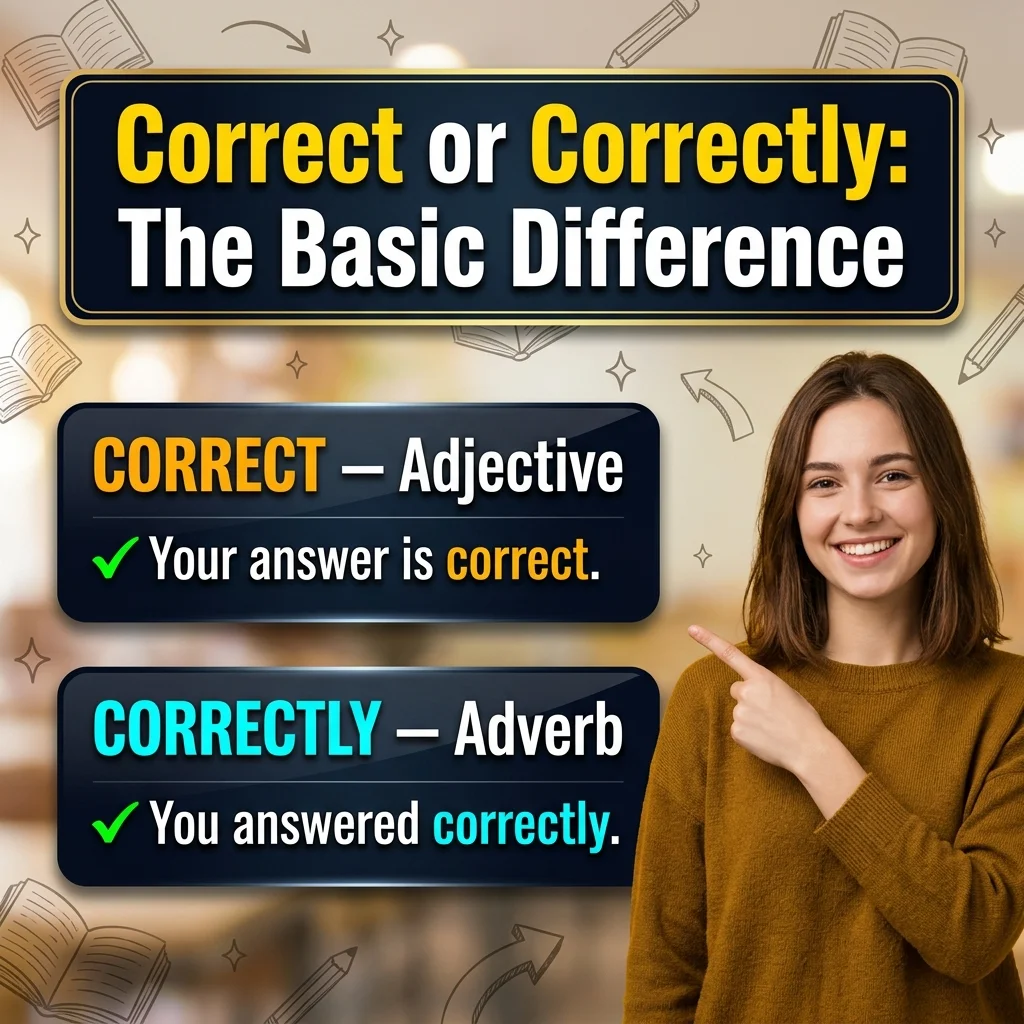
The main difference between correct and correctly is their grammatical function.
- Correct is usually an adjective. It describes a noun or pronoun.
- Correctly is an adverb. It describes a verb, adjective, or another adverb, and explains how an action is performed.
Quick Comparison
| Word | Part of speech | Main function | Example |
| Correct | Adjective | Describes a person, thing, answer, or idea | Your answer is correct. |
| Correctly | Adverb | Describes how an action happens | You answered correctly. |
The easiest way to remember the difference is:
Correct = right or accurate Correctly = in a right or accurate way
Compare These Two Sentences
Your answer is correct.
Here, correct describes the noun answer. It tells us that the answer is right.
You answered correctly.
Here, correctly describes the verb answered. It tells us how you answered.
Both sentences express a similar idea, but their grammar is different.
What Does Correct Mean?
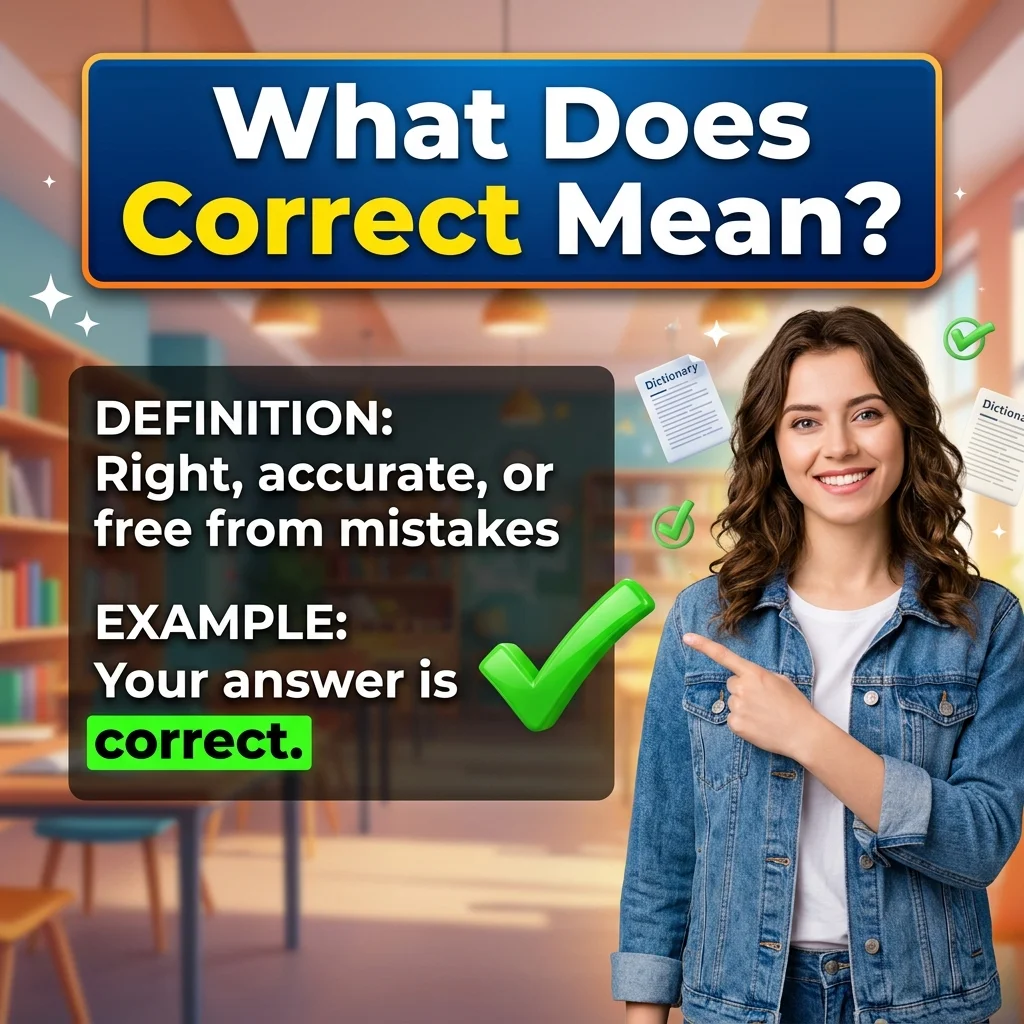
Correct means right, accurate, free from mistakes, or suitable according to a rule or standard. It is most commonly used as an adjective, but it can also function as a verb.
Correct as an Adjective
As an adjective, correct describes a noun or pronoun. It tells us that something is accurate or acceptable.
Examples:
- She gave the correct answer.
- This is the correct spelling.
- Your calculation is correct.
- We used the correct address.
- He chose the correct option.
In each sentence, correct describes a person, place, thing, or idea.
Correct After a Linking Verb
The word correct often appears after linking verbs such as is, am, are, was, and were.
Examples:
- Your answer is correct.
- These instructions are correct.
- His pronunciation was correct.
- The information is correct.
- Their decision was correct.
A linking verb connects the subject to a description. Since correct describes the subject, an adjective is appropriate.
Correct Before a Noun
You can also place correct directly before a noun.
Examples:
- the correct answer
- the correct method
- the correct pronunciation
- the correct information
- the correct sentence
This is one of the most common uses of correct in everyday English.
Correct as a Verb
Although correct is usually taught as an adjective, it can also be used as a verb. As a verb, it means to fix, repair, or point out a mistake.
Examples:
- The teacher corrected my essay.
- Please correct this sentence.
- She corrected the spelling mistake.
- The editor corrected several errors.
- I need to correct my pronunciation.
In these examples, correct is an action, not a description.
What Does Correctly Mean?
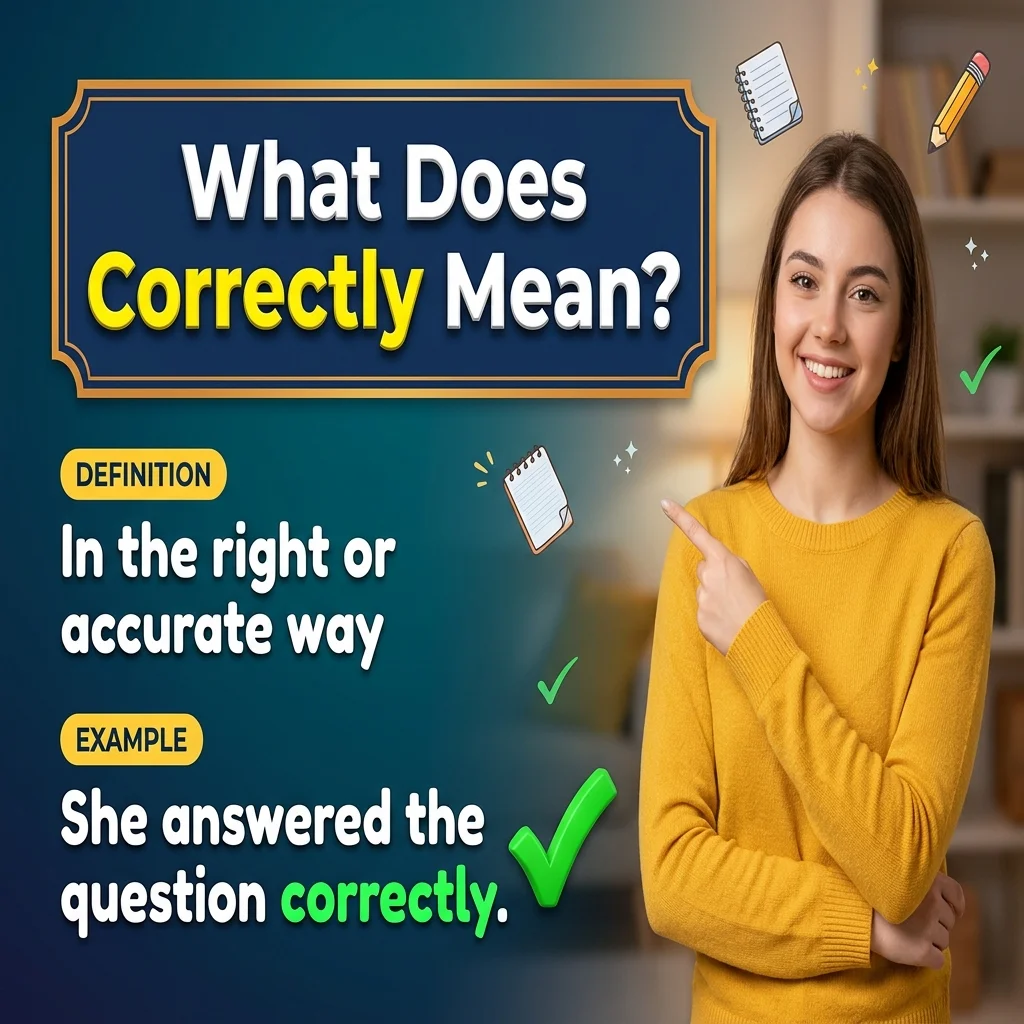
Correctly is an adverb. It means in a correct, accurate, or proper way. It usually describes how someone performs an action.
Correctly Describes a Verb
When you want to explain that an action was done accurately, use correctly.
Examples:
- She answered the question correctly.
- He spelled the word correctly.
- Please pronounce my name correctly.
- They completed the task correctly.
- You used the grammar rule correctly.
In each sentence, correctly explains how the action was performed.
Correctly in Different Sentence Positions
Adverbs can appear in different positions depending on the sentence.
After the verb:
- She answered correctly.
- He wrote the sentence correctly.
Before the main verb:
- She correctly identified the problem.
- He correctly understood the instructions.
After an object:
- She completed the assignment correctly.
- They arranged the words correctly.
The position may change, but the meaning remains the same: the action was performed accurately.
Correct or Correctly: When Should You Use Each Word?

Choosing between correct and correctly depends on what you are describing.
Use Correct to Describe a Noun
Use correct when you are describing an answer, sentence, spelling, method, person, or another noun.
Examples:
- This is the correct answer.
- She gave the correct explanation.
- That is the correct pronunciation.
- We found the correct solution.
Ask yourself:
What is correct?
The answer to that question is usually the noun being described.
Use Correctly to Describe an Action
Use correctly when you are describing how someone does something.
Examples:
- She answered correctly.
- He completed the form correctly.
- You spelled the name correctly.
- They followed the instructions correctly.
Ask yourself:
How was the action performed?
If the answer is “in a correct way,” correctly is usually the right choice.
A Simple Test
Compare these examples:
- The sentence is correct.
- She wrote the sentence correctly.
In the first sentence, correct describes sentence.
In the second sentence, correctly describes wrote.
This test works in many situations.
Correct or Correctly in Common Sentence Patterns
Learning common patterns makes the difference easier to remember.
Pattern 1: Subject + Linking Verb + Correct
Use this pattern when describing a subject.
Examples:
- The answer is correct.
- Your spelling is correct.
- His explanation was correct.
- The information seems correct.
Pattern 2: Subject + Verb + Correctly
Use this pattern when describing an action.
Examples:
- She answered correctly.
- He spelled the word correctly.
- They calculated the total correctly.
- We followed the directions correctly.
Pattern 3: Correct + Noun
Use correct before a noun.
Examples:
- the correct answer
- the correct spelling
- the correct procedure
- the correct address
Pattern 4: Verb + Object + Correctly
Use correctly to explain how an action was completed.
Examples:
- She completed the form correctly.
- He installed the software correctly.
- They arranged the chairs correctly.
- You answered all the questions correctly.
Correct vs. Correctly: Detailed Comparison
The following table shows how the two words work in different situations.
| Situation | Correct | Correctly |
| Describing an answer | The answer is correct. | She answered correctly. |
| Describing spelling | The spelling is correct. | He spelled it correctly. |
| Describing pronunciation | Her pronunciation is correct. | She pronounced it correctly. |
| Describing a method | This is the correct method. | He used the method correctly. |
| Describing information | The information is correct. | She reported the information correctly. |
| Describing a calculation | The calculation is correct. | They calculated the amount correctly. |
Why “Correct” and “Correctly” Cannot Always Replace Each Other
Although the words are closely related, they do not fit every sentence in the same way.
Correct:
Your answer is correct.
Correctly:
You answered correctly.
The first sentence needs an adjective because it describes the answer. The second needs an adverb because it describes the action of answering.
Using the wrong form can make a sentence grammatically incorrect or unnatural.
Common Mistakes With Correct and Correctly
English learners often confuse these words because they have similar meanings. Here are some common mistakes and their corrections.
Mistake 1: “You Answered Correct”
❌ You answered correct.
✅ You answered correctly.
Why? The word describes the verb answered, so an adverb is needed.
Mistake 2: “Your Answer Is Correctly”
❌ Your answer is correctly.
✅ Your answer is correct.
Why? The word describes the noun answer after the linking verb is. Use the adjective correct.
Mistake 3: “She Spelled the Word Correct”
❌ She spelled the word correct.
✅ She spelled the word correctly.
Why? The word explains how she performed the action of spelling.
Mistake 4: “This Is the Correctly Answer”
❌ This is the correctly answer.
✅ This is the correct answer.
Why? The word comes before the noun answer, so an adjective is required.
Mistake 5: “He Did It Correct”
❌ He did it correct.
✅ He did it correctly.
Why? The word describes how he performed the action.
Mistake 6: “She Correctly Answer Is Good”
❌ Her correctly answer is good.
✅ Her correct answer is good.
Why? Answer is a noun, so it needs the adjective correct.
Can Correct Be Used as an Adverb?
In standard formal English, correctly is the usual adverb form of correct.
However, in some informal varieties of English, especially in certain spoken expressions, people may use correct in ways that function like an adverb.
For example:
- “You did it correct.”
This may be heard in casual speech, but it is generally considered nonstandard in formal English.
For writing, schoolwork, professional communication, and SEO content, use:
You did it correctly.
This is the safest and most widely accepted form.
Is “Correct” Always an Adjective?
No. Correct can also be a verb.
Correct as an Adjective
- The answer is correct.
- She chose the correct word.
Correct as a Verb
- Please correct the mistake.
- The teacher corrected my homework.
The meaning changes slightly depending on the grammatical role.
Adjective: right or accurate Verb: to fix or make right
Is “Correctly” Always an Adverb?
In standard English, correctly is used as an adverb. It modifies an action or describes the manner in which something happens.
Examples:
- He understood the lesson correctly.
- She used the word correctly.
- The machine is working correctly.
It does not normally describe a noun directly.
Correct or Correctly in Questions
Both words can be used in questions, depending on what you want to ask.
Questions With Correct
Use correct when asking whether something is right or accurate.
- Is this answer correct?
- Is my spelling correct?
- Is this the correct address?
- Was her explanation correct?
Questions With Correctly
Use correctly when asking whether an action was performed accurately.
- Did I answer correctly?
- Did she spell the word correctly?
- Did he pronounce it correctly?
- Did they complete the task correctly?
Compare
Is my answer correct?
This asks whether the answer is right.
Did I answer correctly?
This asks whether the action of answering was done accurately.
Both are natural and grammatically correct.
Correct or Correctly in Negative Sentences
The same grammar rules apply in negative sentences.
Using Correct
- Your answer is not correct.
- This is not the correct spelling.
- His information was not correct.
Using Correctly
- She did not answer correctly.
- He did not spell the word correctly.
- They did not complete the task correctly.
The negative word not does not change whether you need an adjective or an adverb.
Correct or Correctly in Different Tenses
Both words can be used with different verb tenses.
Present Simple
- The answer is correct.
- She answers correctly.
Past Simple
- The answer was correct.
- She answered correctly.
Present Perfect
- The answer has been correct.
- She has answered correctly.
Future
- The answer will be correct.
- She will answer correctly.
The tense changes the verb, but the distinction between adjective and adverb remains the same.
Correct or Correctly in Academic and Professional English
Choosing the right word is especially important in formal writing.
Academic Examples
- The student provided the correct answer.
- The student solved the problem correctly.
- The explanation is correct.
- The student applied the formula correctly.
Professional Examples
- Please enter the correct information.
- Please complete the form correctly.
- We received the correct documents.
- The documents were submitted correctly.
Using the correct form makes your writing more precise and professional.
Correct or Correctly in Everyday Conversation
In daily conversation, both words are common.
Examples:
- “Is this correct?”
- “Yes, you did it correctly.”
- “That’s the correct answer.”
- “You pronounced my name correctly.”
- “Please use the correct password.”
The words are simple, but using them accurately helps your English sound natural.
Spelling Tips for Correct and Correctly
Spelling these words is easy once you remember their forms.
Correct
C-O-R-R-E-C-T
Example:
- That is the correct answer.
Correctly
C-O-R-R-E-C-T-L-Y
Example:
- She answered correctly.
How to Form Correctly
To form the adverb, add -ly to correct:
correct + ly = correctly
Unlike some adjectives, correct does not require a spelling change before adding -ly.
Common Spelling Mistakes
❌ corect ✅ correct
✅ correct❌ corret
❌ correctley ✅ correctly
✅ correctly❌ corectly
A Useful Spelling Memory Tip
Remember that correct contains:
- two c’s
- two r’s
- one e
- one t
The word begins and ends with c and t:
c o r r e c t
Then add -ly:
c o r r e c t l y
Correct or Correctly: More Examples
Here are additional examples to help you understand the difference.
Examples With Correct
- This is the correct answer.
- Your grammar is correct.
- She used the correct word.
- That is the correct spelling.
- The information is correct.
- We followed the correct procedure.
- His pronunciation was correct.
- They selected the correct option.
- The address is correct.
- This method is correct.
Examples With Correctly
- She answered the question correctly.
- He spelled the word correctly.
- You pronounced the name correctly.
- They completed the assignment correctly.
- We calculated the total correctly.
- She followed the instructions correctly.
- He used the grammar rule correctly.
- The machine is working correctly.
- They arranged the items correctly.
- You understood the lesson correctly.
Correct or Correctly in Paired Sentences
Paired examples make the difference even clearer.
1 Pair
- The answer is correct.
- She answered correctly.
2 Pair
- His spelling is correct.
- He spelled the word correctly.
3 Pair
- Her pronunciation is correct.
- She pronounced the word correctly.
4 Pair
- This is the correct method.
- He used the method correctly.
5 Pair
- The information is correct.
- She reported the information correctly.
6 Pair
- That is the correct way.
- He completed the task correctly.
Notice how correct describes a thing, while correctly describes an action.
Correct or Correctly: A Quick Grammar Test
When you are unsure which word to use, follow these steps.
Step 1: Identify the Word Being Described
Ask:
Am I describing a noun or an action?
If you are describing a noun, you probably need correct.
If you are describing an action, you probably need correctly.
Step 2: Look at the Verb
If the sentence contains a linking verb such as is, am, are, was, or were, an adjective often follows.
Example:
- The answer is correct.
If the sentence contains an action verb such as answered, wrote, spelled, or completed, an adverb often describes it.
Example:
- She answered correctly.
Step 3: Ask the Right Question
- What is correct? → Use correct.
- How was it done? → Use correctly.
Step 4: Check the Sentence
Compare:
- He gave the correct answer.
- He answered correctly.
Both are correct because each word performs the right grammatical function.
Practice: Choose Correct or Correctly
Try completing these sentences with correct or correctly.
- Your answer is ______.
- She answered the question ______.
- This is the ______ spelling.
- He pronounced the word ______.
- The information is ______.
- They completed the task ______.
- Is this the ______ address?
- Did I write the sentence ______?
- The calculation was ______.
- You used the word ______.
Answers
- correct
- correctly
- correct
- correctly
- correct
- correctly
- correct
- correctly
- correct
- correctly
The pattern is simple: nouns usually take correct, while actions usually take correctly.
Frequently Asked Questions About Correct or Correctly
Is it “You are correct” or “You are correctly”?
The correct sentence is:
You are correct.
Here, correct describes the pronoun you after the linking verb are.
Is it “You answered correct” or “You answered correctly”?
The standard correct form is:
You answered correctly.
The word correctly describes the action of answering.
Is “Correctly” a Verb?
No. Correctly is an adverb. It describes how an action is performed.
Example:
She completed the task correctly.
The verb is completed, and correctly explains how she completed it.
Is “Correct” an Adjective?
Yes, correct is commonly used as an adjective.
Example:
This is the correct answer.
It describes the noun answer.
However, correct can also be used as a verb.
Example:
Please correct the mistake.
Can I Say “That Is Correct”?
Yes. That is correct is a natural and grammatically correct sentence.
It means that something is right or accurate.
Can I Say “That Is Correctly”?
No, not when you mean that something is right.
Use:
That is correct.
Use correctly when describing an action:
She completed the task correctly.
Is “Do It Correctly” Correct?
Yes.
Do it correctly.
This means to perform the action in the right way.
Is “Do It Correct” Correct?
In standard formal English, do it correctly is preferred.
What Is the Difference Between “Correct Answer” and “Answer Correctly”?
A correct answer is an answer that is right.
To answer correctly means to give an answer in the right way.
Examples:
- She gave a correct answer.
- She answered the question correctly.
Is “Correctly Spelled” Correct?
Yes.
The word is correctly spelled.
Here, correctly modifies the participle spelled, explaining how the word was spelled.
You can also say:
The word is correctly spelt.
Both spelled and spelt are accepted, depending on the variety of English.
Is “Correctly Written” Correct?
Yes.
The sentence is correctly written.
This means the sentence has been written in an accurate or proper way.
Which Is More Formal: Correct or Correctly?
Neither word is automatically more formal. They have different grammatical functions.
- Correct is used to describe nouns or subjects.
- Correctly is used to describe actions.
The important thing is to use the form that fits the sentence.
Can “Correct” and “Correctly” Be Used in the Same Sentence?
Yes.
She gave the correct answer correctly.
However, this sentence may sound repetitive depending on the context. More natural alternatives include:
- She gave the correct answer.
- She answered correctly.
What Is the Opposite of Correct?
The opposite of correct is usually incorrect or wrong.
Examples:
- Your answer is incorrect.
- That is the wrong spelling.
The adverb correctly is commonly contrasted with incorrectly.
Examples:
- He answered incorrectly.
- She spelled the word incorrectly.
Final Summary:
The difference between correct and correctly is simple once you understand their grammatical roles. Correct is usually an adjective. It describes a noun or pronoun and means right, accurate, or free from mistakes. Use correct when describing what is right. Use correctly when explaining how something is done.
With regular practice, this distinction will become natural. Whether you are writing an email, completing an assignment, or improving your everyday English, choosing the right word will make your sentences clearer, more accurate, and more professional.

Emily Parker is a dedicated writer who enjoys creating clear, useful, and easy-to-understand content. She focuses on language, grammar, word meanings, and everyday expressions to help readers find simple and reliable answers.