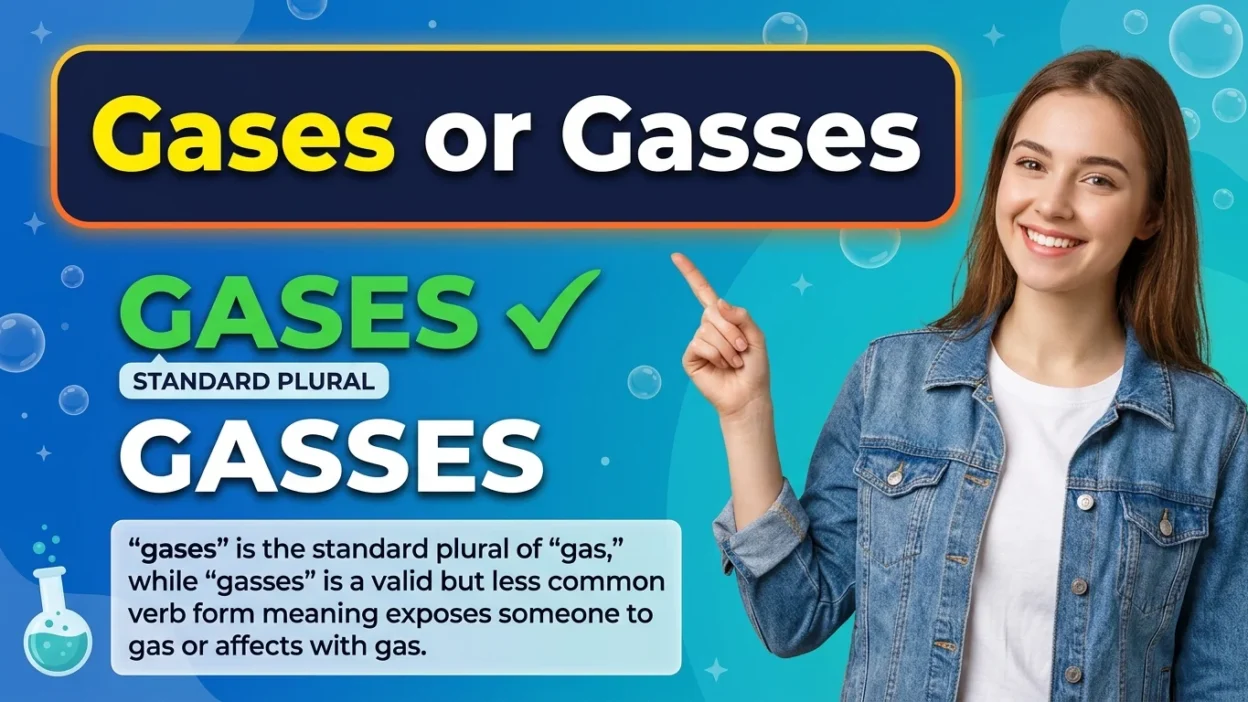
English spelling can be confusing when two words look almost identical but only one is correct for a particular meaning. “Gases or gasses” is a common spelling question because both forms exist in English, although they have different uses.
If you’re writing about chemistry, science, or everyday topics, knowing which spelling to choose can help you avoid mistakes and make your writing more accurate. “Gases” is the standard plural form of “gas.” It refers to substances such as oxygen, nitrogen, and carbon dioxide that exist in a gaseous state.
For example, “Several gases are present in Earth’s atmosphere.” “Gasses,” however, is the third-person singular form of the verb “gas,” meaning to expose someone or something to gas. For instance, “The technician gasses the laboratory sample” uses the verb form, although this usage is less common in everyday writing.
Gases or Gasses: The Quick Answer

The correct spelling depends on what you are trying to say.
Gases is the plural noun form of gas.
Gasses is generally a verb form of gas, meaning that someone or something exposes another person or thing to gas, or in some contexts fills or treats something with gas.
Here is the easiest way to remember the difference:
- Gas → gases when you mean more than one gas.
- Gas → gasses when you are using “gas” as a verb.
- Gases is much more common in everyday scientific and general writing.
- Gasses is less common and usually appears as a verb.
For example:
- Correct: Several gases are present in the atmosphere.
- Correct: The machine gasses the material during the process.
So, if you are talking about different substances such as oxygen, hydrogen, and nitrogen, gases is the word you want.
What Does “Gases” Mean?
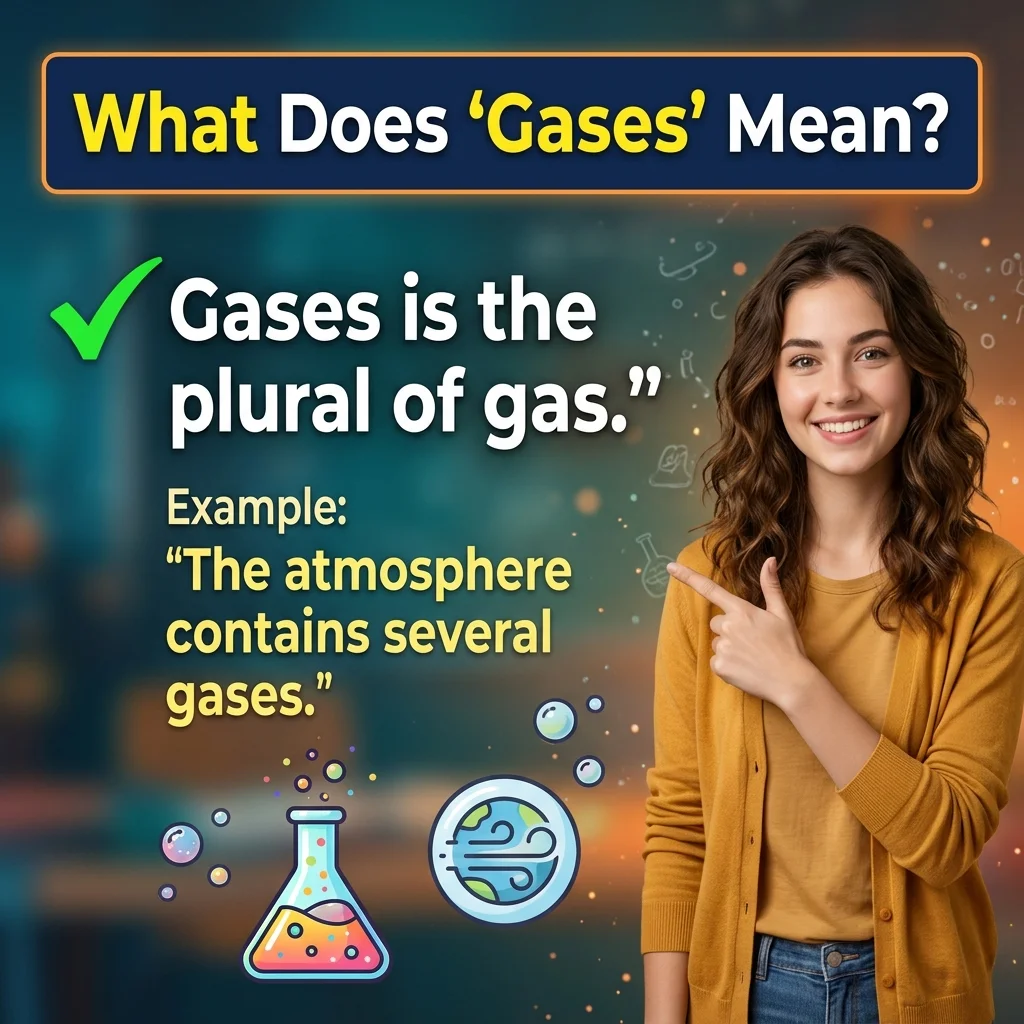
Gases is the plural form of the noun gas. It refers to two or more gases or multiple quantities of gas.
A gas is one of the common states of matter. Unlike solids and liquids, gases do not have a fixed shape or fixed volume. They spread out and fill the space available to them.
For example, oxygen is a gas, nitrogen is a gas, and carbon dioxide is a gas. When we refer to more than one of these substances, we can use the plural word gases.
Consider this sentence:
Oxygen and nitrogen are gases.
Here, “gases” refers to two substances that exist in a gaseous state.
Another example is:
Several gases are released during the chemical reaction.
The word “gases” is plural because more than one type or quantity of gas is being discussed.
Examples of “Gases” as a Noun
Here are some simple examples:
- Oxygen and nitrogen are important gases in Earth’s atmosphere.
- Some gases are invisible to the human eye.
- The scientist studied several gases in the laboratory.
- Greenhouse gases can affect Earth’s climate.
- The container holds different gases.
- Certain gases have strong smells.
- The factory monitors harmful gases.
- Several gases were detected in the air sample.
In all these examples, gases is a noun and means more than one gas.
What Does “Gasses” Mean?
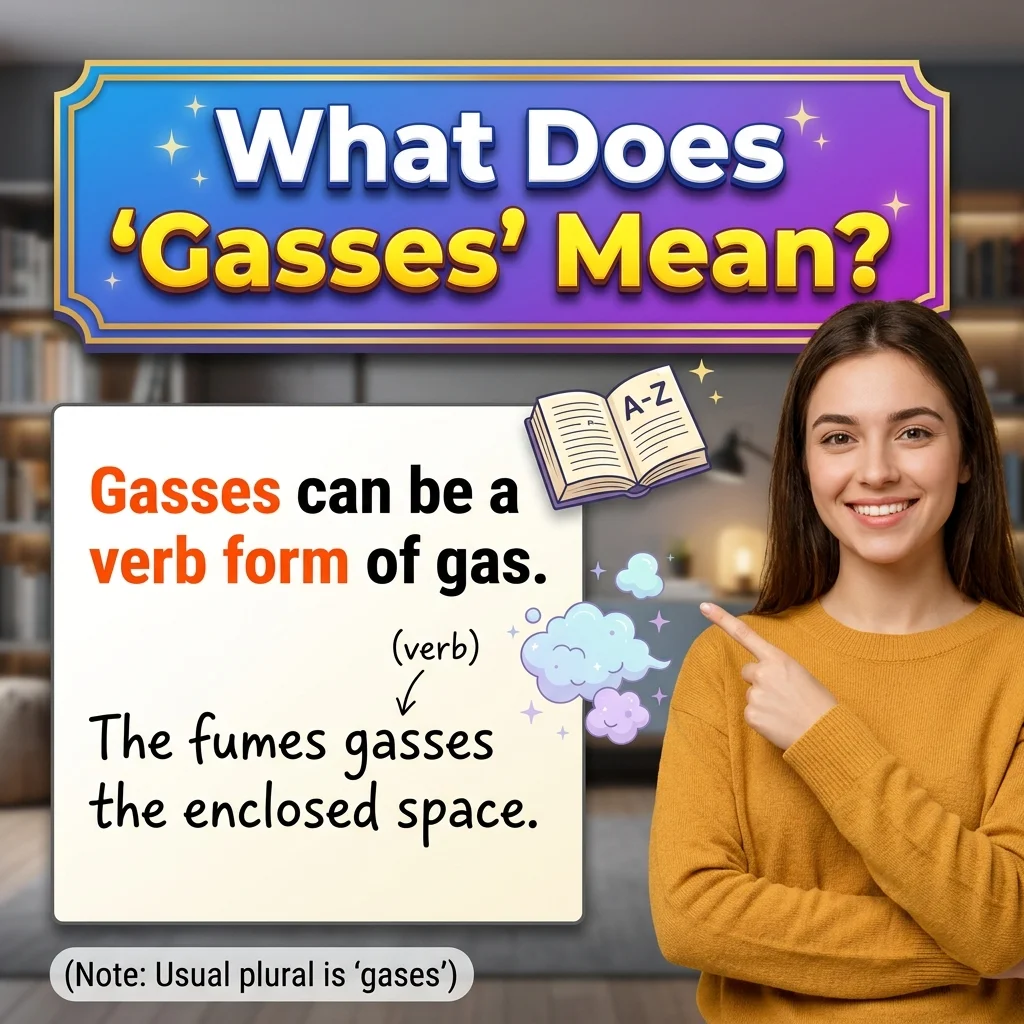
Gasses is generally a verb, not the normal plural form of “gas.”
It is the third-person singular form of the verb gas. Depending on the context, “to gas” can mean to expose someone or something to gas, treat something with gas, or fill something with gas.
For example:
The machine gasses the material before packaging it.
Here, “gasses” describes an action performed by the machine.
Another example is:
The chemical process gasses the chamber.
In this sentence, “gasses” is a verb describing what the process does.
The word can also appear in contexts involving engines, industrial processes, or other specialized meanings.
Examples of “Gasses” as a Verb
Consider these examples:
- The machine gasses the product during production.
- The system gasses the chamber automatically.
- The equipment gasses the material before sealing.
- The process gasses the container to remove unwanted substances.
The important point is that gasses is normally used when “gas” functions as a verb.
Gases vs. Gasses: Main Difference

The easiest way to understand gases vs. gasses is to look at their grammatical roles.
| Word | Function | Meaning | Example |
| Gases | Noun | Plural of gas | Several gases are present. |
| Gasses | Verb | Third-person singular of gas | The machine gasses the chamber. |
The spelling difference is small, but the grammatical difference is important.
If you are naming multiple types or quantities of gas, use gases.
If you are describing an action performed by someone or something using the verb “gas,” gasses may be correct.
Why Is the Plural of Gas “Gases”?
Many English learners wonder why the plural of gas is spelled gases rather than “gasses.”
English spelling can be confusing because plural forms do not always follow one simple rule.
For many nouns ending in -s, adding -es creates the plural:
- bus → buses
- class → classes
- glass → glasses
- gas → gases
Therefore:
gas → gases
The spelling gasses is not normally used as the plural noun in standard modern English when you mean multiple gases.
This is an important spelling distinction.
Gas and Gases
The singular noun is:
gas
The plural noun is:
gases
For example:
- One gas
- Two gases
- Several gases
- Different gases
You can think of it like this:
One gas → many gases
Why Does “Gasses” Have Two S’s?
The spelling gasses occurs because it comes from the verb gas.
When a verb ends in -s, English often forms the third-person singular present tense by adding -es.
For example:
- go → goes
- wash → washes
- pass → passes
- gas → gasses
Therefore:
He gases the equipment.
can be written as:
He gasses the equipment.
The exact usage can depend on the intended meaning and style, but the doubled “s” helps distinguish the verb form from the plural noun gases.
Gases in Scientific Writing
The word gases is especially common in science.
Scientists frequently talk about different gases, including:
- oxygen
- nitrogen
- hydrogen
- carbon dioxide
- helium
- methane
- neon
For example:
The atmosphere contains several different gases.
Another example:
Scientists measure gases released during industrial processes.
Because scientific writing frequently discusses multiple substances, gases is much more common than gasses.
Examples in Science
Here are several examples:
- Different gases have different chemical properties.
- The experiment produced several gases.
- Some gases can be compressed easily.
- Scientists study gases to understand atmospheric changes.
- The laboratory stores certain gases in special containers.
- The atmosphere contains gases that are essential for life.
In each sentence, gases is a plural noun.
Gases in Everyday English
You do not need to be a scientist to use the word gases.
It can appear in everyday conversations and general writing.
For example:
Some gases can be dangerous if they accumulate indoors.
You might also say:
The workers checked the room for harmful gases.
Other everyday examples include:
- Cooking can produce different gases.
- Some gases have no color.
- Certain gases have strong odors.
- The tank contains compressed gases.
- The laboratory uses several gases.
- Some household products can release gases.
Gasses as a Verb
Although gasses is less common than gases, it is still a valid word when used correctly.
The key is to identify whether the word is functioning as a noun or a verb.
Look at this example:
The tank contains several gases.
Here, “gases” is a noun.
Now compare it with:
The machine gasses the tank.
Here, “gasses” is a verb.
The first sentence talks about substances. The second sentence describes an action.
How to Recognize the Verb
One useful trick is to ask:
Is the word naming substances, or is it describing an action?
If it names substances, use:
gases
If it describes an action performed by a subject, gasses may be appropriate.
For example:
The scientist examines different gases.
“Gases” names substances.
The equipment gasses the chamber.
“Gasses” describes an action.
Gases or Gasses in a Sentence
Choosing between these words becomes easier when you look at the whole sentence.
Example 1
The atmosphere contains many gases.
Correct: gases
Why? The sentence is talking about multiple substances.
Example 2
The machine gasses the chamber.
Correct: gasses
Why? The word is being used as a verb.
Example 3
Several gases were released.
Correct: gases
Why? The sentence describes multiple gases.
Example 4
The system gasses the container automatically.
Correct: gasses
Why? The word describes what the system does.
Common Mistakes With Gases and Gasses
Because the two words look so similar, people often use them incorrectly.
Here are some common mistakes.
Mistake 1: Using “Gasses” as the Normal Plural of Gas
Incorrect:
The atmosphere contains several gasses.
For standard general and scientific writing, the preferred form is:
The atmosphere contains several gases.
The plural noun is gases.
Mistake 2: Using “Gases” When You Need a Verb
Consider:
The machine gases the chamber.
Depending on the intended verb meaning, this may create confusion because “gases” is visually identical to the plural noun.
When using the verb gas in the third-person singular form, gasses is commonly used to make the grammatical role clear.
For example:
The machine gasses the chamber.
Mistake 3: Choosing Based Only on Pronunciation
The pronunciation can sometimes make the distinction confusing. It is better to focus on grammar and meaning rather than pronunciation alone.
Ask whether the word is:
- a plural noun, or
- a verb.
This simple question usually solves the problem.
How to Remember the Difference
Here is a simple memory trick:
Gases = things
Gasses = action
If you are talking about things or substances, remember gases.
If you are describing an action involving gas, remember gasses.
You can also memorize this simple pattern:
One gas → two gases
The machine gas → the machine gasses
This is not a universal rule for every possible use of the word “gas,” but it is a helpful beginner-friendly way to remember the most common distinction.
Is “Gasses” a Correct Word?
Yes, gasses can be a correct English word.
However, it is important to use it in the correct grammatical context.
If you want the plural of the noun gas, use:
gases
If you need the third-person singular form of the verb gas, gasses can be correct.
For example:
The factory monitors harmful gases.
Here, “gases” is a plural noun.
The machine gasses the material.
Here, “gasses” is a verb.
Therefore, neither spelling should simply be labeled “wrong.” The correct choice depends on the sentence.
Is “Gasses” the Plural of “Gas”?
In standard English, gases is the normal plural form of the noun gas.
So if you are writing:
There are several ___ in the atmosphere.
The expected answer is:
gases
Not:
gasses
The word gasses has a different grammatical function in common standard usage.
Is “Gases” Singular or Plural?
Gases is plural.
The singular form is:
gas
The plural form is:
gases
Examples:
- One gas
- One type of gas
- Two gases
- Several gases
- Different gases
For example:
Carbon dioxide is a gas.
But:
Carbon dioxide and oxygen are gases.
Pronunciation of Gases
The pronunciation of gases can also cause confusion because English spelling and pronunciation do not always match perfectly.
In standard English, gases is commonly pronounced with a long “a” sound in the first syllable and an ending that sounds like “-iz.”
It is often represented approximately as:
GAS-iz
The word gasses, as the verb form, is commonly pronounced similarly to “gas-es.”
Because pronunciation can vary somewhat by accent, learners should focus primarily on the grammatical difference.
Gases vs. Gasses in American English
In American English, gases is the standard plural form of gas.
For example:
Several gases were detected in the laboratory.
The verb form gasses can also be used when the context requires the verb “gas.”
American English therefore recognizes the distinction between the two spellings.
Gases vs. Gasses in British English
British English also commonly uses gases as the plural noun.
For example:
Different gases can behave differently under pressure.
The verb gasses may also appear in specialized contexts.
The fundamental distinction remains the same:
gases = plural noun
gasses = verb form
Gases in Environmental Discussions
The word gases frequently appears in environmental writing.
For example, people may discuss:
- greenhouse gases
- atmospheric gases
- toxic gases
- industrial gases
- exhaust gases
- volcanic gases
Consider this sentence:
Greenhouse gases play an important role in Earth’s climate system.
Here, “gases” is plural because there are multiple gases that can be discussed as greenhouse gases.
Another example:
Some industrial processes release gases into the atmosphere.
Again, gases is a plural noun.
Gases in Chemistry
Chemistry is another area where gases is frequently used.
Scientists may study how gases:
- expand
- contract
- react
- dissolve
- move
- compress
- change under pressure
For example:
Chemists study how gases behave under different temperatures and pressures.
Another example:
The reaction produced gases that were collected in a separate container.
In these sentences, gases is clearly a plural noun.
Gases in Technology and Industry
The word gases is also common in industrial and technological contexts.
Industries may use or monitor gases for many different purposes.
Examples include:
- medical gases
- industrial gases
- fuel gases
- compressed gases
- welding gases
- laboratory gases
Example:
The facility stores several industrial gases in specially designed containers.
Another example:
Workers must follow safety procedures when handling compressed gases.
Again, gases is the correct plural noun.
A Simple Test for Choosing the Correct Word
When you are unsure whether to write gases or gasses, use this three-step test.
Step 1: Find the Base Word
The base word is:
gas
Step 2: Identify the Grammar
Ask:
Am I talking about more than one gas?
If yes, use:
gases
Step 3: Check Whether It Is a Verb
Ask:
Am I describing an action involving gas?
If yes, gasses may be the appropriate verb form.
For example:
The experiment produced several gases.
Plural noun → gases
The equipment gasses the chamber.
Verb → gasses
This test can help you avoid most common mistakes.
Gases or Gasses: Quick Comparison
Here is the difference one more time:
| Feature | Gases | Gasses |
| Basic form | Gas | Gas |
| Grammar | Plural noun | Verb |
| Meaning | More than one gas | Performs an action involving gas |
| Commonness | Very common | Less common |
| Example | Different gases were detected. | The machine gasses the chamber. |
| Used in science | Very common | Uncommon |
| Used as a verb | No | Yes |
More Examples of “Gases”
Here are additional examples to make the difference clear:
- The atmosphere contains several gases.
- Scientists identified three gases.
- Some gases can be harmful.
- The reaction released gases.
- Different gases react differently.
- The laboratory stores compressed gases.
- The equipment detects dangerous gases.
- Several gases were found in the sample.
- Certain gases are used in manufacturing.
- Greenhouse gases are widely studied.
All of these use gases as a plural noun.
More Examples of “Gasses”
Now consider some examples where gasses functions as a verb:
- The machine gasses the chamber.
- The system gasses the material.
- The equipment gasses the container.
- The process gasses the product.
- The device gasses the chamber automatically.
These examples use gasses as an action word.
Because this verb usage is relatively specialized, you will encounter gases much more frequently in general writing.
Gases or Gasses: Which One Should You Use?
In most situations, especially when discussing science, chemistry, the atmosphere, or multiple types of gas, you should use gases.
Use gasses when you specifically need the verb form of gas.
A simple rule is:
Use “gases” for multiple gases. Use “gasses” when “gas” is functioning as a verb.
If you are still unsure, look at the word before and after it.
For example:
Many gases…
This clearly refers to substances.
But:
The machine gasses…
This clearly describes an action.
Common Spelling Tips
Here are some easy spelling tips to remember.
Tip 1: Remember “Gas → Gases”
When making the noun plural:
gas → gases
Tip 2: Think About the Meaning
If you mean multiple substances, choose gases.
Tip 3: Look for an Action
If the word describes what a person, machine, or system does, gasses may be the correct verb.
Tip 4: Do Not Automatically Add Another “S”
It may feel natural to write gasses because “gas” already ends in “s.” However, the standard plural noun is gases.
Tip 5: Read the Entire Sentence
Never choose between the two words by looking at them alone. The context determines which form is appropriate.
Frequently Asked Questions About Gases or Gasses
Is “gases” the plural of gas?
Yes. Gases is the standard plural form of the noun gas.
Example:
The atmosphere contains several gases.
Is “gasses” a real word?
Yes. Gasses can be a correct word when it is used as a verb, particularly as the third-person singular form of gas.
Example:
The machine gasses the chamber.
Which is correct: gases or gasses?
Both can be correct, but they have different grammatical functions. Gases is the standard plural noun, while gasses is generally a verb form.
Should I write “different gases” or “different gasses”?
You should write:
Different gases
when referring to multiple types or quantities of gas.
What is the singular form of gases?
The singular form of gases is:
gas
For example:
Oxygen is a gas.
What is the plural of gas?
The standard plural is:
gases
Example:
Oxygen and nitrogen are gases.
Is “gasses” grammatically correct?
Yes, when used as the appropriate verb form of gas.
For example:
The machine gasses the material.
However, do not use gasses as the normal plural noun when you mean multiple gases.
Why do people confuse gases and gasses?
The confusion happens because both words look and sound very similar. The main difference is grammatical: gases is usually a plural noun, while gasses is generally a verb.
Is “gases” more common than “gasses”?
Yes. Gases is much more common because people frequently discuss multiple gases in science, environmental topics, chemistry, industry, and everyday writing.
Which spelling should I use in a science article?
Use gases when referring to multiple gases or substances in gaseous form.
For example:
Scientists studied several gases in the atmosphere.
Can “gasses” be a noun?
In standard modern usage, gasses is generally understood as a verb form rather than the normal plural noun of gas. The standard plural noun is gases.
Is “gases” singular or plural?
Gases is plural.
The singular is gas.
Example:
- One gas
- Two gases
How can I remember gases vs. gasses?
Remember:
Gases = multiple gases
Gasses = an action involving gas
This simple distinction will help you choose the correct word in most situations.
Conclusion:
The difference between gases and gasses may seem small, but understanding it can make your English much more accurate. The word gases is the standard plural form of gas. Use it when you are talking about two or more gases, such as oxygen, nitrogen, carbon dioxide, or other gaseous substances.
It is especially common in science, chemistry, environmental writing, industry, and everyday informational content. The word gasses, meanwhile, is generally used as a verb. It is the third-person singular form of gas when describing an action involving gas.

Michael Collins is a skilled writer who creates clear, practical, and reader-friendly content. He focuses on language, grammar, word meanings, and everyday expressions, making complex topics simple to understand.