Knowing when to use become vs became can make your English sound much more natural and grammatically accurate. Although both words come from the same verb, they are used in different situations because they belong to different forms of the verb.
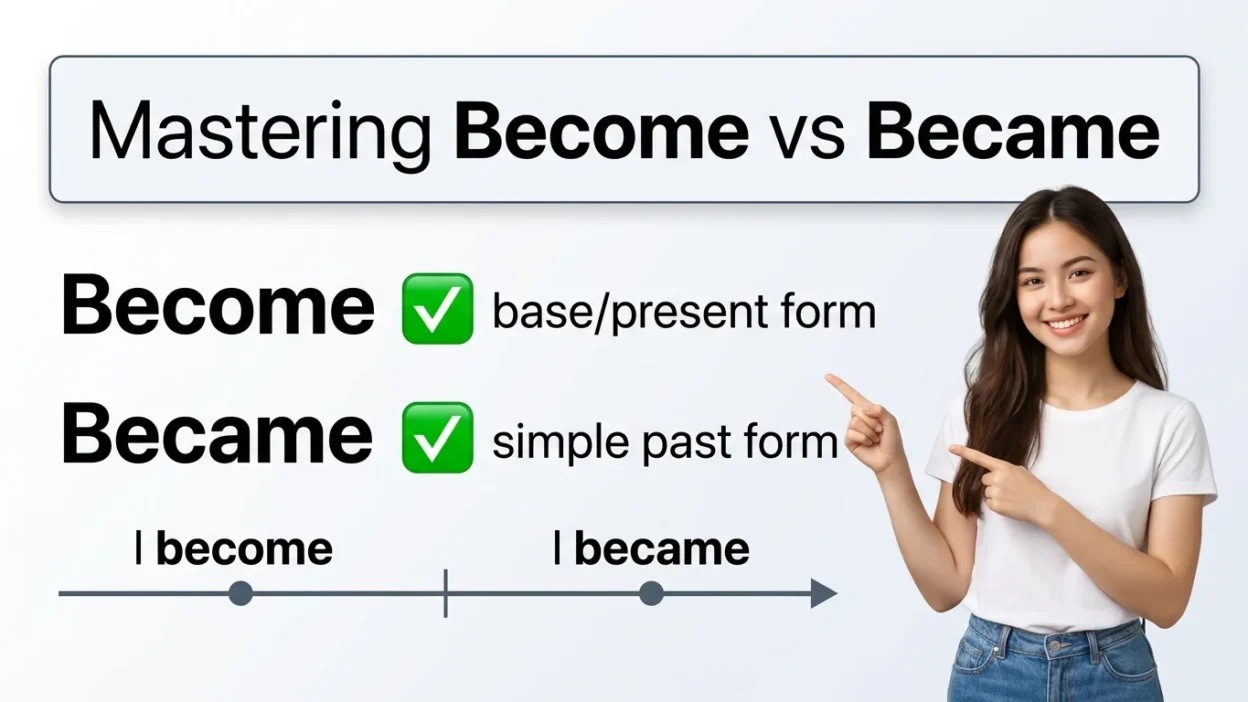
Understanding this small difference becomes especially important when talking about changes, experiences, or events that happen now, regularly, or in the past. Become is the base form of the verb and can be used with modal verbs, infinitives, and present-tense structures.
Became, on the other hand, is the simple past form and describes a change that happened at a specific time in the past. For example, “She wants to become a doctor” and “She became a doctor last year” follow different grammatical patterns.
Become vs Became: Quick Answer
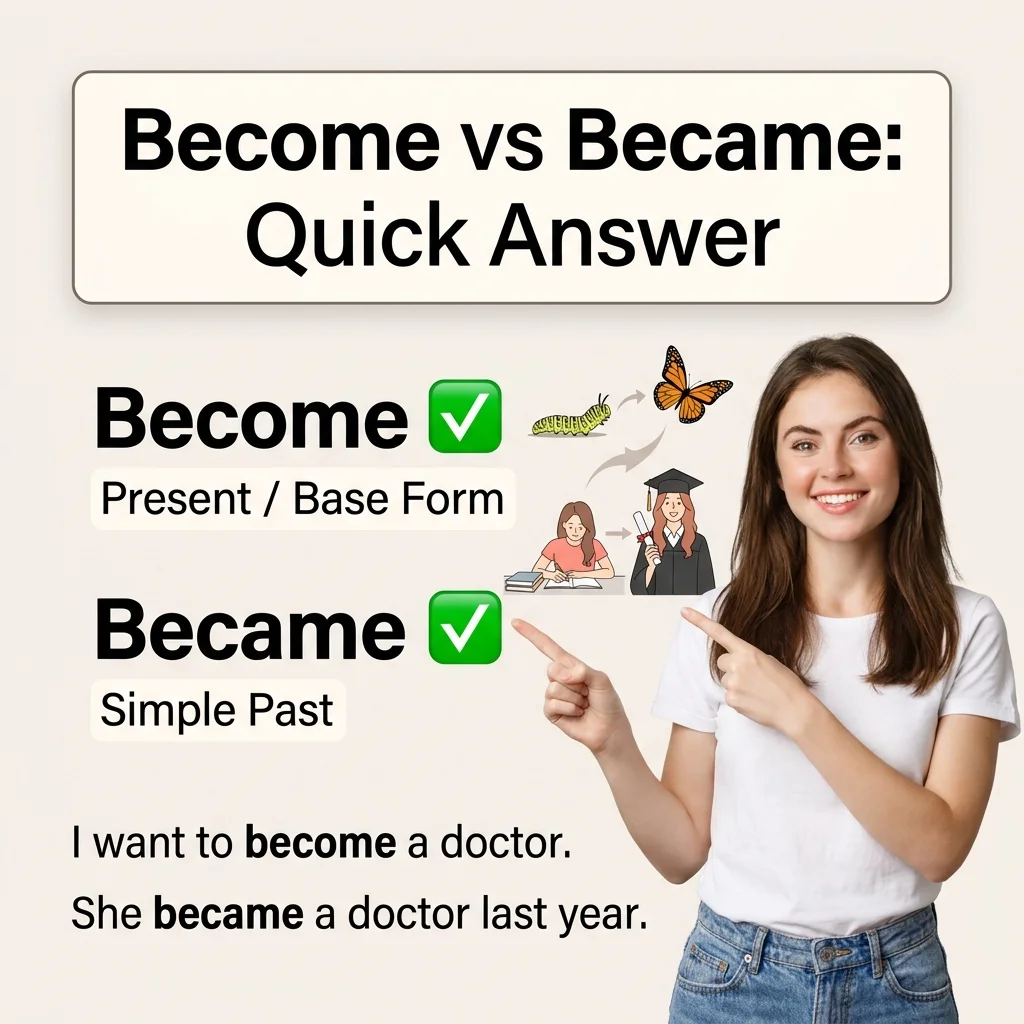
The easiest way to understand become vs became is to look at time.
- Become is the base form of the verb.
- Become is also used as a present-tense form with plural subjects and after helping verbs.
- Became is the simple past form.
- Become is the past participle, used with have, has, or had.
- Became describes a change that happened in the past.
- Become can describe a general situation, a future possibility, or an action used with an auxiliary verb.
Compare these examples:
I want to become a teacher.
She became a teacher in 2022.
He has become more confident.
The meaning is related in all three sentences, but the grammar is different.
What Does Become Mean?
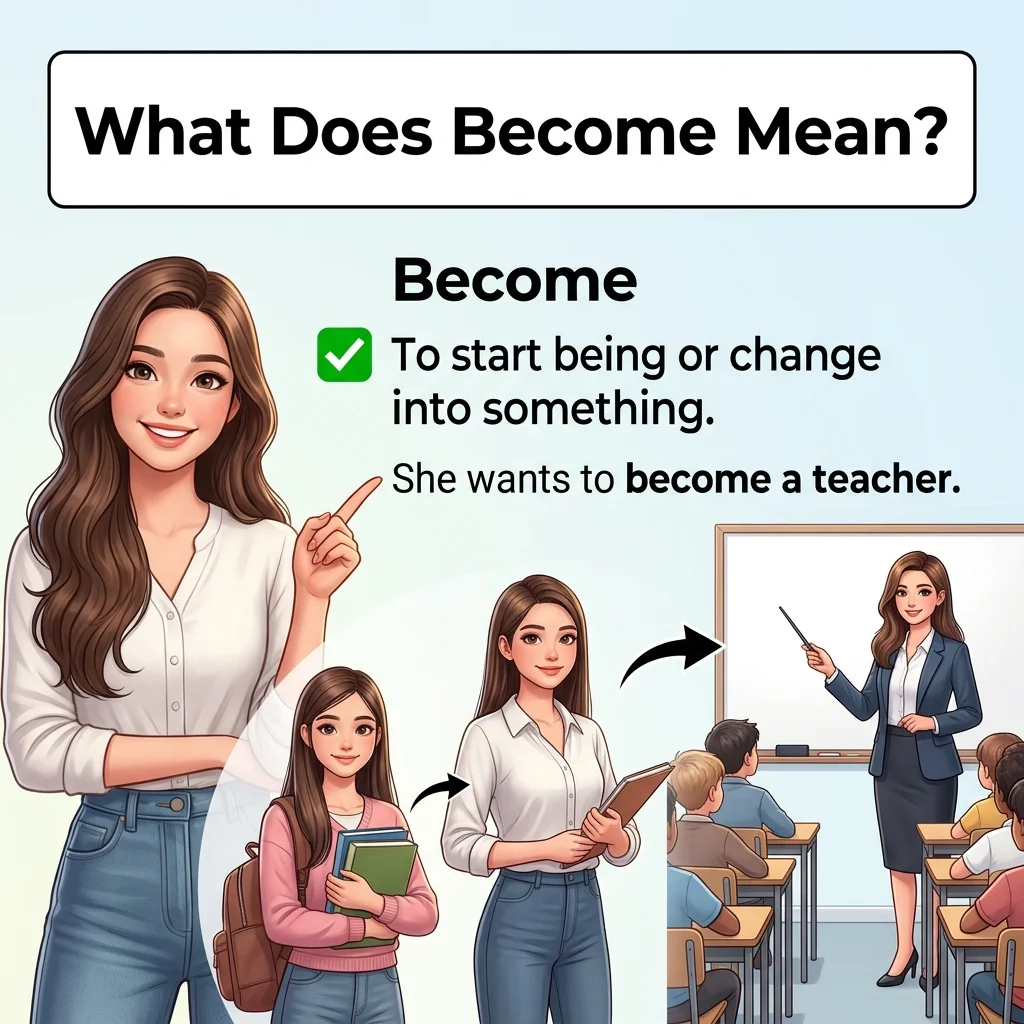
Become means to start being something or to change into a particular state, condition, profession, role, or identity.
It is an irregular verb, so its forms do not follow the regular “-ed” pattern.
The main forms are:
| Verb Form | Word |
| Base form | become |
| Present form | become / becomes |
| Past tense | became |
| Past participle | become |
| Present participle | becoming |
For example:
- I want to become a writer.
- They become nervous before exams.
- She becomes tired after work.
- He became famous.
- She has become successful.
- He is becoming stronger.
The word become often describes a process of change.
Become as a Base Verb
The base form become is commonly used after modal verbs and other auxiliary verbs.
Examples include:
- I want to become a doctor.
- You can become successful.
- They may become friends.
- We will become better with practice.
- She hopes to become an engineer.
Notice that the verb stays become after words such as can, may, will, should, might, must, and to.
For example:
He will become successful.
Not:
He will became successful.
Become in the Present Tense
With plural subjects such as I, you, we, and they, use become.
Examples:
- I become nervous before interviews.
- You become stronger with practice.
- We become better every day.
- They become more confident over time.
With he, she, or it, the present simple usually takes becomes.
Examples:
- She becomes nervous easily.
- He becomes angry when he is ignored.
- The weather becomes colder in winter.
This is important because become and becomes are both present-tense forms, while became is past tense.
What Does Became Mean?
Became is the simple past tense of become.
It describes a change or development that happened in the past.
Examples:
- She became a teacher.
- He became famous.
- I became interested in photography.
- They became close friends.
- The weather became colder.
- He became angry after hearing the news.
The word became does not change according to the subject.
You can use it with:
- I became
- You became
- He became
- She became
- We became
- They became
For example:
I became tired.
She became tired.
They became tired.
Unlike the present tense, you do not say becomes with a past-time subject.
Become vs Became: The Main Difference
The main difference is tense.
Become is generally used for the base or present form, while became is the simple past form.
| Feature | Become | Became |
| Basic meaning | Change into or start being | Changed into or started being |
| Verb type | Base/present form | Simple past |
| Time | Present, future, or after auxiliaries | Past |
| Example | I want to become a doctor. | I became a doctor. |
| Used after “will” | Yes | No |
| Used after “can” | Yes | No |
| Used with “have” | No | No |
| Past participle | No | No |
A useful way to remember this is:
Become = change that is happening, possible, expected, or expressed through an auxiliary verb.
Became = change that happened in the past.
Become vs Became vs Become: Understanding All Three Forms
One reason this topic becomes confusing is that become appears twice in the verb forms.
The three important forms are:
Become → Became → Become
For example:
I want to become a writer.
I have become a writer.
The first become is the base form.
Became is the simple past.
The final become is the past participle.
Become as the Base Form
Use become after to or modal verbs.
Examples:
- I want to become successful.
- She hopes to become a doctor.
- You can become better.
- He will become famous.
Became as the Past Form
Use became when the change happened in the past.
Examples:
- She became a doctor in 2020.
- He became famous after the movie.
- They became friends at school.
Become as the Past Participle
Use become with have, has, or had.
Examples:
- She has become successful.
- He has become more confident.
- They had become close friends.
- I have become interested in science.
This distinction is extremely useful when learning English verb forms.
When Should You Use Become?
There are several common situations where become is the correct choice.
After “To”
Use the base form become after to.
Examples:
- I want to become a pilot.
- She plans to become a lawyer.
- He hopes to become a professional athlete.
- They want to become better speakers.
Incorrect:
I want to became a pilot.
Correct:
I want to become a pilot.
After Modal Verbs
Modal verbs include:
- can
- could
- may
- might
- will
- would
- should
- must
After these verbs, use become, not became.
Examples:
- You can become successful.
- She may become a manager.
- He will become stronger.
- They might become friends.
- You should become familiar with the rules.
Incorrect:
He will became successful.
Correct:
He will become successful.
For Future Changes
When talking about something that will happen in the future, become is often used with a future expression.
Examples:
- She will become a doctor.
- He is going to become a father.
- They may become business partners.
- I hope to become fluent in English.
Here, the change has not happened yet.
For General or Repeated Changes
Become can also be used for general truths or repeated situations.
Examples:
- People become tired after long journeys.
- Some children become nervous before exams.
- Plants become weak without enough water.
- Students become more confident with practice.
These sentences describe general situations rather than one completed event in the past.
When Should You Use Became?
Use became when a change happened in the past.
With a Specific Past Time
If you mention a finished time in the past, became is usually appropriate.
Examples:
- She became a teacher in 2021.
- He became famous last year.
- I became interested in football when I was young.
- They became friends during college.
Words that often signal past time include:
- yesterday
- last year
- last month
- in 2019
- when I was young
- two years ago
- after the event
- during childhood
For Completed Changes
You can use became even when there is no exact time, as long as the sentence describes a completed past event.
Examples:
- He became angry.
- She became successful.
- The situation became difficult.
- They became close friends.
The context tells us that the change happened in the past.
Become vs Became Examples
Here are several examples that make the difference easier to see.
| Sentence | Why? |
| I want to become a doctor. | Future goal |
| She became a doctor in 2022. | Completed past change |
| He will become famous. | Future change |
| He became famous after the movie. | Past change |
| They can become successful. | Modal + base form |
| They became successful. | Past event |
| We want to become friends. | Desired future situation |
| We became friends at school. | Past event |
| She has become confident. | Present perfect |
| She became confident last year. | Simple past |
Become vs Became in Questions
Questions can also cause confusion.
When you use did, the main verb returns to its base form.
Therefore, say:
Did she become a teacher?
Not:
Did she became a teacher?
Why?
Because did already shows the past tense. The main verb should remain in its base form.
More examples:
- Did he become angry?
- Did they become friends?
- Did you become interested in English?
- When did she become famous?
This is one of the most important rules to remember.
Why “Did Became” Is Wrong
Did is already a past-tense auxiliary.
The structure is:
Did + subject + base verb
So:
Did + she + become?
Correct.
Not:
Did + she + became?
Incorrect.
The same rule applies to many other irregular verbs:
- Did he go?
- Did she see?
- Did they come?
- Did you become?
Not:
- Did he went?
- Did she saw?
- Did they came?
- Did you became?
Become vs Became in Negative Sentences
Negative sentences also follow clear patterns.
For the past simple, use:
did not + become
Examples:
- She did not become angry.
- He did not become a doctor.
- They did not become friends.
- I did not become nervous.
Do not say:
She did not became angry.
The correct sentence is:
She did not become angry.
Again, did carries the past tense.
Short Form
You can also use didn’t.
Examples:
- He didn’t become famous.
- She didn’t become angry.
- They didn’t become close.
- I didn’t become tired.
Become vs Became in Different Tenses
Understanding the tense system makes this topic much easier.
Present Simple
Use become with I, you, we, and they.
I become nervous before tests.
With he, she, and it, use becomes.
She becomes nervous before tests.
Past Simple
Use became for all subjects.
I became nervous.
She became nervous.
They became nervous.
Future Simple
Use will become.
She will become a doctor.
Present Perfect
Use have/has become.
He has become successful.
They have become close friends.
Past Perfect
Use had become.
She had become tired before the journey ended.
Present Continuous
Use am/is/are becoming.
He is becoming more confident.
Past Continuous
Use was/were becoming.
She was becoming more confident.
These forms show why became cannot simply replace become in every sentence.
Common Mistakes With Become and Became
Many English learners make similar mistakes when using these verbs.
Mistake 1: Using Became After “Will”
Incorrect:
She will became a doctor.
Correct:
She will become a doctor.
After will, use the base form.
Mistake 2: Using Became After “To”
Incorrect:
I want to became successful.
Correct:
I want to become successful.
After to, use the base form.
Mistake 3: Using Became After “Did”
Incorrect:
Did he became angry?
Correct:
Did he become angry?
The word did already expresses the past.
Mistake 4: Using Became After “Can”
Incorrect:
Anyone can became successful.
Correct:
Anyone can become successful.
Modal verbs require the base form.
Mistake 5: Using Become for a Finished Past Event
Incorrect:
She become a teacher last year.
Correct:
She became a teacher last year.
The phrase last year identifies a completed past event.
Mistake 6: Confusing Became With Become After “Has”
Incorrect:
He has became famous.
Correct:
He has become famous.
The past participle of become is also become.
The complete pattern is:
become → became → become
Spelling Tips for Become and Became
The spelling is irregular, so memorization helps.
A simple pattern is:
Become → Became → Become
Notice that the middle form changes.
The vowel changes from o to a in the past tense:
become → became
Then it returns to become for the past participle.
You can remember it as:
Today: become
Yesterday: became
Have/has/had: become
For example:
I want to become a writer.
I have become a writer.
Become vs Became in Professional English
Both words are common in professional communication.
For future goals:
I hope to become a team leader.
For past achievements:
She became a team leader in 2024.
For ongoing development:
He is becoming more experienced.
For completed development with present relevance:
He has become an important member of the team.
Choosing the correct form makes professional writing sound more natural and grammatically accurate.
Become vs Became in Everyday Conversation
You will hear both words frequently in normal conversations.
For example:
Talking about the future:
I want to become better at English.
Talking about the past:
I became interested in English at school.
Talking about gradual change:
My English is becoming better.
Talking about a recent development:
My English has become much stronger.
The context and tense determine which form you need.
Become vs Became in Relationships
The verb become is often used when talking about relationships and social connections.
Examples:
- We want to become friends.
- They became close friends.
- She became my best friend.
- We have become very close.
- They are becoming closer.
Compare:
We want to become friends.
This describes a desired future relationship.
We became friends at university.
This describes a past event.
We have become close friends.
This describes a change that has happened and is relevant now.
Become vs Became With Adjectives
Both verbs are commonly followed by adjectives.
Examples:
- become tired
- become angry
- become happy
- become nervous
- become successful
- become famous
- become stronger
- become weaker
Past examples:
- She became tired.
- He became angry.
- They became successful.
- The weather became colder.
Present or future examples:
- She will become stronger.
- He may become famous.
- They can become successful.
Become vs Became With Nouns
You can also use these verbs before nouns to describe a change in role, profession, or identity.
Examples:
- She became a teacher.
- He became an engineer.
- I want to become a writer.
- They became business partners.
- She will become a manager.
- He hopes to become an actor.
A useful structure is:
Subject + become/became + noun
For example:
She became a doctor.
Or:
Subject + want/will/can + become + noun
She wants to become a doctor.
How to Choose Between Become and Became
When you are unsure, ask yourself one simple question:
Did the change happen in the past?
If the answer is yes, use became.
She became a nurse last year.
If the change is a goal, possibility, future event, or follows an auxiliary such as will or can, use become.
She wants to become a nurse.
She can become a nurse.
If you are talking about something that has already happened and connects to the present, consider has/have become.
She has become a nurse.
This quick check can prevent many common errors.
Easy Memory Trick for Become vs Became
Use the yesterday test.
If you can naturally add a finished past-time expression such as yesterday, last year, or two years ago, became may be the correct form.
For example:
She became a doctor last year.
Now try the future:
She will become a doctor next year.
Never use:
She will became a doctor.
Another useful trick is to memorize the three forms together:
Become — Became — Become
Think of them as:
Base — Past — Past Participle
Once you remember this pattern, the difference becomes much easier.
Become vs Became: Quick Grammar Chart
| Situation | Correct Form | Example |
| Base form | become | I want to become a writer. |
| Present with I/you/we/they | become | They become nervous easily. |
| Present with he/she/it | becomes | She becomes tired quickly. |
| Simple past | became | She became a writer. |
| After will | become | She will become a writer. |
| After can | become | She can become a writer. |
| After to | become | She wants to become a writer. |
| After did | become | Did she become a writer? |
| Present perfect | become | She has become a writer. |
| Past perfect | become | She had become a writer. |
| Continuous | becoming | She is becoming a writer. |
Practice Examples
Try choosing become, became, or another correct form.
Example 1
I want to ___ a successful writer.
Answer: become
I want to become a successful writer.
Example 2
She ___ a teacher five years ago.
Answer: became
She became a teacher five years ago.
Example 3
He will ___ a better player with practice.
Answer: become
He will become a better player with practice.
Example 4
Did they ___ friends at school?
Answer: become
Did they become friends at school?
Example 5
He has ___ more confident.
Answer: become
He has become more confident.
Example 6
The weather ___ colder last night.
Answer: became
The weather became colder last night.
Frequently Asked Questions About Become vs Became
Is “became” the past tense of “become”?
Yes. Became is the simple past tense of become.
For example:
She became a doctor in 2020.
The three main forms are become, became, become.
Is it correct to say “I became”?
Yes. Became works with every subject in the simple past.
Examples:
I became tired.
You became tired.
He became tired.
They became tired.
Should I say “will become” or “will became”?
The correct phrase is will become.
After will, always use the base form of the verb.
Correct:
He will become successful.
Incorrect:
He will became successful.
Should I say “want to become” or “want to became”?
The correct phrase is want to become.
After to, use the base form.
Correct:
I want to become a doctor.
Incorrect:
I want to became a doctor.
Is “has became” correct?
No. The correct form is has become.
For example:
She has become more confident.
The past participle of become is become, not became.
Is “did become” grammatically correct?
Yes, did become can be grammatically correct when did is used for emphasis or in certain sentence structures.
For example:
He did become successful eventually.
However, in a normal past-tense question, use:
Did he become successful?
Not:
Did he became successful?
What is the difference between “became” and “has become”?
Became is simple past and usually focuses on a past event.
She became a teacher in 2020.
Has become is present perfect and connects a past change to the present.
She has become a successful teacher.
Is “become” present tense?
Become can be a present-tense form with I, you, we, and they, but it is also the base form used after auxiliaries and infinitives.
For example:
They become tired quickly.
She will become successful.
So, the exact function depends on the sentence.
What is the past participle of become?
The past participle is also become.
The three forms are:
become — became — become
For example:
He has become famous.
Can “become” describe a future event?
Yes.
Examples:
I want to become a doctor.
She will become a manager.
He hopes to become successful.
Can “became” be used with “did”?
Not as the main verb after did in a normal question or negative sentence.
Correct:
Did she become angry?
Correct:
She did not become angry.
Incorrect:
Did she became angry?
Incorrect:
She did not became angry.
Final Thoughts
The difference between become and became is mainly about verb form and time. Become is the base form and can also function as a present-tense form or appear after helping verbs. Became is the simple past form and describes a change that happened in the past.
Use become after words such as to, will, can, may, might, and should. Use became when describing a completed change in the past. When using have, has, or had, return to become because it is the past participle.

Daniel Carter is a passionate writer who creates clear, helpful, and easy-to-understand content. He focuses on language, grammar, word meanings, and everyday expressions, helping readers find simple answers to common questions.