Choosing between “strongly recommend” and “highly recommend” can seem like a small language question, but both phrases are common in everyday English and can carry slightly different emphasis.
If you’ve ever wondered whether you should say “I strongly recommend this book” or “I highly recommend this book,” you’re not alone. Both expressions are grammatically correct and generally communicate a very positive recommendation.
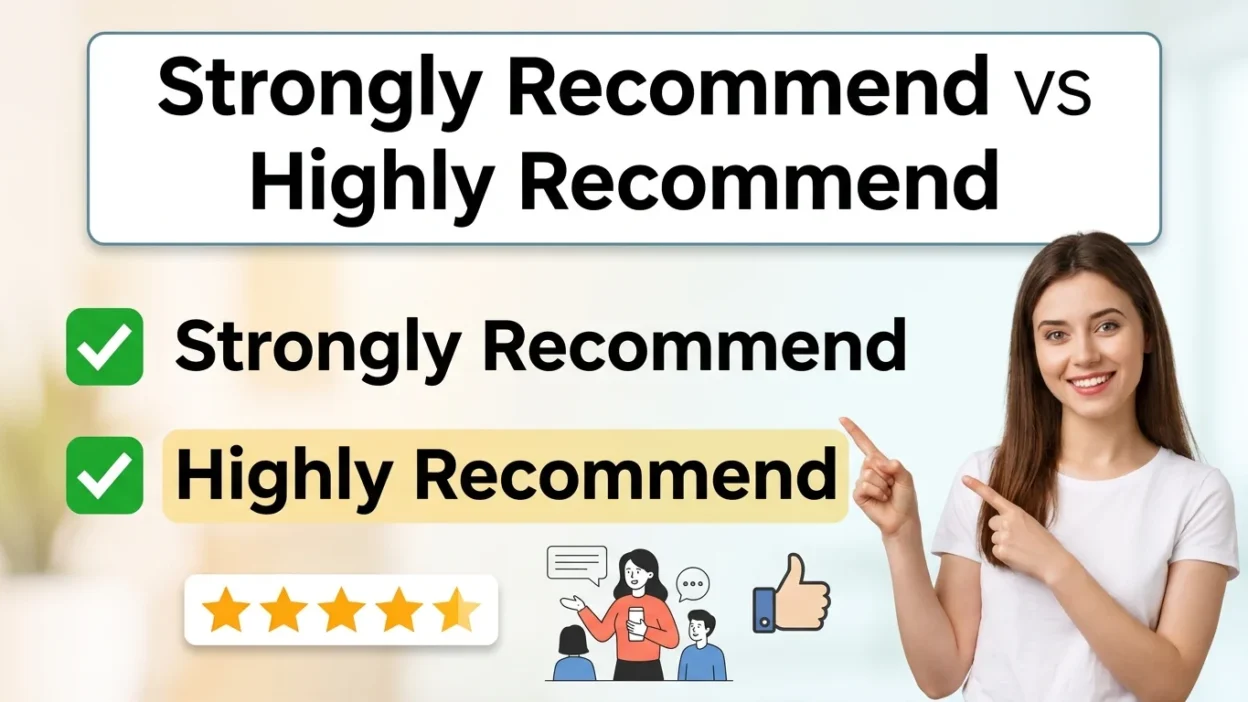
The difference mainly comes down to tone and emphasis. “Highly recommend” is often used to express a very favorable opinion or strong approval, while “strongly recommend” can place more emphasis on the speaker’s firm advice or confidence in the recommendation. In many situations, however, the two phrases can be used interchangeably without changing the overall meaning.
Quick Answer: Strongly Recommend vs Highly Recommend

Both strongly recommend and highly recommend are correct expressions used to give a very positive recommendation.
- Strongly recommend emphasizes the strength of your recommendation.
- Highly recommend emphasizes the high level of your approval or opinion.
- Both can mean “I recommend this very much.”
- Both are grammatically correct.
- Highly recommend is extremely common in reviews and recommendations.
- Strongly recommend is also common, especially when you want to emphasize that you genuinely believe someone should choose or do something.
For example:
I highly recommend this restaurant.
I strongly recommend this restaurant.
Both sentences tell the reader that the speaker thinks the restaurant is worth trying.
What Does “Strongly Recommend” Mean?
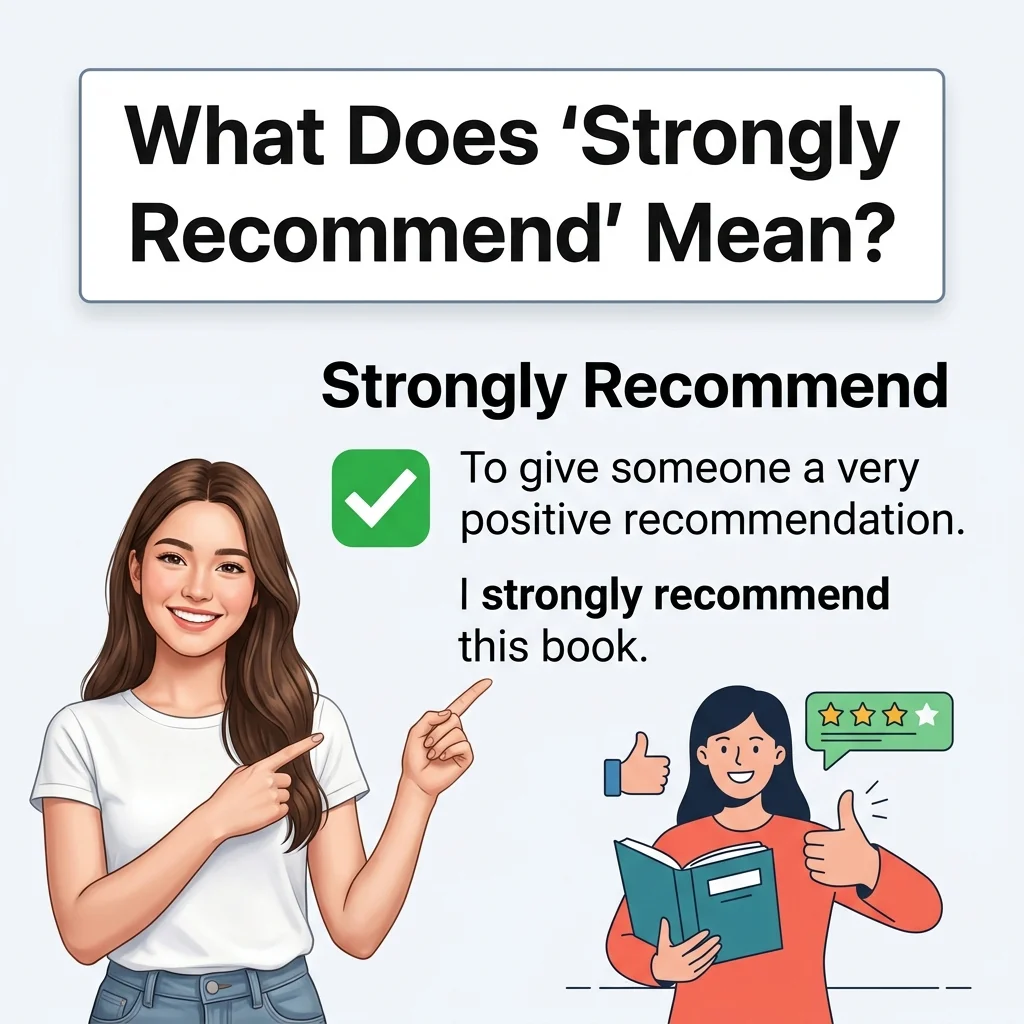
Strongly recommend means to recommend something with a lot of confidence or emphasis.
When you strongly recommend something, you are not simply saying that it is acceptable or good. You are expressing a clear and positive opinion and encouraging another person to consider it.
For example:
I strongly recommend this book.
This means:
I think this book is very good, and I believe you should read it.
The word strongly modifies the verb recommend. It tells us how strongly the speaker is making the recommendation.
Examples of “Strongly Recommend”
Here are some natural examples:
- I strongly recommend this movie.
- I strongly recommend visiting this museum.
- We strongly recommend booking your tickets early.
- She strongly recommends this hotel.
- My teacher strongly recommended this course.
- I strongly recommend that you read the instructions first.
- They strongly recommend using a password manager.
- I strongly recommend trying the chocolate cake.
- He strongly recommends taking the morning flight.
- I strongly recommend this product for beginners.
In each example, the speaker gives a recommendation with noticeable emphasis.
What Does “Highly Recommend” Mean?
Highly recommend means to recommend something very positively.
It is often used when someone thinks a product, service, experience, person, or place is excellent or particularly worthwhile.
For example:
I highly recommend this restaurant.
This means:
I think this restaurant is excellent, and I think you should try it.
Highly acts as an adverb that modifies recommend.
Examples of “Highly Recommend”
- I highly recommend this book.
- We highly recommend this hotel.
- She highly recommends this restaurant.
- I highly recommend watching this movie.
- He highly recommends this software.
- I highly recommend this course to beginners.
- They highly recommend visiting the city in spring.
- My friend highly recommended this café.
- I highly recommend trying the local food.
- Our team highly recommends this service.
These examples show how naturally highly recommend works in everyday English.
Are “Strongly Recommend” and “Highly Recommend” the Same?
In most situations, yes.
Both phrases communicate a strong positive recommendation. If someone says:
I strongly recommend this book.
and another person says:
I highly recommend this book.
The basic message is almost identical:
This person thinks the book is worth reading.
There is no major grammatical difference between the two expressions.
The small difference comes from what the adverb emphasizes.
Strongly focuses more on the strength or force of the recommendation.
Highly focuses more on the degree or level of approval.
However, native speakers often use these phrases without consciously making that distinction.
Strongly Recommend vs Highly Recommend: Main Difference
The easiest way to understand the difference is to look at the emphasis.
| Expression | Main idea | Common use |
| Strongly recommend | Give a recommendation with strong emphasis | Advice, instructions, decisions, personal recommendations |
| Highly recommend | Give a very positive recommendation | Reviews, products, services, books, movies, places |
| Strongly recommended | Something is recommended with strong emphasis | Advice, policies, professional writing |
| Highly recommended | Something receives a very positive recommendation | Reviews, ratings, products, services |
Both are correct.
For example:
I strongly recommend taking an umbrella.
This sounds like the speaker really wants you to consider taking one.
Compare:
I highly recommend this restaurant.
This sounds like a very positive review of the restaurant.
The difference is subtle, not absolute.
When Should You Use “Strongly Recommend”?
Use strongly recommend when you want to emphasize your recommendation or encourage someone to take a particular action.
It works especially well with advice.
Example 1: Giving Advice
I strongly recommend making a backup of your files.
The speaker is emphasizing the importance of the action.
Example 2: Making a Choice
I strongly recommend choosing the second option.
The speaker has a clear preference and wants to emphasize it.
Example 3: Safety or Instructions
We strongly recommend wearing protective equipment.
This sentence sounds firm because the recommendation is important.
Example 4: Personal Advice
I strongly recommend talking to your manager first.
The speaker is giving direct advice.
In these situations, strongly recommend can sound slightly more forceful than highly recommend.
When Should You Use “Highly Recommend”?
Use highly recommend when you want to express strong approval of something.
It is especially common in reviews, testimonials, and conversations about products, restaurants, hotels, movies, books, and services.
Example 1: Restaurant Review
I highly recommend this restaurant. The food was excellent.
Example 2: Product Review
I highly recommend this laptop for students.
Example 3: Movie Recommendation
I highly recommend this movie if you enjoy mystery stories.
Example 4: Hotel Review
We highly recommend this hotel for families.
Example 5: Course Recommendation
I highly recommend this course to anyone learning English.
In these examples, highly recommend sounds natural because the speaker is expressing a high level of approval.
“Strongly Recommend” in Professional English
Strongly recommend is common in professional and formal English.
For example:
I strongly recommend reviewing the contract before signing it.
Or:
We strongly recommend that all employees complete the training.
It can also appear in business reports, professional emails, academic writing, and official advice.
More Professional Examples
I strongly recommend reviewing the proposal before the meeting.
We strongly recommend that customers keep their receipts.
The committee strongly recommends further research.
I strongly recommend contacting the support team.
These sentences have a clear and serious tone.
“Highly Recommend” in Reviews and Everyday English
Highly recommend is particularly common in informal and semi-formal recommendations.
You will often see it in:
- Online reviews
- Social media posts
- Product reviews
- Travel recommendations
- Restaurant reviews
- Book recommendations
- Movie discussions
- Customer testimonials
- Personal conversations
For example:
Highly recommend this place!
This is a very common informal review sentence.
A complete version would be:
I highly recommend this place.
The shorter version is also natural in online communication.
Can You Say “I Strongly Highly Recommend”?
No. You normally should not combine strongly and highly in this way.
Incorrect:
I strongly highly recommend this product.
Correct:
I strongly recommend this product.
Or:
I highly recommend this product.
Choose one.
Both already express a strong recommendation, so using both together sounds unnatural and unnecessary.
Is “I Highly Recommend” Grammatically Correct?
Yes.
I highly recommend is grammatically correct.
The structure is:
Subject + adverb + verb + object
For example:
I + highly + recommend + this book.
The adverb highly modifies recommend.
Other examples include:
I highly recommend this restaurant.
She highly recommends the course.
They highly recommend this service.
Is “I Strongly Recommend” Grammatically Correct?
Yes.
I strongly recommend is also grammatically correct.
The structure is:
Subject + adverb + verb + object
For example:
I + strongly + recommend + this book.
More examples:
I strongly recommend this hotel.
She strongly recommends this method.
We strongly recommend arriving early.
Strongly Recommend vs Highly Recommend With “That”
Both phrases can be followed by a that-clause.
Strongly Recommend That
I strongly recommend that you check the details.
We strongly recommend that you arrive early.
She strongly recommended that he speak to his teacher.
This structure is useful when recommending an action.
Highly Recommend That
You can also say:
I highly recommend that you check the details.
We highly recommend that customers read the terms.
She highly recommended that I visit the museum.
This is grammatically correct, although strongly recommend that may sometimes sound more natural when the recommendation is serious or directive.
Strongly Recommend + Verb-ing
Both expressions can be followed by a gerund, or -ing form.
Strongly Recommend + -ing
I strongly recommend booking early.
We strongly recommend checking the information.
She strongly recommends visiting the museum.
Highly Recommend + -ing
I highly recommend booking early.
I highly recommend trying the local food.
He highly recommends watching the movie.
This structure is extremely useful in everyday English.
Strongly Recommend vs Highly Recommend: Examples
Let’s compare them directly.
Example 1
I strongly recommend this book.
I highly recommend this book.
Both mean that the speaker thinks the book is very good.
Example 2
I strongly recommend arriving early.
I highly recommend arriving early.
Both suggest that arriving early is a good idea.
However, strongly recommend may sound a little more forceful in this context.
Example 3
I strongly recommend this doctor.
I highly recommend this doctor.
Both communicate a positive recommendation.
Example 4
I strongly recommend taking the train.
I highly recommend taking the train.
Both are correct.
The first can sound slightly more like direct advice, while the second can sound like a positive personal recommendation.
Which Is More Common: “Highly Recommend” or “Strongly Recommend”?
Both are common, but highly recommend is especially common in customer reviews and casual recommendations.
For example, you might see:
I highly recommend this product!
or:
I highly recommend this restaurant.
In more formal advice or situations where the speaker wants to emphasize the importance of an action, strongly recommend is also very natural:
We strongly recommend that you save your work regularly.
The best choice depends on the context rather than a strict grammar rule.
Strongly Recommended vs Highly Recommended
There is another important distinction: recommended is the past participle form.
You can use:
- strongly recommended
- highly recommended
Both are correct.
Strongly Recommended
This book is strongly recommended for beginners.
This emphasizes that people are being encouraged to read the book.
Highly Recommended
This book is highly recommended for beginners.
This emphasizes that the book receives very positive recommendations.
Both sentences are grammatically correct.
“Highly Recommended” in Reviews
Highly recommended is especially common in reviews.
For example:
⭐⭐⭐⭐⭐ Highly recommended!
This means the reviewer had a very positive experience.
You may see this expression on:
- Restaurant reviews
- Hotel reviews
- Product pages
- Service reviews
- Travel websites
- Book reviews
- Course reviews
For example:
The hotel was clean, comfortable, and affordable. Highly recommended!
This sounds completely natural.
“Strongly Recommended” in Formal Writing
Strongly recommended can sound more formal or authoritative.
For example:
Regular maintenance is strongly recommended.
Early registration is strongly recommended.
Further testing is strongly recommended.
These sentences often appear in professional instructions, reports, manuals, and formal communications.
Common Mistakes With Strongly and Highly Recommend
English learners sometimes make mistakes when using these phrases. Let’s look at the most common ones.
Mistake 1: Using “Strong Recommend”
Incorrect:
I strong recommend this book.
Correct:
I strongly recommend this book.
Strong is an adjective.
Strongly is the adverb needed to modify recommend.
Mistake 2: Using “Highly Recommends” With the Wrong Subject
Incorrect:
I highly recommends this product.
Correct:
I highly recommend this product.
With I, use recommend, not recommends.
However:
She highly recommends this product.
Here, recommends is correct because the subject is she.
Mistake 3: Saying “I Recommend Highly This Book”
This word order is unnatural in modern everyday English.
Less natural:
I recommend highly this book.
Natural:
I highly recommend this book.
The adverb normally comes before recommend in this structure.
Mistake 4: Using “Highly Strongly Recommend”
Incorrect:
I highly strongly recommend this restaurant.
Better:
I highly recommend this restaurant.
Or:
I strongly recommend this restaurant.
You generally need only one intensifying adverb.
Mistake 5: Writing “I Highly Recommand”
The correct spelling is:
recommend
Not:
recommand
There is no a after the m.
Correct:
I highly recommend this product.
Spelling Tip: Recommend or Recommand?
One common spelling mistake is writing recommand instead of recommend.
The correct spelling is:
recommend
Remember:
re + commend = recommend
Examples:
- recommend
- recommends
- recommended
- recommending
Correct Forms
I recommend this book.
She recommends this restaurant.
He recommended this movie.
We are recommending this service.
Avoid:
recommmand
recommand
recomend
Strongly vs Strong
Remember that strong and strongly have different grammatical jobs.
Strong is an adjective:
She has a strong opinion.
Strongly is an adverb:
She strongly recommends this book.
You cannot normally replace strongly with strong in this sentence.
Incorrect:
She strong recommends this book.
Correct:
She strongly recommends this book.
Highly vs High
The same idea applies to high and highly.
High is generally an adjective:
The building is very high.
Highly is an adverb:
I highly recommend this book.
Incorrect:
I high recommend this book.
Correct:
I highly recommend this book.
Can “Highly Recommend” Be Used for People?
Yes.
You can use highly recommend when recommending a person for a job, service, or professional role.
For example:
I highly recommend Sarah for this position.
This means that the speaker has a very positive opinion of Sarah’s suitability.
You can also say:
I strongly recommend Sarah for this position.
This is also correct and can sound more emphatic.
Can “Strongly Recommend” Be Used for People?
Yes.
For example:
I strongly recommend John for the position.
I strongly recommend this teacher.
She strongly recommends her personal trainer.
The exact meaning depends on the context.
Can You Use These Phrases in Emails?
Absolutely.
Friendly Email
I highly recommend this course. I think you will find it very useful.
Professional Email
I strongly recommend reviewing the document before submitting it.
Business Email
We strongly recommend contacting our support team if you experience any problems.
Both expressions work well in email writing.
Strongly Recommend vs Highly Recommend in Formal English
Both can appear in formal English, but they can create slightly different impressions.
Strongly recommend often sounds more direct:
I strongly recommend that you reconsider the proposal.
Highly recommend often sounds more positive:
I highly recommend this training program.
This is not a strict grammar rule. Context matters.
Strongly Recommend vs Highly Recommend in American English
Both expressions are common in American English.
You may hear:
I highly recommend it.
and:
I strongly recommend it.
Neither is incorrect.
American English speakers often use highly recommend in casual recommendations, online reviews, and conversations.
Strongly recommend is also common when giving advice or expressing a firm recommendation.
Strongly Recommend vs Highly Recommend in British English
Both are also correct in British English.
For example:
I highly recommend this restaurant.
I strongly recommend booking in advance.
The basic grammar does not change between British and American English.
Which One Should English Learners Use?
If you are unsure, you can safely use either phrase in most situations.
Use highly recommend when:
- Reviewing something
- Praising a product
- Recommending a restaurant
- Recommending a movie
- Recommending a book
- Giving a positive testimonial
Use strongly recommend when:
- Giving serious advice
- Encouraging a particular action
- Making a firm suggestion
- Writing instructions
- Writing professional recommendations
Again, this is a practical guideline, not an absolute rule.
Strongly Recommend vs Highly Recommend in Everyday Conversations
Imagine your friend asks:
Should I watch this movie?
You can say:
I highly recommend it.
Or:
I strongly recommend it.
Both are perfectly natural.
Now imagine your friend asks:
Should I back up my computer before updating it?
You might say:
I strongly recommend backing it up first.
The word strongly gives the advice a slightly firmer feeling.
More Natural Alternatives to “Strongly Recommend”
I really recommend trying this restaurant.
I Would Definitely Recommend
This last expression is idiomatic and means the speaker has an extremely positive opinion.
More Natural Alternatives to “Highly Recommend”
You can also say:
I definitely recommend it.
I would highly recommend it.
It is well worth trying.
These alternatives can make your writing less repetitive.
“I Would Highly Recommend” vs “I Highly Recommend”
Both are correct.
Compare:
I highly recommend this product.
I would highly recommend this product.
The second can sound slightly softer and more polite.
For example, in a customer review:
I would highly recommend this hotel to anyone visiting London.
This sounds friendly and natural.
“I Would Strongly Recommend” vs “I Strongly Recommend”
Both are also correct.
I strongly recommend this course.
This sounds direct.
I would strongly recommend this course.
This can sound slightly more polite or personal.
Both are useful in professional and everyday English.
Examples in Different Situations
Restaurants
I highly recommend the pasta.
I strongly recommend making a reservation.
Hotels
I highly recommend this hotel for families.
I strongly recommend booking your room early.
Books
I highly recommend this book to anyone interested in history.
I strongly recommend reading the final chapter carefully.
Movies
I highly recommend this movie.
I strongly recommend watching it with subtitles if English is difficult for you.
Products
I highly recommend this phone for students.
I strongly recommend checking the warranty before buying.
Courses
I highly recommend this English course.
I strongly recommend completing all the practice exercises.
Travel
I highly recommend visiting this city.
I strongly recommend checking the weather before traveling.
A Simple Rule to Remember
If you want a quick rule, remember this:
Highly recommend = very positive approval
Strongly recommend = strong or firm advice
For example:
I highly recommend this restaurant.
Think: It is excellent.
I strongly recommend booking early.
Think: You should really do this.
This simple distinction can help you choose the right phrase, even though both expressions can overlap.
Strongly Recommend vs Highly Recommend: Final Comparison
| Feature | Strongly Recommend | Highly Recommend |
| Grammatically correct | Yes | Yes |
| Gives a positive recommendation | Yes | Yes |
| Emphasizes strength | More noticeable | Less direct |
| Emphasizes high approval | Yes | More noticeable |
| Common in reviews | Yes | Very common |
| Common in advice | Very common | Yes |
| Common in professional writing | Yes | Yes |
| Works with “that” | Yes | Yes |
| Works with -ing | Yes | Yes |
| Can describe a person | Yes | Yes |
| Can describe a product | Yes | Yes |
| Can describe a service | Yes | Yes |
| Can describe an experience | Yes | Yes |
Frequently Asked Questions
Is “strongly recommend” correct?
Yes. Strongly recommend is completely correct English. It means to recommend something with strong emphasis or confidence.
Is “highly recommend” correct?
Yes. Highly recommend is also completely correct. It means to give something a very positive recommendation.
Which is better, strongly recommend or highly recommend?
Neither is universally “better.” Both are correct. Highly recommend is especially natural for reviews and praise, while strongly recommend can sound more forceful when giving advice.
Is “highly recommend” stronger than “recommend”?
Usually, yes. Highly recommend adds emphasis and indicates a very positive recommendation.
Compare:
I recommend this book.
with:
I highly recommend this book.
The second sentence expresses a stronger level of approval.
Is “strongly recommend” stronger than “recommend”?
Yes. The adverb strongly adds emphasis.
I recommend this restaurant.
is a normal recommendation.
I strongly recommend this restaurant.
is a more emphatic recommendation.
Can I use “highly recommend” in a formal email?
Yes. It is grammatically correct and can work well in formal or professional writing.
For example:
I highly recommend reviewing the proposal before the meeting.
Can I say “I strongly highly recommend”?
No. Avoid combining strongly and highly before recommend. Choose one.
Correct:
I strongly recommend it.
Or:
I highly recommend it.
Is “strongly recommended” correct?
Yes. For example:
Early registration is strongly recommended.
This is grammatically correct and often appears in formal instructions.
Is “highly recommended” correct?
Yes. For example:
This restaurant is highly recommended.
This is especially common in reviews and testimonials.
Which phrase is better for a review?
Highly recommend is very natural for reviews.
For example:
I highly recommend this restaurant. The food and service were excellent.
However, strongly recommend is also correct.
Which phrase is better for advice?
Strongly recommend can sound particularly natural when giving firm advice.
For example:
I strongly recommend checking the instructions before starting.
But highly recommend is also grammatically correct.
Can I say “I highly recommend to visit”?
This construction is generally unnatural.
Instead, say:
I highly recommend visiting the museum.
Or:
I highly recommend that you visit the museum.
Can I say “I strongly recommend to go”?
It is better to use the -ing form or a that-clause.
Instead of:
I strongly recommend to go there.
Use:
I strongly recommend going there.
Or:
I strongly recommend that you go there.
What is the difference between “recommend” and “highly recommend”?
Recommend gives a normal recommendation, while highly recommend gives a stronger and more positive recommendation.
What is the difference between “strongly recommend” and “highly recommended”?
Strongly recommend is an active verb phrase:
I strongly recommend this book.
Highly recommended is a passive-style adjective/participle phrase:
This book is highly recommended.
Both express a positive recommendation, but their sentence structures differ.
Conclusion
The difference between strongly recommend and highly recommend is small, and both expressions are correct English.
Strongly recommend usually places more emphasis on the strength of the advice or recommendation. It works particularly well when you want someone to take an action or consider a specific choice.

Emily Parker is a dedicated writer who enjoys creating clear, useful, and easy-to-understand content. She focuses on language, grammar, word meanings, and everyday expressions to help readers find simple and reliable answers.