Have you ever wondered whether to say “copy that” or “roger that” when responding to a message or instruction? Both expressions are commonly used to acknowledge information, especially in radio communication, military settings, and everyday conversations.
Although they can sometimes mean the same thing, there are subtle differences in how people use them. Understanding these differences can help you choose the right phrase for the situation. “Copy that” generally means “I heard you” or “I received your message.”
It focuses on confirming that information has been received and understood. For example, if your manager says, “Please send me the report before noon,” you might reply, “Copy that,” to acknowledge the instruction.
What Does “Copy That” or “Roger That” Mean?
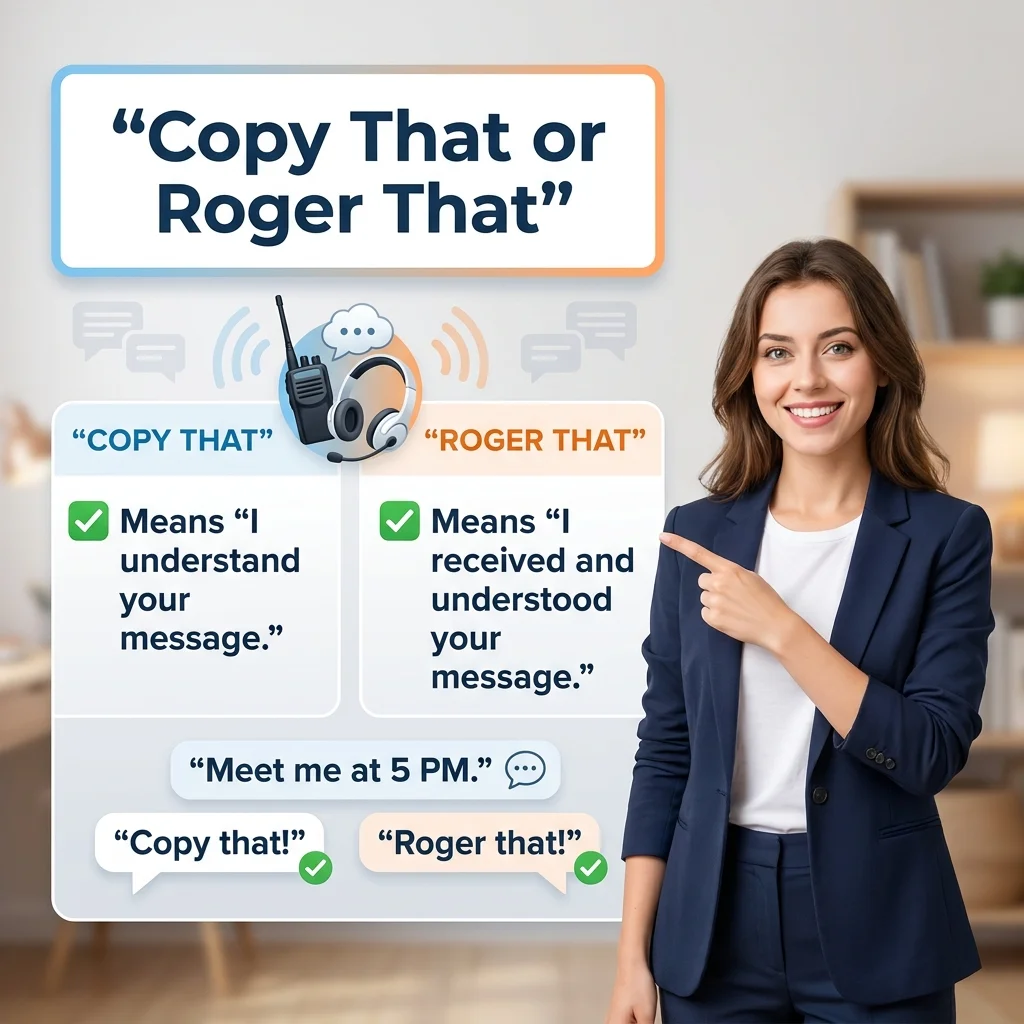
“Copy that” and “Roger that” are expressions used to acknowledge that a message has been received or understood. They are especially associated with radio communication, but they are also used casually in modern English.
Although they often communicate a similar idea, they are not always interchangeable.
- Copy that usually means, “I received your message.”
- Roger that usually means, “I received and understood your message.”
In casual conversation, both can sometimes mean “Got it” or “Understood.” However, the exact meaning depends on the context.
For example:
Person A: Please send me the report before 5 p.m. Person B: Copy that.
Here, “Copy that” confirms that the message was received.
Now consider:
Person A: Stay on the current route until further instructions. Person B: Roger that.
This sounds more like a formal acknowledgment of an instruction.
Both expressions are grammatically acceptable, but they are set phrases, not ordinary sentences that follow the usual subject-verb structure.
What Does “Copy That” Mean?
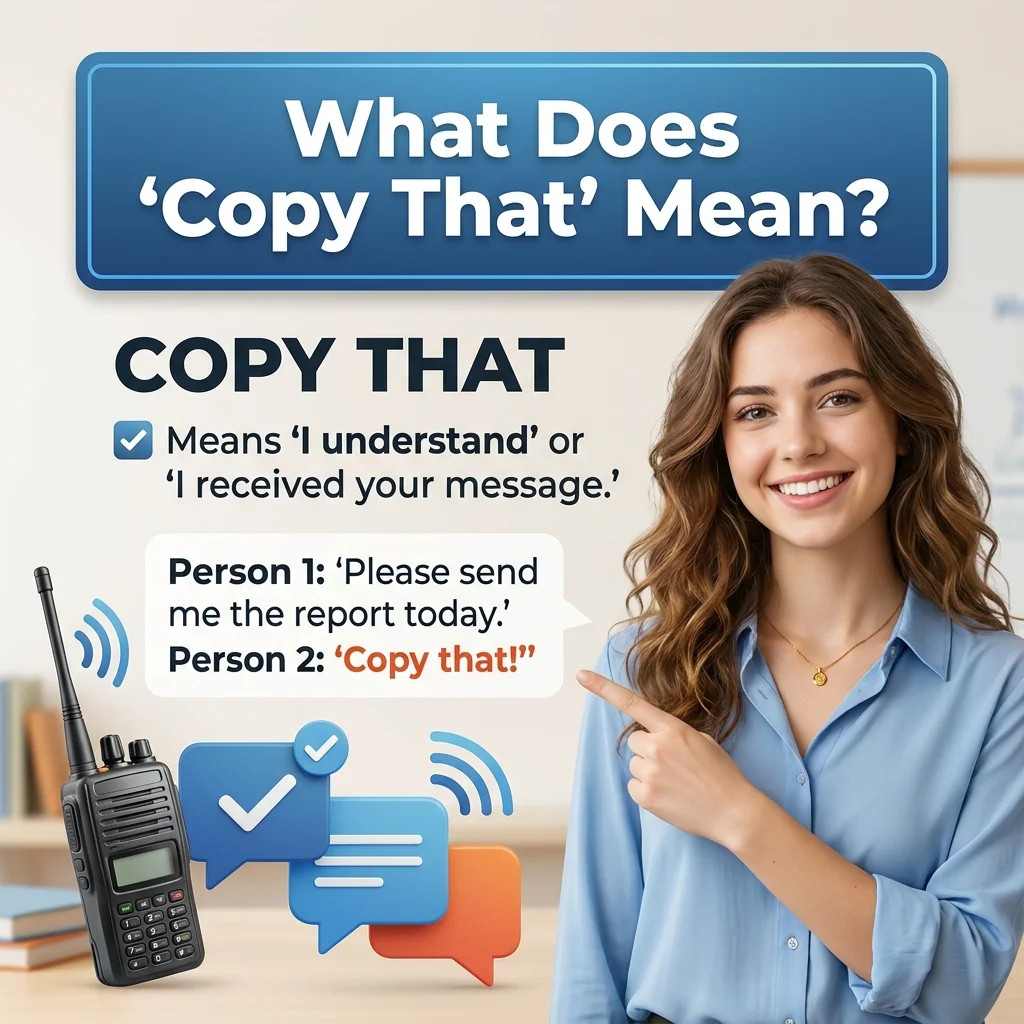
“Copy that” is an informal or professional expression meaning “I received your message” or “I understand what you said.”
It is commonly used in:
- Radio communication
- Military-style conversations
- Aviation and emergency services
- Workplace instructions
- Online gaming
- Text messages
- Casual conversations
The word “copy” refers to receiving or recording a message. It does not necessarily mean making a duplicate of a document.
The Meaning of “Copy”
The word “copy” has several meanings in English.
It can mean:
- To make a duplicate of something
- “Please copy this document.”
- To imitate someone
- “The child copied his teacher.”
- To receive a message, especially in radio communication
- “Do you copy?”
In the expression “Copy that,” the third meaning applies.
What Does “That” Refer To?
In “Copy that,” the word “that” refers to the message, instruction, or information just communicated.
For example:
“The meeting starts at 10 a.m.” “Copy that.”
The listener means:
“I received that information.”
The phrase is short, but its meaning is clear from the context.
Is “Copy That” Grammatically Correct?
Yes, “Copy that” is grammatically correct as an established expression.
It is not usually analyzed as a complete formal sentence. Instead, it functions as a fixed conversational phrase.
In everyday English, people often use short expressions such as:
- “Got it.”
- “Understood.”
- “Sounds good.”
- “Copy that.”
- “Roger that.”
These expressions are accepted because their meanings are understood naturally in conversation.
Examples of “Copy That”
Example 1: Workplace
Manager: Please email the updated schedule to everyone. Employee: Copy that.
Meaning: I received and understood your instruction.
Example 2: Texting
Friend: Bring your laptop tomorrow. You: Copy that.
Meaning: Got it.
Example 3: Gaming
Team leader: Move to the next checkpoint. Player: Copy that.
Meaning: I received the instruction.
Example 4: Radio-style communication
Dispatcher: Unit 4, proceed to the north entrance. Officer: Copy that.
Meaning: I received the message.
Example 5: Casual conversation
Friend: Don’t forget to lock the door. You: Copy that.
Meaning: Understood; I will remember.
What Does “Roger That” Mean?
“Roger that” is an expression used to acknowledge that a message has been received and understood. It is traditionally associated with radio communication, aviation, military communication, and other situations where clear acknowledgment is important.
In modern English, it can also be used humorously or casually.
For example:
Person A: Please wait here until I return. Person B: Roger that.
This means:
“Understood.”
The Meaning of “Roger”
Many people think “Roger” is simply a person’s name in this expression. However, “Roger” originally represented the letter R in an older spelling alphabet.
The letter R was used to indicate “received.” Over time, “Roger” became a standard way to acknowledge a message in radio communication.
Today, “Roger” is often understood as:
“Message received.”
The phrase “Roger that” adds “that” to refer to the message or instruction being acknowledged.
Is “Roger That” Grammatically Correct?
Yes, “Roger that” is a grammatically accepted fixed expression.
Like “Copy that,” it is not normally used as a complete formal sentence. It is a short acknowledgment.
For example:
“Please report to the office at noon.” “Roger that.”
The response is natural in a context where brief communication is appropriate.
Examples of “Roger That”
Example 1: Aviation-style communication
Pilot: We are ready for departure. Controller: Roger that.
Meaning: The message has been received.
Example 2: Workplace instruction
Supervisor: Please check the equipment before starting. Worker: Roger that.
Meaning: Understood.
Example 3: Online gaming
Leader: Stay behind the team until the area is clear. Player: Roger that.
Meaning: I understand the instruction.
Example 4: Friendly conversation
Friend: Meet me outside the café at 6. You: Roger that.
Meaning: Got it.
Example 5: Humorous use
Parent: Clean your room before playing games. Child: Roger that, Captain.
Here, the speaker uses “Roger that” playfully to imitate formal communication.
“Copy That” vs. “Roger That”: What Is the Difference?
The main difference is historical meaning and tone, not basic grammar.
“Copy that” focuses on receiving a message, while “Roger that” traditionally indicates that a message has been received and understood.
However, in modern casual English, the difference is often small.
Quick Comparison Table
| Feature | Copy That | Roger That |
| Basic meaning | I received your message | I received and understood your message |
| Main origin | Radio communication | Older radio spelling alphabet |
| Common tone | Informal, practical | Formal, radio-style, sometimes playful |
| Typical use | Instructions, texting, teamwork | Radio communication, instructions, role-play |
| Meaning of “copy” | Receive a message | Not applicable |
| Meaning of “Roger” | Not applicable | Represents “R” for “received” |
| Can it mean “Got it”? | Yes | Yes |
| Can it mean “I will do it”? | Sometimes, depending on context | Sometimes, depending on context |
| Best for formal writing? | Usually not | Usually not |
Which One Sounds More Natural?
Both can sound natural, but the choice depends on the situation.
“Copy that” often sounds:
- Direct
- Practical
- Modern
- Informal
- Work-oriented
“Roger that” often sounds:
- Radio-inspired
- Formal
- Military-style
- Playful
- Slightly old-fashioned in casual conversation
For example:
“Please send the file.” “Copy that.”
This sounds practical and natural.
“Please send the file.” “Roger that.”
This is also understandable, but it may sound more like radio communication or playful role-play.
Are “Copy That” and “Roger That” Interchangeable?
In many situations, yes. Both can acknowledge a message.
For example:
Person A: The meeting has moved to Room 4. Person B: Copy that.
Or:
Person B: Roger that.
Both responses communicate that the message was received.
However, they are not always identical in tone or implication.
When They Mean Almost the Same Thing
They are often interchangeable when:
- A person gives a simple instruction.
- A team member acknowledges information.
- Someone is using radio-style language.
- Friends are joking around.
- A gamer confirms a command.
Example:
“Wait near the entrance.” “Copy that.”
“Wait near the entrance.” “Roger that.”
Both are understandable.
When the Difference Matters
The difference matters when you need to be precise about receiving information versus agreeing to take action.
For example:
Manager: Please submit the report by Friday. Employee: Copy that.
This confirms receipt, but it does not necessarily promise completion.
If the employee says:
“Will do.”
That more clearly means:
“I will complete the task.”
Similarly:
Supervisor: Do not enter the room. Worker: Roger that.
This confirms understanding, but it does not necessarily mean the speaker agrees with the instruction.
“Copy That” vs. “Got It” vs. “Understood”
These expressions are related, but their tones are different.
| Expression | Meaning | Tone |
| Copy that | I received your message | Informal, radio-style |
| Roger that | I received and understood your message | Formal or radio-style |
| Got it | I understand | Very common and casual |
| Understood | I understand | Clear and professional |
| Okay | I acknowledge your message | Neutral |
| Will do | I will complete the task | Action-oriented |
| Noted | I have recorded or acknowledged the information | Professional |
| Affirmative | Yes | Formal, radio-style |
Examples of the Difference
Message: “Please call me after lunch.”
- Copy that. → I received your message.
- Roger that. → I received and understood your message.
- Got it. → I understand.
- Will do. → I will call you.
- Noted. → I have acknowledged the information.
The best response depends on what you want to communicate.
When Should You Use “Copy That”?
“Copy that” is useful when you want to acknowledge information quickly and clearly.
Use It for Instructions
“Please turn off the lights before leaving.” “Copy that.”
Use It in Team Communication
“Everyone should meet at the main gate.” “Copy that.”
Use It in Casual Texting
“Bring some snacks.” “Copy that 😂”
Use It in Gaming
“Defend the left side.” “Copy that.”
Use It in Radio-Style Conversations
“Unit 2, report your location.” “Copy that.”
When “Copy That” May Sound Unusual
Although it is understandable, “copy that” may sound slightly unnatural in some ordinary conversations.
For example:
Friend: I love chocolate. You: Copy that.
This is grammatically possible, but “Good to know” or “Got it” would sound more natural.
It is best used when acknowledging information, instructions, or messages, rather than responding to every statement.
When Should You Use “Roger That”?
“Roger that” is useful when you want to acknowledge a message with a radio-style or slightly formal tone.
Use It for Clear Instructions
“Stay where you are until I call you.” “Roger that.”
Use It in Role-Playing
“Agent, your mission begins at midnight.” “Roger that.”
Use It in Gaming
“Follow me through the tunnel.” “Roger that.”
Use It in Aviation or Radio Contexts
“Maintain your current heading.” “Roger that.”
Use It Playfully
“Finish your homework before watching TV.” “Roger that, Commander.”
This can make the conversation sound humorous.
When “Roger That” May Sound Too Formal
In a simple conversation, “Roger that” may sound overly dramatic.
For example:
Friend: Want some tea? You: Roger that.
This is understandable, but “Yes, please” or “Sure” would be more natural.
The phrase is often best when the conversation has an instruction-based, professional, or playful tone.
How to Use “Copy That” and “Roger That” in Sentences
Both expressions are usually used as standalone responses.
As a Short Reply
“Copy that.”
“Roger that.”
With a Name or Title
“Copy that, Sarah.”
“Roger that, Captain.”
With Additional Information
“Copy that. I’ll be there in ten minutes.”
“Roger that. We’ll wait for your signal.”
With a Clarification
“Copy that. Do you want the updated version?”
“Roger that. Should we stay here?”
In a Longer Conversation
Team leader: The delivery will arrive at 3 p.m. Team member: Copy that. I’ll prepare the receiving area.
The phrase acknowledges the information, while the second sentence explains the action.
Common Mistakes with “Copy That” and “Roger That”
These expressions are easy to understand, but learners sometimes use them incorrectly.
Mistake 1: Writing “Copy It” Instead of “Copy That”
❌ “Copy it.” ✅ “Copy that.”
“Copy it” can be grammatically correct in another context, but it does not carry the same established meaning.
For example:
“Please copy it onto another page.”
Here, “copy it” means make a duplicate.
But when acknowledging a message, use:
“Copy that.”
Mistake 2: Writing “Roger This”
❌ “Roger this.” ✅ “Roger that.”
The standard expression is “Roger that.”
“Roger this” is not the usual fixed phrase.
Mistake 3: Using “Copy That” as a Promise
Manager: Please finish the report today. Employee: Copy that.
This confirms receipt, but it may not clearly promise completion.
If you want to promise action, say:
“Will do.”
Or:
“I’ll finish it today.”
Mistake 4: Assuming “Roger That” Always Means Agreement
“Roger that” usually means the message was received and understood. It does not necessarily mean the speaker agrees with the instruction.
For example:
“You must leave immediately.” “Roger that.”
The speaker acknowledges the instruction, but the phrase itself does not express personal agreement.
Mistake 5: Using These Phrases in Every Conversation
Although both expressions are understandable, they can sound unnatural if used too frequently.
For example:
Friend: How was your day? You: Roger that.
A more natural response would be:
“It was good.”
Use “copy that” or “roger that” when the context involves acknowledgment, instructions, or playful radio-style communication.
Mistake 6: Confusing “Copy That” with “Copycat”
These are completely different expressions.
- Copy that: I received your message.
- Copycat: A person who imitates someone else.
Example:
“Copy that. I understand.”
“He is a copycat who imitates everyone.”
Mistake 7: Confusing “Roger That” with “Roger”
“Roger” can be used alone in some radio contexts, but “Roger that” is the more familiar expression in everyday English.
Both may be understood, but “Roger that” is often clearer for beginners.
Spelling Tips for “Copy That” and “Roger That”
Correct spelling is important because these expressions are often used in written communication.
Correct Forms
- Copy that
- Roger that
- Copy that, please.
- Roger that, Captain.
Common Incorrect Forms
- ❌ Copy dat
- ❌ Copy tht
- ❌ Roger dat
- ❌ Roger this
- ❌ Copy it, when acknowledging a message
Capitalization Rules
When used in a normal sentence, these expressions are usually written in lowercase unless they begin a sentence.
Correct:
“Copy that.”
“Roger that.”
Also correct:
“I replied, ‘Copy that.’”
You do not need to capitalize every word unless you are using the phrase as a title or heading.
Punctuation Tips
A period is common when the phrase stands alone:
“Copy that.”
A comma can be used when addressing someone:
“Roger that, Alex.”
An exclamation mark may be used for emphasis:
“Copy that!”
However, in professional writing, a simple period is usually best.
Formal vs. Informal Usage
Understanding the tone of these expressions helps you choose the right one.
Informal Situations
You can use them in:
- Text messages
- Online gaming
- Friendly conversations
- Group chats
- Casual teamwork
Example:
“Meet me at the entrance.” “Copy that.”
Professional Situations
They may be appropriate in:
- Radio communication
- Emergency services
- Aviation
- Military-style training
- Certain workplace environments
However, in formal business emails, clearer phrases are often better.
Instead of:
“Roger that.”
You might write:
“Understood. I will proceed accordingly.”
Instead of:
“Copy that.”
You might write:
“Thank you. I have received your instructions.”
Academic Writing
These expressions are generally not suitable for academic essays or formal reports.
Instead, use:
- “This is understood.”
- “The information has been received.”
- “The instructions are clear.”
The best choice depends on the audience and purpose.
“Copy That” or “Roger That” in Texting
Both phrases are popular in texting because they are short and easy to understand.
They can make a conversation sound:
- Confident
- Direct
- Friendly
- Playful
- Efficient
Texting Examples
Example 1
Friend: Don’t forget to bring your charger. You: Copy that.
Example 2
Friend: I’ll call you at 8. You: Roger that.
Example 3
Friend: Meet me outside the mall. You: Copy that 👍
Example 4
Friend: You are in charge of the group project. You: Roger that, boss 😂
Example 5
Friend: Please send me the address. You: Copy that. Sending it now.
Which Is Better for Texting?
“Copy that” often feels more natural in everyday texting.
“Roger that” can be a fun choice when you want to sound playful, formal, or radio-inspired.
For example:
“Please bring the documents.” “Copy that.”
This sounds practical.
“Please bring the documents.” “Roger that, Commander.”
This sounds humorous.
“Copy That” or “Roger That” in Workplace Communication
In workplaces, these phrases can be useful for quick verbal acknowledgment, especially in teams that use short instructions.
However, they should not replace clear communication when details matter.
Example: Simple Instruction
Supervisor: Please check the inventory before lunch. Employee: Copy that.
Example: Confirming a Task
Supervisor: Please check the inventory before lunch. Employee: Understood. I’ll check it before lunch.
The second response is clearer because it confirms both understanding and the intended action.
Better Alternatives in Professional Emails
Instead of writing:
“Roger that.”
You could write:
- “Understood.”
- “Thank you for the clarification.”
- “I have received your instructions.”
- “I’ll take care of it.”
- “I’ll proceed as discussed.”
These alternatives are more suitable for formal business communication.
“Copy That” or “Roger That” in Aviation and Radio Communication
These expressions are strongly associated with radio communication.
In radio-style communication, short phrases are useful because they reduce confusion and save time.
Example
Controller: Maintain your current heading. Pilot: Roger that.
Or:
Dispatcher: Proceed to the north entrance. Officer: Copy that.
In these situations, the phrases act as quick acknowledgments.
However, real-world radio communication often follows specific procedures and terminology. In professional aviation or emergency services, people should use the communication standards required by their organization.
“Copy That” or “Roger That” in Gaming
Gamers frequently use these phrases to acknowledge instructions from teammates.
They work well because gaming often involves quick decisions and short commands.
Gaming Examples
Leader: Defend the base. Player: Copy that.
Leader: Follow me to the next area. Player: Roger that.
Team member: I’ll cover the entrance. Player: Copy that. I’m moving now.
In gaming, both expressions can sound natural, especially when players want to imitate military or tactical communication.
“Copy That” or “Roger That” in Movies and TV Shows
These expressions are often heard in movies and television programs involving:
- Police officers
- Pilots
- Soldiers
- Rescue teams
- Space missions
- Secret agents
- Military operations
Writers use them because they quickly communicate that a character has received an instruction.
For example:
“Team Alpha, move to the east side.” “Roger that.”
This creates a sense of coordinated action.
In casual real-life conversation, however, the phrases may sound more dramatic than necessary.
Can “Copy That” Mean “I Agree”?
Sometimes, but not always.
“Copy that” primarily means:
“I received your message.”
Depending on the context, it may also suggest:
“I understand and will follow the instruction.”
However, it does not automatically mean:
“I agree with your opinion.”
Example
Friend: I think we should leave early. You: Copy that.
This may sound like acknowledgment, but it does not clearly express agreement.
A better response for agreement would be:
“I agree.”
Or:
“That sounds like a good idea.”
Can “Roger That” Mean “I Will Do It”?
Sometimes, but the phrase itself mainly acknowledges a message.
For example:
Manager: Please send the report today. Employee: Roger that.
The employee may intend to complete the task, but the phrase does not explicitly say so.
If you want to clearly communicate future action, use:
- “Will do.”
- “I’ll take care of it.”
- “I’ll send it today.”
- “Consider it done.”
These expressions are more action-oriented.
Is “Copy That” More Modern Than “Roger That”?
In many everyday situations, “copy that” sounds more modern and practical, while “roger that” often sounds more traditional or radio-inspired.
However, both expressions are still understood and used today.
The difference is mainly about tone:
- Copy that: Simple acknowledgment
- Roger that: Radio-style acknowledgment
Neither expression is automatically better. The best choice depends on the context.
How to Choose Between “Copy That” and “Roger That”
Use this simple guide:
Choose “Copy That” When:
- You want to sound direct and practical.
- You are acknowledging a message.
- You are texting casually.
- You are responding to a workplace instruction.
- You want a modern radio-style expression.
Example:
“Please send the file.” “Copy that.”
Choose “Roger That” When:
- You want a radio-style tone.
- You are acknowledging a clear instruction.
- You are using military or aviation-inspired language.
- You are joking or role-playing.
- You want to sound slightly formal or dramatic.
Example:
“Stay at the checkpoint.” “Roger that.”
Choose Another Expression When:
- You need to promise action.
- You need to express agreement.
- You are writing a formal email.
- You are answering a personal question.
- You need to provide a detailed response.
For example:
“Will do.”
“I agree.”
“Understood. I’ll complete the task by Friday.”
Frequently Asked Questions
What is the main difference between “Copy That” and “Roger That”?
“Copy that” generally means “I received your message,” while “roger that” traditionally means “I received and understood your message.” In casual English, they often have nearly the same meaning.
Is “Copy That” grammatically correct?
Yes. “Copy that” is a grammatically accepted fixed expression used to acknowledge a message or instruction.
Is “Roger That” grammatically correct?
Yes. “Roger that” is a standard fixed expression used to acknowledge that a message has been received and understood.
Which is more common: “Copy That” or “Roger That”?
Both are common, but “copy that” often sounds more natural in modern casual conversations. “Roger that” is especially associated with radio communication and playful formal language.
Can I use “Copy That” in texting?
Yes. You can use “copy that” in texting to mean “Got it” or “I understand.”
Example:
“Meet me at 7.” “Copy that.”
Can I use “Roger That” in texting?
Yes. “Roger that” is also acceptable in texting, especially when you want a playful or radio-style tone.
Example:
“Don’t forget your keys.” “Roger that.”
Does “Roger That” mean “Yes”?
Not exactly. It usually means that the speaker received and understood the message. It may imply agreement or compliance depending on the context, but it is not simply a synonym for “yes.”
Does “Copy That” mean “I will do it”?
Not necessarily. It confirms that the message was received. If you want to promise action, “Will do” is clearer.
Is “Copy That” formal English?
It is acceptable English, but it is generally informal or radio-style. In formal writing, phrases such as “Understood” or “I have received your instructions” are often more appropriate.
Is “Roger That” old-fashioned?
It can sound traditional or radio-inspired, especially in casual conversation. However, it remains widely understood and is still used in professional and playful contexts.
Can “Copy That” and “Roger That” be used sarcastically?
Yes. Tone and context can make either phrase sound humorous or sarcastic.
Example:
Friend: You have to clean the entire house today. You: Roger that, Your Majesty.
The added wording makes the sarcasm clear.
What is a better alternative to “Copy That”?
Depending on the context, you can say:
- “Got it.”
- “Understood.”
- “Okay.”
- “Noted.”
- “Will do.”
What is a better alternative to “Roger That”?
You can use:
- “Understood.”
- “Got it.”
- “Affirmative.”
- “Will do.”
- “I’ll take care of it.”
Should I capitalize “Copy That” or “Roger That”?
When used in a normal sentence, write them in lowercase unless they begin the sentence. In headings or titles, capitalization depends on your chosen heading style.
Can I use “Copy That” or “Roger That” in an essay?
You can mention them when discussing language or communication, but they are usually not suitable as everyday responses in formal academic writing. Use clearer formal expressions when appropriate.
Final Thoughts
Understanding the difference between “Copy That” or “Roger That” is easier once you remember their basic purpose. Both expressions are used to acknowledge a message, but “copy that” focuses on receiving information, while “roger that” traditionally emphasizes receiving and understanding it.
In modern English, their meanings often overlap, and the main difference is usually tone. “Copy that” sounds practical and conversational, while “roger that” often sounds radio-inspired, formal, or playful. Both are grammatically correct as fixed expressions, but neither should be used in every situation.

Daniel Carter is a passionate writer who creates clear, helpful, and easy-to-understand content. He focuses on language, grammar, word meanings, and everyday expressions, helping readers find simple answers to common questions.