Have you ever paused while writing a sentence because you were unsure whether to use gluing or glueing? You are not alone. Although both spellings might look reasonable, only one is considered standard in modern English.
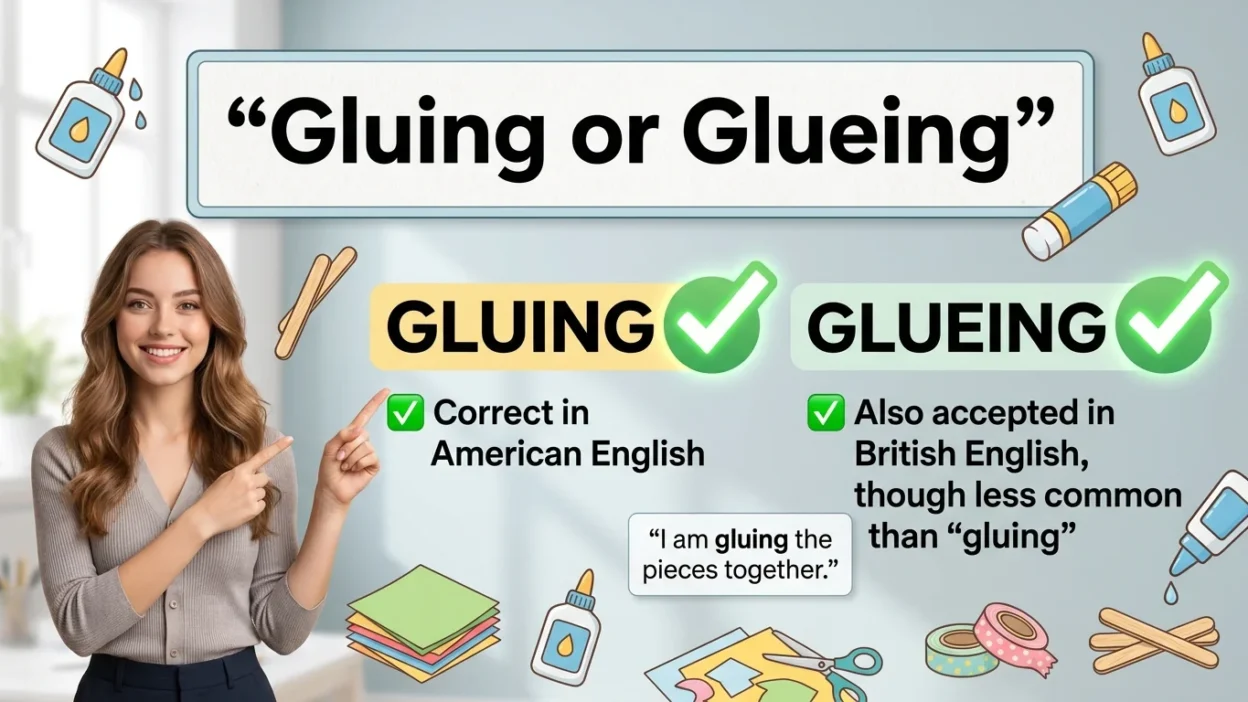
The correct spelling is gluing, which means attaching two things together using glue. You should use this spelling in both American and British English. The confusion happens because the word glue ends with a silent e.
When adding -ing to many English verbs, we drop the final e, as in making, writing, and baking. The same spelling rule applies to glue, giving us gluing rather than glueing. For example, you would write, “She is gluing the pieces of paper together,” when describing someone using adhesive for a craft project.
Gluing or Glueing: Which One Is Correct?
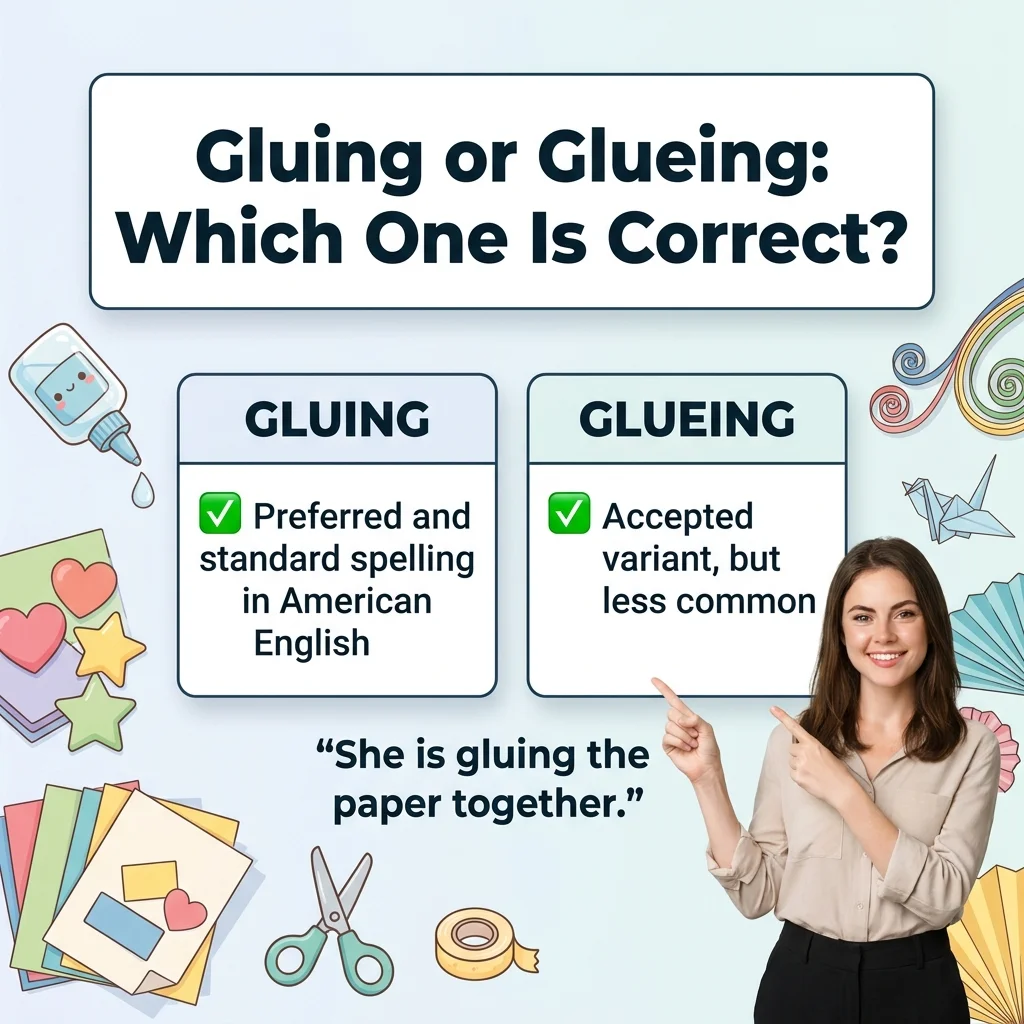
Gluing is the preferred and most common spelling of the present participle and gerund of glue.
For example:
- I am gluing the pieces together.
- She is gluing a picture to the card.
- He spent the afternoon gluing the model together.
- The children are gluing paper onto the board.
Glueing is also found in English, particularly because some speakers apply the general rule of keeping the final e before adding -ing in certain words. However, gluing is the spelling you will usually want to use.
Quick Answer
| Spelling | Correct? | Commonness | Example |
| Gluing | Yes | Very common | She is gluing the pieces together. |
| Glueing | Yes, as an alternative | Less common | He is glueing the paper to the box. |
If you are writing an article, email, school assignment, professional document, or website content, gluing is normally the safest choice.
What Does Gluing Mean?
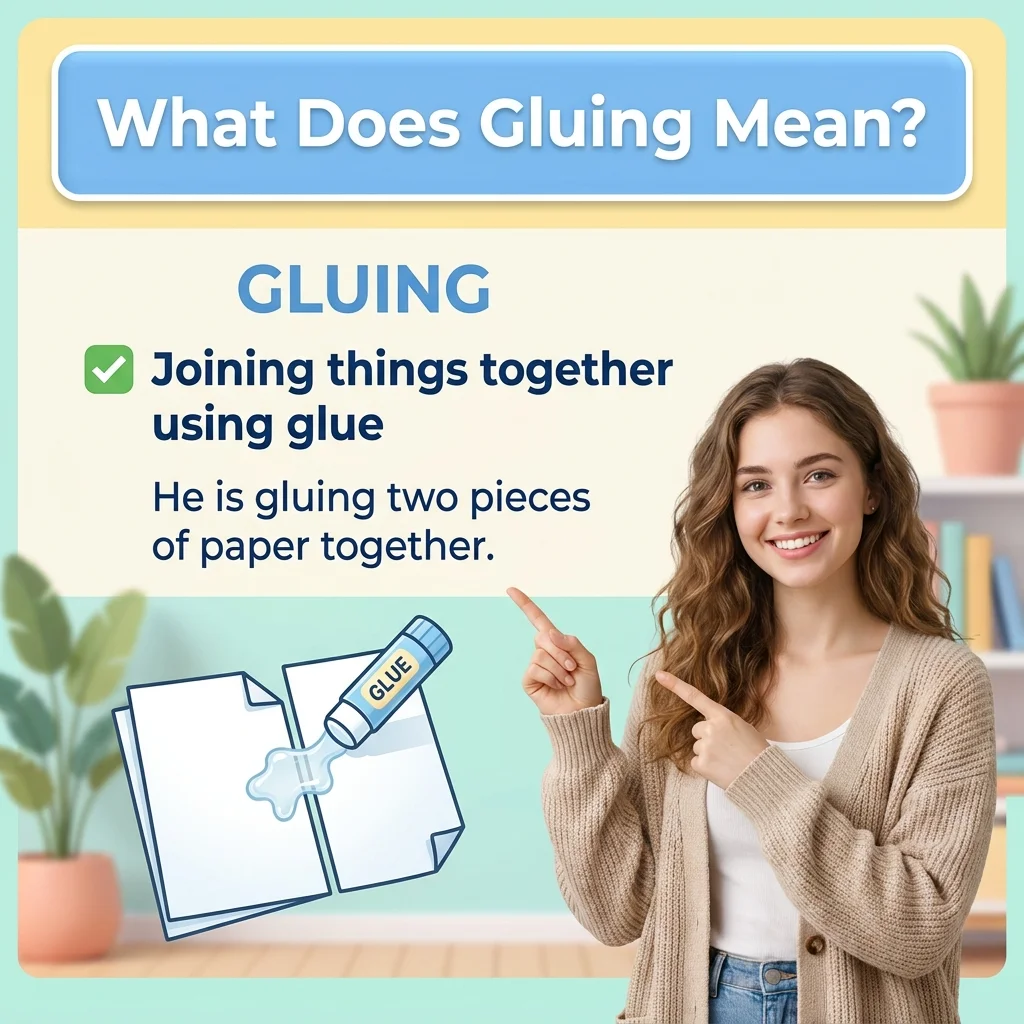
Gluing means joining two or more things together by using glue.
The word comes from the verb glue, which means to attach one object to another with an adhesive substance.
For example:
She is gluing the broken pieces of the vase together.
Here, gluing describes the action of using glue to join the pieces.
You can use gluing for many different situations:
- Gluing paper
- Gluing cardboard
- Gluing wood
- Gluing plastic
- Gluing photographs
- Gluing decorations
- Gluing craft materials
- Gluing broken objects
The exact meaning depends on the context, but the basic idea remains the same: using glue to attach something to something else.
What Does Glueing Mean?
Glueing has the same basic meaning as gluing. It is an alternative spelling of the present participle or gerund form of glue.
For example:
She is glueing the decorations onto the card.
The sentence means exactly the same thing as:
She is gluing the decorations onto the card.
The important difference is not meaning. The difference is spelling and frequency of use.
Although glueing can be found in English dictionaries and publications, gluing is generally much more common in modern usage.
Why Is Gluing More Common Than Glueing?
The difference comes from how English handles verbs ending in -e when forming the -ing form.
Usually, when a verb ends in a silent e, we remove the e before adding -ing.
For example:
- make → making
- take → taking
- write → writing
- use → using
- bake → baking
- hope → hoping
Following this familiar pattern gives:
glue → gluing
However, glue has an unusual spelling and pronunciation pattern. Because of that, glueing has also been used historically.
Modern dictionaries generally recognize gluing as the standard or preferred form.
Gluing vs. Glueing: Main Difference
The biggest difference between gluing and glueing is their level of usage.
Gluing is the spelling you are most likely to encounter in modern English.
Glueing is an alternative spelling that is less common.
Both forms refer to the same action.
Simple Comparison
| Feature | Gluing | Glueing |
| Base verb | Glue | Glue |
| Meaning | Using glue to attach things | Using glue to attach things |
| Grammar | Present participle/gerund | Present participle/gerund |
| Spelling | Preferred/common | Alternative/less common |
| Meaning difference | None | None |
| Recommended for general writing | Yes | Usually avoid if you want the most common form |
So, if you are wondering “Should I write gluing or glueing?”, choose gluing in most situations.
Gluing as a Verb
Gluing can function as the present participle of the verb glue.
The present participle is commonly used with forms of be to create continuous tenses.
Examples of Gluing as a Verb
- I am gluing the pieces together.
- She is gluing the photograph onto the page.
- They are gluing decorations to the wall.
- We were gluing the cardboard pieces together.
- He has been gluing the model all morning.
In each sentence, gluing describes an action that is happening or was happening over a period of time.
Gluing as a Gerund
The word gluing can also work as a gerund.
A gerund is an -ing form of a verb that functions as a noun.
For example:
Gluing requires patience.
Here, gluing is the subject of the sentence. It names an activity rather than simply describing what someone is doing.
More examples include:
- Gluing paper can be messy.
- Gluing small pieces requires care.
- Gluing wood properly takes time.
- I enjoy gluing craft materials together.
- Gluing is an important part of this project.
Examples of Gluing in Everyday English
The easiest way to understand gluing is to see it in natural sentences.
Example 1
I am gluing the broken pieces together.
This means the speaker is using glue to repair something.
Example 2
She is gluing the photo into her scrapbook.
Here, glue is being used to attach a photograph to the scrapbook.
Example 3
We spent two hours gluing the model together.
The word gluing describes an activity that continued for two hours.
Example 4
The children are gluing colorful shapes onto paper.
This sentence describes a craft activity.
Example 5
He is carefully gluing the wooden pieces together.
The adverb carefully explains how the action is being performed.
Gluing in Different Tenses
Understanding the tense can make it easier to use gluing correctly.
Present Continuous
Use am/is/are + gluing.
Examples:
- I am gluing the pieces together.
- She is gluing a label onto the box.
- They are gluing the paper together.
Past Continuous
Use was/were + gluing.
Examples:
- I was gluing the decorations.
- She was gluing the broken pieces.
- They were gluing cardboard together.
Present Perfect Continuous
Use has/have been + gluing.
Examples:
- I have been gluing the pieces for an hour.
- She has been gluing the model since morning.
- They have been gluing decorations onto the poster.
Future Continuous
Use will be + gluing.
Examples:
- I will be gluing the pieces tomorrow.
- She will be gluing the decorations later.
- We will be gluing the final parts together.
Gluing or Glueing in British English
Both gluing and glueing can be encountered in British English.
However, gluing is widely used and is the more straightforward choice for modern writing.
British English often has spelling differences from American English, such as:
- colour vs. color
- organise vs. organize
- travelling vs. traveling
But gluing vs. glueing is not primarily a British-versus-American spelling difference.
The variation exists within English more generally.
Therefore, you should not assume that glueing is specifically British English or that gluing is specifically American English.
Gluing or Glueing in American English
In American English, gluing is the common form.
For example:
The students are gluing pictures onto their posters.
I am gluing the broken handle back onto the cup.
If you are writing for an American audience, gluing is the natural choice.
It is also a good general choice when you are writing for an international audience because readers are very familiar with it.
Why Does Glue Become Gluing?
At first glance, glueing might seem more logical because the base word is glue.
However, English spelling does not always work by simply adding letters.
When many verbs ending in silent e take -ing, the final e disappears.
For example:
love + ing = loving
move + ing = moving
dance + ing = dancing
write + ing = writing
Similarly:
glue + ing = gluing
This is why gluing looks unusual at first but follows a recognizable spelling pattern.
The General Rule for Adding -ing
When a verb ends in a silent e, the final e is usually dropped before adding -ing.
Examples
| Base Verb | -ing Form |
| make | making |
| take | taking |
| write | writing |
| drive | driving |
| bake | baking |
| smile | smiling |
| hope | hoping |
| use | using |
| dance | dancing |
| glue | gluing |
This rule is not completely universal, but it is a useful guide for learners.
Words Similar to Gluing
Looking at similar words can help you remember the spelling.
Consider these examples:
- glue → gluing
- true → truing
- cue → cuing
- argue → arguing
- continue → continuing
- pursue → pursuing
These words show that English sometimes removes the final e before -ing, even when the resulting spelling looks slightly unusual.
Is Glueing a Misspelling?
Not necessarily.
Glueing is a recognized alternative spelling, so it is not simply an invented or meaningless form.
However, it is less common than gluing.
This distinction matters. A spelling can exist in English while another spelling is more widely accepted or preferred in everyday modern writing.
If your goal is clear, standard, and widely recognized English, gluing is the better choice.
Common Mistakes With Gluing and Glueing
Learners often make mistakes because they apply spelling rules inconsistently.
Here are some common problems.
Mistake 1: Assuming Glueing Is Always Wrong
Some people believe that glueing can never be correct.
That is too strong. Glueing does occur as an alternative spelling.
However, if you want the most common modern form, choose gluing.
Mistake 2: Using Both Forms in the Same Article
Mixing gluing and glueing throughout the same piece of writing can make your spelling look inconsistent.
For example:
She is gluing the paper while her brother is glueing the cardboard.
The meaning is understandable, but using two spellings for the same word is unnecessary.
For consistent writing, choose gluing.
Mistake 3: Writing “Gluing” as “Glueing” Because It Looks More Logical
It is understandable to think:
glue + ing = glueing
But English spelling often changes the base word before a suffix is added.
That is why:
glue → gluing
is the preferred form.
Mistake 4: Confusing Glue With Other -E Verbs
Not every English verb follows exactly the same pattern.
For example, see becomes seeing, not “sing.”
Similarly:
- agree → agreeing
- flee → fleeing
- free → freeing
These words already contain a double e, so the spelling behaves differently.
How to Remember the Correct Spelling
A simple memory trick can help.
Think:
Glue loses E before -ing.
So:
GLUE → GLU + ING → GLUING
You can also connect it with familiar words:
- write → writing
- make → making
- take → taking
- glue → gluing
The common idea is that the final e disappears before -ing.
Gluing in Craft and DIY Contexts
The word gluing is especially common when discussing arts, crafts, repairs, and DIY projects.
For example:
Start by gluing the cardboard pieces together.
Allow the glue to dry after gluing the pieces.
Be careful when gluing small decorations.
She enjoys gluing paper shapes onto handmade cards.
In these sentences, gluing refers to the physical process of applying glue to attach materials.
Gluing in School Activities
Teachers and students often use gluing when talking about classroom crafts.
Examples include:
- The students are gluing pictures onto their posters.
- She is gluing colored paper onto the worksheet.
- We are gluing the shapes to the project board.
- The teacher showed us how to glue the pieces together.
- Gluing is part of today’s art activity.
The word is especially common in instructions:
Cut out the shapes before gluing them to the paper.
Gluing in Technical and Professional Contexts
Gluing is not limited to crafts.
The word can also describe industrial or technical processes.
For example:
- The machine is gluing labels onto containers.
- Workers are gluing the panels together.
- The process involves gluing several layers of material.
- The technician is gluing the components into place.
The basic meaning remains the same: attaching something using an adhesive.
Gluing vs. Sticking
Gluing and sticking can sometimes describe similar actions, but they are not always interchangeable.
Sticking has a broader meaning.
For example:
I am gluing the paper to the wall.
This specifically tells us that glue is being used.
But:
I am sticking the paper to the wall.
This could involve glue, tape, a sticker, or another method.
So gluing gives more specific information.
Gluing vs. Pasting
Gluing and pasting are also related.
Pasting often refers to attaching something with paste or glue-like material, especially paper.
For example:
The children are pasting pictures into their notebooks.
Gluing is broader and can refer to many materials.
You can glue:
- wood
- plastic
- cardboard
- fabric
- paper
- decorations
Therefore, gluing is often the more general term.
Is “Gluing” a Verb or Noun?
It can be either, depending on how it is used.
As a Verb
She is gluing the pieces together.
Here, gluing is part of the verb phrase is gluing.
As a Gerund
Gluing requires patience.
Here, gluing functions as a noun because it names an activity.
This is a useful feature of English -ing forms. The same form can have different grammatical functions depending on the sentence.
Sentence Examples: Gluing
Here are more examples to help you understand natural usage.
- I am gluing the pieces together.
- She is gluing a photo into her album.
- We were gluing cardboard shapes.
- They are gluing the decorations onto the poster.
- He enjoys gluing model parts together.
- Gluing the pieces requires patience.
- Please wait before gluing the final piece.
- She spent the morning gluing paper flowers.
- The children are gluing colorful shapes onto the board.
- He carefully finished gluing the broken parts.
- We need to finish gluing the edges.
- She is gluing the label to the package.
- Gluing small objects can be difficult.
- The machine is gluing the labels automatically.
- They have been gluing the model since noon.
Gluing in Questions
You can also use gluing naturally in questions.
Examples:
- Are you gluing the pieces together?
- What are you gluing?
- Why are you gluing that part?
- Are they gluing the cardboard?
- How are you gluing these pieces together?
- Have you finished gluing the model?
These questions all use gluing naturally.
Gluing in Negative Sentences
You can use gluing in negative constructions as well.
Examples:
- I am not gluing the pieces yet.
- She is not gluing the paper.
- They are not gluing the parts correctly.
- We were not gluing the pieces at that stage.
- He has not finished gluing the model.
Again, the spelling remains gluing.
A Simple Rule for Writers
If you need a quick rule, remember this:
Use “gluing” as your default spelling.
This is particularly useful for:
- Blog posts
- School assignments
- Business writing
- Emails
- Website content
- Instructions
- Technical writing
- General communication
You may encounter glueing, but there is usually no need to choose it when gluing is available.
Gluing or Glueing: Which Should You Use in SEO Content?
For SEO content, consistency and natural language matter.
If your target keyword or topic is gluing, use the standard spelling naturally throughout the article. Do not repeatedly insert glueing just to target a spelling variation.
Search engines can understand related word forms and spelling variations, but your main priority should be writing clear content for human readers.
For example, this sentence is natural:
Gluing wood pieces together requires the right adhesive and enough drying time.
You do not need to write:
Glueing wood pieces together…
simply because some people search for the alternative spelling.
If glueing is an important search variation, you can mention it naturally when explaining the difference.
Quick Grammar Test
Choose the correct word in each sentence.
1. She is _____ the paper to the board.
Answer: gluing
2. We spent an hour _____ the model together.
Answer: gluing
3. _____ the pieces requires patience.
Answer: gluing
4. They are _____ decorations onto the card.
Answer: gluing
5. He has been _____ the broken parts.
Answer: gluing
The preferred spelling in all five examples is gluing.
Gluing or Glueing: Quick Reference Table
| Question | Answer |
| Is gluing correct? | Yes |
| Is glueing found in English? | Yes |
| Which form is more common? | Gluing |
| Do they have different meanings? | No |
| Is gluing used as a verb? | Yes |
| Can gluing function as a gerund? | Yes |
| Does glue usually drop the final e before -ing? | Yes |
| Best choice for general modern writing? | Gluing |
People Also Ask About Gluing or Glueing
Is gluing or glueing correct?
Gluing is the preferred and more common spelling. Glueing is also found as an alternative spelling, but most general writing should use gluing.
Is “glueing” grammatically correct?
Yes. Glueing is recognized as an alternative spelling, although it is much less common than gluing. If you want the standard modern form, use gluing.
Why is it spelled gluing instead of glueing?
English commonly drops a final silent e before adding -ing. Therefore, glue becomes gluing. This follows the same general pattern seen in words such as make → making and write → writing.
What is the past tense of glue?
The past tense of glue is glued.
For example:
She glued the pieces together yesterday.
What is the present participle of glue?
The standard present participle is gluing.
For example:
She is gluing the pieces together.
Can I use glueing instead of gluing?
Yes, glueing can be found as an alternative spelling. However, gluing is more common and is generally the better choice for modern general writing.
Is gluing a gerund?
Yes. Gluing can function as a gerund when an -ing form acts as a noun.
For example:
Gluing can be difficult.
Here, gluing names the activity.
Is gluing a verb?
Yes. Gluing is the present participle of glue and can be used as part of continuous verb forms.
For example:
She is gluing the pieces together.
What is the difference between gluing and sticking?
Gluing specifically refers to attaching something with glue or adhesive. Sticking is broader and can describe attaching something with glue, tape, stickers, or another method.
Which spelling should I use in an essay: gluing or glueing?
Use gluing. It is the more common modern spelling and is suitable for academic, professional, and general writing.
Is gluing American or British English?
Gluing is used in both American and British English. The difference between gluing and glueing is not simply a US-versus-UK spelling difference.
Does glue lose the e before ing?
Yes. The standard form is gluing, with the final e removed before -ing.
What is the noun form of glue?
The word glue itself can be a noun.
For example:
I need some glue for this project.
The word gluing can also function as a gerund when referring to the activity.
Final Answer:
When you are choosing between gluing and glueing, remember that both forms can be found in English, but they are not equally common. Gluing is the preferred and more widely used spelling in modern English.
It is the form you should normally choose in everyday writing, schoolwork, professional communication, website content, and other formal or informal contexts. Glueing is an alternative spelling with the same meaning. You may encounter it in dictionaries or older and less common writing, but there is usually no reason to prefer it over gluing.

Michael Collins is a skilled writer who creates clear, practical, and reader-friendly content. He focuses on language, grammar, word meanings, and everyday expressions, making complex topics simple to understand.