Have you ever written a sentence about yourself and your family but wondered which phrase sounds right? Many English learners struggle to choose between “me and my family” and “my family and I.”
Both phrases appear in everyday conversations, social media posts, and written messages. However, the correct choice depends on how you use the phrase in a sentence.
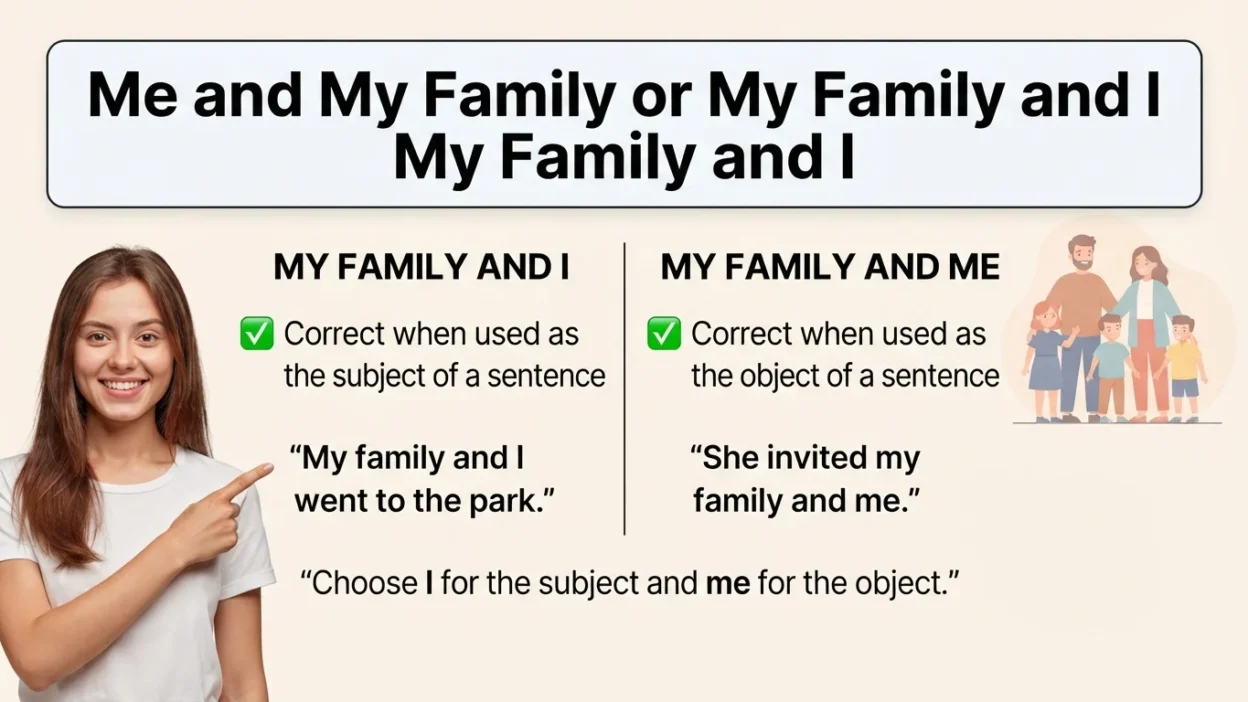
“My family and I” is correct when the phrase acts as the subject of a sentence. For example, “My family and I are going on vacation.” In this sentence, the phrase performs the action, so you use “I” rather than “me.”
Understanding “Me and My Family” or “My Family and I”
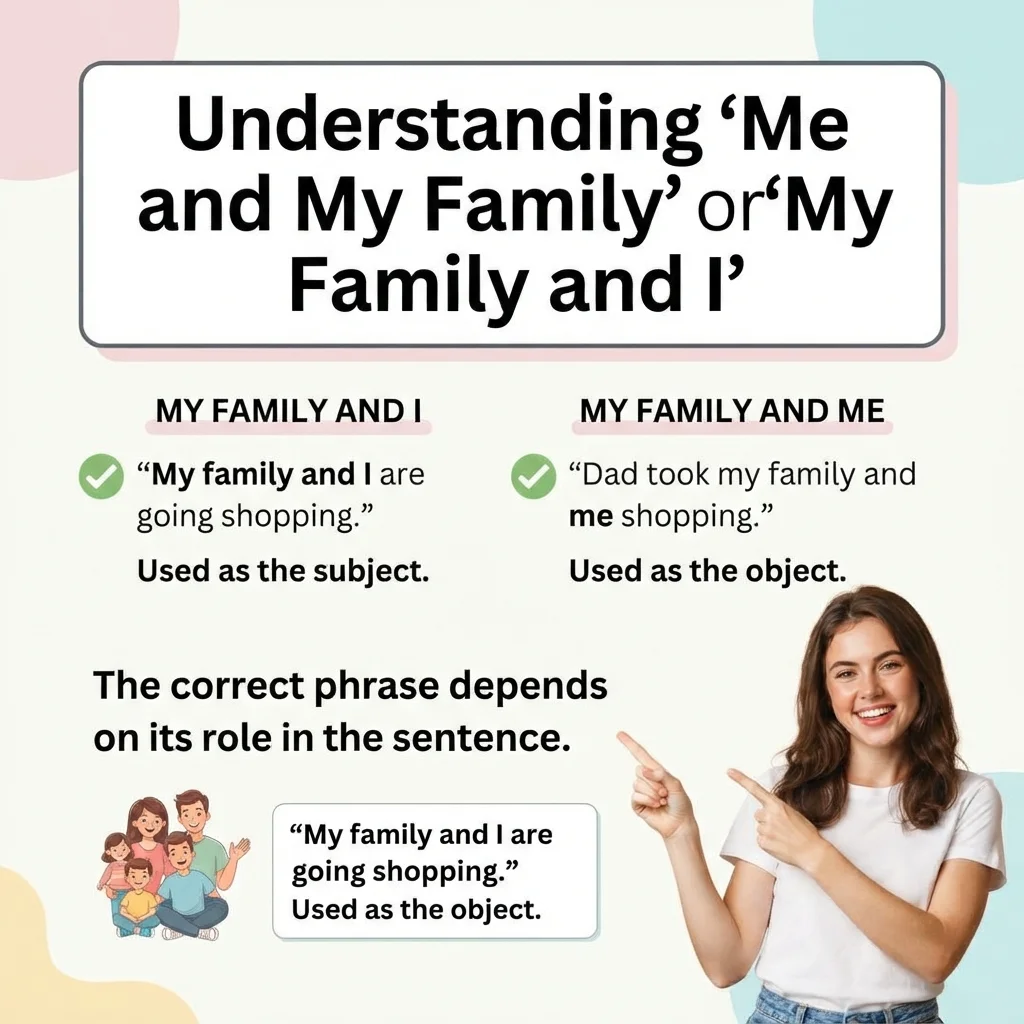
The phrase “me and my family” and the phrase “my family and I” refer to the same group of people: yourself and your family members. However, they do not always serve the same grammatical role.
The main difference is the pronoun:
- I is a subject pronoun.
- Me is an object pronoun.
- My is a possessive adjective that shows ownership or relationship.
- Family is a noun that refers to a group of related people.
Let’s examine each word carefully before comparing the complete phrases.
Meaning and Correct Usage of Each Word
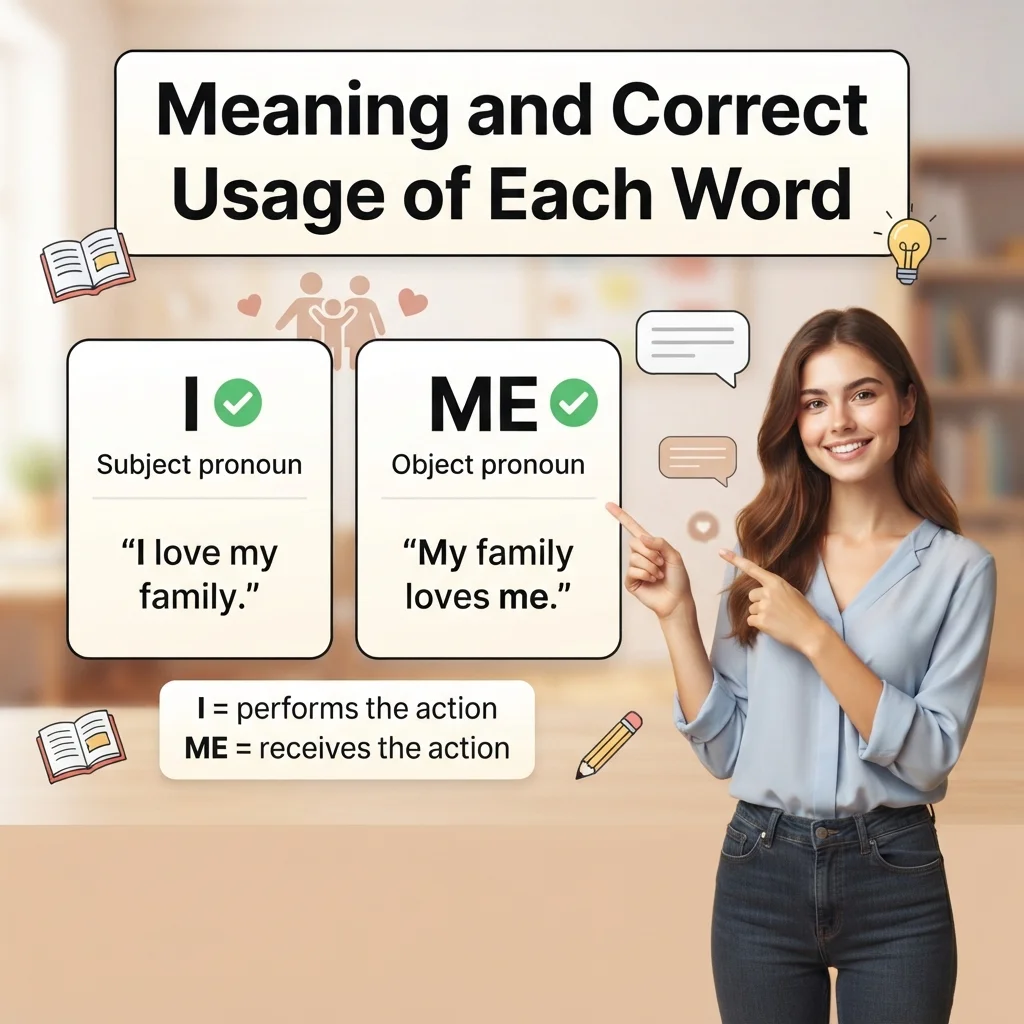
Meaning of “I”
I is a first-person singular subject pronoun. It refers to the person who is speaking or writing.
We use I when the speaker is the subject of a sentence—the person or thing performing the action.
Examples:
- I love my family.
- I live with my parents.
- I am learning English.
- My family and I enjoy traveling.
In each example, I is part of the subject or performs the action.
Important spelling tip: Always write I as a capital letter, even when it appears in the middle of a sentence.
❌ i love my family. ✅ I love my family.
Meaning of “Me”
Me is a first-person singular object pronoun. It refers to the speaker when the speaker receives an action or follows a preposition.
We use me when someone does something to, for, or with the speaker.
Examples:
- My parents support me.
- She called me.
- My brother helped me.
- The teacher spoke to me.
In these sentences, me receives the action or follows a preposition.
Remember: “Me” is not normally used as the subject of a formal English sentence.
❌ Me went to school. ✅ I went to school.
Meaning of “My”
My is a possessive adjective. It shows that something belongs to, relates to, or is connected with the speaker.
It usually comes before a noun.
Examples:
- My family is kind.
- My mother is a teacher.
- My house is near the school.
- I love my friends.
In “my family,” the word my tells us whose family we are talking about.
Meaning of “Family”
Family is a noun that refers to people connected through relationships, such as parents, children, siblings, or other relatives.
Examples:
- My family is very supportive.
- I spend time with my family.
- Her family lives in Lahore.
- Family is important to many people.
The word family can refer to a group, but its grammatical treatment depends on the variety of English and the meaning of the sentence.
Meaning of “And”
And is a coordinating conjunction. It joins words, phrases, or clauses.
In “my family and I,” the word and connects two parts of the subject:
My family and I
In “me and my family,” it connects the two people or groups being mentioned:
Me and my family
The conjunction itself does not determine whether I or me is correct. The sentence’s grammatical role does.
What Is the Difference Between “Me and My Family” and “My Family and I”?
The most important difference is grammar and sentence position.
| Phrase | Grammatical role | Common use |
| My family and I | Subject | When the group performs an action |
| Me and my family | Object in informal usage; subject in casual speech | Common in conversation, but often avoided in formal writing |
| My family and me | Object | When the group receives an action or follows a preposition |
“My Family and I” as the Subject
Use “my family and I” when the entire phrase is the subject of the sentence.
Examples:
- My family and I went to the park.
- My family and I are planning a trip.
- My family and I enjoy watching movies.
- My family and I visited our grandparents.
In these sentences, my family and I perform the action.
To check the grammar, remove “my family and.”
- I went to the park. ✅
- I am planning a trip. ✅
- I enjoy watching movies. ✅
Because I is correct when used alone as the subject, my family and I is the standard formal choice.
“Me and My Family” in Casual Speech
“Me and my family” is common in everyday conversation, especially in informal English. Native speakers may use it naturally when talking about themselves and their relatives.
Examples:
- Me and my family went to the beach.
- Me and my family are having dinner.
- Me and my family love this place.
These sentences are understandable and common in casual speech. However, in formal writing, school assignments, professional communication, and carefully edited content, “my family and I” is usually preferred when the phrase is the subject.
A more formal version would be:
- My family and I went to the beach.
- My family and I are having dinner.
- My family and I love this place.
This does not mean every use of “me and my family” is incorrect. It means the phrase should be judged by its grammatical role and the level of formality.
When Should You Use “My Family and I”?
Use “my family and I” when you and your family are doing something.
Example 1: Going Somewhere
My family and I went to the museum.
Who went to the museum? My family and I.
The phrase is the subject, so I is correct.
Example 2: Enjoying an Activity
My family and I enjoy cooking together.
Who enjoys cooking? My family and I.
The phrase performs the action, so use I.
Example 3: Making a Plan
My family and I are planning a holiday.
Who is planning the holiday? My family and I.
Again, the phrase is the subject.
Example 4: Sharing an Opinion
My family and I believe that education is important.
Who believes this? My family and I.
The phrase is the subject of believe.
Example 5: Introducing Your Family
My family and I live in a small town.
Who lives in the town? My family and I.
This is one of the most natural and common uses of the phrase.
When Should You Use “Me and My Family”?
Use “me and my family” carefully. It is often heard in informal speech, but it is not the standard formal subject construction.
For example, someone might say:
Me and my family are going on vacation.
This is understandable and common in casual conversation. However, for formal English, the preferred version is:
My family and I are going on vacation.
Is “Me and My Family” Always Wrong?
No. The phrase itself is not always wrong. The correct choice depends on its role in the sentence.
For example:
The gift was for me and my family.
Here, me and my family follows the preposition for. The phrase functions as an object, so me is appropriate.
Another example:
She invited me and my family to dinner.
Here, me and my family receives the action of invited. It is the object of the verb, so me is correct.
The issue is not that “me and my family” can never be used. The issue is that me is generally not the standard subject pronoun in formal English.
“My Family and Me”: The Correct Object Form
Many people know that “my family and I” is used as a subject, but they are unsure what to use when the phrase is an object.
The answer is often “my family and me.”
Examples of “My Family and Me” as an Object
- The teacher invited my family and me to the event.
- She gave my family and me some helpful advice.
- The photographer took a picture of my family and me.
- The organizers welcomed my family and me.
- This gift is for my family and me.
To check whether me is correct, remove “my family and.”
The teacher invited me. ✅ She gave me some advice. ✅ The photographer took a picture of me. ✅
Since me is correct when used alone as the object, my family and me is the standard form.
A Simple Trick to Choose Between “I” and “Me”
One of the easiest ways to decide between I and me is to remove the other people from the phrase.
Step 1: Remove “My Family”
Look at the sentence:
My family and I went shopping.
Remove “my family and.”
I went shopping. ✅
So the correct phrase is my family and I.
Now look at:
The manager spoke to my family and me.
Remove “my family and.”
The manager spoke to me. ✅
So the correct phrase is my family and me.
Step 2: Ask Who Is Doing the Action?
If the phrase is doing the action, use I.
My family and I cooked dinner.
Who cooked? My family and I.
Step 3: Ask Who Receives the Action?
If the phrase receives the action, use me.
The chef served my family and me.
Who was served? My family and me.
Quick Memory Rule
I = subject Me = object
This simple rule works in most everyday grammar situations.
Comparison Examples: “My Family and I” vs. “My Family and Me”
| Incorrect or less suitable form | Correct standard form | Why? |
| Me and my family went shopping. | My family and I went shopping. | The phrase is the subject. |
| My family and me went shopping. | My family and I went shopping. | The phrase is the subject. |
| She invited my family and I. | She invited my family and me. | The phrase is the object. |
| The gift is for my family and I. | The gift is for my family and me. | The phrase follows “for.” |
| My family and I enjoyed the trip. | My family and I enjoyed the trip. | “I” is the subject. |
| He helped my family and me. | He helped my family and me. | “Me” is the object. |
Common Mistakes with “Me and My Family” or “My Family and I”
Understanding the rule is helpful, but seeing common mistakes makes it easier to remember.
Mistake 1: Using “Me” as the Subject
❌ Me and my family went to the market. ✅ My family and I went to the market.
In formal English, I is the correct subject pronoun.
Mistake 2: Using “I” After a Preposition
❌ The invitation was for my family and I. ✅ The invitation was for my family and me.
The word for is a preposition. It requires an object pronoun, so me is correct.
Mistake 3: Using “I” After an Object Verb
❌ She invited my family and I. ✅ She invited my family and me.
The verb invited takes an object. The correct pronoun is me.
Mistake 4: Thinking “I” Is Always More Correct
Some people believe that I is always more formal and therefore always correct. That is not true.
❌ The teacher spoke to my family and I. ✅ The teacher spoke to my family and me.
The correct pronoun depends on the sentence, not simply on formality.
Mistake 5: Putting Yourself First in Formal Writing
In standard English, it is generally more natural and polite to mention others before yourself.
Preferred:
My family and I visited the park.
Less formal:
I and my family visited the park.
The second sentence is understandable, but “my family and I” is the more natural and conventional order.
Mistake 6: Confusing “My” and “Me”
❌ Me family is very kind. ✅ My family is very kind.
My shows possession or relationship. Me is an object pronoun.
Mistake 7: Writing “my family and i”
❌ My family and i went home. ✅ My family and I went home.
The pronoun I must always be capitalized.
Is “Me and My Family” Grammatically Correct?
The answer depends on the context.
In informal conversation: “Me and my family” is widely used and easily understood. It may sound natural in casual speech.
In formal writing: “My family and I” is the standard choice when the phrase is the subject.
As an object: “Me and my family” can be acceptable, although “my family and me” is generally the more conventional order in careful writing.
For example:
- My family and I went to the park. — Standard subject form.
- The guide helped my family and me. — Standard object form.
- Me and my family went to the park. — Common informal speech, but less formal.
Examples in Everyday Sentences
Here are several examples to help you understand the difference.
Examples with “My Family and I”
- My family and I live in Islamabad.
- My family and I went to the wedding.
- My family and I enjoy spending time together.
- My family and I are learning new skills.
- My family and I watched a movie last night.
- My family and I visited our relatives.
- My family and I are planning a family dinner.
- My family and I love celebrating special occasions.
- My family and I worked together on the project.
- My family and I hope to travel next year.
Examples with “My Family and Me”
- The teacher invited my family and me to the school event.
- She gave my family and me a warm welcome.
- The photographer took a picture of my family and me.
- The host asked my family and me to sit down.
- The gift was intended for my family and me.
- The guide showed my family and me around the city.
- The organizers thanked my family and me.
- The doctor spoke with my family and me.
- The story reminded my family and me of our childhood.
- The hotel staff helped my family and me.
“My Family and I” in Different Tenses
The phrase “my family and I” can be used with different verb tenses.
Present Simple
My family and I live in a quiet neighborhood.
This describes a current situation.
Present Continuous
My family and I are preparing dinner.
This describes an action happening now.
Past Simple
My family and I visited the museum yesterday.
This describes a completed past action.
Future Simple
My family and I will travel next month.
This describes a future plan or event.
Present Perfect
My family and I have visited many beautiful places.
This describes experiences up to the present.
The pronoun remains I because the phrase is the subject in each sentence.
“Me and My Family” in Informal Conversation
English changes depending on the situation. The way people speak with friends may differ from the way they write in an academic essay or professional email.
In casual conversation, you may hear:
Me and my family are going out tonight.
This is common in informal speech. However, if you are writing a school essay, blog article, formal letter, or professional message, the more standard form is:
My family and I are going out tonight.
When Informal Usage May Be Acceptable
- Casual conversations
- Text messages
- Friendly social media posts
- Informal storytelling
- Dialogue in creative writing
When Standard Grammar Is Better
- School assignments
- Job applications
- Formal emails
- Business writing
- Academic essays
- Professional articles
- Official documents
The goal is not to criticize everyday speech. It is to choose language that fits the audience and purpose.
How to Introduce Yourself and Your Family Correctly
If you want to introduce yourself and your family, “my family and I” is usually the best choice.
Example Introduction
My name is Ahmed, and my family and I live in a small town. We enjoy spending time together, especially on weekends. My parents are supportive, and I have two siblings. My family and I often visit our grandparents and share meals together.
Another Example
My family and I are very close. We respect one another and try to help each other whenever possible. On weekends, my family and I enjoy watching movies, cooking, and visiting relatives.
Simple Sentence for Beginners
My family and I live together.
This is a short, clear, and grammatically standard sentence.
How to Write a Paragraph About Your Family
When writing a paragraph about your family, use “my family and I” when you and your family are performing an action.
Example Paragraph
My family and I live in a comfortable home. There are five people in my family: my parents, my two siblings, and me. We enjoy spending time together and helping one another. My family and I often eat dinner together, talk about our day, and watch television in the evening. On weekends, we sometimes visit relatives or go to a nearby park. I am grateful for my family because they support me and encourage me to achieve my goals.
Notice how “my family and I” is used as the subject of several sentences.
How to Use the Phrase in Formal Writing
Formal writing requires careful grammar, but it should still sound natural.
Example: School Essay
My family and I believe that education is essential for a successful future.
Example: Professional Email
My family and I would like to thank you for your kindness and support.
Example: Application Letter
My family and I have lived in this community for many years.
Example: Blog Article
My family and I recently visited a beautiful historical site.
In each example, “my family and I” is the subject.
Word Order: Why “My Family and I” Sounds More Natural
English speakers generally place the other person or group before themselves when using a coordinated subject.
For example:
- My brother and I
- My parents and I
- My friends and I
- My family and I
- My teacher and I
This is a common convention in English.
Compare:
I and my family went shopping.
This is understandable, but it sounds less natural than:
My family and I went shopping.
The second version follows the usual word order and sounds more polished.
Singular or Plural Verb with “My Family and I”
When “my family and I” is the subject, the phrase refers to more than one person. Therefore, it normally takes a plural verb.
Correct Examples
- My family and I are happy.
- My family and I have a plan.
- My family and I enjoy traveling.
- My family and I were at home.
- My family and I do our work together.
Incorrect Examples
❌ My family and I is happy. ✅ My family and I are happy.
❌ My family and I has a plan. ✅ My family and I have a plan.
Why?
The subject includes I and my family, so it is treated as plural.
Is “Family” Singular or Plural?
The noun family can be used in different ways depending on the variety of English and the intended meaning.
American English
In American English, family is often treated as a singular collective noun when referring to the group as one unit.
My family is large. My family has a house.
British English
In British English, family may be treated as singular or plural depending on whether the speaker emphasizes the group as one unit or the individual members.
My family is visiting us. My family are discussing their plans.
However, when you say “my family and I,” the entire subject is plural because it includes I.
My family and I are ready.
Spelling Tips for “Me and My Family” or “My Family and I”
Correct spelling is important for clear English writing.
1. Always Capitalize “I”
The pronoun I is always capitalized.
- I
- My family and I
- I and my friends
Never write i as a standalone pronoun.
2. Spell “Family” Correctly
The correct spelling is:
Family
Common mistakes include:
- ❌ Famly
- ❌ Familly
- ❌ Fammily
- ✅ Family
3. Use “My” Before a Noun
My is normally followed by a noun.
- My family
- My mother
- My home
- My friends
4. Use “Me” as an Object
Remember that me is not capitalized unless it begins a sentence.
- My parents helped me.
- She called me.
- The gift is for me.
5. Use “And” to Join Words
The correct conjunction is and.
- My family and I
- My brother and I
- My parents and me
Quick Grammar Test
Choose the correct phrase in each sentence.
Question 1
___ went to the market.
A. Me and my family B. My family and I
Answer: B. My family and I
The phrase is the subject.
Question 2
The teacher invited ___.
A. my family and I B. my family and me
Answer: B. my family and me
The phrase is the object of invited.
Question 3
The gift is for ___.
A. my family and I B. my family and me
Answer: B. my family and me
The phrase follows the preposition for.
Question 4
___ enjoy spending time together.
A. My family and I B. My family and me
Answer: A. My family and I
The phrase performs the action.
Question 5
She spoke to ___.
A. my family and I B. my family and me
Answer: B. my family and me
The phrase follows to.
Frequently Asked Questions
Is “Me and My Family” or “My Family and I” Correct?
Both phrases can be used, but “my family and I” is the standard formal choice when the phrase is the subject. “Me and my family” is common in informal speech.
Can I Say “Me and My Family Went”?
In casual conversation, people commonly say “me and my family went.” In formal or standard written English, use “my family and I went.”
Is “My Family and I” Grammatically Correct?
Yes. “My family and I” is grammatically correct when the phrase is the subject of a sentence.
My family and I went to the park.
Is “My Family and Me” Correct?
Yes. “My family and me” is correct when the phrase functions as an object.
The teacher invited my family and me.
Which Is Correct: “Me and My Family Are” or “My Family and I Are”?
For standard formal English, use:
My family and I are.
The phrase is the subject, and are is the plural verb.
Can I Use “Me and My Family” in a School Essay?
It is better to use “my family and I” when the phrase is the subject. School essays generally require standard grammar.
Why Do People Say “Me and My Family”?
“Me and my family” is common in informal spoken English. Everyday speech does not always follow the conventions of formal written grammar.
Should I Say “My Family and I” or “I and My Family”?
“My family and I” is the more natural and conventional word order. It is preferred in formal writing and careful speech.
Is “My Family and I Are Going” Correct?
Yes.
My family and I are going to the park.
The phrase is the subject, so I is correct.
Is “My Family and Me Are Going” Correct?
In standard formal English, no. The subject form should be:
My family and I are going.
Is “My Family and Me” Correct After “For”?
Yes.
This gift is for my family and me.
The phrase follows for, so me is correct.
What Is the Easiest Way to Remember the Difference?
Remove “my family and.” If the remaining pronoun should be I, use “my family and I.” If it should be me, use “my family and me.”
Final Summary
The choice between “me and my family” and “my family and I” becomes easy when you understand the difference between subject and object pronouns. “Me and my family” is common in informal speech, but “my family and I” is usually the better choice for formal writing when the phrase is the subject.
The most useful rule is simple: I is for subjects, and me is for objects. Once you apply this rule, you can confidently choose the correct phrase in conversations, essays, emails, and everyday English.

Michael Collins is a skilled writer who creates clear, practical, and reader-friendly content. He focuses on language, grammar, word meanings, and everyday expressions, making complex topics simple to understand.