Have you ever wondered whether “annunciate” or “enunciate” is the correct word when talking about clear speech? These two words look and sound similar, so it is easy to mix them up. However, they have different meanings and are not interchangeable in most situations.
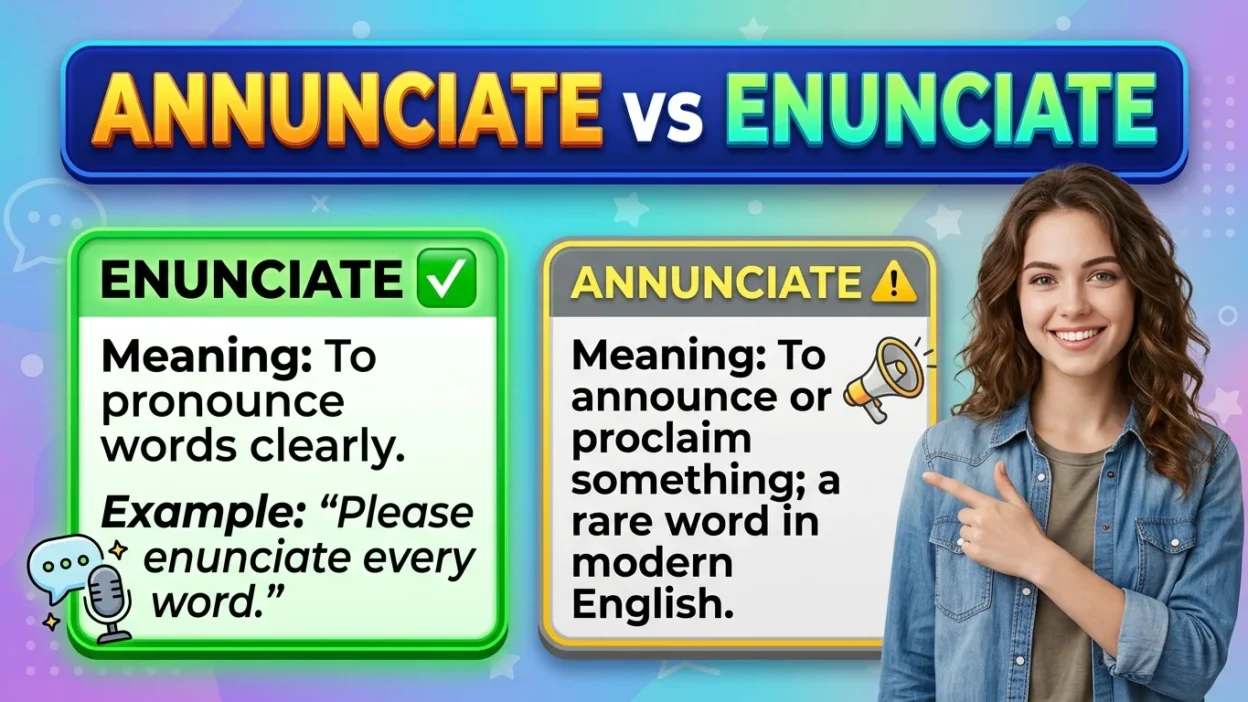
“Enunciate” means to pronounce words clearly and carefully so that others can understand you. For example, a teacher might ask a student to enunciate each word during a speech or reading exercise.
On the other hand, “annunciate” is a much less common word that generally means to announce or proclaim something. It is rare in modern everyday English, and writers usually choose “announce” instead.
Quick Answer :
The main difference between annunciate and enunciate is their meaning and common usage.
- Enunciate means to pronounce words clearly or express an idea clearly.
- Annunciate is a rare word that can mean to announce, proclaim, or make something known.
- Enunciate is the normal and widely accepted choice when talking about clear speech or pronunciation.
- Annunciate should not normally be used as a synonym for “speak clearly.”
For example:
Please enunciate your words so everyone can understand you.
This means the speaker should pronounce each word clearly.
On the other hand:
The official annunciated the decision.
Here, “annunciated” is being used in the sense of formally announcing something, although announced would usually sound more natural in modern English.
What Does Enunciate Mean?
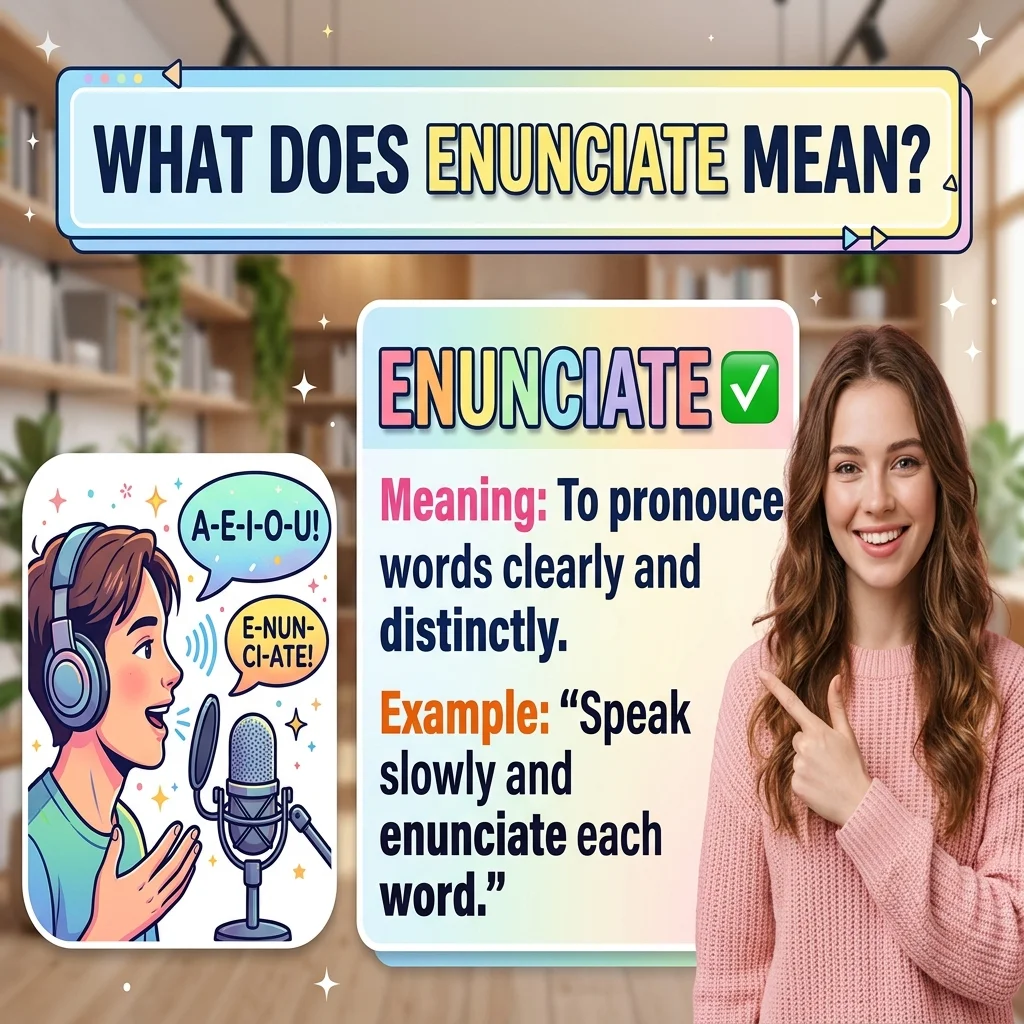
Enunciate is a verb that means to pronounce words clearly and distinctly. It can also mean to express an idea, opinion, or statement clearly.
The word is especially common when discussing speech, pronunciation, public speaking, presentations, acting, teaching, and communication.
When someone tells you to “enunciate,” they usually want you to make your words easier to hear and understand.
For example:
- Please enunciate each word clearly.
- The teacher asked the student to enunciate during the presentation.
- Good speakers know how to enunciate difficult words.
- She enunciated every sentence carefully.
Enunciate Meaning in Simple English
In very simple terms:
Enunciate = say or pronounce something clearly.
Imagine someone speaking very quickly and quietly. You cannot understand every word. You might say:
“Please slow down and enunciate.”
You are asking that person to pronounce the words more clearly.
However, enunciate is not limited to pronunciation. It can also describe expressing an idea clearly.
For example:
The professor enunciated his main argument clearly.
Here, the professor is not simply pronouncing individual words. He is expressing his argument in a clear and understandable way.
What Does Annunciate Mean?
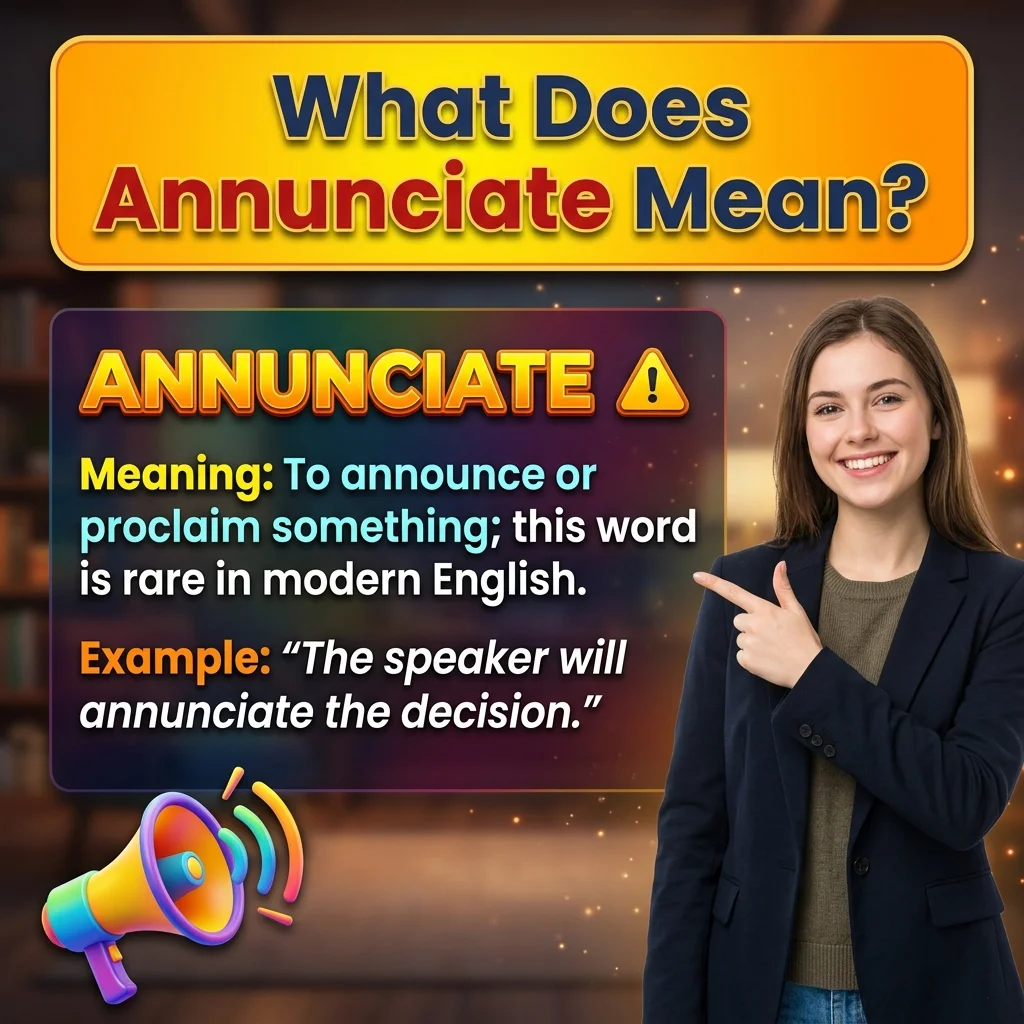
Annunciate is a much less common English verb. It is related to the idea of announcing, proclaiming, or making something known.
In modern everyday English, people rarely use “annunciate.” Instead, they normally use words such as:
- announce
- proclaim
- declare
- state
- communicate
The rarity of “annunciate” is one reason people become confused about annunciate vs enunciate.
Annunciate Meaning in Simple English
In simple terms:
Annunciate = announce or proclaim something.
For example, in a formal or unusual context, someone might use a form of “annunciate” to describe the formal announcement of information.
However, if you simply want to say that someone made an announcement, announce is usually the better and more natural choice.
Is Annunciate a Common Word?
No. Annunciate is considerably less common than enunciate.
Most English speakers are much more familiar with:
- announce
- announcement
- enunciate
- enunciation
Because of this, using “annunciate” in ordinary conversation can sound unusual or overly formal.
If your intended meaning is “pronounce clearly,” do not use “annunciate.” Use enunciate.
Enunciate vs Annunciate: The Main Difference
The easiest way to understand the difference is to focus on what the speaker is doing.
Enunciate is mainly about clear pronunciation or clear expression.
Annunciate is connected with announcing or proclaiming information.
| Word | Basic Meaning | Commonness | Example |
| Enunciate | Pronounce or express clearly | Very common | Please enunciate your words. |
| Annunciate | Announce or proclaim | Rare | The message was annunciated formally. |
The two words share similar letters, but their meanings are different.
When to Use Enunciate
Use enunciate when you are talking about clear speech, pronunciation, or the clear expression of an idea.
Enunciate for Pronunciation
This is the most common use.
For example:
The actor enunciated every line perfectly.
The sentence means that the actor pronounced the words clearly enough for the audience to understand.
Another example:
You need to enunciate the final sounds in these words.
Here, “enunciate” refers directly to pronunciation.
Enunciate for Public Speaking
Public speakers often need to enunciate because large audiences may have difficulty understanding unclear speech.
For example:
A good public speaker should enunciate clearly.
This means the speaker should pronounce words distinctly and avoid mumbling.
Enunciate for Presentations
If you are giving a presentation, clear pronunciation can make your message easier to follow.
For example:
During the presentation, remember to slow down and enunciate.
The speaker is being advised to make each word clear.
Enunciate for Expressing Ideas
Enunciate can also mean to express something clearly and systematically.
For example:
The writer enunciated her position in the opening paragraph.
Here, the meaning is closer to clearly stated or expressed.
Another example:
The organization enunciated its goals for the coming year.
The organization clearly expressed its goals.
When to Use Annunciate
Because annunciate is uncommon, you should use it carefully.
Its meaning is related to announcing or proclaiming something.
For example, in a formal or specialized context:
The speaker annunciated the official declaration.
However, most modern readers would probably find this more natural:
The speaker announced the official declaration.
In everyday English, announce is usually the better choice.
Why Is Annunciate Rare?
English already has the extremely common verb announce, so there is usually little reason to choose the unusual “annunciate.”
This is especially important when writing for a general audience.
For example:
Less natural:
The company annunciated its new policy.
More natural:
The company announced its new policy.
The second sentence is clearer and more familiar.
Annunciate vs Enunciate Pronunciation
Another reason these words are confused is that they look and sound somewhat alike.
Enunciate is commonly pronounced approximately:
ih-NUN-see-ayt
Annunciate is commonly pronounced approximately:
uh-NUN-see-ayt
The middle sound is similar, which can make the words difficult to distinguish when you hear them quickly.
The safest way to remember them is not to rely only on pronunciation. Instead, connect each word with its meaning.
Enunciate → pronunciation and clear expression
Annunciate → announcement or proclamation
Enunciate Examples
Here are several examples showing how enunciate works in different situations.
Example 1: Everyday Speech
Please enunciate because I cannot understand what you are saying.
The person needs to pronounce the words more clearly.
Example 2: Classroom
The teacher asked the students to enunciate their answers.
The students should speak clearly when answering.
Example 3: Public Speaking
The presenter enunciated every important point.
The presenter expressed the points clearly.
Example 4: Acting
The actor was trained to enunciate each line.
The actor was trained to pronounce the dialogue clearly.
Example 5: Telephone Conversation
You should enunciate when speaking on the phone.
Clear pronunciation can make phone conversations easier to understand.
Example 6: Language Learning
English learners often practice enunciating difficult sounds.
They practice producing speech clearly.
Example 7: Expressing an Idea
The author enunciated her central argument in the first chapter.
Here, the meaning is “clearly expressed.”
Example 8: Formal Writing
The report enunciates the principles that guide the organization.
The report clearly states those principles.
Annunciate Examples
Because “annunciate” is rare, examples should be understood in the context of its less common meaning.
Example 1
The official annunciated the decision before the audience.
The intended meaning is that the official formally announced the decision.
Example 2
The proclamation was annunciated during the ceremony.
The sentence uses the word in a formal sense related to proclaiming information.
Example 3
The message was annunciated to the assembled group.
The message was formally made known.
However, in modern everyday English, you would generally write:
The official announced the decision.
or:
The official proclaimed the decision.
These alternatives are more natural for most readers.
Common Mistakes With Annunciate and Enunciate
The biggest mistake is using annunciate when you mean enunciate.
Mistake 1: Using Annunciate for Clear Speech
Incorrect or unusual:
Please annunciate your words.
If you mean “pronounce your words clearly,” the better sentence is:
Please enunciate your words.
Mistake 2: Assuming Both Words Mean the Same Thing
Although the words look similar, they are not interchangeable.
Enunciate focuses on clear pronunciation or clear expression.
Annunciate has a rare sense connected with announcing or proclaiming.
Mistake 3: Using Annunciate Instead of Announce
Because “annunciate” resembles “announce,” some writers use it as if it were a more sophisticated version of “announce.”
For example:
The manager annunciated the new schedule.
A simpler and more natural sentence is:
The manager announced the new schedule.
Using complicated vocabulary does not automatically make writing better. The best word is the one that communicates your meaning clearly.
Mistake 4: Spelling Enunciate as Annunciate
A common spelling mistake is writing:
Annunciate your words.
when the intended meaning is:
Enunciate your words.
Remember that enunciate begins with “enu-”, while annunciate begins with “annu-.”
Enunciate vs Pronounce
Another useful distinction is between enunciate and pronounce.
These words are related but not exactly identical.
Pronounce means to say a word or sound correctly.
Enunciate emphasizes saying words clearly and distinctly.
For example:
She pronounced the word correctly.
This tells us that she said the word correctly.
But:
She enunciated the word clearly.
This emphasizes the clarity of the pronunciation.
Someone can pronounce a word correctly but speak so quietly or unclearly that listeners struggle to understand it.
Enunciate vs Articulate
Articulate is another word that is often confused with enunciate.
Both can describe clear communication, but there is a subtle difference.
Enunciate often focuses on pronunciation and clarity of speech.
Articulate often focuses on expressing thoughts, ideas, or feelings clearly.
For example:
He enunciated every word.
This focuses on speech sounds.
He articulated his concerns clearly.
This focuses on expressing ideas or concerns.
There can be some overlap because enunciate can also mean to clearly express an idea.
Annunciate vs Announce
These words are much closer in meaning.
Announce is the standard modern English verb for telling people about something publicly or officially.
Examples include:
- announce a winner
- announce a decision
- announce a new product
- announce a change
- announce a meeting
- announce the results
“Annunciate” can have a related formal sense, but it is far less common.
Therefore, when writing normal content, business communication, blog posts, or everyday messages, announce will almost always be the safer choice.
How to Remember Enunciate
If you frequently confuse these words, use a simple memory trick.
Think:
ENUNCIATE = EASY-TO-UNDERSTAND SPEECH
Both ideas connect with clear communication.
You can also remember:
Enunciate your words.
This is a very common phrase.
Whenever you want to tell someone to speak clearly, think enunciate.
How to Remember Annunciate
Connect annunciate with announce.
Both contain the idea of making information known.
So:
Annunciate → announce/proclaim
Enunciate → pronounce clearly
This simple association can prevent most mistakes.
Why People Confuse Annunciate and Enunciate
There are several reasons these words are easy to mix up.
Similar Spelling
Both words contain:
- “nunci”
- similar vowel patterns
- similar endings
- several of the same letters
Similar Pronunciation
When spoken quickly, they can sound quite similar.
Related Historical Roots
Both words are associated with ideas involving communicating or making something known, which contributes to their similarity.
Limited Familiarity
Many people regularly encounter enunciate but rarely encounter annunciate. Others may hear “annunciate” and assume it is simply another form of “announce.”
Enunciation: The Noun Form of Enunciate
The noun form of enunciate is enunciation.
Enunciation means the way someone pronounces words clearly and distinctly.
For example:
Her enunciation was excellent during the speech.
This means her pronunciation was clear.
Another example:
Good enunciation is important for radio presenters.
Here, “enunciation” refers to clear pronunciation.
Related Forms of Enunciate
You may encounter several related forms:
- enunciate — verb
- enunciated — past tense
- enunciating — present participle
- enunciation — noun
- enunciator — a person or device that enunciates
For example:
He enunciates clearly.
He enunciated every word.
He is enunciating the sentence carefully.
His enunciation is excellent.
Annunciation vs Annunciate
There is another word that can cause confusion: annunciation.
Annunciation is a noun and has a particular religious meaning referring to the announcement made to Mary concerning the birth of Jesus.
This is different from the everyday meaning of enunciation.
The spellings are very similar:
- annunciation
- enunciation
But their meanings are different.
If you are talking about clear pronunciation, the correct noun is generally enunciation.
For example:
Her enunciation was very clear.
If you are referring to the religious event, Annunciation is the appropriate word.
Is “Annunciate” Correct English?
Yes, annunciate is a real English word, but it is uncommon.
The fact that a word exists does not mean it is the best choice in every sentence.
When you mean “pronounce clearly,” enunciate is the correct and natural word.
When you mean “announce,” announce is normally the clearer modern choice.
Therefore, you should not automatically replace “announce” with “annunciate.”
Is “Enunciate” Correct for Writing?
Yes, but its use depends on what you want to say.
If you mean that someone clearly expressed an idea, “enunciate” can be appropriate.
For example:
The researcher enunciated a clear theory.
If you simply mean someone wrote something down, words such as state, describe, or explain may be more natural.
For example:
The report clearly explains the new policy.
The best word depends on the context.
Examples: Choosing the Correct Word
Here are some quick examples to make the distinction clearer.
Situation: A person speaks too quickly
Correct:
Please enunciate more clearly.
Not:
Please annunciate more clearly.
Situation: A company reveals a new product
Correct:
The company announced its new product.
Not usually:
The company annunciated its new product.
Situation: An actor speaks clearly
Correct:
The actor enunciated every line.
Situation: Someone clearly expresses an argument
Correct:
The writer enunciated her position.
Situation: A government officially tells people about a decision
Best everyday choice:
The government announced the decision.
Annunciate vs Enunciate: A Simple Comparison
The easiest way to remember the difference is:
ENUNCIATE = SPEAK CLEARLY
ANNUNCIATE = ANNOUNCE/PROCLAIM
If you are talking about pronunciation, use enunciate.
If you are talking about making information known, announce is usually the natural modern choice, while “annunciate” is rare.
Tips for Using Enunciate Correctly
If you want to use “enunciate” naturally, follow these tips:
- Use it when discussing clear pronunciation.
- Use it when someone needs to speak distinctly.
- Use it for clear expression of ideas when appropriate.
- Do not confuse it with “announce.”
- Remember the noun enunciation.
- Avoid using “annunciate” simply because it sounds more formal.
For example:
The teacher encouraged students to enunciate clearly.
This sounds natural.
Tips for Avoiding Spelling Mistakes
Spelling can become easier when you associate each word with another familiar word.
Remember “Enunciate”
Think:
ENUNCIATE → ENUNCIATION → CLEAR SPEECH
Remember “Annunciate”
Think:
ANNUNCIATE → ANNOUNCE → MAKE KNOWN
You can also write both words several times and create your own example sentences.
For example:
Enunciate = pronounce clearly.
Annunciate = announce or proclaim.
Frequently Asked Questions About Annunciate vs Enunciate
Is enunciate the same as pronounce?
Not exactly. Pronounce means to say a word or sound correctly, while enunciate emphasizes saying words clearly and distinctly. The meanings overlap, but “enunciate” puts more emphasis on clarity.
Is annunciate a real word?
Yes. Annunciate is a real but uncommon English word. It is associated with announcing or proclaiming something. In most everyday situations, “announce” is more natural.
Should I say “enunciate your words”?
Yes. “Enunciate your words” is a natural expression when you want someone to pronounce their words clearly.
Should I use annunciate instead of announce?
Usually, no. In modern everyday English, announce is much more common and natural. “Annunciate” is rare and can sound unusual.
What is the difference between enunciate and articulate?
Enunciate often refers to pronouncing words clearly, while articulate often refers to expressing thoughts or ideas clearly. Their meanings can overlap.
What is the noun form of enunciate?
The noun is enunciation.
For example:
Her enunciation was clear and easy to understand.
What is the past tense of enunciate?
The past tense is enunciated.
For example:
The speaker enunciated every word carefully.
Can enunciate mean “express clearly”?
Yes. Besides referring to clear pronunciation, enunciate can mean to clearly state or express an idea, position, or principle.
Is “annunciate” commonly used in conversation?
No. It is relatively rare in modern everyday English. Most speakers would use announce, proclaim, or declare depending on the context.
Which word should I use for clear speech: annunciate or enunciate?
Use enunciate.
For example:
Please enunciate so the audience can understand you.
Which word should I use for making an announcement?
Usually, use announce.
For example:
The company announced the results.
“Annunciate” may technically be associated with announcing or proclaiming, but it is not the normal everyday choice.
Final Thoughts
Understanding annunciate vs enunciate becomes much easier when you focus on the meaning rather than the spelling. Enunciate is the important word to remember when you are talking about clear pronunciation or expressing something clearly. If someone speaks too quickly, mumbles, or does not pronounce words distinctly, you can ask them to enunciate.
The word can also describe clearly stating an idea or position. Annunciate, meanwhile, is a rare word connected with announcing or proclaiming something. Although it is a legitimate English word, it is not normally the best choice for everyday communication.

Daniel Carter is a passionate writer who creates clear, helpful, and easy-to-understand content. He focuses on language, grammar, word meanings, and everyday expressions, helping readers find simple answers to common questions.