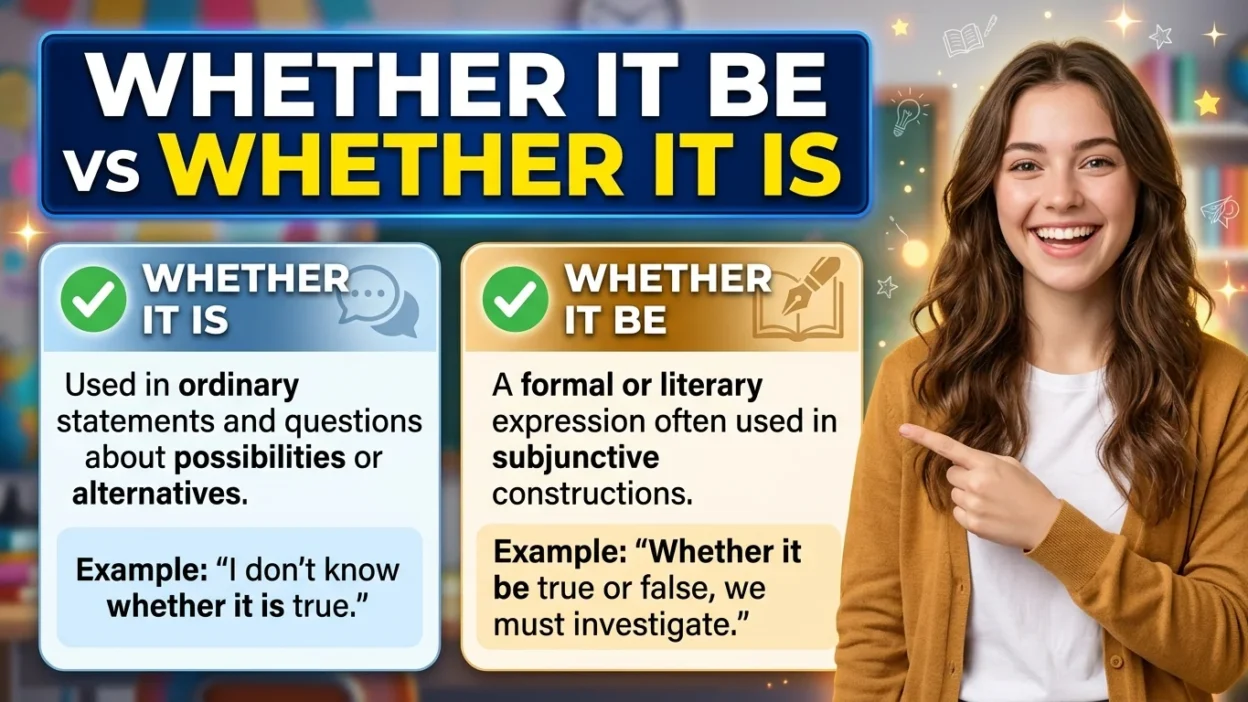
Choosing between “whether it be” and “whether it is” can be confusing, especially when both phrases seem to fit the same sentence. Although they can express similar ideas, they differ in grammar, tone, and usage. “Whether it is” is the more common choice in everyday English.
You can use it to discuss possibilities, compare options, or introduce different situations. For example, “Whether it is sunny or rainy, we will go outside” sounds natural in ordinary conversation.
In contrast, “whether it be” uses the subjunctive mood and often appears in formal, literary, or rhetorical writing. For instance, “Whether it be sunny or rainy, we will continue our journey” has a more formal tone.
What Does “Whether It Is” Mean?
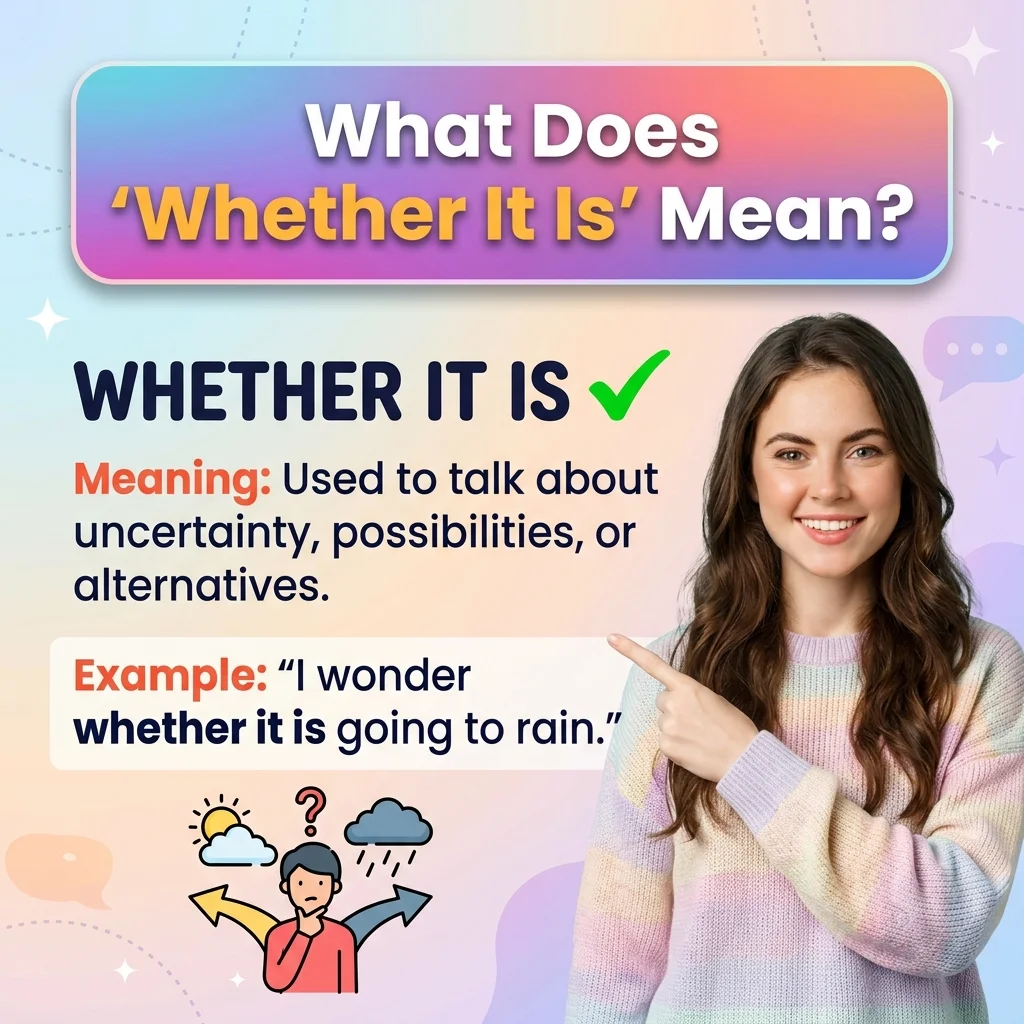
“Whether it is” is a common English construction used to introduce alternatives, possibilities, or conditions. It normally refers to something that may be true, possible, or applicable.
The phrase contains:
- Whether — introduces alternatives or possibilities.
- It — a pronoun referring to a thing, situation, idea, or condition.
- Is — the present-tense form of the verb “to be.”
For example:
I don’t know whether it is safe.
Here, the speaker is uncertain about whether something is safe.
Another example is:
She cannot decide whether it is better to stay or leave.
The speaker is considering two possibilities: staying or leaving.
When Should You Use “Whether It Is”?
You can use “whether it is” when you are discussing:
- A possibility
- An uncertainty
- Two or more alternatives
- A condition
- A choice
- A fact that has not yet been established
For example:
We need to find out whether it is true.
This means that the truth of the statement is uncertain.
You can also use it when comparing alternatives:
I don’t know whether it is better to call or send a message.
The phrase sounds natural in both everyday speech and formal writing.
What Does “Whether It Be” Mean?
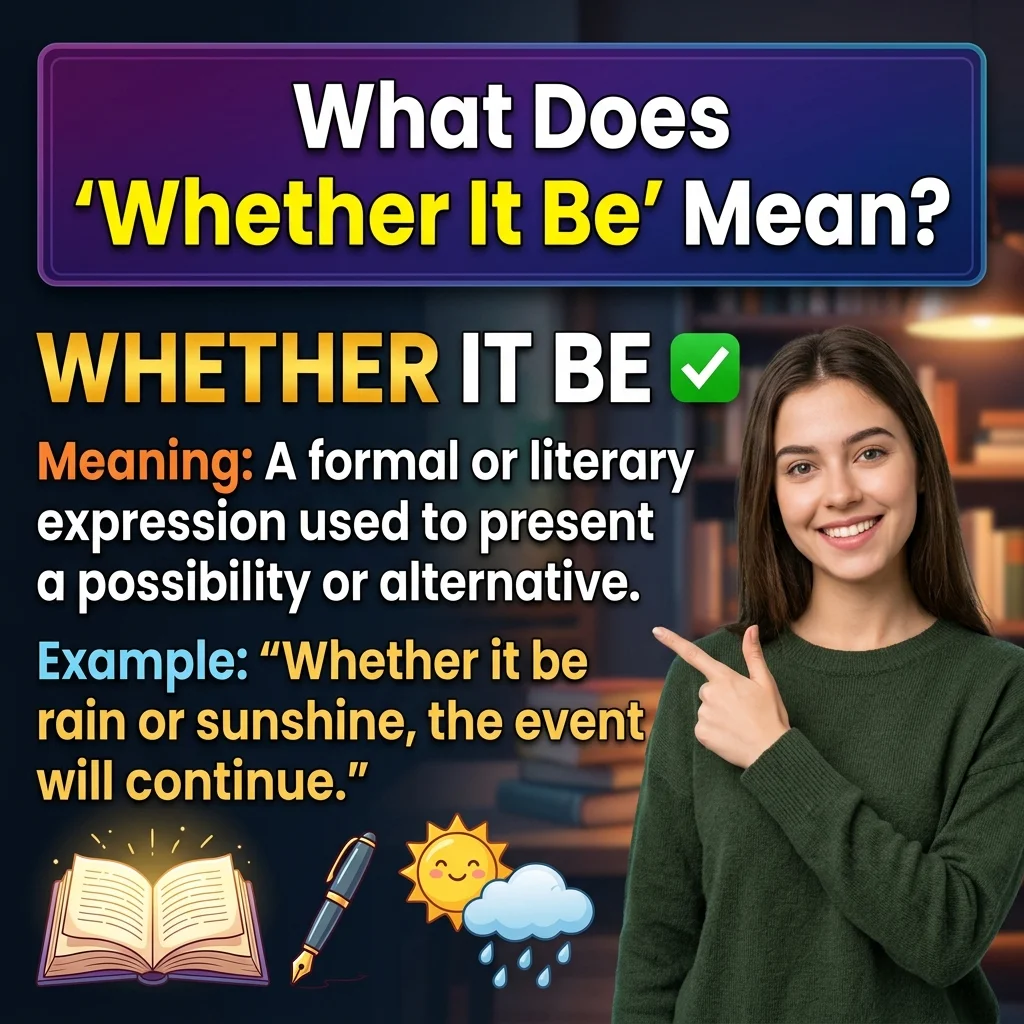
“Whether it be” is a more formal and somewhat traditional construction. It is commonly used to present alternatives or different possibilities.
For example:
Whether it be rain or sunshine, the event will continue.
This means that regardless of whether there is rain or sunshine, the event will continue.
The word “be” is the base form of the verb “to be.” In this construction, it is traditionally associated with the subjunctive mood.
You may see “whether it be” more frequently in:
- Formal writing
- Literature
- Speeches
- Academic-style writing
- Legal or traditional language
- Expressions involving alternatives
For example:
Whether it be a small mistake or a serious error, we should correct it.
This sounds more formal than:
Whether it is a small mistake or a serious error, we should correct it.
Both can communicate a similar idea, but their style is different.
Whether It Be vs Whether It Is: The Main Difference
The biggest difference between “whether it be” and “whether it is” is grammatical mood and style.
“Whether it is” uses the ordinary present form of the verb “to be.” It is the natural choice for most everyday situations.
“Whether it be” uses the base form “be” and is commonly associated with a subjunctive or formal construction.
Consider these examples:
I don’t know whether it is correct.
This is ordinary, natural English.
Whether it be correct or incorrect, we should check the information.
This presents two alternatives in a more formal way.
The first sentence focuses on uncertainty. The second emphasizes alternatives.
Quick Comparison
| Expression | Commonness | Style | Main Use |
| Whether it is | Very common | Neutral | Everyday statements and questions |
| Whether it be | Less common | Formal/traditional | Alternatives, formal writing, subjunctive constructions |
| Whether it was | Common | Neutral | Past situations |
| Whether it will be | Common | Neutral | Future possibilities |
| Whether it may be | Common | Formal/neutral | Possibilities and uncertainty |
Why Do We Say “Whether It Be”?
The construction “whether it be” can be understood through the subjunctive mood.
In English, the subjunctive is sometimes used when discussing hypothetical, uncertain, desired, or non-specific situations. The form of the verb may remain in its base form.
For example:
Whether it be true or false, we need evidence.
The word “be” does not change to “is” because the construction is presenting a general or hypothetical alternative.
Compare:
Whether it is true or false, we need evidence.
and:
Whether it be true or false, we need evidence.
Both sentences are understandable and grammatical, but the second has a more formal or literary tone.
Why Is “Whether It Is” More Common?
Modern English generally prefers simpler and more direct constructions.
In everyday conversation, people usually say:
I don’t know whether it is possible.
rather than:
I don’t know whether it be possible.
The second sentence can sound old-fashioned or unnatural in ordinary conversation.
This is why “whether it is” is usually the safer choice for:
- Everyday conversations
- Emails
- General blog posts
- Informal writing
- Messages
- Beginner English
- Most business communication
However, “whether it be” still has a legitimate place in formal English.
Whether It Be vs Whether It Is in Everyday English
If your goal is natural, modern English, “whether it is” will usually be the better choice.
For example:
I don’t know whether it is available.
This sounds completely natural.
Using “whether it be” here would sound unnecessarily formal:
I don’t know whether it be available.
A native speaker might find the second sentence unusual depending on the context.
However, when “whether it be” introduces a series of alternatives, it can sound appropriate:
Whether it be summer or winter, she enjoys traveling.
This has a formal or polished style.
Examples of “Whether It Is”
Here are several examples showing how “whether it is” works naturally.
Example 1
I don’t know whether it is going to rain.
The speaker is uncertain about the weather.
Example 2
She asked whether it is possible to change the appointment.
The speaker is asking about possibility.
Example 3
We need to determine whether it is safe.
The sentence expresses a need to establish safety.
Example 4
He wasn’t sure whether it is the right decision.
The speaker is uncertain about a decision.
Example 5
Tell me whether it is true.
The speaker wants to know if something is true.
Example 6
I wonder whether it is worth the effort.
The speaker is considering whether something is worthwhile.
Example 7
We need to know whether it is available.
The speaker wants information about availability.
Example 8
She couldn’t decide whether it is better to stay home.
The sentence describes uncertainty about a choice.
Examples of “Whether It Be”
Now let’s look at examples where “whether it be” works naturally.
Example 1
Whether it be day or night, the guards remain alert.
The sentence presents two alternatives.
Example 2
Whether it be a small problem or a major issue, we should address it.
The construction covers different possibilities.
Example 3
Whether it be true or false, the claim deserves investigation.
The sentence presents two possible conditions.
Example 4
Whether it be rain or snow, the match will continue.
This means the match will continue regardless of the weather condition.
Example 5
Whether it be a friend, colleague, or stranger, everyone deserves respect.
The construction introduces several alternatives.
Example 6
Whether it be success or failure, every experience teaches us something.
This has a formal, motivational style.
Example 7
Whether it be a minor error or a serious mistake, it should be corrected.
Again, the phrase introduces alternative possibilities.
Example 8
Whether it be in business or education, communication is important.
This presents two areas in which the statement applies.
Whether It Be vs Whether It Is: Formality
One of the easiest ways to understand the difference is to think about tone.
“Whether It Is” — Neutral
We need to know whether it is correct.
This sounds straightforward and conversational.
“Whether It Be” — Formal
Whether it be correct or incorrect, we should examine the evidence.
This sounds more polished and formal.
Neither construction is automatically “better.” The correct choice depends on the sentence and the tone you want.
Can “Whether It Be” and “Whether It Is” Be Interchanged?
Sometimes they can be used to express a similar general idea, but they are not always interchangeable without changing the naturalness or grammatical structure of the sentence.
Consider:
I don’t know whether it is true.
This is natural.
Replacing “is” with “be” gives:
I don’t know whether it be true.
This sounds unusual in modern everyday English.
Now consider:
Whether it be true or false, we need evidence.
Changing it to:
Whether it is true or false, we need evidence.
This is also grammatical and natural.
So, in many sentences involving alternatives, both forms can work, but “whether it be” gives the sentence a more formal or literary feel.
Whether It Is vs Whether It Be: Grammar Explained
To understand the difference more deeply, it helps to examine the verbs.
“Is”
Is is a present-tense form of “to be.”
Examples:
- It is good.
- It is possible.
- It is important.
- It is true.
- It is difficult.
When used after “whether,” it generally describes a specific situation or possibility.
“Be”
Be is the base form of “to be.”
Examples:
- Be careful.
- Let it be.
- Whether it be true or false.
In “whether it be,” the base form is used in a construction associated with the subjunctive.
The Role of the Subjunctive
The subjunctive mood can be confusing for English learners because it is not always obvious.
In simple terms, the subjunctive is often used for situations involving:
- Hypothetical ideas
- Wishes
- Demands
- Recommendations
- Possibilities
- Non-specific conditions
For example:
Whether it be true or false, we should investigate.
The sentence is not simply stating that something is true. It is considering either possibility.
Another common example is:
If he be found guilty, further action may be taken.
This type of “be” construction is formal and less common in everyday modern English.
Common Mistakes With “Whether It Be”
One common mistake is using “whether it be” simply because it sounds more sophisticated.
For example:
I don’t know whether it be available.
Although you may encounter similar constructions in older or highly formal writing, this sentence sounds unnatural in modern standard English.
A better sentence is:
I don’t know whether it is available.
Another mistake is assuming that “whether it be” should always replace “whether it is.”
That is not true.
Use the construction that fits the sentence and intended tone.
Common Mistakes With “Whether It Is”
Another common mistake is confusing whether with if.
In many situations, “whether” and “if” can both introduce uncertainty:
I don’t know whether it is correct.
I don’t know if it is correct.
Both are common.
However, whether is particularly useful when presenting alternatives.
For example:
I don’t know whether to stay or leave.
This sounds natural and clearly presents two choices.
Whether vs If
The difference between whether and if deserves attention because it frequently appears with “whether it is.”
Whether
“Whether” is commonly used when there are two or more possibilities.
I don’t know whether he is coming or staying home.
If
“If” often introduces a condition.
If he comes, we will start the meeting.
Compare:
I don’t know whether it is safe.
with:
If it is safe, we can continue.
The first expresses uncertainty. The second expresses a condition.
“Whether It Is” With Two Alternatives
A very common structure is:
Whether it is X or Y…
For example:
Whether it is summer or winter, she goes jogging every morning.
Another example:
Whether it is expensive or affordable, quality matters.
This construction is extremely useful because it allows you to discuss different possibilities.
“Whether It Be” With Two Alternatives
The same structure can use “be”:
Whether it be summer or winter, she goes jogging every morning.
This is grammatical, but more formal.
Another example:
Whether it be expensive or affordable, quality matters.
Again, the meaning is similar, but the style is more formal.
Which One Should Beginners Use?
If you are learning English and are unsure which expression to choose, “whether it is” is usually the safer option.
Use “whether it is” for ordinary communication.
For example:
I don’t know whether it is correct.
This is simple, clear, and natural.
Learn “whether it be” mainly so you can recognize it when reading formal, literary, historical, or polished English.
You can use it when the sentence naturally calls for a formal alternative structure.
Whether It Be vs Whether It Is in Formal Writing
Formal writing does not automatically require “whether it be.”
This is an important point.
Some learners think that using unusual grammar makes their writing more professional. Usually, clear writing is better than unnecessarily complicated writing.
For example:
We need to determine whether it is appropriate.
This is formal and perfectly acceptable.
You do not need to write:
We need to determine whether it be appropriate.
The second version may sound awkward in modern professional writing.
However:
Whether it be a question of cost, time, or quality, each factor must be considered.
Here, “whether it be” works well because it introduces a formal list of alternatives.
Whether It Be vs Whether It Is in Literature
Literature often uses “whether it be” because writers may intentionally choose a formal, poetic, or traditional style.
For example:
Whether it be love, friendship, or loyalty, every relationship requires trust.
The construction has a polished rhythm.
In everyday conversation, you might simply say:
Whether it is love, friendship, or loyalty, every relationship requires trust.
Both communicate essentially the same idea.
Examples Side by Side
Here are some useful comparisons.
| Whether It Is | Whether It Be |
| I don’t know whether it is true. | Whether it be true or false, we should investigate. |
| Tell me whether it is possible. | Whether it be possible or impossible, we must try. |
| We need to know whether it is safe. | Whether it be safe or dangerous, we need to assess it. |
| She asked whether it is available. | Whether it be available or unavailable, we need another option. |
| I wonder whether it is necessary. | Whether it be necessary or unnecessary, we should review the plan. |
The examples demonstrate an important pattern: “whether it is” is especially natural when expressing uncertainty about a particular situation, while “whether it be” often works well when presenting alternatives in a formal way.
How to Choose the Correct Expression
When you are unsure, ask yourself three questions.
Is This Everyday English?
If yes, choose:
Whether it is
Example:
I don’t know whether it is working.
Am I Presenting Alternatives?
If you are presenting alternatives in a formal or literary style, “whether it be” may work.
Example:
Whether it be day or night, the service operates continuously.
Does the Sentence Sound Natural?
Read the sentence aloud.
If “whether it be” sounds overly formal or strange, use “whether it is” when grammatically appropriate.
Good English is not about choosing the most complicated form. It is about choosing the clearest and most suitable form.
Spelling Tips for “Whether”
A surprisingly common mistake is spelling whether incorrectly.
The correct spelling is:
Whether
Common incorrect forms include:
- Wether
- Wheather
- Weather
Remember that whether and weather are different words.
Whether
Used for alternatives or uncertainty:
I don’t know whether she will come.
Weather
Refers to atmospheric conditions:
The weather is beautiful today.
A simple memory trick is:
Whether = choice or possibility
Weather = rain, sunshine, wind, temperature, etc.
Whether It Be vs Whether It Is: Pronunciation
“Whether” is generally pronounced like “WEH-thər” in standard English.
“It is” is pronounced naturally as two words, although in conversation it may become contracted:
Whether it’s…
For example:
I don’t know whether it’s true.
The contraction “it’s” means “it is.”
You should not confuse:
whether it is
with:
weather it is
The second version is incorrect when you mean “whether.”
Common Grammar Mistakes to Avoid
Mistake 1: Using “weather” Instead of “whether”
Incorrect:
I don’t know weather it is true.
Correct:
I don’t know whether it is true.
Mistake 2: Using “whether it be” Everywhere
Incorrect or unnatural in many everyday contexts:
I don’t know whether it be available.
Better:
I don’t know whether it is available.
Mistake 3: Assuming “Whether” Always Means “If”
While “whether” and “if” can overlap, “whether” is particularly useful when alternatives are involved.
I don’t know whether to stay or leave.
Mistake 4: Overcomplicating Formal Writing
Don’t use “whether it be” simply to make your writing sound intelligent.
Clear writing is usually more effective.
Mistake 5: Forgetting the Alternatives
“Whether” often introduces alternatives.
For example:
Whether you agree or disagree, your opinion matters.
This structure is very common.
Whether It Be or Whether It Is: Which Is Correct?
The answer is: both can be correct, depending on the sentence.
Use “whether it is” for normal, modern English when discussing whether something is true, possible, available, correct, or appropriate.
Use “whether it be” when you want a more formal, traditional, literary, or alternative-based construction.
For example:
I don’t know whether it is possible.
This is natural and correct.
Whether it be possible or impossible, we must try.
This is also correct, but more formal.
Can You Say “Whether It Be True or False”?
Yes.
Whether it be true or false, we need to examine the evidence.
This is a well-formed formal construction.
You can also say:
Whether it is true or false, we need to examine the evidence.
This is more neutral and common.
Can You Say “Whether It Is True or False”?
Yes, absolutely.
This is one of the most common structures using “whether.”
Examples include:
Whether it is true or false, we need evidence.
I don’t know whether it is true or false.
The first sentence treats both possibilities equally. The second expresses uncertainty.
Can You Use “Whether It Be” in Conversation?
Yes, but it depends on the context.
In casual conversation, it may sound formal or old-fashioned.
For example:
Whether it be rain or sunshine, I’ll go.
This is grammatically acceptable, but a casual speaker might say:
Whether it’s raining or sunny, I’ll go.
The second version sounds more natural in everyday conversation.
Is “Whether It Be” Old-Fashioned?
It can sound old-fashioned depending on the sentence.
However, it is not simply an incorrect or obsolete expression. It continues to appear in formal and literary English.
Its use is more limited than “whether it is.”
The key is understanding the tone.
Is “Whether It Is” Always Better?
No.
“Whether it is” is more common, but “whether it be” can be stylistically appropriate.
For example:
Whether it be a friend or an enemy, everyone deserves fairness.
Here, “whether it be” creates a formal rhetorical effect.
Replacing it with:
Whether it is a friend or an enemy, everyone deserves fairness.
is also grammatical and perhaps more modern.
Therefore, neither expression is universally better.
Quick Rule to Remember
Here is the easiest rule:
Use “whether it is” for normal modern English.
Use “whether it be” for formal, literary, or alternative-focused constructions.
If you remember this basic distinction, you will avoid most mistakes involving these expressions.
More Examples for Practice
Try reading these examples carefully.
Neutral English
I don’t know whether it is worth buying.
Formal English
Whether it be worth buying or not, we should consider the long-term benefits.
Neutral English
She asked whether it is available.
Formal English
Whether it be available or not, we need a backup plan.
Neutral English
We need to determine whether it is necessary.
Formal English
Whether it be necessary or unnecessary, the decision must be reviewed.
Neutral English
Tell me whether it is correct.
Formal English
Whether it be correct or incorrect, the document requires careful review.
Frequently Asked Questions
What is the difference between “whether it be” and “whether it is”?
“Whether it is” is the more common modern construction used to express uncertainty or possibility. “Whether it be” is more formal and is often used to present alternatives or hypothetical possibilities.
Is “whether it be” grammatically correct?
Yes. “Whether it be” is a legitimate grammatical construction, particularly in formal, literary, or traditional English.
Is “whether it is” more common than “whether it be”?
Yes. “Whether it is” is much more common in modern everyday English and is generally the safest choice for ordinary communication.
Can I use “whether it be” in an essay?
Yes. You can use it when it fits the sentence and tone. However, do not use it simply to make your essay sound more formal. Clear and natural English is usually preferable.
Is “whether it be” subjunctive?
It can be understood as a subjunctive construction in formal English. The base form “be” is used rather than the ordinary present form “is.”
Should I say “whether it is true or whether it be true”?
Both are possible, but they have different stylistic effects. “Whether it is true” is neutral and common, while “whether it be true” sounds more formal.
Can “whether” be followed by “is”?
Yes. For example:
I don’t know whether it is correct.
This is completely grammatical.
Can “whether” be followed by “be”?
Yes. For example:
Whether it be true or false, we need evidence.
This is also grammatical.
Is “whether it be” formal English?
Generally, yes. It often gives writing a formal, literary, traditional, or rhetorical tone.
Which is better for beginners: “whether it be” or “whether it is”?
Beginners should generally use “whether it is” because it is more common and easier to use naturally.
What is the difference between “whether” and “weather”?
Whether refers to alternatives or possibilities. Weather refers to atmospheric conditions such as rain, wind, snow, and sunshine.
Can I replace “whether it be” with “whether it is”?
In many sentences, yes, especially when presenting alternatives. However, the sentence may become less formal and sometimes require slight restructuring.
Is “whether it be true or false” correct?
Yes. It is a formal construction meaning that the statement may be true or false.
Is “whether it is true or false” correct?
Yes. It is natural, modern, and widely used.
Which phrase should I use in everyday conversation?
In most everyday situations, use “whether it is” or the natural contraction “whether it’s.”
Final Thoughts
Understanding whether it be vs whether it is becomes much easier when you focus on context rather than trying to memorize complicated grammar rules. “Whether it is” is the standard, natural choice for most modern English. It works especially well when you are expressing uncertainty about whether something is true, possible, correct, safe, or necessary.
“Whether it be” is also grammatically valid, but it has a more formal, traditional, literary, or rhetorical feel. It is particularly useful when introducing alternatives such as “whether it be true or false” or “whether it be day or night.”

Michael Collins is a skilled writer who creates clear, practical, and reader-friendly content. He focuses on language, grammar, word meanings, and everyday expressions, making complex topics simple to understand.