Planning a meeting, arranging a trip, or confirming weekend plans can become confusing when someone says “this Friday” or “next Friday.” Although both expressions refer to a Friday, they can point to different dates depending on when you have the conversation and how the speaker uses them.
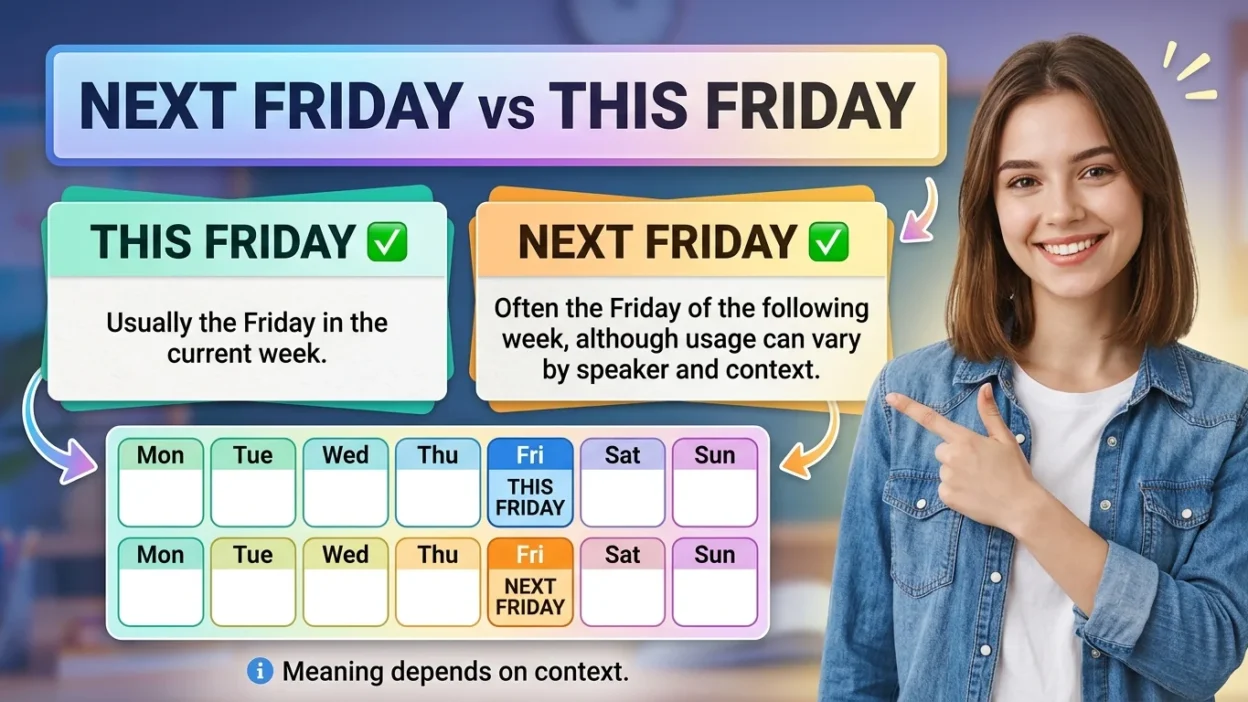
“This Friday” usually means the Friday in the current week, while “next Friday” often refers to the Friday of the following week. However, people sometimes use “next Friday” to mean the upcoming Friday, which can create misunderstandings.
For example, if today is Tuesday, someone might use “this Friday” for the Friday just three days away. Another person might say “next Friday” to refer to the Friday eight days later. The exact meaning can also depend on regional habits and personal preferences.
What Does “This Friday” Mean?
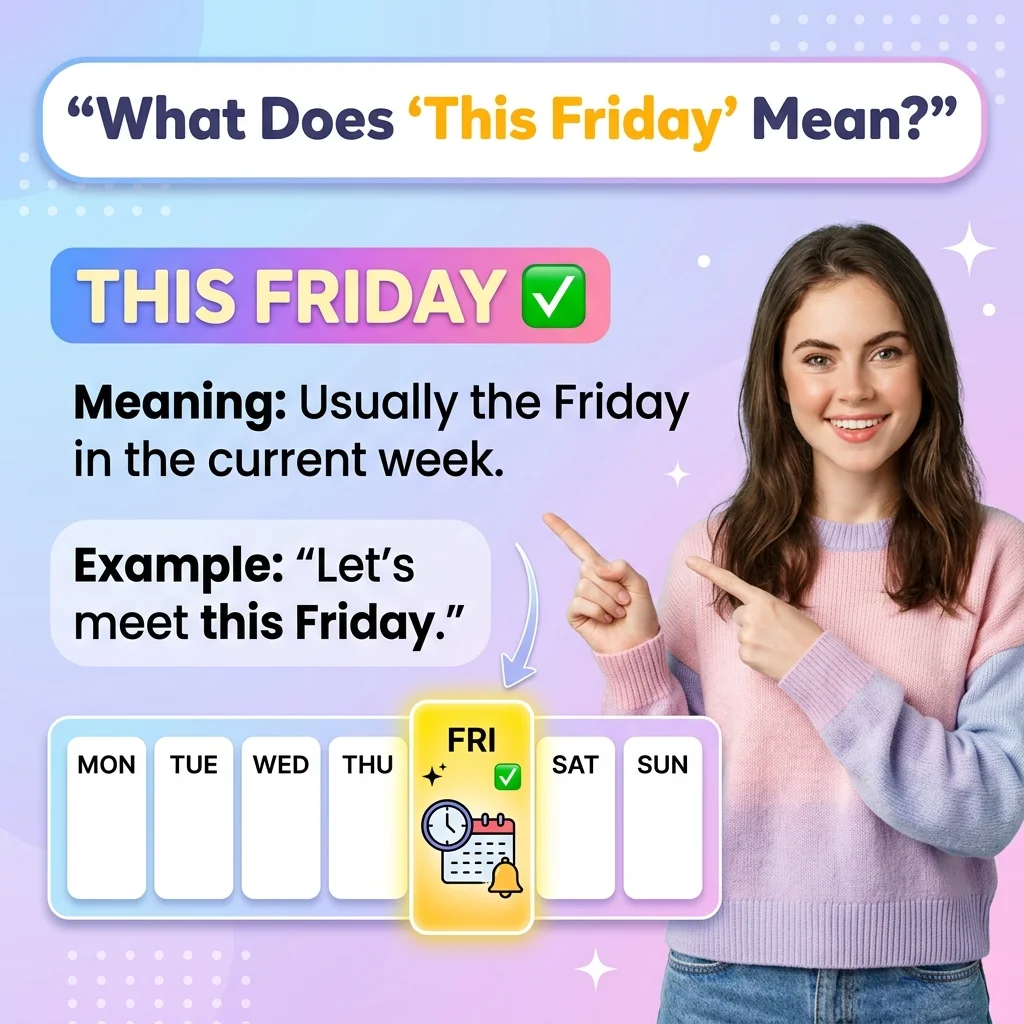
This Friday usually refers to the Friday that belongs to the current week or the Friday closest to the present time. It is commonly used when talking about an upcoming Friday within the current week.
For example:
“I have a meeting this Friday.”
This generally means the meeting is scheduled for the Friday coming up in the current week.
However, the exact meaning can depend on the day you are speaking. If today is Monday, “this Friday” normally means the Friday only a few days away. If today is Saturday, some people may use “this Friday” to refer to the Friday that has just passed, while others may interpret it as the upcoming Friday. This is why context matters.
Examples of “This Friday”
- “We are going to the cinema this Friday.”
- “My exam is this Friday.”
- “Can you send me the report this Friday?”
- “I’m free this Friday evening.”
- “The school will close this Friday.”
In each example, this Friday connects the event to the Friday associated with the current week.
When Should You Use “This Friday”?
Use this Friday when:
- You mean the Friday in the current week.
- The Friday is relatively close to the present.
- You are discussing a plan or event that people already understand.
- You want to refer to the Friday coming up soon.
Example:
“Today is Tuesday, and I’m visiting my grandparents this Friday.”
Here, “this Friday” clearly refers to the Friday later in the same week.
What Does “Next Friday” Mean?
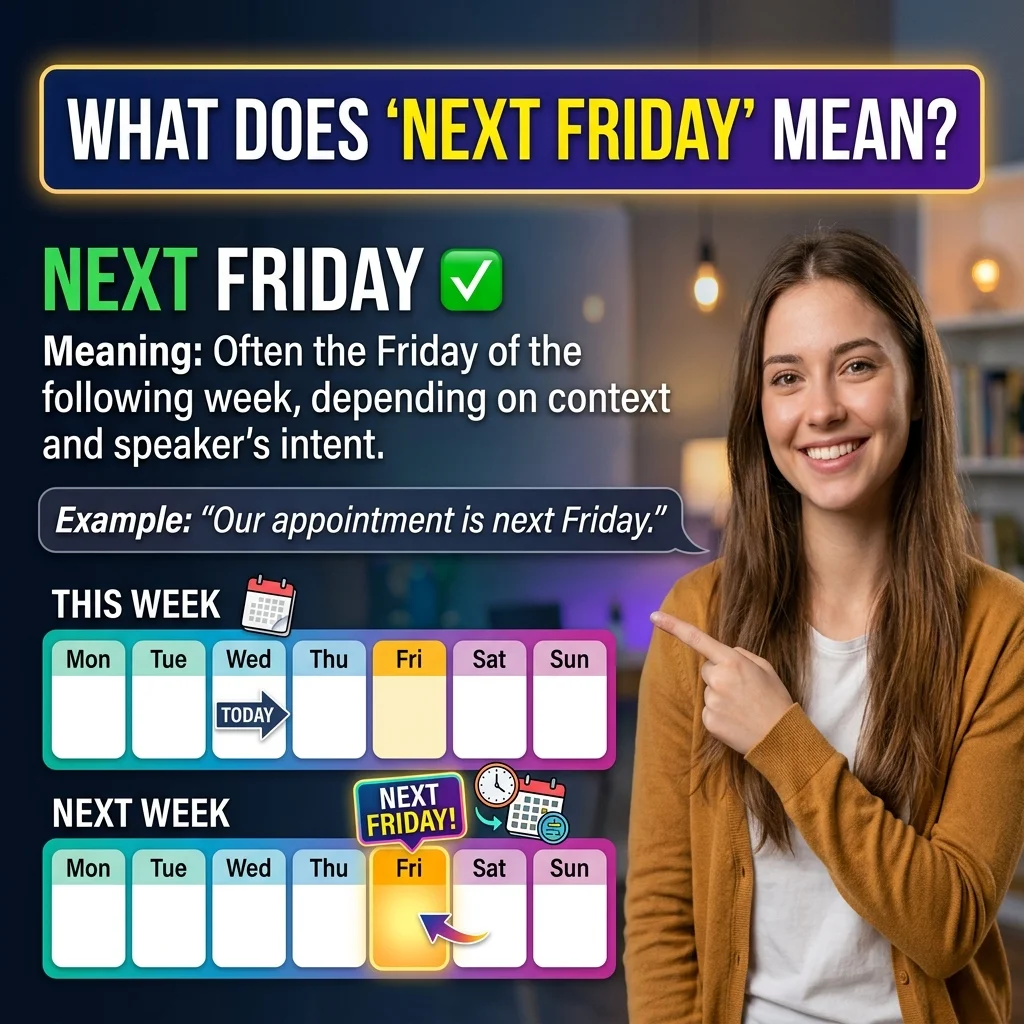
Next Friday usually refers to the Friday after the current week’s Friday. In many situations, it means the Friday in the following week.
For example:
“I’ll call you next Friday.”
If today is Monday, this often means the Friday of the following week, not the Friday only four days away.
However, English speakers do not always use “next Friday” in exactly the same way. Some people use it to mean the upcoming Friday, especially when speaking casually. This difference in interpretation is one of the main reasons the phrase can cause confusion.
Examples of “Next Friday”
- “Our next class is next Friday.”
- “I’m traveling next Friday.”
- “The project deadline is next Friday.”
- “We can discuss the issue next Friday.”
- “She is getting married next Friday.”
Depending on the speaker’s intention, these sentences may refer to the Friday immediately ahead or the Friday in the following week. When the date matters, it is better to clarify.
When Should You Use “Next Friday”?
Use next Friday when:
- You mean the Friday after the current week.
- You are referring to a future event in the following week.
- The context makes the intended Friday clear.
- You want to discuss a future plan without mentioning the exact date.
Example:
“Today is Wednesday. I have an appointment this Friday, but I’ll be available next Friday.”
In this sentence, “this Friday” means the upcoming Friday, while “next Friday” means the Friday after it.
Next Friday vs This Friday: The Main Difference
The main difference is how the two expressions connect a Friday to the current week.
| Expression | Common meaning | Example |
| This Friday | The Friday associated with the current week, often the upcoming Friday | “I have an exam this Friday.” |
| Next Friday | Usually the Friday in the following week | “I’ll submit the assignment next Friday.” |
The important point is that “this Friday” usually feels closer to the present, while “next Friday” often suggests the following week.
A Simple Weekly Example
Suppose today is Monday, September 14.
- This Friday = Friday, September 18
- Next Friday = Friday, September 25
This is the most common interpretation when someone distinguishes between the two phrases.
This Friday
The Friday coming up in the current week.
Monday → Tuesday → Wednesday → Thursday → Friday
Next Friday
Usually the Friday in the following week.
Current Friday → Saturday → Sunday → Monday → … → Next Friday
Is “Next Friday” the Same as “This Friday”?
Not always. In standard everyday usage, many speakers distinguish them:
- This Friday = the Friday in the current week.
- Next Friday = the Friday in the following week.
But some speakers use next Friday to mean the nearest upcoming Friday. This is especially common in casual conversation.
For example, if today is Monday, one person might say:
“Let’s meet next Friday.”
They may mean the Friday coming in four days.
Another person might say:
“Let’s meet this Friday.”
They may mean exactly the same day.
This does not necessarily mean one person is using incorrect grammar. It means the phrase can be ambiguous.
Why Does This Confusion Happen?
The word next can mean “the one immediately following,” but it can also mean “the following one in a sequence.” In time expressions, people may use it differently.
For example:
- “Next Monday” may mean the upcoming Monday.
- “Next week” usually means the week after the current week.
- “Next Friday” may be interpreted differently depending on the speaker.
Because of this, it is often better to use the exact date when making important plans.
This Friday vs Next Friday: Examples in Different Situations
Understanding examples is one of the easiest ways to learn the difference.
Example 1: Today Is Monday
Suppose today is Monday.
This Friday:
“I’m going to the dentist this Friday.”
This normally means the Friday coming in a few days.
Next Friday:
“I’m going to the dentist next Friday.”
This normally means the Friday after the upcoming Friday.
Example 2: Today Is Thursday
Suppose today is Thursday.
This Friday:
“Our test is this Friday.”
This clearly suggests tomorrow.
Next Friday:
“Our test is next Friday.”
Many speakers would understand this as the Friday after tomorrow, but some may interpret it as tomorrow. If the test is important, specify the date.
Example 3: Today Is Saturday
Suppose today is Saturday.
This Friday:
“I went shopping this Friday.”
This may refer to the Friday that just passed.
Next Friday:
“I’m going shopping next Friday.”
This usually refers to the upcoming Friday.
This example shows why the meaning can change depending on whether the Friday has already passed.
Example 4: Making a Work Appointment
“Can we meet this Friday to discuss the project?”
This usually means the nearest Friday in the current week.
“Can we meet next Friday to discuss the project?”
This usually suggests the following week, although clarification may be needed.
A clearer version would be:
“Can we meet on Friday, September 25, to discuss the project?”
Example 5: School Plans
“Our school trip is this Friday.”
The trip is generally happening in the current week.
“Our school trip is next Friday.”
The trip is generally planned for the following week.
Example 6: Social Invitations
“Would you like to come over this Friday?”
This usually means the Friday coming up soon.
“Would you like to come over next Friday?”
This may mean the Friday after the upcoming one, but casual speakers sometimes use it for the upcoming Friday.
How to Avoid Confusion When Making Plans
If you want your message to be completely clear, use the day and date together.
Instead of saying:
“Let’s meet next Friday.”
Say:
“Let’s meet on Friday, September 25.”
You can also use phrases such as:
- This coming Friday
- The Friday after this one
- Friday, September 25
- The upcoming Friday
- The Friday after next
What Does “This Coming Friday” Mean?
This coming Friday usually means the next Friday that will occur after today.
For example, if today is Tuesday:
“I’ll see you this coming Friday.”
This clearly refers to the Friday only a few days away.
It is often more precise than this Friday when the speaker wants to emphasize that the Friday is upcoming.
What Does “The Friday After Next” Mean?
The Friday after next usually means the Friday after the next upcoming Friday.
For example, if today is Monday:
- Upcoming Friday = September 18
- Friday after next = September 25
However, this phrase can also be confusing in some contexts. Using the exact date is the safest option.
Grammar Rules for Using “This Friday” and “Next Friday”
Both expressions are grammatically correct. The key is using them naturally in a sentence.
Rule 1: Use “On” Before Friday When Needed
When referring to a specific day, you can use on.
“I will visit you on Friday.”
But when using this Friday or next Friday, the preposition on is usually unnecessary.
Natural:
“I’ll visit you this Friday.”
Natural:
“I’ll visit you next Friday.”
Less natural in everyday English:
“I’ll visit you on this Friday.”
“I’ll visit you on next Friday.”
The versions without on are generally preferred.
Rule 2: Use “This” and “Next” Directly Before Friday
The correct structure is:
This + Friday
Next + Friday
Examples:
- This Friday
- Next Friday
- This Monday
- Next Sunday
Do not add unnecessary words between them.
Rule 3: Use the Correct Capitalization
Days of the week are proper nouns, so Friday should always begin with a capital letter.
Correct:
“I’ll call you next Friday.”
Incorrect:
“I’ll call you next friday.”
Rule 4: Use “Friday” for a Specific Day
If you are referring to a general habit, use Fridays.
“I go jogging on Fridays.”
If you are referring to one particular Friday, use Friday.
“I’m going jogging this Friday.”
Common Mistakes with “Next Friday” and “This Friday”
Even advanced English learners sometimes make mistakes with these expressions. Here are the most common ones.
Mistake 1: Assuming Everyone Interprets “Next Friday” the Same Way
Some people understand next Friday as the upcoming Friday. Others understand it as the Friday after the upcoming Friday.
Better approach: If the timing is important, mention the date.
“Let’s meet next Friday, September 25.”
Mistake 2: Using “On Next Friday”
Many learners say:
“I will go there on next Friday.”
This is understandable, but it is not the most natural form.
Better:
“I will go there next Friday.”
Or:
“I will go there on Friday.”
Mistake 3: Confusing “This Friday” with “Every Friday”
This Friday refers to one specific Friday.
Every Friday refers to a repeated habit.
Correct:
“I have a meeting this Friday.”
Correct:
“I have a meeting every Friday.”
Mistake 4: Forgetting That “This Friday” Can Refer to a Past Friday
If today is Saturday, someone may use this Friday to refer to the Friday that just passed.
For example:
“I met my teacher this Friday.”
This may mean the Friday earlier in the same week.
To avoid confusion, use:
“I met my teacher yesterday.”
Or:
“I met my teacher on Friday.”
Mistake 5: Using “Next Friday” When You Mean “The Following Friday”
The phrase the following Friday is often clearer in formal writing.
For example:
“The meeting will take place the following Friday.”
This is especially useful when describing events in a story, report, or business document.
Next Friday vs This Friday in American and British English
The expressions this Friday and next Friday are used in both American and British English. The main difference is not usually the country but the speaker’s personal interpretation.
In both varieties:
- This Friday commonly refers to the Friday in the current week.
- Next Friday commonly refers to the Friday in the following week.
However, casual usage can vary.
American English
In American English, next Friday may sometimes mean the upcoming Friday, especially when the speaker is thinking about the next occurrence of Friday.
British English
British English also uses next Friday in both ways, depending on context. Some speakers prefer this Friday for the upcoming Friday and next Friday for the following week.
The Best Advice
Do not focus too much on regional differences. Instead, focus on clarity.
If someone says:
“I’ll see you next Friday.”
You can ask:
“Do you mean this coming Friday or the Friday after?”
This is a natural and polite way to confirm the plan.
Formal vs Informal Usage
Both expressions are acceptable in casual and formal English, but the level of clarity may differ.
Informal Conversation
“Are you free this Friday?”
“Can we meet next Friday?”
These are perfectly natural in everyday speech.
Formal Writing
In formal writing, especially for business, school, travel, or appointments, it is often better to include the exact date.
Less precise:
“The meeting will be held next Friday.”
More precise:
“The meeting will be held on Friday, September 25.”
This helps readers understand the schedule without guessing.
Can “This Friday” Refer to a Friday That Has Passed?
Yes, depending on the day and context.
If today is Saturday, the phrase this Friday may refer to the Friday that just passed because it belongs to the current calendar week.
For example:
“I submitted the assignment this Friday.”
This could mean the assignment was submitted yesterday.
However, many speakers prefer to say:
“I submitted the assignment yesterday.”
or
“I submitted the assignment on Friday.”
These alternatives are clearer.
Why Context Matters
Time expressions are not always fixed. Their meaning depends on:
- The current day
- The speaker’s intention
- The listener’s expectations
- Whether the event is past or future
- The surrounding conversation
That is why exact dates are useful when there is any possibility of confusion.
Next Friday vs This Friday: Quick Comparison
| Feature | This Friday | Next Friday |
| Common meaning | Friday in the current week | Friday in the following week |
| Usually refers to | The upcoming Friday | A later Friday |
| Can be ambiguous? | Yes | Yes |
| Best for casual conversation? | Yes | Yes |
| Best for formal schedules? | Use with a date if needed | Use with a date if needed |
| Example | “I’ll see you this Friday.” | “I’ll see you next Friday.” |
More Examples to Practice
Here are additional examples to help you understand the difference.
Everyday Conversation
- “I’m busy this Friday.”
- “Are you free next Friday?”
- “We’re having dinner this Friday.”
- “I’ll visit my cousin next Friday.”
- “The movie comes out this Friday.”
- “Our next lesson is next Friday.”
Work and Business
- “The report is due this Friday.”
- “We can review the contract next Friday.”
- “The manager will return this Friday.”
- “The team meeting has been moved to next Friday.”
- “Please send the invoice this Friday.”
School and Education
- “Our English test is this Friday.”
- “The teacher will explain the next chapter next Friday.”
- “The assignment must be submitted this Friday.”
- “The school competition will take place next Friday.”
Travel and Events
- “My flight is this Friday.”
- “We’re leaving for Lahore next Friday.”
- “The festival begins this Friday.”
- “The concert will be held next Friday.”
How to Choose the Right Phrase
When deciding between this Friday and next Friday, ask yourself:
- Am I talking about the current week? Use this Friday in the usual sense.
- Am I talking about the following week? Use next Friday in the usual sense.
- Could the listener misunderstand me? Add the exact date.
- Am I discussing a past event? Consider using “on Friday” or “last Friday” for greater clarity.
- Am I writing a formal schedule? Include the full date whenever possible.
A Simple Memory Trick
Think of it this way:
This Friday = the Friday connected to now. Next Friday = the Friday that comes after it.
This is a useful starting point, but remember that everyday speakers may use next Friday differently.
Frequently Asked Questions
Is “this Friday” grammatically correct?
Yes. This Friday is grammatically correct and commonly used to refer to the Friday in the current week or the upcoming Friday.
Is “next Friday” grammatically correct?
Yes. Next Friday is also grammatically correct. It usually refers to the Friday in the following week, but the meaning can depend on context.
Is next Friday the Friday after this Friday?
Usually, yes. When someone clearly distinguishes the two, next Friday generally means the Friday after this Friday.
Which is closer: this Friday or next Friday?
Usually, this Friday is closer because it often refers to the upcoming Friday. Next Friday commonly refers to the following week.
Can “next Friday” mean this coming Friday?
Yes. Some speakers use next Friday to mean the nearest upcoming Friday. Because of this, the phrase can be ambiguous.
Should I say “on this Friday” or “this Friday”?
In most everyday situations, say this Friday.
Natural: “I’ll call you this Friday.”
Less natural: “I’ll call you on this Friday.”
Should I say “on next Friday” or “next Friday”?
Use next Friday.
Correct: “We’ll meet next Friday.”
Incorrect or unnatural: “We’ll meet on next Friday.”
Is “this Friday” used for past events?
Yes, it can be, especially when today is Saturday or Sunday. However, on Friday or last Friday may be clearer when discussing the past.
What is the clearest way to refer to a Friday?
The clearest way is to use the day and date together.
For example:
“We’ll meet on Friday, September 25.”
Is “the Friday after next” the same as “next Friday”?
Not usually. The Friday after next generally means the Friday after the next upcoming Friday. It is often used to refer to a later Friday.
Can I use “this Friday” in formal writing?
Yes, but if the date could be misunderstood, it is better to include the exact date.
What should I say if someone uses “next Friday” unclearly?
You can politely ask:
“Do you mean this coming Friday or the Friday after?”
This is a natural way to clarify the intended date.
Final Thoughts
The difference between next Friday vs this Friday is mainly about how speakers connect a Friday to the current week. This Friday usually refers to the Friday in the current week, while next Friday commonly refers to the Friday in the following week. However, because people sometimes use next Friday to mean the upcoming Friday, the phrase can be ambiguous.
The best way to communicate clearly is to consider the context and use the exact date when necessary. Whether you are making a social plan, discussing a work deadline, or talking about a school event, a small clarification can prevent a big misunderstanding.

Emily Parker is a dedicated writer who enjoys creating clear, useful, and easy-to-understand content. She focuses on language, grammar, word meanings, and everyday expressions to help readers find simple and reliable answers.