Choosing between “whichever” and “whatever” can be confusing because both words help you talk about choices, possibilities, and things that are not specifically identified.
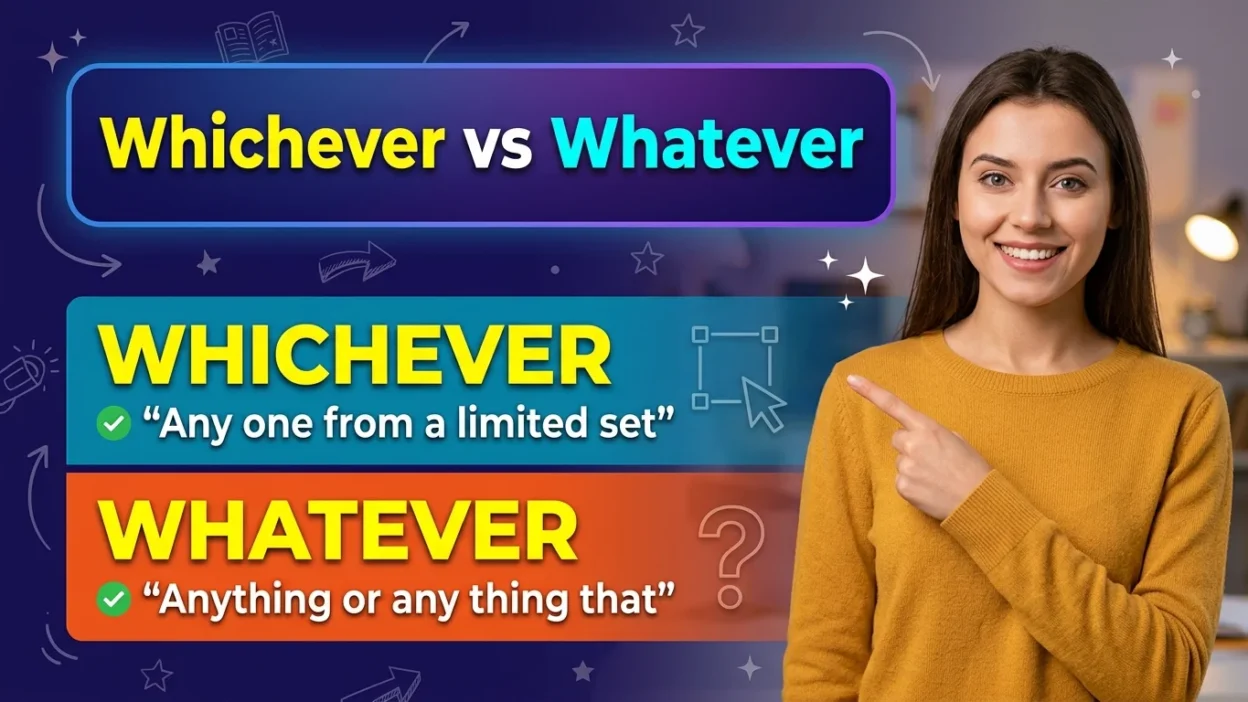
However, they do not always mean the same thing. “Whichever” refers to any option from a known or limited set of choices, while “whatever” refers to anything or any thing that fits a situation, often without limiting the possibilities to a specific list.
For example, you might say, “Choose whichever dress you like” when you have several dresses to choose from. In contrast, “Eat whatever you want” allows someone to choose any food they prefer.
What Is the Difference Between Whichever and Whatever?
The main difference is simple:
- Whichever refers to one choice from a particular or limited group.
- Whatever refers to any thing, everything of a certain kind, or something that is not specified.
Compare these sentences:
Whichever route you choose, you will reach the destination.
This suggests that there are several known routes, and the person can choose any one of them.
Whatever happens, stay calm.
This refers to any possible event or situation, without limiting the possibilities.
Quick Comparison
| Word | Main meaning | Typical use | Example |
| Whichever | Any one from a known or limited group | Choosing among options | Choose whichever color you prefer. |
| Whatever | Any thing, no matter what | Unlimited or unspecified things | Take whatever you need. |
| Whichever | The one that or any one that | Referring to a choice | Whichever answer is correct will receive credit. |
| Whatever | Anything that or no matter what | Referring to things or situations | Whatever you decide is fine. |
Easy memory tip: Which = choice from options → Whichever What = thing or situation → Whatever
What Does Whichever Mean?

Whichever is a pronoun or determiner used to refer to any one person or thing from a particular group of possibilities. It often introduces a choice when the available options are known, understood, or limited.
In simple English, whichever means “any one of the available choices.”
Examples of Whichever
- Choose whichever book you want.
- You can sit in whichever chair is available.
- Take whichever bus arrives first.
- Whichever team wins will receive the trophy.
- Use whichever method works best for you.
In each sentence, the speaker is referring to a choice from a group.
Whichever as a Determiner
A determiner comes before a noun and helps identify it. When whichever is used this way, it comes directly before a noun.
Structure:
Whichever + noun + clause
Examples:
- Choose whichever shirt you like.
- Read whichever chapter interests you.
- Select whichever option is most convenient.
- Take whichever road looks safer.
Here, whichever modifies the nouns shirt, chapter, option, and road.
Whichever as a Pronoun
A pronoun replaces a noun. Whichever can stand alone when the noun is already understood.
Examples:
- You can choose whichever you prefer.
- I do not mind whichever you select.
- Whichever is cheaper will be fine.
- Take whichever is closest.
In these examples, whichever represents an understood noun, such as option, item, or choice.
Whichever in Questions
Although which is commonly used in direct questions, whichever can appear when emphasizing free choice among known options.
Examples:
- Whichever would you choose?
- You may select whichever you think is best.
- Whichever option do you recommend?
However, in ordinary questions, which is often more natural:
Which dress do you prefer?
Whichever is more commonly used when giving permission or emphasizing that any option from the group is acceptable.
What Does Whatever Mean?

Whatever is a pronoun or determiner used to refer to any thing, no matter what it is, or to an unspecified thing. It can also mean “no matter what” when introducing a condition or situation.
In simple English, whatever means “any thing at all” or “no matter what.”
Examples of Whatever
- Take whatever you need.
- You can ask me whatever question you want.
- Whatever happens, do not panic.
- I will support whatever decision you make.
- Eat whatever you like.
Unlike whichever, whatever does not usually suggest a specific, limited group of choices.
Whatever as a Determiner
When whatever comes before a noun, it means any thing of that type, without restriction.
Structure:
Whatever + noun + clause
Examples:
- Ask whatever question you want.
- Bring whatever equipment you need.
- Choose whatever color makes you happy.
- Use whatever method is easiest.
The focus is on freedom or lack of restriction.
Whatever as a Pronoun
Whatever can stand alone when it refers to an unspecified thing or anything at all.
Examples:
- Take whatever you want.
- Whatever is acceptable to me.
- Do whatever you think is right.
- I will believe whatever you tell me.
Whatever Meaning “No Matter What”
One of the most important uses of whatever is to introduce an unrestricted situation.
Examples:
- Whatever happens, we will remain calm.
- Whatever you decide, I will respect it.
- Whatever the weather, the event will continue.
- Whatever the cost, they wanted to finish the project.
Here, whatever does not mean a particular object. It means “no matter what.”
Whichever vs Whatever: The Main Grammar Difference
The clearest way to understand whichever vs whatever is to focus on the type of choice involved.
Whichever Refers to a Known or Limited Set
Use whichever when the listener can imagine a particular group of options.
Examples:
- Choose whichever of these three bags you like.
- Take whichever train arrives first.
- You may select whichever dessert is on the menu.
- Whichever candidate receives the most votes will win.
The choices may be visible, previously mentioned, or understood from the situation.
Whatever Refers to an Unrestricted or Unknown Set
Use whatever when the possibilities are open-ended or not limited to a particular group.
Examples:
- Buy whatever food you need.
- Ask whatever question comes to mind.
- Whatever happens, keep trying.
- You can wear whatever clothes you prefer.
The speaker is not focusing on a defined list of options.
Compare Similar Sentences
| With Whichever | With Whatever |
| Choose whichever of these five pens you like. | Choose whatever pen you like. |
| Take whichever bus is available at the station. | Take whatever transportation you prefer. |
| Read whichever book from this shelf interests you. | Read whatever book you enjoy. |
| Whichever answer you select must be supported. | Whatever answer you give, explain it clearly. |
The distinction is sometimes subtle. In everyday English, both words can occasionally work, but their emphasis is different.
Whichever vs Whatever in Choice Sentences
Both words can introduce a choice, but they communicate different ideas.
Use Whichever for “Any One of These”
Imagine you are showing someone three smartphones. You might say:
Choose whichever phone you like.
This means the person can choose any one phone from the available group.
Other examples:
- Pick whichever seat is empty.
- Use whichever key opens the door.
- Select whichever plan suits your budget.
- Buy whichever laptop you prefer from these options.
Use Whatever for “Anything You Want”
Now imagine you are allowing someone to choose freely without referring to a specific list.
Choose whatever phone you like.
This suggests that the person has broad freedom to choose any phone, not necessarily from a limited group already discussed.
Other examples:
- Eat whatever food you want.
- Buy whatever gift you think is suitable.
- Wear whatever clothes make you comfortable.
- Watch whatever movie interests you.
Important Note About Overlap
In many everyday sentences, whichever and whatever can both be grammatically possible.
For example:
Choose whichever book you like.
Choose whatever book you like.
The first sentence often suggests a known selection, while the second emphasizes unrestricted choice. Context determines which word sounds more natural.
Whichever vs Whatever in Relative Clauses
Both words can introduce clauses that function like noun phrases. These clauses often act as subjects, objects, or complements.
Whichever in Relative Clauses
Whichever means “any one that” or “the one that.”
Examples:
- Whichever you choose will be acceptable.
- I will take whichever is cheaper.
- Whichever team wins will advance to the final.
- She selected whichever option seemed safest.
Here, the clause refers to a choice from a group.
Whatever in Relative Clauses
Whatever means “anything that” or “no matter what.”
Examples:
- Whatever you choose is fine with me.
- I will accept whatever you decide.
- Whatever happens next, remain patient.
- Take whatever is available.
Here, the possibilities are broader or unspecified.
Compare the Meaning
Whichever you choose, I will support you.
This can suggest a choice from known options.
Whatever you choose, I will support you.
This emphasizes that the decision can be anything at all.
Both sentences are correct, but whatever often sounds more unrestricted.
Whichever vs Whatever: Sentence Structure
Understanding the common structures makes these words easier to use correctly.
Common Structures with Whichever
1. Whichever + noun
- Whichever route
- Whichever answer
- Whichever option
- Whichever team
Example: Choose whichever route seems safest.
2. Whichever + subject + verb
- Whichever you prefer
- Whichever she selects
- Whichever they choose
Example: I will accept whichever you recommend.
3. Whichever + of + plural noun/pronoun
- Whichever of these options
- Whichever of the two answers
- Whichever of them
Example: Choose whichever of these two jackets fits better.
Common Structures with Whatever
1. Whatever + noun
- Whatever food
- Whatever answer
- Whatever method
- Whatever time
Example: Use whatever method works best.
2. Whatever + subject + verb
- Whatever you want
- Whatever he says
- Whatever they decide
Example: I will respect whatever you decide.
3. Whatever + happens/comes/is available
- Whatever happens
- Whatever comes next
- Whatever is available
Example: Whatever happens, stay positive.
Whichever vs Whatever Examples in Everyday English
Here are practical examples to help you understand the difference.
Shopping Examples
- Choose whichever dress fits you best. The dresses are part of a known selection.
- Buy whatever clothes you need. The choice is broad and unrestricted.
- Take whichever pair of shoes you prefer from this shelf.
- Purchase whatever shoes you like.
School and Study Examples
- Answer whichever question you understand best.
- Study whatever subject interests you.
- Choose whichever topic from the list you want to present.
- Read whatever material helps you learn.
Travel Examples
- Take whichever train arrives first.
- Use whatever transportation is convenient.
- Follow whichever route your map recommends.
- Travel whatever distance is necessary to reach the destination.
Food Examples
- Choose whichever dish you prefer from the menu.
- Eat whatever food you enjoy.
- Take whichever dessert looks most appealing.
- Cook whatever meal you have ingredients for.
Work Examples
- Use whichever software your manager approves.
- Use whatever software helps you complete the task.
- Select whichever proposal meets the requirements.
- Follow whatever process improves efficiency.
Personal Decisions
- Choose whichever option makes you comfortable.
- Do whatever makes you happy.
- I will support whichever decision you make.
- I will respect whatever decision you make.
Whichever vs Whatever in Formal and Informal English
Both words are common in formal and informal English. The difference is not about formality; it is about meaning.
Formal Examples
- Applicants may select whichever option best suits their qualifications.
- Participants may use whatever resources are available.
- Whichever candidate meets the requirements will be considered.
- Whatever the outcome, the committee will publish a report.
Informal Examples
- Pick whichever one you want.
- Eat whatever you like.
- Do whatever works for you.
- Take whichever seat is free.
Whichever is not more formal than whatever. Both are natural in everyday conversation and professional writing.
Common Mistakes with Whichever and Whatever
Learning common mistakes can help you avoid confusion.
Mistake 1: Using Whichever for Completely Unrestricted Meaning
Incorrect or less natural:
Whatever happens, I will help you.
This sentence is already correct. Replacing whatever with whichever changes the meaning and usually sounds unnatural:
Whichever happens, I will help you.
Why? Happens refers to an unspecified event, not one choice from a known group. Whatever happens is the natural expression.
Mistake 2: Using Whatever When Referring to a Clearly Defined Group
Less precise:
Choose whatever of these three options you prefer.
This may be understood, but whichever is more natural when referring to a specific group.
Better:
Choose whichever of these three options you prefer.
Mistake 3: Confusing Whichever with Which
Incorrect:
Whichever book do you want?
More natural:
Which book do you want?
Use which for a direct question asking someone to identify a choice. Use whichever when emphasizing that any option from a group is acceptable.
Mistake 4: Using “Whichever One” Incorrectly
Whichever one is grammatically correct when the noun is understood.
Examples:
- Choose whichever one you like.
- Take whichever one is cheaper.
- I will use whichever one works.
However, avoid unnecessary repetition:
Choose whichever one of the books you like.
This is possible, but:
Choose whichever book you like.
is often simpler and more natural.
Mistake 5: Forgetting the Difference Between “Whatever” and “What”
What usually asks for or identifies a specific thing.
What book do you want?
Whatever gives unrestricted choice.
Read whatever book you want.
These words are related, but they do not serve the same purpose.
Mistake 6: Treating “Whatever” as Always Rude
In some conversations, whatever can sound dismissive or annoyed.
Example:
Whatever. I do not care.
However, in grammar, whatever is completely neutral when used correctly.
Examples:
- Choose whatever you like.
- Whatever happens, remain calm.
- I will accept whatever you decide.
The tone depends on the context and delivery.
Spelling Tips for Whichever and Whatever
Both words are compound words formed from a question word and -ever.
Whichever
Which + ever = Whichever
Correct spelling:
whichever
Common incorrect forms:
- which ever
- whichevers
- whitch ever
Whatever
What + ever = Whatever
Correct spelling:
whatever
Common incorrect forms:
- what ever
- whatevar
- watever
Are They Written as One Word?
Yes. When used as pronouns or determiners, whichever and whatever are normally written as one word.
Examples:
- Choose whichever you prefer.
- Take whatever you need.
However, what ever can occasionally appear as two words when ever is being used separately for emphasis, especially in unusual or rhetorical expressions.
Example:
What ever could he mean?
This is different from the ordinary pronoun whatever.
Whichever vs Whatever: Can They Be Interchanged?
Sometimes, yes. But not always.
When Both Can Work
Consider:
Choose whichever color you like.
Choose whatever color you like.
Both sentences are grammatically correct. The difference is subtle:
- Whichever color often suggests a known set of colors.
- Whatever color emphasizes freedom to choose any color.
Another example:
Use whichever method is easiest.
Use whatever method is easiest.
Both are possible. The first may refer to a group of methods already discussed, while the second is broader.
When They Cannot Be Easily Interchanged
Some expressions strongly prefer one word.
Natural:
- Whatever happens
- Whatever the reason
- Whatever the cost
- Whatever you say
Natural:
- Whichever of the two options you choose
- Whichever team wins
- Whichever route you take
- Whichever answer is correct
Replacing one with the other may make the sentence awkward or change its meaning.
Whichever vs Whatever: A Simple Decision Guide
When you are unsure which word to use, ask yourself these questions.
Step 1: Are You Choosing from a Known Group?
If yes, use whichever.
Choose whichever of these shirts you like.
Step 2: Are You Referring to Anything at All?
If yes, use whatever.
Choose whatever shirt you like.
Step 3: Does the Sentence Mean “No Matter What”?
If yes, use whatever.
Whatever happens, I will remain calm.
Step 4: Does the Sentence Mean “Any One That”?
If yes, use whichever.
Whichever route you take, you will arrive on time.
Step 5: Is It a Direct Question?
If you are asking someone to identify a choice, which is usually better.
Which option do you prefer?
Whichever vs Whatever: More Example Sentences
Examples with Whichever
- Choose whichever pen writes smoothly.
- Take whichever seat is empty.
- Whichever team wins will receive the award.
- I will accept whichever answer you provide.
- Use whichever key fits the lock.
- Select whichever design looks best.
- Whichever road you take, drive carefully.
- You can invite whichever friends you want.
- Whichever explanation is clearer should be used.
- I do not mind whichever restaurant you choose.
Examples with Whatever
- Take whatever you need.
- Do whatever makes you happy.
- Whatever happens, keep moving forward.
- Ask whatever question you want.
- Wear whatever clothes feel comfortable.
- I will support whatever decision you make.
- Use whatever tools are available.
- Whatever the reason, honesty matters.
- Eat whatever food you enjoy.
- Whatever comes next, we will handle it together.
Whichever vs Whatever in Negative Sentences
Both words can appear in negative sentences, but their meanings remain different.
Whichever in Negative Sentences
- I do not care whichever option you choose.
- She could not decide whichever route was better.
- We have not selected whichever design will be used.
Whatever in Negative Sentences
- I do not want whatever is left.
- He refused to accept whatever explanation they gave.
- She does not believe whatever people say.
In negative sentences, context is especially important because the speaker may be rejecting a particular choice or an unrestricted set of things.
Whichever vs Whatever in Conditional Sentences
Both words can introduce clauses that express conditions or choices.
Whichever in Conditional Sentences
- Whichever option you choose, follow the instructions.
- Whichever route you take, allow extra time.
- Whichever candidate wins, the results will be announced tomorrow.
The sentence refers to one choice from a group.
Whatever in Conditional Sentences
- Whatever happens, remain calm.
- Whatever you decide, I will respect it.
- Whatever the weather, the match will continue.
- Whatever the result, we should learn from the experience.
The sentence means “no matter what.”
Frequently Asked Questions
Is “whichever” the same as “whatever”?
Not exactly. Whichever usually refers to any one option from a known or limited group. Whatever refers to any thing or situation without restriction. They can overlap in some sentences, but their emphasis differs.
Which is correct: “Choose whichever” or “Choose whatever”?
Both can be correct. Use choose whichever when selecting from a particular group. Use choose whatever when allowing unrestricted choice.
Examples:
- Choose whichever of these five books you want.
- Choose whatever book you want.
Can I use “whatever” for people?
Yes, but it is generally used for things, not people. When referring to people, whoever is usually the correct word.
Example:
Whoever arrives first can start the meeting.
Can I use “whichever” for two options?
Yes. Whichever can refer to two or more options.
Example:
Choose whichever of the two dresses you prefer.
Is “whatever” rude?
Not always. It is neutral in sentences such as “Whatever you decide is fine.” However, saying “Whatever!” by itself can sound dismissive or annoyed.
What is the difference between “which” and “whichever”?
Which usually asks someone to identify a particular choice.
Which book do you want?
Whichever means any one from a group.
Choose whichever book you want.
What is the difference between “whatever” and “what”?
Whatever means any thing or no matter what.
Take whatever you need.
Is “whichever one” grammatically correct?
Yes. It is correct when the noun is understood.
Choose whichever one you like.
Is “whatever one” grammatically correct?
Yes, but it is less common in some contexts. It can mean any one of a group.
You may choose whatever one you prefer.
In many situations, whichever one or simply whatever may sound more natural depending on the intended meaning.
Which word should I use in “___ happens”?
Use whatever.
Whatever happens, stay calm.
This is a common expression meaning “no matter what happens.”
Which word should I use in “___ of these”?
Use whichever when referring to a specific group.
Whichever of these options you choose will work.
Can “whichever” and “whatever” begin a sentence?
Yes. Both can begin a sentence.
Examples:
- Whichever you choose will be fine.
- Whatever you choose will be fine.
The meaning depends on the context.
Which is more formal: whichever or whatever?
Neither is inherently more formal. Both are used in formal and informal English. The correct choice depends on the meaning you want to express.
Final Tips for Using Whichever and Whatever Correctly
Remember these simple rules:
- Use whichever for any one from a known or limited group.
- Use whatever for any thing at all or no matter what.
- Use which for most direct questions about a choice.
- Use whoever when referring to people.
- Both whichever and whatever can be determiners or pronouns.
- Context can make both words grammatically possible, but their emphasis may differ.
- Write whichever and whatever as one word in ordinary usage.
Conclusion
Understanding whichever vs whatever becomes much easier when you focus on the type of choice being discussed. Whichever is generally used for any one option from a known or limited group, while whatever refers to anything at all, an unrestricted choice, or any possible situation.
For example, “Choose whichever of these three bags you like” refers to a specific group. On the other hand, “Choose whatever bag you like” gives broader freedom. Similarly, “Whatever happens, stay calm” means “no matter what happens,” while “Whichever route you take, you will arrive” refers to a choice among routes.

Emily Parker is a dedicated writer who enjoys creating clear, useful, and easy-to-understand content. She focuses on language, grammar, word meanings, and everyday expressions to help readers find simple and reliable answers.