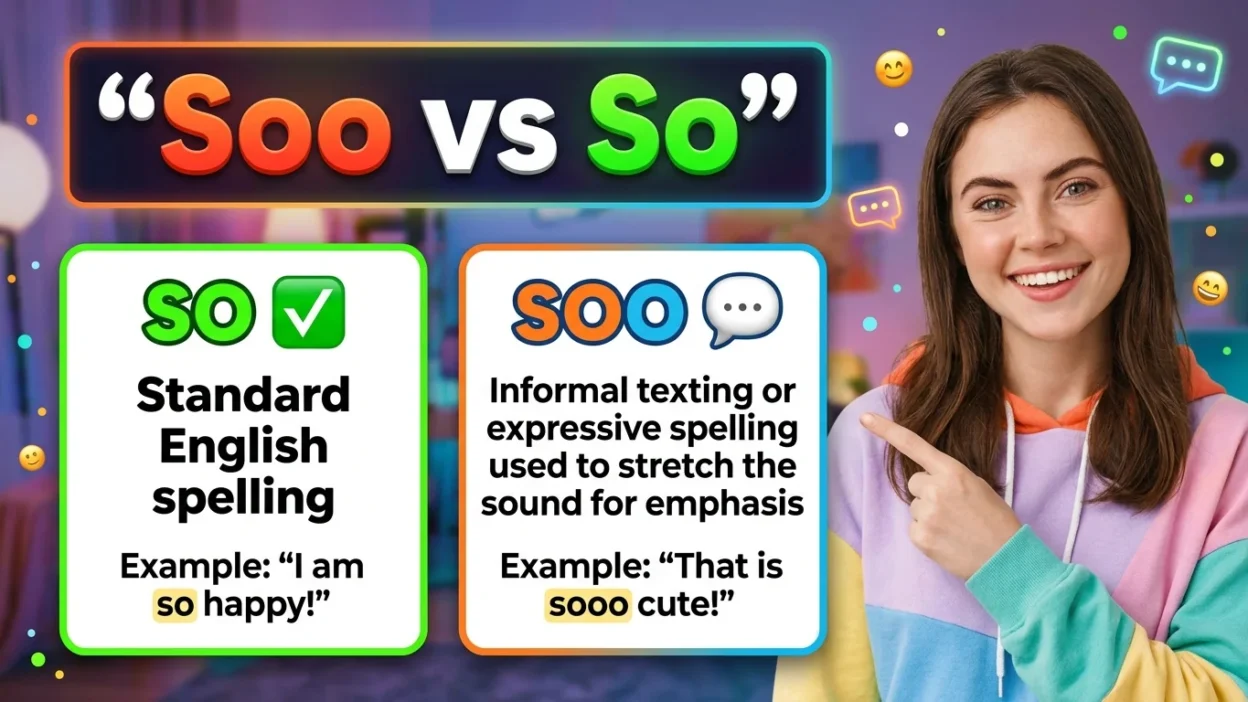
A tiny change in spelling can completely change how a message feels, especially when you’re texting friends or chatting on social media. The words “soo” and “so” look almost identical, but they serve different purposes in everyday communication.
“So” is the standard English spelling used to express a result, explain a reason, show degree, or introduce a thought. “Soo,” on the other hand, is an informal, nonstandard spelling that people often use in texts to add emphasis, excitement, affection, or a playful tone.
For example, “I am so happy” is correct in standard English, while “I am soo happy!” adds extra emotional emphasis in a casual message. Although “soo” appears frequently in online conversations, you should generally use “so” in school assignments, professional emails, and formal writing.
Soo vs So: The Basic Difference
The easiest way to understand soo vs so is to remember that so is the correct standard spelling in almost every ordinary English sentence. It is used to express degree, result, agreement, and emphasis.
Soo, on the other hand, is usually an informal or nonstandard spelling. People may use it in texting to stretch the sound of “so,” make a message feel more emotional, or create a playful tone. It can also appear as a proper name or in specialized contexts.
Here is a quick comparison:
| Word | Meaning | Correct usage |
| So | Very, to such a degree, therefore, or in that way | Standard English |
| Soo | Usually an informal or extended spelling of “so” | Casual texting, playful writing, or specific names |
| Sooo | A stretched version of “so” | Very informal messages |
| So, | A word used to begin a sentence or show a result | Standard English |
Example:
- Standard: “I am so happy today.”
- Informal texting: “I am soo happy today!”
- More exaggerated texting: “I am sooo happy today!”
The meaning is usually similar, but the spelling and tone are different.
What Does “So” Mean in English?
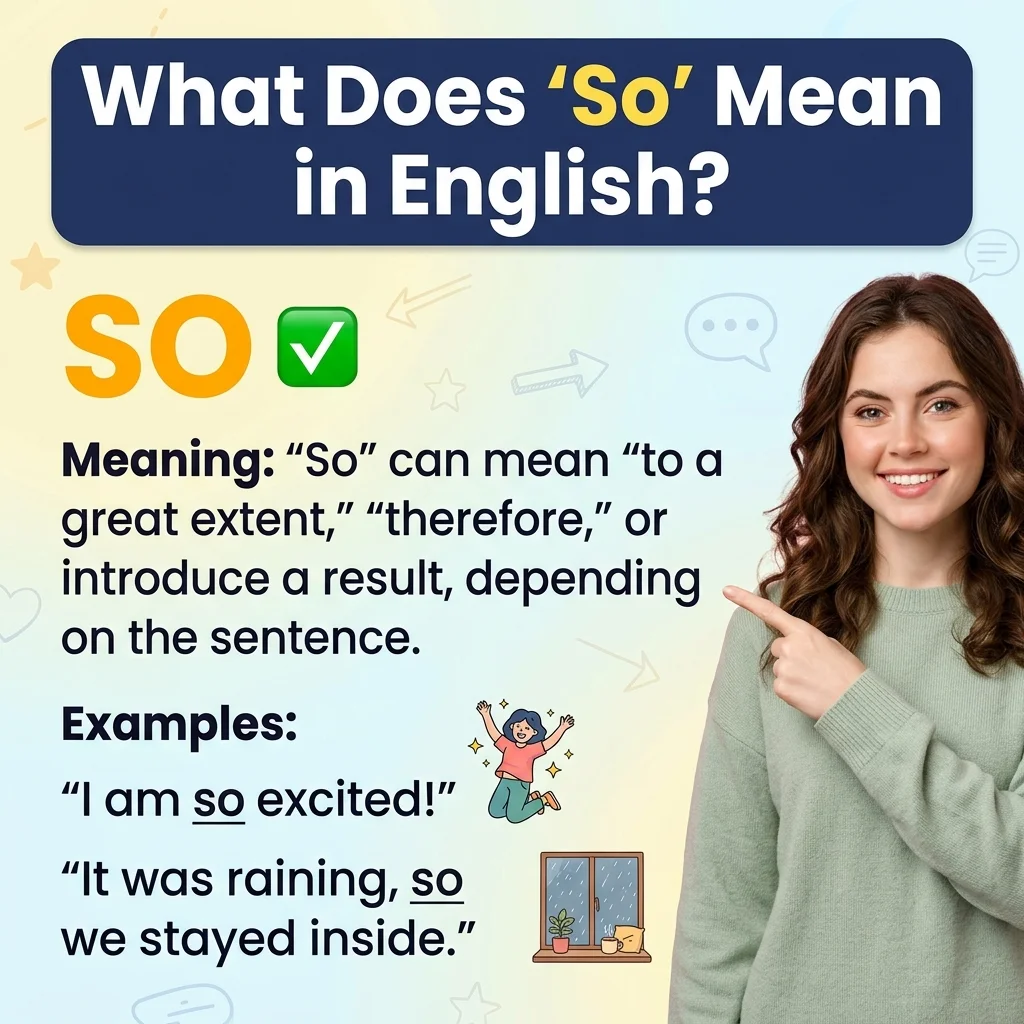
So is a standard English word with several meanings. It can function as an adverb, conjunction, or part of a phrase. Its meaning depends on the sentence.
“So” Means “Very” or “To a Great Degree”
One of the most common uses of so is to show a high degree of something. It is often placed before an adjective or adverb.
Examples:
- She is so kind.
- This movie is so interesting.
- The baby is so cute.
- He runs so quickly.
- I am so tired after work.
In these sentences, so makes the adjective or adverb stronger.
Compare:
- “The food is good.”
- “The food is so good!”
The second sentence expresses stronger feeling.
“So” Can Mean “Therefore” or “As a Result”
So can also connect two ideas and show a result. In this use, it is often a conjunction.
Examples:
- It was raining, so we stayed home.
- I was hungry, so I made a sandwich.
- She studied hard, so she passed the exam.
- The shop was closed, so we came back later.
In each sentence, the first part explains the reason, and the second part gives the result.
Pattern:
Reason + so + Result
Example:
I missed the bus, so I walked to school.
“So” Can Mean “In That Way”
Sometimes so refers to something already mentioned. It can mean “in that manner” or “in that way.”
Examples:
- If you think so, you should explain why.
- I hope so.
- I don’t think so.
- She said so during the meeting.
- Please don’t do so again.
Here, so does not mean “very.” It refers to an idea, action, or statement.
“So” Is Used for Agreement
In conversations, so can appear in short expressions that show agreement or confirm something.
Examples:
- “You are coming with us, right?” “I think so.”
- “Is he the new teacher?” “I believe so.”
- “Will they arrive tomorrow?” “I hope so.”
These expressions are common in everyday English.
“So” Can Introduce a Question or Topic
People often use so at the beginning of a sentence to introduce a topic, move a conversation forward, or ask what happens next.
Examples:
- So, what are you doing today?
- So, how was your trip?
- So, should we begin?
- So, what do you think?
- So, where were we?
In this use, so is often conversational and natural.
What Does “Soo” Mean?
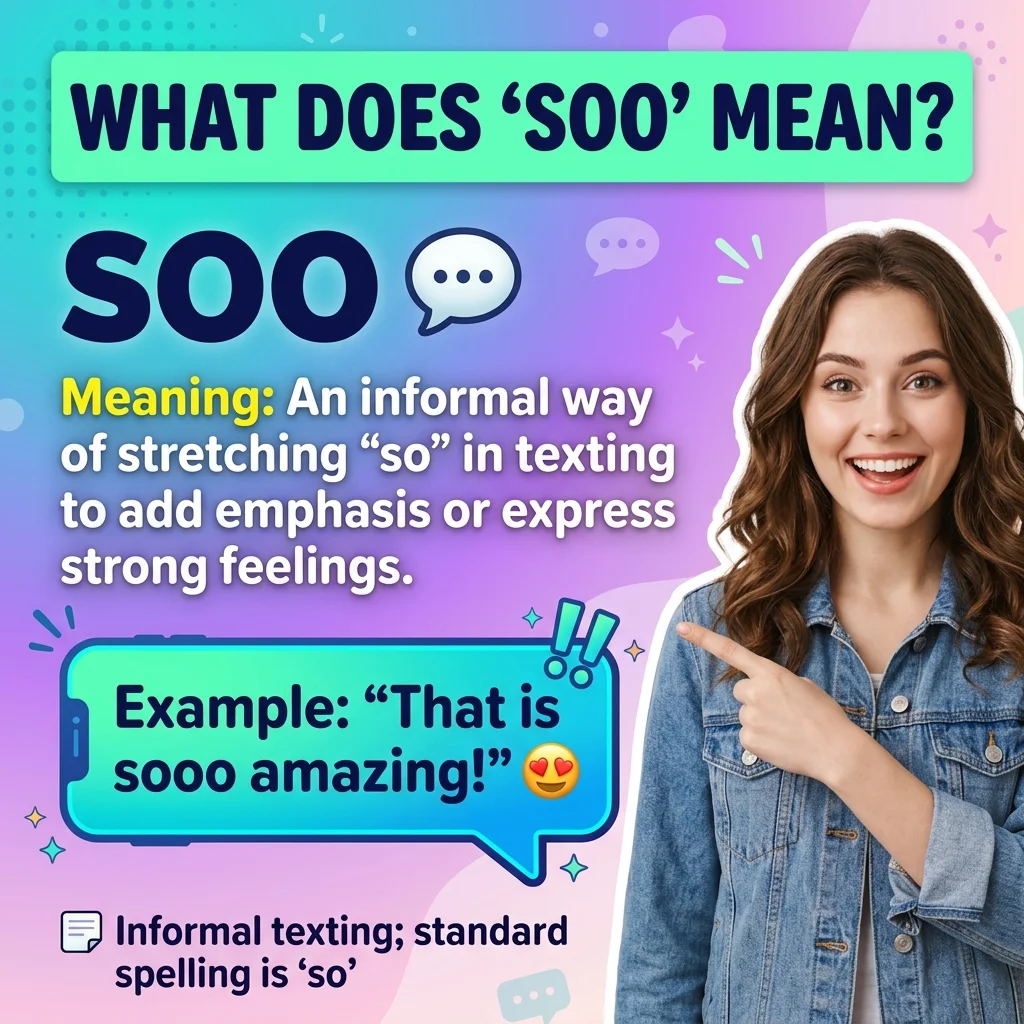
Soo is not normally the standard spelling of the English word so. However, it appears in informal communication and may have different meanings depending on the context.
“Soo” as an Informal Spelling of “So”
In texting, people sometimes write soo instead of so to make the word feel longer, softer, or more emotional.
Examples:
- “That was soo funny!”
- “I am soo excited!”
- “You are soo sweet!”
- “This is soo cute!”
- “I missed you soo much!”
The extra o is usually intentional. It adds emphasis or emotion rather than changing the basic meaning.
“Soo” Can Show Excitement or Emotion
When someone writes soo, they may want the reader to hear a stretched pronunciation.
Compare:
- “I am so happy.”
- “I am soo happy!”
- “I am sooo happy!!!”
The last two versions feel more expressive and informal. They may suggest excitement, affection, surprise, or exaggeration.
“Soo” Is Common in Social Media and Texting
Informal online communication often changes spelling to express personality. People may use extra letters, emojis, capitalization, or repeated punctuation.
For example:
- “That dress is soo pretty 😍”
- “I am sooo ready for the weekend!”
- “You are soo right!”
- “This song is soo good!”
These spellings are understandable in casual messages, but they are not recommended for formal writing.
“Soo” May Appear as a Name or Specialized Term
In some contexts, Soo may be a proper name, part of a place name, or a term from another language. In such cases, it is not simply an informal version of so.
For example, Soo can appear in names such as Soojin or in place names such as Soo Locks. The meaning depends on the specific context.
Therefore, it is important not to assume that every occurrence of soo is a spelling mistake.
Soo vs So in Texting
The difference between soo and so is especially noticeable in text messages. Texting is informal, so people often change spelling to express feelings.
When People Use “Soo” in Text Messages
People may use soo when they want to:
- Show strong emotion
- Make a word sound longer
- Sound playful or affectionate
- Emphasize excitement
- Make a message feel less formal
- Add personality to a conversation
Examples:
| Text message | Possible feeling |
| “I am soo happy!” | Strong happiness |
| “That is soo cute!” | Affection or excitement |
| “You are soo funny!” | Friendly praise |
| “I am soo tired.” | Strong tiredness |
| “I missed you soo much.” | Emotional emphasis |
Does “Soo” Change the Meaning?
Usually, soo does not change the basic meaning of so. It mainly changes the tone.
For example:
- “You are so nice.”
- “You are soo nice.”
Both sentences mean that the person is very nice. The second one sounds more casual or expressive.
However, tone can depend on the conversation. In some situations, extra letters may suggest sarcasm, exaggeration, or playful teasing.
Example:
“Wow, you are soo dramatic 😂”
This may be friendly teasing rather than a serious criticism.
Is “Soo” Correct in Texting?
In casual texting, soo is understandable and commonly used as an expressive spelling. However, it is not the standard spelling in formal English.
Use so when you want to be grammatically correct and clear. Use soo only when the informal tone is appropriate.
Soo vs So: Grammar and Correct Usage
The most important grammar rule is simple:
Use “so” in standard English. Use “soo” only when you intentionally want an informal or specialized form.
Correct Standard English Examples
- I am so happy to see you.
- This book is so useful.
- She was so tired that she went to bed early.
- It was late, so we left.
- I think so.
- So, what is your plan?
Informal “Soo” Examples
- I am soo happy to see you!
- This book is soo useful!
- You are soo kind!
- That was soo unexpected!
- I missed you soo much!
The informal examples are suitable for casual messages, captions, and playful conversations. They are not the best choice for academic writing, professional emails, or formal documents.
Common Phrases with “So”
Because so is a standard English word, it appears in many common expressions.
“So Much”
So much means a large amount or a strong degree of something.
Examples:
- Thank you so much.
- I love you so much.
- There is so much work to do.
- She talks so much.
- I learned so much from this experience.
“So Many”
So many is used before plural countable nouns.
Examples:
- There are so many people here.
- I have so many questions.
- She bought so many books.
- Why are there so many cars?
“So Good”
So good emphasizes that something is very good.
Examples:
- This cake is so good.
- Your idea is so good.
- The concert was so good.
- That movie was so good that I watched it twice.
“So Far”
So far means “until now” or “up to this point.”
Examples:
- So far, everything is going well.
- I have read three chapters so far.
- So far, no one has complained.
- The project is successful so far.
“So That”
So that is used to explain purpose or result.
Examples:
- I wrote it down so that I would not forget.
- She spoke slowly so that everyone could understand.
- We left early so that we could avoid traffic.
“So Do I” and “So Am I”
These expressions show agreement with a positive statement.
Examples:
- “I love coffee.” “So do I.”
- “I am tired.” “So am I.”
- “I can swim.” “So can I.”
These are standard grammatical expressions.
Soo vs So in Formal and Informal Writing
Choosing between soo and so depends on the type of writing.
| Writing situation | Best choice |
| School essay | So |
| University assignment | So |
| Professional email | So |
| Business report | So |
| News article | So |
| Website article | So |
| Formal letter | So |
| Text message | So or informal soo |
| Social media caption | So or informal soo |
| Personal chat | So or informal soo |
| Playful conversation | Soo may be appropriate |
Why “So” Is Better for Formal Writing
Formal writing should be clear, consistent, and grammatically standard. Informal spellings such as soo, sooo, and soooo can make writing look careless or overly casual.
Less suitable for a formal email:
I am soo excited to join your company!
Better:
I am so excited to join your company!
The second version is professional and appropriate.
Why “Soo” Can Work in Casual Writing
Casual writing often focuses on personality and emotion rather than strict formality.
Example:
“That puppy is soo adorable!”
This sounds natural in a friendly chat or social media caption. The extra o adds enthusiasm.
Common Mistakes with Soo vs So
Many people make mistakes because they hear so pronounced with a long vowel sound. Others use soo because they see it frequently online.
Mistake 1: Using “Soo” in Formal Writing
Incorrect for standard formal writing:
The results were soo impressive.
Correct:
The results were so impressive.
The informal spelling should be replaced with the standard form.
Mistake 2: Thinking “Soo” Is Always a Separate English Word
In most ordinary sentences, soo is not a standard alternative spelling of so.
Example:
I am soo tired.
Here, soo is simply an informal spelling of so.
It is better to understand the context before deciding whether it is a typo, an expressive spelling, or a proper name.
Mistake 3: Adding Too Many “O” Letters
In casual texting, people may write:
- sooo
- soooo
- sooooo
- soooooo
There is no fixed grammatical rule for how many extra letters are acceptable. These forms are expressive rather than standard.
For clear writing, simply use so.
Mistake 4: Confusing “So” with “Sew”
So and sew sound alike in many accents, but they have different meanings.
- So = very, therefore, or in that way
- Sew = to join fabric using a needle and thread
Examples:
- I am so happy.
- She learned to sew a dress.
Mistake 5: Confusing “So” with “Sow”
Sow is another word with a different meaning.
- So = standard English word
- Sow = to plant seeds
- Sow can also refer to a female pig in certain contexts
Examples:
- It was so cold.
- Farmers sow seeds in spring.
Mistake 6: Using “So” When “Too” Is Needed
Sometimes learners confuse so and too because both can describe degree.
- So often emphasizes something.
- Too often means “more than is desirable” or “also.”
Examples:
- The bag is so heavy. = The bag is very heavy.
- The bag is too heavy to carry. = The bag is heavier than is practical to carry.
Spelling Tips for Remembering “So”
If you want to remember the correct spelling, these simple tips can help.
Tip 1: Use “So” as the Default
When you are unsure, choose so. It is the standard spelling in ordinary English.
Example:
I am so glad you came.
Tip 2: Remember That “Soo” Is Usually Informal
If you see soo in a text message, it often means the writer is stretching the word for emphasis.
Example:
“That is soo funny!”
Think of it as a stylistic choice, not a formal grammar rule.
Tip 3: Check the Writing Situation
Ask yourself:
- Am I writing an essay?
- Am I sending a professional email?
- Am I writing a social media caption?
- Am I chatting with a friend?
For formal situations, use so. For casual conversations, soo may be acceptable if you want an expressive tone.
Tip 4: Read the Sentence Aloud
If soo sounds like a stretched version of so, it is probably being used informally.
Example:
“I am sooo excited!”
The extra letters show emotion, not a new grammatical meaning.
Soo vs So: Example Sentences
Here are more examples to help you understand the difference.
Examples Using “So”
- The weather is so beautiful today.
- I am so proud of you.
- She was so nervous before the interview.
- He worked hard, so he achieved his goal.
- I think so.
- So, what should we do next?
- This lesson is so easy to understand.
- There are so many options.
- Thank you so much for your help.
- I hope so.
- The movie was so interesting.
- She speaks so clearly.
- I was so busy that I forgot lunch.
- It was raining, so we canceled the picnic.
- So far, the plan is working.
Examples Using “Soo” in Informal Texting
- “You are soo sweet!”
- “I am soo excited for tomorrow!”
- “That was soo funny 😂”
- “This dress is soo pretty!”
- “I missed you soo much!”
- “You are soo right!”
- “That puppy is soo cute!”
- “I am soo tired today.”
- “This is soo unexpected!”
- “Your message made me soo happy!”
Examples Showing the Tone Difference
Standard:
“I am so happy for you.”
Informal:
“I am soo happy for you!”
Standard:
“That is so cute.”
Informal:
“That is sooo cute!”
Standard:
“You are so kind.”
Informal:
“You are soo kind!”
The meaning is almost the same, but the informal versions sound more expressive.
Is “Soo” a Correct Spelling?
The answer depends on what you mean by “correct.”
In Standard English
So is the correct spelling for the ordinary word used in standard English grammar.
For example:
She is so talented.
Writing soo in this sentence would generally be considered nonstandard.
In Informal Communication
Soo can be acceptable as an intentional informal spelling in texting, social media, and casual conversations.
For example:
“I am soo excited!!!”
This is understandable and common in informal communication, but it is not the preferred spelling for formal writing.
In Names and Special Contexts
Soo may be correct when it is part of a proper name or a specialized term. In those cases, it should not be treated as a spelling mistake automatically.
Soo vs So on Social Media
Social media encourages creative and emotional writing. Users often add letters to words to make captions and comments more expressive.
Why People Write “Soo” Online
People may use soo because it:
- Makes a message feel more enthusiastic
- Shows excitement or affection
- Mimics spoken emphasis
- Creates a playful or friendly tone
- Makes a caption feel more personal
Examples:
- “This view is soo beautiful!”
- “I am soo ready for vacation!”
- “That outfit is soo stylish!”
- “You are soo funny!”
- “This is soo satisfying!”
Is “Soo” Good for SEO Content?
For SEO articles, the standard spelling so should be used in the main content. Search engines and readers generally benefit from clear, natural, grammatically correct writing.
If the keyword is Soo vs So, you can mention soo naturally while explaining its informal usage. However, repeating the keyword unnecessarily can make the article feel unnatural.
Good SEO usage:
Many people search for soo vs so because they see “soo” in text messages and want to know whether it is a correct spelling.
This is clear, useful, and natural.
Soo vs So: Quick Decision Guide
Use this simple guide whenever you are unsure.
Use “so”
For standard English, formal writing, schoolwork, professional communication, and ordinary sentences.
Use “soo”
When intentionally stretching “so” in casual texting, playful writing, or expressive social media posts.
Check the context
If “Soo” is part of a name, place name, or specialized term, it may have a meaning unrelated to the ordinary word “so.”
Frequently Asked Questions About Soo vs So
Is “soo” a real word?
Soo can appear as a name, a specialized term, or an informal spelling of so. In ordinary standard English sentences, however, so is the correct spelling.
Is “soo” grammatically correct in texting?
In casual texting, soo is commonly used as an expressive spelling. It is understandable, but it is not standard formal English.
Should I use “so” or “soo” in an essay?
Use so. It is the standard spelling and is appropriate for essays, assignments, reports, and other formal writing.
What does “soo” mean in a text message?
In a text message, soo usually means so, with extra emphasis. It may express excitement, affection, surprise, or exaggeration.
Example:
“That is soo cute!”
This means:
“That is so cute!”
Is “sooo” better than “soo”?
Neither is more grammatically correct. Both are informal ways to stretch the word so. The number of extra letters simply changes the visual emphasis.
Can “soo” be used in a professional email?
It is better to use so in a professional email. The standard spelling looks clearer and more polished.
Better:
I am so pleased to hear from you.
Why do people add extra “o” letters to “so”?
People add extra letters to express emotion, make a message sound longer, or create a playful tone. It is similar to saying “soooo” aloud for emphasis.
Does “soo” have the same pronunciation as “so”?
When used informally as an extended spelling, soo is generally intended to sound like a stretched version of so. The pronunciation may be exaggerated in texting, but the basic word is the same.
Is “soo” a spelling mistake?
It depends on the context. In formal writing, it is usually a nonstandard spelling or mistake. In casual texting, it may be an intentional expressive form.
What is the difference between “so” and “too”?
So often means “very” or shows a result, while too can mean “more than is desirable” or “also.”
Examples:
- She is so kind.
- The box is too heavy to lift.
- I like tea too.
Can I use “soo” in a social media caption?
Yes, if you want a casual and expressive tone. For example:
“This place is soo beautiful!”
For a more polished caption, use:
“This place is so beautiful!”
What is the correct spelling: “so much” or “soo much”?
The standard spelling is so much.
Correct:
Thank you so much.
Informal texting:
Thank you soo much!
The second version is expressive, but the first is the standard form.
Is “soo” used in British and American English?
As an informal spelling, soo may appear in both British and American online communication. It is not a standard spelling difference between the two varieties of English.
Final Thoughts
The difference between soo vs so is mainly about standard spelling and informal expression. So is the correct standard English word used to express degree, show results, introduce topics, and form common phrases such as “so much,” “so many,” and “so far.”
Soo is usually an informal spelling that adds emotion or emphasis in texting and social media. It may also appear in names or specialized contexts. While it can be perfectly understandable in casual communication, it is best to use so in formal writing.

Michael Collins is a skilled writer who creates clear, practical, and reader-friendly content. He focuses on language, grammar, word meanings, and everyday expressions, making complex topics simple to understand.