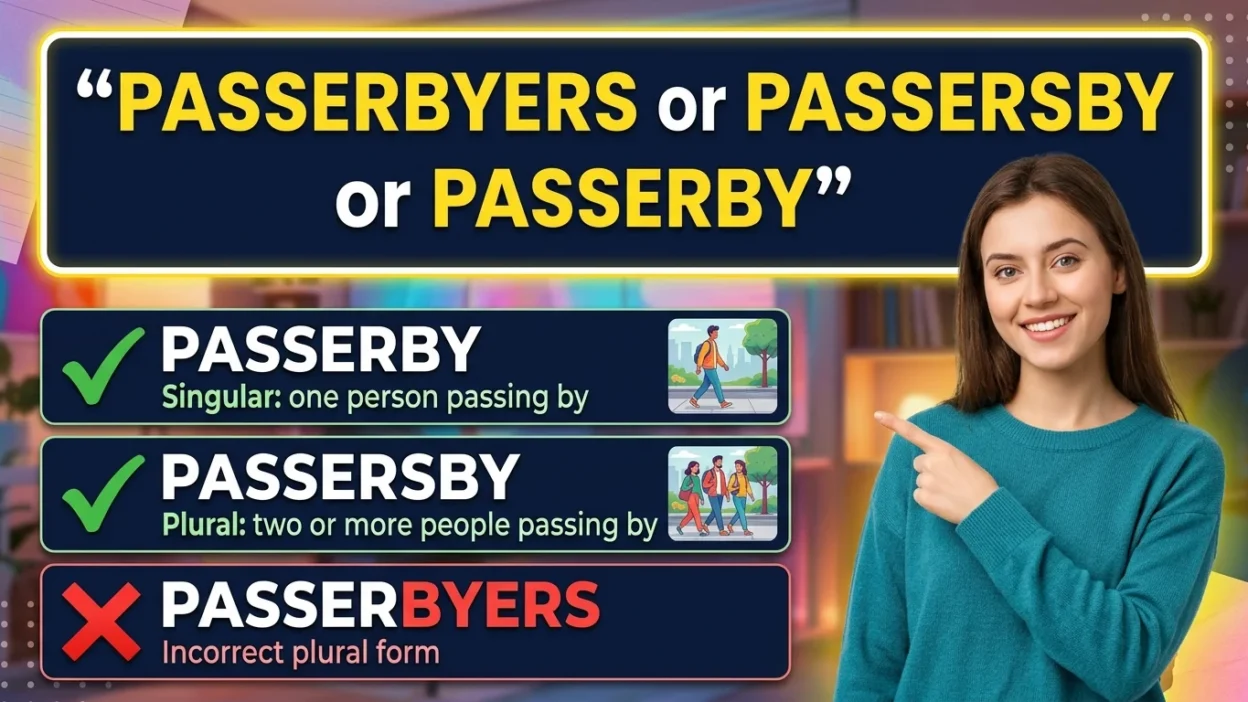
English plurals can be tricky, especially when a word combines two parts and follows an unusual spelling pattern. If you’ve ever wondered whether to write “passerbyers,” “passersby,” or “passerby,” you’re not alone.
These forms may look similar, but only two are correct in standard English, and each serves a different purpose. “Passerby” is the singular form, referring to one person who walks past a particular place. For example, “A passerby stopped to help the injured cyclist.”
When you’re talking about more than one person, the correct plural is “passersby,” as in “Several passersby gathered near the street performer.” The word “passerbyers” is incorrect and should be avoided in formal and everyday writing.
What Does Passerby Mean?
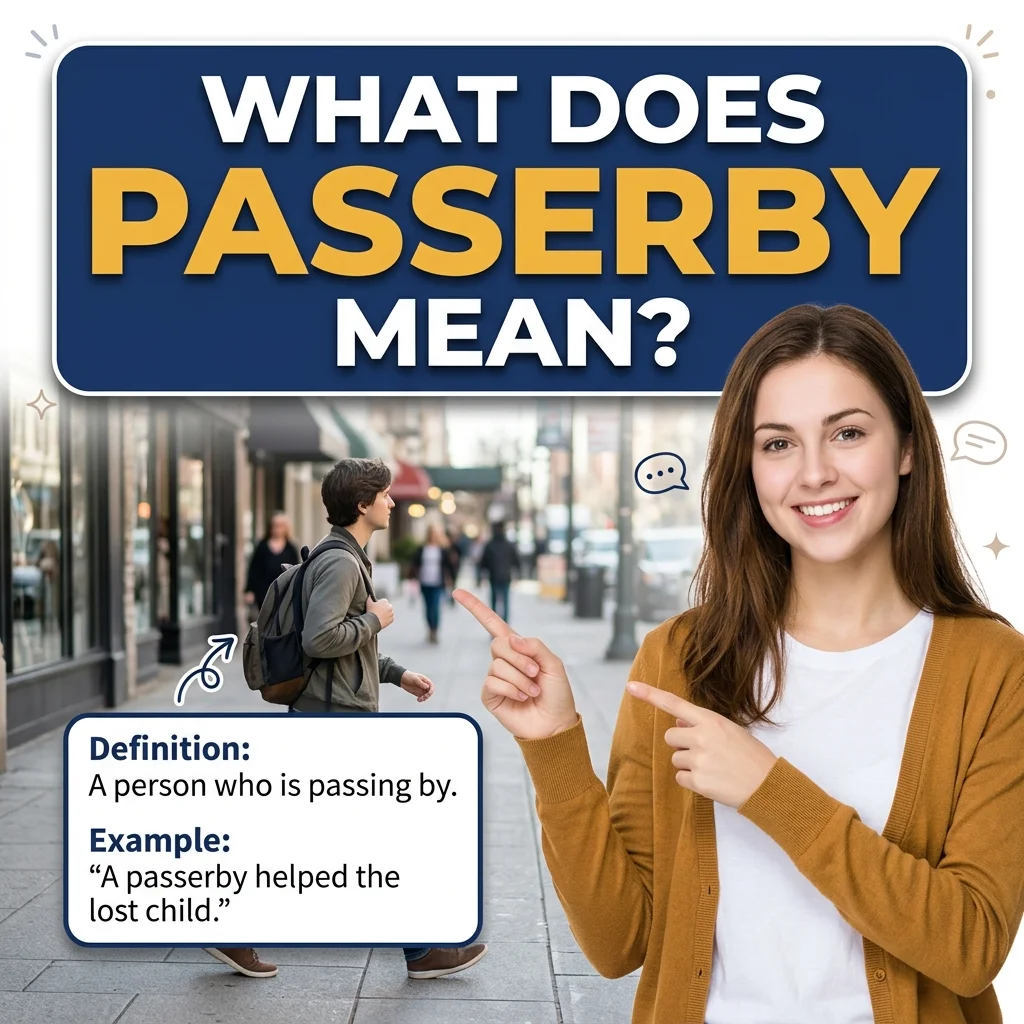
A passerby is a person who walks or travels past a particular place. The word usually describes someone who happens to be nearby but is not directly involved in an event.
For example, if someone drops a wallet on a busy street, a person walking past might notice it. That person is a passerby.
The word is commonly used in news reports, stories, everyday conversations, and descriptions of public places.
Simple Definition of Passerby
Passerby (noun): A person who passes by a place, usually on foot.
Example:
A passerby helped the older people man cross the street.
In this sentence, passerby refers to one person who was walking past and offered help.
Passerby in Everyday English
You might hear or read passerby in situations such as:
- A person walking past a shop
- Someone who notices an accident
- A stranger who stops to help
- A person passing a street performer
- Someone who sees an unusual event in public
Examples:
- A passerby found the lost child’s backpack.
- The passerby stopped to ask whether we needed help.
- A passerby took a photograph of the beautiful sunset.
- The injured cyclist was helped by a passerby.
The word does not necessarily mean the person is a stranger, although it often describes someone who is not previously known to the people involved.
Passerby vs. Passersby: The Main Difference
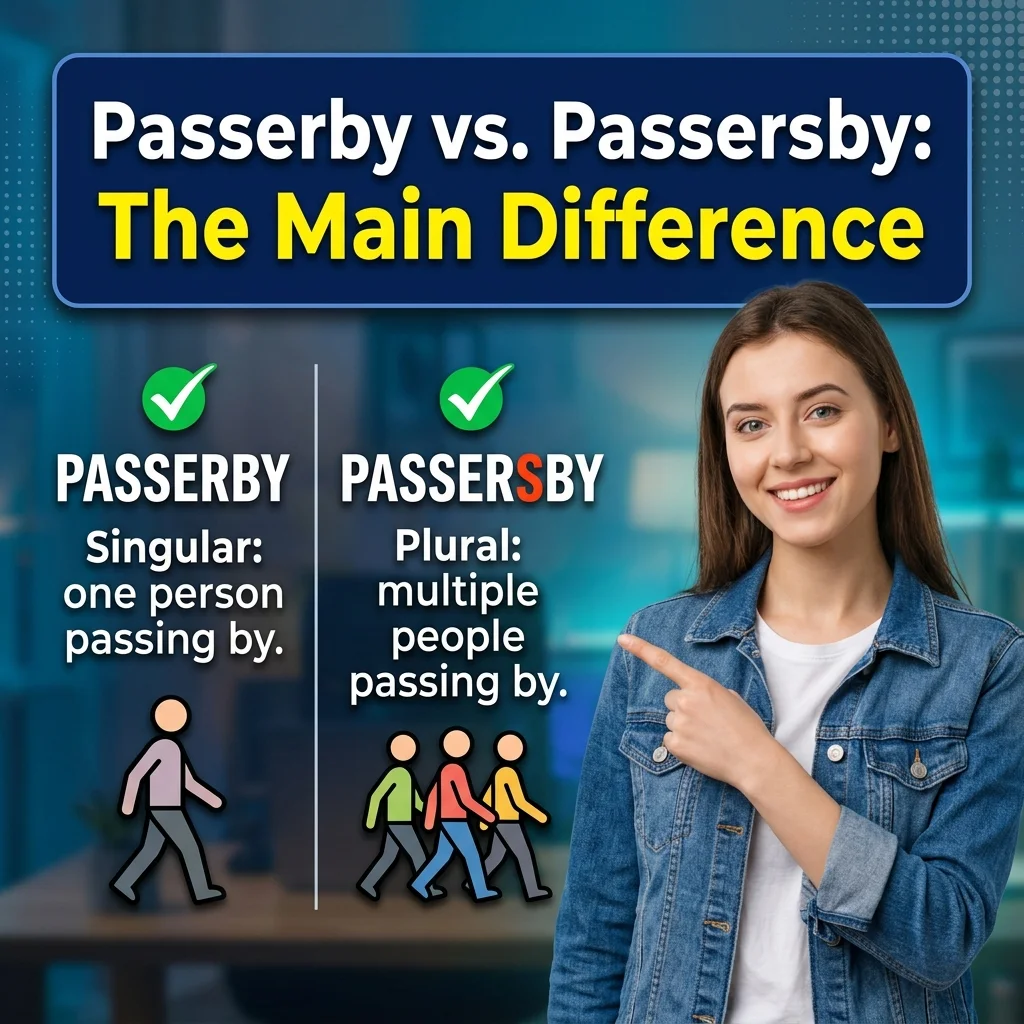
The difference between passerby and passersby is simple:
- Passerby = one person
- Passersby = two or more people
The plural is formed by changing the first part of the compound word, not by adding -s to the end.
| Word | Number | Meaning | Example |
| Passerby | Singular | One person passing by | A passerby called the police. |
| Passersby | Plural | Two or more people passing by | Several passersby stopped to watch. |
| Passerbyers | Incorrect standard form | Not the accepted plural | Avoid this spelling. |
Singular Example: Passerby
A passerby noticed smoke coming from the building.
Only one person is being described, so passerby is correct.
Plural Example: Passersby
Several passersby gathered outside the building.
More than one person is being described, so passersby is correct.
Why the Plural Is Passersby
The word passerby is made up of two parts:
- Passer — a person who passes
- By — past or alongside something
In traditional English usage, the main noun is passer, so the plural marker is added to that part:
passer + s + by = passersby
This is similar to other compound nouns in which the principal noun appears before another word.
Is Passerbyers Correct?
No. “Passerbyers” is not the standard English plural of “passerby.”
Although it may seem logical to add -ers to passerby, that spelling is unnecessary and incorrect in standard English. The word passer already refers to a person who passes, so adding another ending creates a form that English does not normally use.
Why People Write Passerbyers
People sometimes write passerbyers because they assume the plural should follow the same pattern as words such as:
- Player → players
- Worker → workers
- Runner → runners
However, passerby is a compound noun with an established plural form. English does not form its plural by adding -ers to the entire word.
Incorrect and Correct Examples
Incorrect:
The passerbyers watched the parade.
Correct:
The passersby watched the parade.
Incorrect:
Two passerbyers helped the driver.
Correct:
Two passersby helped the driver.
Incorrect:
Several passerbyers gathered near the entrance.
Correct:
Several passersby gathered near the entrance.
Is Passerbyers Ever Acceptable?
In standard modern English, passersby is the accepted plural. Passerbyers may occasionally appear as a mistake, a joke, or an informal invention, but it should not be used in formal writing, professional communication, or SEO content that aims to follow standard grammar.
Is Passerby Singular or Plural?
Passerby is singular.
It refers to one person who passes by.
Examples:
- A passerby helped me find the bus stop.
- The passerby reported the accident.
- One passerby offered the lost tourist directions.
When you are talking about more than one person, use passersby.
Examples:
- Several passersby stopped to help.
- The passersby watched the street performance.
- Two passersby called emergency services.
How to Identify the Correct Form
Look at the noun that comes before passerby.
| Sentence | Correct Form | Reason |
| A ___ called for help. | passerby | One person |
| Two ___ called for help. | passersby | More than one |
| Several ___ watched the event. | passersby | More than one |
| One ___ found the wallet. | passerby | One person |
| Many ___ gathered outside. | passersby | More than one |
A useful rule is:
One passerby, two passersby.
What Is the Plural of Passerby?
The plural of passerby is passersby.
This is the standard form used in dictionaries, books, newspapers, and everyday English.
Correct Plural Spelling
Singular: passerby Plural: passersby
Notice that the plural s is added after passer, before by.
Spelling Breakdown
Singular
passerby
One person passing by
Plural
passersby
Two or more people passing by
Examples of the Plural Form
- The passersby watched the magician perform.
- Several passersby helped move the fallen bicycle.
- The passersby were surprised by the sudden noise.
- A group of passersby gathered near the fountain.
- The police asked the passersby whether they had seen anything.
Is Passerbyers a Common Spelling Mistake?
Yes, passerbyers is a common mistake because the word looks like it should take a regular plural ending. However, standard English uses passersby.
The mistake usually happens when writers focus on the whole word rather than the main noun inside it.
A Simple Way to Remember
Think of passerby as meaning:
A person who passes by.
If there is more than one person, the plural becomes:
People who pass by → passersby
You do not need to add -ers to the end.
Quick Memory Trick
One passerby → Many passersby
The s moves into the middle of the word.
How to Use Passerby in a Sentence
The word passerby is a countable noun. This means you can use it with words such as a, one, each, and another.
Using Passerby with “A”
Use a passerby when talking about one person.
- A passerby helped the woman pick up her groceries.
- A passerby noticed the broken window.
- A passerby called an ambulance.
Using Passerby with “One”
Use one passerby to emphasize that only one person is involved.
- One passerby stopped to help.
- One passerby reported the incident.
- One passerby recognized the missing dog.
Using Passerby with “Another”
Use another passerby when referring to an additional person.
- Another passerby offered directions.
- Another passerby joined the search.
- Another passerby called the police.
Using Passerby with “Each”
Use each passerby when referring to people individually.
- Each passerby received a small leaflet.
- Each passerby was asked to keep the sidewalk clear.
- Each passerby seemed curious about the unusual display.
How to Use Passersby in a Sentence
Use passersby when referring to multiple people who are passing by.
Common Determiners with Passersby
You can use passersby with:
- Several passersby
- Many passersby
- A few passersby
- Two passersby
- Numerous passersby
- The passersby
- Some passersby
Examples:
- Several passersby stopped to watch the performance.
- Many passersby ignored the noise.
- A few passersby offered assistance.
- Two passersby helped carry the injured person.
- The passersby moved away when it started raining.
Passersby with “Were”
Because passersby is plural, it normally takes a plural verb.
Correct:
The passersby were surprised.
Incorrect:
The passersby was surprised.
The same rule applies to other plural nouns.
| Singular | Plural |
| The passerby was helpful. | The passersby were helpful. |
| A passerby noticed the problem. | Several passersby noticed the problem. |
| The passerby has arrived. | The passersby have arrived. |
Passerby and Passersby in Different Tenses
The noun itself does not change according to tense. The verb changes depending on the time of the action.
Present Tense
- A passerby walks past the shop.
- Several passersby walk past the shop.
Past Tense
- A passerby noticed the accident.
- Several passersby noticed the accident.
Present Perfect
- A passerby has reported the problem.
- Several passersby have reported the problem.
Future Tense
- A passerby will probably notice the sign.
- Several passersby will probably notice the sign.
The important point is that passerby and passersby are nouns. Their spelling does not change with tense.
Passerby vs. Passersby vs. Passerbyers: Comparison Table
| Feature | Passerby | Passersby | Passerbyers |
| Grammar | Singular noun | Plural noun | Nonstandard form |
| Meaning | One person passing by | Two or more people passing by | Intended to mean multiple passersby |
| Correct spelling | Yes | Yes | No |
| Example | A passerby helped. | Several passersby helped. | Avoid this form. |
| Common use | Everyday and formal English | Everyday and formal English | Usually a spelling mistake |
Which Form Should You Use?
Use passerby when you mean one person.
Use passersby when you mean two or more people.
Avoid passerbyers in standard English.
Common Mistakes with Passerby and Passersby
Even though the rule is simple, several mistakes appear frequently in writing.
Mistake 1: Using Passerbyers as the Plural
Incorrect:
The passerbyers watched the concert.
Correct:
The passersby watched the concert.
Why? The accepted plural is passersby, not passerbyers.
Mistake 2: Using Passerby for Multiple People
Incorrect:
Several passerby stopped to help.
Correct:
Several passersby stopped to help.
Why? The word several requires a plural noun.
Mistake 3: Adding an Extra “S” at the End
Incorrect:
The passersbys gathered outside.
Correct:
The passersby gathered outside.
Why? The plural s has already been added to passer. Adding another s at the end is unnecessary.
Mistake 4: Using a Singular Verb with Passersby
Incorrect:
The passersby was curious.
Correct:
The passersby were curious.
Why? Passersby is plural, so it normally takes a plural verb.
Mistake 5: Treating Passerby as a Verb
Incorrect:
I passerby the store every day.
Correct:
I pass by the store every day.
Why? Passerby is a noun. The verb phrase is pass by.
Mistake 6: Confusing Passerby with Pass by
The noun passerby is one word.
The verb phrase pass by is two words.
Noun:
A passerby waved at us.
Verb phrase:
People pass by this street every morning.
This distinction is important because the two forms have different grammatical roles.
Passerby vs. Pass by: What Is the Difference?
Although they look similar, passerby and pass by are not interchangeable.
Passerby
Passerby is a noun that refers to a person.
A passerby found my keys.
Pass by
Pass by is a verb phrase that means to move past something or someone.
I pass by the library on my way to work.
Comparison
| Expression | Part of Speech | Meaning | Example |
| Passerby | Noun | A person passing by | A passerby helped us. |
| Passersby | Plural noun | People passing by | The passersby stopped. |
| Pass by | Verb phrase | To move past | Cars pass by the house. |
More Examples
- A passerby saw the accident.
- The passersby watched the event.
- We pass by the park every evening.
- She passed by the bakery yesterday.
- Many people pass by this street daily.
Pronunciation of Passerby and Passersby
The pronunciation of passerby is generally:
PASS-er-bye
The pronunciation of passersby is generally:
PASS-erz-bye
The plural adds a z sound after passer.
Pronunciation Tip
Think of the words in parts:
- Passerby: passer + by
- Passersby: passers + by
The final sound of passers is similar to the z sound in roses.
Is Passersby a Compound Word?
Yes. Passersby is the plural of the compound noun passerby.
A compound noun is formed when two or more words work together as one noun.
Examples of compound nouns include:
- Toothbrush
- Bedroom
- Mother-in-law
- Editor-in-chief
- Passerby
Some compound nouns form their plurals by adding -s to the end. Others form plurals by changing the main noun within the compound.
Similar Compound-Noun Patterns
| Singular | Plural |
| Passerby | Passersby |
| Mother-in-law | Mothers-in-law |
| Editor-in-chief | Editors-in-chief |
| Attorney general | Attorneys general |
| Runner-up | Runners-up |
These examples show that English compound nouns do not always follow the simplest plural pattern.
Why Is the Plural Not Passerbys?
A common question is why we do not write passerbys.
The answer is that the plural marker belongs to the main noun passer, not to the final word by.
The word by is a preposition in the compound, so it does not receive the plural ending.
Correct structure:
passer + s + by = passersby
Incorrect structure:
passerby + s = passerbys
This is the same general idea used in compounds such as mothers-in-law, where the main noun changes rather than the final word.
Can Passerby Be Used as an Adjective?
No. Passerby is normally used as a noun, not as an adjective.
However, it can appear before another noun in certain compound expressions or descriptive phrases.
For example:
A passerby report was not available.
This sentence is unnatural because passerby is not commonly used as a general adjective.
More natural alternatives include:
- A report from a passerby
- A witness who was passing by
- A passerby’s account
- An eyewitness account
Possessive Form
When something belongs to one passerby, use passerby’s.
The passerby’s statement helped the investigation.
When something belongs to multiple passersby, use passersby’s.
The passersby’s accounts were similar.
However, when each person has something separately, passersby’s can still be used depending on the intended meaning.
Examples:
- The passerby’s phone was found nearby.
- The passersby’s observations helped explain what happened.
- The passersby’s reactions were different.
Possessive Forms at a Glance
| Meaning | Correct Form | Example |
| One passerby owns something | passerby’s | The passerby’s bag was missing. |
| Several passersby own something collectively | passersby’s | The passersby’s comments were recorded. |
Passerby in Formal and Informal Writing
The word passerby is suitable for both formal and informal English.
Formal Examples
- A passerby reported the incident to the authorities.
- Several passersby provided useful information.
- The witness was identified as a passerby who had been nearby.
Informal Examples
- A passerby helped me find my phone.
- Some passersby stopped to watch.
- A passerby gave us directions.
The word is neutral and does not sound overly formal or overly casual.
Passerby in News Reports
News writing often uses passerby and passersby to describe people who witness or respond to public events.
Examples:
- A passerby alerted emergency workers after noticing the fire.
- Several passersby helped rescue the driver.
- Police asked passersby to provide information about the incident.
- A passerby captured the event on a mobile phone.
In these sentences, the word describes people who happened to be present, rather than people who were officially involved.
Passerby in Storytelling
Writers often use passerby to introduce an unknown person who appears briefly in a story.
Examples:
- A passerby stopped and pointed toward the station.
- The old man thanked a passerby for his kindness.
- A passerby noticed the unusual sound and looked around.
- The mysterious passerby disappeared into the crowd.
The word can help create a sense of movement, chance encounters, or public activity.
More Example Sentences with Passerby
Here are several examples using the singular form.
- A passerby helped the child find her parents.
- A passerby noticed that the door was unlocked.
- The passerby offered directions to the nearest hospital.
- A passerby called the fire department.
- The passerby stopped to admire the street artist.
- A passerby found a wallet near the bus stop.
- The passerby asked whether anyone needed assistance.
- A passerby saw the dog wandering alone.
- The passerby reported the broken traffic light.
- A passerby gave the cyclist a bottle of water.
- The passerby heard a loud noise and turned around.
- A passerby helped carry the boxes.
- The passerby smiled and continued walking.
- A passerby noticed the missing sign.
- The passerby waited until help arrived.
More Example Sentences with Passersby
Here are examples using the plural form.
- Several passersby stopped to watch the parade.
- The passersby helped clear the road.
- Many passersby noticed the colorful display.
- Two passersby called for assistance.
- The passersby gathered around the street performer.
- A few passersby offered food to the stray dog.
- The passersby were surprised by the sudden announcement.
- Several passersby took photographs of the artwork.
- The passersby moved aside to let the ambulance pass.
- Many passersby ignored the advertisement.
- The passersby helped the older people woman carry her bags.
- Several passersby witnessed the incident.
- The passersby waited patiently near the entrance.
- A group of passersby stopped to listen to the musician.
- The passersby continued along the sidewalk.
Passerby in Questions
You can use passerby and passersby naturally in questions.
Singular Questions
- Did a passerby help you?
- Was the passerby able to identify the driver?
- Did a passerby call the police?
- Who was the passerby who found the wallet?
- Did the passerby notice anything unusual?
Plural Questions
- Did any passersby stop to help?
- How many passersby witnessed the accident?
- Were the passersby asked to leave?
- Did the passersby see the missing person?
- Why did the passersby gather outside?
Passerby in Negative Sentences
The same singular and plural rules apply in negative sentences.
Singular
- No passerby noticed the small sign.
- The passerby did not hear the announcement.
- A passerby was not available to help.
Plural
- No passersby noticed the small sign.
- The passersby did not hear the announcement.
- Several passersby were not interested in the event.
Notice that no passerby means not one person, while no passersby refers to multiple people in general.
Passerby in Different Sentence Structures
As the Subject
A passerby found the lost wallet.
Here, passerby is the subject performing the action.
As the Object
The police questioned a passerby.
Here, passerby is the object receiving the action.
After a Preposition
The information came from a passerby.
Here, passerby follows the preposition from.
In a Possessive Phrase
The passerby’s phone was ringing.
Here, passerby’s shows possession.
As Part of a Prepositional Phrase
The cyclist was helped by a passerby.
Here, passerby follows the preposition by.
Common Questions About Passerby Grammar
Is “Passerbyers” a Word?
Passerbyers is not the standard plural of passerby. The correct plural is passersby.
What Is the Plural of Passerby?
The plural is passersby.
Is Passerby One Word or Two?
Passerby is normally written as one word when used as a noun.
Is Passersby One Word?
Yes. Passersby is also written as one word.
Is “Passer by” Correct?
When referring to a person, the standard noun is passerby. When describing the action of moving past something, use the verb phrase pass by.
Can I Say “A Passersby”?
No. Use a passerby for one person.
Incorrect: A passersby helped me. Correct: A passerby helped me.
Can I Say “Two Passerby”?
No. Use two passersby.
Incorrect: Two passerby helped the driver. Correct: Two passersby helped the driver.
Can I Say “Passerbys”?
No. The standard plural is passersby, not passerbys.
Is “Passersby” Formal English?
Yes. Passersby is standard English and is appropriate in formal, academic, journalistic, and informal writing.
Does Passerby Mean Stranger?
Not necessarily. A passerby is simply someone who passes by. The person may be a stranger, but the word itself does not require that meaning.
What Is the Possessive Form of Passerby?
The singular possessive is passerby’s.
The passerby’s umbrella was left behind.
The plural possessive is passersby’s.
The passersby’s observations were useful.
Is Passerby a Countable Noun?
Yes. You can say:
- One passerby
- A passerby
- Two passersby
- Several passersby
Which Is Correct: Passerby or Passersby?
Both are correct, but they have different meanings. Passerby is singular, while passersby is plural.
People Also Ask: Passerby and Passersby FAQs
What is the correct plural of passerby?
The correct plural is passersby. It refers to two or more people who pass by a place.
Why is the plural passersby instead of passerbys?
The plural s is added to the main noun passer, producing passersby. The word by remains unchanged.
Is passerbyers grammatically correct?
No. Passerbyers is not the standard English plural. Use passersby instead.
Is passerby a noun or a verb?
Passerby is a noun. It refers to a person who passes by. The verb phrase is pass by.
What is the difference between passerby and passersby?
Passerby refers to one person, while passersby refers to two or more people.
Can I use passersby with “a”?
No. Use a passerby for one person. Use passersby with plural expressions such as several, many, or two.
What is the correct spelling: passersby or passerbys?
The correct spelling is passersby.
How do you pronounce passersby?
It is generally pronounced PASS-erz-bye.
Can passerby be used in formal writing?
Yes. It is a standard noun suitable for formal and informal writing.
Is “the passerby” singular?
Yes. The passerby refers to one person.
Is “the passersby” plural?
Yes. The passersby refers to multiple people.
What is the possessive form of passersby?
The plural possessive form is passersby’s.
Is passerby a compound noun?
Yes. Passerby is a compound noun made from passer and by.
Can I write “passer-by”?
The hyphenated form passer-by may appear in some older or historical usage, but passerby is the usual modern spelling. The plural is generally passersby.
Final Spelling and Grammar Checklist
Before using passerby or passersby in your writing, check the following:
- Use passerby for one person.
- Use passersby for two or more people.
- Do not use passerbyers as the standard plural.
- Do not write passerbys.
- Use passerby’s for singular possession.
- Use passersby’s for plural possession.
- Use pass by when describing an action.
- Match plural nouns with plural verbs.
- Remember that the plural s goes after passer.
Conclusion:
The answer is straightforward: passerby is the singular form, passersby is the plural form, and passerbyers is not the standard English plural. When you are talking about one person walking or traveling past a place, use a passerby. When you are talking about several people, use passersby.
The key spelling rule is to add the plural s to passer, not to the end of the entire compound word. Remember the simple pattern: one passerby, two passersby. Once you understand this pattern, you can use the word confidently in conversations, stories, news reports, and professional writing.

Michael Collins is a skilled writer who creates clear, practical, and reader-friendly content. He focuses on language, grammar, word meanings, and everyday expressions, making complex topics simple to understand.