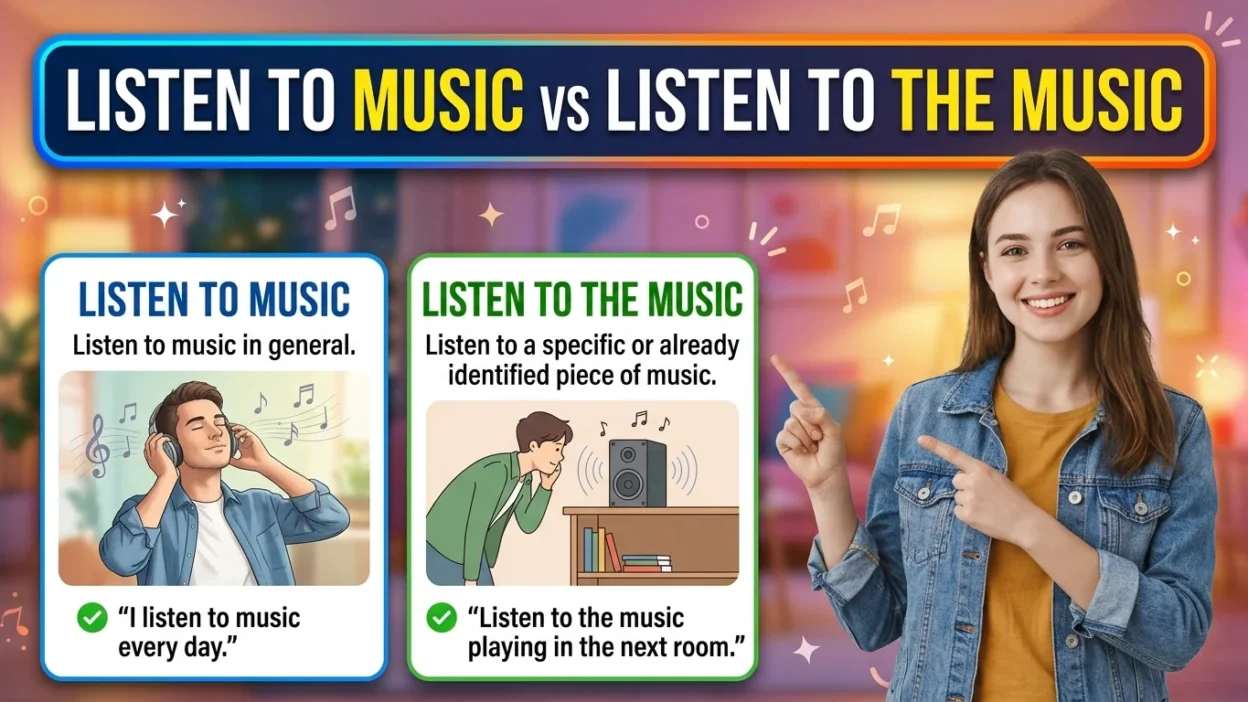
Have you ever wondered why English speakers sometimes say “listen to music” and other times say “listen to the music”? Both phrases are grammatically correct, but the small word “the” changes how the listener understands the sentence.
Learning the difference can help you speak more naturally, write clearer sentences, and avoid common grammar mistakes in everyday English. “Listen to music” usually refers to the general activity of enjoying music without identifying a particular song or piece.
For example, “I listen to music while studying” describes a regular habit. In contrast, “listen to the music” points to specific music that the speaker and listener can identify. For instance, “Listen to the music playing in the background” directs attention to a particular sound.
Listen to Music vs Listen to the Music: The Main Difference

The main difference between “listen to music” and “listen to the music” is the use of the article “the.”
- Listen to music = Listen to music in general, as an activity or interest.
- Listen to the music = Listen to particular music that is known, identified, or connected to a specific situation.
Both phrases use the verb listen, which is normally followed by the preposition to when we mention what we hear.
Quick Comparison
| Expression | Meaning | Example |
| Listen to music | Enjoy or hear music generally | I listen to music every day. |
| Listen to the music | Hear specific music | Listen to the music in this video. |
| Listen to some music | Hear an unspecified amount or selection of music | Let’s listen to some music. |
| Listen to this music | Hear the particular music being presented | Listen to this music! |
The article “the” does not make one expression more grammatical than the other. It simply makes the meaning more specific.
What Does “Listen to Music” Mean?
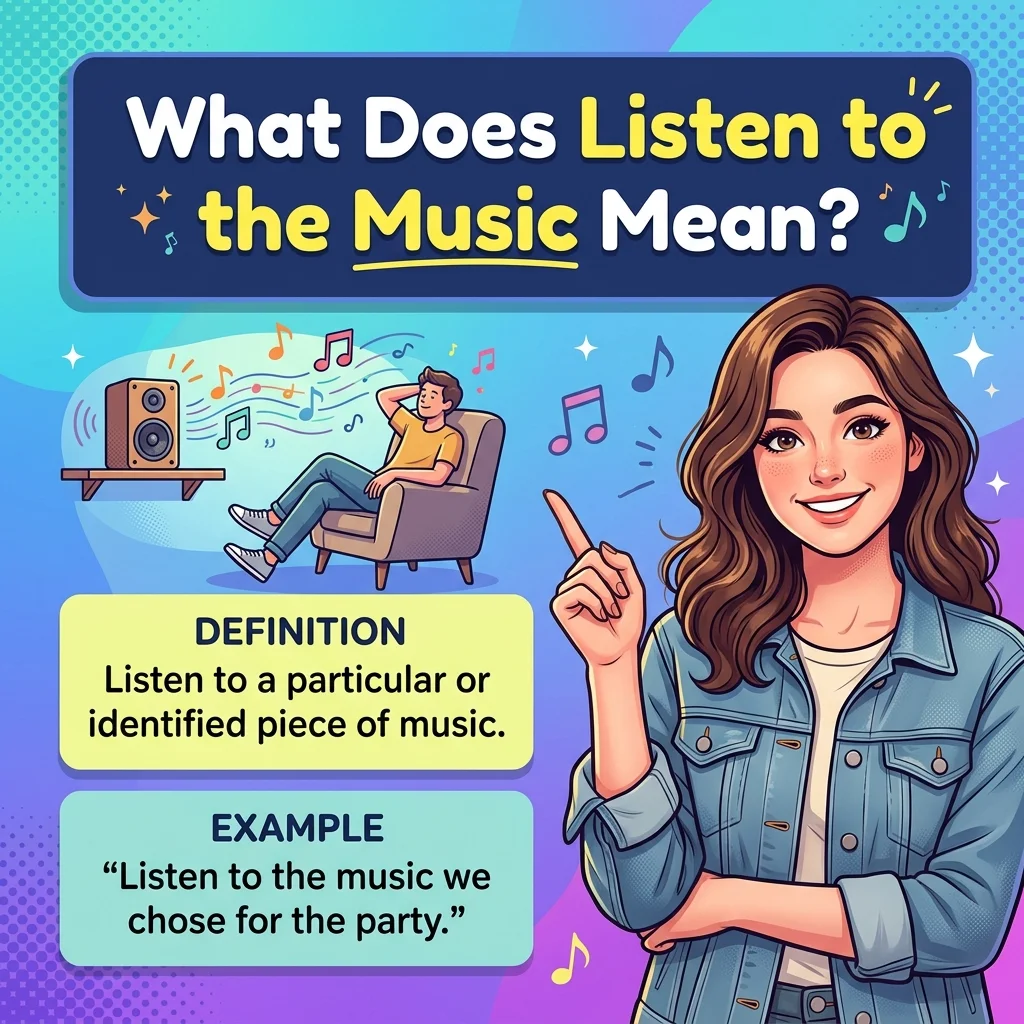
“Listen to music” means to hear or pay attention to music as a general activity. It does not usually identify one particular song, recording, or piece of music.
We commonly use this expression when talking about:
- Hobbies
- Daily routines
- Musical preferences
- General enjoyment
- Relaxation
- Studying or working
- Traveling
- Exercise
Examples of “Listen to Music”
- I listen to music every morning.
- She likes to listen to music while studying.
- We often listen to music in the car.
- He listens to music to relax after work.
- Do you listen to music before going to bed?
- My brother listens to music when he exercises.
- They enjoy listening to music together.
- I usually listen to music through my headphones.
In each example, the speaker is talking about music generally, not one specific piece.
Why Is There No “The” Before Music?
The word “music” is often used as an uncountable noun when we mean music in general.
For example:
- I love music.
- She studies music.
- They listen to music.
- Music can improve your mood.
When we use an uncountable noun in a general sense, we often do not need an article.
Compare:
- I listen to music. → Music in general.
- I listen to the music. → Particular music.
This is similar to other general expressions:
- I drink tea.
- She enjoys reading.
- We study history.
- He listens to music.
The absence of “the” is natural because the speaker is not referring to a specific item.
What Does “Listen to the Music” Mean?
“Listen to the music” means to listen to particular music that is identifiable from the context. The listener usually knows which music the speaker means, or the music is clearly connected to a specific place, event, recording, or situation.
The phrase may refer to:
- A song playing nearby
- Music in a video
- Music at a party
- A particular piece of music
- Music from a movie
- Music coming from a specific room
- A recording that has already been mentioned
Examples of “Listen to the Music”
- Listen to the music in this video.
- Can you hear the music? Listen to the music carefully.
- We sat quietly and listened to the music.
- Listen to the music coming from the next room.
- The dancers listened to the music before starting.
- I love this song. Listen to the music in the background.
- Everyone stopped talking to listen to the music.
- The teacher asked the students to listen to the music.
Here, “the music” refers to music that can be identified in the situation.
Why Do We Use “The”?
We use “the” when the noun is specific or already understood.
For example:
There is music playing in the café. Listen to the music.
The listener knows which music is meant: the music playing in the café.
Another example:
I found an interesting song. Listen to the music.
The phrase refers to the particular music in that song.
Is “Listen to Music” Grammatically Correct?
Yes, “listen to music” is grammatically correct and is one of the most common ways to talk about enjoying music in general.
Correct Sentences
- I listen to music every day.
- She listens to music while cooking.
- We listen to music on weekends.
- He loves listening to music.
- They listen to music during their journey.
Incorrect or Less Natural Forms
- I listen music every day. ❌
- She listens the music. ❌
- I am listening music. ❌
The correct structure is:
Listen + to + music
The preposition “to” is important because listen normally requires it when we mention the sound or thing being heard.
Correct Verb Forms
| Subject | Correct Form |
| I | listen to music |
| You | listen to music |
| We | listen to music |
| They | listen to music |
| He | listens to music |
| She | listens to music |
| It | listens to music |
Remember to add -s to listen when the subject is he, she, or it in the simple present tense.
Is “Listen to the Music” Grammatically Correct?
Yes, “listen to the music” is also grammatically correct. It is used when the music is specific or identifiable.
Correct Sentences
- Listen to the music carefully.
- I listened to the music in the restaurant.
- She is listening to the music from the movie.
- We listened to the music at the concert.
- He asked me to listen to the music.
The phrase becomes natural when the listener can understand which music is being discussed.
Listen to Music vs Listen to the Music: Detailed Comparison
Understanding the difference becomes easier when we compare the expressions in real situations.
General Habit vs Specific Sound
General habit:
I listen to music while working.
This means listening to music is part of your routine.
Specific sound:
I listen to the music while working.
This suggests you are listening to particular music, perhaps the music playing in the room or a specific recording.
General Interest vs Particular Recording
General interest:
She enjoys listening to music.
She enjoys music as a broad category.
Particular recording:
She enjoys listening to the music from that movie.
She enjoys a specific soundtrack or collection of songs.
General Activity vs Immediate Instruction
General activity:
We listen to music on long journeys.
This describes a common habit.
Immediate instruction:
Listen to the music! It is beautiful.
This directs someone to pay attention to particular music.
When Should You Use “Listen to Music”?
Use “listen to music” when you are talking about music generally.
1. Talking About Hobbies
Listening to music is one of my favorite hobbies.
I listen to music in my free time.
You are describing a general interest, so no article is needed before music.
2. Talking About Daily Routines
I listen to music while getting ready for work.
She listens to music every evening.
These sentences describe repeated activities.
3. Talking About Musical Preferences
I listen to music from many different countries.
He listens to music in several languages.
They listen to music from different genres.
The focus is on music as a broad category.
4. Talking About Relaxation
I listen to music when I feel stressed.
She listens to music to relax.
The phrase describes a general method of relaxation.
5. Talking About Studying or Working
Many students listen to music while studying.
I listen to music when I work from home.
Again, the expression refers to music generally.
When Should You Use “Listen to the Music”?
Use “listen to the music” when the music is specific, known, or identifiable.
1. When Music Is Already Mentioned
We heard a beautiful song. Let’s listen to the music again.
The phrase refers to the music in that particular song.
2. When Music Is Playing Nearby
Can you hear something? Listen to the music.
The music is identifiable from the situation.
3. When Referring to Music in a Video
Listen to the music in this video.
The video contains specific music.
4. When Referring to Music at an Event
Everyone stopped talking to listen to the music.
The music at the event is understood.
5. When Giving an Instruction
Listen to the music carefully and follow the rhythm.
The speaker is referring to the particular music being played.
Can “Listen to Music” and “Listen to the Music” Both Be Correct?
Yes, both can be correct in different contexts. The choice depends on whether you mean music generally or specific music.
Consider this example:
I listen to music when I drive.
This describes a general habit.
Now compare:
I listen to the music when I drive.
This could mean you listen to a particular piece of music, perhaps the music playing in the car or a specific soundtrack.
The second sentence is not automatically wrong. It simply needs a context that makes “the music” identifiable.
Another Example
She likes to listen to music.
This means she enjoys music generally.
She likes to listen to the music from that album.
This means she enjoys the particular music associated with that album.
The second sentence is more specific because “the music” is identified by “from that album.”
Listen to Music vs Listen to the Music in Questions
Both expressions can be used in questions, but the meaning changes slightly.
Questions About General Habits
- Do you listen to music every day?
- What kind of music do you listen to?
- Do you listen to music while studying?
- How often do you listen to music?
These questions ask about music as a general activity or interest.
Questions About Specific Music
- Did you listen to the music I sent you?
- Can you listen to the music in this video?
- Are you listening to the music from the movie?
- Did you hear the music at the concert?
These questions refer to particular music.
Compare These Two Questions
Do you listen to music?
This asks whether someone generally enjoys or hears music.
Are you listening to the music?
This asks whether someone is paying attention to a particular piece of music now.
The first is about a general habit. The second is about a specific situation.
Listen to Music vs Listen to the Music in Different Tenses
The article “the” does not change the tense. You can use both expressions in the present, past, future, and continuous forms.
Simple Present
- I listen to music every day.
- I listen to the music in this playlist every morning.
Present Continuous
- I am listening to music right now.
- I am listening to the music you recommended.
Simple Past
- She listened to music yesterday.
- She listened to the music at the concert.
Past Continuous
- We were listening to music when you called.
- We were listening to the music from the movie.
Future
- I will listen to music later.
- I will listen to the music you sent me.
The main difference remains general vs specific, not tense.
Common Mistakes With “Listen to Music” and “Listen to the Music”
Many English learners make small mistakes when using these expressions. Here are the most common ones.
Mistake 1: Leaving Out “To”
Incorrect: I listen music every day.
Correct: I listen to music every day.
The verb listen normally takes to before the thing being heard.
Mistake 2: Adding “The” for General Music
Less natural in a general statement: I listen to the music every day.
More natural: I listen to music every day.
If you mean music generally, the article is usually unnecessary.
However, “I listen to the music every day” can be correct if you mean a specific collection or particular music already identified.
Mistake 3: Using “A Music”
Incorrect: I listen to a music.
Correct: I listen to music.
Correct: I listen to a song.
The noun music is generally uncountable when used in this way. We do not normally say “a music” to mean one song.
Use:
- A song
- A piece of music
- A track
- A recording
Mistake 4: Forgetting the “S” With Such as They
Incorrect: She listen to music.
Correct: She listens to music.
Incorrect: He listen to the music.
Correct: He listens to the music.
Mistake 5: Confusing “Listen” and “Hear”
Hear usually describes receiving a sound naturally.
Listen suggests paying attention to a sound.
Compare:
- I heard music from outside.
- I listened to music for an hour.
- Did you hear that song?
- Listen to the music carefully.
Both verbs are useful, but they do not always mean exactly the same thing.
Listen vs Hear: What Is the Difference?
The difference between listen and hear is important when discussing music.
Hear
Hear means to perceive or receive a sound with your ears.
Examples:
- I heard music outside.
- Can you hear the music?
- She heard a beautiful song on the radio.
Listen
Listen means to pay attention to a sound intentionally.
Examples:
- I listen to music every day.
- Listen to the music carefully.
- She listened to the song twice.
Easy Way to Remember
- Hear = Sound reaches your ears.
- Listen = You pay attention to the sound.
For example:
I heard music from the next room, so I went there to listen to it.
First, the sound reached your ears. Then, you intentionally paid attention to it.
Is “Listen Music” Correct Without “To”?
In standard English, “listen music” is incorrect when you mean paying attention to music.
The correct expression is:
Listen to music.
The preposition “to” is part of the normal verb structure.
More Examples
- Listen to the radio.
- Listen to this song.
- Listen to the teacher.
- Listen to the birds.
- Listen to the sound.
However, some expressions use listen without to when no object follows:
- Listen!
- Listen carefully.
- Listen closely.
Here, the listener is being told to pay attention, but no specific sound is mentioned.
Listen to Music vs Listen to the Music: Real-Life Examples
Example 1: Talking About a Hobby
A: What do you do in your free time?
B: I listen to music and read books.
Here, music is general.
Example 2: Talking About a Specific Song
A: I sent you a song yesterday.
B: Yes, I listened to the music. It was beautiful.
Here, the music refers to the music in the song that was sent.
Example 3: At a Party
A: Why is everyone dancing?
B: Because they are listening to the music.
The music at the party is specific and understood.
Example 4: During a Study Session
A: What helps you concentrate?
B: I listen to music while studying.
This describes a general habit.
Example 5: Watching a Video
A: What do you like about this video?
B: Listen to the music. It makes the video exciting.
The phrase refers to the specific music in the video.
Example 6: Talking About a Playlist
A: Do you listen to music while driving?
B: Yes, I listen to music every day.
A: What about the playlist I made?
B: I listen to the music in your playlist, too.
The first phrase is general. The second refers to a specific playlist.
Other Useful Expressions With “Listen”
Learning related expressions can help you use listen more naturally.
Listen to a Song
I listen to a song before bed.
This means one particular song.
Listen to the Radio
My father listens to the radio every morning.
Here, the radio is a common fixed expression.
Listen to a Podcast
She listens to a podcast while walking.
Listen to an Album
I listened to an album yesterday.
Listen to Some Music
Let’s listen to some music.
This means listening to an unspecified amount or selection of music.
Listen to This Music
Listen to this music! It is amazing.
The word “this” identifies the music more directly than “the.”
Listen to Your Favorite Music
I like to listen to my favorite music while relaxing.
Here, “my favorite music” identifies the music through possession and description.
“Listen to Music” vs “Listen to Some Music”
These expressions are both correct, but they have slightly different meanings.
Listen to Music
This refers to music generally.
I listen to music every day.
Listen to Some Music
This suggests listening to an unspecified amount or selection of music.
Let’s listen to some music.
The word “some” makes the expression sound like a suggestion or activity involving a certain amount of music.
Compare
- I listen to music when I work. → General habit.
- I want to listen to some music. → A particular activity or amount of music.
“Listen to the Music” vs “Listen to This Music”
These expressions are similar, but “this” often points more directly to music being presented or played.
Listen to the Music
Listen to the music in the background.
The music is specific and identifiable.
Listen to This Music
Listen to this music! You will love it.
The speaker is introducing or pointing out the music.
Another Example
I don’t usually listen to classical music, but listen to this music. It is incredible.
The first phrase refers to classical music generally. The second points to a specific piece.
Spelling Tips for “Listen”
The word listen has a silent t.
Correct Spelling
L-I-S-T-E-N → listen
The t is written but not pronounced in standard English.
Common Spelling Mistakes
- Liston ❌
- Lisen ❌
- Lissten ❌
- Listen ✅
Pronunciation Tip
Listen is pronounced approximately like “LIS-uhn.”
The t is silent.
Examples:
- Listen to music.
- Listen carefully.
- She listens to the radio.
Spelling of “Listening”
When adding -ing, the word becomes:
listen → listening
Not:
- Listennig ❌
- Listining ❌
- Listenting ❌
Correct:
I am listening to music.
Spelling of “Listens”
For he, she, or it in the simple present:
listen → listens
Example:
She listens to music every evening.
Grammar Structure of “Listen to Music”
The basic structure is:
Subject + listen/listens + to + music
Examples
- I listen to music.
- You listen to music.
- We listen to music.
- They listen to music.
- He listens to music.
- She listens to music.
For a specific expression:
Subject + listen/listens + to + the music
Examples:
- I listen to the music.
- She listens to the music.
- They listen to the music.
- He listens to the music.
Continuous Form
Subject + am/is/are + listening + to + music
Examples:
- I am listening to music.
- She is listening to the music.
- They are listening to music.
How to Choose the Correct Expression
When you are unsure, ask yourself one simple question:
Am I talking about music generally, or a specific piece of music?
If You Mean Music Generally
Use:
Listen to music
Examples:
- I listen to music every day.
- She loves listening to music.
- We listen to music while traveling.
If You Mean Specific Music
Use:
Listen to the music
Examples:
- Listen to the music in this video.
- I listened to the music you sent me.
- Listen to the music playing outside.
A Simple Memory Trick
No article = general idea.
The = specific idea.
This rule is not limited to music. It is a useful general English grammar principle.
Frequently Asked Questions (People Also Ask)
Is it correct to say “listen to music”?
Yes. “Listen to music” is grammatically correct and is the usual expression when talking about music in general.
Is “listen to the music” also correct?
Yes. “Listen to the music” is correct when referring to specific or identifiable music.
What is the difference between “listen to music” and “listen to the music”?
“Listen to music” means listening to music generally. “Listen to the music” means listening to particular music that the listener can identify.
Should I say “listen music” or “listen to music”?
The correct expression is “listen to music.” The verb listen normally requires the preposition to before the object.
Can I say “I listen to the music every day”?
Yes, but the meaning depends on context. If you mean music generally, “I listen to music every day” is more natural. If you mean specific music, “I listen to the music every day” can be correct.
Is “music” countable or uncountable?
Music is usually an uncountable noun when referring to music generally. You can say “some music” or “a piece of music,” but not normally “a music” to mean one song.
What is the correct sentence: “I listen music” or “I listen to music”?
The correct sentence is “I listen to music.”
Do we use “the” before music?
It depends on the meaning. Use “music” for music in general and “the music” for specific or identifiable music.
Is “listen to the music” more formal than “listen to music”?
No. Neither expression is automatically more formal. The choice depends on whether the music is general or specific.
Can “listen to music” be used in the present continuous?
Yes.
I am listening to music right now.
Can “listen to the music” be used in the past tense?
Yes.
We listened to the music at the concert.
What is the difference between “hear music” and “listen to music”?
Hear music means you perceive music with your ears. Listen to music means you intentionally pay attention to it.
Is “listen to some music” correct?
Yes. It means listening to an unspecified amount or selection of music.
Let’s listen to some music.
Is “listen to this music” correct?
Yes. It is used when pointing to or presenting particular music.
Listen to this music. It is beautiful.
Final Thoughts
The difference between “listen to music” and “listen to the music” is simple once you understand the role of the article “the.” Use “listen to music” when discussing music as a general activity, hobby, or interest. Use “listen to the music” when referring to particular music that is known, identified, or connected to a specific situation.
Both expressions are correct, and neither should be avoided. The key is to choose the phrase that matches your meaning. Also remember that listen normally requires “to” before the sound or thing being heard. With regular practice, you will naturally know when to use each expression and communicate more clearly in English.

Daniel Carter is a passionate writer who creates clear, helpful, and easy-to-understand content. He focuses on language, grammar, word meanings, and everyday expressions, helping readers find simple answers to common questions.