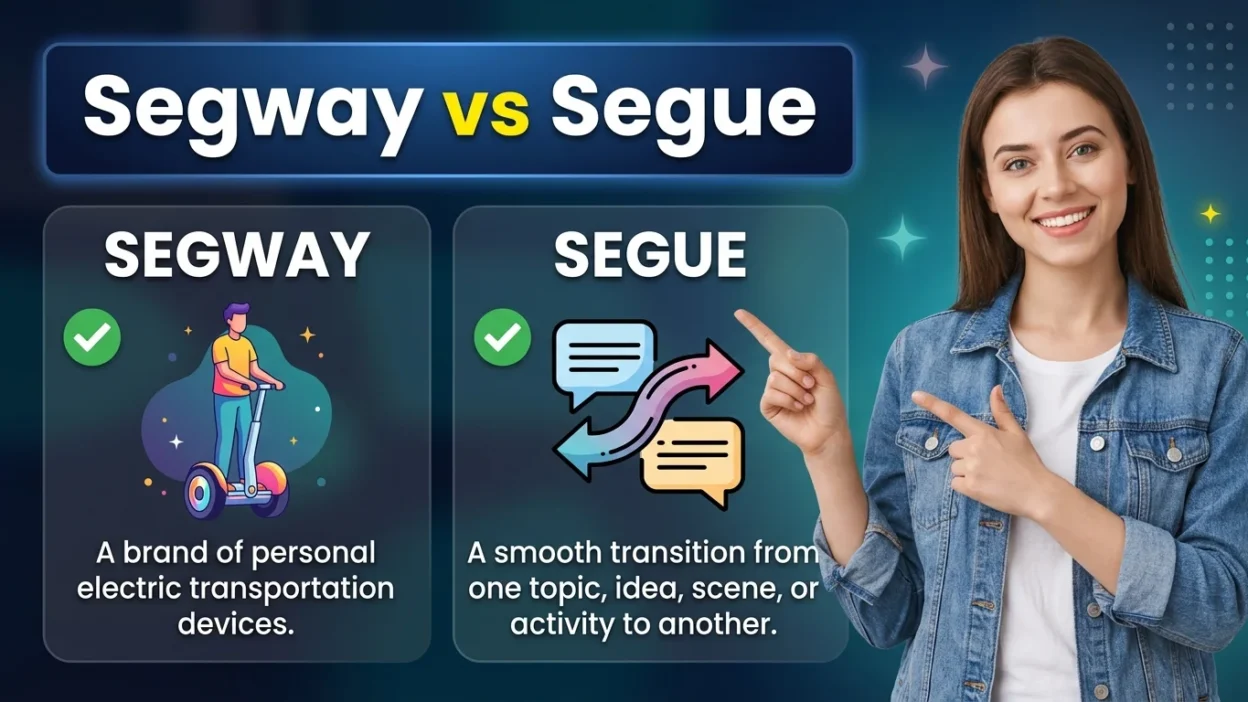
Some English words sound exactly alike but have completely different meanings, and “segway” vs “segue” is a perfect example. Although people often confuse these two words because they share the same pronunciation, they are not interchangeable.
Knowing the difference helps you avoid spelling mistakes and choose the correct word in conversations, essays, presentations, and professional writing.
“Segway” is commonly known as the brand name of a personal electric transporter that people ride while standing upright. In contrast, “segue” means to move smoothly from one topic, activity, scene, or idea to another.
Quick Answer :
Segway is a brand name associated with a self-balancing personal transportation device. It is usually written with a capital S when referring to the brand.
Segue is a word meaning a smooth transition from one subject, scene, activity, or idea to another. It can be used as a noun or a verb.
The easiest way to remember
- Segway → A transportation device.
- Segue → A smooth transition.
Example:
We rode a Segway through the city.
The speaker used a funny story to segue into the next topic.
Although the words sound similar, their meanings are entirely different.
What Does Segway Mean?

Segway is a brand name associated with a two-wheeled, self-balancing personal transportation device. The device is designed to help a person move while standing upright. It uses sensors and balancing technology to remain stable as the rider moves.
The word Segway is a proper noun when it refers to the brand. That means it is generally written with a capital S.
Segway meaning in simple English
A Segway is a personal transportation device that a person rides while standing.
Examples of Segway in sentences
- We rented a Segway to explore the historic district.
- The tour guide showed us how to ride a Segway safely.
- She used a Segway during the outdoor sightseeing tour.
- The visitors traveled around the park on Segways.
- Have you ever tried riding a Segway?
In each example, Segway refers to transportation, not a change in conversation.
Is Segway a noun?
Yes. Segway is primarily used as a noun when referring to the device or brand.
Example:
The tourist stood on a Segway.
Here, “Segway” is the name of the transportation device.
Is Segway always capitalized?
When referring to the Segway brand, it is normally capitalized.
However, people sometimes use “segway” informally to describe similar self-balancing devices. In general writing, it is best to use Segway when you mean the brand.
Correct brand usage:
The company offers Segway tours.
Important: Do not use Segway when you mean “a smooth transition.” That meaning belongs to segue.
What Does Segue Mean?

Segue means to move smoothly from one subject, situation, activity, or scene to another without a sudden interruption.
It is commonly used when talking about conversations, speeches, writing, music, films, presentations, and other situations where one thing changes naturally into another.
Segue meaning in simple English
A segue is a smooth transition from one thing to another.
Examples of segue in sentences
- The host used a joke to segue into the next topic.
- Her speech segued from education to employment.
- The documentary segues from history into modern politics.
- That question provides a natural segue into our next discussion.
- The music segued smoothly into the final song.
In these examples, segue describes a change or transition—not a vehicle.
Segue as a noun
As a noun, segue means a smooth transition.
Examples:
- That was an excellent segue into the next subject.
- The introduction created a natural segue to the main argument.
- The presenter made a clever segue from sports to health.
- The film contains a beautiful segue between two scenes.
Sentence structure:
a segue + into/to + another topic
Example:
His comment was a perfect segue into the discussion about teamwork.
Segue as a verb
As a verb, segue means to transition smoothly from one thing to another.
Examples:
- Let’s segue into the next section.
- The speaker segued from the introduction to the main topic.
- The conversation segued into a discussion about travel.
- The song segues into a softer melody.
- We can segue from this point to the next example.
Common verb forms of segue
| Form | Example |
| Base form | segue |
| Third-person singular | segues |
| Past tense | segued |
| Present participle | segueing |
Examples:
- She segues into the conclusion.
- He segued into a new subject.
- The presenter is segueing into the final section.
Segway vs Segue: Main Differences
The biggest difference between Segway and segue is their meaning.
| Feature | Segway | Segue |
| Meaning | A personal transportation device or brand | A smooth transition |
| Word type | Mainly a proper noun | Noun and verb |
| Capitalization | Usually capitalized as a brand | Usually lowercase |
| Pronunciation | Commonly pronounced “SEG-way” | Commonly pronounced “SEG-way” |
| Used for | Riding and transportation | Conversations, writing, music, and transitions |
| Example | We rented a Segway. | She made a segue into the next topic. |
| Related idea | Movement through a place | Movement from one idea to another |
The key difference
Segway is something you can ride.
Segue is something you can make, use, or do when moving smoothly from one idea to another.
We rode a Segway around the park.
We used a segue to move from the introduction to the main topic.
Segway vs Segue: Pronunciation
One reason these words are confusing is that they are commonly pronounced almost identically.
How to pronounce Segway
Segway is commonly pronounced:
SEG-way
The emphasis is on the first syllable.
How to pronounce segue
Segue is also commonly pronounced:
SEG-way
Even though “segue” contains unusual spelling, its pronunciation is not “seg-you” or “see-gway.”
Why do they sound the same?
The word segue comes from Italian, where it means “follows.” English pronunciation adapted the word into a sound similar to “Segway.”
The brand name Segway was created with a similar sound, which is why the two words are often confused.
Pronunciation memory tip
If you hear “SEG-way,” ask yourself:
- Are we talking about riding something? → Segway
- Are we talking about moving from one idea to another? → segue
Segway vs Segue: Spelling Differences
The spelling difference is small but important.
Segway spelling
S-E-G-W-A-Y
Segway
Segue spelling
S-E-G-U-E
segue
The most noticeable difference is the ending:
- Segway ends in -way.
- Segue ends in -gue.
A simple spelling trick
Remember:
Segway has “way” because it can take you somewhere.
Segue has “gue” because it helps you move from one idea to another.
This is not the historical origin of either word, but it is a useful memory trick for English learners.
Why Are Segway and Segue So Often Confused?
Several factors make these words easy to mix up.
1. They sound alike
Both words are commonly pronounced “SEG-way.” When people hear them in conversation, they may not know which spelling is correct.
2. Their spellings are unusual
The spelling segue does not look the way it sounds. Many English words are pronounced differently from their spelling, and “segue” is a good example.
3. They are both connected to movement
A Segway involves physical movement from one place to another.
A segue involves a smooth movement from one idea, topic, or activity to another.
This similarity in the general idea of “moving” can make the words even more confusing.
4. Autocorrect may not help
When typing quickly, people may write “segway” when they mean “segue.” Spell-checkers do not always identify the intended meaning because both spellings are valid words.
5. The brand name became familiar
Many people recognize the word Segway because of the transportation device. As a result, they may use that spelling for the transition word.
When to Use Segway
Use Segway when you are talking about the personal transportation device or brand.
Common situations where Segway is correct
- Guided city tours
- Outdoor sightseeing
- Personal transportation
- Recreational riding
- Self-balancing devices
- Brand-related products and services
Examples
The tour company offers Segway rides through the city.
He learned how to balance on a Segway.
The group explored the park using Segways.
The hotel arranged a Segway tour for its guests.
Segway in a travel sentence
We booked a Segway tour because we wanted to see more of the city without walking long distances.
Here, Segway is correct because the sentence refers to a transportation activity.
When to Use Segue
Use segue when you are talking about a smooth transition between topics, ideas, scenes, activities, or musical sections.
Common situations where segue is correct
- Public speaking
- Presentations
- Essays and articles
- Conversations
- Podcasts
- Music
- Television and films
- Business meetings
- Storytelling
Examples
The teacher used a question to segue into the next lesson.
The podcast host made a natural segue from technology to education.
The writer created a smooth segue between the two paragraphs.
The movie segued from a quiet scene into an exciting action sequence.
Segue in a writing sentence
The final paragraph provides a clear segue into the conclusion.
Here, segue is correct because the sentence describes a transition in writing.
Segway vs Segue in Everyday Conversations
In everyday English, segue is especially useful when you want to change the subject smoothly.
For example, imagine two friends discussing work:
“I have been working late all week. Speaking of time, how was your vacation?”
The phrase “Speaking of time” creates a natural transition from work to vacation.
You could describe this as a segue.
Conversation examples
Example 1:
“That reminds me of something else. Let’s segue into our travel plans.”
Example 2:
“The host used a funny story as a segue into the serious discussion.”
Example 3:
“We were talking about books, and the conversation naturally segued into movies.”
Example 4:
“Can we segue to the next question?”
In all these examples, segue refers to a change in topic.
Segway vs Segue in Writing
Writers often use segue to describe how one paragraph, section, or idea connects to another.
A good segue makes writing easier to follow. It helps readers understand why the discussion is moving in a new direction.
Example without a smooth transition
Exercise is important for health. Many people enjoy traveling. Online shopping has become popular.
These sentences introduce unrelated ideas without clear connections.
Example with a smooth segue
Exercise is important for health. Because staying active can also make travel more enjoyable, many people choose walking tours or cycling trips. This connection leads naturally into a discussion of travel habits.
The second example uses a logical transition between ideas.
Common phrases that create a segue
- Speaking of…
- That brings us to…
- Moving on to…
- This leads us to…
- On a related note…
- Another important point is…
- With that in mind…
- Let’s turn our attention to…
These phrases can help you segue from one topic to another.
Segway vs Segue in Presentations
A presentation often includes several sections. A speaker needs to move from one section to the next without confusing the audience.
That smooth movement is called a segue.
Example presentation segue
“Now that we have discussed the problem, let’s segue into the solutions.”
Another example:
“That brings us to our next question: How can businesses improve customer service?”
Why good segues matter
A good segue can:
- Improve clarity
- Keep the audience engaged
- Make the presentation feel organized
- Connect related ideas
- Reduce sudden topic changes
- Help listeners follow the speaker’s argument
Example of a professional segue
“We have looked at the causes of the issue. Next, let’s segue into the practical steps that can help solve it.”
This sounds natural and professional.
Segway vs Segue in Music and Film
The word segue is also used in music and film to describe a smooth transition between sections.
Music examples
The song segues into a slower melody.
The DJ made a smooth segue between two tracks.
The album uses a short instrumental segue between songs.
Film and television examples
The scene segued from the busy city to a quiet countryside.
The director created a smooth segue between the two scenes.
The documentary uses a voice-over to segue into the next chapter.
In these contexts, segue describes a transition in sound, visuals, or storytelling.
Common Mistakes with Segway and Segue
Because the words sound alike, several mistakes are common.
Mistake 1: Using “Segway” for a topic transition
Incorrect:
Let’s use this Segway to discuss the next point.
Correct:
Let’s use this segue to discuss the next point.
The sentence refers to a transition, so segue is correct.
Mistake 2: Using “segue” for the transportation device
Incorrect:
We rented a segue for the city tour.
Correct:
We rented a Segway for the city tour.
The sentence refers to a vehicle, so Segway is correct.
Mistake 3: Spelling segue as “segway”
Incorrect:
The speaker made a smooth segway into the conclusion.
Correct:
The speaker made a smooth segue into the conclusion.
Mistake 4: Pronouncing segue incorrectly
Some learners pronounce “segue” as “seg-you.” The standard English pronunciation is commonly “SEG-way.”
Mistake 5: Assuming the words are interchangeable
They are not interchangeable. Replacing one with the other can completely change the meaning of a sentence.
Segway vs Segue: Correct and Incorrect Examples
| Incorrect sentence | Correct sentence | Reason |
| The presenter made a Segway into the next topic. | The presenter made a segue into the next topic. | A transition is meant. |
| We rode a segue through the park. | We rode a Segway through the park. | A transportation device is meant. |
| The conversation segwayed into politics. | The conversation segued into politics. | The verb is “segue.” |
| She bought a new segue for sightseeing. | She bought a new Segway for sightseeing. | The device is meant. |
| That was a clever Segway between the two ideas. | That was a clever segue between the two ideas. | The sentence describes a connection. |
How to Use Segue Correctly in a Sentence
The word segue can function as both a noun and a verb.
Segue as a noun
Pattern:
a segue + into/to + topic
Examples:
- That was a natural segue into the next chapter.
- His question provided a useful segue to the main issue.
- The story created a perfect segue into the conclusion.
Segue as a verb
Pattern:
subject + segue + into/to + topic
Examples:
- The speaker segued into the next topic.
- The discussion segued to a different issue.
- The presenter segued from the introduction into the main argument.
Common prepositions used with segue
| Phrase | Example |
| segue into | She segued into the next topic. |
| segue to | The discussion segued to another issue. |
| segue from | He segued from sports to education. |
| a segue into | This is a good segue into the conclusion. |
| a segue between | The transition creates a segue between two scenes. |
Both segue into and segue to are common. The choice depends on the sentence and the intended transition.
Segway vs Segue: Memory Tricks
Here are some easy ways to remember the difference.
Memory trick 1: Segway = way
The word Segway contains the sound of way.
Think:
A Segway takes you on your way.
Memory trick 2: Segue = transition
Think of segue as a smooth bridge between ideas.
A segue helps one idea follow another.
Memory trick 3: Ask what is moving
- If a person is moving physically on a device, use Segway.
- If a conversation, story, or idea is moving smoothly, use segue.
Memory trick 4: Think of the sentence
“We rode a ___.”
The answer is Segway.
“She made a smooth ___ into the next topic.”
The answer is segue.
Memory trick 5: Capital letter clue
Segway is commonly capitalized because it is a brand name.
segue is usually lowercase because it is an ordinary English word.
Segway vs Segue: More Example Sentences
Examples using Segway
- The tourists rode a Segway around the old town.
- He watched a short video about how to operate a Segway.
- The company organizes guided Segway tours.
- We saw several people traveling on Segways.
- She wore comfortable shoes while riding a Segway.
- The guide explained the safety rules before the Segway tour.
- They explored the park on a Segway.
- The rental shop offers different types of personal transportation devices, including Segways.
Best Examples using segue as a noun
- That joke was a perfect segue into the next subject.
- The introduction provides a smooth segue to the main discussion.
- The speaker created a natural segue between the two ideas.
- The transition was an effective segue into the final section.
- The music included a beautiful segue between two songs.
- The story needs a better segue into the ending.
- Her question gave us a useful segue into the topic.
- The documentary uses a short segue between chapters.
Examples using segue as a verb
- Let’s segue into the next part of the lesson.
- The speaker segued from history into modern culture.
- The conversation segued into a discussion about education.
- The film segued into a new scene.
- The host segued to the next question.
- The writer segued from the problem to the solution.
- The presentation segued into a question-and-answer session.
- The music segued smoothly into the final track.
Can “Segway” Be Used as a Verb?
In standard English, Segway is primarily used as a noun referring to the brand or device.
Some people may informally use “segway” as a verb to mean riding a Segway, but this is not the standard use in careful writing.
Better:
We rode a Segway through the park.
Less standard:
We segwayed through the park.
If you are writing an article, essay, or professional message, use Segway as a noun and segue when referring to transitions.
Is “Segue” a Formal Word?
Yes. Segue is commonly used in formal and informal English.
It is especially useful in:
- Academic writing
- Business presentations
- Speeches
- Journalism
- Podcasts
- Film criticism
- Music discussions
- Everyday conversations
However, because some readers may not know the word, you can use simpler alternatives such as transition, move smoothly, or shift when appropriate.
Example
Formal:
The final paragraph provides a segue into the conclusion.
Simpler:
The final paragraph provides a smooth transition into the conclusion.
Both sentences are correct.
Segue vs Transition: Are They the Same?
The words segue and transition are closely related, but they are not always used in exactly the same way.
A transition is any change from one state, place, idea, or activity to another.
A segue usually emphasizes a smooth or natural transition.
Examples
- The transition from childhood to adulthood can be challenging.
- The speaker made a smooth segue into the next topic.
The first sentence describes a broad change. The second emphasizes a smooth connection.
Segway vs Segue in SEO and Content Writing
For writers, understanding Segway vs segue is especially important because spelling mistakes can affect clarity and professionalism.
If you are writing an article about grammar, communication, or vocabulary, using the correct word helps readers trust your content.
Example for an article
Incorrect:
Now, let’s use this Segway to explain the next grammar rule.
Correct:
Now, let’s use this segue to explain the next grammar rule.
Example for a blog introduction
In the previous section, we explained the meaning of the word. Now, let’s segue into its correct usage.
This sentence uses segue correctly because it describes a smooth movement from one section to another.
Why correct spelling matters
- It improves readability.
- It makes your writing look professional.
- It prevents confusion.
- It helps search engines understand the topic more accurately.
- It builds reader confidence.
Frequently Asked Questions About Segway vs Segue
Is Segway and segue the same thing?
No. Segway refers to a personal transportation device or brand, while segue means a smooth transition from one topic, idea, or activity to another.
Is it “Segway” or “segue” when changing the subject?
Use segue when changing the subject smoothly.
Example:
Let’s segue into the next topic.
Is “Segway” a vehicle?
Yes. A Segway is a type of self-balancing personal transportation device.
How do you spell the transition word?
The transition word is spelled segue: S-E-G-U-E.
How do you pronounce segue?
Segue is commonly pronounced “SEG-way.”
How do you pronounce Segway?
Segway is commonly pronounced “SEG-way.”
Why is segue spelled differently from how it sounds?
“Segue” comes from Italian and has an English pronunciation that does not directly match its spelling. It is commonly pronounced “SEG-way.”
Can I use “segway” instead of “segue”?
No, not in standard writing. If you mean a smooth transition, use segue.
Can “segue” be a noun?
Yes.
Example:
That was a smooth segue into the next subject.
Can “segue” be a verb?
Yes.
Example:
The speaker segued into the next topic.
What is the past tense of segue?
The past tense is segued.
Example:
The conversation segued into a discussion about travel.
What is the plural of Segway?
The plural is usually Segways.
Example:
The tourists rode Segways through the city.
What is the plural of segue?
The plural is segues.
Example:
The presentation included several smooth segues between sections.
Is “segue” a formal word?
Yes. It is widely used in professional, academic, and everyday English.
What is an easy way to remember Segway vs segue?
Remember:
Segway = something you ride. Segue = a transition you make.
Final Thought:
The difference between Segway vs segue becomes easy once you focus on meaning. Segway is a brand name associated with a self-balancing personal transportation device. It is used when talking about riding, touring, or moving physically.
Segue is an English word meaning a smooth transition. It is used when one topic, idea, scene, activity, or musical section moves naturally into another. Although both words are commonly pronounced “SEG-way,” their spellings and meanings are different. The best way to remember them is to connect Segway with transportation and segue with transitions.

Emily Parker is a dedicated writer who enjoys creating clear, useful, and easy-to-understand content. She focuses on language, grammar, word meanings, and everyday expressions to help readers find simple and reliable answers.