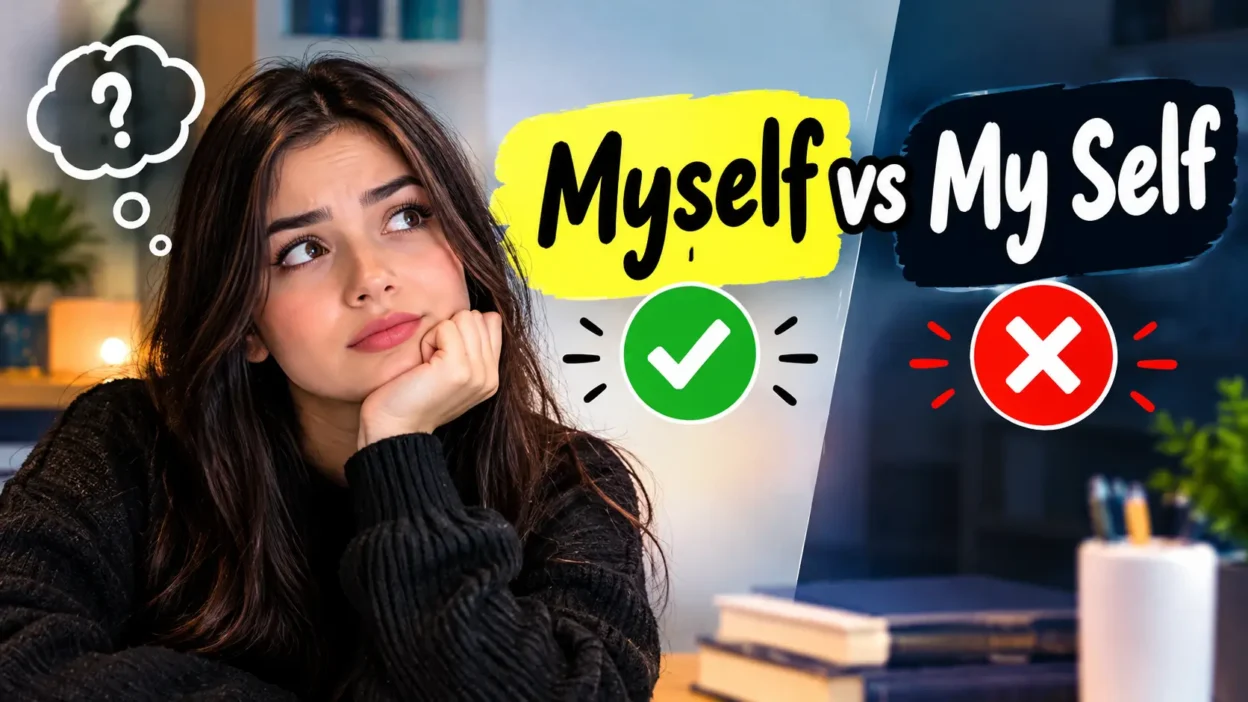
The difference between myself and my self comes down to more than just a space. These forms look almost identical, but they serve different purposes in English.
Myself is a reflexive or emphatic pronoun, while my self refers to your personal identity, personality, or inner sense of who you are.
The Myself vs My Self distinction can be confusing because both forms are grammatically possible in specific situations. For example, you can say, “I made it myself” when emphasizing that you did something personally.
What Does “Myself” Mean?
Myself is one word. It is a reflexive pronoun and can also function as an intensive pronoun.
It refers back to the subject I. In simple terms, when I performs an action and that action affects I, we can use myself.
For example:
- I hurt myself.
- I introduced myself.
- I taught myself English.
- I made the meal myself.
In these examples, myself is connected to the person speaking.
The word can also add emphasis:
I myself completed the project.
Here, myself emphasizes that the speaker personally completed the project.
“Myself” as a Reflexive Pronoun
A reflexive pronoun is used when the subject and object of a sentence refer to the same person.
For example:
I blamed myself.
The subject is I, and the object is myself. Both refer to the same person.
Other examples include:
- I looked at myself in the mirror.
- I accidentally cut myself.
- I reminded myself to call her.
- I prepared myself for the interview.
- I told myself to stay calm.
Without the reflexive pronoun, these sentences would either become incorrect or change meaning.
“Myself” as an Intensive Pronoun
Myself can also emphasize the subject.
For example:
I myself saw what happened.
The sentence means that I personally saw what happened.
Compare:
- I saw what happened.
- I myself saw what happened.
The basic meaning is similar, but the second sentence places extra emphasis on the speaker.
More examples include:
- I myself checked the documents.
- I myself will handle the problem.
- I myself cooked dinner.
- I myself heard the announcement.
- I myself chose this design.
What Does “My Self” Mean?
My self consists of two separate words:
- my = possessive determiner
- self = noun
Together, they can refer to your identity, personality, inner being, thoughts, feelings, or personal nature.
For example:
I am learning to accept my self.
Here, my describes the noun self. The phrase is talking about the speaker’s sense of identity rather than simply acting as a reflexive pronoun.
However, “my self” is much less common in ordinary modern English than “myself.” In many situations where learners might write my self, native speakers would normally choose myself or my own self, depending on the intended meaning.
“My Self” as a Noun Phrase
Because self is a noun, it can be modified by words such as my, your, true, inner, or future.
Examples:
- I want to understand my inner self.
- I am trying to discover my true self.
- I need to be honest with myself.
- I am becoming more comfortable with my own self.
The phrase my self can therefore appear when self is being treated as an actual noun.
Why “My Self” Looks Unusual
Most English speakers are accustomed to seeing myself as one word. As a result, writing my self may look incorrect even when a writer intends self to function as a noun.
For example:
I need to find my self.
This is grammatically possible in a very specific context, but it sounds unusual. A more natural version would often be:
I need to find myself.
Or, if you specifically mean your identity:
I need to find my true self.
This is why context matters when deciding between myself vs my self.
Myself vs My Self: The Main Difference
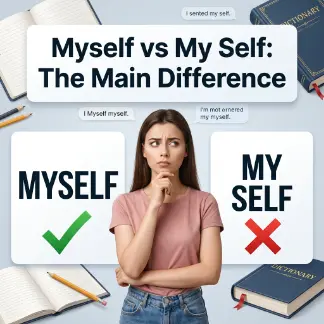
The easiest way to remember the difference is to ask what role the word is playing.
Myself is a single pronoun. It usually refers back to I or emphasizes I.
My self is two words. It treats self as a noun and my as the word that shows possession.
| Feature | Myself | My Self |
| Spelling | One word | Two words |
| Grammar | Reflexive/intensive pronoun | Possessive determiner + noun |
| Commonness | Very common | Uncommon |
| Refers to | The speaker | The speaker’s identity or inner being |
| Example | I hurt myself. | I want to understand my self. |
| Everyday usage | Normal | Usually replaced by “myself” or “my own self” |
| Main purpose | Reflection or emphasis | Talking about identity/personality |
The important point is that myself is normally the correct choice in everyday English when you need the reflexive pronoun.
When Should You Use “Myself”?
Use myself when it refers back to I.
There are two major situations where this happens.
When “Myself” Receives the Action
Use myself when the speaker performs an action on themselves.
Examples:
- I washed myself.
- I dressed myself.
- I injured myself.
- I introduced myself.
- I taught myself to cook.
- I reminded myself about the appointment.
Consider this sentence:
I introduced myself to the manager.
The person introducing someone is I, and the person being introduced is also the speaker. Therefore, myself is appropriate.
When “Myself” Adds Emphasis
You can also use myself to emphasize that you personally performed an action.
Examples:
- I made this website myself.
- I myself wrote the article.
- I will do it myself.
- I checked the information myself.
- I personally handled the situation myself.
In some cases, myself can come at the end of the sentence:
I fixed the computer myself.
It can also appear directly after the subject:
I myself fixed the computer.
Both forms emphasize the speaker.
When Should You Use “My Self”?
Use my self only when self is functioning as a separate noun and you genuinely mean your identity, personality, or inner being.
This use is relatively uncommon in normal conversation.
For example:
I am trying to understand my self as an individual.
However, a more natural modern-English version would usually be:
I am trying to understand myself as an individual.
Or:
I am trying to understand my own self as an individual.
The two-word form may appear in philosophical, psychological, literary, or academic discussions where self is deliberately treated as a noun.
“My Self” in Philosophical Writing
In philosophical writing, self can be discussed as a concept.
For example:
- The relationship between the mind and my self is complex.
- The experience changed my understanding of my self.
- I began questioning the nature of my self.
Even here, writers often use the self, myself, or my own self depending on their exact meaning.
Therefore, do not assume that separating myself automatically makes a sentence more sophisticated or correct.
Myself vs My Self in Everyday English
For everyday writing, myself is usually the word you want.
Consider these examples:
Correct and natural:
I did it myself.
Unusual:
I did it my self.
The second sentence is not the normal way to express this meaning.
Another example:
Natural:
I introduced myself.
Incorrect in standard usage:
I introduced my self.
If you are talking about an action that you perform on yourself, use myself.
Examples of “Myself” in Sentences
Here are several examples to help you recognize the correct pattern.
Reflexive Examples
- I accidentally hurt myself.
- I taught myself how to swim.
- I looked at myself in the mirror.
- I bought myself a new phone.
- I reminded myself to study.
- I prepared myself for the test.
- I blamed myself for the mistake.
- I told myself to remain patient.
- I challenged myself to improve.
- I caught myself making the same mistake.
In each sentence, myself refers back to the subject I.
Emphasis Examples
- I made the entire meal myself.
- I myself checked every page.
- I will finish the work myself.
- I myself witnessed the event.
- I designed the logo myself.
- I myself spoke to the customer.
- I repaired the chair myself.
- I myself chose the final option.
Here, myself means something like personally or without someone else doing it for me.
Examples of “My Self”
Because my self is uncommon, it is important to understand where the two words can genuinely have separate meanings.
Examples include:
- I want to understand my self better.
- The experience forced me to question my self.
- I am learning to accept my true self.
- My inner self feels different from my public personality.
- I am trying to reconnect with my younger self.
Notice something important: expressions such as my true self, my inner self, and my younger self are much more natural than simply my self.
This happens because the additional adjective makes self clearly function as a noun.
“Myself” vs “My Self” Grammar Rule
A simple grammar test can help.
Ask yourself:
Am I using the word as a reflexive pronoun?
If yes, use myself.
Example:
I hurt myself.
Ask:
Am I specifically talking about “self” as a noun representing identity or inner nature?
If yes, my self may be grammatically possible, although another phrasing may sound more natural.
Example:
I am exploring my inner self.
This distinction prevents many spelling mistakes.
Common Mistakes With “Myself”
Many English learners make mistakes because they use myself simply because they are talking about themselves.
That is not enough. The grammar of the sentence determines whether myself is appropriate.
Mistake 1: Using “Myself” Instead of “I”
A common mistake is:
Myself went to the store.
This is incorrect in standard English.
The correct sentence is:
I went to the store.
Myself cannot normally replace I as the subject.
Mistake 2: Using “Myself” Instead of “Me”
Another common mistake is:
Please contact myself tomorrow.
In standard English, the natural sentence is:
Please contact me tomorrow.
Here, me is the correct object pronoun.
Mistake 3: Writing “My Self” for Every Reflexive Meaning
Incorrect:
I hurt my self.
Correct:
I hurt myself.
When the word functions as a reflexive pronoun, it is written as one word.
Mistake 4: Adding “Myself” After “I” Unnecessarily
You may sometimes hear:
Myself, I think this is a good idea.
This construction can appear in informal speech or certain regional varieties, but standard English normally uses:
I think this is a good idea.
Or:
I personally think this is a good idea.
Mistake 5: Using “Myself” as a Formal Replacement for “Me”
Some people believe myself sounds more professional than me.
It does not.
For example:
Please send the document to myself.
The natural standard-English version is:
Please send the document to me.
Using myself does not automatically make a sentence more formal.
Spelling Tip: Why Is “Myself” One Word?
Myself is an established compound pronoun in English.
It belongs to the same group as:
- yourself
- himself
- herself
- itself
- ourselves
- yourselves
- themselves
These words are normally written as single words.
For example:
- I did it myself.
- She prepared herself.
- He blamed himself.
- They introduced themselves.
Therefore, when self functions as part of a reflexive pronoun, keep it attached to the possessive form.
A Simple Trick to Remember Myself vs My Self
Here is an easy memory trick:
Action back to “I” = myself.
For example:
I blamed myself.
Personal identity = self as a noun.
For example:
I want to understand my true self.
You can also remember:
Myself = one pronoun.
My self = my + noun “self.”
This rule works for most everyday situations.
Myself vs My Own Self
Another phrase worth understanding is my own self.
This phrase contains three words:
my + own + self
It can emphasize personal identity or individuality.
For example:
I need to be true to my own self.
It can also be used for emphasis:
I was surprised by my own self-control.
In many situations, myself is more natural:
I need to be true to myself.
Both can be grammatical, but the meaning and emphasis can differ slightly.
Myself vs My Self vs My Own Self
These three forms can be compared like this:
| Form | Typical Function | Example |
| Myself | Reflexive or emphasis | I did it myself. |
| My self | My + noun self | I am exploring my self. |
| My own self | Strong emphasis on identity | I want to be true to my own self. |
In everyday communication, myself and my own self are much more likely to sound natural than the bare phrase my self.
Myself vs My Self in Formal Writing
Formal writing requires grammatical accuracy, but you should not use myself simply because it sounds formal.
For example:
Incorrect:
The manager contacted myself.
Correct:
The manager contacted me.
Likewise:
Correct:
I completed the report myself.
Here, myself is correct because it adds emphasis.
The best approach is to choose the pronoun based on its grammatical function rather than its perceived level of formality.
Myself vs My Self in Professional Communication
The same rule applies to emails, reports, applications, and workplace communication.
Consider:
Please send the information to myself.
Use:
Please send the information to me.
But:
I prepared the report myself.
is completely correct.
If you remember this distinction, your professional writing will sound much more natural.
Myself vs My Self in American English
In standard American English, myself is overwhelmingly more common for reflexive and emphatic purposes.
Examples:
- I introduced myself.
- I made it myself.
- I taught myself.
- I reminded myself.
- I checked it myself.
The two-word my self is generally reserved for situations where self is intentionally being treated as a noun.
For everyday American English, therefore, do not separate myself unless the sentence specifically requires my + self as separate grammatical elements.
Is “Myself” Always Correct When Talking About Yourself?
No.
This is one of the most important lessons.
The fact that a sentence is about you does not mean myself is automatically correct.
Compare:
I am a student.
Not:
Myself am a student.
And:
She called me.
Not:
She called myself.
But:
I introduced myself.
Here, myself is correct because it refers back to the subject I.
So, think about the grammatical role first.
How to Choose Between Myself and My Self
Use this quick process.
Step 1: Find the Subject
Look for I.
If the sentence has I as the subject, ask whether the action comes back to the same person.
Step 2: Check the Action
If you are doing something to yourself, use myself.
Example:
I washed myself.
Step 3: Check for Emphasis
If you mean personally, myself may be correct.
Example:
I completed the task myself.
Step 4: Look at “Self” as a Noun
If you are discussing identity, personality, or inner nature, self may function as a noun.
Example:
I am trying to understand my true self.
This method will solve most myself vs my self questions.
Quick Comparison Examples
Here are some side-by-side examples.
| Incorrect or Less Natural | Better Choice | Why |
| I hurt my self. | I hurt myself. | Reflexive pronoun |
| Myself went home. | I went home. | Subject requires “I” |
| Contact myself. | Contact me. | Object requires “me” |
| I did it my self. | I did it myself. | Emphatic pronoun |
| I found my self again. | I found myself again. | Reflexive usage |
| I discovered my true self. | I discovered my true self. | “Self” is a noun |
| I introduced my self. | I introduced myself. | Reflexive pronoun |
“Myself” in Common Expressions
You will frequently see myself in everyday phrases.
“By Myself”
By myself can mean alone or without help.
Examples:
- I live by myself.
- I completed the project by myself.
- I went to the restaurant by myself.
- I learned the skill by myself.
“For Myself”
For myself can mean for my own benefit or personal use.
Examples:
- I bought a gift for myself.
- I kept some money for myself.
- I made this decision for myself.
“To Myself”
To myself can refer to directing something toward the speaker or keeping something private.
Examples:
- I kept the secret to myself.
- I said to myself, “Stay calm.”
- I promised myself I would improve.
“Of Myself”
This construction can describe your own actions, characteristics, or opinions.
Examples:
- I am proud of myself.
- I am disappointed in myself.
- I am confident in myself.
Why “Myself” Is Often Misused
There are several reasons learners misuse myself.
First, the word contains my, so people sometimes assume it can replace me or I.
Second, myself sounds more formal to some speakers, so they use it in professional situations where me would be correct.
Third, people may think that any sentence referring to themselves requires a reflexive pronoun.
However, English pronouns have different grammatical jobs.
I is a subject pronoun.
Me is an object pronoun.
Myself is a reflexive or intensive pronoun.
Knowing these roles is more useful than simply memorizing the spelling.
Myself, Me, and I: A Quick Guide
| Pronoun | Main Function | Example |
| I | Subject | I called him. |
| Me | Object | He called me. |
| Myself | Reflexive/emphasis | I called myself. |
Consider:
I made the cake.
Subject = I.
She thanked me.
Object = me.
I made the cake myself.
Emphasis = myself.
This three-word comparison makes the role of myself much easier to understand.
Frequently Asked Questions
Is “myself” one word or two?
Myself is normally written as one word when it functions as a reflexive or intensive pronoun.
Example:
I did it myself.
Is “my self” grammatically correct?
It can be correct when my modifies self as a noun. However, the phrase is uncommon in ordinary English. Expressions such as my true self, my inner self, or simply myself are often more natural.
Which is correct: “I did it myself” or “I did it my self”?
The correct standard form is:
I did it myself.
Here, myself emphasizes that you personally performed the action.
Can I use “myself” instead of “me”?
Usually, no.
Say:
Please call me.
Not:
Please call myself.
Use myself when it refers back to the subject I or when it provides emphasis.
Can “myself” be the subject of a sentence?
In standard English, myself should not normally replace I as the subject.
Say:
I went to the store.
Not:
Myself went to the store.
Is “myself” formal English?
Myself is standard English, but it is not simply a more formal version of me or I. It has specific grammatical functions.
What is the difference between “myself” and “my own self”?
Myself is a reflexive or emphatic pronoun. My own self treats self as a noun and adds extra emphasis to personal identity.
For example:
I need to trust myself.
I need to be true to my own self.
Should I write “my self” in an essay?
Only if you genuinely mean my + the noun self. In most normal sentences, myself will be the correct form.
Is “I myself” correct?
Yes.
For example:
I myself checked the information.
Here, myself emphasizes that the speaker personally checked it.
Is “by myself” correct?
Yes. By myself commonly means alone or without assistance.
For example:
I completed the assignment by myself.
Is “I did it myself” correct grammar?
Yes. This is a very common and natural use of myself as an intensive pronoun.
Is “myself” a pronoun?
Yes. Myself is a reflexive pronoun and can also be used as an intensive pronoun.
What is the easiest way to remember “myself vs my self”?
Remember:
Myself = reflexive or emphasis.
My self = my + the noun self.
For most everyday sentences involving an action performed by or on the speaker, choose myself.
Final Thoughts
The difference between myself vs my self may seem small because the only visible difference is a space. However, that space changes the grammatical structure. Myself is a standard reflexive and intensive pronoun. Use it when the action refers back to I, such as “I hurt myself,” or when you want to emphasize personal involvement, such as “I did it myself.”
My self, meanwhile, contains two separate words: the possessive determiner my and the noun self. It can be used when you are specifically discussing your identity, inner nature, or sense of self. Still, this form is uncommon in everyday English, and phrases like my true self, my inner self, or myself often sound more natural.

Michael Collins is a skilled writer who creates clear, practical, and reader-friendly content. He focuses on language, grammar, word meanings, and everyday expressions, making complex topics simple to understand.