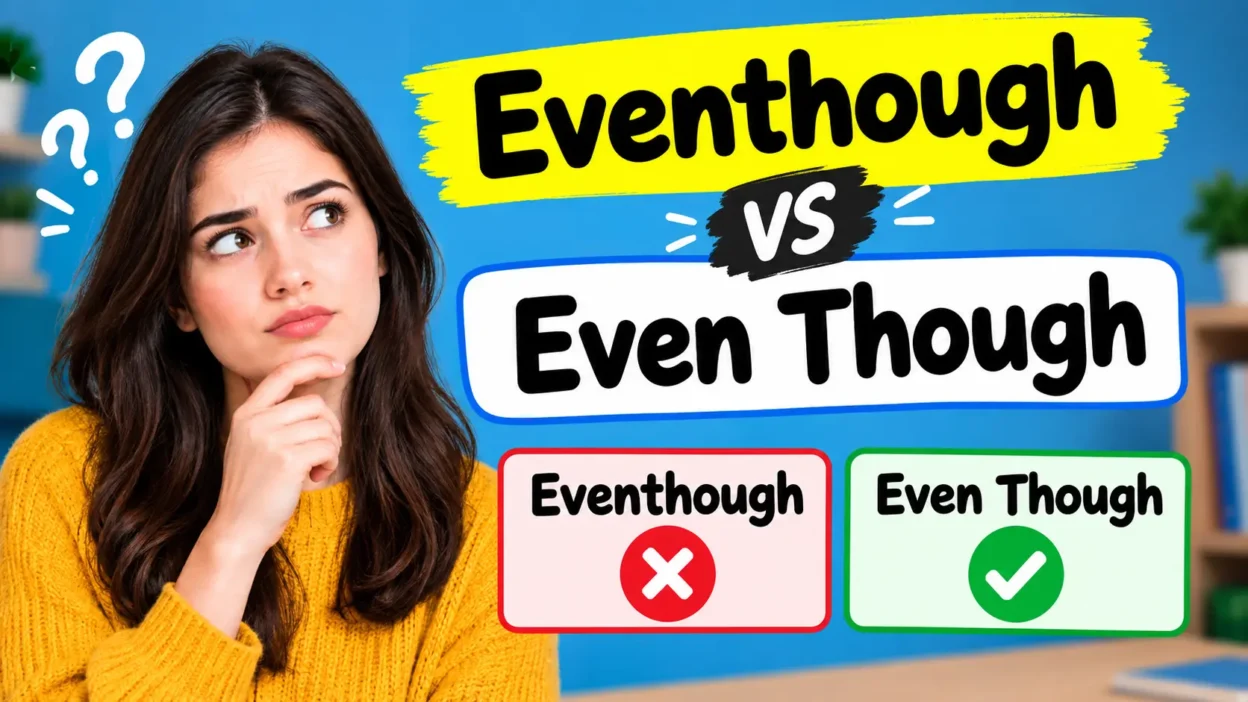
Spelling can make two phrases look almost identical while only one is correct. That’s exactly what happens with eventhough vs even though. Many English learners accidentally combine the two words into “eventhough,” but standard English uses even though as two separate words.
Even though is a conjunction used to introduce a contrast or unexpected fact. For example, “Even though it was raining, we went outside.” The phrase shows that the rain did not stop the action. “Eventhough” is generally considered a misspelling, so you should avoid it in formal and everyday writing.
In this guide, we’ll explain eventhough vs even though clearly and simply. You’ll learn the correct spelling, meaning, grammar rules, sentence structure, common mistakes, and plenty of examples to help you use even though confidently.
Eventhough vs Even Though: Quick Answer
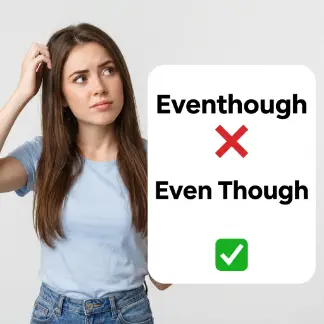
The correct spelling is even though, written as two separate words.
“Eventhough” is incorrect in standard English. It is usually a spelling mistake caused by combining the two words.
| Form | Correct? | Usage |
| Even though | Yes | Standard English |
| Eventhough | No | Incorrect spelling |
| Even though I was tired | Yes | Correct sentence |
| Eventhough I was tired | No | Incorrect spelling |
The easiest rule to remember is simple:
Always write “even though” as two words.
There is no standard grammar situation where eventhough should replace even though.
What Does “Even Though” Mean?
Even though is a conjunction that introduces a fact that contrasts with the main idea of a sentence.
It often means something similar to:
- although
- despite the fact that
- in spite of the fact that
For example:
Even though it was cold, we went for a walk.
The sentence tells us two contrasting facts:
- It was cold.
- We went for a walk anyway.
Normally, cold weather might make someone stay indoors. The phrase even though shows that the second action happened despite the first situation.
Another example is:
Even though Sarah was nervous, she gave the presentation.
Sarah was nervous, but she still gave the presentation. The phrase even though connects these two contrasting ideas.
Is “Eventhough” a Correct Word?
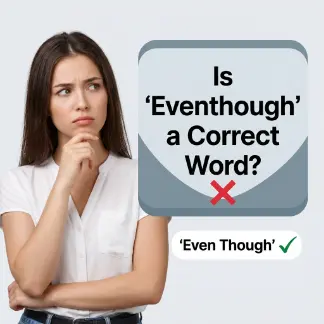
No. Eventhough is not the standard spelling.
You should write:
Even though
Not:
Eventhough
This mistake happens because people often pronounce even though quickly. When spoken naturally, the phrase can sound like one connected unit. As a result, some writers incorrectly combine the words.
However, spelling matters in written English.
Incorrect
Eventhough I was busy, I helped him.
Correct
Even though I was busy, I helped him.
The second sentence follows standard English grammar and spelling.
Why Do People Write “Eventhough”?
There are several reasons people accidentally write eventhough.
First, even though is commonly pronounced smoothly as a phrase. When people hear it, they may assume it is one word.
Second, English contains many conjunctions and linking words that are written as single words, such as although, because, and however. This can make learners unsure about whether even though should also be combined.
Third, people often type quickly. When two words frequently appear together, it is easy to accidentally remove the space.
For example:
- even though → eventhough
- a lot → alot
- in to → into
However, these words and phrases do not all follow the same spelling rules.
The important point is that even though must remain two words.
Correct Meaning and Usage of “Even Though”
The phrase even though introduces a subordinate clause. It tells the reader that one fact exists, but another action or result still happens.
The basic pattern is:
Even though + subject + verb, main clause.
For example:
Even though I was tired, I finished my homework.
Here:
- Even though I was tired = subordinate clause
- I finished my homework = main clause
You can also reverse the order:
I finished my homework even though I was tired.
Both sentences are grammatically correct.
Examples of “Even Though”
- Even though it was late, we continued working.
- Even though she was sick, she went to school.
- Even though he apologized, she remained upset.
- Even though the test was difficult, I passed.
- Even though they were hungry, they waited for dinner.
- Even though I had little money, I bought the book.
- Even though the weather was bad, the event continued.
- Even though he is young, he is very responsible.
- Even though she disagreed, she respected my opinion.
- Even though the road was crowded, we arrived on time.
In every example, even though introduces a contrast.
Even Though vs Although
A common question is whether even though and although have the same meaning.
They are very similar. Both can introduce a contrasting clause.
Compare these sentences:
Although it was raining, we went outside.
Even though it was raining, we went outside.
Both sentences are correct. However, even though can provide a slightly stronger sense of contrast or surprise.
For example:
Although he was tired, he continued working.
This simply presents a contrast.
Even though he was extremely tired, he continued working.
This can emphasize how surprising the action was.
| Phrase | Meaning | Example |
| Even though | Strong contrast | Even though it was raining, we played. |
| Although | Contrast | Although it was raining, we played. |
| Though | Contrast, often more conversational | Though it was raining, we played. |
For everyday writing, all three can be useful.
Even Though vs Though
Though can also mean although, but it is often more flexible in casual English.
For example:
Even though I was tired, I went to work.
Though I was tired, I went to work.
Both are grammatically correct.
You can also place though at the end of a sentence in some contexts:
The movie was good, though.
You cannot normally use even though in exactly the same way:
The movie was good, even though. ❌
So, while these expressions are related, they do not always work in the same sentence positions.
Even Though vs Despite
Another common comparison is even though vs despite.
These expressions can communicate a similar idea, but their grammatical structures are different.
After even though, use a clause containing a subject and verb.
Even though I was tired, I worked.
After despite, use a noun, pronoun, or gerund.
Despite being tired, I worked.
You should not normally write:
Despite I was tired, I worked. ❌
Instead, write:
Despite being tired, I worked. ✅
Or:
Despite the fact that I was tired, I worked. ✅
Comparison Table
| Expression | What follows it? | Example |
| Even though | Subject + verb | Even though I was tired, I worked. |
| Although | Subject + verb | Although I was tired, I worked. |
| Despite | Noun/gerund | Despite being tired, I worked. |
| In spite of | Noun/gerund | In spite of being tired, I worked. |
Understanding this difference will help you avoid many common grammar mistakes.
How to Use “Even Though” at the Beginning of a Sentence
You can begin a sentence with even though.
The general structure is:
Even though + clause, main clause.
For example:
Even though the store was closing, we stayed for another five minutes.
When the even though clause comes first, a comma usually separates it from the main clause.
More examples include:
- Even though I was nervous, I answered the question.
- Even though she was busy, she called me.
- Even though the task was difficult, he completed it.
- Even though we were late, the teacher allowed us to enter.
- Even though the restaurant was crowded, we found a table.
This structure is especially useful when you want to emphasize the contrast before presenting the main result.
How to Use “Even Though” in the Middle of a Sentence
You can also put even though after the main clause.
The pattern is:
Main clause + even though + subordinate clause.
For example:
I went for a walk even though it was raining.
In this structure, you generally do not need a comma before even though.
More examples:
- I finished the project even though I was exhausted.
- She attended the meeting even though she felt sick.
- We enjoyed the trip even though the weather was poor.
- He bought the phone even though it was expensive.
- They continued playing even though it became dark.
This sentence structure sounds natural in everyday English.
“Even Though” in Questions
You can also use even though in questions.
For example:
Why did you go outside even though it was raining?
The phrase explains the contrast between the action and the situation.
Other examples include:
- Why did she leave even though she was enjoying herself?
- How did he finish the work even though he started late?
- Why did they travel even though the weather was bad?
- Did you go to school even though you were sick?
- Did he buy it even though it was expensive?
These questions are grammatically correct because even though introduces the contrasting circumstance.
“Even Though” in Negative Sentences
You can also use even though with negative verbs.
For example:
Even though I didn’t sleep well, I went to work.
The phrase still introduces a contrast.
Other examples:
- Even though she didn’t like the food, she finished it.
- Even though he didn’t study much, he passed the test.
- Even though we didn’t have much time, we completed the task.
- Even though they didn’t agree with us, they remained polite.
- Even though I don’t know him well, I trust him.
Notice that even though does not make the sentence negative by itself. The negative meaning comes from words such as not, didn’t, don’t, or never.
“Even Though” With Different Tenses
You can use even though with different verb tenses. The tense depends on when the events happen.
Present Tense
Even though she is tired, she keeps working.
Even though he doesn’t like coffee, he drinks it every morning.
Past Tense
Even though I was tired, I finished the assignment.
Even though they arrived late, they joined the meeting.
Future Meaning
Even though it may rain tomorrow, we will go hiking.
Even though the journey will be long, we will continue.
Present Perfect
Even though I have studied the topic, I still have questions.
The important rule is that even though does not require one specific tense. Choose the tense that fits the meaning of your sentence.
Eventhough vs Even Though Examples
Seeing the incorrect and correct versions side by side can make the spelling rule easier to remember.
| Incorrect | Correct |
| Eventhough I was tired, I worked. | Even though I was tired, I worked. |
| Eventhough it was raining, we left. | Even though it was raining, we left. |
| Eventhough she was busy, she called. | Even though she was busy, she called. |
| Eventhough he failed, he tried again. | Even though he failed, he tried again. |
| Eventhough they were late, they joined us. | Even though they were late, they joined us. |
The mistake in every sentence is the same: eventhough should be separated into even though.
Common Mistakes With “Even Though”
Learning the correct spelling is only one part of using this phrase properly. There are several other mistakes that learners often make.
Writing “Eventhough” as One Word
This is the most obvious mistake.
Eventhough I was tired, I went to work. ❌
Correct it to:
Even though I was tired, I went to work. ✅
Remember that the phrase contains two words.
Using “Even Though” With a Noun Alone
Even though the rain, we went outside. ❌
This structure is incorrect because even though normally introduces a clause.
Better:
Even though it was raining, we went outside. ✅
Or use despite:
Despite the rain, we went outside. ✅
Confusing “Even Though” With “Despite”
Do not copy the grammatical structure of despite after even though.
Incorrect:
Even though the rain, we went outside. ❌
Correct:
Even though it was raining, we went outside. ✅
Or:
Despite the rain, we went outside. ✅
Adding “But” Unnecessarily
A sentence can become awkward when writers use even though and but together.
For example:
Even though it was raining, but we went outside. ❌
Use one structure:
Even though it was raining, we went outside. ✅
Or:
It was raining, but we went outside. ✅
You usually do not need both even though and but to show the same contrast.
Punctuation With “Even Though”
Punctuation depends on where the phrase appears.
When the even though clause comes first, use a comma after that introductory clause.
Even though I was tired, I finished my work.
When the main clause comes first, a comma is usually unnecessary.
I finished my work even though I was tired.
Compare:
Even though she was nervous, she gave the speech.
She gave the speech even though she was nervous.
Both are correct.
A simple rule for beginners is:
Even though + clause at the beginning → usually use a comma after the clause.
Is “Even Though” Formal or Informal?
Even though is standard English and works in both formal and informal writing.
You can use it in:
- emails
- school assignments
- essays
- blog posts
- business writing
- conversations
- academic writing
- social media posts
For example:
Even though the results were positive, further research is necessary.
This sounds appropriate in formal writing.
In casual conversation, you might say:
Even though I was tired, I went anyway.
So you do not need to replace even though simply because your writing is formal.
Eventhough vs Even Though: Spelling Tip
One of the easiest ways to remember the correct spelling is to break the phrase into its two meanings:
even + though = even though
Think of even and though as two separate building blocks.
Do not combine them.
A useful memory trick is:
Even though has two words, just like “in spite” has two words.
If you are unsure while writing, pause and check whether you have accidentally typed eventhough.
Examples From Everyday English
Here are some natural examples you might hear or use in everyday conversations.
At Work
Even though I had several tasks, I finished the report before lunch.
She attended the meeting even though she was busy.
At School
Even though the exam was difficult, I passed.
He studied hard even though he was tired.
With Friends
Even though it was raining, we decided to go out.
I enjoyed the movie even though it was very long.
While Traveling
Even though the flight was delayed, we enjoyed the trip.
We visited the beach even though the weather was cloudy.
At Home
Even though I was hungry, I waited for dinner.
She cleaned the house even though she had a headache.
These examples show how naturally even though fits into everyday communication.
20 Correct “Even Though” Sentences
Practice is one of the best ways to learn grammar. Read these sentences carefully and notice the structure.
- Even though I was tired, I finished my homework.
- Even though it was cold, we went outside.
- She smiled even though she was upset.
- He continued working even though he felt sick.
- Even though the road was busy, we arrived on time.
- They played football even though it was raining.
- Even though she was nervous, she spoke confidently.
- I bought the book even though it was expensive.
- Even though he apologized, she was still angry.
- We enjoyed the trip even though the hotel was small.
- Even though I had little time, I helped him.
- She went shopping even though she was tired.
- Even though the question was difficult, he answered it.
- They stayed outside even though it was getting dark.
- Even though he failed once, he tried again.
- I trusted him even though I had doubts.
- Even though the restaurant was crowded, we found a seat.
- She completed the project even though she had limited resources.
- Even though we disagreed, we remained friends.
- He went to work even though he didn’t feel well.
Eventhough vs Even Though: Quick Comparison
| Feature | Eventhough | Even Though |
| Spelling | Incorrect | Correct |
| Number of words | One | Two |
| Standard English | No | Yes |
| Used for contrast | Not standard | Yes |
| Formal writing | Avoid | Appropriate |
| Informal writing | Avoid | Appropriate |
| Example | Eventhough I was tired. ❌ | Even though I was tired. ✅ |
The choice is straightforward: use even though.
How to Correct “Eventhough” in Your Writing
If you find eventhough in your draft, simply separate the two words.
Eventhough → Even though
For example:
Before:
Eventhough the weather was bad, we went hiking.
After:
Even though the weather was bad, we went hiking.
The correction does not change the meaning. It only fixes the spelling.
You can also use your word processor’s spell checker. Most modern writing tools will identify eventhough as a spelling error.
However, do not depend entirely on spell checkers. Learning the rule helps you recognize the correct form yourself.
Why Correct Spelling Matters
A small spelling mistake can make otherwise good writing look less polished.
When readers see eventhough, they can usually understand what you mean. Still, standard spelling is important when you are writing:
- academic assignments
- resumes
- professional emails
- websites
- blog posts
- business documents
- applications
Using even though shows that you understand the standard form.
This is especially important for SEO content because clean grammar and natural writing improve readability and help create a better experience for visitors.
Frequently Asked Questions About Eventhough vs Even Though
Is “eventhough” one word?
No. Eventhough is not the standard spelling. The correct form is even though, written as two separate words.
Is “even though” grammatically correct?
Yes. Even though is a grammatically correct conjunction used to introduce a contrasting clause.
For example:
Even though it was raining, we went outside.
Which is correct: eventhough or even though?
Even though is correct. Eventhough is an incorrect spelling in standard English.
Can I use “even though” at the beginning of a sentence?
Yes. You can begin a sentence with even though.
For example:
Even though I was tired, I finished the work.
Can “even though” be used in the middle of a sentence?
Yes. For example:
I finished the work even though I was tired.
This is completely correct.
What is the difference between “even though” and “although”?
Both introduce contrast. Even though can sometimes make the contrast feel stronger or more surprising.
For example:
Although he was tired, he worked.
Even though he was extremely tired, he worked.
Can “even though” and “but” be used together?
Normally, you should not use but with even though to introduce the same contrast.
Incorrect:
Even though I was tired, but I worked.
Correct:
Even though I was tired, I worked.
Is “even though” formal?
Yes. Even though is standard English and can be used in both formal and informal writing.
What can I use instead of “even though”?
Depending on the sentence, you can use although, though, despite, or in spite of. However, the grammar after each expression can differ.
Is “even though” the same as “despite”?
They express similar ideas, but their grammatical structures are different.
Even though I was tired, I worked.
Despite being tired, I worked.
How do I remember the spelling of “even though”?
Remember that it contains two separate words: even + though. Never combine them into eventhough.
Conclusion :
The difference between eventhough vs even though is simple once you know the rule. Even though is the correct standard form, while eventhough is an incorrect spelling. Use even though when you want to show a contrast between two ideas. It is normally followed by a complete clause containing a subject and a verb.
Once you remember that even and though stay separate, you will avoid one of the most common spelling mistakes involving this phrase. Whether you are writing a school assignment, professional email, blog post, or everyday message, even though is the form you should choose.

Emily Parker is a dedicated writer who enjoys creating clear, useful, and easy-to-understand content. She focuses on language, grammar, word meanings, and everyday expressions to help readers find simple and reliable answers.