Knowing the difference between “shown” and “showed” can save you from a common English grammar mistake. Both forms come from the verb show, but they are used differently in sentences.
“Showed” is the simple past tense, while “shown” is usually used as the past participle with helping verbs such as has, have, had, or be. For example, you can say, “She showed me the picture yesterday.”
However, you would say, “She has shown me the picture before.” Understanding this small difference makes your writing clearer and helps your sentences sound more natural.
Shown vs Showed: Quick Answer
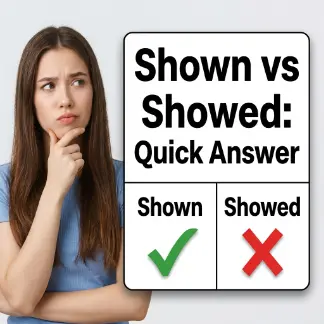
The quickest way to understand the difference is to remember that showed is the simple past form, while shown is generally the past participle.
| Word | Grammatical form | Common use | Example |
| Show | Base form | Present/simple forms | I show my work. |
| Showed | Simple past | Completed past action | I showed my work yesterday. |
| Shown | Past participle | Perfect/passive constructions | I have shown my work. |
So, these sentences are correct:
She showed me the picture yesterday.
She has shown me the picture before.
A useful rule is:
Use “showed” for simple past actions and “shown” after helping verbs such as “has,” “have,” and “had.”
However, shown can also appear in passive constructions, which we will cover later.
What Does “Show” Mean?

Before comparing shown and showed, it helps to understand the base verb show.
Show means to make something visible, explain something, present something, or allow someone to see something.
For example:
- Please show me your homework.
- Can you show me the way?
- She wants to show us her new house.
- The teacher will show the students an example.
- This graph shows how sales changed.
The verb can describe both physical and abstract actions.
You can show someone a photograph, or you can show someone that you care.
For example:
He showed his friend the photograph.
She showed that she cared about her family.
What Is the Past Tense of “Show”?

The simple past form of show is showed.
For example:
- I showed him the answer.
- She showed me her new dress.
- They showed us their house.
- He showed great courage.
- The teacher showed the class a video.
When you are describing something that happened and finished in the past, showed is usually the correct choice.
Examples With Past Time
I showed him the message yesterday.
She showed me the picture last night.
We showed our guests around the city last weekend.
He showed me how to use the software two days ago.
Words such as yesterday, last week, last night, ago, and in 2025 often indicate that the simple past form showed may be appropriate.
What Is the Past Participle of “Show”?
The past participle of show is generally shown.
For example:
I have shown him the report.
She has shown excellent progress.
They had shown considerable interest.
The important point is that shown normally works with an auxiliary or helping verb in standard constructions.
Common combinations include:
- has shown
- have shown
- had shown
- is shown
- was shown
- has been shown
- have been shown
- had been shown
For example:
The study has shown interesting results.
The results have been shown in the table.
Showed vs Shown: The Main Difference
The basic distinction is grammatical.
Showed is the simple past form.
Shown is the past participle.
Compare:
She showed me the picture.
This describes a completed past action.
Now compare:
She has shown me the picture.
This uses the present perfect tense.
The two sentences have related meanings, but they use different grammatical structures.
| Form | Role | Example |
| Showed | Simple past | He showed me the document. |
| Shown | Past participle | He has shown me the document. |
This is the most important difference to remember.
When to Use “Showed”
Use showed when you are talking about a completed action in the past.
The basic pattern is:
Subject + showed + object
For example:
I showed my friend the photo.
Here, showed tells us that the action happened in the past.
Examples of “Showed”
- She showed me her new car.
- He showed us his collection.
- I showed my teacher the assignment.
- They showed everyone their new house.
- The doctor showed me the results.
- We showed our visitors around town.
- The manager showed the employees the new system.
- She showed great patience.
- He showed me how the machine worked.
- The presentation showed several important facts.
All of these examples describe past actions or past results.
When to Use “Shown”
Use shown when it functions as a past participle.
It commonly appears with:
- has
- have
- had
- been
- forms of be in passive constructions
For example:
She has shown me the results.
They have shown great improvement.
He had shown considerable interest.
The results have been shown clearly.
Examples of “Shown”
- She has shown great improvement.
- He has shown me the report.
- They have shown excellent teamwork.
- We had shown our support.
- The study has shown a strong connection.
- The evidence has shown that the plan worked.
- His actions have shown his true character.
- The results have been shown in the chart.
- The video has shown what happened.
- The data had shown a different pattern.
Showed vs Shown in Different Tenses
Understanding verb tense makes this difference much easier.
Simple Present
Use show or shows.
I show my work to the teacher.
She shows me her drawings.
Simple Past
Use showed.
I showed my work yesterday.
She showed me her drawings last week.
Present Perfect
Use has shown or have shown.
She has shown me her drawings.
They have shown excellent progress.
Past Perfect
Use had shown.
She had shown me the document before the meeting.
The results had shown a clear pattern.
Future
Use will show.
The report will show the final results.
Notice that you do not say will showed or will shown.
Correct:
The report will show the results.
Incorrect:
The report will showed the results. ❌
Incorrect:
The report will shown the results. ❌
Showed vs Shown With “Has”
When you see has, the past participle shown is normally required.
Correct:
She has shown me the picture.
Incorrect:
She has showed me the picture. ❌
The same rule applies to many sentences involving the present perfect.
Examples:
- He has shown improvement.
- She has shown great interest.
- The report has shown a significant change.
- The experiment has shown positive results.
- The teacher has shown us the correct method.
Why Is “Has Showed” Wrong?
In standard English, has requires the past participle in the present perfect construction.
The pattern is:
has + past participle
Because shown is the past participle, we say:
has shown
Not:
has showed
This is similar to other irregular verbs:
- has gone, not has went
- has seen, not has saw
- has written, not has wrote
- has taken, not has took
- has shown, not has showed
Showed vs Shown With “Have”
The same principle applies to have.
Correct:
They have shown great improvement.
Incorrect:
They have showed great improvement. ❌
More examples:
We have shown our support.
The researchers have shown interesting results.
You have shown excellent judgment.
The students have shown strong progress.
Whenever have is functioning as the perfect-tense auxiliary, use shown.
Showed vs Shown With “Had”
The past perfect tense uses:
had + past participle
Therefore:
She had shown me the document before I left.
Not:
She had showed me the document before I left. ❌
More examples:
- He had shown his true personality.
- They had shown strong interest.
- We had shown them the correct route.
- The research had shown a major difference.
- She had shown great determination.
Can “Showed” Be Used With “Was” or “Were”?
This depends on the sentence structure.
You should not normally say:
He was showed the picture. ❌
In a passive construction, use shown:
He was shown the picture. ✅
Here, shown is the past participle.
For example:
The students were shown a video.
She was shown the results.
We were shown the correct procedure.
This is an important distinction because was/were + past participle forms a passive construction.
Showed vs Shown in Passive Voice
The passive voice commonly uses shown.
For example:
The teacher showed the students a video.
Active voice.
The passive version can be:
The students were shown a video by the teacher.
Here, shown is required because the construction uses the past participle.
Other examples include:
- The results were shown on the screen.
- The visitors were shown around the building.
- The evidence was shown to the jury.
- The correct method was shown to the students.
- The video was shown during the meeting.
Active vs Passive
| Active | Passive |
| The teacher showed us the video. | We were shown the video. |
| She showed him the results. | He was shown the results. |
| They showed us the house. | We were shown the house. |
| The manager showed the employees the system. | The employees were shown the system. |
The active sentence uses showed, while the passive sentence commonly uses shown.
Showed vs Shown With “Been”
When been is part of a passive or perfect construction, shown is generally used.
For example:
The results have been shown clearly.
The students have been shown the correct technique.
The video had been shown before the event.
You would not normally write:
The results have been showed clearly. ❌
Instead:
The results have been shown clearly. ✅
This pattern is worth remembering:
has/have/had + been + shown
Is “Showed” Ever Used as a Past Participle?
In standard modern English, shown is the usual past participle, especially in formal writing.
However, showed can sometimes appear as a past participle in certain historical, dialectal, or less common uses. You may encounter phrases such as “a showed horse” in specialized or older contexts, but these are not the normal forms learners should use.
For everyday standard English, the safest rule is:
Simple past = showed
Past participle = shown
For example:
He showed me the picture.
He has shown me the picture.
This distinction will work correctly in ordinary modern English.
Showed vs Shown: Easy Sentence Comparison
Compare these pairs carefully.
Pair 1
She showed me the message yesterday.
She has shown me the message before.
The first sentence uses the simple past. The second uses the present perfect.
Pair 2
He showed his teacher the project.
He had shown his teacher the project before the deadline.
Again, the first uses showed, while the second uses shown after had.
Pair 3
The report showed a major increase.
The report has shown a major increase.
Both can be correct, but the tense and meaning are slightly different.
Showed vs Shown With Time Expressions
Time expressions can help you decide which form to use.
Common Expressions With “Showed”
Use showed when the sentence refers to a specific completed past time.
Examples:
- yesterday
- last night
- last week
- last year
- two days ago
- in 2024
- earlier today, when the action is finished
For example:
She showed me the picture yesterday.
The report showed a significant increase last year.
Common Expressions With “Shown”
The perfect tenses often appear with expressions such as:
- already
- recently
- so far
- before
- ever
- never
- yet
- since
- over the past few years
For example:
The study has shown promising results so far.
He has shown great improvement recently.
Remember that these are helpful clues, not absolute rules. The complete sentence determines the correct tense.
Showed vs Shown With “Yesterday”
Because yesterday refers to a completed past time, showed is normally appropriate.
Correct:
She showed me the picture yesterday. ✅
Incorrect:
She has shown me the picture yesterday. ❌
The present perfect generally does not combine with a finished past-time expression such as yesterday.
Instead, use the simple past:
She showed me the picture yesterday.
Showed vs Shown With “Already”
With already, the present perfect is common.
She has already shown me the picture.
This means the action happened before now.
You can also use showed when the sentence has a specific past context:
She already showed me the picture when I arrived.
The choice depends on the time relationship you want to express.
Showed vs Shown With “Before”
Both forms can appear with before, depending on the sentence.
She showed me the picture before dinner.
Here, the sentence refers to a past event.
She has shown me the picture before.
Here, before means at some unspecified time in the past.
The second sentence focuses on experience rather than a specific completed time.
Showed vs Shown With “Never”
The word never commonly appears with perfect constructions.
I have never shown anyone this photo.
She has never shown any interest in the project.
However, simple past is possible when talking about a specific past period:
I never showed him the letter when we were in college.
The tense changes the time perspective.
Common Mistakes With “Showed” and “Shown”
Many English learners understand the meaning of both words but confuse their grammatical roles.
Using “Showed” After “Has”
Incorrect:
She has showed me the results. ❌
Correct:
She has shown me the results. ✅
Remember:
has + shown
Using “Showed” After “Have”
Incorrect:
They have showed great progress. ❌
Correct:
They have shown great progress. ✅
Using “Showed” After “Had”
Incorrect:
He had showed me the document. ❌
Correct:
He had shown me the document. ✅
Using “Shown” as the Simple Past
Incorrect:
Yesterday, she shown me the picture. ❌
Correct:
Yesterday, she showed me the picture. ✅
Without a helping verb, the simple past form is showed.
Using “Shown” After “Did”
After did, use the base form show, not showed or shown.
Incorrect:
Did she showed you the picture? ❌
Incorrect:
Did she shown you the picture? ❌
Correct:
Did she show you the picture? ✅
This is an important grammar rule:
After “did,” use the base form of the verb.
Why “Did Showed” Is Incorrect
The auxiliary did already carries the past tense.
Compare:
She showed me the photo.
Question:
Did she show me the photo?
The word did tells us that the question is about the past. Therefore, the main verb returns to its base form, show.
The same pattern applies to other verbs:
- Did you go?
- Did he see?
- Did she write?
- Did they take?
- Did you show?
Not:
- Did you went? ❌
- Did he saw? ❌
- Did she wrote? ❌
- Did they took? ❌
- Did you showed? ❌
“Showed” and “Shown” in Questions
Both forms can appear in questions, but the structure determines which one you need.
Simple Past Question
Did you show him the message?
Present Perfect Question
Have you shown him the message?
Past Perfect Question
Had you shown him the message before the meeting?
These three questions refer to different time relationships.
“Showed” and “Shown” in Negative Sentences
Negative sentences follow the same tense rules.
Simple Past
I didn’t show him the picture.
Notice that after didn’t, we use show, not showed.
Present Perfect
I haven’t shown him the picture.
Past Perfect
I hadn’t shown him the picture.
So:
- didn’t + show
- hasn’t + shown
- haven’t + shown
- hadn’t + shown
Showed vs Shown With “Would”
After would, use the base form show.
Correct:
He would show us the results.
Incorrect:
He would showed us the results. ❌
Incorrect:
He would shown us the results. ❌
This is because modal verbs such as would, could, should, might, and will are followed by the base form.
For example:
- would show
- could show
- should show
- might show
- will show
- can show
Showed vs Shown With “Can” and “Could”
Use show after modal verbs.
Can you show me the way?
Could you show me your notes?
Not:
Could you showed me your notes? ❌
Not:
Could you shown me your notes? ❌
The correct pattern is:
Modal + base verb
Therefore:
could show
Showed vs Shown in Report Writing
Both forms are common in reports, but the tense depends on the context.
For example:
The survey showed that customers preferred online shopping.
This describes a completed research result.
You could also write:
The survey has shown that customers prefer online shopping.
This connects the research finding to the present.
In academic and professional writing, choosing the right tense helps readers understand whether you are describing a completed finding or a result that remains relevant.
Showed vs Shown in Academic English
Academic writing frequently uses shown with perfect or passive constructions.
For example:
Previous studies have shown that regular practice improves performance.
Here, have shown connects previous research to the current discussion.
Another example:
A clear relationship was shown between the two variables.
Here, shown appears in a passive construction.
You can also use showed:
The experiment showed a significant difference between the groups.
The correct form depends on the sentence structure and intended time reference.
Showed vs Shown in Everyday Conversation
In casual conversation, both forms are common.
You might say:
I showed him your message.
Or:
I’ve shown him your message already.
The first is simple past. The second is present perfect.
Native speakers often choose between these forms based on whether they are talking about a specific past event or an experience connected to the present.
A Simple Trick to Remember Showed vs Shown
If you struggle with this difference, use this three-step trick.
Step 1: Look for “Has,” “Have,” or “Had”
If you see one of these helping verbs, shown is usually the correct form.
She has shown…
They have shown…
He had shown…
Step 2: Look for “Did”
If you see did or didn’t, use show.
Did she show…?
He didn’t show…
Step 3: If It Is a Simple Past Statement
Use showed.
She showed me the picture.
This simple test will solve many shown vs showed questions.
Showed vs Shown: Comparison Table
| Sentence pattern | Correct form | Example |
| Simple past | showed | She showed me the photo. |
| Present perfect | shown | She has shown me the photo. |
| Past perfect | shown | She had shown me the photo. |
| Passive | shown | The photo was shown to us. |
| After did | show | Did she show you the photo? |
| After didn’t | show | She didn’t show me the photo. |
| After will | show | She will show me the photo. |
| After can | show | She can show me the photo. |
| After would | show | She would show me the photo. |
30 Examples of “Showed”
Here are some simple examples using showed correctly.
- She showed me her new phone.
- He showed us his collection.
- I showed my teacher the assignment.
- They showed us their new house.
- The doctor showed me the results.
- She showed great courage.
- He showed me how to use the machine.
- We showed our guests around the city.
- The teacher showed us an interesting video.
- The report showed a significant change.
- She showed me the message yesterday.
- He showed his parents the certificate.
- I showed my brother the photograph.
- They showed everyone their new project.
- The map showed the location clearly.
- She showed considerable patience.
- He showed us the correct direction.
- The experiment showed unexpected results.
- We showed our support for the team.
- She showed me her drawings.
- He showed the visitors around the museum.
- The chart showed a steady increase.
- I showed him the email.
- The movie showed what happened next.
- She showed everyone her talent.
- They showed strong determination.
- The document showed the original date.
- He showed me where to park.
- The photograph showed the entire building.
- She showed me the answer.
30 Examples of “Shown”
Now compare these examples using shown.
- She has shown me her new phone.
- He has shown us his collection.
- I have shown my teacher the assignment.
- They have shown us their new house.
- The doctor has shown me the results.
- She has shown great courage.
- He has shown me how to use the machine.
- We have shown our guests around the city.
- The teacher has shown us an interesting video.
- The report has shown a significant change.
- She has shown me the message before.
- He has shown his parents the certificate.
- I have shown my brother the photograph.
- They have shown everyone their new project.
- The map has shown the location clearly.
- She has shown considerable patience.
- He has shown us the correct direction.
- The experiment has shown unexpected results.
- We have shown our support for the team.
- She has shown me her drawings.
- The visitors were shown around the museum.
- The chart has shown a steady increase.
- I have shown him the email.
- The movie has shown what happened next.
- She has shown everyone her talent.
- They have shown strong determination.
- The document has shown the original date.
- He has shown me where to park.
- The photograph has shown the entire building.
- She has shown me the answer.
Showed vs Shown: Common Sentence Corrections
Let’s correct some common mistakes.
Mistake 1
She has showed me the picture. ❌
Correct:
She has shown me the picture. ✅
Mistake 2
He shown me the picture yesterday. ❌
Correct:
He showed me the picture yesterday. ✅
Mistake 3
Did she showed you the results? ❌
Correct:
Did she show you the results? ✅
Mistake 4
They have showed great progress. ❌
Correct:
They have shown great progress. ✅
Mistake 5
The students were showed the video. ❌
Correct:
The students were shown the video. ✅
Mistake 6
He had showed me the document. ❌
Correct:
He had shown me the document. ✅
Is “Showed” or “Shown” More Common?
Neither word is simply “better.” They have different grammatical jobs.
Use showed when the sentence is in the simple past.
She showed me the picture.
Use shown when the grammar calls for the past participle.
She has shown me the picture.
Trying to choose based only on which word sounds better can cause mistakes. Instead, look at the helping verb and sentence structure.
Showed vs Shown vs Show
These three forms can be confusing, so here is a simple summary:
| Form | Example | Use |
| Show | I show my work. | Base/present form |
| Showed | I showed my work. | Simple past |
| Shown | I have shown my work. | Past participle |
A useful memory pattern is:
show → showed → shown
Think of them as three different forms of the same irregular verb.
Why Is “Show” an Irregular Verb?
Many English verbs form the past by adding -ed.
For example:
- walk → walked
- play → played
- work → worked
But show does not use the regular pattern for its past participle.
Its main forms are:
show → showed → shown
That is why learners sometimes make mistakes. They may assume that showed can be used everywhere.
For example:
I showed him the picture. ✅
But:
I have shown him the picture. ✅
The helping verb changes which form you need.
Showed vs Shown in American English
In standard American English, showed is the simple past form and shown is the standard past participle.
For everyday writing, you should follow this pattern:
Yesterday, I showed him the picture.
I have shown him the picture before.
This distinction is clear, natural, and appropriate for academic, professional, and casual writing.
How to Choose the Correct Word Quickly
When you are writing and suddenly wonder whether to use showed or shown, ask yourself one question:
What comes before the verb?
If you have:
has / have / had → shown
Examples:
- has shown
- have shown
- had shown
If you have:
did / didn’t → show
Examples:
- did show
- didn’t show
If you are simply describing a completed past action:
showed
Example:
She showed me the picture yesterday.
This quick check can prevent most mistakes.
Frequently Asked Questions
Is “shown” the past tense of show?
No. Showed is the simple past form of show. Shown is generally the past participle.
For example:
She showed me the photo yesterday.
She has shown me the photo before.
Is “showed” grammatically correct?
Yes. Showed is the correct simple past form of show.
For example:
He showed me the answer.
Is “shown” grammatically correct?
Yes. Shown is the past participle of show and is commonly used with helping verbs.
For example:
He has shown me the answer.
Which is correct: “I have showed” or “I have shown”?
The correct form is:
I have shown. ✅
I have showed is incorrect in standard modern English.
Which is correct: “She showed me” or “She shown me”?
The correct sentence is:
She showed me. ✅
You need a helping verb before shown:
She has shown me. ✅
Can I say “I shown”?
No. In standard English, shown normally needs an auxiliary verb in this type of construction.
Say:
I showed him the picture.
Or:
I have shown him the picture.
Can I say “I have showed”?
No. Use the past participle:
I have shown.
Is “was shown” correct?
Yes.
The video was shown to the students.
Here, shown is the past participle used in a passive construction.
Is “was showed” correct?
Not in standard English.
Instead, say:
The video was shown to the students.
Which is correct: “Did you show” or “Did you showed”?
The correct form is:
Did you show?
After did, use the base verb.
Which is correct: “Had shown” or “had showed”?
The correct form is:
had shown
For example:
She had shown me the document earlier.
Can “shown” be used without a helping verb?
In standard everyday English, shown normally appears as a past participle with an auxiliary verb or in a passive construction. For simple past statements, use showed.
Is “showed” a regular or irregular verb form?
Show is an irregular verb because its past forms do not follow the usual -ed pattern completely. Its common forms are show, showed, shown.
What is the easiest way to remember showed vs shown?
Remember:
Simple past = showed
Past participle = shown
So:
I showed him.
I have shown him.
Conclusion
In conclusion, “showed” and “shown” are both correct forms of the verb “show,” but they have different grammatical uses. “Showed” is the simple past tense, so you can use it for an action that happened in the past, such as “She showed me her new book.”
“Shown” is the past participle and usually appears with helping verbs such as has, have, had, or be. For example, “He has shown great improvement.” Understanding this difference will help you choose the correct form and make your English sentences clearer, smoother, and grammatically accurate.

Michael Collins is a skilled writer who creates clear, practical, and reader-friendly content. He focuses on language, grammar, word meanings, and everyday expressions, making complex topics simple to understand.