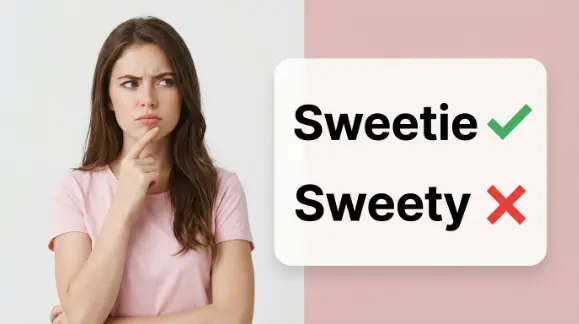
When you want to call someone by a cute or affectionate name, you might wonder whether “sweetie” or “sweety” is the correct spelling.
Both forms are commonly seen in texts, social media, and casual conversations, but they don’t have exactly the same status in standard English. Knowing the difference can help you choose the right word for your message.
“Sweetie” is the standard spelling for a term of affection. It can be used for a partner, child, friend, or someone you care about. “Sweety” is also widely used, especially in informal messages, although many English dictionaries treat it differently or less commonly than “sweetie.”
Sweetie or Sweety: Quick Answer 🌸

If you are looking for the standard spelling of the affectionate term, sweetie is generally the better choice.
Sweetie is a noun used as a term of affection. It can mean a person you feel affection or warmth toward. It is commonly used with children, partners, friends, and family members.
Sweety is also used informally, particularly in texts, messages, and as a personal nickname. However, it is not usually the preferred standard spelling when you simply mean an affectionate person or someone you are addressing warmly.
Simple answer:
- Sweetie = standard and widely accepted spelling.
- Sweety = informal variant or nickname spelling.
- Sweetie is usually the safest choice in standard English.
- Both are pronounced almost the same in everyday speech.
- The correct choice can depend on context.
If you are writing a formal or carefully edited sentence, sweetie is usually the better option.
What Does Sweetie Mean? 🌷
Sweetie is an affectionate noun derived from the adjective sweet. People use it to show affection, kindness, warmth, or friendliness toward another person.
It can be used as a form of address, meaning you are directly calling someone “sweetie.”
For example:
“Are you okay, sweetie?”
Here, sweetie is not describing a type of food. Instead, the speaker is using it as a warm and caring name.
You might hear the word in conversations between:
- Parents and children
- Romantic partners
- Close friends
- Family members
- Older and younger people
- People who have a friendly relationship
The exact feeling depends on the relationship and tone of voice.
Examples of Sweetie in Sentences
Here are some natural examples:
- “Thank you for helping me, sweetie.”
- “Come here, sweetie.”
- “Are you feeling better, sweetie?”
- “You did a great job, sweetie.”
- “Good morning, sweetie.”
- “Don’t worry, sweetie. Everything will be fine.”
- “I missed you, sweetie.”
- “Sweetie, could you pass me the phone?”
In each example, sweetie works as a term of affection.
What Does Sweety Mean? 🌼
Sweety is an informal spelling that people sometimes use when addressing someone affectionately. It is especially common in texting, social media, casual messages, and personal nicknames.
For example:
“Thank you, sweety!”
Many people use this spelling because it sounds similar to sweetie.
However, there is an important distinction. If you are trying to use the standard English word for an affectionate person or term of address, sweetie is generally preferred.
Sweety may still be understood easily, especially in informal communication. It can also function as someone’s nickname or online name.
Examples of Sweety in Informal Writing
You might see sentences such as:
- “Hi sweety, how are you?”
- “Thanks, sweety!”
- “Good night, sweety.”
- “Don’t worry, sweety.”
- “You look beautiful, sweety.”
These sentences are understandable, but in standard edited English, sweetie would generally be the preferred spelling.
Sweetie vs. Sweety: What’s the Difference? 🔍
The biggest difference between sweetie and sweety is their standard usage.
| Word | Meaning | Usage | Standard English |
| Sweetie | A term of affection | Common in everyday speech and writing | Preferred |
| Sweety | Informal term of affection/nickname | Common in casual messages | Less standard |
| Sweet | Pleasant, kind, or sugary | Adjective/noun | Standard |
| Sweets | Candy or sweet foods | Food-related noun | Standard |
The word sweetie has a clear place in standard English. Sweety, on the other hand, is often influenced by informal spelling and personal usage.
Therefore, if you are unsure which one to use, choose sweetie.
Is Sweetie the Correct Spelling? ✅
Yes. Sweetie is a standard English word.
It is commonly defined as an affectionate form of address. The word comes from sweet, with the suffix -ie creating a familiar or affectionate form.
For example:
“Thanks for helping me, sweetie.”
This is a completely natural use of the word.
You can use sweetie in casual conversations, text messages, personal letters, and many other forms of everyday communication.
Is Sweety a Correct Word? 🤔
Sweety can be found in informal English, but it is not generally the preferred spelling when you mean the affectionate term sweetie.
This is where many English learners become confused.
Because sweety looks like it could naturally come from sweet, some people assume it is the standard spelling. However, standard English generally favors sweetie for this meaning.
That does not mean every use of sweety is automatically wrong. A person might deliberately use Sweety as a nickname, username, character name, or personal spelling.
For example:
“My friends call me Sweety.”
Here, Sweety can be a personal nickname.
The important point is to understand the difference between a standard vocabulary word and a personal or informal spelling.
Why Do People Spell Sweetie as Sweety? ✍️
There are several reasons people write sweety instead of sweetie.
It Sounds the Same
In many accents, sweetie and sweety sound very similar or identical.
When people hear a word before seeing it written, they may naturally spell it according to the sounds they hear.
Texting Encourages Informal Spelling
Texting and social media have made informal spelling extremely common.
People often write:
- “u” instead of “you”
- “ur” instead of “your”
- “thx” instead of “thanks”
- “sweety” instead of “sweetie”
These forms may be understandable, but they are not always appropriate for formal writing.
It Looks Like an Adjective
The spelling sweety may look like it follows the pattern of words ending in -y.
For example:
- cloudy
- rainy
- funny
- sunny
Because sweet can describe something, some people naturally assume sweety is the related form. But sweetie is the established affectionate noun.
Sweetie Meaning in Text Messages 💬
In text messages, sweetie usually expresses affection, friendliness, or warmth.
For example:
“Good morning, sweetie ❤️”
Depending on the relationship, this could be romantic, friendly, or caring.
Similarly:
“Thank you, sweetie!”
can express appreciation in a warm and personal way.
The meaning depends heavily on context.
Sweetie From a Girl
If a girl calls someone sweetie, it can simply mean she is being friendly or affectionate. It does not automatically mean she has romantic feelings.
For example:
“Thanks for helping me, sweetie!”
This could simply be a friendly expression.
In a romantic relationship, however, sweetie can be a pet name.
Sweetie From a Guy
A guy may also use sweetie as a term of affection.
For example:
“Are you okay, sweetie?”
This could indicate care, friendliness, or romantic affection depending on the relationship.
The word itself does not establish romantic intent.
Sweetie as a Term of Endearment ❤️
A term of endearment is a word or phrase used to express affection toward someone.
Common examples include:
- Sweetie
- Honey
- Darling
- Dear
- Love
- Babe
- Baby
- Sweetheart
Sweetie is one of the softer and more familiar options.
For example:
“Have a good day, sweetie.”
The speaker is expressing warmth rather than simply identifying the person.
Sweetie vs Sweetheart
Both sweetie and sweetheart can work as terms of affection.
However, they are not exactly the same.
Sweetie is shorter and often sounds casual and friendly.
Sweetheart can sound warmer, more affectionate, or more traditional.
Compare:
“Thanks, sweetie.”
and:
“Thank you, sweetheart.”
Both are affectionate, but the emotional tone can differ.
Sweetie vs Honey
Honey is another common term of affection.
For example:
“Can you help me, honey?”
and:
“Can you help me, sweetie?”
Both sentences are grammatically correct.
The choice usually depends on personal preference, relationship, regional speech, and tone.
Sweetie vs Sweety in American English 🇺🇸
In American English, sweetie is the standard spelling for the affectionate noun.
For example:
“Thanks, sweetie.”
is a natural sentence.
Sweety may appear in informal writing, usernames, nicknames, or messages, but it is not usually the preferred standard spelling for this meaning.
If you are writing an article, email, school assignment, professional message, or other carefully edited content, sweetie is the safer choice.
Sweetie vs Sweety in British English 🇬🇧
British English also uses sweetie as an affectionate term.
For example:
“Come along, sweetie.”
You may also see sweetie used to refer to a sweet or candy in some British contexts.
However, this meaning is different from using sweetie as a term of affection.
Can You Use Sweetie for a Friend? 😊
Yes. You can call a friend sweetie, especially when the relationship is close and the tone is friendly.
For example:
“Thanks for checking on me, sweetie.”
However, not everyone likes being called terms of affection. Some people may consider words like sweetie, honey, or dear too personal.
Therefore, context matters.
If you do not know someone well, using their name is usually safer.
Can You Call a Child Sweetie? 👧
Yes. Sweetie is commonly used when speaking affectionately to children.
For example:
“Are you hungry, sweetie?”
or:
“You did a wonderful job, sweetie.”
The word can communicate warmth and care.
Parents, grandparents, teachers, relatives, and other adults may use it depending on the situation and relationship.
Can Sweetie Be Romantic? 💕
Yes. Sweetie can be romantic, but it is not exclusively romantic.
A boyfriend may say:
“Good night, sweetie.”
A girlfriend may say:
“I love you, sweetie.”
But a parent can also say:
“Come here, sweetie.”
Therefore, sweetie can be romantic, friendly, familial, or simply caring.
The surrounding words and relationship determine the meaning.
Common Mistakes With Sweetie and Sweety ⚠️
Many people make spelling mistakes because these words sound similar.
Mistake 1: Always Assuming Sweety Is the Standard Spelling
Some writers use sweety whenever they mean an affectionate person.
Better:
“Thank you, sweetie.”
Mistake 2: Thinking Sweetie Means Sweet Food
Although sweetie comes from sweet, it is often used as a person-related term.
For example:
“Sweetie, please sit down.”
Here, it has nothing to do with food.
Mistake 3: Using Affectionate Words in Formal Situations
Calling a customer or professional contact sweetie may sound overly familiar.
Instead of:
“I can help you, sweetie.”
a professional speaker could say:
“I’d be happy to help you.”
Mistake 4: Assuming Sweetie Always Means Romance
The word does not automatically indicate romantic interest.
Someone may say sweetie simply to be kind or friendly.
Mistake 5: Using Informal Spellings in Formal Writing
If you are writing a school assignment or professional document, avoid informal spellings such as sweety when sweetie is intended.
How to Remember the Correct Spelling 🧠
A simple trick can help you remember sweetie.
Think:
Sweet + ie = Sweetie
The word begins with the complete spelling of sweet:
S W E E T
Then add:
I E
So:
SWEET + IE = SWEETIE
This makes it easier to remember than trying to memorize the whole word.
Sweetie in Different Sentences
Here are several examples showing how naturally sweetie can fit into everyday English.
Friendly Examples
- “Thanks for your help, sweetie.”
- “You’re very kind, sweetie.”
- “Have a great day, sweetie.”
Caring Examples
- “Are you feeling okay, sweetie?”
- “Don’t worry, sweetie.”
- “Take some rest, sweetie.”
Romantic Examples
- “I miss you, sweetie.”
- “Good night, sweetie.”
- “I love you, sweetie.”
Family Examples
- “Come here, sweetie.”
- “Are you ready, sweetie?”
- “You did very well, sweetie.”
Informal Sweety Examples
- “Thanks, sweety!”
- “Good morning, sweety.”
- “Don’t be sad, sweety.”
Again, sweetie is generally the preferred standard spelling.
Is Sweetie Formal or Informal? 📝
Sweetie is informal.
It is normally used in personal or conversational situations rather than formal professional writing.
For example, it is natural in:
- Text messages
- Family conversations
- Personal conversations
- Romantic conversations
- Friendly chats
It is generally less suitable for:
- Business letters
- Academic papers
- Formal reports
- Professional customer communication
Instead of saying:
“Thank you, sweetie.”
in a formal email, you might simply write:
“Thank you for your help.”
Can Sweetie Be Used in Professional Communication?
Usually, it is better to avoid it.
Even though sweetie can be intended kindly, some people may consider it too personal or patronizing in a professional environment.
For example, a manager saying:
“Good work, sweetie.”
could make an employee uncomfortable.
A more professional alternative would be:
“Good work. I appreciate your effort.”
The same principle applies to customer service and workplace communication.
Is Sweetie a Noun or Adjective?
When sweetie refers to a person as a term of affection, it is a noun.
For example:
“My sweetie is waiting outside.”
Here, sweetie functions as a noun.
It can also be used directly when addressing someone:
“Sweetie, can you help me?”
The word sweet itself can be an adjective:
“She is a sweet person.”
So don’t confuse sweet and sweetie grammatically.
Sweet vs Sweetie
The words sweet and sweetie are related but serve different purposes.
| Word | Part of Speech | Example |
| Sweet | Adjective | “She is very sweet.” |
| Sweet | Noun | “I bought some sweets.” |
| Sweetie | Noun | “Thank you, sweetie.” |
For example:
“You are sweet.”
describes someone’s personality or behavior.
But:
“Thank you, sweetie.”
uses sweetie as a term of affection.
Sweetie vs Sweety: Which One Should You Use?
If you are writing a normal English sentence and want to address someone affectionately, choose sweetie.
Use sweety only when:
- It is someone’s chosen nickname.
- You are quoting informal writing.
- You are intentionally using a casual spelling.
- The context specifically uses that spelling.
Otherwise, sweetie is the safer and more standard option.
Quick Grammar Tip for English Learners 📚
When two words sound the same but have different spellings, do not rely only on pronunciation.
English contains many words that sound alike but are spelled differently.
For example:
- to / too / two
- there / their / they’re
- your / you’re
- flower / flour
The same idea applies to sweetie and sweety in informal usage. Always consider how the word is normally written in standard English.
Frequently Asked Questions
Is Sweetie or Sweety correct?
Sweetie is generally the preferred standard spelling when you mean a term of affection. Sweety is an informal spelling that people may use in texts, nicknames, or casual communication.
Is Sweety a misspelling of Sweetie?
In many situations, yes. If someone intends to use the standard affectionate noun, sweetie is normally the correct spelling. However, Sweety can also be deliberately used as a personal nickname.
Is Sweetie a romantic word?
It can be romantic, but it does not always have a romantic meaning. Friends, family members, parents, and other people may also use sweetie affectionately.
Can I call my boyfriend sweetie?
Yes. Sweetie is a common affectionate name for a romantic partner.
For example:
“I’ll call you later, sweetie.”
Can I call my girlfriend sweetie?
Yes. You can use sweetie as a loving nickname for your girlfriend.
Can you call a friend sweetie?
Yes. Close friends may use sweetie in a friendly way. However, make sure the person is comfortable with affectionate language.
Is sweetie a nickname?
Yes. Sweetie can function as a nickname or term of endearment.
Is Sweety acceptable in texting?
It can be acceptable in informal texting because people often use creative or nonstandard spellings. However, sweetie remains the standard choice when you want conventional English spelling.
How do you spell sweetie correctly?
The standard spelling is:
S-W-E-E-T-I-E
Think of it as:
sweet + ie = sweetie
What is the plural of sweetie?
The plural is sweeties.
For example:
“The children were such sweeties.”
Can sweetie be used for a man?
Yes. Sweetie can be used for people of any gender when the context is appropriate.
Is sweetie rude?
Usually, no. It is generally affectionate or friendly. However, the tone and relationship matter. In some professional or unfamiliar situations, it may sound overly familiar or patronizing.
Is sweetie the same as sweetheart?
They are similar because both can be terms of affection. However, they have slightly different tones and personal usage patterns.
Is sweetie a formal word?
No. Sweetie is generally an informal term used in personal or conversational settings.
Which is better: sweetie or sweety?
For standard English, sweetie is generally the better choice. Sweety is more commonly seen as an informal spelling or personal nickname.
Final Verdict:
When you are choosing between sweetie or sweety, remember one simple rule: sweetie is the standard spelling for the affectionate term. You can use sweetie when speaking warmly to a friend, family member, child, or romantic partner.
It is a common and natural word in everyday English. Sweety can still appear in informal texts, social media, nicknames, and personal messages. It is easy to understand, but it is usually not the best choice when you want standard English spelling.

Daniel Carter is a passionate writer who creates clear, helpful, and easy-to-understand content. He focuses on language, grammar, word meanings, and everyday expressions, helping readers find simple answers to common questions.