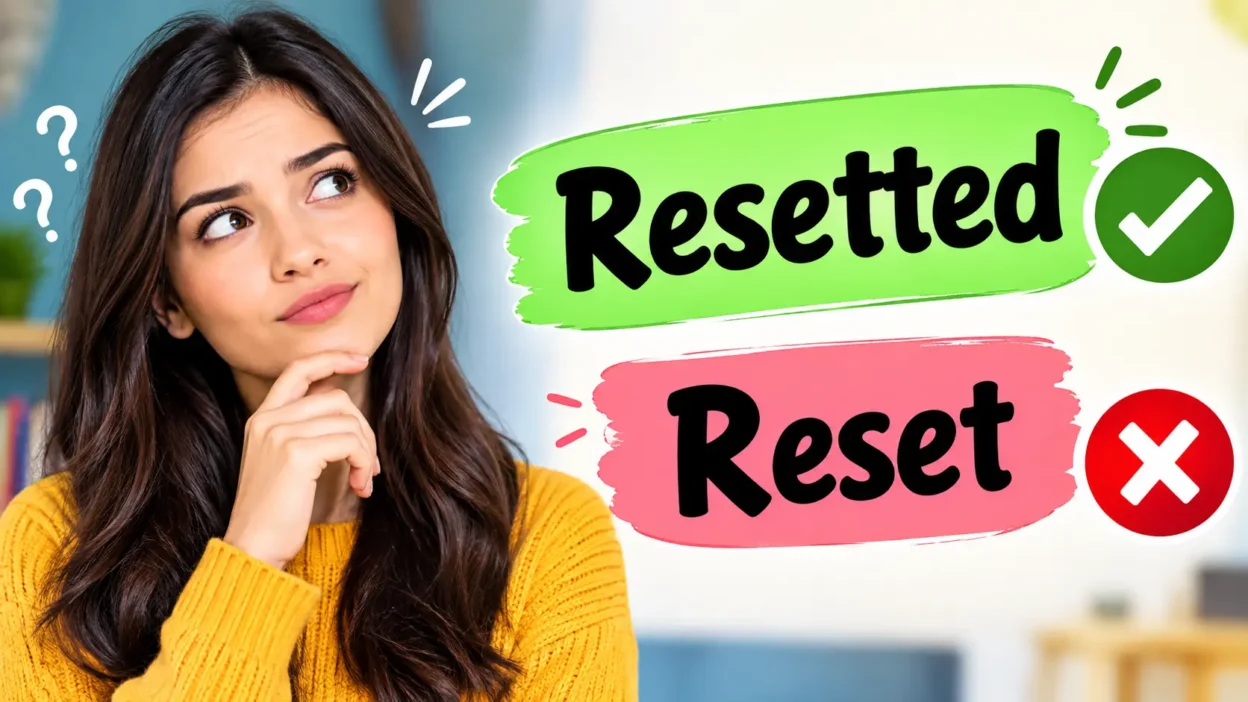
Choosing between “resetted” and “reset” can be confusing, especially because “reset” looks like a regular verb but follows a different pattern. If you’ve ever wondered whether you should say “I reset my password” or “I resetted my password,” the correct choice is “reset.”
The verb reset keeps the same spelling in the present, past, and past participle forms. For example, you can say, “I reset the device yesterday” and “I have reset my password.” Although “resetted” may appear in informal writing or online conversations, it is generally considered incorrect in standard English.
In this guide, we’ll explain resetted or reset, show you the correct grammar rules, and provide simple examples so you can confidently use “reset” in everyday writing and conversation.
Reset vs. Resetted: Which One Is Correct?
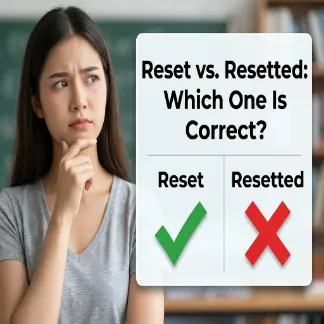
Reset is the correct standard English form. Resetted is generally considered incorrect when you are trying to use the normal past tense or past participle of the verb reset.
The verb reset has the same form in the present, past, and past participle:
| Verb Form | Correct Form | Example |
| Base form | reset | I need to reset my phone. |
| Present tense | reset/resets | She resets her password regularly. |
| Past tense | reset | I reset my password yesterday. |
| Past participle | reset | I have reset the device. |
| -ing form | resetting | He is resetting the router. |
So, unlike regular verbs such as walk → walked, the verb reset does not become resetted.
Why Is “Reset” Used Instead of “Resetted”?
The reason is connected to the structure of the word. Reset is formed from the prefix re- and the verb set. The verb set itself does not change when it moves into the past tense.
For example:
- I set the alarm.
- I set the alarm yesterday.
- I have set the alarm.
Because reset follows the same pattern, we say:
- I reset the alarm.
- I reset the alarm yesterday.
- I have reset the alarm.
Adding -ed to create “resetted” does not follow the standard conjugation of this verb.
What Does “Reset” Mean?

Reset means to return something to a previous, original, default, or starting condition. It can also mean to establish something again, such as a password, timer, device setting, or system.
The word is extremely common in technology.
For example:
- I need to reset my password.
- She reset her phone.
- We reset the router.
- He reset the timer.
- The technician reset the system.
However, reset is not limited to technology. You can use it in many everyday situations.
For example:
- I reset the clock after the power outage.
- The teacher reset the timer.
- The machine automatically reset itself.
- We reset the game and started again.
The exact meaning depends on the context, but the general idea is starting something again or returning it to a particular state.
What Does “Resetted” Mean?
Resetted is not the standard past tense or past participle of reset in modern standard English.
People sometimes write or say resetted because they assume reset behaves like a regular verb. This is understandable because many English verbs form their past tense by adding -ed.
For example:
- change → changed
- restart → restarted
- clean → cleaned
- open → opened
However, reset does not follow that pattern.
The correct forms are:
- reset
- reset
- reset
Therefore:
Incorrect: I resetted the password.
Correct: I reset the password.
In casual online communication, you may occasionally encounter “resetted,” especially in informal technical discussions. However, if you want standard, polished English, use reset.
Reset as a Verb
The most important use of reset is as a verb.
As a verb, reset means to change something back to a previous, default, or starting condition.
Examples of Reset as a Verb
Here are some simple examples:
- I need to reset my password.
- She reset the router.
- He reset his phone.
- We reset the game.
- They reset the machine.
- I reset the timer.
- The technician reset the system.
- She reset her account settings.
- He reset the device to factory settings.
- We reset the computer after the error.
Notice that reset stays the same when talking about the past.
For example:
Yesterday, I reset my password.
Not:
Yesterday, I resetted my password.
Reset in the Present Tense
You can use reset in the present tense when the subject is I, you, we, or they.
Examples:
- I reset my phone every few months.
- You reset the device too often.
- We reset the system every morning.
- They reset their passwords regularly.
When the subject is he, she, or it, the verb usually becomes resets.
Examples:
- She resets her password every month.
- He resets the router when it stops working.
- The system resets automatically.
- The application resets the settings after an update.
The important point is that resets is the third-person singular present form. It is not the past tense.
Reset in the Past Tense
The past tense of reset is also reset.
This is where many learners make the mistake of writing resetted.
Correct examples include:
- I reset my password yesterday.
- She reset the device last night.
- He reset the router this morning.
- We reset the timer before the test.
- They reset the system after the error.
The time expression can help you recognize the past tense:
- yesterday
- last night
- last week
- earlier
- this morning
- two hours ago
Even with these past-time expressions, the verb remains reset.
Reset as a Past Participle
Reset is also the past participle of the verb.
The past participle commonly appears with helping verbs such as have, has, and had.
Examples:
- I have reset the device.
- She has reset her password.
- He has reset the router.
- We had reset the system before the technician arrived.
- They have reset all the settings.
Again, resetted is not necessary.
Compare these sentences:
Correct: I have reset my password.
Incorrect: I have resetted my password.
Reset in the Present Perfect
The present perfect uses has/have + past participle.
Because the past participle of reset is reset, we say:
- I have reset the password.
- You have reset the device.
- She has reset the account.
- He has reset the computer.
- We have reset the system.
- They have reset the settings.
The same rule applies regardless of the subject.
Reset in the Past Perfect
The past perfect uses had + past participle.
Examples:
- I had reset the password before I received the email.
- She had reset the phone before selling it.
- He had reset the machine before the technician arrived.
- We had reset the system before the meeting started.
- They had reset the settings before testing the software.
Since reset remains unchanged, these sentences are easy to form once you remember the rule.
Reset in the Future
When talking about the future, use will reset.
Examples:
- I will reset my password tonight.
- She will reset the device tomorrow.
- We will reset the system after the update.
- The application will reset automatically.
- They will reset the timer before the next round.
You can also use going to reset:
- I am going to reset my phone.
- She is going to reset her password.
- We are going to reset the system.
Reset vs. Resetted: Quick Comparison
| Feature | Reset | Resetted |
| Standard English | Yes | No |
| Present tense | Yes | No |
| Past tense | Yes | No |
| Past participle | Yes | No |
| Common in technical English | Yes | Rare/incorrect |
| Example | I reset my phone. | I resetted my phone. |
| Recommended usage | Use it | Avoid it |
The simplest rule is:
Use “reset” for the base form, past tense, and past participle.
Why “Resetted” Sounds Natural to Some People
If “resetted” is incorrect, why does it sometimes sound natural?
English has thousands of verbs that form their past tense by adding -ed. Learners naturally apply that familiar pattern to new words.
For example:
- restart → restarted
- update → updated
- download → downloaded
- delete → deleted
- install → installed
Because reset is commonly used with technology, people may assume that it works the same way:
reset → resetted
But English has many irregular and unchanged verbs. Set is one of them, and reset follows the same pattern.
Consider:
- set → set
- reset → reset
- upset → upset
You would not normally say:
- setted
- resetted
- upsetted
Instead, the standard forms are:
- set
- reset
- upset
The Relationship Between “Set” and “Reset”
Understanding set makes reset much easier.
The verb set remains unchanged in its basic forms:
- I set the alarm.
- I set the alarm yesterday.
- I have set the alarm.
When you add re-, the same basic pattern remains:
- I reset the alarm.
- I reset the alarm yesterday.
- I have reset the alarm.
This is a useful memory trick because you do not have to memorize reset as an isolated word.
Think:
set → set → set
Therefore:
reset → reset → reset
Common Mistakes With Reset
Learning the correct form is easier when you know what mistakes to avoid.
Mistake 1: Using “Resetted” for the Past
A common sentence is:
I resetted my password yesterday.
The correct version is:
I reset my password yesterday.
The word yesterday clearly indicates past time, but the verb does not need -ed.
Mistake 2: Writing “Have Resetted”
Another common mistake occurs with perfect tenses.
Incorrect:
I have resetted my phone.
Correct:
I have reset my phone.
Remember that have/has/had requires the past participle, and the past participle is reset.
Mistake 3: Confusing “Reset” and “Resets”
These words have different grammatical functions.
- I reset the device.
- She resets the device.
Here, reset is used with “I,” while resets is used with “she.”
The -s in resets marks the third-person singular present tense.
Mistake 4: Writing “Reseted”
Some people write reseted with only one t before -ed.
This is also incorrect as the standard past form.
Avoid both:
- reseted
- resetted
Use:
- reset
Reset vs. Restart
Although reset and restart can sometimes have similar meanings, they are not always interchangeable.
Restart usually means to stop something and start it again.
For example:
I restarted my computer.
This usually means the computer shut down or stopped and then started again.
Reset often means returning something to a particular state, setting, or default condition.
For example:
I reset my computer to factory settings.
That action can remove settings, applications, or personal data depending on the reset process.
Reset vs. Restore
Reset often means returning something to a default or starting condition.
Restore generally means bringing something back to an earlier condition.
For example:
- I reset my phone.
- I restored my phone from a backup.
A reset might change the device’s settings, while restoration may bring back previous data or settings.
The exact meaning depends on the technology or situation.
Examples of Correct “Reset” Sentences
Here are more examples to help you understand the word naturally.
Everyday Examples
- I reset the alarm.
- She reset the clock.
- He reset the timer.
- We reset the game.
- They reset the score.
- I reset the combination.
- She reset her account.
- He reset the device.
Technology Examples
- I reset my password yesterday.
- She reset her phone after it froze.
- He reset the router.
- We reset the network settings.
- The technician reset the server.
- The system reset automatically.
- I have reset the application.
- She has reset the device to its default settings.
Workplace Examples
- I reset the meeting timer.
- The administrator reset my account.
- We reset the system after the update.
- The technician reset the machine.
- The team reset the access credentials.
- The manager asked me to reset the password.
School Examples
- The teacher reset the timer.
- I reset the quiz after making a mistake.
- The computer reset during the exam.
- We reset the classroom projector.
How to Remember the Correct Form
If you frequently forget whether to use reset or resetted, use a simple memory trick.
Think about these three words:
set → reset → upset
They all keep the same basic past form.
For example:
- I set the alarm yesterday.
- I reset the alarm yesterday.
- The situation upset me yesterday.
You would not normally add -ed to these verbs.
Another useful rule is:
Reset does not need -ed in the past tense.
So instead of memorizing a complicated grammar rule, simply remember:
Present: reset
Past: reset
Past participle: reset
Continuous: resetting
Third-person singular: resets
Reset Verb Forms at a Glance
| Tense/Form | Correct Example |
| Base form | I need to reset the device. |
| Present | I reset the device regularly. |
| Third-person present | She resets the device regularly. |
| Past | I reset the device yesterday. |
| Present participle | I am resetting the device. |
| Past participle | I have reset the device. |
| Past perfect | I had reset the device. |
| Future | I will reset the device. |
This table shows why resetted does not belong in the standard conjugation pattern.
Is “Resetted” Ever Correct?
In standard modern English, you should generally avoid resetted when using the verb reset.
You may encounter it in informal writing, user-generated content, software discussions, or nonstandard English. However, its appearance does not make it the preferred grammatical form.
If you are writing:
- an article,
- an email,
- a school assignment,
- a business document,
- technical instructions,
- a website,
- a report,
use reset.
This is the safest and most widely accepted choice.
Is “Reset” an Irregular Verb?
Reset is often treated as an irregular or unchanged verb because its past tense and past participle do not change from the base form.
It behaves like set.
Examples:
- set → set → set
- reset → reset → reset
- put → put → put
- cut → cut → cut
These verbs do not follow the typical -ed pattern.
You do not need to worry about complicated terminology, though. For everyday writing, simply remember that reset stays reset in the past.
How to Use “Resetting” Correctly
The -ing form of reset is resetting.
Notice that the final t is doubled:
reset → resetting
Examples:
- I am resetting my password.
- She is resetting the router.
- He is resetting the device.
- We are resetting the system.
- They are resetting the timer.
This form is different from resetted.
Why Is It “Resetting”?
When adding -ing, the final consonant is doubled in resetting.
Correct:
resetting
Incorrect:
reseting
So there are two common spelling mistakes to remember:
- resetted ❌
- reseting ❌
Correct:
- reset ✅
- resetting ✅
Reset in Questions
You can easily use reset in questions.
Examples:
- Did you reset your password?
- Did she reset the device?
- Have you reset the router?
- Has he reset the system?
- When did you reset the account?
- Why did they reset the settings?
Notice something important:
After did, use the base form reset, not resetted.
Correct:
Did you reset your phone?
Incorrect:
Did you resetted your phone?
The same rule applies to other verbs after did:
Did you go?
Not:
Did you went?
Likewise:
Did you reset?
Not:
Did you resetted?
Reset in Negative Sentences
You can also use reset in negative sentences.
Examples:
- I did not reset the device.
- She did not reset the password.
- He has not reset the router.
- We have not reset the system.
- They did not reset the settings.
After did not, use reset.
Correct:
I did not reset my password.
Incorrect:
I did not resetted my password.
Reset in Passive Voice
The past participle reset can also appear in passive constructions.
Examples:
- The device was reset by the technician.
- The password was reset yesterday.
- The system has been reset.
- The settings were reset automatically.
- The account was reset after verification.
Notice that reset remains unchanged.
This is another reason learning the correct form is useful. You can use reset across many grammatical structures.
Common Spelling Tips for Reset
Here are the most important spelling points:
Remember: Reset, Not Resetted
Do not automatically add -ed.
Reset is correct.
Remember: Resetting Has Two Ts
The continuous form is:
resetting
Not:
reseting
Remember: Resets Has One Final S
The third-person singular form is:
resets
For example:
The system resets automatically.
Avoid “Reseted”
Some writers try to use reseted instead of resetted. Both should be avoided when you mean the standard past form.
The correct word is:
reset
A Simple Rule for Beginners
If you want one rule that you can remember easily, use this:
The past tense of “reset” is “reset,” not “resetted.”
Here are three sentences that cover the most important forms:
Present: I reset my password regularly.
Past: I reset my password yesterday.
Perfect: I have reset my password.
If you remember these three examples, you will avoid most mistakes with this verb.
Frequently Asked Questions
Is “resetted” grammatically correct?
No. Resetted is generally not considered the standard past tense or past participle of reset. Use reset instead.
Is “I resetted my password” correct?
No. The correct sentence is:
I reset my password.
The past tense of reset remains reset.
Is “I reset my password yesterday” correct?
Yes. This is completely correct. Reset is the past tense of the verb.
What is the past tense of reset?
The past tense of reset is reset.
For example:
I reset the router yesterday.
What is the past participle of reset?
The past participle is also reset.
For example:
I have reset the router.
Is it “reseted” or “resetted”?
Neither is the standard form. The correct word is reset.
For example:
She reset the device.
Is “resetting” correct?
Yes. Resetting is the correct present participle or gerund form.
For example:
I am resetting my phone.
Should I say “I have reset” or “I have resetted”?
Say I have reset.
For example:
I have reset my password.
Is “reset” an irregular verb?
It behaves like an unchanged or irregular verb because its base, past, and past participle forms are the same.
The pattern is:
reset → reset → reset
Why don’t we say “resetted”?
Because reset follows the pattern of set, which does not take -ed in its past form.
We say:
set → set
Therefore:
reset → reset
Is “resetted” common in informal English?
You may see resetted in informal or nonstandard writing, especially online. However, it is best to use reset in standard English and professional writing.
What is the correct form after “did”?
Use reset.
Correct:
Did you reset the device?
Incorrect:
Did you resetted the device?
After did, English uses the base form of the verb.
What is the correct form after “has” or “have”?
Use reset.
Examples:
She has reset the password.
They have reset the system.
Is “reset” the same as “restart”?
Not always. Restart usually means stopping something and starting it again, while reset often means returning something to a particular or default state.
How do I remember “reset vs. resetted”?
Remember the pattern set → set → set. Since reset contains set, its main forms remain reset → reset → reset.
Final Answer:
In conclusion, “reset” is the correct and standard form to use in most situations. The verb reset is irregular because its past tense and past participle remain “reset.” For example, you can say, “I reset my password yesterday” or “She has reset the device.”
“Resetted” is generally considered incorrect in standard English, even though some people may use it informally. Remembering that reset stays the same in the present, past, and past participle forms can make your writing clearer and more grammatically accurate. When in doubt, choose “reset” rather than “resetted” in everyday English.

Daniel Carter is a passionate writer who creates clear, helpful, and easy-to-understand content. He focuses on language, grammar, word meanings, and everyday expressions, helping readers find simple answers to common questions.