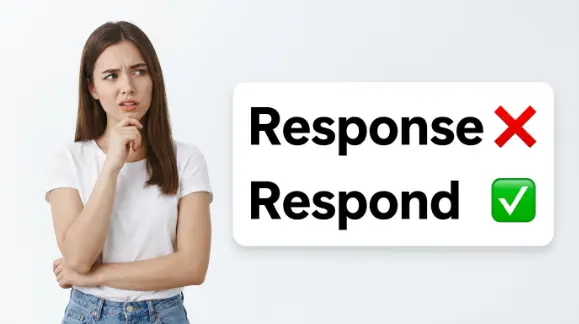
Choosing between “response” and “respond” can be confusing because the two words look and sound closely related. The key difference is their grammatical role. “Response” is usually a noun that refers to an answer, reaction, or reply, while “respond” is a verb that means to answer or react to something.
For example, you can say, “I’m waiting for your response,” because you’re talking about the reply itself. However, you would say, “Please respond to my message,” because you’re asking someone to take the action of answering. Understanding this small difference can make your writing and everyday communication much clearer.
In this guide, you’ll learn the difference between response or respond, including their meanings, grammatical uses, sentence structures, and common examples. You’ll also see how to use each word correctly in texting, emails, conversations, and formal writing.
What Does “Response” Mean? 📝
Response is a noun that means an answer, reply, reaction, or way of reacting to something.
It describes the answer or reaction itself, rather than the action of giving that answer.
For example:
- I am waiting for your response.
- Her response was very polite.
- We received a quick response from the company.
- His response to the question was correct.
- The teacher liked my response.
In each sentence, response names something. It can be an answer, reaction, or reply.
Response as a Noun
The most important grammar rule is that response is a noun.
A noun can name a person, place, thing, idea, or concept. In this case, response names an answer or reaction.
Consider this sentence:
I received a response from my friend.
Here, response is the thing the speaker received.
You could replace it with another noun:
I received a message from my friend.
This shows why response works as a noun.
Response Can Mean an Answer
One common meaning of response is an answer to a question.
For example:
Her response to the interview question was impressive.
The response is the answer she gave.
Another example:
What was your response to the teacher’s question?
Here, response means the answer given to the question.
Response Can Mean a Reaction
Response does not always mean a spoken or written answer. It can also describe a reaction to an event, situation, treatment, or action.
For example:
The patient’s response to the treatment was positive.
Here, response means the patient’s reaction to the treatment.
Similarly:
The public response to the announcement was mixed.
This means people reacted to the announcement in different ways.
Response in Everyday Communication
You will often see response when talking about emails, text messages, social media, customer service, or conversations.
Examples include:
- I haven’t received a response yet.
- Thank you for your response.
- We appreciate your quick response.
- Her response to my text was unexpected.
- I am still waiting for his response.
These sentences all refer to an answer or reply.
What Does “Respond” Mean? 💬
Respond is a verb that means to answer, reply, or react to something.
Unlike response, which names the answer or reaction, respond describes the action of giving an answer or reaction.
For example:
- Please respond to my email.
- She did not respond to my question.
- He responded quickly.
- I will respond later.
- They responded to the complaint.
In these examples, respond tells us what someone does.
Respond as a Verb
The key grammar rule is simple:
Respond is a verb.
A verb usually describes an action, event, or state.
For example:
Please respond to my message.
The action is respond.
You can change its tense:
- respond
- responds
- responded
- responding
Examples:
I respond to emails every morning.
She responds quickly.
He responded yesterday.
They are responding now.
This flexibility is one reason respond behaves differently from response.
Respond Can Mean Answer
The most common use of respond is to answer someone.
For example:
Please respond to my question.
This means:
Please answer my question.
Another example:
She responded to my message.
This means she answered or replied to the message.
Respond Can Mean React
Respond can also mean react to a situation.
For example:
The firefighters responded quickly to the emergency.
Here, respond does not simply mean “answer.” It means take action because of something that happened.
Another example:
The company responded to customer complaints.
The company took action or gave an answer because customers complained.
Response vs. Respond: The Main Difference
The easiest way to understand response vs. respond is to remember their parts of speech.
| Word | Part of Speech | Basic Meaning | Example |
| Response | Noun | An answer or reaction | I received your response. |
| Respond | Verb | To answer or react | Please respond soon. |
Think of it this way:
Response = the answer
Respond = give the answer
For example:
I am waiting for your response.
The response is the answer.
Please respond to my message.
Respond is the action of answering.
This distinction is simple, but it solves most response or respond grammar questions.
Response or Respond: Which One Should You Use?
Choosing between these words depends on what your sentence needs.
If you need a noun, use response.
If you need a verb, use respond.
Use “Response” When You Mean an Answer or Reaction
Use response when you are talking about the answer itself.
Examples:
- I need your response.
- His response was honest.
- We received a positive response.
- There was no response.
- Her response surprised everyone.
Notice that response often comes after words such as:
- a
- the
- your
- his
- her
- their
- my
- no
- quick
- positive
- negative
For example:
I am waiting for your response.
Use “Respond” When You Mean the Action
Use respond when someone needs to perform the action of answering or reacting.
Examples:
- Please respond soon.
- Can you respond to this email?
- She didn’t respond.
- He responded immediately.
- We will respond tomorrow.
Here, respond functions as the verb.
“Response” vs. “Respond” in a Sentence
Looking at paired examples can make the difference even clearer.
Example 1
I am waiting for your response.
Here, response is a noun.
Please respond to my message.
Here, respond is a verb.
Example 2
We received a quick response.
Response refers to the answer.
The company responded quickly.
Responded describes the action.
Example 3
Her response was unexpected.
The response is the reaction.
She responded unexpectedly.
Responded describes what she did.
Example 4
Thank you for your response.
Response is the answer received.
Thank you for responding.
Responding refers to the action of answering.
Is “Response” a Noun or Verb?
Response is a noun.
This is one of the most important facts to remember.
You should not normally use response as the main verb in a sentence.
Incorrect:
Please response to my email.
Correct:
Please respond to my email.
Here, the sentence needs a verb after “please,” so respond is correct.
Another incorrect example is:
She will response tomorrow.
Correct:
She will respond tomorrow.
The word after “will” needs to be the base form of a verb. Therefore, respond is correct.
Is “Respond” a Noun or Verb?
Respond is a verb.
It describes the action of answering or reacting.
For example:
I will respond later.
She responded to the question.
They are responding now.
You generally cannot use respond as a noun in standard English.
Incorrect:
I am waiting for your respond.
Correct:
I am waiting for your response.
The sentence needs a noun after “your,” so response is the correct choice.
Response or Respond in Emails 📧
These words are especially common when discussing emails.
Consider these examples:
I am waiting for your response.
This means you are waiting for the person’s reply.
Please respond to my email.
This asks the person to take action and reply.
Thank you for your response.
This thanks someone for their reply.
Thank you for responding.
This thanks someone for taking the action of replying.
Which Is More Natural in an Email?
Both are correct, but the structure determines which word you need.
For a professional email, you might write:
I look forward to your response.
Or:
Please respond at your earliest convenience.
Both are grammatically correct.
However, they serve different grammatical functions.
Response or Respond to a Message
When talking about messages, a common mistake is confusing response and respond.
Correct:
Please respond to my message.
Correct:
I am waiting for your response to my message.
Both sentences use “to,” but the grammar is different.
In the first sentence, respond to is a verb phrase.
In the second sentence, response to is a noun phrase.
Respond to
The verb respond commonly takes to before the thing or person receiving the response.
Examples:
- Respond to the email.
- Respond to the question.
- Respond to the message.
- Respond to the complaint.
- Respond to the request.
Response to
The noun response can also be followed by to.
Examples:
- A response to the question.
- A response to the email.
- A response to the complaint.
- A response to the request.
- His response to the situation.
This pattern can be confusing at first, but context makes it clear.
Response or Respond to a Question?
Both expressions are correct, but they have different structures.
Please respond to the question.
Here, respond is the verb.
Please give a response to the question.
Here, response is the noun.
A more natural version is often:
Please respond to the question.
You can also say:
Her response to the question was correct.
The first example focuses on the action. The second focuses on the answer.
Response or Respond to an Email?
Use respond when telling someone to answer an email.
Please respond to the email.
Use response when referring to the answer itself.
I haven’t received a response to my email.
Both are correct.
More Examples
- She responded to my email quickly.
- I am waiting for her response to my email.
- Please respond when you have time.
- Thank you for your response.
- His response arrived this morning.
Response or Respond in Text Messages
The same grammar rules apply to texting.
Correct:
Why didn’t you respond to my text?
Correct:
Why didn’t I get a response?
Incorrect:
Why didn’t you response to my text?
The third sentence is incorrect because “didn’t” requires a base-form verb. The correct verb is respond.
Another common mistake:
I am waiting for your respond.
Correct:
I am waiting for your response.
Common Mistakes With Response and Respond
Understanding common mistakes can help you avoid them in your own writing.
Mistake 1: Using “Response” as a Verb
Incorrect:
Please response to me.
Correct:
Please respond to me.
Why?
Because “please” is followed by the base form of a verb in this structure. Response is a noun.
Mistake 2: Using “Respond” as a Noun
Incorrect:
I am waiting for your respond.
Correct:
I am waiting for your response.
Why?
The word “your” needs a noun in this phrase.
Mistake 3: “Didn’t Responded”
Incorrect:
She didn’t responded to my message.
Correct:
She didn’t respond to my message.
After didn’t, use the base form of the verb.
Remember:
didn’t + respond
Not:
didn’t + responded
Mistake 4: “Will Responded”
Incorrect:
I will responded tomorrow.
Correct:
I will respond tomorrow.
After modal verbs such as will, can, could, should, may, and might, use the base form.
Examples:
- I will respond.
- She can respond.
- He should respond.
- They may respond.
Mistake 5: “A Respond”
Incorrect:
I need a respond.
Correct:
I need a response.
The article “a” can introduce a singular countable noun. Since response is the noun, it is correct here.
Response and Respond Word Forms
These words belong to the same word family.
| Word | Function | Example |
| Respond | Verb | Please respond soon. |
| Responds | Verb, third-person singular | She responds quickly. |
| Responded | Past-tense verb | He responded yesterday. |
| Responding | Present participle/gerund | They are responding now. |
| Response | Noun | I received a response. |
| Responses | Plural noun | We received several responses. |
| Responsive | Adjective | The support team is responsive. |
| Responsiveness | Noun | Customer responsiveness matters. |
Learning the word family can help you recognize which form belongs in a sentence.
Responded vs. Response
Another common confusion is between responded and response.
Responded is the past tense of the verb respond.
Response is a noun.
Examples:
She responded to my email yesterday.
Her response was helpful.
The first sentence describes an action that happened in the past.
The second sentence refers to the answer itself.
Responding vs. Response
Responding is the -ing form of the verb respond.
Response is a noun.
Examples:
Thank you for responding.
Thank you for your response.
Both can be correct, but the grammar differs.
In “thank you for responding,” responding is a gerund or -ing form functioning after the preposition “for.”
In “thank you for your response,” response is a noun.
Response vs. Reply
Response and reply are often interchangeable, especially when talking about communication.
For example:
I am waiting for your response.
I am waiting for your reply.
Both can mean that you are waiting for an answer.
However, response can have a broader meaning. It can describe a reaction to an event, situation, treatment, or action.
For example:
The patient’s response to the medicine was positive.
You could not always replace response with reply in this context.
Respond vs. Reply
Respond and reply are also similar.
You can say:
Please respond to my email.
Or:
Please reply to my email.
Both are natural.
However, respond can sometimes describe a reaction or action rather than simply answering someone.
For example:
The emergency team responded quickly.
Here, reply would not be appropriate.
Response vs. Reaction
A response can mean a reaction, but the words are not always identical.
A reaction is generally how someone or something reacts to an event.
A response can be an answer, reply, or reaction.
For example:
Her response to the criticism was calm.
This could describe both her verbal answer and her overall reaction.
How to Remember the Difference
A simple memory trick can make this grammar rule easy.
Think:
Response = thing
Respond = action
For example:
I need your response.
You need the answer.
Please respond.
You want the person to take action.
Another useful trick is to look at nearby words.
If you see:
- a response
- your response
- his response
- her response
- the response
- no response
then response is probably correct.
If you see:
- please respond
- will respond
- can respond
- should respond
- did respond
- didn’t respond
then respond is probably correct.
20 Examples of “Response”
Here are practical examples showing how to use response correctly:
- I am waiting for your response.
- Thank you for your quick response.
- Her response was very polite.
- We received a positive response.
- There was no response from the customer.
- His response surprised me.
- The teacher liked her response.
- I haven’t received a response yet.
- Your response was helpful.
- We need a detailed response.
- The public response was mixed.
- His response to the question was correct.
- The treatment produced a positive response.
- I appreciate your response.
- The company’s response came quickly.
- Her emotional response was understandable.
- We are analyzing customer responses.
- The manager gave a professional response.
- His response to the criticism was calm.
- I am still expecting a response.
20 Examples of “Respond”
Now look at examples using respond:
- Please respond to my email.
- I will respond tomorrow.
- She didn’t respond to my message.
- He responded quickly.
- Can you respond to this question?
- They responded to the complaint.
- Please respond when you are available.
- I need you to respond soon.
- She always responds politely.
- He refused to respond.
- We should respond immediately.
- The company will respond to the issue.
- Did she respond to your text?
- I haven’t had time to respond.
- They are responding to customer requests.
- The team responded to the emergency.
- You should respond professionally.
- He finally responded to my question.
- Please respond to the invitation.
- We need to respond carefully.
Formal Examples of Response and Respond
Both words appear frequently in professional English.
Response in Formal Writing
We appreciate your prompt response.
Thank you for your detailed response.
We are reviewing your response and will contact you shortly.
Your response has been forwarded to the appropriate department.
Respond in Formal Writing
Please respond by Friday.
We will respond to your request shortly.
Kindly respond at your earliest convenience.
Our team will respond to your inquiry as soon as possible.
These structures are common in business emails and customer service communication.
Informal Examples
In casual conversations, both words are also common.
Why didn’t you respond?
I am still waiting for your response.
Did he respond to your text?
I haven’t gotten a response yet.
Thanks for the response!
The grammar remains the same even when the tone becomes informal.
Can “Response” and “Respond” Be Used Interchangeably?
No. They are related words, but they cannot normally be used interchangeably because they have different grammatical roles.
You cannot say:
Please response to me.
You need:
Please respond to me.
Likewise, you cannot normally say:
I am waiting for your respond.
You need:
I am waiting for your response.
The meaning is closely related, but the grammar is different.
Response or Respond: Quick Comparison
| Feature | Response | Respond |
| Part of speech | Noun | Verb |
| Meaning | Answer or reaction | Answer or react |
| Example | I need your response. | Please respond. |
| Past form | Not applicable | Responded |
| -ing form | Not applicable | Responding |
| Plural | Responses | Not normally applicable |
| Common phrase | A quick response | Respond quickly |
| Common use | The response was positive. | She responded positively. |
Easy Grammar Test
When you are unsure, ask yourself:
Am I talking about the answer, or the action of answering?
If you mean the answer, choose response.
I received a response.
If you mean the action, choose respond.
She will respond.
This quick test works in most everyday situations.
Frequently Asked Questions About Response or Respond
Is “response” a noun or a verb?
Response is a noun. It refers to an answer, reply, or reaction. For example, “I am waiting for your response.”
Is “respond” a noun or a verb?
Respond is a verb. It means to answer, reply, or react. For example, “Please respond to my message.”
Which is correct: “Please response” or “Please respond”?
Please respond is correct. Respond is the verb needed after “please.”
Which is correct: “your respond” or “your response”?
Your response is correct. Your normally needs a noun in this structure.
Is “respond to” correct?
Yes. Respond to is a common and correct structure.
For example:
Please respond to my email.
She responded to my question.
Is “response to” correct?
Yes. Response to is also correct.
For example:
I am waiting for your response to my email.
His response to the question was excellent.
What is the past tense of respond?
The past tense is responded.
Example:
She responded to my message yesterday.
What is the noun form of respond?
The common noun form is response.
For example:
He responded quickly.
His response was quick.
Can I say “I need your response”?
Yes. This is completely correct and very common.
It means you need the person’s answer or reaction.
Can I say “I need you to respond”?
Yes. This is also correct.
It means you want the person to take the action of answering or reacting.
What is the difference between “respond” and “reply”?
Both can mean to answer someone. However, respond has a broader meaning and can also describe reacting to an event or situation.
Which is correct: “I didn’t respond” or “I didn’t responded”?
I didn’t respond is correct.
After didn’t, use the base form of the verb.
Which is correct: “I will respond” or “I will responded”?
I will respond is correct.
After will, use the base form of the verb.
Which is correct: “Thank you for responding” or “Thank you for response”?
Both can be correct with the right structure, but the natural forms are:
Thank you for responding.
or:
Thank you for your response.
Is “no response” correct?
Yes.
There was no response.
This means that no answer or reaction was received.
Is “no respond” correct?
No, not in standard English when you mean “no answer.”
Use:
There was no response.
Final Tips for Using Response and Respond Correctly
The difference between these two words is easier than it first appears.
Remember these basic rules:
- Response is a noun.
- Respond is a verb.
- Response means an answer, reply, or reaction.
- Respond means to answer, reply, or react.
- Use your response when referring to someone’s answer.
- Use respond to when asking someone to answer.
- After didn’t, use respond, not responded.
- After will, use respond, not responded.
- Do not use response as the main verb.
- Do not use respond as a noun in standard phrases such as “your response.”
The simplest memory trick is:
Response = the answer.
Respond = give the answer.
Once you remember that response is a noun and respond is a verb, choosing between them becomes much easier.
Conclusion
The words response and respond are closely related, but they have different grammatical functions. Response is a noun that refers to an answer, reply, or reaction. Respond is a verb that describes the action of answering, replying, or reacting.
For example, you can say, “I am waiting for your response,” because you are waiting for an answer. You can also say, “Please respond to my message,” because you are asking someone to take the action of replying.

Emily Parker is a dedicated writer who enjoys creating clear, useful, and easy-to-understand content. She focuses on language, grammar, word meanings, and everyday expressions to help readers find simple and reliable answers.