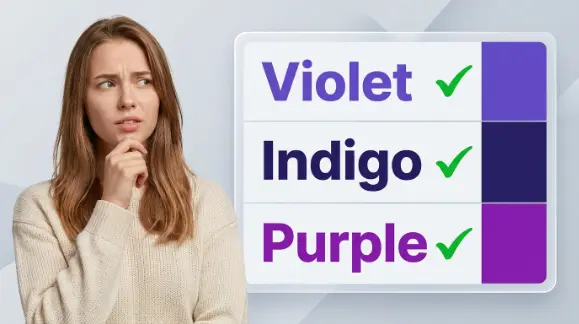
Color names can sound interchangeable, especially when three shades seem so close to each other. Violet vs Indigo vs Purple is a common source of confusion because these colors can overlap in everyday descriptions.
However, they are not exactly the same. Violet is generally a spectral color found at the shorter-wavelength end of the visible spectrum, while indigo is traditionally described as a darker blue-purple shade.
Purple is a broader color category that can include many shades between red and blue. The differences become easier to notice when you look at how these colors are created and used.
What Is Violet? 💜
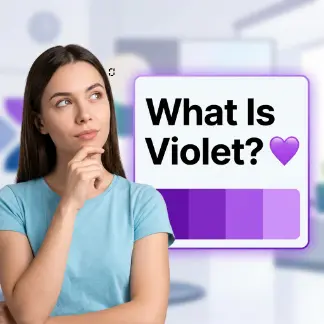
Violet is a color located near the blue end of the visible light spectrum. It is commonly described as a blue-purple or reddish-blue color. In the traditional rainbow color sequence, violet is usually listed as the final color.
Violet is also a spectral color, which means it corresponds to visible light within a particular range of wavelengths. It has a shorter wavelength than blue.
The word violet comes from the name of the violet flower, whose petals often have a purple-blue appearance.
Violet Meaning
The word violet can describe both a specific color and things associated with that color.
For example:
- “She wore a violet dress.”
- “The sunset had a violet glow.”
- “Violet flowers grew beside the garden.”
- “The artist used violet paint.”
In everyday English, people often use violet to describe a color that appears bluish-purple.
What Does Violet Look Like?
Violet generally looks more blue-based than ordinary purple. However, the exact appearance can change depending on lighting, screen settings, paint, and the color system being used.
A simple way to imagine violet is:
Blue + a noticeable touch of red = violet-like appearance
Violet is usually cooler and more blue-oriented than many shades of purple.
Is Violet a Rainbow Color?
Yes. Violet is traditionally considered one of the seven colors of the rainbow.
The traditional sequence is:
- Red
- Orange
- Yellow
- Green
- Blue
- Indigo
- Violet
A common memory trick is ROYGBIV, where the final letter represents violet.
However, modern explanations of the visible spectrum sometimes simplify the rainbow into fewer broad color categories. This is one reason people may see different color labels in different sources.
What Is Indigo? 🔵
Indigo is traditionally described as a deep blue-purple color located between blue and violet in the rainbow.
It is generally darker and more blue-heavy than violet. The exact appearance of indigo can vary because the word is used differently in science, art, design, and everyday language.
Indigo is also associated with the natural dye historically obtained from certain plants.
Indigo Meaning
The word indigo can refer to both a color and a traditional dye.
For example:
- “The fabric was dyed indigo.”
- “He bought an indigo shirt.”
- “The sky turned deep indigo after sunset.”
- “The artist painted the background in indigo.”
The word often suggests a deep, rich blue with a purple or violet undertone.
What Does Indigo Look Like?
Indigo usually appears darker and more blue-oriented than violet.
You can think of the general progression as:
Blue → Indigo → Violet
However, real-world colors do not always form perfectly separated categories. There can be many shades between them.
Is Indigo a Rainbow Color?
Yes. Indigo is traditionally listed as one of the seven rainbow colors.
In the traditional ROYGBIV sequence, indigo comes immediately before violet.
That means:
Blue → Indigo → Violet
This position helps explain why indigo and violet can look very similar.
What Is Purple? 🟣
Purple is a broad color category that generally combines red and blue. Unlike violet, purple is not a single spectral color of visible light.
This is one of the most important differences when discussing violet vs purple.
Purple can include many different shades, from reddish purple to bluish purple. Examples include lavender, plum, grape, mauve, and many other related colors.
Purple Meaning
In everyday English, purple is one of the most commonly used words for this family of colors.
For example:
- “I bought a purple shirt.”
- “Her room has purple walls.”
- “The flowers are purple.”
- “He chose a dark purple jacket.”
People usually do not need a highly technical definition when they say something is purple.
What Does Purple Look Like?
Purple can range from:
- Light purple
- Dark purple
- Red-purple
- Blue-purple
- Pinkish purple
- Muted purple
- Bright purple
Because purple covers such a wide range, it can sometimes look very similar to violet or indigo.
Is Purple a Rainbow Color?
Purple is not traditionally listed as one of the seven rainbow colors.
The traditional rainbow sequence includes violet, not purple.
This distinction is important:
Violet is a spectral color. Purple is a broader color category produced by combining red and blue light or pigments, depending on the color system.
Violet vs Indigo vs Purple: Quick Comparison
The easiest way to understand the difference is to compare their basic characteristics.
| Feature | Violet | Indigo | Purple |
| General appearance | Blue-purple | Deep blue-purple | Red-blue mixture |
| Traditional rainbow color | Yes | Yes | No |
| Position in rainbow | Last | Before violet | Not traditionally included |
| Main impression | Bluish and bright | Dark blue-purple | Broad purple family |
| Spectral color | Yes | Traditionally treated as one | No |
| Common use | Science, flowers, color names | Dye, clothing, design | Everyday language, art, fashion |
| Typical appearance | More blue than many purples | Darker and bluer | Can be blue- or red-heavy |
The biggest point to remember is that violet and indigo are traditionally connected to the visible spectrum, while purple is a broader color category.
Violet vs Indigo: What Is the Difference?
The difference between violet and indigo can be confusing because they sit next to each other in the traditional rainbow.
Indigo is generally positioned between blue and violet. It is commonly described as a dark blue-purple. Violet appears closer to the purple end of the spectrum and is generally more reddish than indigo.
Think about the transition like this:
Blue → Indigo → Violet
Indigo tends to look deeper and bluer, while violet tends to look brighter and more purple-blue.
Which Is Darker: Indigo or Violet?
In common descriptions, indigo is usually considered darker than violet.
However, perceived brightness depends on the exact shade, lighting, display, and color system.
For everyday use, you can remember:
Indigo = deep blue-purple
Violet = brighter blue-purple
Violet vs Purple: What Is the Difference?
The difference between violet and purple is more technical.
Violet is a color found at the short-wavelength end of visible light. Purple, by contrast, is a non-spectral color that can be produced by combining red and blue light.
In everyday speech, however, people frequently use the two words as synonyms.
For example, someone might call a violet flower “purple,” and there is usually nothing wrong with that in casual conversation.
The distinction becomes more important in subjects such as physics, optics, color theory, and digital color science.
Is Violet More Blue Than Purple?
Generally, violet has a stronger blue component than many common shades of purple.
Purple is a broad category, so some purples can be extremely blue while others can be strongly red.
That means you cannot always identify a color simply by asking whether it is “more blue.”
Indigo vs Purple: What Is the Difference?
Indigo is generally a deep blue-purple, while purple is a much broader color family.
Purple can contain many different combinations of red and blue. Indigo usually refers to a narrower, darker range that is strongly associated with blue.
For example, a deep blue-purple fabric may be called indigo, while a warmer red-purple fabric would more likely be called purple.
Is Indigo a Shade of Purple?
In everyday language, people may describe indigo as a type of purple-blue shade. However, traditionally, indigo is treated as its own color in the rainbow rather than simply being called purple.
The exact classification depends on the context.
Violet, Indigo, and Purple on the Color Spectrum
Understanding their position helps make the difference easier.
The traditional rainbow order is:
Red → Orange → Yellow → Green → Blue → Indigo → Violet
Purple is not placed in this traditional sequence.
Why?
Because a rainbow forms from the continuous visible spectrum. Spectral colors correspond to specific ranges of wavelengths.
Purple is different because it is generally perceived when red and blue components combine rather than from a single wavelength of visible light.
This is why purple and violet can look similar even though they have different scientific descriptions.
Why Do People Confuse Violet, Indigo, and Purple?
There are several reasons.
They Are Visually Similar
Violet, indigo, and many shades of purple are close together in appearance. Your eyes can distinguish differences, but the boundaries are not always obvious.
Color Names Are Flexible
Everyday color names do not always have strict boundaries.
One person might call a shirt violet. Another might call the same shirt purple.
Both descriptions may make sense in casual conversation.
Screens Display Colors Differently
Phones, laptops, televisions, and monitors can display colors differently.
Brightness, contrast, screen technology, and color calibration can affect how a shade appears.
Paint and Light Behave Differently
Color mixing with pigments is not exactly the same as mixing colored light.
This is another reason that simple statements such as “purple is always red plus blue” need context.
Violet vs Indigo vs Purple in Everyday English
When speaking or writing casually, you usually do not need to worry about the scientific distinction.
For example:
Violet:
“She wore a violet scarf.”
Indigo:
“He chose an indigo shirt.”
Purple:
“The room has purple curtains.”
All three sentences are grammatically correct.
The main difference is the color you want to describe.
Examples of Violet in Sentences
Here are several examples showing how violet is used naturally.
- The garden was filled with violet flowers.
- She wore a beautiful violet dress.
- The sky had a violet tint at sunset.
- Violet light is found at one end of the visible spectrum.
- The artist mixed blue and red to create a violet shade.
- Her notebook had a violet cover.
- The painting contained soft violet tones.
- A violet glow appeared around the clouds.
In these examples, violet works as an adjective describing a color.
Examples of Indigo in Sentences
Here are some natural examples using indigo:
- He bought an indigo jacket.
- The fabric was dyed a deep indigo.
- The evening sky looked indigo.
- She chose indigo curtains for her bedroom.
- The artist used indigo to create a darker blue effect.
- His jeans had an indigo color.
- The painting used indigo as its main background shade.
- The traditional rainbow includes indigo.
Examples of Purple in Sentences
Here are common examples of purple:
- She bought a purple sweater.
- The flowers in the garden are purple.
- He painted his room purple.
- I like the purple color of this dress.
- The logo uses purple and white.
- She picked a dark purple bag.
- The sunset turned the clouds purple.
- Purple is a popular color in fashion and design.
Violet vs Indigo vs Purple in Fashion
Fashion often uses these color names creatively.
A clothing company may call a shade violet, indigo, purple, plum, or another name even when the colors are visually close.
Violet Clothing
Violet clothing often has a cool, blue-purple appearance.
Examples include:
- Violet dresses
- Violet shirts
- Violet scarves
- Violet sweaters
Indigo Clothing
Indigo is especially common for denim and deep blue clothing.
Examples include:
- Indigo jeans
- Indigo jackets
- Indigo shirts
- Indigo dresses
Purple Clothing
Purple has a much broader range.
You may see:
- Lavender
- Plum
- Royal purple
- Grape purple
- Deep purple
- Mauve
- Bright purple
So, in fashion, the exact name can depend on the brand’s preferred color terminology.
Violet vs Indigo vs Purple in Art
Artists use these colors to create different visual effects.
Violet can add a cool, bright purple-blue quality.
Indigo can create depth and darkness while maintaining a blue appearance.
Purple can produce warmer or cooler results depending on the amount of red and blue.
For example, an artist might use indigo for a dark sky, violet for highlights, and purple for flowers or clothing.
Violet vs Indigo vs Purple in Design
Graphic designers often need to distinguish colors carefully.
A website may use:
- Violet for a bright accent
- Indigo for a dark background
- Purple for branding
- Lavender for a softer appearance
The exact color should ideally be defined with a digital color value rather than only a name.
This is because words such as purple and violet can mean slightly different shades to different people.
Violet vs Indigo vs Purple in the Rainbow
The traditional rainbow sequence creates a useful comparison.
| Position | Color |
| 1 | Red |
| 2 | Orange |
| 3 | Yellow |
| 4 | Green |
| 5 | Blue |
| 6 | Indigo |
| 7 | Violet |
Purple does not appear as one of the traditional seven named rainbow colors.
This does not mean purple is somehow “fake” or not a real color. It simply means purple is classified differently from spectral colors.
Is Violet the Same as Purple?
No, violet and purple are not technically identical.
Violet is associated with a specific part of the visible spectrum. Purple is a broader non-spectral color category.
However, in ordinary conversation, people often use the words interchangeably.
For example, if you describe a violet flower as purple, most people will understand exactly what you mean.
Is Indigo the Same as Violet?
No. Indigo traditionally comes immediately before violet in the rainbow.
Indigo is generally darker and more blue-oriented, while violet is closer to the short-wavelength end of visible light.
Still, the distinction can be difficult to see because the colors overlap visually.
Is Indigo the Same as Purple?
Not exactly.
Indigo is usually a deep blue-purple, whereas purple describes a much wider family of colors.
Some shades of purple may look similar to indigo, but many purple shades are much warmer or lighter.
Which Color Comes First: Indigo or Violet?
Indigo comes first, followed by violet.
The traditional order is:
Blue → Indigo → Violet
This is also why indigo is often described as being between blue and violet.
Which Is More Blue: Indigo or Violet?
Indigo is generally more blue-oriented than violet.
A simple mental picture is:
Blue → Indigo → Violet → Purple family
This is only a simplified way to understand the colors because real color spaces contain many intermediate shades.
Which Is More Purple: Violet or Indigo?
Generally, violet appears more purple than indigo.
Indigo tends to remain closer to deep blue, while violet sits closer to blue-purple.
However, the exact appearance depends on the specific shade being discussed.
Common Mistakes With Violet, Indigo, and Purple
People make several common mistakes when using these color names.
Mistake 1: Saying Purple Is a Rainbow Color
Purple is commonly associated with the rainbow, but the traditional seven-color list includes violet, not purple.
A better sentence is:
“Violet is traditionally considered a color of the rainbow.”
Mistake 2: Treating Indigo and Violet as Identical
They are adjacent in the traditional rainbow but are not normally treated as the same color.
Mistake 3: Assuming Every Purple Is Violet
Purple is a broad category. Violet is more specific.
A reddish-purple shade may not be well described as violet.
Mistake 4: Thinking Color Names Have Exact Boundaries
Color terminology can vary across science, art, fashion, design, and everyday speech.
Context matters.
Spelling Tips for Violet, Indigo, and Purple
These three words are relatively easy to spell, but learners sometimes make mistakes.
Violet
Correct:
Violet
Common mistake:
Violett
Remember that violet has one “t” at the end.
Indigo
Correct:
Indigo
It starts with indi- and ends with -go.
Purple
Correct:
Purple
A useful spelling reminder is:
PUR + PLE = PURPLE
Avoid adding an extra “p” or “l.”
Violet vs Indigo vs Purple: Simple Memory Trick
If you want a quick way to remember the difference, use this:
Indigo = deep blue-purple
Violet = blue-purple spectral color
Purple = broad red-and-blue color family
For the rainbow, remember:
Blue → Indigo → Violet
Purple is not traditionally part of that seven-color sequence.
How to Choose the Right Word
If you are describing a color in everyday conversation, choose the word that best matches what you see.
Use violet when the color looks blue-purple and you want a more specific or traditional term.
Use purple when you are referring to the general family of colors between red and blue.
For example:
- Light blue-purple → Violet
- Deep blue-purple → Indigo
- General red-blue color → Purple
These are helpful guidelines rather than strict rules.
Violet vs Indigo vs Purple: At a Glance
| Question | Answer |
| Is violet a rainbow color? | Yes |
| Is indigo traditionally a rainbow color? | Yes |
| Is purple traditionally one of the seven rainbow colors? | No |
| Is violet a spectral color? | Yes |
| Is purple a broad color category? | Yes |
| Is indigo usually darker than violet? | Generally, yes |
| Is indigo closer to blue? | Generally, yes |
| Is violet closer to purple? | Generally, yes |
| Can people use violet and purple interchangeably? | Often in casual speech |
| Do color boundaries vary? | Yes |
Frequently Asked Questions
Is violet darker than purple?
Not necessarily. Purple covers a wide range of shades, so some purple colors are darker than violet, while others are lighter.
Is indigo darker than purple?
Indigo is commonly described as a deep, dark blue-purple. However, some shades of purple can also be very dark.
Is violet closer to blue or purple?
Violet is generally closer to blue-purple in appearance. It is commonly positioned between indigo and the broader purple family in everyday descriptions.
Is indigo blue or purple?
Indigo is generally described as a deep blue-purple. It has a strong blue character with a violet or purple undertone.
Why is purple not in the rainbow?
The traditional rainbow represents the visible spectrum, where colors correspond to different wavelengths. Purple is generally considered a non-spectral color rather than a single wavelength.
Can violet and purple mean the same thing?
In everyday language, yes, people often use them interchangeably. Technically, however, violet and purple have different meanings in color science.
What color comes between blue and violet?
Traditionally, indigo comes between blue and violet in the seven-color rainbow sequence.
Which is closer to blue, indigo or violet?
Indigo is generally closer to blue. Violet is usually closer to blue-purple.
Which color is closest to purple?
Violet is generally the color most closely associated with purple among the traditional rainbow colors.
Is purple a spectral color?
No. Purple is generally classified as a non-spectral color because it does not correspond to one single wavelength of visible light.
What is the easiest way to remember violet, indigo, and purple?
Remember:
Indigo = deep blue-purple
Violet = spectral blue-purple
Purple = broad red-blue color family
Are violet and indigo next to each other?
Yes. In the traditional rainbow sequence, indigo appears immediately before violet.
Can a color be both violet and purple?
In everyday descriptions, yes. A shade may reasonably be called violet by one person and purple by another, especially when the shade falls near the boundary between the two.
Final Thoughts o
The difference between violet vs indigo vs purple becomes much easier once you understand that color names can be used in both technical and everyday ways.
Violet is traditionally the final color in the rainbow and is associated with a short-wavelength region of visible light. Indigo is traditionally placed between blue and violet and is usually described as a deep blue-purple. Purple is a broader color family that includes many shades created from red and blue components.

Emily Parker is a dedicated writer who enjoys creating clear, useful, and easy-to-understand content. She focuses on language, grammar, word meanings, and everyday expressions to help readers find simple and reliable answers.