Choosing between Unaccessible vs Inaccessible can be confusing because both words look similar and seem to describe something that cannot be reached or accessed.
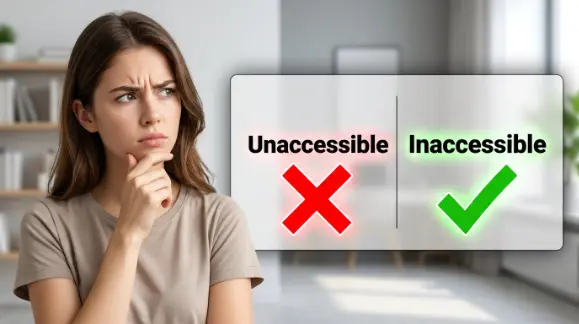
However, there is an important difference in how commonly they are used in modern English. Inaccessible is the standard and widely accepted choice when you mean that something is difficult or impossible to reach, enter, use, or obtain.
You may come across unaccessible in some dictionaries or older writing, but it is much less common than inaccessible. For everyday English, academic writing, professional communication, and most formal situations, inaccessible is generally the more natural word.
Unaccessible vs Inaccessible: Quick Answer
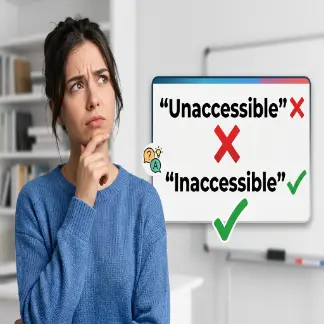
The short answer is that inaccessible is the standard and much more common word in modern English.
Inaccessible means something cannot be reached, entered, accessed, obtained, used, or understood easily.
Unaccessible is a rare variant that you may encounter in some older or less common writing, but it is generally not the best choice for everyday modern English.
For example:
- Correct and natural: The website is inaccessible.
- Less common: The website is unaccessible.
- Correct and natural: The remote village is inaccessible by road.
- Less common: The remote village is unaccessible by road.
- Correct and natural: His explanation was inaccessible to beginners.
- Less common: His explanation was unaccessible to beginners.
If you are writing an essay, article, email, school assignment, professional document, or website content, inaccessible is the safer and more natural choice.
What Does Inaccessible Mean?
Inaccessible is an adjective that describes something that cannot be reached, entered, obtained, used, or understood easily.
It can describe physical things as well as abstract ideas.
For example, a mountain area may be inaccessible because there is no road leading to it. A website may be inaccessible because users cannot open it. A difficult scientific book may be inaccessible to beginners because the language and concepts are too complicated.
The word can therefore have several related meanings.
Inaccessible Meaning in Simple English
In simple terms, inaccessible means:
Not easy or possible to reach, enter, use, obtain, or understand.
Here are a few examples:
- The road was blocked, making the village inaccessible.
- The museum is inaccessible to people using wheelchairs.
- The information was written in highly technical language and was inaccessible to beginners.
- The account became inaccessible after the password was forgotten.
- The island is inaccessible during the winter months.
In each example, something is difficult or impossible to access.
Inaccessible as a Physical Description
One of the most common uses of inaccessible refers to a physical location.
If you cannot easily reach a place, you can call it inaccessible.
For example:
The cave is inaccessible without special equipment.
This means that people cannot easily reach or enter the cave without the necessary equipment.
Another example is:
The mountain village becomes inaccessible during heavy snowfall.
Here, the snow prevents people from reaching the village easily.
Inaccessible for People
The word can also describe places, buildings, services, or systems that people cannot use because they do not provide proper access.
For example:
The old building is inaccessible to wheelchair users.
This means the building does not provide suitable access for people who use wheelchairs.
You can also say:
The website is inaccessible to users with certain disabilities.
This use is especially common when discussing accessibility, technology, public services, and design.
Inaccessible for Ideas and Information
Inaccessible does not only describe physical objects.
It can describe information, knowledge, language, or ideas that are difficult to understand.
For example:
The professor’s explanation was inaccessible to most students.
This does not mean the explanation was physically impossible to reach. Instead, it means the explanation was too complicated or difficult for the students to understand.
Another example:
The research paper contains highly technical information that is inaccessible to ordinary readers.
Here, inaccessible means difficult to understand.
What Does Unaccessible Mean?
Unaccessible is a word that can be found in English, but it is far less common than inaccessible in modern standard usage.
It generally carries the same basic idea: something is not accessible or cannot be reached.
However, most modern English speakers and writers prefer inaccessible.
For example, instead of writing:
The area is unaccessible.
It is more natural to write:
The area is inaccessible.
Likewise:
The information is inaccessible to beginners.
sounds much more standard than:
The information is unaccessible to beginners.
This is why learners should generally choose inaccessible.
Is Unaccessible Technically a Word?
Yes, unaccessible can be found in dictionaries and historical or less common usage. However, its existence does not make it the preferred choice in modern everyday English.
English contains many words that are technically possible but are rarely used. A word can exist while still being unusual, outdated, regional, or less preferred.
That distinction matters here.
If you are learning English and want to sound natural, inaccessible should be your first choice.
Inaccessible vs Unaccessible: Main Difference
The biggest difference between these two words is not their basic meaning. Both can communicate the idea of something not being accessible.
The main difference is frequency, standard usage, and naturalness.
| Word | Meaning | Modern Usage | Best Choice? |
| Inaccessible | Difficult or impossible to reach, enter, use, obtain, or understand | Very common | Yes |
| Unaccessible | Not accessible | Rare and uncommon | Usually no |
Inaccessible is the normal word you should use in most situations.
Unaccessible may appear in older texts or uncommon contexts, but it can sound awkward or unusual to modern readers.
Why Is Inaccessible More Common?
The word inaccessible follows a common English word-building pattern.
It comes from:
in- + accessible = inaccessible
The prefix in- can mean “not” or “the opposite of.”
For example:
- visible → invisible
- possible → impossible
- complete → incomplete
- active → inactive
- accessible → inaccessible
This pattern is well established in English.
The word accessible means something can be reached, entered, used, obtained, or understood. Adding in- creates the opposite:
accessible → inaccessible
This makes inaccessible the natural negative form for most modern English contexts.
Accessible vs Inaccessible
Understanding the base word accessible makes the difference easier to remember.
Accessible means easy or possible to reach, enter, use, obtain, or understand.
Inaccessible means not easy or not possible to reach, enter, use, obtain, or understand.
Compare these examples:
| Accessible | Inaccessible |
| The building is accessible to everyone. | The building is inaccessible to some visitors. |
| The website is accessible on mobile devices. | The website is inaccessible on older devices. |
| The information is accessible to beginners. | The information is inaccessible to beginners. |
| The beach is accessible by road. | The beach is inaccessible by road. |
| The manager is accessible to employees. | The manager is inaccessible to employees. |
This contrast can help you remember the correct word.
Examples of Inaccessible in Sentences
Here are several examples showing how inaccessible works in different situations.
Physical Location Examples
1. The remote island is inaccessible during the winter.
2. The mountain road became inaccessible after the landslide.
3. The cave is inaccessible without professional equipment.
4. Heavy snow made the village inaccessible.
5. The upper floor is inaccessible without a key.
These examples describe places that cannot be reached or entered easily.
Technology Examples
1. The website became inaccessible after the server crashed.
2. My account is currently inaccessible.
3. The file was inaccessible because the permission settings were changed.
4. The online service is inaccessible in some regions.
5. The database is inaccessible without authorization.
In these sentences, inaccessible means users cannot reach or use something.
Information Examples
1. The scientific article was inaccessible to beginners.
2. The book contains information that is inaccessible to most readers.
3. The instructions were so complicated that they became inaccessible to ordinary users.
4. The professor explained the subject in an inaccessible way.
5. The legal language made the document inaccessible to the general public.
Here, inaccessible means difficult to understand rather than physically unreachable.
Social Examples
The word can also describe people who are difficult to approach.
For example:
The celebrity seemed inaccessible to ordinary fans.
This means the celebrity seemed difficult to approach or communicate with.
Another example:
The manager appeared inaccessible to junior employees.
This suggests that employees found it difficult to approach or communicate with the manager.
Examples of Unaccessible in Sentences
Although unaccessible is uncommon, you may still encounter it.
Here are examples that demonstrate its intended meaning:
- The remote location was described as unaccessible.
- The information appeared unaccessible to the general audience.
- The building was considered unaccessible without assistance.
- The region remained unaccessible for several months.
However, in modern standard writing, these sentences would normally be improved by replacing unaccessible with inaccessible.
For example:
Less preferred: The remote location was unaccessible.
Preferred: The remote location was inaccessible.
Less preferred: The information was unaccessible to beginners.
Preferred: The information was inaccessible to beginners.
Unaccessible or Inaccessible: Which Is Correct?
If you are asking, “Is it unaccessible or inaccessible?”, the answer is:
Use “inaccessible” in almost all modern English writing.
For example:
- The road is inaccessible.
- The website is inaccessible.
- The building is inaccessible.
- The information is inaccessible.
- The area is inaccessible.
You may see unaccessible occasionally, but it is not the normal choice for modern English.
This is especially important in formal writing.
If you are writing a school assignment, business report, website article, academic paper, or professional email, inaccessible will usually be the better choice.
Is Unaccessible Grammatically Wrong?
It is better to call unaccessible uncommon or non-preferred rather than simply saying that it can never be used.
English usage can be complicated because some words have historical, dialectal, or rare forms. Unaccessible has appeared in English, but modern writers overwhelmingly favor inaccessible for the intended meaning.
Therefore, if your goal is clear, natural, standard English, choose inaccessible.
Think of it this way:
Technically encountered ≠ preferred in modern writing.
A word may exist in dictionaries or historical texts while still being a poor choice for everyday communication.
Common Mistakes With Inaccessible
English learners often make several mistakes with this word.
Mistake 1: Writing Unaccessible Instead of Inaccessible
A common sentence is:
The website is unaccessible.
A more natural version is:
The website is inaccessible.
Remember that inaccessible is the standard modern form.
Mistake 2: Spelling It as Inaccessable
Another common spelling mistake is:
inaccessable
This spelling is incorrect.
The correct spelling is:
inaccessible
Notice the ending:
-ible, not -able
Correct:
inaccessible
Incorrect:
inaccessable
Mistake 3: Forgetting the Double “C”
The correct spelling contains two consecutive c letters:
inaccessible
Break it into parts:
in + accessible
The base word accessible already contains the spelling pattern cc.
Mistake 4: Confusing Accessible and Inaccessible
These words have opposite meanings.
Accessible = available or easy to reach/use/understand.
Inaccessible = not available or difficult/impossible to reach/use/understand.
For example:
The information is accessible.
means the information is easy to obtain or understand.
The information is inaccessible.
means it is difficult or impossible to obtain or understand.
How to Remember the Spelling of Inaccessible
A simple way to remember the spelling is to start with the word accessible.
First remember:
accessible
Then add in-:
in + accessible = inaccessible
You can also remember the spelling through this sequence:
access → accessible → inaccessible
The word contains access, so think about “access” first.
A Simple Spelling Trick
Try this:
IN + ACCESS + IBLE
That gives you:
INACCESSIBLE
The important middle section is:
ACCESS
not:
ACCES
And the ending is:
IBLE
not:
ABLE
So the correct spelling is:
inaccessible
Inaccessible Pronunciation
The pronunciation of inaccessible can seem difficult because the word is relatively long.
It is commonly pronounced approximately as:
in-ak-SES-uh-buhl
The stress usually falls on the “ses” sound.
You do not need to pronounce every letter separately. Say the word smoothly:
in-access-ible
Listening to the word being spoken can also help you recognize its natural pronunciation.
Is Inaccessible an Adjective?
Yes. Inaccessible is an adjective.
An adjective describes a person, place, thing, condition, or idea.
For example:
- an inaccessible building
- an inaccessible road
- an inaccessible website
- an inaccessible location
- an inaccessible document
- an inaccessible explanation
In each phrase, inaccessible describes the noun.
Inaccessible in Different Sentence Positions
You can use the adjective before a noun:
The inaccessible road was closed.
You can also use it after a linking verb:
The road was inaccessible.
Both constructions are grammatically correct.
Other examples include:
The website is inaccessible.
The website became inaccessible.
The inaccessible website caused problems for users.
Inaccessible Synonyms
Depending on the context, several words can have a similar meaning to inaccessible.
Common alternatives include:
- unreachable
- unavailable
- unobtainable
- unapproachable
- unattainable
- difficult to reach
- difficult to access
- out of reach
- impossible to reach
However, these words are not always interchangeable.
For example, unreachable often focuses on something that cannot be reached physically or contacted.
Unobtainable usually means something cannot be obtained.
Unapproachable often describes a person who seems difficult to talk to.
Inaccessible is broader and can describe physical access, digital access, information, services, and even ideas.
Inaccessible vs Unreachable
These two words can sometimes describe similar situations, but they are not identical.
Inaccessible focuses on access.
Unreachable focuses more directly on the inability to reach something.
For example:
The website is inaccessible.
This suggests that users cannot access or use the website.
The website is unreachable.
This may suggest that the website cannot currently be reached, perhaps because of a technical problem.
Similarly:
The village is inaccessible.
means it is difficult or impossible to access.
The village is unreachable.
emphasizes that people cannot reach it.
Inaccessible vs Unavailable
These words are also related but have different meanings.
Inaccessible means difficult or impossible to access.
Unavailable means something is not available for use, purchase, communication, or another purpose.
For example:
The file is inaccessible.
This means you cannot access the file.
The file is unavailable.
This means the file is not currently available.
The correct word depends on what you want to say.
Inaccessible vs Impossible to Access
In many situations, inaccessible is simply a shorter and more polished way to say impossible or difficult to access.
Compare:
The area is impossible to access during winter.
and:
The area is inaccessible during winter.
Both sentences can communicate a similar idea.
The second sentence is more concise.
This is one reason inaccessible is useful in formal and professional writing.
When Should You Use Inaccessible?
You should use inaccessible when something is difficult or impossible to reach, enter, use, obtain, approach, or understand.
Common situations include:
Places
Use it when describing locations that are difficult to reach.
The island is inaccessible during storms.
Buildings
Use it when describing buildings that lack suitable access.
The entrance is inaccessible to wheelchair users.
Websites and Technology
Use it when something cannot be accessed digitally.
The website is currently inaccessible.
Information
Use it when information is difficult to understand or obtain.
The technical report is inaccessible to beginners.
People
Use it when someone is difficult to approach or communicate with.
The director seemed inaccessible to junior staff.
Ideas
Use it when a concept is too difficult for a particular audience.
The author’s writing is inaccessible to younger readers.
When Should You Avoid Unaccessible?
In most modern writing, you should simply avoid unaccessible and choose inaccessible instead.
This is especially true when you want your writing to sound:
- natural
- professional
- clear
- standard
- polished
- easy to understand
For example:
Instead of:
The service is unaccessible to customers.
Write:
The service is inaccessible to customers.
Instead of:
The location is unaccessible by car.
Write:
The location is inaccessible by car.
Instead of:
The information is unaccessible to new users.
Write:
The information is inaccessible to new users.
Unaccessible vs Inaccessible in Formal Writing
Formal writing requires clear and widely accepted vocabulary.
Because inaccessible is the standard and familiar form, it is the better choice in:
- academic essays
- business documents
- reports
- applications
- professional emails
- websites
- news articles
- educational materials
- research papers
Using inaccessible also reduces the chance that readers will stop and wonder whether your word choice is correct.
Unaccessible vs Inaccessible in Everyday Conversation
In casual conversation, you are also much more likely to hear inaccessible.
For example:
“That road is inaccessible right now.”
This sounds completely natural.
You could also say:
“You can’t get there right now.”
The second version is more informal and conversational.
However, when you want a single adjective, inaccessible is the natural choice.
Quick Comparison Examples
Here are some side-by-side examples to make the difference easier to understand.
| Less Preferred | Preferred |
| The road is unaccessible. | The road is inaccessible. |
| The website is unaccessible. | The website is inaccessible. |
| The building is unaccessible. | The building is inaccessible. |
| The information is unaccessible. | The information is inaccessible. |
| The area became unaccessible. | The area became inaccessible. |
| The document is unaccessible to users. | The document is inaccessible to users. |
| The village is unaccessible during winter. | The village is inaccessible during winter. |
The pattern is simple: when you mean “not accessible,” inaccessible is normally the word you want.
Why Do People Write Unaccessible?
There is a logical reason people make this mistake.
The word un- commonly creates opposites in English.
For example:
- happy → unhappy
- clear → unclear
- known → unknown
- available → unavailable
- comfortable → uncomfortable
Because of this pattern, it is natural for learners to think:
accessible → unaccessible
However, English does not always form negative words using un-.
Sometimes another prefix is standard.
For example:
- possible → impossible
- legal → illegal
- regular → irregular
- responsible → irresponsible
- accessible → inaccessible
So you cannot always create an opposite simply by adding un-.
The Prefix In- in Inaccessible
The prefix in- often creates a negative meaning.
Some examples include:
- accurate → inaccurate
- complete → incomplete
- direct → indirect
- visible → invisible
- active → inactive
- accessible → inaccessible
The prefix may also change form in certain words depending on the following sound. This is why English has related forms such as im-, il-, and ir-.
For example:
- possible → impossible
- legal → illegal
- regular → irregular
These patterns come from the history of English and Latin-derived vocabulary.
Can You Say “Not Accessible” Instead?
Absolutely.
Not accessible is grammatically correct and often very clear.
For example:
The road is not accessible during winter.
You could also write:
The road is inaccessible during winter.
Both are correct.
The choice depends on your sentence and writing style.
Sometimes not accessible sounds more conversational or direct, while inaccessible is more concise.
Compare:
The information is not accessible to the public.
The information is inaccessible to the public.
Both work well.
Is “Inaccessible” Negative?
Yes. Inaccessible has a negative meaning because it indicates a lack of access.
However, it does not necessarily express criticism.
For example:
The mountain trail is inaccessible during heavy snow.
This is simply a factual statement.
Likewise:
The document is inaccessible without administrator permission.
This describes a condition rather than expressing an opinion.
Common Search Questions About Unaccessible vs Inaccessible
People often search for this word pair because the spelling can be confusing.
Here are some of the most common questions.
Is “Unaccessible” a Correct Word?
Unaccessible exists as a rare or less common form, but inaccessible is the standard and much more common choice in modern English. Use inaccessible in most writing.
Is It Inaccessible or Unaccessible?
The preferred word is inaccessible.
For example:
The website is inaccessible.
This is the natural modern English form.
Why Is Inaccessible Correct?
Inaccessible is the established negative form of accessible. It means something cannot be reached, entered, used, obtained, or understood easily.
Is Unaccessible a Misspelling?
Not necessarily. Unaccessible has existed in English, but it is uncommon and generally not preferred in modern standard usage. Writers should normally use inaccessible.
What Is the Opposite of Accessible?
The standard opposite of accessible is inaccessible.
For example:
The building is accessible.
Opposite:
The building is inaccessible.
What Is the Difference Between Accessible and Inaccessible?
Accessible means easy or possible to reach, enter, use, obtain, or understand.
Inaccessible means difficult or impossible to reach, enter, use, obtain, or understand.
Can I Use Unaccessible in an Essay?
It is better to use inaccessible in an essay. It is more common, standard, and natural for modern readers.
Is Inaccessible Formal English?
Yes. Inaccessible is perfectly appropriate in formal, academic, professional, and everyday English.
What Is the Correct Spelling?
The correct standard spelling is:
inaccessible
Not:
inaccessable
And although unaccessible can be found in English, it is not normally the preferred modern form.
What Is a Simple Sentence With Inaccessible?
Here are a few simple examples:
The road is inaccessible.
The website is inaccessible.
The building is inaccessible to wheelchair users.
The information is inaccessible to beginners.
A Simple Rule to Remember
If you are unsure whether to write unaccessible or inaccessible, remember this rule:
Use “inaccessible” when you mean “not accessible.”
This one rule will solve the problem in almost every everyday writing situation.
Think:
accessible → inaccessible
rather than:
accessible → unaccessible
Once you remember this pattern, the spelling becomes much easier.
Final Examples for Practice
Try reading these examples aloud:
- The mountain path is inaccessible after heavy rain.
- The website is currently inaccessible.
- The building is inaccessible from the main entrance.
- The information is inaccessible to people without permission.
- The book is inaccessible to young readers because of its advanced language.
- The village becomes inaccessible during the winter.
- The file is inaccessible without a password.
- The manager seemed inaccessible to new employees.
- The remote beach is inaccessible by car.
- The technical report may be inaccessible to beginners.
Now compare the less preferred versions:
- The mountain path is unaccessible after heavy rain.
- The website is unaccessible.
- The building is unaccessible from the main entrance.
- The information is unaccessible to people without permission.
The meaning is understandable, but inaccessible sounds more natural and standard.
Conclusion:
The difference between unaccessible vs inaccessible is mainly a matter of modern usage and preference rather than a completely different meaning. Inaccessible is the standard, common, and natural word used to describe something that cannot be reached, entered, used, obtained, approached, or understood easily.
Unaccessible can be found in English, particularly in rare or historical usage, but it is much less common and is generally not the best choice for modern writing. If you are writing an article, essay, email, report, school assignment, or professional document, choose inaccessible.

Michael Collins is a skilled writer who creates clear, practical, and reader-friendly content. He focuses on language, grammar, word meanings, and everyday expressions, making complex topics simple to understand.