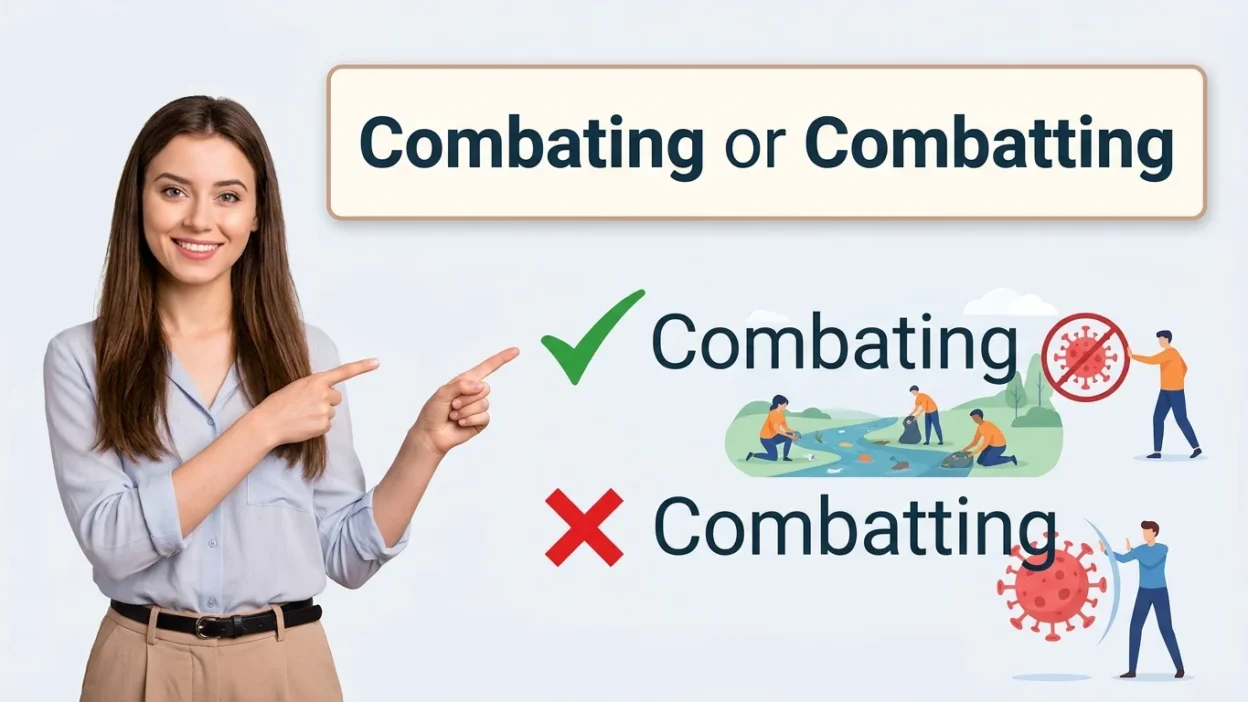
English spelling can sometimes make a simple word surprisingly difficult, and combating or combatting is a good example. Both forms are used to describe the act of fighting, opposing, or trying to stop something, but their spelling can vary depending on the style of English being used. If you’re unsure which version belongs in your sentence, you’re not alone.
The confusion usually comes from the word combat and how its final consonant is handled when adding -ing. In many forms of standard English, combating is the preferred spelling. However, combatting is also found in dictionaries and published writing, particularly in some varieties of British English. Understanding this difference can help you choose the form that fits your audience and writing style.
In this guide, we’ll explain combating vs. combatting, their meanings, pronunciation, grammatical usage, and clear sentence examples. You’ll also learn how American and British English may differ when using these spellings.
Combating or Combatting: Quick Answer 💡
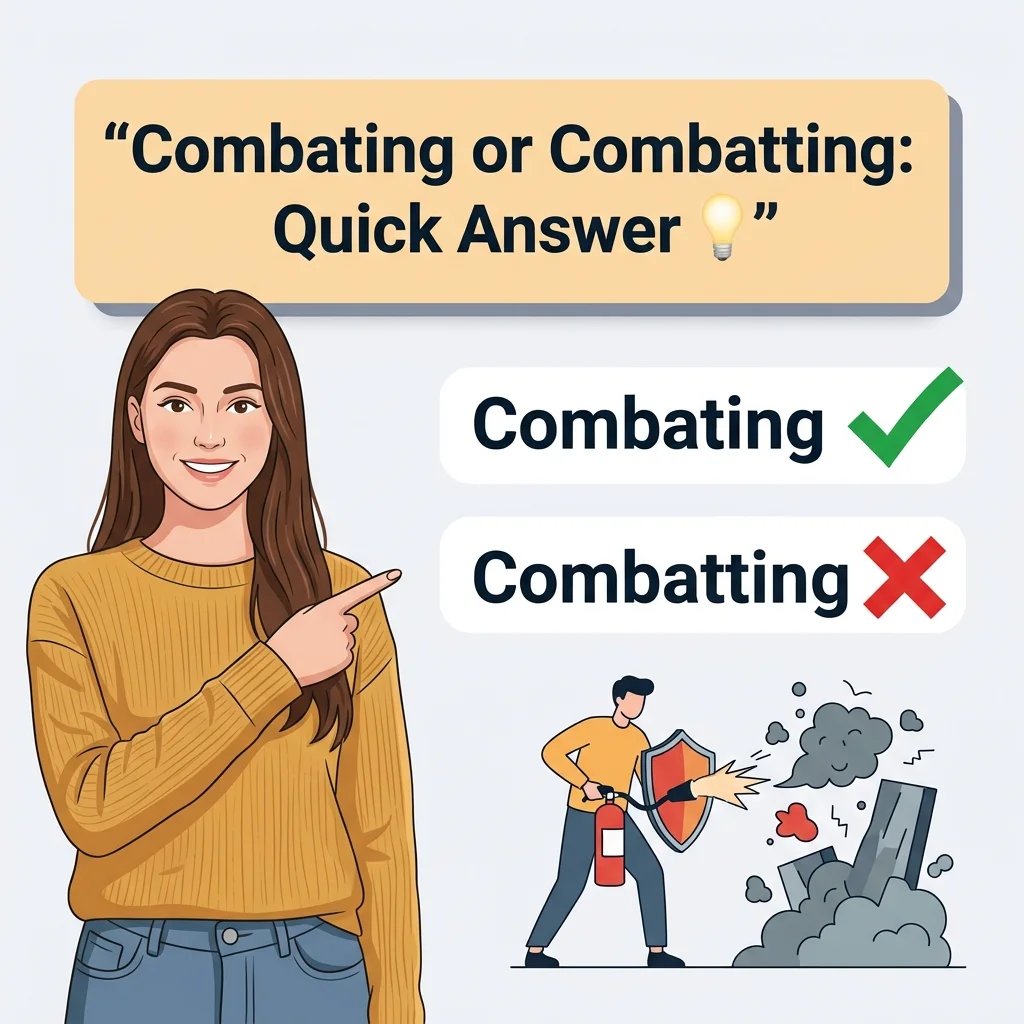
Both combating and combatting are grammatically correct forms of the verb combat.
The difference is mainly a matter of spelling preference and regional usage:
| Spelling | Correct? | Common Usage |
| Combating | Yes | More common in American English |
| Combatting | Yes | Common in British English and other varieties |
| Combat | Yes | Base verb |
| Combated | Yes | Past tense and past participle |
If you are writing for an American audience, combating is usually the safer and more familiar choice. If you are following British English conventions, combatting is also perfectly acceptable.
So, you do not need to think of one as a misspelling of the other.
What Does Combating Mean? 📖
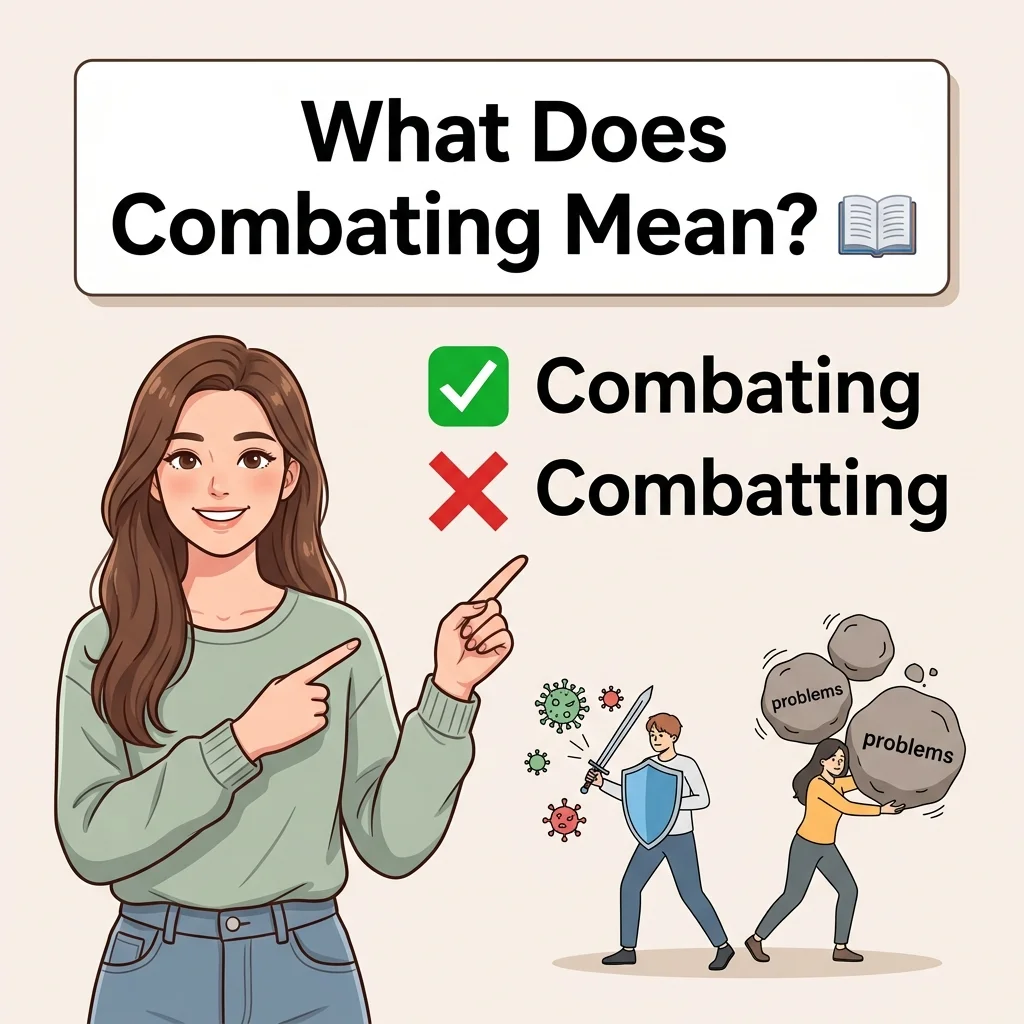
Combating means fighting against, opposing, resisting, or trying to stop something.
It is the -ing form of the verb combat.
For example:
The organization is combating online fraud.
Here, “combating” means the organization is actively working to fight or prevent online fraud.
The word can describe both physical and nonphysical forms of opposition. However, in modern writing, it is very often used for problems, risks, social issues, diseases, misinformation, crime, and other unwanted conditions.
Examples of Combating
- The government is combating poverty.
- Doctors are combating the spread of disease.
- Schools are combating bullying.
- Companies are combating cybercrime.
- Researchers are combating climate change.
- The campaign focuses on combating misinformation.
In each example, “combating” describes an ongoing effort to deal with or overcome a problem.
What Does Combatting Mean? 📚
Combatting has the same basic meaning as combating.
It is another accepted spelling of the present participle or gerund form of combat.
For example:
The organization is combatting online fraud.
This sentence means essentially the same thing as:
The organization is combating online fraud.
There is no major difference in meaning between the two spellings.
The extra t in combatting comes from a spelling pattern in which the final consonant is doubled before adding -ing.
This can make the word look unusual if you are more familiar with combating, but combatting is not automatically wrong.
Combating vs. Combatting: What Is the Difference? 🔍
The most important point is simple: there is no meaningful difference in definition.
Both forms mean fighting against or working to stop something.
The difference is mostly related to spelling conventions and regional preferences.
Combating
Combating is the spelling you are more likely to see in American English.
Examples include:
- combating crime
- combating corruption
- combating poverty
- combating disease
- combating terrorism
- combating climate change
- combating misinformation
For an American audience, this spelling generally looks more familiar and natural.
Combatting
Combatting is also standard English. It is especially common in British English, although actual usage can vary by publication, dictionary, and writer.
Examples include:
- combatting crime
- combatting corruption
- combatting poverty
- combatting disease
- combatting misinformation
The meaning remains exactly the same.
Is Combating Correct? ✅
Yes, combating is correct.
It is the present participle and gerund form of combat.
You can use it when describing an action that is happening now, an ongoing effort, or an activity.
For example:
Scientists are combating the effects of pollution.
You can also use it as a noun-like gerund:
Combating pollution requires cooperation.
Both sentences use combating correctly.
More Examples
- We are combating fraud through stronger security measures.
- The team is combating harmful rumors.
- Combating stress can require lifestyle changes.
- The program focuses on combating food insecurity.
- New technology is helping with combating cyberattacks.
Is Combatting Correct? ✅
Yes, combatting is also correct.
Some writers mistakenly assume that combatting is always a spelling error because they learned combating first. That is not the case.
For example:
The organization is combatting discrimination.
This sentence is grammatically correct.
You can also write:
The organization is combating discrimination.
Both versions communicate the same idea.
The choice usually depends on the English variety or the style guide you are following.
Why Are There Two Spellings? 🤔
The confusion comes from the way English handles words ending in a consonant before -ing.
Many English verbs double their final consonant when adding -ing.
For example:
- run → running
- stop → stopping
- sit → sitting
- plan → planning
This may lead writers to expect:
combat → combatting
And that spelling is indeed accepted.
However, combat has historically been treated differently in some English spelling traditions. As a result, combating is also established and widely used.
English contains many spelling variations because it has developed from several linguistic traditions. American and British English sometimes preserve different spelling preferences.
Is Combating or Combatting More Common? 📊
If you are deciding which spelling to use for general online writing, combating is usually the more familiar choice, particularly for an American audience.
However, combatting remains a valid spelling.
Think of it this way:
Combating = common and widely recognized
Combatting = correct alternative spelling
Neither spelling changes the meaning.
For a website targeting readers in the United States, I would generally recommend combating for consistency.
For a publication that follows British English, check its house style. If it prefers combatting, use that form consistently.
Combating or Combatting in American English 🇺🇸
American English commonly uses combating.
For example:
The agency is combating financial fraud.
Researchers are combating antibiotic resistance.
Communities are combating homelessness.
This spelling is familiar to most American readers.
If your website, blog, academic paper, or business communication follows American English, combating is a practical choice.
However, seeing combatting in an American publication does not automatically mean the writer has made a grammatical error.
Combating or Combatting in British English 🇬🇧
British English can use combatting more readily.
For example:
The government is combatting rising crime.
The campaign focuses on combatting discrimination.
At the same time, combating can also be found in British English.
That is why it is better to describe the two spellings as variant forms rather than saying one belongs exclusively to one country.
Combating vs. Combatting: Grammar Explained 📝
Both forms function as the present participle of the verb combat.
The basic verb is:
combat
The present participle can be:
combating
or
combatting
The form can be used after forms of be to create continuous tenses.
For example:
They are combating corruption.
It can also work as a gerund:
Combating corruption requires strong laws.
Verb Forms of Combat
| Form | Example |
| Base form | combat |
| Present tense | combat / combats |
| Past tense | combated |
| Past participle | combated |
| Present participle | combating / combatting |
This table shows why combating and combatting are both connected to the same verb.
When Should You Use Combating? ✍️
Use combating when you want the spelling that is especially familiar in American English and common in international digital content.
It works naturally in formal and informal writing.
Formal Examples
The initiative aims to combat corruption.
The agency is combating financial crime.
Researchers are developing new methods for combating infectious diseases.
Informal Examples
We are combating the problem together.
The team is combating spam every day.
This tool helps with combating unwanted messages.
The word is flexible enough for emails, articles, reports, essays, websites, and everyday communication.
When Should You Use Combatting? ✍️
Use combatting when it matches the spelling convention or editorial style you are following.
For example, if you are writing for a British publication that prefers doubled consonants in this type of word, combatting can fit naturally.
Examples
The charity is combatting homelessness.
The company is combatting online scams.
New policies are aimed at combatting corruption.
Again, these sentences have the same meaning if you replace combatting with combating.
Combating vs. Combatting in a Sentence 🧩
Let’s compare the two forms directly.
The government is combating cybercrime.
The government is combatting cybercrime.
Both sentences mean that the government is taking action against cybercrime.
Another example:
Scientists are combating climate change.
Scientists are combatting climate change.
Again, the meaning does not change.
This is important because some spelling differences change meaning, but this one does not.
Examples of Combating in Everyday Writing 💬
Here are several natural examples:
- The school is combating bullying through educational programs.
- The company is combating workplace discrimination.
- Doctors are combating the spread of infection.
- The government is combating illegal trafficking.
- Communities are combating homelessness.
- Parents can help with combating cyberbullying.
- Researchers are combating antibiotic resistance.
- The organization is combating food waste.
- New software helps businesses with combating fraud.
- The campaign focuses on combating misinformation.
Notice that the word often appears before the name of a problem or threat.
Examples of Combatting in Everyday Writing 💬
You can replace combating with combatting in the examples above.
For example:
The school is combatting bullying.
Doctors are combatting the spread of infection.
Researchers are combatting antibiotic resistance.
The campaign focuses on combatting misinformation.
These sentences remain grammatically correct.
The main change is simply the spelling.
Common Mistakes With Combating and Combatting ❌
Although both spellings are correct, writers still make several mistakes when using these words.
Mistake 1: Saying Combatting Is Always Wrong
Some people believe:
“Combatting is incorrect. Only combating is right.”
That statement is too absolute.
Combatting is an accepted spelling.
The better approach is to consider your audience and the spelling convention you are following.
Mistake 2: Saying Combating Is Incorrect
The opposite claim is also wrong.
Combating is fully correct and widely used.
If you use it in American English, formal writing, or online content, you are not making a spelling mistake.
Mistake 3: Changing the Meaning
Some writers think the two spellings express different levels of fighting.
They do not.
Combating and combatting have the same basic meaning.
The difference is spelling preference, not intensity.
Mistake 4: Using Combatting and Combating Randomly
Although both forms are correct, switching between them throughout the same article can look inconsistent.
For example:
The organization is combating poverty. Later, it discusses combatting unemployment.
There is nothing grammatically wrong here, but consistent spelling usually looks more polished.
Choose one form and stick with it unless you have a specific reason to change.
Spelling Tip: Remember the Double T 🔤
If you prefer combatting, remember that the spelling contains two t’s:
combat + ting = combatting
If you prefer the American-style spelling:
combat + ing = combating
A simple way to remember the difference is:
Combating has one “t” before “ing.”
Combatting has two “t’s” before “ing.”
Both are legitimate forms.
Is Combatting a Misspelling of Combating?
No.
Combatting is not simply a typo or an incorrect version of combating.
It is an accepted spelling variant.
However, your spelling checker may flag one form depending on the language setting or dictionary installed on your device.
For example, a program configured for one regional variety of English might prefer combating, while another dictionary may recognize combatting.
That does not necessarily mean the flagged word is wrong.
Is Combating a Misspelling of Combatting?
No.
Combating is also a correct spelling.
It is especially common in American English and widely recognized internationally.
If you have been using combating, there is no reason to change it simply because you discovered combatting.
Combating or Combatting in Formal Writing 🎓
Both can appear in formal writing.
For example:
The study examines methods for combating online misinformation.
Or:
The study examines methods for combatting online misinformation.
Both sentences are grammatically sound.
For academic writing, however, consistency matters more than choosing one form simply because it looks more formal.
Which One Should You Use? 🎯
If you need a simple recommendation, use combating for general American English content.
Choose combatting when your publication or audience follows a spelling style that favors the doubled consonant.
Here is a quick guide:
| Situation | Recommended Choice |
| American English | Combating |
| British English | Combating or combatting |
| General website content | Combating |
| Formal writing | Follow the required style guide |
| SEO article for U.S. readers | Combating |
| British publication | Follow its house style |
| Casual writing | Either is correct |
The most important rule is consistency.
Combating or Combatting: Simple Memory Trick 🧠
Here is an easy trick.
Think of the word combat and ask yourself:
“Do I want the common American-style form?”
If yes, use:
combating
If your preferred spelling convention doubles the final consonant, use:
combatting
You can also remember:
One T = combating
Two T’s = combatting
Both lead to the same meaning.
Combating vs. Combatting vs. Fighting
These words are related, but they do not always sound exactly the same.
Fighting is a broad and everyday word.
Combating sounds more formal and often describes an organized effort against a problem.
For example:
People are fighting against corruption.
This is understandable and natural.
The organization is combating corruption.
This sounds more formal and institutional.
That is why combat and its forms appear frequently in government reports, news articles, academic writing, health information, and professional communication.
Combating vs. Opposing
Opposing means being against something.
Combating often suggests actively taking action against it.
For example:
The group opposes the policy.
This tells us about the group’s position.
The group is combating corruption.
This suggests that the group is actively trying to stop or reduce corruption.
The words can overlap, but they are not always interchangeable.
Combating vs. Preventing
Preventing means stopping something from happening.
Combating means fighting against something that exists or is considered a threat.
For example:
The program is preventing accidents.
This emphasizes stopping accidents before they happen.
The program is combating workplace injuries.
This emphasizes an active effort to deal with the problem.
Depending on context, both words can be appropriate.
Can Combating and Combatting Be Used as Nouns?
Yes.
The -ing form can function as a gerund, which means it behaves like a noun.
For example:
Combating pollution requires cooperation.
Here, “combating pollution” acts as the subject of the sentence.
Another example:
Combatting misinformation is becoming increasingly important.
Here, “combatting misinformation” is also functioning as a noun-like phrase.
This is one reason you may see these forms frequently in titles, reports, and formal documents.
Can You Say “Combating Against”?
Usually, no.
One common mistake is adding against after combat.
For example:
❌ The organization is combating against corruption.
A more natural construction is:
✅ The organization is combating corruption.
The verb combat already contains the idea of fighting against something.
You can say:
The organization is fighting against corruption.
But with combat, you normally do not need against.
Can You Say “Combatting Against”?
The same rule applies.
Instead of:
❌ The organization is combatting against crime.
Write:
✅ The organization is combatting crime.
Or:
✅ The organization is fighting against crime.
This small distinction can make your writing sound much more natural.
Combating or Combatting: Which Is Better for Essays?
Both forms can work in an essay.
However, if your teacher or institution follows American English, combating is likely the safer choice.
For example:
Governments should focus on combating climate change.
If your institution uses British English, combatting may also be acceptable.
The best approach is to check the style requirements before submitting an academic paper.
Combating or Combatting: Which Is Better for Business Writing?
Both are acceptable in business writing.
For a broad international audience, combating may be the more recognizable option.
For example:
Our company is committed to combating financial fraud.
This sounds clear and professional.
If your company follows British English and prefers combatting, you can write:
Our company is committed to combatting financial fraud.
Again, the meaning is identical.
Why Consistency Matters in Professional Writing
Imagine reading a report that uses both spellings randomly:
The company is combating fraud. It also has a program for combatting online scams. The new team is combating financial crime.
Although the grammar is technically fine, the changing spelling can look careless.
A polished writer usually chooses one spelling based on the target audience and keeps it consistent.
That small detail can improve the overall appearance of your content.
Quick Comparison: Combating vs. Combatting 📋
| Feature | Combating | Combatting |
| Correct spelling | Yes | Yes |
| Meaning | Fighting against | Fighting against |
| Grammar | Present participle/gerund | Present participle/gerund |
| Extra “t” | No | Yes |
| Common in U.S. English | Yes | Less common |
| Used in British English | Yes | Yes |
| Formal writing | Yes | Yes |
| SEO writing | Yes | Yes |
| Meaning difference | None | None |
How to Choose the Right Spelling
Choosing between the two does not need to be complicated.
Consider Your Audience
If your readers are mainly in the United States, combating is a straightforward choice.
If your readers are in the United Kingdom or your publication has a preferred style, check whether it favors combatting.
Follow Your Style Guide
Academic institutions, newspapers, businesses, and publishers may have their own style rules.
Follow those rules instead of mixing spelling systems.
Stay Consistent
Once you choose one spelling, use it consistently throughout the same document.
Consistency makes your writing look professional and intentional.
Frequently Asked Questions About Combating or Combatting ❓
Is “combating” correct?
Yes. Combating is completely correct. It is the present participle and gerund form of the verb combat and is especially common in American English.
Is “combatting” correct?
Yes. Combatting is also correct. It is an accepted spelling variant of combating and is used in British English and other varieties.
Which is correct, combating or combatting?
Both are correct. They have the same meaning. Your choice mainly depends on regional spelling preferences and the style guide you are following.
Is combatting British or American?
Combatting is commonly associated with British English, while combating is especially common in American English. However, neither spelling is exclusive to one variety.
Does combating mean fighting?
Yes. Combating can mean fighting against, opposing, resisting, or working to stop something.
For example:
The organization is combating corruption.
This means the organization is actively working against corruption.
Does combatting have a different meaning from combating?
No. There is no significant difference in meaning between the two spellings.
Both mean fighting against or trying to stop something.
Is “combating against” grammatically correct?
It is generally better to avoid “combating against.” The verb combat already includes the idea of fighting against something.
Write:
The team is combating crime.
Instead of:
The team is combating against crime.
Is “combatting against” correct?
It is also better to avoid “combatting against.”
Use:
The organization is combatting fraud.
Or:
The organization is fighting against fraud.
Which spelling should I use in American English?
Combating is generally the best choice for American English.
It is familiar, widely used, and easy for American readers to recognize.
Which spelling should I use in British English?
Both combating and combatting can be found in British English. If you are writing for a specific publication, follow its preferred house style.
Can I use both combating and combatting in one article?
You can, but it is usually better to choose one spelling and use it consistently. Randomly switching between the two can make your writing look inconsistent.
Is combatting a spelling mistake?
No. Combatting is an accepted spelling.
A spell checker may prefer another form depending on its language settings, but that does not automatically make combatting incorrect.
Is combating a spelling mistake?
No. Combating is also an accepted and widely used spelling.
What is the past tense of combat?
The past tense is combated.
For example:
The organization combated the problem for many years.
The past participle is also combated.
What is the base form of combating?
The base form is combat.
The relationship is:
combat → combating
or
combat → combatting
Can combating be used as a noun?
Yes. It can function as a gerund.
For example:
Combating fraud requires constant attention.
Here, “combating fraud” functions as the subject of the sentence.
Which one is better for SEO: combating or combatting?
Neither has an inherent SEO advantage simply because of its spelling. Choose the form that matches your audience and search intent, then write naturally rather than forcing both spellings into the content.
Final Thought:
Combating is especially common in American English and is a safe choice for most U.S.-focused content. Combatting is also standard and may be preferred in some British English contexts.
Neither spelling changes the meaning. Both forms describe the act of fighting against, opposing, resisting, or trying to stop something. If you are writing an article, essay, email, or business document, choose the spelling that matches your audience or style guide. Then stick with that spelling throughout your work.

Emily Parker is a dedicated writer who enjoys creating clear, useful, and easy-to-understand content. She focuses on language, grammar, word meanings, and everyday expressions to help readers find simple and reliable answers.