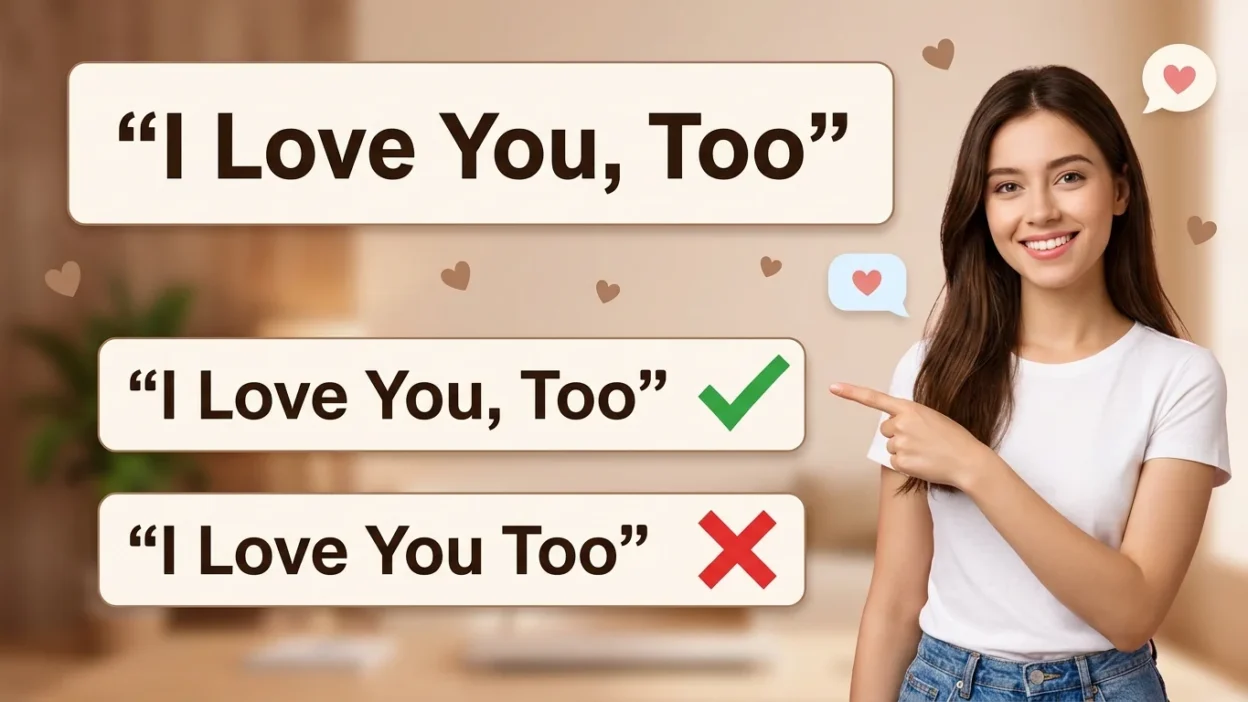
Punctuation can sometimes change the way a simple sentence is read, and “I Love You, Too” or “I Love You Too” is a common example. Both versions appear frequently in everyday communication, but the comma can affect the grammatical emphasis of the sentence.
If you’re unsure which form to use, understanding how too works makes the choice much easier. In “I love you, too,” the word too means “also” or “as well.”
The comma separates this added thought from the main statement, following a traditional punctuation style. However, in casual texting and informal writing, many people write “I love you too” without the comma.
“I Love You, Too” vs “I Love You Too”: Quick Answer
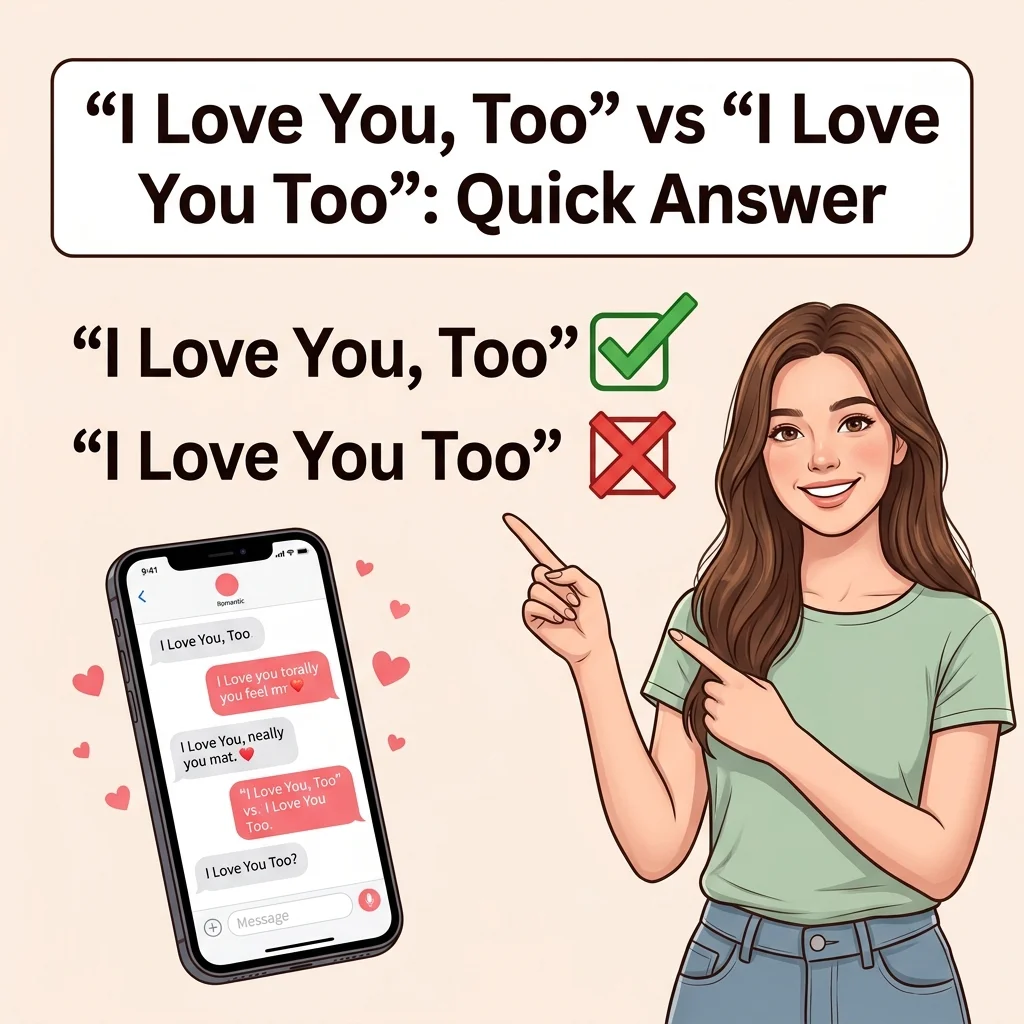
The short answer is simple:
“I love you, too” is the traditional punctuation when too means “also.”
“I love you too” is also common and acceptable in informal modern writing, especially text messages and casual conversations.
| Version | Correct? | Style | Meaning |
| I love you, too. | Yes | Traditional/standard punctuation | I also love you. |
| I love you too. | Yes | Informal/modern | I also love you. |
| I love you, to. | No | Incorrect | “To” is the wrong word. |
| I love too you. | No | Incorrect word order | “Too” is misplaced. |
If you are writing a formal sentence and want to follow traditional punctuation rules, “I love you, too” is the safest choice.
If you are sending a casual text, “I love you too” is completely natural.
What Does “I Love You, Too” Mean?
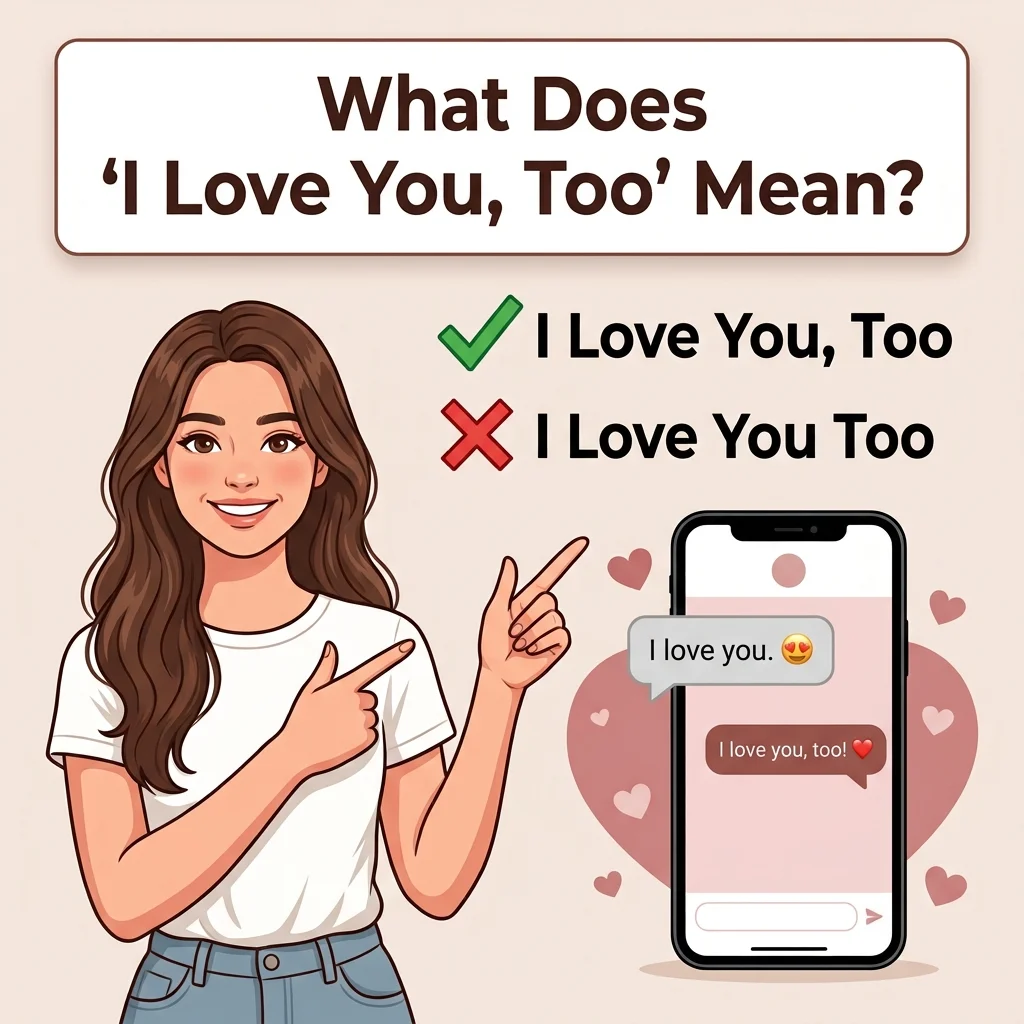
The sentence “I love you, too” means:
I also love you.
The word too means also or as well.
Imagine that one person says:
“I love you.”
The other person responds:
“I love you, too.”
The second speaker is saying that the feeling is mutual. In other words, the second person also loves the first person.
The comma does not change the basic meaning.
Compare:
I love you, too.
I love you too.
Both normally mean:
“I also love you.”
The difference is primarily punctuation and style.
What Does “Too” Mean in “I Love You Too”?
In this sentence, too is an adverb.
It means also, as well, or in addition.
For example:
Sarah likes coffee, too.
This means:
Sarah also likes coffee.
Likewise:
I love you, too.
means:
I also love you.
The word too can appear in many sentences with the same meaning:
- I miss you, too.
- I like this movie, too.
- I want to go, too.
- She knows the answer, too.
- He wants some food, too.
- We enjoyed the trip, too.
In each example, too adds the idea of also.
What Is the Difference Between “I Love You, Too” and “I Love You Too”?
There is very little difference in meaning.
The main difference is punctuation.
“I Love You, Too”
The comma separates too from the rest of the sentence.
This follows the traditional punctuation convention for a sentence-final too meaning also.
For example:
I enjoyed the movie, too.
I love you, too.
This style is especially suitable for formal or carefully edited writing.
“I Love You Too”
This version leaves out the comma.
It is extremely common in modern communication, particularly:
- Text messages
- Social media
- Online chats
- Casual emails
- Personal notes
- Everyday conversations written down
For example:
A: I love you.
B: I love you too.
There is nothing confusing about this exchange. The meaning is immediately clear.
Is “I Love You, Too” Grammatically Correct?
Yes.
“I love you, too” is grammatically correct.
The comma is traditionally used because too is an added element meaning also.
For example:
I am happy, too.
She likes pizza, too.
They are coming, too.
The same principle applies to:
I love you, too.
However, punctuation conventions have become more flexible in modern English. Many contemporary writers omit the comma before sentence-final too, particularly when the sentence is short and informal.
Therefore, you should not assume that “I love you too” is grammatically wrong.
Is “I Love You Too” Correct Without a Comma?
Yes.
“I love you too” is commonly used and accepted in modern informal English.
You will see it frequently in:
- Texting
- Messaging apps
- Social media
- Casual writing
- Personal conversations
For example:
I love you too ❤️
This is a completely natural text-message response.
The lack of a comma does not normally create confusion because too clearly means also.
In formal writing, however, you may prefer:
I love you, too.
The comma makes the sentence follow traditional punctuation conventions.
Why Is There a Comma Before “Too”?
The comma can be used to set off too when it means also.
Think of it as a small pause:
I love you, too.
When spoken, some people naturally make a slight pause before too.
The comma can represent that pause in writing.
However, punctuation is not always a direct copy of speech. English punctuation has developed through conventions, and different modern style guides and writers may handle sentence-final too differently.
That is why you may see both forms:
I love you, too.
and
I love you too.
Both are widely understood.
Does the Comma Change the Meaning?
Usually, no.
This is important to remember.
Compare:
I love you, too.
I love you too.
In normal conversation, both mean:
“I also love you.”
The comma does not suddenly create a completely different meaning.
Instead, it affects the presentation and rhythm of the sentence.
The version with the comma may feel slightly more deliberate or traditional.
The version without the comma can feel more direct, casual, and natural in texting.
“I Love You, Too” in Romantic Conversations
The phrase is especially common in romantic conversations.
Imagine this exchange:
Person A: I love you.
Person B: I love you, too.
Here, too clearly means also.
The response communicates mutual affection.
You could also say:
- I love you too.
- I love you, too.
- I love you so much, too.
- I really love you, too.
- I love you just as much.
- I feel the same way.
- I love you as well.
The most natural response depends on the relationship and the tone of the conversation.
“I Love You Too” in Text Messages
In texting, “I love you too” is probably the version many people naturally type.
For example:
A: Goodnight. I love you ❤️
B: Goodnight. I love you too ❤️
The missing comma does not make the message unclear.
In fact, adding a comma may feel slightly more formal to some people:
I love you, too.
That does not make it wrong. It simply gives the message a more traditionally punctuated appearance.
Texting allows much more flexibility with punctuation than academic or professional writing.
“I Love You, Too” in Formal Writing
If you are writing something where punctuation and grammar need to follow traditional conventions, “I love you, too” is a good choice.
For example, you might write:
I want you to know that I love you, too.
Or:
After everything we have been through, I want you to know that I love you, too.
The comma before too is perfectly appropriate.
However, remember that romantic writing itself is usually personal rather than formal. The choice often depends more on the tone you want than on strict grammatical necessity.
“I Love You Too” vs “I Love You, Too” in Texting
When texting, both versions work.
Casual Text
I love you too ❤️
This feels simple and natural.
More Deliberate Text
I love you, too. ❤️
This can feel slightly more polished or intentional.
Emotional Text
I love you too. More than you know. ❤️
This style is common in personal messages because texting often uses short sentences for emotional impact.
The important thing is that the comma is not what makes the message loving. The words and context do that.
Can “Too” Come at the End of a Sentence?
Yes.
When too means also, it commonly appears at the end of a sentence.
Examples include:
- I like it too.
- She wants to come too.
- He misses you too.
- We are excited too.
- I understand too.
- I love you too.
When using traditional punctuation, you may add a comma:
- I like it, too.
- She wants to come, too.
- He misses you, too.
- We are excited, too.
- I understand, too.
- I love you, too.
Both punctuation styles appear in modern English.
Can “Too” Be Used at the Beginning of a Sentence?
Yes, but the meaning and structure can be different.
For example:
Too many people arrived late.
Here, too does not mean also. It means more than is desirable or necessary.
Another example:
Too much noise makes it difficult to sleep.
Again, too means excessively or more than is wanted.
This is different from:
I love you, too.
Here, too means also.
Understanding these two meanings can help you avoid confusion.
“Too” Has Two Main Meanings
The word too commonly has two important meanings.
Too = Also
This is the meaning in:
I love you, too.
Here, too means also.
Other examples:
I want one, too.
She likes chocolate, too.
He is coming, too.
Too = Excessively
The second meaning is more than necessary, desirable, or suitable.
For example:
The coffee is too hot.
This means the coffee is hotter than it should be.
Another example:
This bag is too heavy.
Here, the bag weighs more than is comfortable or suitable.
Compare:
I love you, too. → also
The movie is too long. → excessively
The spelling is the same, but the meaning depends on context.
“Too” vs “To” in “I Love You”
One common spelling mistake is confusing too with to.
Correct:
I love you too. ✅
Incorrect:
I love you to. ❌
The word to is usually used for direction, movement, or as part of an infinitive.
Examples:
- I went to school.
- Give it to me.
- I want to sleep.
- She likes to read.
The word too, on the other hand, can mean also or excessively.
Examples:
- I love you too.
- She wants one too.
- It is too expensive.
Easy Memory Trick
Think:
Too = also
If you can replace too with also, you probably need too.
I love you too.
→ I also love you.
That works.
But:
I love you to.
does not make sense because to cannot mean also.
“I Love You, Too” vs “I Love You As Well”
Another way to express the same idea is:
I love you as well.
For example:
I love you.
I love you as well.
This is grammatically correct, but I love you too is generally more natural in casual conversation.
Compare:
| Expression | Meaning | Tone |
| I love you too. | I also love you. | Natural/casual |
| I love you, too. | I also love you. | Traditional punctuation |
| I love you as well. | I also love you. | Slightly more formal |
| I feel the same way. | I share your feelings. | Indirect |
| I love you back. | I return your affection. | Casual/affectionate |
“I Love You Too” vs “I Love You, Too” in American English
In American English, you will see both versions in real-world writing.
Traditional grammar teaching often recommends the comma:
I love you, too.
Modern informal writing frequently drops it:
I love you too.
This is especially common online.
The important thing is to understand that punctuation conventions can vary. Not every comma decision has a single absolute answer across all writing situations.
If you are writing for a formal audience and want the traditional style, use the comma.
If you are texting someone you love, either version is natural.
Common Mistakes With “I Love You Too”
Several mistakes appear frequently when people write this sentence.
Writing “I Love You To”
This is incorrect when you mean also.
I love you to. ❌
Correct:
I love you too. ✅
Or:
I love you, too. ✅
Putting the Comma in the Wrong Place
Do not write:
I love, you too. ❌
The comma should not separate love from you.
Correct:
I love you, too. ✅
The comma, when used, comes before too.
Writing “I Too Love You”
This sentence is grammatically possible, but it sounds more formal or literary than normal conversation.
I too love you.
It means:
I also love you.
In everyday communication, most people would naturally say:
I love you too.
Using “To” Instead of “Too”
Remember:
I love you too. ✅
Not:
I love you to. ❌
The spelling matters because to and too have different meanings.
Does “I Love You Too” Sound More Casual?
Often, yes.
When someone writes:
I love you too ❤️
it can feel relaxed and conversational.
The version:
I love you, too.
can look more carefully punctuated.
Neither is inherently more loving.
The emotional meaning comes from the relationship, context, words, and tone.
For example:
I love you too ❤️
may feel warm and spontaneous.
I love you, too.
may feel calm and deliberate.
But these are subtle differences, not strict grammar rules.
Is “I Love You, Too” More Correct?
If you are following the traditional punctuation convention for sentence-final too meaning also, then “I love you, too” is the preferred form.
However, it would be misleading to say that “I love you too” is simply wrong.
Modern English often omits the comma before sentence-final too, especially in informal writing.
So the best practical answer is:
Formal or traditional style:
I love you, too.
Casual or conversational style:
I love you too.
Both are widely understood.
Examples With “Too” and a Comma
Here are several examples where too means also.
- I miss you, too.
- I need some help, too.
- She loves music, too.
- He wants to go, too.
- We enjoyed the movie, too.
- They are coming, too.
- I understand your feelings, too.
- I would like some coffee, too.
- She knows the answer, too.
- I appreciate your help, too.
The comma is traditionally used before sentence-final too.
Examples Without the Comma
The following versions are also common in informal modern writing:
- I miss you too.
- I need some help too.
- She loves music too.
- He wants to go too.
- We enjoyed the movie too.
- They are coming too.
- I understand your feelings too.
- I would like some coffee too.
- She knows the answer too.
- I appreciate your help too.
These sentences remain clear because too clearly means also.
“I Love You Too” in Different Situations
The same phrase can appear in many contexts.
Romantic Relationship
A: I love you.
B: I love you too. ❤️
This is the most obvious use.
Family
Mom: Love you!
Son: Love you too!
Here, the phrase expresses affection between family members.
Close Friends
Friend A: I appreciate you so much.
Friend B: I love you too, man.
In this context, the meaning can be friendly rather than romantic.
Emotional Conversation
A: I just want you to know how much you mean to me.
B: You mean so much to me too.
The phrase does not always need to be romantic.
Does “I Love You Too” Always Mean Romantic Love?
No.
The meaning depends on context and the relationship between the speakers.
I love you too can be romantic when said between partners.
It can also express family love:
I love you too, Mom.
Friends can also use love casually:
Love you too, bro.
Therefore, you should not interpret the phrase without considering the surrounding conversation.
“I Love You, Too” in a Letter or Card
If you are writing a romantic letter, greeting card, or personal note, either form can work.
Traditional punctuation gives the sentence:
I love you, too.
This can look polished and carefully written.
For a more casual handwritten message, you might write:
I love you too ❤️
Neither version changes the emotional message.
Your choice can depend on the overall style of the writing.
“I Love You Too” in Social Media
On social media, punctuation is often relaxed.
You might see:
Love you too! ❤️
I love you too!
I love you too, bestie!
The comma before too is often omitted in quick online communication.
That does not mean people do not understand punctuation. Social media simply allows more informal writing habits.
“I Love You, Too” With Other Punctuation
You can combine too with other punctuation depending on the sentence.
For example:
I love you, too!
The comma separates too, while the exclamation mark shows strong emotion.
You might also write:
I love you, too.
This sounds calmer.
Or:
I love you too ❤️
This is common in casual messaging.
The punctuation after too depends on the overall sentence, while the comma before too is a separate punctuation choice.
“I Love You Too!” vs “I Love You, Too!”
Both can be correct.
I Love You Too!
This is a common informal style.
It feels energetic and conversational.
I Love You, Too!
This follows the traditional comma convention.
It also sounds natural.
The exclamation mark adds emotion to either version.
For example:
I love you too! ❤️
and
I love you, too! ❤️
Both are perfectly understandable.
When Should You Use the Comma?
A simple practical rule is useful.
Use the comma before too when:
- You are following traditional punctuation.
- You are writing formal or edited content.
- You want to make the sentence carefully punctuated.
- You are writing an essay, article, or formal document.
For example:
I appreciate your support, too.
For casual communication, the comma is often optional in modern usage:
I appreciate your support too.
The key is consistency.
When Can You Skip the Comma?
You can commonly skip the comma when writing:
- Text messages
- Social media posts
- Casual chats
- Personal messages
- Informal online comments
For example:
I love you too ❤️
This is natural and clear.
However, if your teacher, editor, employer, or style guide expects traditional punctuation, use the comma.
A Simple Rule to Remember
If you want an easy rule, remember this:
“I love you, too” is the traditional form, while “I love you too” is common in informal modern writing.
You do not need to worry about a major difference in meaning.
Both normally mean:
“I also love you.”
The comma is a punctuation choice rather than a change in the emotion being expressed.
Quick Comparison Table
| Sentence | Correct? | Meaning | Best Use |
| I love you, too. | Yes | I also love you. | Traditional/formal |
| I love you too. | Yes | I also love you. | Casual/informal |
| I love you, to. | No | Incorrect word | Avoid |
| I love, you too. | No | Incorrect comma | Avoid |
| I too love you. | Grammatically possible | I also love you. | Formal/literary |
| I love you as well. | Yes | I also love you. | Slightly formal |
Common Questions About “I Love You Too”
Is “I love you too” grammatically correct?
Yes. I love you too is commonly used in modern informal English. It means I also love you.
Is “I love you, too” grammatically correct?
Yes. I love you, too follows the traditional punctuation convention of setting off sentence-final too when it means also.
Which is more correct: “I love you too” or “I love you, too”?
If you want traditional punctuation, choose “I love you, too.” In casual modern writing, “I love you too” is also widely accepted.
Does the comma change the meaning?
Usually, no. Both versions normally mean “I also love you.” The comma mainly affects punctuation and style.
Should there be a comma before “too”?
Traditionally, yes, when too means also at the end of a sentence. Modern informal writing often leaves out the comma.
Is “I love you to” correct?
No. If you mean also, you need too, not to.
Correct:
I love you too.
What does “too” mean in “I love you too”?
Here, too means also or as well.
I love you too = I also love you.
Can I write “I love you too ❤️” in a text?
Yes. This is completely natural for casual texting.
Is “I love you, too ❤️” also okay?
Yes. The comma is traditionally correct and can be used in texts, cards, letters, or other personal messages.
Is “I too love you” correct?
Yes, but it sounds more formal or literary. In everyday conversation, I love you too is much more natural.
Can “too” mean something other than “also”?
Yes. Too can also mean excessively.
For example:
The bag is too heavy.
Here, too does not mean also.
Can “too” appear at the beginning of a sentence?
Yes, but its meaning may be different.
Too much sugar can be unhealthy.
Here, too means more than necessary, not also.
Is “I love you as well” correct?
Yes. I love you as well means I also love you. It can sound slightly more formal than I love you too.
Should I use “I love you, too” in an essay?
If the sentence is appropriate for the essay, the traditional punctuation “I love you, too” is a safe choice. Always follow any specific style guide your instructor provides.
Conclusion
In conclusion, both “I Love You, Too” and “I Love You Too” are correct ways to express love in English. The main difference is the use of the comma. When “too” means “also,” a comma can be used to make the sentence clearer and emphasize the added feeling.
However, in everyday texting and casual writing, people commonly write “I Love You Too” without a comma. Your choice depends on the style and context. For formal or carefully edited writing, “I Love You, Too” is a clear option.

Daniel Carter is a passionate writer who creates clear, helpful, and easy-to-understand content. He focuses on language, grammar, word meanings, and everyday expressions, helping readers find simple answers to common questions.