When choosing between annual, yearly, and every year, the difference can seem small, but each expression fits certain sentences more naturally. All three relate to something happening once during each year, yet their grammar and style are slightly different. Understanding these differences can help you sound clearer and more natural in both everyday and professional English.
Annual is commonly used as an adjective for events, payments, reports, meetings, or activities that happen once a year. Yearly can work as both an adjective and an adverb, making it more flexible in casual writing and conversation. Every year is a straightforward phrase that clearly describes something that happens each year.
If you’re comparing Annual vs Yearly vs Every Year, this guide will explain their meanings, grammatical roles, differences, and common uses. You’ll also find simple examples to help you choose the right expression confidently in everyday and formal English.
What Does “Annual” Mean? 📅
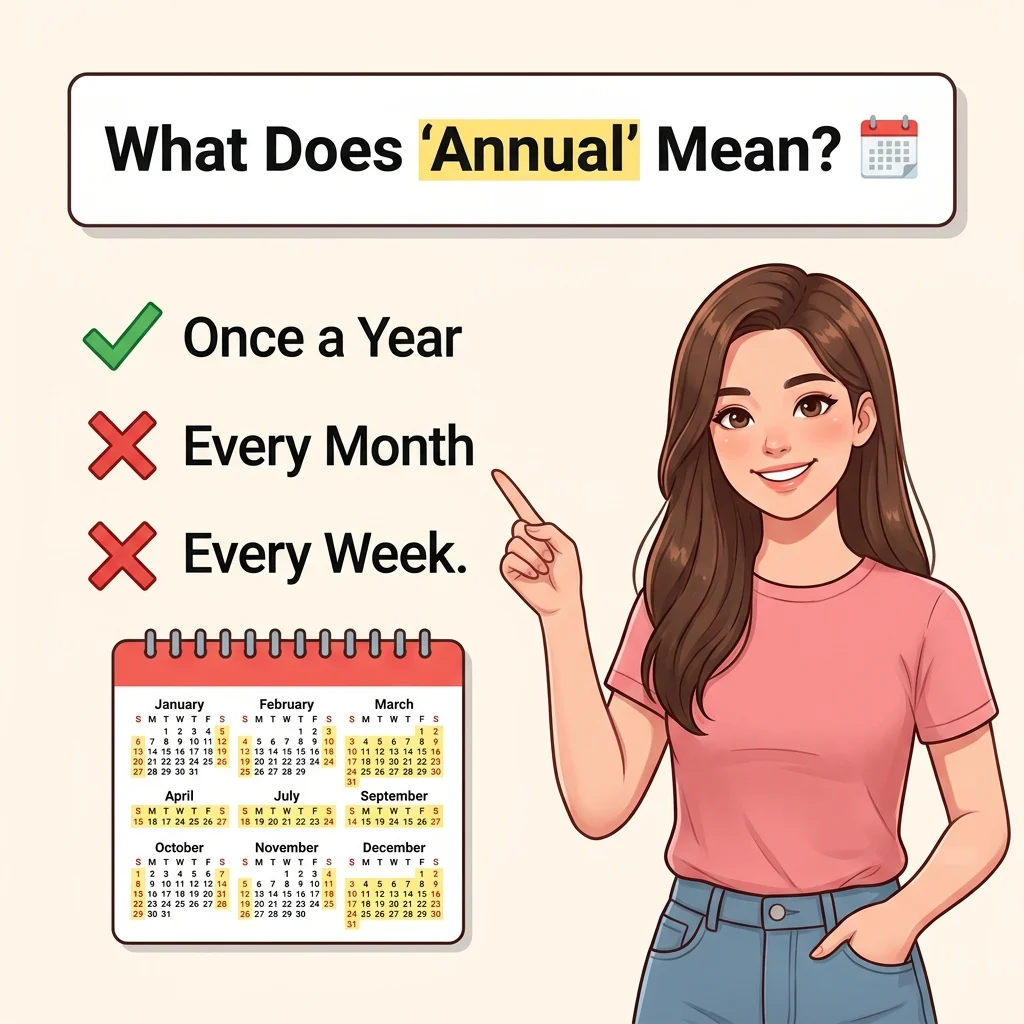
Annual means something that happens once every year or relates to a period of one year. It is an adjective, so it usually describes a noun.
For example:
- We attended the annual conference.
- The company publishes an annual report.
- She received her annual bonus.
- The school holds an annual sports event.
In each example, annual describes a noun. The conference happens once a year, the report is published once a year, the bonus is received once a year, and the sports event takes place once a year.
Annual as an Adjective
The most common use of annual is as an adjective.
An adjective gives information about a noun. Therefore, you normally place annual before the noun it describes.
Examples:
- annual salary
- annual income
- annual payment
- annual meeting
- annual report
- annual event
- annual subscription
- annual review
- annual vacation
- annual festival
Consider this sentence:
The company conducts an annual review of its employees.
Here, annual describes the review and tells us that the review happens once each year.
Is “Annual” Formal?
Yes, annual often sounds more formal than yearly.
You will commonly see annual in:
- Business writing
- Financial documents
- Official reports
- Contracts
- Government documents
- Academic writing
- Professional communication
For example, a business is more likely to write annual financial report than yearly financial report in a formal document.
However, this does not mean yearly is incorrect. It simply has a more general and conversational feel.
What Does “Yearly” Mean? 🗓️
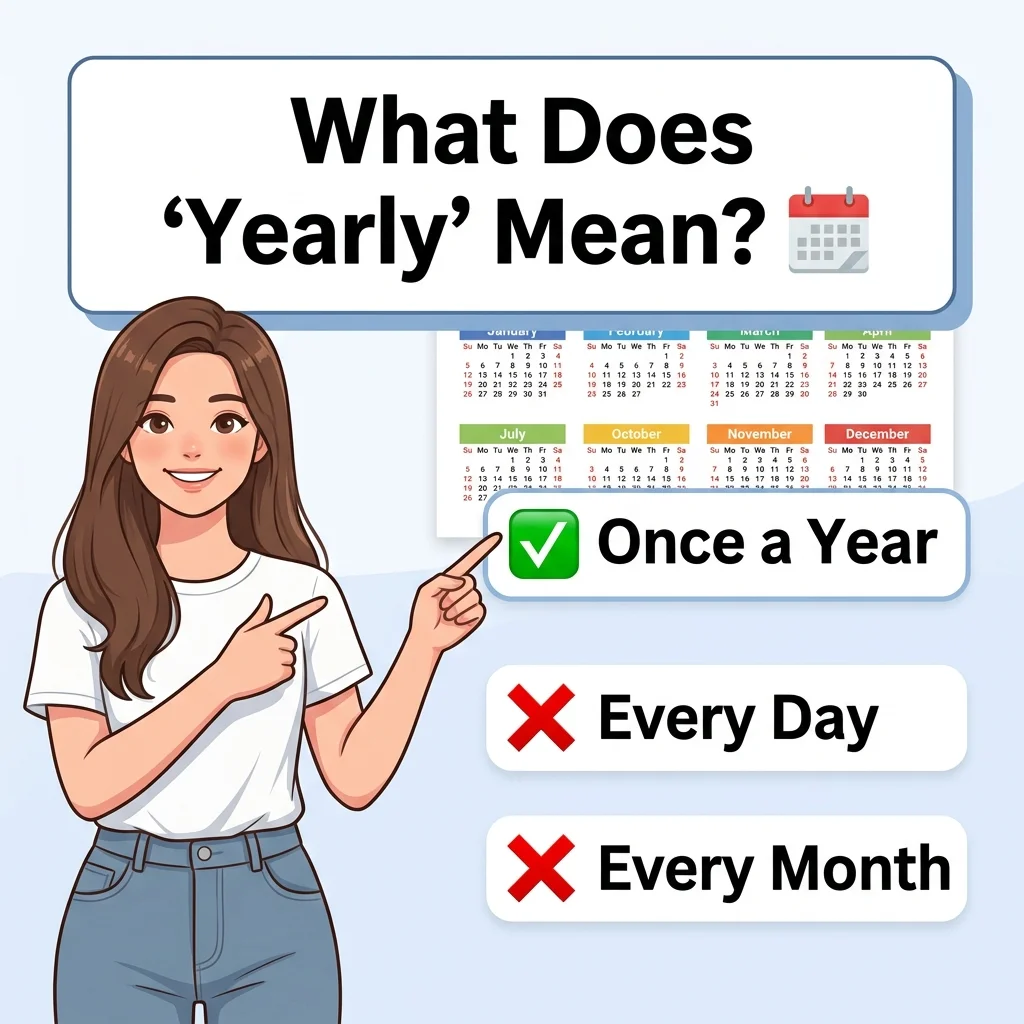
Yearly means happening once every year or relating to one year.
Unlike annual, yearly can be used as both an adjective and an adverb.
For example:
- We have a yearly meeting.
- We meet yearly.
In the first sentence, yearly is an adjective because it describes the noun “meeting.”
In the second sentence, yearly is an adverb because it tells us how often we meet.
Yearly as an Adjective
When yearly is an adjective, it can describe something that occurs once a year.
Examples:
- yearly payment
- yearly subscription
- yearly event
- yearly examination
- yearly budget
- yearly report
- yearly celebration
For example:
I make a yearly payment for my insurance.
The payment occurs once each year.
Yearly as an Adverb
Yearly can also describe how frequently something happens.
Examples:
- We visit our grandparents yearly.
- The company checks its equipment yearly.
- The festival takes place yearly.
- The organization publishes statistics yearly.
In these examples, yearly tells us that the action happens once every year.
Is “Yearly” Correct English?
Yes. Yearly is completely correct English.
Some learners think annual is always correct and yearly is somehow informal or incorrect. That is not true.
Both words are standard English. The main difference is that annual tends to sound more formal, while yearly often sounds more natural in everyday communication.
What Does “Every Year” Mean? 🔄
Every year means once each year or each year.
It is a phrase rather than a single word.
Examples:
- We visit the beach every year.
- She buys a new planner every year.
- The company organizes a party every year.
- They travel abroad every year.
The phrase every year is especially common when talking about repeated actions.
For example:
My family visits this restaurant every year.
This sentence sounds natural and conversational.
“Every Year” Is an Adverbial Phrase
In grammar, every year often works as an adverbial phrase because it tells us when or how frequently something happens.
Compare:
We celebrate the festival every year.
The phrase “every year” tells us how often the celebration happens.
You can move it to different positions in some sentences:
Every year, we celebrate the festival.
or:
We celebrate the festival every year.
Both are correct.
“Every Year” in Everyday English
Every year is extremely common in normal conversation.
If someone asks:
How often do you visit your hometown?
You could naturally answer:
I visit my hometown every year.
You could also say:
I visit my hometown yearly.
Both are grammatically correct, but the first one sounds more conversational to many speakers.
Annual vs Yearly vs Every Year: Quick Comparison
The three expressions are closely related, but their grammar and style are different.
| Expression | Main Meaning | Grammar | Common Use | Style |
| Annual | Happening once a year | Adjective | Annual report, annual meeting | Formal |
| Yearly | Happening once a year | Adjective or adverb | Yearly payment, visit yearly | Neutral |
| Every year | Once each year | Adverbial phrase | We travel every year | Conversational |
| Annual | Related to a year | Usually adjective | Annual salary | Professional |
| Yearly | Related to or occurring each year | Adjective/adverb | Yearly event | General |
| Every year | Repeated each year | Phrase | It happens every year | Natural/conversational |
The most important point is that annual usually describes a noun, while yearly can describe a noun or an action. Every year usually tells us how often an action happens.
Annual vs Yearly: What Is the Difference?
The difference between annual and yearly is usually about grammar and style rather than basic meaning.
Both can mean something happens once a year.
Compare:
We have an annual meeting.
We have a yearly meeting.
Both sentences are correct.
However, the first sentence sounds more formal and professional. The second sounds more general and conversational.
Another example:
The company publishes an annual report.
This is a very common business expression.
You could say:
The company publishes a yearly report.
This is grammatically correct, but annual report is more conventional in formal business English.
When Should You Use “Annual”?
Choose annual when you want a professional, formal, or official tone.
Common combinations include:
- annual report
- annual meeting
- annual income
- annual salary
- annual fee
- annual budget
- annual review
- annual conference
- annual subscription
- annual event
For example:
The company released its annual financial report.
The word annual fits naturally because the sentence has a professional context.
Yearly vs Every Year: What Is the Difference?
Yearly and every year can often communicate the same frequency.
Compare:
We go camping yearly.
We go camping every year.
Both mean that the activity happens once each year.
However, every year often sounds more natural in casual conversation.
For example:
I visit my cousins every year.
This is very natural.
You could say:
I visit my cousins yearly.
This is correct, but some speakers may prefer the first version in everyday conversation.
Yearly Can Be More Flexible
One advantage of yearly is that it can function as an adjective.
For example:
We have a yearly celebration.
You cannot replace yearly with every year directly in this structure.
Incorrect:
We have an every year celebration.
Correct:
We have a yearly celebration.
Or:
We have a celebration every year.
This is an important difference.
Annual vs Every Year: What Is the Difference?
Annual and every year often have the same basic meaning, but they perform different grammatical jobs.
Consider:
We have an annual conference.
Here, annual modifies “conference.”
You could also say:
We have a conference every year.
Here, every year describes the frequency of the action.
Notice the difference:
Annual + noun
annual conference
Noun + every year
conference every year
You should not normally say:
every year conference
Instead, use:
annual conference
or:
a conference every year
Is “Annual” the Same as “Every Year”?
In many situations, yes. Annual generally means something occurs once each year.
For example:
The school holds an annual sports day.
This means:
The school holds a sports day every year.
However, the words are not always interchangeable because their grammatical positions differ.
You can say:
an annual event
but not:
an every year event
You can say:
The event happens every year.
You could also say:
The event happens annually.
The grammar changes even though the basic meaning remains similar.
Is “Yearly” the Same as “Annual”?
In most ordinary contexts, yearly and annual have almost the same meaning.
For example:
annual payment
and:
yearly payment
can both refer to a payment made once a year.
However, annual is more common in certain fixed expressions.
For example:
- annual report
- annual leave
- annual meeting
- annual income
- annual percentage rate
- annual fee
These combinations are so common that replacing annual with yearly may sound less natural even though it is not necessarily grammatically wrong.
Can You Say “Annually” Instead?
Yes. Annually is the adverb form related to annual.
It means once every year.
Examples:
- The company publishes its report annually.
- The event is held annually.
- Employees receive the payment annually.
- The organization reviews its policy annually.
Compare:
The company holds an annual meeting.
and:
The company meets annually.
The first uses annual as an adjective. The second uses annually as an adverb.
Annual vs Annually
This is another common grammar distinction.
Annual = adjective
We attended the annual conference.
Annually = adverb
We attend the conference annually.
You should not normally use annual where an adverb is required.
Incorrect:
We meet annual.
Correct:
We meet annually.
Or:
We meet every year.
Examples of “Annual” in Sentences
Here are several examples showing how annual works naturally.
- The company holds an annual meeting in December.
- I receive an annual salary from my employer.
- The school organizes an annual sports competition.
- We paid the annual membership fee.
- The government released its annual report.
- The festival has become an annual tradition.
- She attends the annual conference.
- The business prepares an annual budget.
- My insurance requires an annual payment.
- The organization conducts an annual review.
In each example, annual describes a noun.
Examples of “Yearly” in Sentences
Here are examples of yearly as an adjective:
- We have a yearly family reunion.
- The company offers a yearly subscription.
- She makes a yearly donation.
- The school conducts a yearly examination.
- They organize a yearly celebration.
Now look at yearly as an adverb:
- We visit the museum yearly.
- The company reviews its policies yearly.
- The festival returns yearly.
- They update the information yearly.
- The organization publishes the results yearly.
This flexibility makes yearly useful in many different situations.
Examples of “Every Year” in Sentences
The phrase every year is especially useful when describing repeated actions.
Examples:
- We travel to the mountains every year.
- She visits her parents every year.
- The company increases its prices every year.
- They celebrate their anniversary every year.
- I buy a new calendar every year.
- The weather changes every year.
- The festival attracts thousands of visitors every year.
- We plant trees every year.
- He takes a vacation every year.
- The school hosts a cultural event every year.
These sentences sound natural and clear in everyday English.
Annual vs Yearly vs Every Year in Different Contexts
The best choice can depend on the situation.
Business Context
In professional writing, annual is often the strongest choice.
For example:
The company published its annual financial report.
Instead of:
The company published its yearly financial report.
Both are understandable, but annual financial report is more established.
Casual Conversation
In casual speech, every year often sounds natural.
For example:
We go there every year.
This is simple and easy to understand.
General Writing
Yearly can work well in general writing.
For example:
The website receives a yearly update.
Or:
The website is updated yearly.
Formal Reports
For formal reports, annual and annually are often preferred.
For example:
The department conducts an annual review.
Or:
The department reviews its performance annually.
Common Mistakes With Annual, Yearly, and Every Year
Even though these expressions seem simple, learners often make mistakes when combining them with other words.
Mistake 1: “Every Years”
One of the most common errors is adding s to “year” after every.
Incorrect:
I visit my family every years.
Correct:
I visit my family every year.
After every, use a singular noun.
More examples:
- every day
- every week
- every month
- every year
Not:
- every days
- every weeks
- every months
- every years
Mistake 2: “Annual Every Year”
Sometimes people use both expressions unnecessarily.
For example:
We have an annual meeting every year.
This sentence is not grammatically impossible, but it can sound repetitive because annual already communicates the idea of once a year.
A cleaner version is:
We have an annual meeting.
Or:
We have a meeting every year.
Mistake 3: “Yearly Every Year”
The same issue can happen with yearly.
For example:
We hold a yearly event every year.
The sentence repeats the same idea.
Better:
We hold a yearly event.
Or:
We hold an event every year.
Mistake 4: “Annual” as an Adverb
Do not use annual directly after a verb when you need an adverb.
Incorrect:
The company checks the system annual.
Correct:
The company checks the system annually.
You can also say:
The company checks the system every year.
Mistake 5: “Every Yearly”
Avoid combining every directly with yearly.
Incorrect:
We visit the city every yearly.
Correct:
We visit the city yearly.
Or:
We visit the city every year.
Mistake 6: “An Annual Every Year”
Avoid structures such as:
We have an annual every year.
Annual is normally an adjective, so it needs a noun after it.
Correct:
We have an annual meeting.
Or:
We have a meeting every year.
Spelling Tips for Annual, Yearly, and Every Year
These words are easy to spell, but there are still a few things to remember.
Annual
The correct spelling is:
annual
Not:
- anually
- anual
- annnual
A useful way to remember it is to think of ann + ual.
Yearly
The correct spelling is:
yearly
It comes from year + ly.
Do not write:
- yeerly
- yearlyy
- yearley
Every Year
Write these as two separate words:
every year
Not:
everyyear
Also remember that year remains singular after every.
Annual, Yearly, or Every Year: Which One Sounds Most Natural?
There is no single answer because the best option depends on the sentence.
Use annual when:
- You are describing a noun.
- You are writing formally.
- You are talking about business, finance, or official events.
- The phrase is a common formal expression.
Example:
The company released its annual report.
Use yearly when:
- You want to describe something that happens once a year.
- You want an adjective or adverb.
- You are using general English.
Example:
We have a yearly celebration.
Or:
We meet yearly.
Use every year when:
- You are describing how often an action happens.
- You want simple conversational English.
- You want to emphasize repetition.
Example:
We visit our hometown every year.
A Simple Trick to Remember the Difference
Here is an easy formula:
Annual + noun
annual meeting
Yearly + noun
yearly meeting
Verb + yearly
We meet yearly.
Verb + every year
We meet every year.
Think of annual as a word that often sits directly in front of a noun.
Think of every year as a phrase that usually tells you how often an action happens.
Annual vs Yearly vs Every Year: Side-by-Side Examples
| Meaning | Annual | Yearly | Every Year |
| A meeting once a year | annual meeting | yearly meeting | meeting every year |
| A payment once a year | annual payment | yearly payment | payment every year |
| A celebration once a year | annual celebration | yearly celebration | celebration every year |
| A report once a year | annual report | yearly report | report every year |
| Visiting once a year | — | visit yearly | visit every year |
| Reviewing something once a year | — | review yearly | review every year |
The table shows why grammar matters. Annual and yearly can modify nouns, while every year normally functions as a phrase that expresses frequency.
Which Is Better: “Annual Meeting” or “Yearly Meeting”?
Both are grammatically correct.
However, annual meeting is generally more common in professional and formal English.
For example:
The shareholders attended the annual meeting.
This sounds polished and natural.
Yearly meeting is understandable, but it has a more general tone.
In business writing, annual meeting is usually the better choice.
Which Is Better: “Annual Payment” or “Every Year Payment”?
The correct choice is:
annual payment
or:
payment every year
Do not normally say:
every year payment
That word order does not work naturally in standard English.
For example:
I make an annual payment.
Or:
I make a payment every year.
Both are correct.
Which Is Better: “Yearly” or “Every Year”?
If you are speaking casually, every year is often the easiest and most natural choice.
For example:
I visit my grandparents every year.
If you are writing a sentence where an adjective is needed, use yearly:
I make a yearly visit to my grandparents.
You could also write:
I make an annual visit to my grandparents.
The last version sounds somewhat more formal.
Can “Annual” Mean More Than Once a Year?
Generally, annual means once a year or relating to a year. It should not normally be used to describe something that happens several times within the same year.
For example, if a company has four meetings every year, calling each meeting an annual meeting could create confusion unless the context clearly explains what is meant.
If something happens four times a year, clearer expressions include:
- quarterly
- four times a year
- every three months
For example:
The company holds quarterly meetings.
This is different from:
The company holds an annual meeting.
The annual meeting happens once a year, while quarterly meetings happen four times a year.
Annual Does Not Always Mean Exactly the Same Date
Another useful point is that annual means once in each year or relating to a one-year period. It does not necessarily mean the event occurs on the exact same calendar date.
For example:
The company holds an annual conference.
The conference may happen every year, but the exact date can change.
One year it might happen in March. Another year it might happen in April.
The important idea is the yearly frequency.
“Every Year” vs “Each Year”
Every year and each year are very similar.
For example:
We visit the park every year.
and:
We visit the park each year.
Both are correct.
Every year is very common in everyday English. Each year can sometimes sound slightly more formal or emphasize the individual years.
You can generally use either one depending on your writing style.
“Yearly” vs “Annually”
These two are also closely related.
Yearly can function as both an adjective and an adverb.
We have a yearly meeting.
We meet yearly.
Annually is an adverb.
We meet annually.
So you should not confuse annual with annually.
A useful pattern is:
annual + noun
annual report
annually + verb
report annually
Why These Small Differences Matter
At first, annual, yearly, and every year may seem completely interchangeable. In many sentences, the meaning is indeed almost identical.
However, good English is not only about understanding the general meaning. It is also about choosing the expression that fits the grammar and context.
For example:
The company publishes an annual report.
This sounds natural.
The company publishes a report every year.
This also sounds natural.
But:
The company publishes an every year report.
This does not sound natural.
Similarly:
We meet every year.
is natural, while:
We meet annual.
is incorrect.
These examples show that the choice depends on the role the expression plays in the sentence.
Quick Grammar Rules to Remember
If you want a simple summary, remember these rules:
- Annual usually comes before a noun.
- Yearly can come before a noun or after a verb.
- Every year is a two-word phrase.
- Use every year, not “every years.”
- Use annually when you need an adverb related to “annual.”
- Annual often sounds more formal.
- Every year often sounds more conversational.
- Yearly is correct and flexible.
- Avoid unnecessary repetition such as “annual every year.”
- Choose the expression that fits the sentence structure.
Frequently Asked Questions
Is annual the same as every year?
In most contexts, annual means something that happens once a year, so it has a similar meaning to every year. However, they have different grammatical functions. “Annual” usually describes a noun, while “every year” describes frequency.
Is yearly grammatically correct?
Yes, yearly is completely correct. It can be used as both an adjective and an adverb. For example, “yearly payment” uses it as an adjective, while “We meet yearly” uses it as an adverb.
Which is more formal, annual or yearly?
Annual generally sounds more formal than yearly. It is especially common in business, financial, academic, and official writing. However, yearly is also standard English.
Should I say annual meeting or yearly meeting?
Both are correct, but annual meeting is usually more natural in formal and professional contexts. “Yearly meeting” is understandable and can work in general English.
Is it correct to say every years?
No. The correct expression is every year. After “every,” use a singular noun.
Correct:
We go there every year.
Incorrect:
We go there every years.
Can yearly be an adverb?
Yes. Yearly can function as an adverb.
For example:
The company reviews its policies yearly.
It can also function as an adjective:
The company conducts a yearly review.
Is annually the same as every year?
Yes, annually generally means once every year. For example, “The company publishes its report annually” means that it publishes the report every year.
Can I use annual and yearly interchangeably?
Often, yes. Both can describe something that happens once a year. However, annual is more common in formal expressions such as “annual report,” while yearly may sound more conversational.
Is “every year” one word?
No. The correct spelling is every year, with a space between the two words.
What is the difference between annual and annually?
Annual is an adjective, while annually is an adverb.
For example:
We attended the annual conference.
We attend the conference annually.
Which is better for everyday conversation: yearly or every year?
Both are correct, but every year often sounds more natural in casual conversation.
For example:
We visit our hometown every year.
This is a very natural everyday sentence.
Can I say “annual event every year”?
You can, but it may be repetitive because annual already means once a year. Usually, choose one:
We have an annual event.
Or:
We have an event every year.
Does annual always mean once every 12 months?
Usually, annual refers to something occurring once in each year or covering a one-year period. The exact dates do not necessarily need to be exactly 12 months apart.
Is “yearly” more casual than “annual”?
Generally, yes. Yearly often feels more conversational or neutral, while annual has a more formal or professional tone.
Which word should I use in an essay?
For formal writing, annual or annually will often fit better. However, yearly and every year are not incorrect. Always choose the word that best fits the grammar and meaning of your sentence.
Final Thoughts
The difference between annual, yearly, and every year is mainly about grammar, style, and sentence structure. All three expressions relate to something that occurs once during each year, but they are used in slightly different ways.
Use annual when you need an adjective, especially in formal or professional writing. You can talk about an annual report, annual meeting, annual payment, or annual event.

Emily Parker is a dedicated writer who enjoys creating clear, useful, and easy-to-understand content. She focuses on language, grammar, word meanings, and everyday expressions to help readers find simple and reliable answers.