Choosing between “agreed” and “agree” can be confusing because both words come from the same verb, but they do not always work in the same sentence.
The correct choice depends on whether you are talking about a present opinion, showing agreement, or describing something that happened in the past.
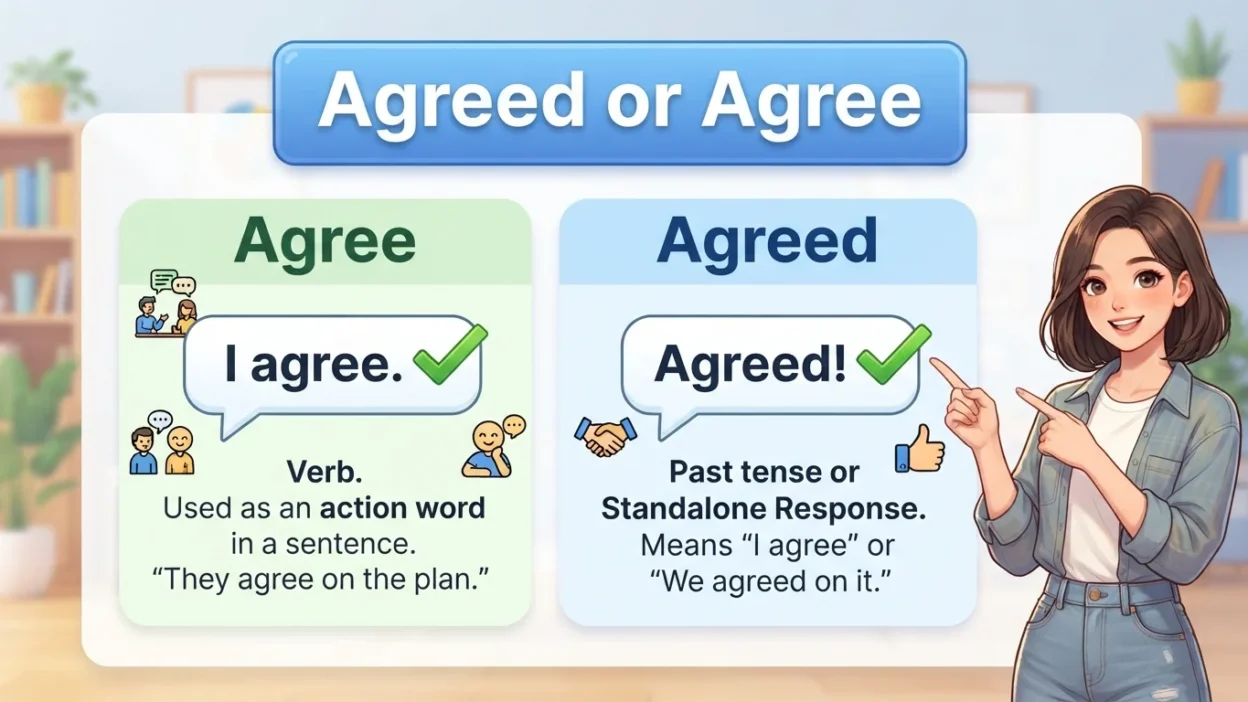
If you’re searching for Agreed or Agree, this guide will explain the difference in simple English with clear examples. Agree is commonly used when you express your current opinion or say that you share someone’s view.
Agree or Agreed: Quick Answer
The simplest answer is that agree is the base or present form of the verb, while agreed is the past tense and past participle form.
However, agreed can also be used independently as a response.
| Word | Main use | Example |
| Agree | Present/base verb | I agree with you. |
| Agreed | Past tense | I agreed with you yesterday. |
| Agreed | Short response | “This plan is better.” “Agreed.” |
| Agreeing | -ing form | I am agreeing with your point. |
| Agrees | Third-person singular | She agrees with me. |
The easiest rule to remember is:
Use “agree” for a current opinion or agreement. Use “agreed” for past agreement or as a short response meaning “I agree.”
For example:
- I agree with you. ✅
- I agreed with you yesterday. ✅
- “That was the right decision.” “Agreed.” ✅
- I agreed with you now. ❌ Usually unnatural; use “I agree with you now.”
What Does “Agree” Mean?
Agree is a verb. It generally means to have the same opinion as someone else, accept an idea, or say that something is acceptable.
For example:
I agree with your opinion.
This means your opinion is the same as the other person’s.
You can also use agree when accepting a suggestion or arrangement:
I agree to the terms.
Here, agree means that you accept or approve something.
The word can therefore have several related meanings.
Agree Means to Have the Same Opinion
This is the most common use.
I agree with you.
The speaker is saying that they share the other person’s opinion.
More examples:
- I agree with your point.
- We agree about the problem.
- She agrees with her teacher.
- They agree that the plan will work.
- I completely agree with you.
Agree Means to Accept Something
You can also use agree when you accept a proposal, condition, or arrangement.
For example:
I agree to your proposal.
This means you accept the proposal.
Another example:
They agreed to the new rules.
Here, the people accepted the rules.
Agree Means to Reach the Same Decision
The verb can also describe people reaching a common decision.
For example:
After a long discussion, we agreed on a price.
This means both sides reached the same decision about the price.
What Does “Agreed” Mean?
Agreed is the past tense and past participle form of agree.
When you use it as a normal verb, it usually refers to something that happened in the past.
For example:
I agreed with him yesterday.
The agreement happened in the past.
Another example:
She agreed to help me last week.
Her decision to help happened in the past.
However, agreed can also function as a short standalone response.
For example:
“We should finish this today.”
“Agreed.”
Here, agreed does not necessarily refer to a specific past event. Instead, it means:
“I agree.”
This special conversational use is one of the main reasons learners sometimes find agree vs agreed confusing.
Agree vs Agreed: The Main Difference
The most important difference is the time or function of the word.
Agree generally expresses a present opinion, current agreement, or a general fact.
Agreed can describe a past agreement or work as a concise response to another person’s statement.
Compare:
I agree with you.
This means you share the person’s opinion now.
I agreed with you yesterday.
This means you shared the person’s opinion at an earlier time.
Now consider:
“We should order pizza.”
“Agreed.”
Here, agreed means “I agree with that suggestion.”
| Sentence | Meaning |
| I agree with you. | I share your opinion now. |
| I agreed with you. | I shared your opinion in the past. |
| We agree on the issue. | We have the same opinion now. |
| We agreed on the issue. | We reached the same opinion or decision in the past. |
| Agreed! | I agree with what you just said. |
Understanding this distinction makes the choice much easier.
When to Use “Agree”
Use agree when you are talking about a current opinion, belief, or agreement.
For example:
I agree with your idea.
You currently support the idea.
You can also use agree when describing a general situation:
Most people agree that exercise is important.
This does not describe one particular moment in the past. It expresses a general belief.
Examples of “Agree”
- I agree with you.
- I agree with your opinion.
- We agree on this issue.
- They agree that the plan is useful.
- I agree with what you said.
- She agrees with her parents.
- Do you agree with me?
- I completely agree.
- I agree that we need more time.
- We agree about the main problem.
All of these sentences describe agreement in a present or general sense.
When to Use “Agreed”
Use agreed when you are describing an agreement that happened in the past.
For example:
We agreed to meet at 7 p.m.
The agreement was made before the current moment.
Another example:
I agreed with his suggestion during the meeting.
The agreement happened during a past meeting.
Examples of Past “Agreed”
- I agreed with her yesterday.
- We agreed to meet later.
- They agreed on a price.
- She agreed to help me.
- He agreed with my suggestion.
- We agreed that the project needed more time.
- The two companies agreed on the contract.
- I agreed with his decision at the time.
- They agreed to change the schedule.
- She agreed that I was right.
In each example, agreed describes something that happened previously.
“Agreed” as a Short Response
One of the most useful conversational meanings of agreed is a short response.
Imagine someone says:
“We should save more money.”
You can respond:
“Agreed.”
This means:
“I agree.”
It is short, clear, and natural.
You might also hear:
“That was a great decision.”
“Agreed.”
Again, agreed means that you share the speaker’s opinion.
Examples of “Agreed” as a Response
A: We should leave early.
B: Agreed.
A: This is the best option.
B: Agreed.
A: We need to improve our communication.
B: Agreed.
A: That movie was much better than I expected.
B: Agreed.
This use is especially common in workplace discussions, online conversations, debates, and casual speech.
Is “Agreed” the Same as “I Agree”?
In many conversations, yes.
When someone says:
“We should start tomorrow.”
You can respond:
“I agree.”
Or:
“Agreed.”
Both communicate agreement.
However, the tone can be slightly different.
I agree sounds direct and conversational.
Agreed can sound more concise, firm, professional, or emphatic.
Compare:
I agree with your suggestion.
This sounds natural and conversational.
Agreed.
This is shorter and gives a strong sense that you accept the suggestion.
Agree vs Agreed in Text Messages
Both forms are common in texting, but they can have different effects.
For example:
Friend: We need to stop wasting money.
You: I agree.
This sounds friendly and conversational.
You could also say:
Agreed.
This sounds shorter and more decisive.
You might even use:
Agreed!
The exclamation mark can make the response feel more enthusiastic.
For casual messages, you can choose the form based on the meaning and tone you want.
Agree vs Agreed in Professional Communication
In professional communication, both words are useful.
For example:
I agree with your recommendation.
This is a complete and polite sentence.
You can also write:
Agreed. We should move forward with the proposal.
Here, agreed works as a concise response before adding more information.
In formal emails, however, a complete sentence can sometimes sound clearer:
I agree with your recommendation, and I believe we should move forward.
This provides more context than simply saying “Agreed.”
Agree With vs Agree To
A common grammar issue involves the prepositions that follow agree.
You will often see agree with, agree to, and agree on. They are related, but they are not always interchangeable.
Agree With
Use agree with when you share someone’s opinion or believe their statement is correct.
For example:
I agree with you.
I agree with your opinion.
She agrees with her teacher.
You can think of agree with as meaning “have the same opinion as.”
Agree To
Use agree to when you accept a proposal, request, condition, plan, or arrangement.
For example:
I agreed to the plan.
She agreed to help us.
They agreed to the terms.
Here, the focus is on acceptance.
Agree On
Use agree on when two or more people reach the same decision about a particular subject.
For example:
We agreed on a price.
They agreed on the final date.
The two teams agreed on the rules.
Quick Comparison
| Expression | Main meaning | Example |
| Agree with | Share an opinion | I agree with you. |
| Agree to | Accept something | I agree to the plan. |
| Agree on | Reach a decision | We agree on the price. |
This distinction is useful because choosing the wrong preposition can make your sentence sound unnatural.
Agreed With vs Agreed To vs Agreed On
The same preposition rules apply when you use agreed.
Agreed With
I agreed with him.
This means you shared his opinion.
Agreed To
I agreed to his proposal.
This means you accepted the proposal.
Agreed On
We agreed on the final price.
This means both sides reached the same decision about the price.
Compare these three:
- I agreed with Sarah.
- I agreed to Sarah’s proposal.
- Sarah and I agreed on the price.
The words after the preposition determine which structure makes sense.
Agree vs Agreed in Questions
You can use both forms in questions depending on the time.
Present Question
Do you agree with me?
This asks about the person’s opinion now.
Other examples:
- Do you agree with this idea?
- Do you agree that this is important?
- Do they agree with us?
- Does she agree with your opinion?
- Do you agree on the final plan?
Past Question
Did you agree with him?
This asks about a past situation.
Other examples:
- Did you agree with her?
- Did they agree to the proposal?
- Did you agree on a price?
- Did he agree to help you?
- Did everyone agree with the decision?
Notice an important grammar rule:
After did, use the base form agree, not agreed.
Correct:
Did you agree with him? ✅
Incorrect:
Did you agreed with him? ❌
This is one of the most common mistakes with agree vs agreed.
Why “Did You Agreed” Is Wrong
English uses the auxiliary verb did to form many past-tense questions.
Once did appears, the main verb returns to its base form.
Therefore:
Did + agree ✅
Not:
Did + agreed ❌
For example:
Did you agree with her?
Not:
Did you agreed with her?
The same rule applies to negative sentences:
I did not agree. ✅
Not:
I did not agreed. ❌
You can remember this pattern:
Did + base verb
Examples:
- Did you agree?
- Did he go?
- Did she call?
- Did they finish?
- Did we decide?
Agree vs Agreed in Negative Sentences
You can also use both forms in negative sentences.
Present
I don’t agree with you.
This means you currently have a different opinion.
Past
I didn’t agree with you.
This means you had a different opinion at that past time.
Compare:
I don’t agree with his decision.
This is about your current opinion.
I didn’t agree with his decision yesterday.
This refers to your opinion in the past.
Remember:
don’t + agree
didn’t + agree
Not:
didn’t + agreed
Agree vs Agreed With “Would”
Sometimes people use agreed with would to describe something that was expected or decided in the past.
For example:
We agreed that we would meet on Friday.
This means the decision was made in the past.
Another example:
They agreed that they would work together.
Here, agreed introduces a past decision, while would refers to the future from that past point of view.
This structure is common in storytelling and formal writing.
Agree vs Agreed in Reported Speech
The word agreed is also useful when reporting what someone accepted or decided.
For example:
She agreed that the plan was too expensive.
This reports a past agreement.
You could also say:
He agreed to help us.
This reports his past decision.
Another example:
They agreed that we should wait.
The agreement occurred before the current moment.
Common Mistakes With “Agree” and “Agreed”
Understanding the basic meaning is easy, but learners often make mistakes when building sentences.
Mistake 1: Using “Agreed” for a Current Opinion
Incorrect:
I agreed with you.
If you are talking about your opinion right now, this can sound as though the agreement happened in the past.
Better:
I agree with you.
However, I agreed with you can be correct if you are referring to an earlier situation.
Mistake 2: Using “Agree” for a Clearly Past Agreement
Incorrect in a past-time context:
Yesterday, I agree with him. ❌
Correct:
Yesterday, I agreed with him. ✅
The word yesterday clearly places the action in the past.
Mistake 3: Saying “Did You Agreed?”
Incorrect:
Did you agreed with her? ❌
Correct:
Did you agree with her? ✅
After did, always use the base form of the verb.
Mistake 4: Saying “I Didn’t Agreed”
Incorrect:
I didn’t agreed with him. ❌
Correct:
I didn’t agree with him. ✅
Again, didn’t already carries the past tense.
Mistake 5: Using the Wrong Preposition
Incorrect:
I agree to you. ❌
Correct:
I agree with you. ✅
But:
I agree to your proposal. ✅
The correct preposition depends on the meaning.
Mistake 6: Using “Agree” When You Mean “Accept”
Consider:
I agree with the contract.
This may not express the intended meaning.
If you mean that you accept the contract’s terms, agree to is often better:
I agree to the contract terms.
Spelling Tips for “Agree” and “Agreed”
Both words are easy to spell once you remember their structure.
Agree contains two e’s at the end:
agree
When you add -d, it becomes:
agreed
Notice that you do not need to change the spelling of the base word.
agree + d = agreed
Examples:
- agree → agreed
- disagree → disagreed
The spelling is different from verbs that require a spelling change before adding a suffix.
Agree, Agrees, Agreed, and Agreeing
The verb agree has several forms.
| Verb form | Example |
| Agree | I agree. |
| Agrees | She agrees. |
| Agreed | They agreed. |
| Agreeing | We are agreeing. |
Agree
Used with I, you, we, they in the simple present.
I agree with you.
Agrees
Used with he, she, it in the simple present.
She agrees with me.
Agreed
Used as the simple past form.
She agreed with me yesterday.
Agreeing
Used as the present participle or gerund.
They are agreeing on the details.
In normal everyday English, agree and agreed are the forms learners encounter most often.
25 Examples of “Agree”
Here are practical examples using the present form.
- I agree with you.
- I agree with your opinion.
- We agree about the problem.
- They agree with our decision.
- Do you agree with me?
- I completely agree.
- She agrees with her brother.
- He agrees that the plan is useful.
- We agree on the main point.
- I agree that something needs to change.
- Do they agree with this idea?
- I agree with what you said.
- Most experts agree on this point.
- We agree that the project needs more time.
- She doesn’t agree with my opinion.
- I agree to your suggestion.
- They agree to the new conditions.
- Do you agree to these terms?
- We agree on the final price.
- The teams agree on the rules.
- I agree that this is important.
- Everyone seems to agree with her.
- I agree with your recommendation.
- We agree that the issue needs attention.
- Do you agree that this is the best option?
25 Examples of “Agreed”
Now look at examples using agreed.
- I agreed with him yesterday.
- She agreed to help me.
- We agreed on a price.
- They agreed to the proposal.
- He agreed with my opinion.
- We agreed that the plan needed changes.
- She agreed to meet us later.
- They agreed on the final date.
- I agreed with her during the meeting.
- He agreed to the new rules.
- We agreed that something had to change.
- She agreed with my suggestion.
- They agreed to work together.
- I agreed with the decision at the time.
- He agreed on the terms with the company.
- We agreed to postpone the meeting.
- She agreed that I was right.
- They agreed to the conditions.
- I agreed with your point earlier.
- We agreed on the best solution.
- He agreed to help with the project.
- She agreed that the plan was reasonable.
- The two sides agreed on a contract.
- I agreed to his request.
- Everyone agreed that the meeting was useful.
20 Examples of “Agreed” as a Response
Agreed is particularly useful as a short reply.
- “We should leave now.” — “Agreed.”
- “This is the best solution.” — “Agreed.”
- “We need more time.” — “Agreed.”
- “That was a smart decision.” — “Agreed.”
- “We should discuss this later.” — “Agreed.”
- “The plan needs improvement.” — “Agreed.”
- “We should save money.” — “Agreed.”
- “This is a serious problem.” — “Agreed.”
- “We need to be more careful.” — “Agreed.”
- “That movie was excellent.” — “Agreed.”
- “We should start early.” — “Agreed.”
- “The price is too high.” — “Agreed.”
- “We need another meeting.” — “Agreed.”
- “That was the right choice.” — “Agreed.”
- “We should try again.” — “Agreed.”
- “The deadline is too close.” — “Agreed.”
- “This option is better.” — “Agreed.”
- “We need a backup plan.” — “Agreed.”
- “The instructions are confusing.” — “Agreed.”
- “We should finish this today.” — “Agreed.”
Agree vs Agreed: A Simple Tense Comparison
The easiest way to understand the difference is to compare present and past situations.
| Present | Past |
| I agree with him. | I agreed with him. |
| We agree on the price. | We agreed on the price. |
| She agrees with me. | She agreed with me. |
| They agree to the plan. | They agreed to the plan. |
| Do you agree? | Did you agree? |
The first column generally describes a current situation.
The second column generally describes something that happened before now.
Can “Agreed” Be Used for the Present?
Yes, but there is an important distinction.
When agreed appears alone as a response, it can express agreement with something said immediately before.
For example:
Person A: We should focus on quality.
Person B: Agreed.
Here, agreed does not mean that the person agreed yesterday. It is a short conversational response.
However, if you are forming a complete sentence about your current opinion, agree is usually the natural choice:
I agree with you.
Not:
I agreed with you.
Unless you specifically mean a past agreement.
Is “Agreed” More Formal Than “Agree”?
Not necessarily, but agreed can sound more concise or businesslike when it is used as a standalone response.
For example:
I agree with your suggestion.
This is conversational and clear.
Agreed.
This is short and decisive.
You may see agreed frequently in workplace conversations, meetings, online discussions, negotiations, and written exchanges.
However, context matters. In some situations, “Agreed” may sound slightly abrupt. If you want to sound warmer or more detailed, use:
I completely agree with you.
or:
I agree. I think that’s the best option.
Can You Say “I Agreed” in a Conversation?
Yes, but it usually refers to a past situation.
For example:
I agreed with you when we discussed it yesterday.
This is correct.
You can also use it when telling a story:
At first, I wasn’t sure, but eventually I agreed with her.
Here, the agreement happened during a past event.
If you mean that you agree right now, use:
I agree.
Agree vs Agreed: Quick Memory Trick
Use this simple three-question test.
Are You Talking About Your Opinion Now?
Use agree.
I agree with you.
Are You Talking About an Agreement in the Past?
Use agreed.
I agreed with you yesterday.
Are You Giving a Short Response to Someone?
You can use agreed.
“We should leave.”
“Agreed.”
This simple test will help you choose the right form in most everyday situations.
How to Choose Between “I Agree” and “I Agreed”
Ask yourself when the agreement happened.
If it is happening now:
I agree.
If it happened before:
I agreed.
Compare:
I agree with your decision.
This means you support the decision now.
I agreed with your decision yesterday.
This tells the reader that your agreement happened yesterday.
The time expression can make the difference especially clear.
Current Time Expressions
These often work naturally with agree:
- now
- today
- currently
- generally
- usually
- always
Example:
I agree with you now.
Past Time Expressions
These commonly work with agreed:
- yesterday
- last week
- earlier
- before
- during the meeting
- at that time
- last year
Example:
I agreed with you yesterday.
FAQ: People Also Ask About Agree or Agreed
Is it correct to say “I agree”?
Yes. I agree is one of the most common ways to express that you share someone’s opinion.
For example:
I agree with your point.
Is it correct to say “I agreed”?
Yes. I agreed is correct when you are referring to a past agreement or past opinion.
For example:
I agreed with him yesterday.
Should I say “I agree” or “I agreed”?
Use I agree for your current opinion. Use I agreed when referring to an agreement that happened in the past.
Is “agreed” a past tense of “agree”?
Yes. Agreed is the simple past and past participle form of agree.
For example:
I agree now.
I agreed yesterday.
Can “agreed” mean “I agree”?
Yes. When used as a standalone response, agreed can mean “I agree” or “I accept that point.”
For example:
“We should leave early.”
“Agreed.”
Is “I agreed with you” correct?
Yes. It is correct when the agreement happened in the past.
For example:
I agreed with you during yesterday’s meeting.
Is “I agree with you” correct?
Yes. This is the normal way to say that you currently share someone’s opinion.
Is “Did you agreed?” correct?
No. The correct form is:
Did you agree?
After did, use the base form of the verb.
Is “I didn’t agreed” correct?
No. Say:
I didn’t agree.
The auxiliary didn’t already carries the past tense.
Do you agree with me or agree to me?
Usually:
I agree with you.
Use agree with when you share someone’s opinion.
Do you agree to or agree with a proposal?
You generally use agree to when you accept a proposal or terms.
For example:
I agree to the proposal.
What is the difference between “agree on” and “agree with”?
Agree with usually means sharing someone’s opinion.
Agree on usually means reaching the same decision about a particular subject.
For example:
I agree with Sarah.
Sarah and I agree on the price.
Can I say “Agreed!”?
Yes. Agreed! is a natural short response. The exclamation mark can make it sound enthusiastic or emphatic.
Is “agreed” formal English?
Yes. Agreed is standard English. As a short response, it can sound concise and sometimes slightly formal or businesslike.
What is the opposite of agree?
The opposite is disagree.
For example:
I agree with you.
I disagree with you.
What is the noun form of agree?
The main noun is agreement.
For example:
We reached an agreement.
What is the adjective form related to agree?
Depending on the meaning, you may see agreeable, although it does not simply mean “having the same opinion.”
For example:
She has an agreeable personality.
Conclusion
Once you understand these three patterns, choosing between agree and agreed becomes much easier.
Whether you are writing an email, having a conversation, completing an English assignment, or creating online content, using the correct form will make your English clearer and more natural.

Emily Parker is a dedicated writer who enjoys creating clear, useful, and easy-to-understand content. She focuses on language, grammar, word meanings, and everyday expressions to help readers find simple and reliable answers.