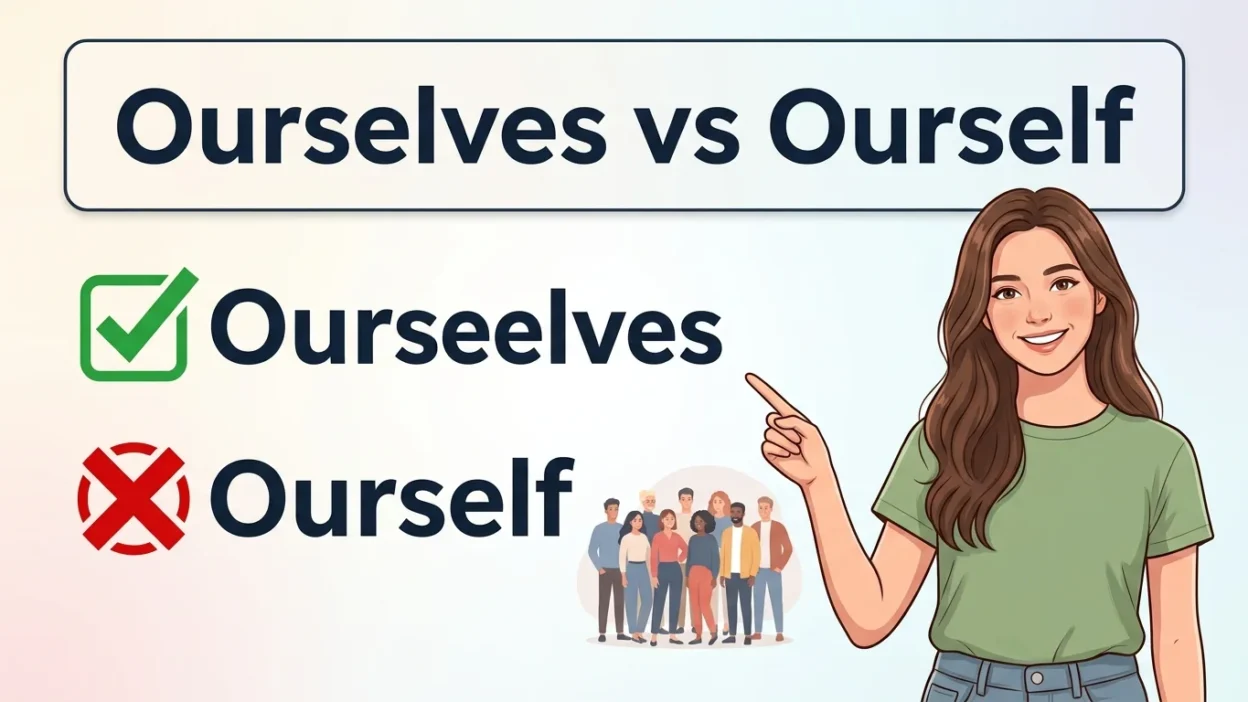
Reflexive pronouns can be confusing when two words look almost identical but work differently in sentences. Ourselves vs. Ourself is one such pair. Although “ourselves” is common in everyday English, “ourself” has a more limited use and may sound unusual in many modern sentences.
Ourselves is the standard reflexive and emphatic pronoun used with “we” and “us.” For example, “We prepared ourselves for the trip.” Ourself can appear in specific formal or historical contexts, particularly when “we” is used as a singular pronoun by a person speaking in an official capacity. It is not normally interchangeable with “ourselves.”
In this guide, you’ll learn the difference between ourselves and ourself, including their meanings, grammar rules, correct sentence structures, and practical examples. You’ll also discover common mistakes so you can use each form confidently and naturally.
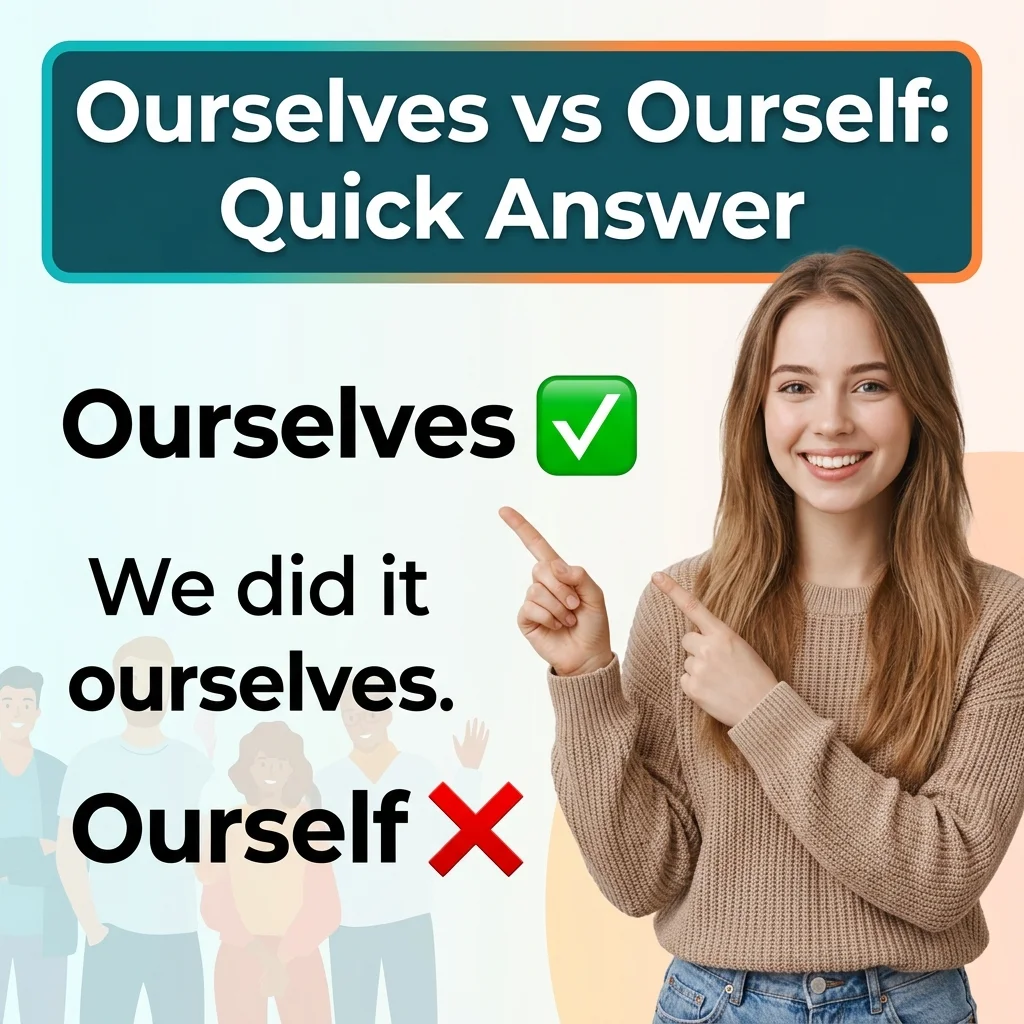
Ourselves vs Ourself: Quick Answer
The simplest rule is:
“Ourselves” is the standard reflexive pronoun used with “we” or “us.”
Examples:
- We introduced ourselves to the new teacher.
- We should take care of ourselves.
- We made the project ourselves.
“Ourself” is uncommon in standard modern English. It may appear when a singular person uses “we” to refer to themselves, such as a monarch or an author speaking on behalf of an institution.
For normal everyday writing and conversation, use “ourselves,” not “ourself.”
| Word | Standard use | Example |
| Ourselves | Normal reflexive form of “we” | We enjoyed ourselves. |
| Ourself | Rare/special use | We, the monarch, have decided for ourself. |
What Does “Ourselves” Mean?
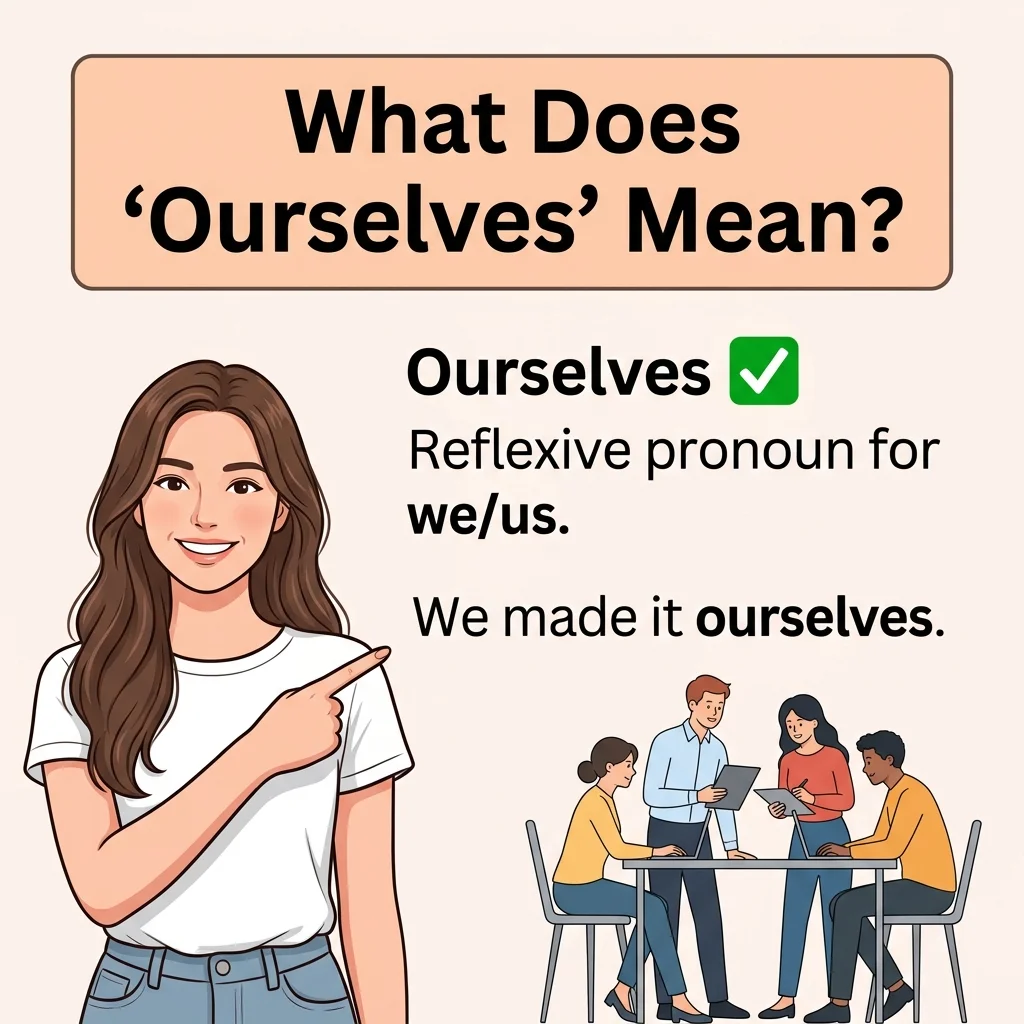
Ourselves is a reflexive pronoun. It refers back to we or us when the people doing the action and receiving the action are the same people.
For example:
We taught ourselves English.
Here, “we” is the subject, while “ourselves” refers back to the same people.
Another example is:
We looked at ourselves in the mirror.
The people who looked are the same people who are being looked at. Therefore, “ourselves” is the appropriate reflexive pronoun.
Ourselves as a Reflexive Pronoun
A reflexive pronoun is used when the subject and object of a sentence refer to the same person or people.
Consider these examples:
- I hurt myself.
- You hurt yourself.
- He hurt himself.
- She hurt herself.
- We hurt ourselves.
- They hurt themselves.
Notice that ourselves matches the plural pronoun we.
Ourselves as an Emphatic Pronoun
“Ourselves” can also add emphasis to a sentence.
For example:
We ourselves completed the entire project.
The word “ourselves” emphasizes that we personally completed the project rather than asking someone else to do it.
Other examples include:
- We ourselves made the decision.
- We ourselves witnessed the event.
- We ourselves organized the meeting.
- We ourselves checked every detail.
In these examples, removing “ourselves” does not usually make the sentence grammatically incorrect. It simply removes the emphasis.
What Does “Ourself” Mean?
Ourself is a rare reflexive form associated with certain special uses of “we.”
In normal modern English, “we” is plural, so its standard reflexive form is “ourselves.”
However, “we” can sometimes be used by a single person. This is known as the royal we, editorial we, or another formal use of the first-person plural.
When one person uses “we” in such a context, “ourself” may sometimes be used as the corresponding reflexive form.
For example:
We have decided to represent ourself in this matter.
This construction is uncommon and may sound formal, old-fashioned, or unusual to many readers.
Why Is “Ourself” So Rare?
The main reason is simple: most speakers use “we” to mean more than one person.
If several people are speaking, the correct reflexive form is:
We prepared ourselves.
Not:
We prepared ourself.
Because “ourself” is uncommon, using it in ordinary conversation can make a sentence sound unnatural.
Ourselves vs Ourself: Main Difference
The biggest difference between ourselves and ourself is the number and context of the pronoun “we.”
Ourselves normally refers to two or more people who use we.
Ourself can refer to one person when that person uses we in a special or formal sense.
Here is the basic comparison:
| Feature | Ourselves | Ourself |
| Common in modern English | Yes | No |
| Used with ordinary “we” | Yes | Usually no |
| Refers to multiple people | Yes | Usually no |
| Reflexive pronoun | Yes | Rarely |
| Used for emphasis | Yes | Rarely |
| Common in conversation | Yes | No |
| Suitable for everyday writing | Yes | Usually no |
When Should You Use “Ourselves”?
You should use ourselves when we refers to multiple people and the action comes back to those same people.
For example:
We introduced ourselves.
The subject is we, and the object is ourselves.
Here are several common situations where ourselves is correct.
When We Perform an Action on Ourselves
Use ourselves when a group does something to itself.
Examples:
- We washed ourselves after the game.
- We prepared ourselves for the interview.
- We blamed ourselves for the mistake.
- We reminded ourselves to stay calm.
- We dressed ourselves for the event.
When We Want to Emphasize Personal Action
“Ourselves” can emphasize that we personally did something.
Examples:
- We built the table ourselves.
- We completed the assignment ourselves.
- We solved the problem ourselves.
- We cooked the entire meal ourselves.
In these sentences, ourselves has an emphatic function.
After “By”
“Ourselves” can appear after by when you want to say that you did something without help.
Examples:
- We traveled by ourselves.
- We completed the work by ourselves.
- We learned the software by ourselves.
- We stayed there by ourselves.
However, depending on the context, “on our own” may sound more natural.
For example:
We completed the project on our own.
When Should You Use “Ourself”?
You should use ourself only in unusual situations where we refers to one person.
This construction is uncommon in everyday English.
For example, a monarch may use we instead of I in a formal declaration. In that context, a writer may use ourself as the reflexive form.
However, this is not the normal pattern learners should use in everyday English.
Instead, most people should write:
We should take care of ourselves.
rather than:
We should take care of ourself.
Ourself in Formal or Historical Language
You may occasionally see ourself in historical documents, legal language, royal statements, or very formal writing.
Its appearance does not mean that ourself is interchangeable with ourselves.
For modern everyday English, ourselves remains the normal choice when we represents multiple people.
Ourselves vs Ourself Examples
Examples make this difference much easier to understand.
Examples With Ourselves
We enjoyed ourselves at the party.
We introduced ourselves to the guests.
All of these sentences use ourselves correctly because we refers to multiple people.
Examples With Ourself
The following type of construction is possible in rare formal contexts:
We have decided to represent ourself.
We must ask ourself whether this decision is appropriate.
These examples are unusual because we is being used in a special singular sense. They should not be copied into ordinary everyday writing unless the context specifically requires this style.
Ourselves vs Ourself in a Sentence
A useful way to choose between the two words is to look at what we means.
If we means several people, use:
ourselves
Example:
We enjoyed ourselves.
If we represents one person in a special formal context, ourself may be possible.
Example:
We must remind ourself of our duty.
But this second pattern is rare.
A Simple Question to Ask
When you are unsure, ask:
“Does ‘we’ mean multiple people?”
If the answer is yes, use ourselves.
For example:
We need to protect ourselves.
Here, “we” means several people, so ourselves is correct.
Is “Ourself” Grammatically Correct?
Yes, ourself can be grammatically correct in certain specialized contexts, but it is not the normal reflexive pronoun for ordinary plural “we.”
This distinction is important.
It would be misleading to say that ourself is always grammatically wrong. English has historical, formal, and specialized uses that do not always follow everyday patterns.
However, if you are writing a normal sentence involving a group, ourselves is the correct choice.
Incorrect for Ordinary Plural We
We enjoyed ourself at the party.
This is not standard modern usage.
Correct:
We enjoyed ourselves at the party.
Special Singular We
In an unusual formal context:
We have decided to defend ourself.
Here, “we” may represent one individual using a special form of first-person plural language.
This is not something you normally need in casual English.
Is “Ourselves” Always Correct?
No. Ourselves is not automatically correct just because a sentence contains “our” or “we.”
It should refer back to we or us.
Correct:
We prepared ourselves for the journey.
Incorrect:
The teacher gave the books to ourselves.
The second sentence is usually incorrect because the indirect object should normally be us, not ourselves.
Correct:
The teacher gave the books to us.
This is an important distinction. Reflexive pronouns should not replace ordinary object pronouns without a grammatical reason.
Ourselves vs Us
People sometimes confuse ourselves with us.
The two words have different functions.
Us is an ordinary object pronoun.
Ourselves is a reflexive or emphatic pronoun.
Compare:
She invited us.
We invited ourselves.
In the first sentence, us receives the action but does not refer back to the subject.
In the second sentence, ourselves refers back to we.
More Examples
They helped us.
We helped ourselves.
The manager spoke to us.
We spoke to ourselves.
He gave us some advice.
We gave ourselves some time.
This difference becomes much easier when you identify the subject first.
Ourselves vs Our Own
Another common confusion is between ourselves and our own.
They are not interchangeable.
Ourselves refers back to we.
Our own shows possession or emphasizes that something belongs to us.
Examples:
We built the house ourselves.
We built our own house.
The first sentence emphasizes who built the house.
The second emphasizes ownership or independence.
You can also use both:
We built our own house ourselves.
This is grammatically possible, although the sentence may sound more natural if you simply say:
We built our house ourselves.
Common Mistakes With Ourselves and Ourself
Learning the correct form is easier when you know the mistakes to avoid.
Mistake 1: Using “Ourself” With Normal Plural “We”
Incorrect:
We enjoyed ourself during the trip.
Correct:
We enjoyed ourselves during the trip.
When “we” means several people, use ourselves.
Mistake 2: Assuming “Ourself” Is the Singular Form of “Ourselves”
It may seem logical that ourself is simply the singular version of ourselves, but English does not work that way in ordinary usage.
The normal singular first-person reflexive pronoun is:
myself
For example:
I prepared myself.
The normal plural first-person reflexive pronoun is:
ourselves
For example:
We prepared ourselves.
Mistake 3: Using “Ourselves” Instead of “Us”
Incorrect:
She called ourselves yesterday.
Correct:
She called us yesterday.
“Ourselves” normally needs to refer back to we or serve an emphatic purpose.
Mistake 4: Adding an Unnecessary Reflexive Pronoun
Sometimes people add “ourselves” simply because they think it makes the sentence sound more formal.
For example:
We ourselves went to the store.
This is grammatically possible, but if there is no reason to emphasize we, you can simply say:
We went to the store.
Good grammar is not about using complicated words. It is about using the right words for the right purpose.
How to Remember Ourselves vs Ourself
Here is a simple memory trick:
We → ourselves
Think of the pair as:
We → ourselves
I → myself
You can also remember:
One person: myself
Multiple people: ourselves
Examples:
I taught myself.
We taught ourselves.
This simple pattern will solve most everyday ourselves vs ourself questions.
The “We Test”
When you see ourself, replace it mentally with ourselves.
Ask whether we refers to multiple people.
If yes, use ourselves.
For example:
We should protect ourself.
Change it to:
We should protect ourselves.
The second version is correct for normal plural “we.”
Ourselves in Everyday Conversation
“Ourselves” is extremely common in natural conversation.
You might hear:
We had to do it ourselves.
We should look after ourselves.
These expressions are natural and widely understood.
By contrast, ourself can sound unusual in casual conversation. A native speaker may interpret it as a mistake unless the context clearly indicates a specialized use of “we.”
Ourselves in Formal Writing
“Ourselves” is also perfectly appropriate in professional and academic writing.
Examples:
We must hold ourselves accountable for the results.
We should prepare ourselves for future challenges.
You do not need to replace ourselves with a more complicated expression to make your writing formal.
Ourselves in Different Sentence Positions
“Ourselves” can appear in several positions.
As a Direct Object
We congratulated ourselves.
As an Indirect Object
We bought ourselves new shoes.
After a Preposition
We kept the secret to ourselves.
For Emphasis
We ourselves made the decision.
After “By”
We completed the task by ourselves.
Understanding these patterns can make your English more flexible.
Ourselves vs Ourself in Questions
The same rule applies when you ask a question.
Correct:
Did we introduce ourselves?
Correct:
Should we prepare ourselves?
Correct:
Can we teach ourselves this skill?
For normal plural we, do not use ourself.
Instead:
Did we introduce ourself?
is generally incorrect in everyday standard English.
Ourselves vs Ourself in American English
In standard American English, ourselves is the normal reflexive pronoun corresponding to we.
Examples include:
- We helped ourselves.
- We introduced ourselves.
- We taught ourselves.
- We reminded ourselves.
- We prepared ourselves.
Ourself is not a normal everyday alternative.
If you are writing a school assignment, website article, business email, application, or general online content, ourselves is almost always the form you want when referring to multiple people.
Ourselves vs Ourself in British English
British English also commonly uses ourselves as the reflexive form of we.
The rare use of ourself can occur in formal, historical, or specialized contexts, but it is not the standard everyday replacement for ourselves.
Therefore, the basic rule works across both major varieties of English:
We → ourselves
Why Do People Write “Ourself”?
There are several possible reasons.
First, people may logically assume that ourself is the singular form of ourselves.
Second, they may confuse ourself with other reflexive patterns.
Third, they may encounter the word in old, formal, royal, or specialized writing and assume it is common modern English.
Finally, simple typing mistakes can also lead to ourself.
Knowing the standard pattern helps you avoid these errors.
Can “Ourself” Be Used in a Formal Letter?
It depends on the context.
If we refers to a group, use ourselves.
For example:
We have prepared ourselves for the meeting.
If one person uses we in a special institutional or royal sense, ourself may occur, but this is highly formal and uncommon.
For most business letters, emails, school assignments, and website content, you should avoid ourself unless the context specifically requires it.
Can “Ourself” Be Used in Legal Writing?
You may encounter ourself in certain historical or highly formal legal or governmental language. However, modern legal writing generally favors clarity and precision.
If we refers to multiple people, ourselves is the natural reflexive form.
Always consider the specific drafting convention and context rather than assuming that an unusual form is more professional.
Ourselves vs Ourself: Quick Grammar Test
Choose the correct word:
- We introduced ______ to the class.
- We completed the work by ______.
- We should remind ______ about the meeting.
- We enjoyed ______ at the celebration.
- We need to take care of ______.
The answers are:
- ourselves
- ourselves
- ourselves
- ourselves
- ourselves
Why? Because we refers to multiple people in every ordinary sentence.
Another Practice Test
Choose between ourselves and ourself:
We blamed ______ for the mistake.
Answer: ourselves
We bought ______ some food.
Answer: ourselves
We taught ______ how to play the instrument.
Answer: ourselves
We should ask ______ whether this is the right choice.
Answer: ourselves
For everyday plural “we,” the answer will normally be ourselves.
Ourselves vs Ourself: Simple Grammar Rule
If you remember only one thing from this article, remember this:
Use “ourselves” when “we” refers to two or more people.
For example:
We prepared ourselves.
We introduced ourselves.
Use “ourself” only when a special context uses we to refer to one person.
That situation is rare in modern everyday English.
Frequently Asked Questions
Is “ourselves” or “ourself” correct?
Ourselves is the correct standard form when we refers to multiple people. Ourself is a rare form used in special contexts where one person uses “we.”
Is “ourself” grammatically wrong?
Not always. Ourself can appear in specialized or formal contexts, particularly when “we” refers to one person. However, it is not the standard reflexive form for ordinary plural “we.”
Can I say “we enjoyed ourself”?
No, not in normal standard English when “we” refers to several people. The correct sentence is:
We enjoyed ourselves.
What is the plural of “myself”?
The corresponding first-person plural reflexive pronoun is ourselves.
For example:
I taught myself.
We taught ourselves.
Is “ourselves” a reflexive pronoun?
Yes. Ourselves is a first-person plural reflexive pronoun. It can also work as an emphatic pronoun.
Can “ourselves” be used for emphasis?
Yes. For example:
We ourselves checked the information.
Here, ourselves emphasizes that we personally checked it.
What is the difference between “us” and “ourselves”?
Us is an object pronoun, while ourselves is a reflexive or emphatic pronoun.
Compare:
They invited us.
We invited ourselves.
Is “ourself” common in English?
No. Ourself is uncommon in modern everyday English. Most speakers use ourselves when referring to plural “we.”
Should I use “ourself” in an essay?
Usually, no. If you are referring to a group with we, use ourselves. Use ourself only when the context specifically calls for its rare formal or singular use.
Is “we ourselves” correct?
Yes. We ourselves is correct when you want to emphasize that you personally or directly performed an action.
Example:
We ourselves conducted the research.
Which is correct: “by ourselves” or “by ourself”?
For ordinary plural we, the correct phrase is by ourselves.
Example:
We completed the project by ourselves.
Which is correct: “take care of ourselves” or “take care of ourself”?
For ordinary plural we, use take care of ourselves.
Example:
We need to take care of ourselves.
Is “ourself” an old word?
It has historical and specialized uses, but its exact usage depends on the context and period. In modern everyday English, it is rare.
Final Thought
The difference between ourselves vs ourself becomes simple once you understand how we is being used. Ourselves is the normal reflexive pronoun for we when we means multiple people.
You will use it in everyday conversations, schoolwork, professional writing, emails, articles, and most other forms of modern English. Ourself is much less common. It may appear when one person uses we in a special formal, royal, institutional, or historical sense.

Emily Parker is a dedicated writer who enjoys creating clear, useful, and easy-to-understand content. She focuses on language, grammar, word meanings, and everyday expressions to help readers find simple and reliable answers.