Choosing the correct spelling can be tricky when a word is mostly heard in conversation rather than seen in writing. “Damnit” or “Dammit” is a common spelling question because both forms appear online and in casual messages. However, they do not have exactly the same status in standard English usage.
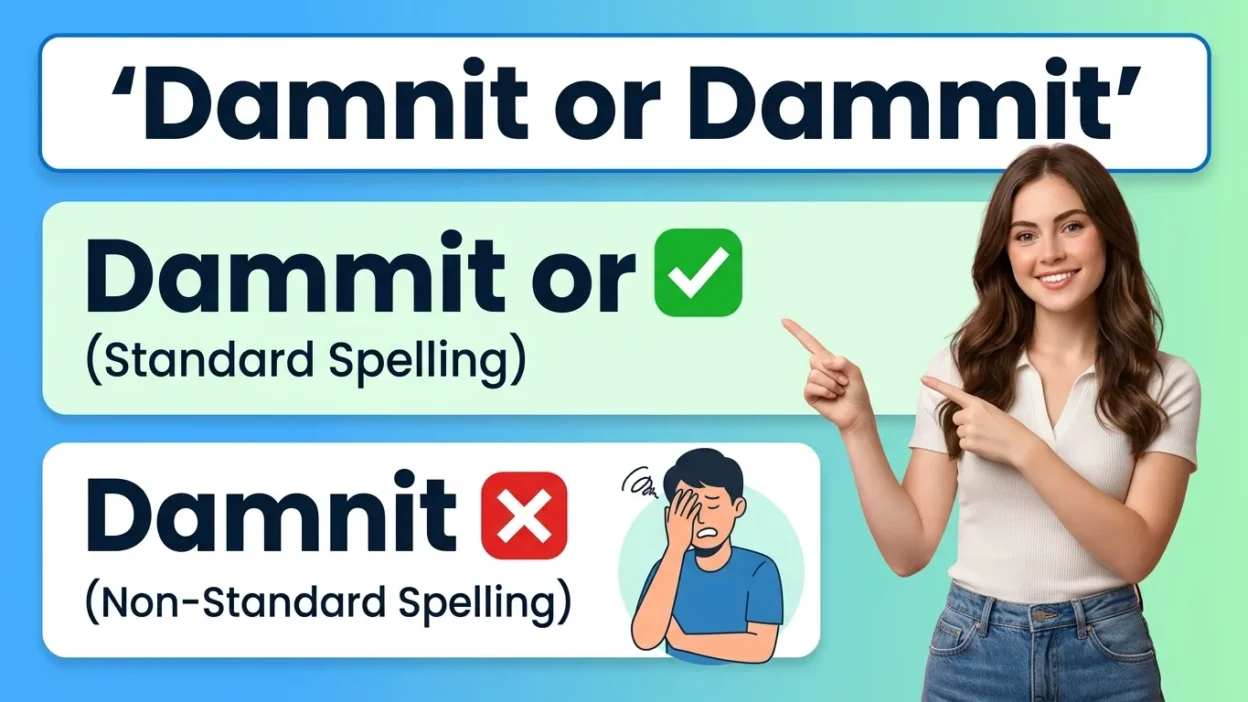
Dammit is the established spelling of the informal exclamation used to show annoyance, frustration, or anger. Damnit is also widely used as an alternative spelling, especially in informal writing, but it is generally less standard. Knowing this difference can help you choose the more conventional form when writing.
In this guide, you’ll learn Damnit vs. Dammit, their meanings, correct usage, pronunciation, and examples. We’ll also explain which spelling is preferred in standard English and share simple tips to help you avoid confusion when using this expression.
Damnit or Dammit: Quick Answer

If you are wondering “Is it damnit or dammit?”, the short answer is:
Dammit is the preferred and more established one-word spelling.
Damnit is commonly used in informal writing, but it is generally considered a less standard variant.
The original expression is “damn it.”
Here is a simple comparison:
| Spelling | Status | Meaning | Best Use |
| Dammit | Standard informal spelling | Anger, frustration, annoyance | Casual writing |
| Damnit | Informal variant/nonstandard spelling | Same meaning | Texting and casual online use |
| Damn it | Original two-word expression | Same basic meaning | Formal grammatical construction is still informal in tone |
If you are writing an article, school assignment, professional email, or other carefully edited content, it is usually better to avoid the expression entirely because it is considered mild profanity.
What Does “Dammit” Mean?
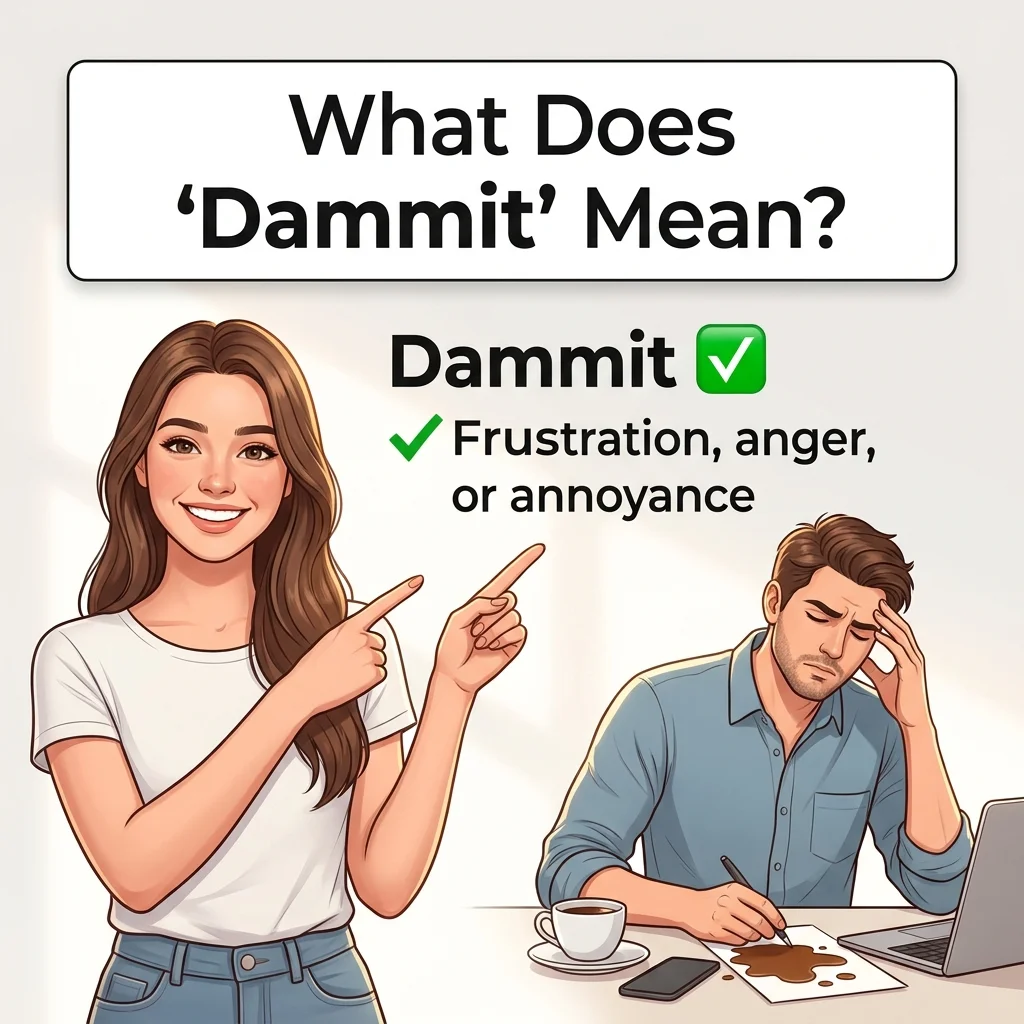
Dammit is an informal exclamation used to express strong emotion. Most often, people use it when they are angry, frustrated, annoyed, disappointed, or upset.
For example:
“Dammit! I missed the bus.”
The speaker is not necessarily angry at another person. They are expressing frustration about what happened.
The word can also emphasize a command or statement:
“Dammit, listen to me!”
Here, the speaker is showing strong irritation.
The exact emotional meaning depends on the situation and tone. Someone might say “Dammit!” after dropping their phone, losing a game, making a mistake, or realizing that they forgot something important.
Is “Dammit” a Bad Word?
Dammit is generally considered mild profanity or a swear word.
It comes from the expression “damn it,” which contains the word “damn.” In modern English, “damn” can be used casually, but it may still be considered inappropriate in certain settings.
Whether it is acceptable depends on your audience and situation.
For example, saying:
“Dammit, I forgot my wallet.”
might be normal among friends.
However, saying it during a formal business meeting, in a professional email, or in a classroom may sound inappropriate.
What Does “Damnit” Mean?
Damnit generally has the same meaning as dammit. People use it to express frustration, anger, annoyance, or disappointment.
For example:
“Damnit, I left my phone at home.”
The meaning is clear, and many English speakers will understand the word immediately.
However, damnit is less established as the standard spelling. It often appears because people spell the sound the way they hear it.
When people pronounce “damn it” quickly, the two words can sound like a single word. This likely contributes to spellings such as dammit and damnit.
If you want to use a recognized one-word spelling, dammit is generally the safer choice.
Dammit vs. Damnit: What Is the Difference?
The main difference between dammit and damnit is spelling rather than meaning.
Both expressions are generally used to communicate the same emotions.
For example:
“Dammit, I broke my glasses.”
and:
“Damnit, I broke my glasses.”
have essentially the same meaning.
The difference is that dammit is the more established spelling, while damnit is commonly treated as an informal variant.
Think of it this way:
Dammit = preferred one-word spelling
Damnit = common informal variant
Damn it = original two-word expression
If you are unsure which one to choose, use dammit in casual writing.
Why Do People Spell It “Damnit”?
One reason people write damnit is pronunciation.
When people say “damn it” quickly, the phrase can sound like one word. The pronunciation may lead someone to spell it as damnit.
English contains many words and expressions that are spelled differently from how they sound. Informal internet communication makes this even more common.
Texting and social media also encourage people to write words based on how they hear them.
For example, someone may think:
“I hear ‘dam-nit,’ so I should write ‘damnit.’”
That spelling makes sense phonetically, but it does not make damnit the preferred spelling.
The established one-word spelling is generally dammit.
Is “Dammit” One Word or Two?
You may see both “dammit” and “damn it.”
Both forms are used, but they have slightly different grammatical structures.
“Damn It” as Two Words
The original expression is “damn it.”
Here, damn functions as an expression of anger or as a verb, while it is a pronoun.
For example:
“Damn it, I forgot the password.”
The two-word form is still understandable and commonly used.
“Dammit” as One Word
Dammit has developed into a conventionalized interjection.
It functions almost like a single emotional word:
“Dammit!”
You do not necessarily need to think of “it” as a separate pronoun when using the one-word form.
This is why dammit can stand alone:
“Dammit!”
The speaker is simply expressing frustration.
How to Use “Dammit” Correctly
Because dammit is an exclamation, it is usually used at the beginning or end of a sentence. It can also stand alone.
At the Beginning of a Sentence
You can use dammit before a statement to show frustration.
“Dammit, I forgot my appointment.”
“Dammit, the computer stopped working.”
“Dammit, why did I do that?”
A comma often follows the interjection when it introduces a sentence.
At the End of a Sentence
It can also appear at the end.
“I forgot my keys, dammit.”
“You should have told me earlier, dammit.”
In this position, it adds emotional emphasis.
As a Standalone Expression
You can simply say:
“Dammit!”
This can communicate frustration without any additional words.
For example, someone might drop a glass and say:
“Dammit!”
The context tells you why they are frustrated.
Examples of “Dammit” in Everyday English
Here are several examples to show how native and fluent English speakers may use the expression.
Example 1: Forgetting Something
“Dammit, I forgot my wallet.”
The speaker is frustrated because they left their wallet somewhere.
Example 2: Making a Mistake
“Dammit! I entered the wrong number.”
The speaker is upset about their mistake.
Example 3: Missing Transportation
“Dammit, the train just left.”
The expression communicates disappointment and frustration.
Example 4: Technology Problems
“Dammit, my laptop froze again.”
The speaker is annoyed because the computer stopped responding.
Example 5: Losing a Game
“Dammit! We were so close to winning.”
The speaker is disappointed about the result.
Example 6: Something Breaking
“Dammit, I broke the handle.”
The word emphasizes the speaker’s frustration.
Example 7: Asking Someone to Listen
“Dammit, please listen to me.”
Here, the expression adds emotional intensity to the request.
Examples of “Damnit”
Although dammit is generally preferred, you will still see damnit in informal communication.
For example:
“Damnit, I forgot the meeting.”
“Damnit! That was my last chance.”
“I lost my keys again, damnit.”
“Damnit, why isn’t this working?”
These sentences are understandable. The issue is not the meaning. The issue is that damnit is generally less standard than dammit.
If you are trying to improve your spelling, remember:
dammit → preferred
damnit → common informal variant
Dammit or Damn It: Which One Should You Use?
The choice depends on context.
If you want the established one-word spelling, use dammit.
If you want to write the original expression as two words, use damn it.
For example:
“Dammit! I forgot the tickets.”
or:
“Damn it! I forgot the tickets.”
Both communicate frustration.
However, the tone remains informal because the expression contains profanity.
Quick Comparison
| Expression | Meaning | Spelling | Tone |
| Dammit | Frustration or anger | One word | Informal |
| Damn it | Frustration or anger | Two words | Informal |
| Damnit | Frustration or anger | Informal variant | Informal |
Is “Damnit” Wrong?
Calling damnit completely “wrong” can be misleading because it is widely used and understood.
However, if the question is “Which spelling should I use?”, dammit is usually the better answer.
The spelling damnit is commonly found in online writing, texts, comments, and informal conversations. It may also appear in dictionaries as a variant depending on the dictionary and edition.
Still, when you want to follow the more established spelling, choose dammit.
In other words:
Damnit is understandable, but dammit is the safer standard spelling.
Is “Dammit” Formal English?
No. Dammit is informal.
It is an emotional exclamation and is generally associated with casual speech and writing.
You may see it in:
- Text messages
- Social media
- Online comments
- Fictional dialogue
- Casual conversations
- Informal stories
- Movies and television dialogue
You should generally avoid it in:
- Formal business emails
- Academic assignments
- Professional reports
- Official documents
- Job applications
- Formal presentations
Instead, choose a less offensive expression.
For example, instead of:
“Dammit, I made a mistake.”
you could say:
“Unfortunately, I made a mistake.”
Or:
“Oh no, I made a mistake.”
Polite Alternatives to “Dammit”
Sometimes you want to express frustration without using profanity.
Here are some alternatives:
- Oh no!
- Darn!
- Dang!
- Shoot!
- Seriously?
- What a shame!
- This is frustrating!
- I can’t believe it!
- That’s annoying!
- What happened?
For example:
Instead of:
“Dammit, I missed the bus!”
you could say:
“Darn, I missed the bus!”
The second version is softer and more appropriate around children or in professional environments.
Dammit vs. Damnit: Spelling Tip
A simple way to remember the preferred spelling is to connect it with damn.
Think:
DAMN + IT → DAMMIT
The common one-word form is spelled with two m’s:
DAMMIT
Not:
DAMNIT
A useful memory trick is:
Damn + it = dammit
This can help you remember that dammit is the spelling you should generally choose.
Common Spelling Mistakes
People make several mistakes when writing this expression.
Writing “Damnit” in Formal Documents
Even if you spell it correctly, damnit is not appropriate for most formal writing because the expression is informal and mildly profane.
Use a neutral expression instead.
Confusing “Dammit” and “Damn It”
Both can be used, but they represent different forms.
Dammit is written as one word.
Damn it is written as two words.
Do not randomly switch between the two forms within the same piece of carefully edited writing.
Using “Damnit” When You Want the Preferred Spelling
If you are writing an article, story, or casual post and want the established one-word spelling, choose dammit.
Overusing the Expression
Using dammit in every emotional sentence can make your writing sound repetitive or unnatural.
For example:
“Dammit, I woke up late. Dammit, I missed breakfast. Dammit, I forgot my bag.”
This sounds exaggerated unless the writing intentionally portrays an extremely frustrated character.
Good writing uses emotional expressions selectively.
Punctuation With “Dammit”
Punctuation can change how the sentence reads.
Exclamation Mark
An exclamation mark is common when the emotion is strong.
“Dammit!”
“Dammit! I can’t believe this.”
Comma
When dammit introduces a sentence, a comma can separate the interjection from the rest of the statement.
“Dammit, I forgot the appointment.”
When it appears at the end, a comma can separate it from the main sentence.
“I forgot the appointment, dammit.”
Period
A period can work when the expression is part of a calmer sentence.
“I really need to fix this, dammit.”
The punctuation depends on the speaker’s emotional intensity.
Can “Dammit” Be Used in Text Messages?
Yes. Dammit is common in casual text messages.
For example:
“Dammit, I just missed your call.”
“Dammit 😂 I forgot again.”
“Oh dammit, I thought today was Friday.”
However, remember that texting is informal. You should consider the person you are messaging.
A close friend may not care about the word, while a teacher, manager, customer, or professional contact might find it inappropriate.
Can You Use “Damnit” on Social Media?
Yes, people frequently use damnit on social media because social platforms are generally informal.
You might see posts such as:
“Damnit, I should have taken a picture!”
or:
“Damnit, I missed the sale.”
However, if you are creating professional content for a business or brand, it is usually better to choose cleaner language.
Your audience matters as much as spelling.
Dammit or Damnit in American English
In American English, dammit is widely recognized as the established informal spelling.
Damnit is also understandable and appears frequently in casual writing.
The important point is that neither form should be confused with a formal vocabulary word. Both carry an emotional and somewhat profane tone.
If you are writing for an American audience and need the most recognizable one-word form, dammit is the safer option.
Dammit or Damnit in British English
British English speakers also understand dammit and damnit.
The basic meaning remains the same. The difference is mainly spelling preference and context rather than a major difference in meaning.
Because English varies by region, informal expressions may appear in several forms. However, dammit remains the more established spelling to use when you want the one-word version.
Does “Dammit” Mean the Same as “Damn It”?
Yes, in most everyday contexts, dammit carries essentially the same meaning as “damn it.”
For example:
“Dammit, I lost my phone.”
means roughly the same as:
“Damn it, I lost my phone.”
The main difference is that dammit functions as a single conventionalized expression, while damn it retains the two-word structure.
Is “Damnit” a Typo?
Not necessarily.
Someone who writes damnit may intentionally use that spelling. It is a common informal variant.
However, if a teacher, editor, or grammar checker asks you to use the standard spelling, dammit is generally the better choice.
So you should not assume every use of damnit is simply a typing error.
It is better described as a less standard or variant spelling.
Why Is “Dammit” Spelled With Two M’s?
The spelling comes from the expression “damn it.”
When the expression became commonly used as a single interjection, its spelling developed into dammit.
The doubled m helps represent the connection between damn and it in the conventional spelling.
This is similar to how some phrases gradually become single words in English.
Language changes over time, especially with frequently spoken expressions.
“Dammit” in Dialogue
Writers often use dammit in dialogue to show a character’s emotions.
For example:
“Dammit, Jack! You should have told me earlier.”
This immediately gives the reader a sense that the character is angry or frustrated.
However, writers should not rely on swear words to communicate every emotion. Dialogue becomes stronger when the character’s words, actions, and situation work together.
For example:
“Dammit!” Sarah slammed the door.
Here, the dialogue and action both communicate frustration.
When Should You Avoid “Dammit”?
You should avoid dammit when the setting requires professional, respectful, or family-friendly language.
Avoid it in:
- Formal letters
- Business proposals
- Academic papers
- Job applications
- Official complaints
- Professional presentations
- Customer service messages
- Children’s educational content
This does not mean the word is always offensive. Its acceptability depends heavily on the situation.
A word that sounds harmless among close friends can sound unprofessional in a workplace.
Dammit or Damnit: Which Is Correct?
If you need a direct answer, choose dammit.
The most useful rule is:
Use “dammit” as the preferred one-word spelling.
You may encounter damnit frequently, especially online, but it is generally treated as an informal variant rather than the preferred spelling.
If you want to avoid the issue entirely, write “damn it” or choose a polite alternative depending on your context.
Dammit or Damnit: Final Comparison
| Feature | Dammit | Damnit |
| Meaning | Frustration, anger, annoyance | Frustration, anger, annoyance |
| Word form | One word | One word |
| Standard preference | More established | Less standard variant |
| Informal | Yes | Yes |
| Mild profanity | Yes | Yes |
| Common online | Yes | Yes |
| Suitable for formal writing | Generally no | Generally no |
| Recommended spelling | Yes | Usually avoid if aiming for standard spelling |
Examples: Correct and Incorrect Usage
Preferred
“Dammit, I forgot my password.”
“Dammit! That was my last chance.”
“I can’t believe I did that, dammit.”
Informal Variant
“Damnit, I forgot my password.”
“Damnit! That was my last chance.”
These examples are understandable, but dammit is generally the better spelling.
Better for Formal Writing
Instead of:
“Dammit, the project is late.”
Use:
“Unfortunately, the project is late.”
Instead of:
“Dammit, I made a mistake.”
Use:
“I apologize. I made a mistake.”
This keeps your writing professional.
Frequently Asked Questions About Damnit or Dammit
Is “dammit” the correct spelling?
Yes. Dammit is the preferred and more established one-word spelling of the informal expression. It is commonly used to show frustration, anger, annoyance, or disappointment.
Is “damnit” spelled correctly?
Damnit is widely used and understood, but it is generally considered a less standard variant of dammit. If you want the safer spelling, use dammit.
Should it be “dammit” or “damn it”?
Both are used. Dammit is the established one-word form, while damn it is the original two-word expression.
Is “dammit” a swear word?
Yes, dammit is generally considered mild profanity because it comes from “damn it.” It is less severe than many stronger swear words, but it may still be inappropriate in formal settings.
Is “damnit” a swear word?
Yes. Damnit has the same basic meaning and emotional force as dammit, so it is also considered mild profanity.
Can I use “dammit” in an email?
You can use it in a casual email to someone you know well, but it is usually better to avoid it in professional emails. A neutral phrase such as “unfortunately” or “oh no” may be more appropriate.
Is “damnit” or “dammit” more common?
Dammit is generally the more established spelling. Both appear in informal online communication, but dammit is the safer choice when you want the conventional one-word spelling.
What does “dammit” mean in texting?
In texting, dammit usually expresses frustration, annoyance, anger, or disappointment. The exact meaning depends on the conversation and the situation.
Can “dammit” be used as a sentence?
Yes. It can stand alone as an exclamation.
For example:
“Dammit!”
This complete utterance expresses frustration without needing another sentence.
What is a polite alternative to “dammit”?
Depending on the situation, you can use darn, dang, shoot, oh no, seriously, or that’s frustrating.
Is “damnit” a typo for “dammit”?
Not always. Damnit is a commonly seen informal variant. However, if you want the more established spelling, use dammit.
Is “dammit” appropriate in academic writing?
Generally, no. Academic writing usually requires formal and objective language. Use a neutral expression instead of an emotional swear word.
How do you remember the spelling of “dammit”?
Think of the original expression:
damn + it = dammit
The preferred one-word spelling contains two m’s: dammit.
Final Verdict:
Most importantly, remember that dammit is informal and mildly profane. It can work naturally in casual conversations, texts, social media, and fictional dialogue. However, it is usually better to avoid it in professional, academic, and formal writing.
When you need a cleaner expression, choose words such as “darn,” “dang,” “shoot,” “oh no,” or “that’s frustrating.” If you are specifically asking which spelling to choose, go with dammit. It is clear, widely recognized, and the safest choice when you want the conventional one-word form.

Daniel Carter is a passionate writer who creates clear, helpful, and easy-to-understand content. He focuses on language, grammar, word meanings, and everyday expressions, helping readers find simple answers to common questions.