Hyphens can make English spelling surprisingly confusing, especially when two versions of a phrase look almost identical. “Real life” and “real-life” are both correct, but they are used in different grammatical situations.
Knowing where to use the hyphen can make your writing clearer and more natural. If you’re searching for Real Life or Real-Life, this guide will explain the difference in simple terms.
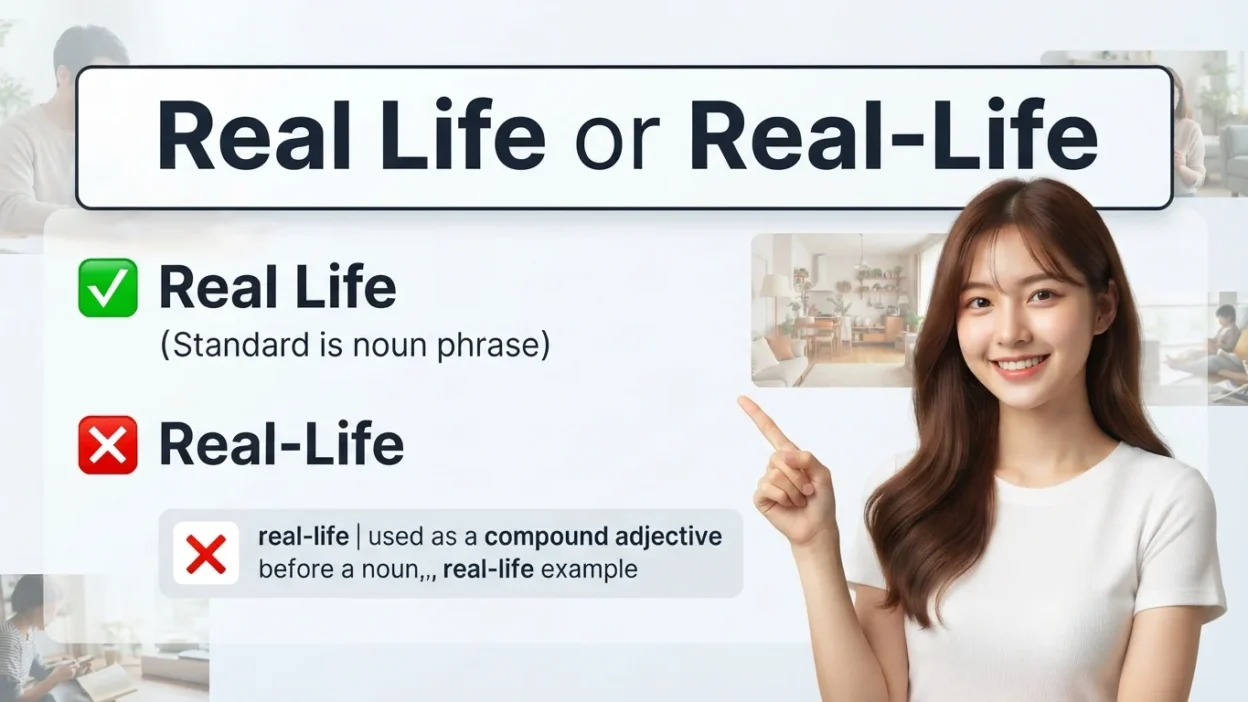
Real life is generally used as a noun phrase when you are talking about actual life or experiences outside fiction. Real-life is usually a compound adjective placed before a noun, such as “real-life experience” or “real-life story.”
Real Life vs Real-Life: Quick Answer
Both real life and real-life can be correct. The correct choice depends on their grammatical role in the sentence.
Use real life as a noun phrase when you are talking about actual life, everyday existence, or life outside fiction, imagination, or digital environments.
Use real-life as a compound adjective when the phrase comes directly before a noun and describes that noun.
Compare these examples:
| Form | Correct? | Typical Use | Example |
| real life | Yes | Noun phrase | Real life can be unpredictable. |
| real-life | Yes | Compound adjective | It is a real-life story. |
| real life story | Usually unclear | Avoid in formal writing | She told a real-life story. |
| real-life story | Yes | Adjective + noun | She told a real-life story. |
| in real life | Yes | Fixed noun phrase | We met in real life. |
| real-life experience | Yes | Compound adjective | He shared a real-life experience. |
The easiest rule is:
Use “real life” when it stands on its own. Use “real-life” when it comes before a noun and describes it.
What Does “Real Life” Mean?
Real life refers to actual life as it happens in the physical or everyday world.
It can be used to contrast reality with:
- fiction
- movies
- television
- dreams
- imagination
- online activity
- social media
- games
- stories
- virtual experiences
For example:
Things are different in real life.
Here, real life means actual everyday existence.
Another example is:
She looks different in real life than she does in her photos.
The phrase refers to how someone appears when you meet them physically rather than seeing a photograph.
Examples of “Real Life”
- Real life is not always as simple as it looks online.
- We became friends in real life.
- He has a successful career in real life.
- Social media does not always show real life.
- The character does not exist in real life.
- I finally met her in real life.
- Real life can be challenging sometimes.
- What happens in movies does not always happen in real life.
In each example, real life acts as a noun phrase.
What Does “Real-Life” Mean?
Real-life is the hyphenated form used when real and life work together as a compound adjective before another noun.
For example:
She told us a real-life story.
The phrase real-life describes the noun story.
It means the story actually happened or is based on real events.
Other examples include:
- a real-life experience
- a real-life example
- a real-life situation
- a real-life hero
- a real-life problem
- a real-life relationship
- a real-life event
- a real-life lesson
The hyphen makes it clear that real and life belong together as a single descriptive unit.
Why Is “Real-Life” Hyphenated?
Hyphens are often used in English to connect two or more words that work together as one adjective before a noun.
Consider:
real-life story
Without the hyphen:
real life story
The reader may still understand the meaning, but the grammatical relationship is less clear.
With the hyphen:
real-life story
It is immediately clear that real-life describes story.
This is called a compound modifier or compound adjective.
Other examples follow the same pattern:
- well-known author
- high-quality product
- long-term plan
- full-time job
- real-life experience
The hyphen connects the words so the reader understands that they function together.
When Should You Write “Real Life”?
Use real life when you are using the phrase as a noun.
A useful test is to ask:
Am I talking about actual life itself?
If the answer is yes, real life is usually correct.
For example:
Real life is not always predictable.
Here, you are talking about actual life itself.
Another example:
She prefers real life to social media.
Again, real life is the thing being discussed.
Common Expressions With “Real Life”
Some common expressions almost always use the two-word form:
- in real life
- real life experience
- real life problems
- real life situations
- real life events
- real life examples
- real life relationships
- real life people
However, there is an important point here.
When real life comes directly before another noun and functions as a modifier, many style guides prefer real-life.
For example:
a real-life experience
rather than:
a real life experience
So context matters.
When Should You Write “Real-Life”?
Use real-life when it acts as a compound adjective before a noun.
For example:
The movie is based on a real-life event.
The words real-life describe event.
Here are more examples:
- a real-life story
- a real-life example
- a real-life situation
- a real-life experience
- a real-life person
- a real-life problem
- a real-life relationship
- a real-life adventure
- a real-life challenge
- a real-life success story
In each example, the hyphen helps connect real and life before the noun.
Real Life vs Real-Life: The Main Difference
The difference becomes much easier when you look at the grammatical function.
Real life is generally a noun phrase.
Real-life is generally a compound adjective.
Compare:
Real life can be difficult.
Here, real life is the subject of the sentence.
Now compare:
She shared a real-life experience.
Here, real-life describes experience.
Simple Comparison
| Sentence | Form | Why? |
| Real life can be difficult. | real life | Noun phrase |
| We met in real life. | real life | Noun phrase |
| It was a real-life experience. | real-life | Describes “experience” |
| He told a real-life story. | real-life | Describes “story” |
| Real-life problems require practical solutions. | real-life | Describes “problems” |
| Social media is different from real life. | real life | Noun phrase |
This distinction is the key to understanding the entire topic.
“In Real Life” or “In Real-Life”?
The correct expression is:
in real life
Not:
in real-life
For example:
She looks even better in real life.
The phrase in real life is an established expression meaning in actual or physical existence.
More examples:
- I have never met him in real life.
- She is very friendly in real life.
- The place looks different in real life.
- He is quieter in real life than online.
- They finally met in real life.
- The product looks better in real life.
Do not add a hyphen to this expression.
Incorrect
I met her in real-life. ❌
Correct
I met her in real life. ✅
The phrase is functioning as a noun phrase rather than a compound adjective before another noun.
“Real-Life Story” or “Real Life Story”?
The preferred form is:
real-life story
For example:
This movie is based on a real-life story.
Why?
Because real-life works together to describe story.
The same pattern appears in:
- real-life events
- real-life examples
- real-life characters
- real-life situations
- real-life experiences
Incorrect or Less Clear
She wrote a real life story.
Preferred
She wrote a real-life story.
The hyphen makes the compound modifier easier to understand.
Real-Life Example or Real Life Example?
The preferred form when the phrase directly modifies example is:
real-life example
For example:
Let me give you a real-life example.
The phrase real-life describes example.
You can also say:
Examples from real life can help students understand the topic.
Here, real life is a noun phrase.
Compare:
I will give you a real-life example.
I will give you an example from real life.
Both are correct, but their grammatical structures are different.
Real-Life Experience or Real Life Experience?
The standard compound-adjective form is:
real-life experience
For example:
He shared a real-life experience with the audience.
Here, real-life modifies experience.
However, when the phrase appears after the noun, the hyphen may no longer be needed.
For example:
The experience was from real life.
The exact punctuation depends on how the phrase functions in the sentence.
Compare
She described a real-life experience.
Her experience was from real life.
The first uses real-life as a compound adjective. The second uses real life as a noun phrase.
Real-Life Examples in Everyday English
The easiest way to understand this rule is to see it in natural sentences.
Example 1
I learned this lesson from real life.
Use real life because it refers to actual life.
Example 2
This is a real-life lesson.
Use real-life because it describes lesson.
Example 3
We met in real life after talking online for months.
Use real life because it refers to actual physical interaction.
Example 4
They shared their real-life experience with us.
Use real-life because it describes experience.
Example 5
Real life does not always follow a perfect plan.
Use real life because it is the subject.
Example 6
The documentary tells a real-life story.
Use real-life because it describes story.
Real Life or Real-Life in Titles?
Titles can make the choice slightly confusing because writers sometimes use different capitalization and punctuation styles.
If you are writing a title such as:
Real Life vs. Social Media
use real life because the phrase functions as a noun.
But if the title is:
10 Real-Life Lessons Everyone Should Learn
use real-life because it modifies lessons.
Another example:
Real Life Experiences That Changed My Perspective
This title can be written without the hyphen if real life is functioning as a noun phrase in a particular construction. However, if you want the phrase to function clearly as a compound modifier directly before experiences, real-life experiences is often the cleaner choice.
For professional and SEO writing, consistency matters.
Is “Real-Life” Always Correct Before a Noun?
Not necessarily.
The hyphen depends on whether the words are functioning together as a compound modifier.
For example:
real-life story
The phrase directly describes story, so the hyphen is useful.
But:
The story happened in real life.
Here, real life does not modify another noun. It functions as a noun phrase.
This is why you should not simply memorize that real-life is always correct.
The better rule is to look at the sentence structure.
Real Life vs Real-Life in Formal Writing
Both forms can appear in formal writing, but you need to use each one correctly.
For example:
Real life presents challenges that cannot always be predicted.
This is grammatically appropriate.
You could also write:
Real-life situations often require flexible solutions.
This is also appropriate.
In professional writing, the hyphen can improve clarity when two words work together as a modifier.
For example:
The researchers examined real-life behavior.
The hyphen tells the reader that real-life describes behavior.
Real Life vs Real-Life in Academic Writing
The same principle applies to academic writing.
Consider:
Students need opportunities to apply their knowledge to real-life situations.
The hyphenated form is appropriate because real-life modifies situations.
Another example:
Learning from real life can help students understand abstract concepts.
Here, real life functions as a noun phrase.
Academic writing often benefits from clear compound modifiers because they reduce ambiguity.
Common Mistakes With “Real Life” and “Real-Life”
There are several mistakes that English learners frequently make.
Mistake 1: Using “Real-Life” Everywhere
Some writers assume that because real-life is a common phrase, it should always contain a hyphen.
That is incorrect.
For example:
I met her in real-life. ❌
Correct:
I met her in real life. ✅
The phrase in real life does not need a hyphen.
Mistake 2: Removing the Hyphen Before a Noun
Another common mistake is writing:
This is a real life story.
A clearer standard form is:
This is a real-life story.
Here, real-life acts as a compound adjective modifying story.
Mistake 3: Treating the Hyphen as Part of the Word
The hyphen does not mean real-life is always one word.
It is still made from two words connected by a punctuation mark.
Think of it as:
real + life → real-life
when the two words work together as a modifier.
Mistake 4: Using “Real Life” When You Mean “Real-Life”
Consider:
The documentary contains several real life examples.
A clearer form is:
The documentary contains several real-life examples.
The hyphen helps show that real-life describes examples.
Mistake 5: Hyphenating After the Noun
Writers sometimes add a hyphen even when the phrase is not acting as a compound modifier.
For example:
We finally met in real-life. ❌
Correct:
We finally met in real life. ✅
A Simple Test for Choosing the Correct Form
If you are unsure whether to use real life or real-life, try this simple test.
Step 1: Look at What Comes After the Phrase
If real life comes before a noun and describes that noun, consider using a hyphen.
real-life story
real-life experience
Step 2: Ask What You Mean
If you mean actual life or everyday existence, use:
real life
For example:
Life is different in real life than it appears online.
Step 3: Check Whether “Real-Life” Is a Compound Modifier
If real and life work together to describe another noun, use the hyphen.
real-life situation
real-life character
This three-step test will solve most situations.
Real Life or Real-Life: Sentence Patterns
Here are some useful sentence patterns to remember.
Pattern 1: Real Life as a Noun Phrase
Real life + verb
Example:
Real life can be unpredictable.
Pattern 2: In Real Life
Subject + verb + in real life
Example:
She is much quieter in real life.
Pattern 3: Real-Life + Noun
real-life + noun
Example:
He shared a real-life story.
Pattern 4: Based on Real-Life Events
based on + real-life + noun
Example:
The film is based on real-life events.
Pattern 5: Learn From Real Life
learn + from + real life
Example:
We can learn important lessons from real life.
Learning these patterns can help you use the expressions naturally without constantly thinking about the hyphen.
30 Correct Examples of “Real Life”
Here are examples where real life works as a noun phrase.
- Real life can be unpredictable.
- Social media does not always represent real life.
- I finally met him in real life.
- She looks different in real life.
- Real life is often more complicated.
- He prefers real life to virtual games.
- The character does not exist in real life.
- We became friends in real life.
- Things are different in real life.
- Real life teaches valuable lessons.
- She is very friendly in real life.
- The situation is more difficult in real life.
- You cannot always plan real life.
- He wanted to experience real life.
- Real life can surprise you.
- The movie is different from real life.
- They finally met in real life.
- What works online may not work in real life.
- Real life requires practical decisions.
- He enjoys spending time in real life.
- Her online personality differs from her real life.
- Real life is not always perfect.
- We should focus on real life sometimes.
- The story reminded me of real life.
- His dreams eventually became real life experiences.
- She learned a lot from real life.
- Real life involves both success and failure.
- The game is not like real life.
- Their friendship continued in real life.
- Real life can teach lessons that books cannot.
30 Correct Examples of “Real-Life”
Now look at examples where real-life functions as a compound adjective.
- She told a real-life story.
- This is a real-life example.
- He shared a real-life experience.
- The book describes real-life situations.
- We discussed real-life problems.
- The movie is based on real-life events.
- She became a real-life hero.
- The course uses real-life examples.
- He faced a real-life challenge.
- They studied real-life behavior.
- The documentary features real-life people.
- This lesson has real-life applications.
- The article includes real-life stories.
- We need real-life solutions.
- The students discussed real-life issues.
- It was a real-life adventure.
- The speaker shared real-life lessons.
- The book contains real-life examples.
- She described a real-life situation.
- The program teaches real-life skills.
- He used a real-life case study.
- The film portrays a real-life character.
- They explored real-life relationships.
- The story contains real-life details.
- We need real-life evidence.
- The teacher gave a real-life example.
- She explained the concept through a real-life situation.
- The documentary focuses on real-life experiences.
- He offered a real-life solution.
- These are common real-life challenges.
Real Life vs Real-Life With “Experience”
The word experience often creates confusion.
Both structures can be correct depending on the sentence.
Real-Life Experience
Use real-life experience when the phrase describes a specific experience.
She shared a real-life experience with the class.
Here, real-life modifies experience.
Experience From Real Life
You can also write:
She shared an experience from real life.
Here, real life is a noun phrase after the preposition from.
Both sentences communicate a similar idea, but the grammatical structures differ.
Real Life vs Real-Life With “Examples”
The same rule applies to examples.
Real-Life Examples
The teacher gave us several real-life examples.
Here, real-life modifies examples.
Examples From Real Life
The teacher gave us several examples from real life.
Here, real life functions as a noun phrase.
Both are correct.
Real Life vs Real-Life With “Stories”
Consider these two sentences:
She told a real-life story.
She told a story about real life.
Both are correct, but they have slightly different structures.
In the first sentence, real-life describes story.
In the second sentence, real life is the subject matter of the story.
This distinction is useful because it shows that punctuation is connected to grammar, not just appearance.
Real-Life as a Compound Adjective
A compound adjective is formed when two or more words work together to describe a noun.
For example:
- real-life story
- high-speed internet
- long-term goal
- full-time employee
- well-known writer
The hyphen tells readers that the words should be understood together.
In real-life story, the words real and life combine to describe the type of story.
Without the hyphen, the relationship can become less obvious.
Does “Real Life” Need a Hyphen After a Linking Verb?
Usually, no.
Compare:
It is a real-life story.
Here, real-life comes before the noun story.
Now consider:
The story is real life.
This sentence is unusual because the meaning changes, but there is no compound modifier before a noun.
More naturally:
The story is about real life.
Here, real life is not directly modifying a noun.
Another example:
The experience was real-life.
This construction can occur in informal or specialized contexts, but it is usually clearer to rewrite it as:
The experience was real.
or:
The experience happened in real life.
As a general beginner rule, do not automatically add a hyphen simply because real and life appear together.
Is “Real Life” One Word?
No.
Real life consists of two separate words.
It should not be written as:
reallife ❌
The correct forms are:
- real life ✅
- real-life ✅ when used as a compound modifier
Never write reallife as a standard English word.
Is “Real-Life” One Word?
No.
Although the hyphen connects the words, real-life is still made up of two words.
The hyphen simply indicates that they are functioning together as a compound adjective.
For example:
real-life experience
not:
reallife experience
and not necessarily:
real life experience
when the intended meaning is a compound modifier.
Is “Real Life” Formal or Informal?
Real life is standard English and can be used in both formal and informal writing.
Examples include:
The study examines how people behave in real life.
This can work in formal writing.
In casual conversation:
She is really funny in real life.
This is also natural.
The phrase itself is not informal. Its tone depends on the context.
Is “Real-Life” Formal or Informal?
Real-life is also standard English.
It can be used in:
- academic writing
- business writing
- journalism
- blogs
- books
- essays
- websites
- everyday writing
For example:
The training program uses real-life scenarios to prepare employees for unexpected situations.
This sounds completely appropriate in professional writing.
FAQS :
FAQs
Is “real life” one word?
No. “Real life” is normally written as two words.
Is “real-life” correct?
Yes. “Real-life” is correct when it works as a compound adjective before a noun.
Which is correct: real life or real-life?
Both are correct, but their use depends on the sentence and grammatical position.
Is “real life” hyphenated?
Usually, no. Write “real life” when it functions as a noun phrase.
When should I use “real-life”?
Use “real-life” before a noun, such as “a real-life story” or “real-life experience.”
Can I write “real-life experience”?
Yes. “Real-life experience” is a common and grammatically correct phrase.
Is “real life example” correct?
It is often better written as “real-life example” because the words work together as an adjective.
Is “real life” an adjective?
No. “Real life” is generally a noun phrase, while “real-life” functions as a compound adjective.
Do I need a hyphen in “real life”?
No, when “real life” is used as a noun phrase, you normally do not need a hyphen.
What is the easiest way to remember the difference?
Use “real life” as a noun and “real-life” as an adjective directly before a noun.
Conclusion
“Real life” and “real-life” are both correct, but they have different grammatical roles. Real life is usually used as a noun phrase when you are talking about actual everyday existence or experiences. For example, you can say, “This happens in real life.”
Real-life, with a hyphen, is generally used as a compound adjective before a noun, such as “a real-life experience” or “a real-life example.” The easiest way to remember the difference is to check what comes after the phrase. If it directly describes a noun, use real-life. Otherwise, real life is usually the correct choice.

Daniel Carter is a passionate writer who creates clear, helpful, and easy-to-understand content. He focuses on language, grammar, word meanings, and everyday expressions, helping readers find simple answers to common questions.