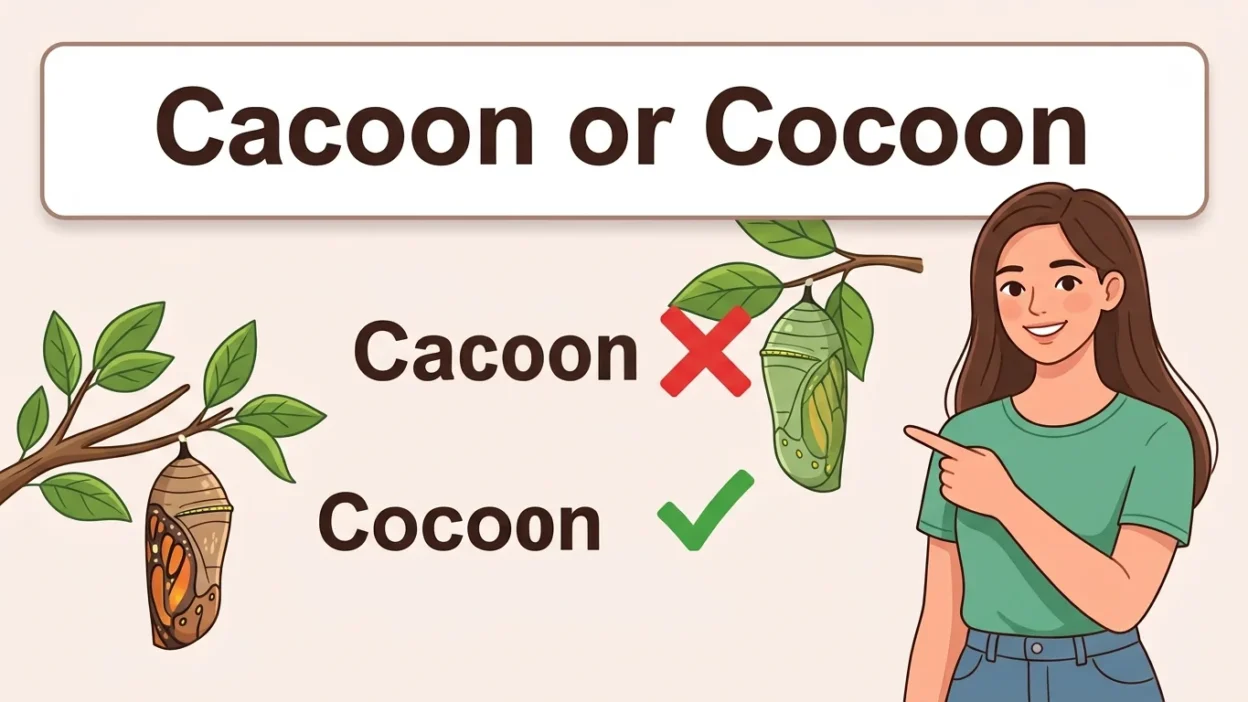
Spelling mistakes can be surprisingly easy to make when two words look almost identical. Cacoon or Cocoon is a common example because “cacoon” may seem natural at first glance, but it is not the standard English spelling. The correct word is cocoon, which refers to the protective covering made by certain insects, especially before they transform into their adult form.
You may also come across cocoon in a figurative sense. For example, someone might describe a person as being “in a cocoon” when they are protected from the outside world or spending time in a comfortable, private environment.
If you’re confused about Cacoon or Cocoon, this guide will explain the correct spelling, meaning, pronunciation, common mistakes, and simple examples. You’ll also learn why cocoon is the correct choice in standard English writing.
Cacoon or Cocoon: Quick Answer
The correct spelling is cocoon.
Cacoon is not the standard spelling of the English word referring to the protective covering made by certain insects.
| Spelling | Correct? | Meaning |
| Cocoon | Yes | A protective covering around a developing insect |
| Cacoon | No | Common misspelling of “cocoon” |
| Cocoons | Yes | Plural form of “cocoon” |
| Cocooned | Yes | Enclosed or wrapped in a cocoon-like covering |
| Cocooning | Yes | The act or process of enclosing or withdrawing into a protected space |
The easiest rule to remember is:
Cocoon is correct. Cacoon is a misspelling.
If you are writing about a moth, insect development, metamorphosis, or a protective covering, use cocoon.
What Does “Cocoon” Mean?
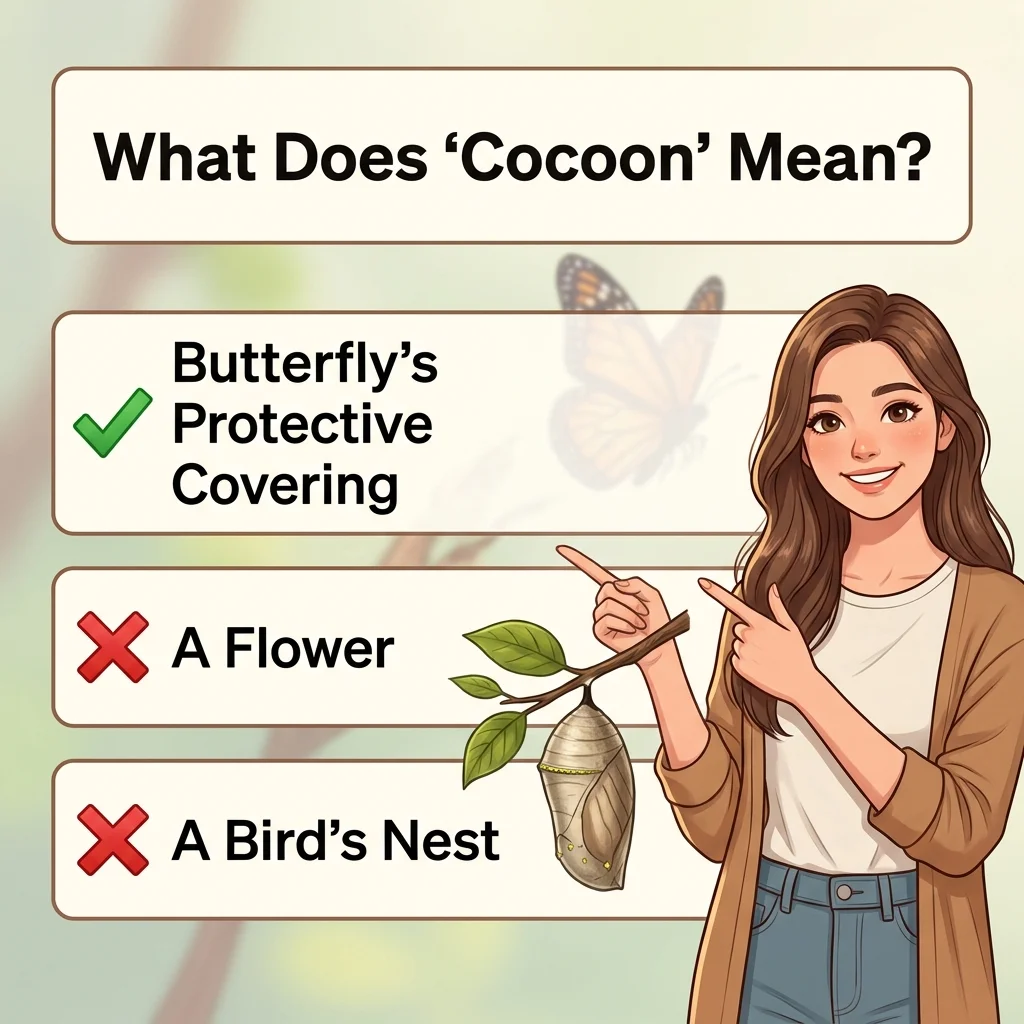
The word cocoon primarily refers to a protective covering made by certain insects during a stage of their development.
A caterpillar may produce silk and use it to create a protective structure around itself. Inside this covering, the insect undergoes major physical changes.
For example:
The caterpillar disappeared inside its cocoon.
Here, cocoon refers to the protective structure surrounding the developing insect.
The word can also be used more generally. A person, place, or environment can be described as a cocoon when it provides comfort, privacy, safety, or protection.
For example:
Her bedroom became a quiet cocoon where she could relax.
In this sentence, the word does not refer to an insect. It is being used metaphorically to describe a safe and comfortable environment.
Is “Cacoon” a Correct Word?
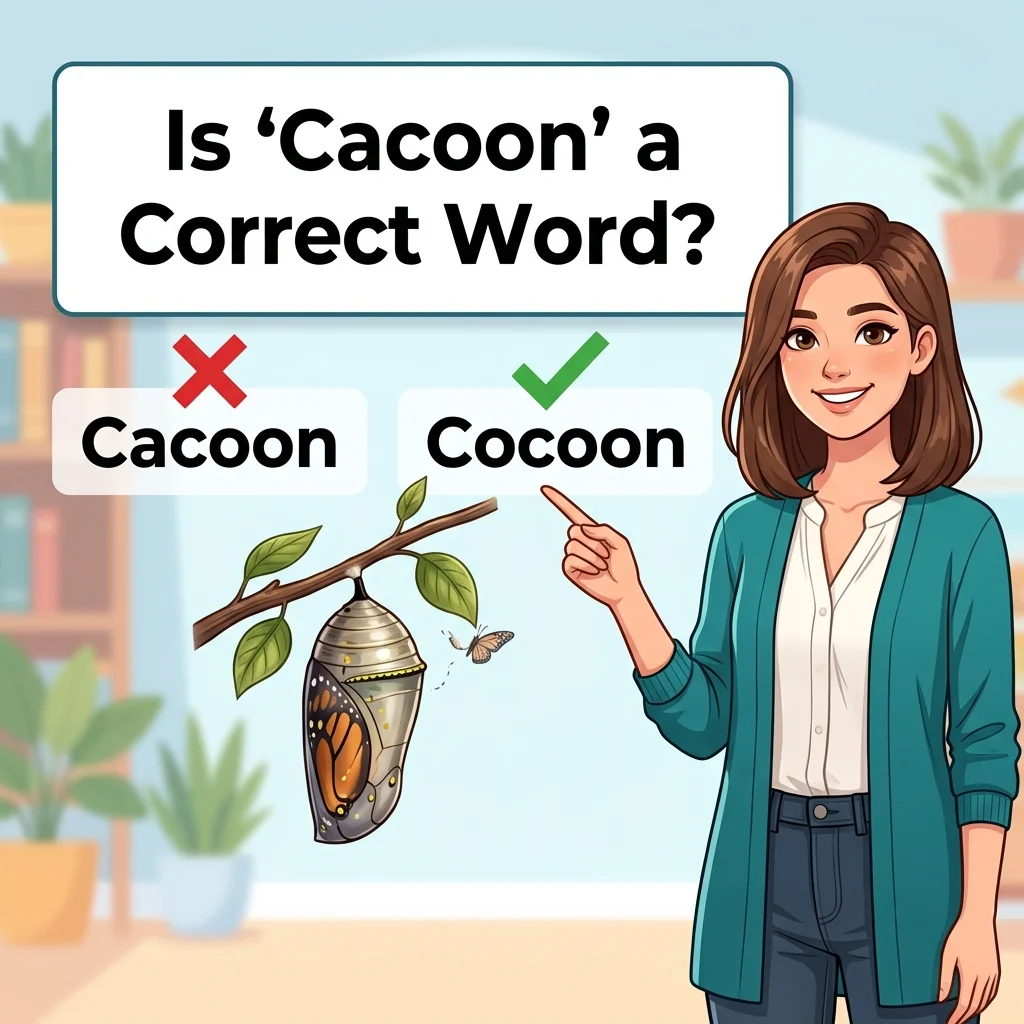
If you mean the insect covering, cacoon is not the standard spelling. The correct word is cocoon.
A common mistake is to replace the second o with a:
Cacoon ❌
Cocoon ✅
This mistake is understandable because English spelling can be difficult. When people pronounce the word quickly, they may not clearly notice the vowel sounds.
However, when writing standard English, use cocoon.
Incorrect Examples
- The butterfly came out of its cacoon. ❌
- I found a cacoon on the tree. ❌
- The caterpillar made a cacoon. ❌
Correct Examples
- The butterfly came out of its cocoon. ✅
- I found a cocoon on the tree. ✅
- The caterpillar made a cocoon. ✅
If you remember only one thing from this article, remember the spelling:
C-O-C-O-O-N
How Do You Spell Cocoon?
The correct spelling is:
Cocoon
It contains six letters:
C – O – C – O – O – N
A simple way to remember it is to divide the word into two parts:
co + coon
You can also focus on the three o sounds/letters that appear in the middle and end of the word.
The incorrect spelling cacoon changes the second letter after the first c:
cacoon ❌
The correct spelling keeps the pattern:
cocoon ✅
When writing quickly, check the first four letters. They should be:
COCO
That can help you remember the correct spelling.
Cocoon Pronunciation
The word cocoon is commonly pronounced approximately like:
kuh-KOON
The stress usually falls on the second syllable.
The pronunciation can make the spelling confusing for English learners because the written form does not always look exactly like the way the word sounds.
You can think of it as:
co-Coon
However, pronunciation can vary slightly depending on accent.
The important point is that pronunciation does not change the standard spelling. Whether you are speaking American English or another variety of English, the standard written form is cocoon.
What Is a Cocoon in Biology?
In biology, a cocoon is a protective structure produced by certain animals, especially insects, during development.
Many people associate cocoons with butterflies, but there is an important distinction.
Moths commonly form cocoons, while many butterflies form chrysalises instead.
A cocoon may be made from materials such as silk. It surrounds and protects the developing insect during a vulnerable stage of its life cycle.
For example, a moth caterpillar may spin silk around itself before entering the pupal stage.
Inside the protective structure, the insect undergoes significant changes.
This process is part of metamorphosis, which is the biological process through which an organism changes its body form during development.
Cocoon and Butterfly: Are They the Same Thing?
People often say that butterflies come out of cocoons, but this is not always scientifically accurate.
Butterflies generally form a chrysalis, which is a hardened pupal case. Moths, on the other hand, commonly form silk cocoons around their pupae.
So, while the terms are sometimes used casually as if they mean the same thing, they can refer to different structures.
For example:
A moth may develop inside a cocoon.
A butterfly usually develops inside a:
chrysalis
This distinction is useful if you are writing a science article, school assignment, or educational content.
Cocoon vs Chrysalis
The words cocoon and chrysalis are related, but they are not exactly the same.
A cocoon is generally a protective covering spun by certain insects, particularly moths.
A chrysalis is the hardened pupal form of a butterfly.
| Cocoon | Chrysalis |
| Commonly associated with moths | Commonly associated with butterflies |
| Often made from silk | Usually a hardened outer pupal covering |
| Provides protection during development | Protects the butterfly during its pupal stage |
| Often surrounds the pupa | The chrysalis itself is the pupal covering |
For everyday conversation, people may use the words loosely. In scientific writing, however, the distinction matters.
Cocoon vs Pupa
Another word that is often confused with cocoon is pupa.
A pupa is a developmental stage between the larval stage and the adult stage in insects that undergo complete metamorphosis.
A cocoon is a protective structure that can surround the pupa.
This means that a cocoon and a pupa are not necessarily the same thing.
Think of it this way:
Pupa = developmental stage
Cocoon = protective covering
For example, a moth pupa may remain protected inside a silk cocoon.
Understanding this distinction can make insect life cycles much easier to understand.
Cocoon vs Chrysalis vs Pupa
Here is a simple comparison:
| Term | Basic Meaning |
| Cocoon | Protective covering produced by some insects |
| Chrysalis | Hardened pupal covering of a butterfly |
| Pupa | Developmental stage between larva and adult |
| Larva | Young stage of an insect after hatching |
| Adult | Fully developed stage of the insect |
These terms describe different parts or stages of insect development.
What Happens Inside a Cocoon?
A cocoon provides protection while an insect undergoes development.
For many moths, the caterpillar spins a protective silk structure before entering the pupal stage. During this time, the insect undergoes major internal and external changes.
The transformation may include changes to:
- body structure
- wings
- legs
- mouthparts
- reproductive organs
- other adult features
The exact process varies between species.
When development is complete, the adult insect eventually emerges from the protective structure.
This transformation is one reason cocoons are often used as symbols of change, growth, and transformation.
Why Do Caterpillars Make Cocoons?
Caterpillars of certain insects create cocoons primarily for protection during the pupal stage.
The developing insect is vulnerable during this period because it cannot move around like a normal adult insect.
The cocoon can help provide physical protection from environmental conditions and potential threats.
However, not every caterpillar creates a cocoon. Different insect species use different strategies during their development.
Some form exposed pupae, while others create protective coverings.
That is why it is more accurate to say that some insects make cocoons, rather than saying that every caterpillar does.
Why Is “Cacoon” So Commonly Misspelled?
There are several possible reasons people write cacoon instead of cocoon.
One reason is pronunciation. The vowel sounds in spoken English can be difficult to identify, particularly for people learning English as a second language.
Another reason is visual memory. A writer may remember the general shape of the word but not the exact vowel sequence.
The word also contains repeated letters, which can make spelling more difficult.
For example:
COCOON
has a repeated CO pattern followed by another O.
When typing quickly, someone may accidentally produce:
CACOON
The best solution is to memorize the correct spelling rather than relying only on pronunciation.
Easy Spelling Trick for Cocoon
Here is a simple memory trick:
Think:
CO + COON = COCOON
The first part is:
CO
Then comes:
COON
Together:
CO + COON = COCOON
Another trick is to remember that cocoon starts with COCO, just like the name Coco.
So you can mentally connect:
COCO + ON = COCOON
These little patterns can make the spelling easier to remember.
Cocoon as a Noun
The most common use of cocoon is as a noun.
A noun names a person, place, thing, or idea.
In this case, cocoon names a protective structure.
For example:
The moth was hidden inside a cocoon.
Here, cocoon is the name of the protective structure.
More examples include:
- The cocoon was attached to a branch.
- We discovered a cocoon in the garden.
- The moth emerged from its cocoon.
- The cocoon protected the insect during development.
- The children watched the cocoon carefully.
Cocoon as a Verb
Cocoon can also be used as a verb.
As a verb, it can mean to enclose or surround something in a protective covering.
For example:
The insect cocooned itself in silk.
The word can also be used figuratively when someone isolates themselves in a comfortable or protected environment.
For example:
She cocooned herself in blankets during the storm.
In this sentence, there is no actual insect cocoon. The verb is being used metaphorically.
What Does “Cocooned” Mean?
Cocooned is the past tense or past participle form of cocoon.
It can mean enclosed, surrounded, or protected.
For example:
The insect was cocooned inside a protective covering.
It can also have a figurative meaning:
He stayed cocooned in his room all weekend.
Here, cocooned suggests that he remained in a comfortable or isolated space.
What Does “Cocooning” Mean?
Cocooning is the present participle or gerund form of cocoon.
It can describe the process of enclosing or protecting something.
For example:
The caterpillar is cocooning itself in silk.
In modern everyday English, cocooning can also describe spending time at home in a comfortable, private environment.
For example:
I enjoy cocooning at home with a book on rainy evenings.
The meaning depends on context.
What Is the Plural of Cocoon?
The plural form of cocoon is:
cocoons
You simply add s to the singular form.
| Singular | Plural |
| cocoon | cocoons |
Examples:
- One cocoon was hanging from the branch.
- Several cocoons were found in the garden.
- The scientist examined the cocoons carefully.
- We saw three cocoons on the tree.
Do not write cacoon or cacoons when you mean the standard English word.
Cocoon in a Sentence
Here are several simple examples using cocoon correctly.
The caterpillar created a cocoon on the branch.
The moth remained inside the cocoon for a period of development.
I found a small cocoon under a leaf.
The empty cocoon was still attached to the tree.
The children were excited to see a cocoon in the garden.
The moth eventually emerged from its cocoon.
These examples show the most common literal use of the word.
25 Example Sentences With “Cocoon”
Practice can make the correct spelling easier to remember. Here are 25 examples.
- The caterpillar formed a cocoon on a branch.
- We found a cocoon under a leaf.
- The moth emerged from its cocoon.
- The cocoon protected the developing insect.
- A small cocoon was attached to the tree.
- She carefully observed the cocoon.
- The cocoon was covered with fine silk.
- Several cocoons were hanging from the branches.
- The insect remained inside its cocoon.
- The empty cocoon was left behind.
- We learned about cocoons in science class.
- The moth spent part of its development inside a cocoon.
- The cocoon looked small from a distance.
- He discovered a cocoon in the garden.
- The children were fascinated by the cocoon.
- The cocoon provided protection during development.
- The insect eventually left the cocoon.
- The researcher examined the cocoon carefully.
- A brown cocoon was attached to the plant.
- The caterpillar disappeared inside its cocoon.
- We saw several cocoons near the tree.
- The cocoon was difficult to notice among the leaves.
- The moth broke through the cocoon.
- The empty cocoon remained on the branch.
- The teacher explained how a cocoon protects some insects.
Cocoon in a Figurative Meaning
The word cocoon is not limited to biology.
English speakers often use it metaphorically to describe a place, person, or situation that feels protected, private, comfortable, or isolated.
For example:
Her home felt like a warm cocoon during the winter.
The home is not literally a cocoon. Instead, the word creates an image of comfort and protection.
Another example:
He created a quiet cocoon around himself while studying.
This suggests that he created a peaceful environment where he could focus without distractions.
The metaphor comes from the idea of an insect being protected inside a cocoon.
Cocoon Meaning in Everyday Life
In everyday English, cocoon can describe a comfortable private environment.
For example, someone might say:
I just want to stay in my cozy cocoon this weekend.
This can mean that the person wants to stay home, relax, avoid outside distractions, and enjoy a comfortable environment.
The word often creates a positive feeling of:
- comfort
- safety
- privacy
- relaxation
- protection
- peace
However, depending on context, it can also suggest isolation.
Is Cocoon a Positive or Negative Word?
The meaning of cocoon depends on how it is used.
In its literal biological meaning, it is simply a protective structure.
In figurative language, it can have either a positive or negative meaning.
Positive Meaning
A cocoon can represent comfort and safety.
Her home was a peaceful cocoon after a stressful day.
Negative Meaning
It can sometimes suggest that someone is isolated from the outside world.
He stayed in his cocoon and avoided talking to anyone.
Therefore, the surrounding sentence determines the meaning.
Common Spelling Mistakes With Cocoon
There are several ways people may accidentally misspell this word.
Cacoon
Cacoon ❌
Cocoon ✅
This is the most common spelling confusion.
Coccon
Coccon ❌
Cocoon ✅
Some people accidentally remove one of the o letters.
Cocoonn
Cocoonn ❌
Cocoon ✅
This mistake adds an unnecessary n.
Cocoune
Cocoune ❌
Cocoon ✅
This is another possible typing error.
The correct form remains:
Cocoon
Cacoon vs Cocoon: Common Mistake Table
| Incorrect Form | Correct Form |
| Cacoon | Cocoon |
| Cacooning | Cocooning |
| Cacoons | Cocoons |
| Coccon | Cocoon |
| Cocoonn | Cocoon |
When referring to the insect covering, always choose the standard spelling cocoon.
How to Remember “Cocoon” Forever
If you frequently confuse cacoon and cocoon, use a simple visual trick.
Remember:
COCOON
The beginning looks like:
COCO
Then add:
ON
So:
COCO + ON = COCOON
You can also associate the word with the image of a caterpillar:
Caterpillar → Cocoon → Adult insect
Repeating this sequence can help connect the spelling with its meaning.
Another useful trick is to write the word several times:
cocoon
cocoon
After seeing the correct spelling repeatedly, it becomes easier to recognize the incorrect version.
Cocoon vs Cacoon in Search Queries
You may see people searching for cacoon or cocoon because they are unsure which spelling is correct.
Search queries may include:
- cacoon or cocoon
- cacoon meaning
- cocoon meaning
- how do you spell cacoon
- is cacoon a word
- cocoon spelling
- cocoon definition
- cacoon definition
- cocoon vs cacoon
These searches usually lead to the same answer: when you mean the insect covering, the standard spelling is cocoon.
Search engines may still understand cacoon because it is a common misspelling, but understanding the intended word does not make the spelling correct.
When Should You Use “Cocoon”?
Use cocoon when referring to:
- a protective insect covering
- a moth’s protective structure
- a figurative protective environment
- a comfortable private space
- something that surrounds and protects another thing
Examples:
The moth built a cocoon.
Her room felt like a cocoon.
The insect was protected inside its cocoon.
When Should You Not Use “Cocoon”?
You should not use cocoon simply because something is round, enclosed, or covered.
The word has a specific biological meaning and several related figurative meanings.
For example, if you are talking about a general box, container, or package, cocoon may not be the most accurate word unless you are intentionally using it as a metaphor.
Choosing the right word makes your writing clearer.
Frequently Asked Questions
Is it “cacoon” or “cocoon”?
Cocoon is the correct spelling. Cacoon is a common misspelling.
Is “cacoon” a real word?
When you mean the protective covering made by certain insects, cacoon is not the standard spelling. Use cocoon instead.
How do you spell cocoon?
The correct spelling is C-O-C-O-O-N: cocoon.
What is a cocoon?
A cocoon is a protective covering made by certain insects, particularly some moths, during their development.
Is a butterfly inside a cocoon?
Butterflies generally develop inside a chrysalis, not a silk cocoon. Moths commonly produce cocoons.
What is the plural of cocoon?
The plural of cocoon is cocoons.
Can cocoon be used as a verb?
Yes. Cocoon can be used as a verb meaning to enclose or surround something with a protective covering. It can also have a figurative meaning.
What does cocooned mean?
Cocooned means enclosed, surrounded, protected, or isolated in a comfortable environment, depending on the context.
What does cocooning mean?
Cocooning can mean enclosing something in a protective covering. In everyday language, it can also describe staying in a comfortable private environment.
Is a cocoon the same as a pupa?
No. A pupa is a developmental stage, while a cocoon is a protective structure that may surround the pupa.
Is a cocoon the same as a chrysalis?
Not exactly. A cocoon is generally a protective covering made by certain insects, while a chrysalis is the pupal stage or hardened pupal covering associated with butterflies.
Why do people spell cocoon as cacoon?
The spelling mistake may happen because the pronunciation is not always easy to map onto the written form. Repeated letters can also make the spelling confusing.
Is “cocoon” an English word?
Yes. Cocoon is a standard English word used literally for certain insect coverings and figuratively for protected or comfortable environments.
Can I use cocoon in formal writing?
Yes. Cocoon is a standard English word and can be used in formal, academic, scientific, and everyday writing when it fits the context.
What is the easiest way to remember cocoon spelling?
Remember COCO + ON = COCOON. The correct word starts with COCO, not CACO.
Conclusion:
In conclusion, “cocoon” is the correct English spelling, while “cacoon” is a common spelling mistake. A cocoon is a protective covering made by certain insects, especially moths, during a stage of their development. Remembering the correct spelling can help you write more clearly and avoid confusion in school, work, and everyday communication.
If you are unsure, focus on the spelling C-O-C-O-O-N. Although “cacoon” may appear in informal writing or online searches, it is not the standard spelling used in modern English. So, whenever you need the word, choose “cocoon” for accurate and proper English usage.

Michael Collins is a skilled writer who creates clear, practical, and reader-friendly content. He focuses on language, grammar, word meanings, and everyday expressions, making complex topics simple to understand.