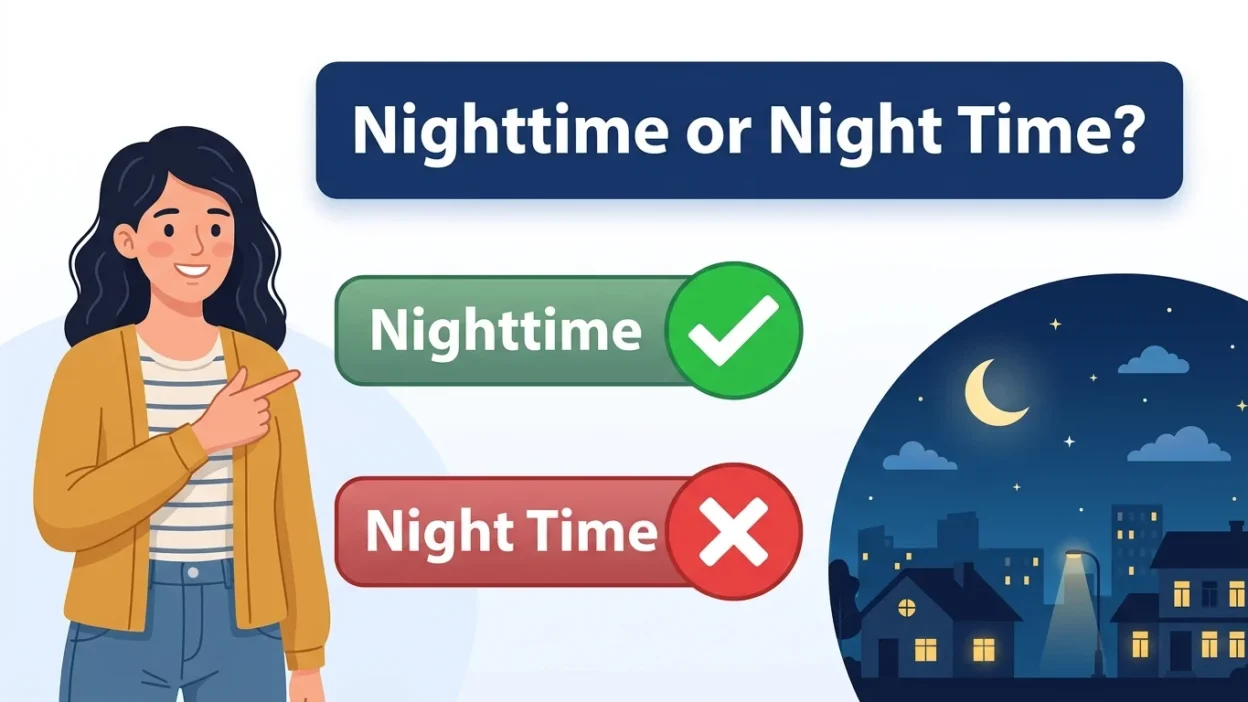
Choosing between nighttime or night time can be confusing, especially when both forms appear in English writing. You may have seen nighttime written as one word in dictionaries, articles, and everyday sentences, while night time sometimes appears as two words. So, which spelling is correct?
The answer depends partly on grammar, style, and regional usage. In modern English, nighttime is commonly used as a noun or adjective to describe the period when it is dark or when people usually sleep.
For example, you might say, “I enjoy walking at nighttime” or “The nighttime temperature is much lower.” The two-word form night time can also appear when the writer wants to emphasize the words separately, although it is less common in standard usage.
Nighttime vs Night Time: Quick Answer
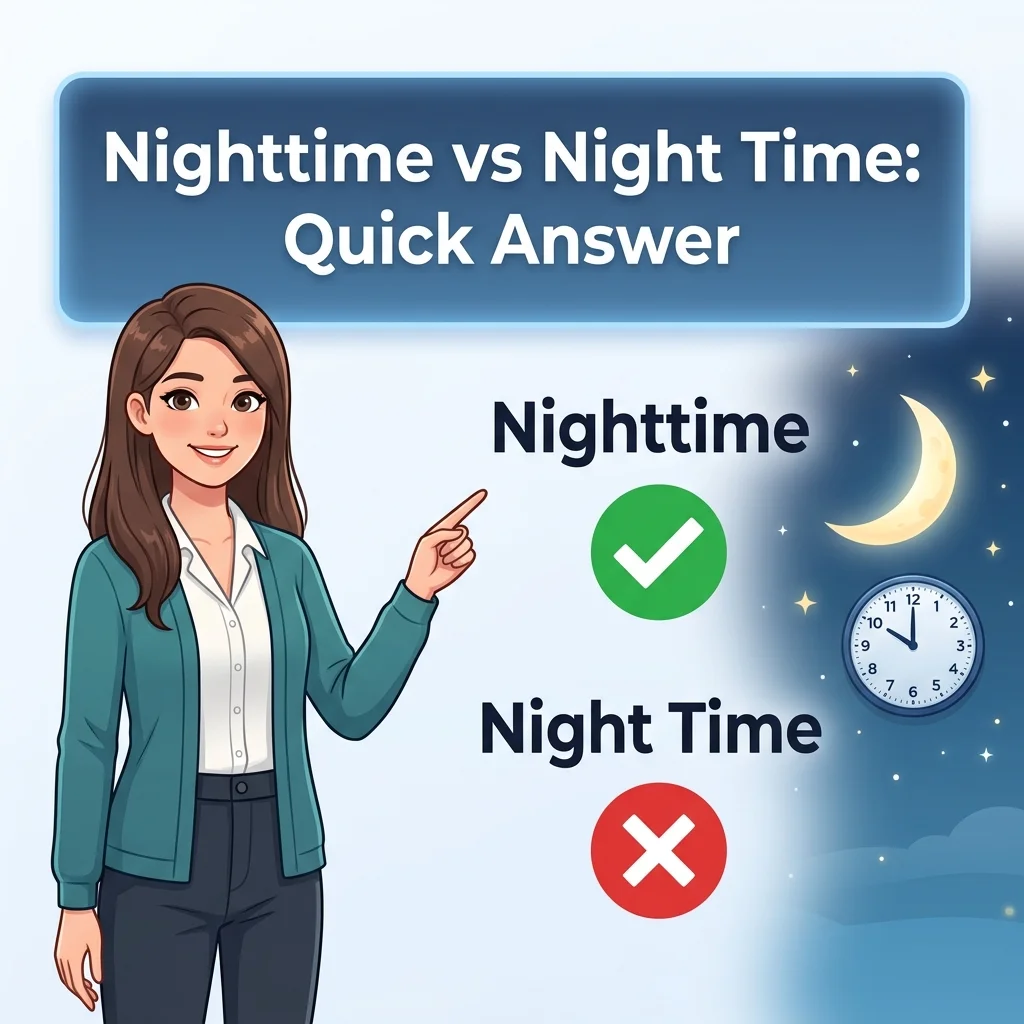
The standard spelling is usually nighttime, written as one word.
Night time can also be grammatically possible when the two words are being used separately, but it is much less common when referring generally to the period of darkness.
| Form | Correct? | Common Usage |
| nighttime | Yes | Standard noun/adjective |
| night time | Sometimes | Context-dependent |
| night-time | Sometimes | Hyphenated style, especially in some varieties of English |
| at nighttime | Yes | Refers to the period during the night |
| during nighttime | Yes | Refers to nighttime hours |
| night time hours | Less natural | Usually better as “nighttime hours” |
The easiest rule is:
Use “nighttime” as one word when you mean the general period of the night.
For example:
I prefer working during nighttime.
However, night time may appear when the writer is treating night and time as separate words for a particular reason.
What Does “Nighttime” Mean?
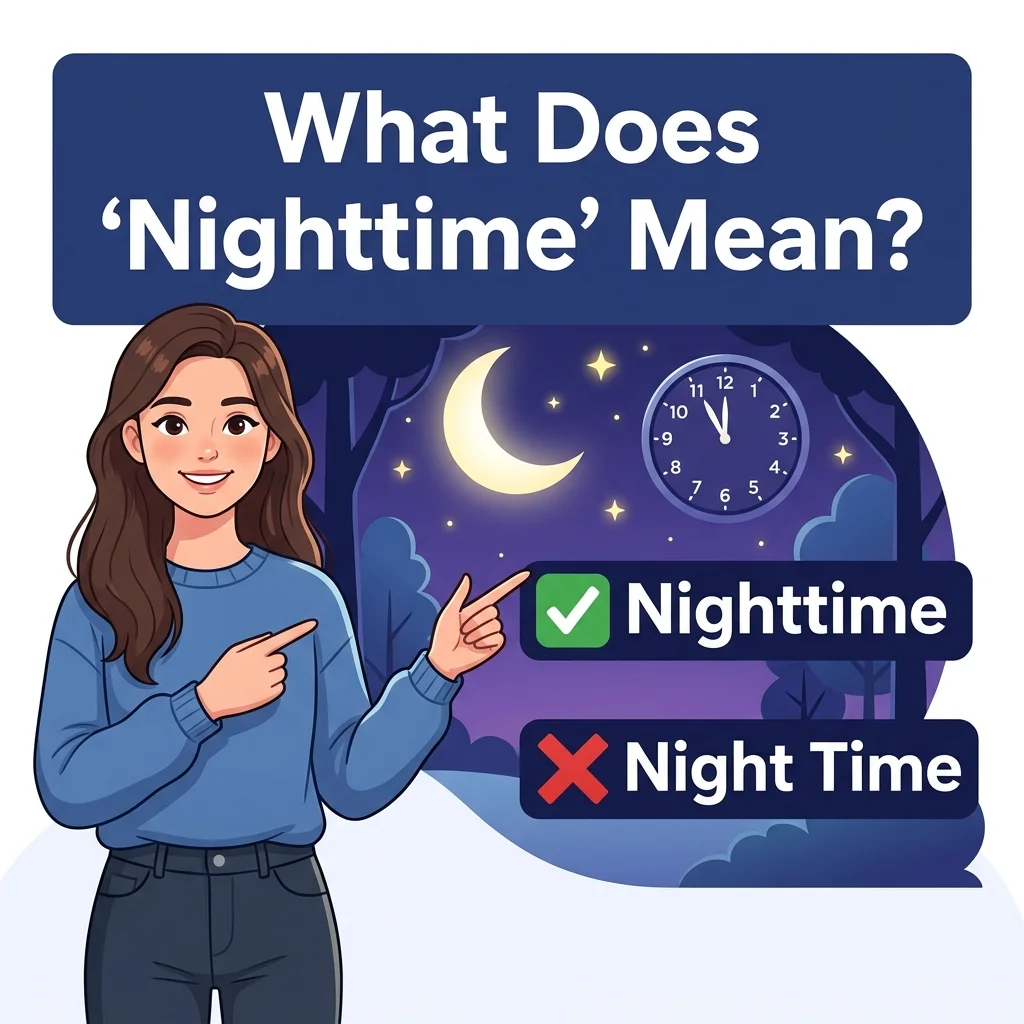
Nighttime means the period of the day when it is dark, generally between sunset and sunrise.
It is the opposite of daytime.
For example:
- Nighttime is peaceful in the countryside.
- Some animals are active mainly during nighttime.
- I usually sleep at nighttime.
- The city looks completely different at nighttime.
The word can function as a noun and can also be used as a modifier before another noun.
Nighttime as a Noun
When nighttime acts as a noun, it refers to the period of night.
Examples:
- Nighttime can be very peaceful.
- I love nighttime because the streets are quieter.
- Nighttime is when many people relax after work.
- The temperature drops significantly during nighttime.
In these sentences, nighttime names a period.
Nighttime as a Modifier
Nighttime can also describe another noun.
Examples:
- nighttime activities
- nighttime routine
- nighttime temperatures
- nighttime driving
- nighttime hours
- nighttime sounds
- nighttime animals
- nighttime photography
For example:
The city has strict rules about nighttime driving.
Here, nighttime describes driving.
Another example:
My nighttime routine includes reading for thirty minutes.
Here, nighttime describes routine.
Is “Nighttime” One Word?
Yes. Nighttime is a standard English compound word.
When you are using it to refer to the period of darkness, writing it as one word is generally the most natural choice.
Correct:
I enjoy nighttime walks.
Less natural:
I enjoy night time walks.
The one-word form is especially common in modern American English.
You will often see nighttime in dictionaries, books, websites, news articles, and everyday writing.
Is “Night Time” Two Words Correct?
It can be correct in certain contexts, but it is not normally the preferred spelling when you simply mean nighttime.
For example, a sentence such as:
Night time is my favorite time of the day.
may be understood, but nighttime is generally more natural:
Nighttime is my favorite time of the day.
However, there are situations where night and time may function independently.
Consider:
What time is it at night?
Here, time is a separate noun, and night is part of the phrase at night. You would not combine them into nighttime.
Similarly:
The night time was longer than expected.
This could theoretically be interpreted as a particular amount or period of time during the night, although a more natural sentence would usually be:
The nighttime period was longer than expected.
So, when the meaning is simply “the period of night,” nighttime is normally the better choice.
Nighttime vs Night Time: Main Difference
The biggest difference is grammatical and stylistic.
Nighttime is a recognized compound word. It directly means the period of darkness.
Night time treats night and time as two separate words. It may be understandable, but it is less common when the intended meaning is simply the general period of night.
Compare:
I like nighttime. ✅
I like night time. ⚠️
The first sentence sounds much more natural.
Another example:
Nighttime temperatures can become very low. ✅
Night time temperatures can become very low. ⚠️
Again, the one-word form is usually preferred.
Nighttime vs Night Time Comparison Table
| Feature | Nighttime | Night time |
| Number of words | One | Two |
| Standard compound word | Yes | Not usually |
| Means period of darkness | Yes | Sometimes |
| Common in modern English | Very common | Less common |
| Good for formal writing | Yes | Usually avoid when “nighttime” is meant |
| Good as an adjective | Yes | Less natural |
| Example | nighttime routine | night time routine |
| Recommended for general use | Yes | Usually no |
If you are unsure, choose nighttime when you mean the general period when it is dark.
When Should You Use “Nighttime”?
Use nighttime when you are referring generally to the period of the day between evening and morning.
For example:
Nighttime is my favorite part of the day.
Here, you are talking about the general period of night.
You can also use it with words such as:
- routine
- activities
- hours
- temperatures
- driving
- noise
- photography
- wildlife
- safety
- entertainment
Examples:
- My nighttime routine helps me relax.
- The park closes during nighttime hours.
- Some animals are easier to observe during nighttime.
- Nighttime temperatures can be surprisingly cold.
- Nighttime driving requires extra attention.
- We enjoy nighttime photography.
- The city has increased nighttime security.
In all of these examples, nighttime works naturally as one word.
When Can “Night Time” Appear?
Although nighttime is normally preferred, you may occasionally see night time in writing.
One reason is that English compound words can sometimes have variations depending on style, context, or editorial preference.
For example, a writer may deliberately separate the words:
The night time was divided into several periods.
However, this sentence sounds somewhat formal or unusual. A more natural version might be:
The nighttime period was divided into several periods.
Another possibility is that night modifies time in a specific expression.
For example:
What time at night do you usually go to bed?
Here, time and night are not functioning as the compound word nighttime.
The sentence means:
At what time during the night do you usually go to bed?
That is different from using nighttime as a single noun.
Nighttime as a Noun
One of the most common uses of nighttime is as a noun.
A noun names a person, place, thing, or idea. In this case, nighttime names a period.
Examples:
- Nighttime is quieter than daytime.
- I enjoy nighttime more than the morning.
- Nighttime can be dangerous for inexperienced drivers.
- The animals become active at nighttime.
- Nighttime brings cooler temperatures.
Notice that you can replace nighttime with something like the period of night.
For example:
Nighttime is peaceful.
means roughly:
The period of night is peaceful.
Nighttime as an Adjective
Although nighttime is commonly used as a noun, it can also act as a modifier.
For example:
nighttime routine
nighttime activities
In these phrases, nighttime tells us what kind of routine, activities, temperature, or photography we mean.
Consider:
I have a nighttime routine.
The word nighttime tells us that the routine happens at night.
Another example:
Nighttime temperatures are lower in winter.
Here, nighttime describes the temperatures that occur during the night.
Nighttime vs At Night
Another common question is whether you should say nighttime or at night.
Both are correct, but they are used differently.
At night is a prepositional phrase.
Nighttime is a noun or modifier.
Compare:
I usually read at night.
I enjoy nighttime reading.
Both sentences communicate a similar idea, but the grammar is different.
At Night
Use at night when talking about when something happens.
Examples:
- I work at night.
- She studies at night.
- The streets are quiet at night.
- We often watch movies at night.
Nighttime
Use nighttime when referring to the period itself or when modifying another noun.
Examples:
- Nighttime is peaceful.
- I enjoy nighttime walks.
- Nighttime temperatures are lower.
- My nighttime routine is simple.
This distinction makes your writing sound more natural.
Nighttime vs Evening
Nighttime and evening are related, but they are not exactly the same.
Evening usually refers to the period after the afternoon and before late night.
Nighttime generally refers to the darker period of the day, especially after evening.
For example:
I usually exercise in the evening.
I usually sleep at nighttime.
The exact boundaries are not always fixed because people use these terms differently depending on context.
A simple way to remember them is:
afternoon → evening → nighttime → morning
This is not a strict scientific timeline, but it works well for everyday English.
Nighttime vs Night
Another useful comparison is nighttime vs night.
Both can refer to the dark period of the day, but their grammatical behavior differs.
For example:
I work at night.
This is very natural.
You can also say:
I work during nighttime.
However, at night is often more natural than at nighttime in everyday conversation.
Compare:
I sleep at night. ✅
I sleep at nighttime. ✅
The second sentence is grammatically possible, but the first is usually more natural.
When talking casually about when something happens, at night is often the best choice.
When naming the period or creating a compound modifier, nighttime becomes more useful.
Nighttime vs Night-Time
You may sometimes see night-time written with a hyphen.
For example:
night-time activities
This form is found in some English varieties and editorial styles, particularly in British English.
However, nighttime is widely accepted and is especially common in American English.
If your goal is simple, modern, American English, use:
nighttime
For example:
Nighttime activities can be relaxing.
There is usually no need to add a hyphen.
Is “Nighttime” Formal or Informal?
Nighttime is standard English and can be used in both formal and informal writing.
You can use it in:
- school assignments
- blog posts
- professional writing
- emails
- websites
- articles
- conversations
- reports
- social media
For example:
Nighttime temperatures can affect road conditions.
This sentence would be appropriate in a formal article.
In casual conversation, you can also say:
I love nighttime walks.
So there is no need to avoid nighttime in formal writing.
Common Mistake: Writing “Night Time” Everywhere
One of the most common mistakes is assuming that because the phrase contains two meaningful words, it should always be written separately.
For example:
I love night time walks.
This is understandable, but:
I love nighttime walks.
is the more standard and natural choice.
Another example:
Night time activities are popular during summer.
Better:
Nighttime activities are popular during summer.
The one-word form is especially useful when nighttime modifies another noun.
Common Mistake: Using “Nighttime” Instead of “At Night”
Sometimes writers choose nighttime when at night would sound much more natural.
For example:
I usually study nighttime. ❌
The problem is not that nighttime is an incorrect word. The problem is its grammatical position.
Better:
I usually study at night. ✅
Or:
I usually study during nighttime. ✅
The first version sounds more natural for everyday English.
Another example:
She works nighttime. ❌
Better:
She works at night. ✅
Or:
She works during nighttime hours. ✅
The key is to choose the expression that fits the sentence structure.
Common Mistake: Using “At Nighttime” Unnecessarily
At nighttime is possible, but it can sound less natural than at night in many everyday sentences.
For example:
I like walking at night. ✅
I like walking at nighttime. ✅
Both are understandable. The first is generally more concise and natural.
When you simply want to say when an activity happens, at night is usually enough.
When you want to emphasize the period itself, nighttime can be useful.
Common Mistake: Confusing Nighttime With Midnight
Nighttime does not mean midnight.
Nighttime refers broadly to the period of night.
Midnight refers specifically to twelve o’clock at night.
For example:
The store is closed during nighttime.
This could refer to several hours.
But:
The meeting ended at midnight.
This refers to a specific time.
So you should not use these words interchangeably.
Common Mistake: Confusing Nighttime With Night Shift
Nighttime and night shift are also different.
Nighttime describes a period.
Night shift describes a work shift that takes place during the night.
For example:
The hospital is busy at nighttime.
My brother works the night shift.
You could say:
My brother works a nighttime shift.
But night shift is the more common expression when referring to employment.
Common Mistake: Adding a Hyphen Everywhere
Some writers use night-time because they have seen the hyphenated form somewhere.
The hyphenated version can be acceptable in certain style systems, but you do not need to use it in ordinary American English.
For general writing, choose:
nighttime
Instead of:
night-time
For example:
Nighttime temperatures are falling.
This is clean, simple, and standard.
Nighttime in Different Sentence Positions
You can place nighttime in several positions depending on what you want to say.
At the Beginning
Nighttime can be very peaceful.
In the Middle
I enjoy nighttime because the city becomes quieter.
Before a Noun
My nighttime routine is simple.
After a Preposition
The animals become active during nighttime.
However, remember that at night may sound more natural in some prepositional expressions.
25 Examples Using “Nighttime”
Here are some natural examples to help you understand how nighttime works.
- Nighttime is usually quieter than daytime.
- I enjoy taking walks during nighttime.
- My nighttime routine includes reading.
- Nighttime temperatures can fall quickly.
- Some animals are active mainly during nighttime.
- The city looks beautiful at nighttime.
- We avoid unnecessary nighttime driving.
- Nighttime photography requires patience.
- My children have a regular nighttime routine.
- The park becomes peaceful at nighttime.
- Nighttime activities can be relaxing.
- The hotel offers nighttime security.
- Nighttime noise can disturb nearby residents.
- I prefer nighttime walks to morning walks.
- Nighttime temperatures are often lower than daytime temperatures.
- The desert can become very cold at nighttime.
- Many insects become more active during nighttime.
- The city has improved nighttime lighting.
- We enjoy watching the stars during nighttime.
- Nighttime traffic is usually lighter.
- My nighttime skincare routine takes ten minutes.
- Nighttime wildlife is difficult to photograph.
- The area has special rules for nighttime events.
- Nighttime entertainment attracts many visitors.
- The quietness of nighttime helps me concentrate.
These examples show why the one-word spelling is so useful.
20 Examples With “At Night”
Because nighttime and at night can sometimes be confused, compare these examples:
- I usually sleep at night.
- She studies at night.
- The streets become quiet at night.
- We saw the moon at night.
- He works at night.
- The temperature drops at night.
- I enjoy reading at night.
- They travel less at night.
- The restaurant becomes busy at night.
- Some animals hunt at night.
- We could hear music at night.
- The city looks beautiful at night.
- I rarely go outside at night.
- She likes exercising at night.
- They arrived at night.
- The roads can be dangerous at night.
- He prefers working at night.
- The stars are visible at night.
- I often think more clearly at night.
- The neighborhood is peaceful at night.
In many of these sentences, at night is more natural than at nighttime.
Nighttime Routine: Why This Form Is Correct
One phrase where nighttime is especially common is nighttime routine.
A nighttime routine is a set of activities someone regularly does before sleeping.
For example:
My nighttime routine includes brushing my teeth, reading, and preparing for bed.
Here, nighttime modifies routine, so the one-word form works naturally.
Other examples include:
- nighttime skincare routine
- nighttime workout
- nighttime meditation
- nighttime reading
- nighttime preparation
- nighttime habits
You can also say night routine, but nighttime routine clearly emphasizes that the routine happens during the night.
Nighttime Activities
Nighttime activities are things people do during the night.
Examples include:
- reading
- watching movies
- stargazing
- photography
- walking
- studying
- working
- exercising
- traveling
- relaxing
Example:
Stargazing is one of my favorite nighttime activities.
Here, nighttime describes the activities.
Another example:
The city offers many nighttime activities for visitors.
Again, the one-word form is natural.
Nighttime Hours
The phrase nighttime hours is also common.
It refers to hours that occur during the night.
For example:
The store does not operate during nighttime hours.
You could also say:
The store does not operate at night.
Both are understandable, but nighttime hours is useful when you need to describe a specific category of hours.
Other examples:
- nighttime working hours
- nighttime business hours
- nighttime operating hours
- nighttime quiet hours
- nighttime security hours
Nighttime in American English
In American English, nighttime is a very common spelling.
If you are writing for a US audience, nighttime is generally the best choice.
For example:
Nighttime temperatures are expected to drop this week.
The hotel provides nighttime security.
I enjoy nighttime photography.
This one-word form is clear and familiar to American readers.
Nighttime in British English
British English may use night-time more often than American English in some writing styles.
However, nighttime is also recognized and used.
This means that the difference is partly a matter of spelling convention and editorial style.
If you are writing for a broad English-speaking audience, especially an American audience, nighttime is a simple choice.
The important thing is consistency. Do not randomly switch between nighttime, night-time, and night time throughout the same article unless there is a specific reason.
How to Remember “Nighttime”
A simple memory trick can help.
Think of these common compound words:
- daytime
- nighttime
- lunchtime
- bedtime
Notice how nighttime follows the same general pattern.
day + time = daytime
night + time = nighttime
This makes it easier to remember that the standard compound form is usually written as one word.
You can create a simple mental pair:
daytime ↔ nighttime
Both are normally written as one word.
Nighttime vs Daytime
The two words are opposites in many contexts.
| Daytime | Nighttime |
| Usually light | Usually dark |
| Sun is generally visible | Sun is below the horizon |
| Many people work | Many people sleep |
| Daytime activities | Nighttime activities |
| Daytime temperatures | Nighttime temperatures |
Examples:
Daytime temperatures are higher than nighttime temperatures.
The park is busy during the daytime but quiet during nighttime.
This comparison makes the spelling pattern easy to remember.
Nighttime vs Bedtime
Do not confuse nighttime with bedtime.
Nighttime refers to the period of night.
Bedtime refers to the time when someone normally goes to bed.
For example:
Nighttime begins after evening.
My bedtime is 10 p.m.
You can have a bedtime during nighttime, but the two words do not mean exactly the same thing.
Nighttime vs Midnight: Quick Table
| Word | Meaning | Example |
| Nighttime | General period of night | Nighttime is peaceful. |
| Night | Dark period of the day | I sleep at night. |
| Evening | Period after afternoon | We met in the evening. |
| Midnight | Exactly 12:00 a.m. | I went home at midnight. |
| Bedtime | Usual time for going to bed | My bedtime is 10 p.m. |
Understanding these differences will help you choose the right word naturally.
Grammar Tips for Using “Nighttime”
Here are some simple rules to keep in mind.
Use “Nighttime” as One Word
When you mean the general period of night, write:
nighttime
not:
night time
Use “At Night” for Simple Time Expressions
When explaining when an activity happens, at night is often the most natural choice.
I work at night.
Use “Nighttime” Before Nouns
When describing something connected to the night, nighttime is useful.
nighttime routine
nighttime activities
Stay Consistent
If you choose nighttime, use the same spelling throughout your article or document.
Consistency makes your writing look more professional.
Common Search Questions About Nighttime
People often search for this topic because they encounter different versions online. Here are some of the most common questions.
Is “nighttime” one word or two?
Nighttime is normally written as one word when it refers to the period of the night.
Example:
Nighttime is peaceful.
Is “night time” grammatically correct?
Night time can appear in certain contexts, but it is generally less common when you mean the general period of night. Nighttime is usually the preferred form.
Which is correct: nighttime or night time?
For most situations, nighttime is the better choice when referring to the period when it is dark.
Should I write “nighttime routine” or “night time routine”?
The standard and more natural form is nighttime routine.
Example:
I have a relaxing nighttime routine.
Is “nighttime” formal?
Yes. Nighttime is standard English and can be used in formal and informal writing.
Is “night-time” correct?
Yes, night-time can be found in some varieties and styles of English. However, nighttime is a common standard form, especially in American English.
Is “at nighttime” correct?
Yes. At nighttime can be grammatically correct, but at night is often more natural in everyday English.
Should I say “at night” or “at nighttime”?
Both can be correct.
I study at night.
I study at nighttime.
The first sentence is generally more natural and concise.
What is the opposite of nighttime?
The usual opposite is daytime.
Is nighttime the same as midnight?
No. Nighttime refers broadly to the night, while midnight refers specifically to 12:00 a.m.
Is nighttime the same as evening?
Not exactly. Evening usually comes before the later part of the night. Nighttime generally refers to the darker period of the day.
Why is nighttime one word?
Nighttime developed as a compound word combining night and time. Modern English commonly treats it as one word when referring to the period of night.
Conclusion
When you mean the general period of darkness between day and morning, nighttime is the standard and natural one-word form. It works as a noun and can also modify another noun.
The two-word form night time may appear in some contexts, but it is usually unnecessary when you simply mean the period of night. Similarly, night-time can be found in certain English varieties and editorial styles, but nighttime is a straightforward choice for standard American English.

Michael Collins is a skilled writer who creates clear, practical, and reader-friendly content. He focuses on language, grammar, word meanings, and everyday expressions, making complex topics simple to understand.