Words that look closely related can still play different roles in a sentence, and Complete or Completed is a common example. Both words describe something being finished, but their grammar and usage are not always interchangeable.
Knowing the difference can help you write clearer messages, emails, assignments, and everyday English. Complete can work as a verb or adjective. It may describe the action of finishing something or something that has all its necessary parts.
Completed usually describes something that has already been finished, often focusing on the result of an action. The correct choice depends on what you want to say and how the word functions in your sentence.
Complete vs Completed: Quick Answer
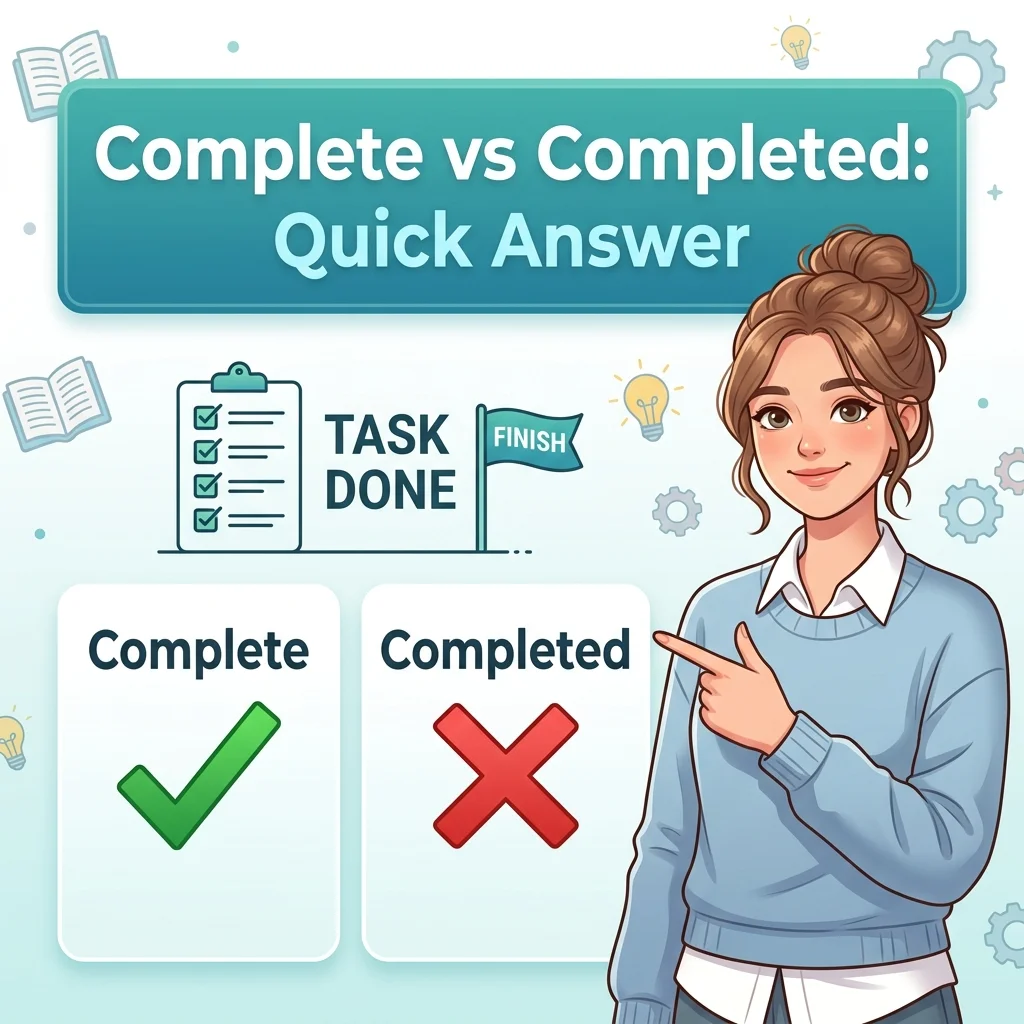
Complete is the base form of the verb, while completed is its past tense and past participle form.
However, complete can also be an adjective, meaning something is whole, finished, or containing everything needed. Completed can also describe something that has been finished.
| Word | Main Function | Basic Meaning | Example |
| Complete | Verb / adjective | Finish or whole | Please complete the task. |
| Completed | Past tense / past participle / adjective | Finished | I completed the task yesterday. |
| Complete | Adjective | Whole or entire | We have a complete report. |
| Completed | Adjective | Finished | The completed report is ready. |
A simple rule is:
Use “complete” for the base form or present-related meaning, and “completed” when the action has already been finished.
For example:
I need to complete my homework.
The homework still needs to be finished.
I completed my homework.
The homework is already finished.
What Does “Complete” Mean?
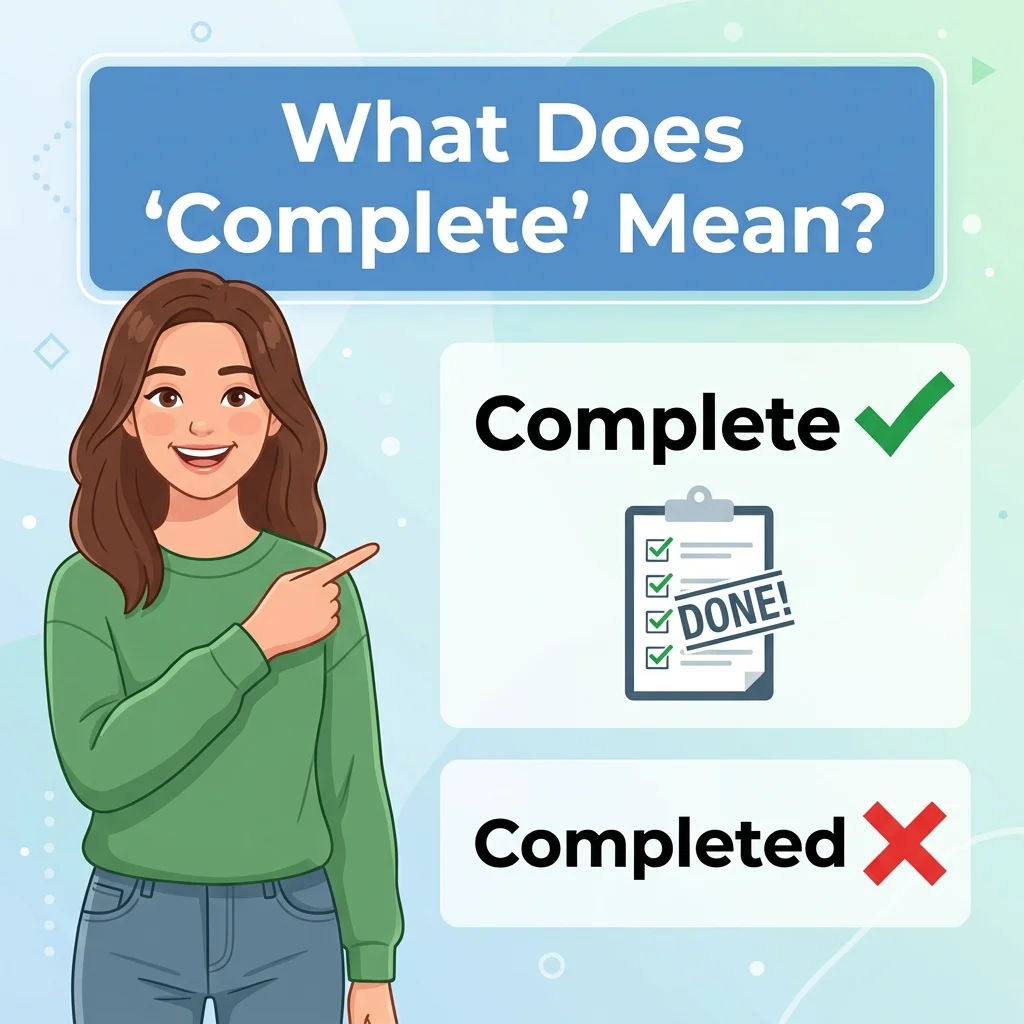
Complete generally means to finish something or to make something whole or finished.
As a verb, it describes an action.
For example:
Please complete this application.
Here, complete means finish filling out the application.
As an adjective, complete means whole, entire, or having all necessary parts.
For example:
We need a complete list of names.
Here, complete does not describe an action. It describes the list. The list should contain all the necessary names.
So, when you see complete, always look at how it functions in the sentence.
Complete as a Verb
As a verb, complete means to finish an activity, task, process, or requirement.
Examples:
- Please complete the assignment.
- I need to complete this form.
- She will complete the project tomorrow.
- They complete their work on time.
- You must complete all sections.
In these examples, complete describes an action.
Complete as an Adjective
As an adjective, complete means whole, full, or containing everything required.
Examples:
- This is a complete guide.
- We need a complete answer.
- She gave me a complete explanation.
- The collection is complete.
- He provided a complete list.
Here, complete describes a noun.
What Does “Completed” Mean?
Completed is the past tense and past participle form of the verb complete.
It normally means that an action has already happened or has been finished.
For example:
I completed the assignment.
This means I finished the assignment.
Another example:
She completed the project last week.
The action happened in the past and is now finished.
Completed can also function as an adjective.
For example:
The completed project was submitted to the manager.
Here, completed describes the project. It tells us that the project is finished.
Complete vs Completed in Simple Terms
The easiest way to understand the difference is to think about time.
Complete often refers to something that needs to happen, is happening as a general action, or describes something that is whole.
Completed usually refers to something that happened in the past or something that has already been finished.
Compare:
I need to complete the report.
The report is not finished yet.
I completed the report.
The report is finished.
Another pair:
Please complete the form.
You are asking someone to finish the form.
I completed the form.
You are saying that you already finished it.
This small difference changes the meaning of the sentence.
Complete or Completed: Grammar Difference
The grammatical difference becomes clearer when you look at verb forms.
The main forms of complete are:
| Form | Example |
| Base form | complete |
| Third-person singular | completes |
| Present participle | completing |
| Past tense | completed |
| Past participle | completed |
Because complete is a regular verb, you normally create the past tense by adding -d:
complete → completed
For example:
I complete my work every day.
Past:
I completed my work yesterday.
Present continuous:
I am completing my work now.
Present perfect:
I have completed my work.
Understanding these forms will help you choose between complete and completed correctly.
When to Use “Complete”
There are several common situations where complete is the correct choice.
Use “Complete” for Present Actions
Use complete when talking about something that happens regularly or as a general action.
For example:
I complete my daily tasks before lunch.
This describes a routine.
Another example:
Employees complete the training every year.
The sentence describes something that regularly happens.
With third-person singular subjects, use completes:
She completes her assignments on time.
Not:
She complete her assignments on time. ❌
Use “Complete” for Future Actions
You can also use complete when talking about something that will happen in the future, especially after modal verbs or future expressions.
For example:
I will complete the project tomorrow.
You should complete the form before Friday.
He can complete the task by noon.
Notice that after will, should, and can, we use the base form complete, not completed.
Correct:
I will complete the work tomorrow. ✅
Incorrect:
I will completed the work tomorrow. ❌
Use “Complete” for Instructions
When giving instructions or commands, use the base form.
For example:
Complete the form carefully.
Complete all the questions.
Please complete your registration.
Complete the assignment before Monday.
This is because commands normally use the base form of the verb.
Use “Complete” With “To”
After to, use the base form complete.
Examples:
- I need to complete the report.
- She wants to complete the course.
- We plan to complete the project soon.
- He hopes to complete the training.
- They need to complete the application.
Incorrect:
I need to completed the report. ❌
Correct:
I need to complete the report. ✅
When to Use “Completed”
Use completed when you are talking about an action that happened in the past or when you need the past participle form.
Completed for Simple Past
Use completed for an action that finished in the past.
Examples:
I completed my homework last night.
She completed the project yesterday.
They completed the construction in June.
He completed the course last year.
Words such as yesterday, last week, last year, and two days ago often indicate that the simple past form is appropriate.
Completed With “Have,” “Has,” or “Had”
Completed is also the past participle used with helping verbs such as have, has, and had.
Examples:
I have completed the assignment.
She has completed the training.
They have completed the project.
He had completed the work before the meeting started.
Here, complete would not be correct.
Incorrect:
I have complete the assignment. ❌
Correct:
I have completed the assignment. ✅
Completed in Passive Voice
Completed is also commonly used in passive constructions.
For example:
The project was completed on time.
The form was completed by the applicant.
The work has been completed.
The building will be completed next year.
In these sentences, the subject receives the action rather than performing it.
Complete vs Completed as Adjectives
Both complete and completed can describe nouns, but their meanings are slightly different.
Complete often emphasizes that something contains everything necessary or is whole.
Completed emphasizes that an activity, task, or process has been finished.
Compare:
We received a complete report.
This means the report contains all the required information.
We received a completed report.
This emphasizes that someone finished preparing the report.
These meanings can overlap, but they are not exactly the same.
Examples With “Complete” as an Adjective
- a complete sentence
- a complete report
- a complete list
- a complete collection
- a complete explanation
- a complete set
- a complete answer
- a complete guide
- a complete package
- a complete solution
For example:
The teacher asked for a complete answer.
This means the answer should contain all the necessary information.
Examples With “Completed” as an Adjective
- a completed form
- a completed application
- a completed project
- a completed assignment
- a completed report
- a completed task
- a completed course
- a completed survey
For example:
Please submit the completed application.
The application has already been filled out.
Complete vs Completed: Important Comparison
| Situation | Correct Form | Example |
| Giving an instruction | Complete | Complete the form. |
| Talking about a past action | Completed | I completed the form. |
| After “to” | Complete | I need to complete the form. |
| After “will” | Complete | I will complete the form. |
| After “have” | Completed | I have completed the form. |
| After “has” | Completed | She has completed the form. |
| After “had” | Completed | He had completed the form. |
| Passive voice | Completed | The form was completed. |
| Describing something whole | Complete | We need a complete report. |
| Describing something finished | Completed | We need the completed report. |
This table gives you a quick way to identify the right form.
Complete vs Completed in Questions
Both words can appear in questions, but the structure determines which one you need.
Questions With “Complete”
Use complete after helping verbs such as do, does, will, can, should, and did.
For example:
Did you complete the assignment?
Notice that even though the question refers to the past, we use complete after did.
Why?
Because did already carries the past tense.
Incorrect:
Did you completed the assignment? ❌
Correct:
Did you complete the assignment? ✅
More examples:
- Did she complete the course?
- Did they complete the project?
- Will you complete the form?
- Can he complete the task?
- Should I complete this section?
- Does she complete her work on time?
Questions With “Completed”
Use completed with structures such as have, has, and had.
Examples:
Have you completed the assignment?
Has she completed the application?
Had they completed the project before the deadline?
These structures are grammatically different from questions using did.
Compare:
Did you complete the report?
Have you completed the report?
Both can be correct, but they use different verb structures and can carry slightly different time meanings.
Complete vs Completed in Negative Sentences
Negative sentences also follow specific grammar patterns.
After do not, does not, and did not, use complete, not completed.
Correct:
I did not complete the assignment.
Incorrect:
I did not completed the assignment. ❌
Why? The auxiliary verb did already shows past tense.
More examples:
She does not complete the form.
They did not complete the project.
He will not complete the task today.
However, with have not or has not, use completed.
I have not completed the assignment.
She has not completed the form.
This distinction is important for avoiding common grammar errors.
Complete or Completed After “To”
One of the easiest rules to remember is this:
After “to,” use complete, not completed.
Examples:
I want to complete the course.
She needs to complete the application.
They plan to complete the work soon.
He hopes to complete the project this month.
Incorrect:
I want to completed the course. ❌
Correct:
I want to complete the course. ✅
The same rule applies to many other verbs followed by to + verb.
Complete or Completed After Modal Verbs
Modal verbs are another important area.
After modal verbs such as:
- can
- could
- will
- would
- should
- may
- might
- must
use the base form complete.
Examples:
I will complete the assignment.
She can complete the task.
They should complete the form.
He must complete the training.
Incorrect:
She can completed the task. ❌
Correct:
She can complete the task. ✅
The modal verb is followed by the base form.
Complete or Completed With “Did”
This is one of the most common mistakes English learners make.
Because did is a past-tense helping verb, the main verb returns to its base form.
Correct:
Did you complete the work?
Incorrect:
Did you completed the work?
Compare these sentences:
You completed the work.
Did you complete the work?
In the first sentence, completed carries the past tense.
In the second sentence, did carries the past tense, so the main verb becomes complete.
This rule applies to many regular and irregular verbs, not just complete.
Complete or Completed With “Have”
When using have, has, or had as auxiliary verbs, use the past participle completed.
Examples:
I have completed my work.
She has completed her assignment.
They had completed the project before the deadline.
Incorrect:
I have complete my work. ❌
Correct:
I have completed my work. ✅
A useful pattern is:
have/has/had + completed
This creates perfect tenses.
Complete vs Completed in Passive Voice
Passive voice often uses completed.
For example:
The project was completed yesterday.
Here, the project did not perform the action. Someone completed it.
Other examples include:
- The form was completed by the student.
- The building was completed last year.
- The assignment has been completed.
- The application was completed correctly.
- The work will be completed soon.
Notice the different structures:
was completed
has been completed
will be completed
In each case, completed is the past participle.
“Complete” vs “Completed” With Projects
The difference becomes especially clear when talking about projects.
The project is complete.
This means the project is finished or in a finished state.
I completed the project.
This means I finished the project.
The project was completed by the team.
This uses passive voice and emphasizes the project rather than the people who finished it.
The completed project was submitted yesterday.
Here, completed acts as an adjective describing the project.
These four sentences are closely related but have different grammatical structures.
“Complete” vs “Completed” With Forms
Forms are another common example.
Please complete the form.
This is an instruction.
I completed the form.
This tells us the action happened in the past.
I have completed the form.
This tells us the form is finished and connects the completed action to the present.
Please send me the completed form.
Here, completed describes the form.
Understanding these patterns makes the difference much easier to remember.
Complete or Completed: Common Mistakes
English learners often make predictable mistakes with these two forms.
Mistake 1: Using “Completed” After “Did”
Incorrect:
Did you completed the assignment?
Correct:
Did you complete the assignment?
Remember:
Did + base verb
Mistake 2: Using “Complete” After “Have”
Incorrect:
I have complete the project.
Correct:
I have completed the project.
Remember:
Have/has/had + past participle
Mistake 3: Using “Completed” After “To”
Incorrect:
I need to completed the form.
Correct:
I need to complete the form.
Remember:
to + base verb
Mistake 4: Using “Completed” After a Modal
Incorrect:
She will completed the work tomorrow.
Correct:
She will complete the work tomorrow.
Remember:
modal + base verb
Mistake 5: Confusing “Complete” and “Completed” as Adjectives
Compare:
We need a complete report.
This means the report should contain everything necessary.
We need the completed report.
This means the report has already been finished.
The context tells you which adjective is appropriate.
Complete or Completed: Spelling Tip
The spelling change is straightforward:
Complete + d = completed
Because complete already ends in e, you generally add d, not -ed after removing the final e.
So:
complete → completed
Not:
complete → completeed ❌
Examples:
- create → created
- decide → decided
- graduate → graduated
- relate → related
- complete → completed
The pronunciation also changes slightly.
Complete ends with a long -eet sound.
Completed has an additional -id syllable at the end.
You do not need to overthink the pronunciation, but hearing the difference can help you recognize the forms.
Complete vs Completed in Everyday Sentences
Here are some natural examples to help you understand the difference.
At School
Please complete your homework before class.
I completed my homework last night.
Have you completed the assignment?
The completed assignment is on the teacher’s desk.
At Work
I need to complete this report.
I completed the report yesterday.
She has completed the required training.
The completed report was sent to the manager.
In Business
Customers must complete the registration process.
The customer completed the registration yesterday.
The application has been completed successfully.
We received the completed application this morning.
In Daily Life
I need to complete my shopping list.
I completed everything on my list.
Have you completed your chores?
The completed checklist is on the table.
25 Examples With “Complete”
Here are several examples where complete is the correct choice:
- Please complete the form.
- I need to complete my homework.
- She wants to complete the course.
- We will complete the project tomorrow.
- You should complete the application today.
- He can complete the task by noon.
- They must complete the training.
- Did you complete the assignment?
- Please complete all the questions.
- I hope to complete the work soon.
- She plans to complete her degree.
- You need to complete this section.
- Can you complete the report?
- We should complete the process carefully.
- He will complete the job next week.
- I want to complete the checklist.
- They need to complete registration.
- Did she complete the survey?
- You can complete the form online.
- Please complete your profile.
- We must complete the final step.
- He hopes to complete the training.
- She will complete the assignment tonight.
- Did they complete the construction?
- Please complete the required fields.
Notice that complete appears after modal verbs, to, commands, and auxiliary verbs such as did.
25 Examples With “Completed”
Here are examples where completed is correct:
- I completed the form yesterday.
- She completed her homework.
- He completed the project last week.
- They completed the training.
- We completed the assignment on time.
- I have completed the report.
- She has completed the course.
- They had completed the work before lunch.
- The project was completed yesterday.
- The form has been completed.
- The building was completed last year.
- He completed the application successfully.
- We have completed all the required steps.
- She completed her degree in 2025.
- They completed the construction early.
- The completed form is ready.
- Please send the completed application.
- The completed project looks excellent.
- I submitted the completed assignment.
- The completed report was reviewed.
- He has completed his training.
- She had completed the task before I arrived.
- The work was completed on schedule.
- The completed checklist was submitted.
- We have completed the final stage.
Complete vs Completed in Different Tenses
Understanding verb tense is one of the best ways to choose between these forms.
| Tense | Example |
| Simple present | I complete my work every day. |
| Simple past | I completed my work yesterday. |
| Simple future | I will complete my work tomorrow. |
| Present continuous | I am completing my work now. |
| Present perfect | I have completed my work. |
| Past perfect | I had completed my work before lunch. |
| Future perfect | I will have completed my work by Friday. |
Notice that complete is used in the base form in some structures, while completed appears in past and perfect constructions.
Complete vs Completed: Which One Should You Use?
When you are unsure, ask yourself a few simple questions.
Is Someone Being Asked to Finish Something?
Use complete.
Please complete the form.
Did the Action Happen in the Past?
Use completed.
I completed the form yesterday.
Does the Sentence Use “Have,” “Has,” or “Had”?
Use completed.
She has completed the form.
Does the Sentence Use “Did”?
Use complete.
Did she complete the form?
Does the Sentence Use “Will,” “Can,” “Should,” or “Must”?
Use complete.
She will complete the form.
Are You Describing Something as Whole?
Use complete.
We need a complete report.
Are You Describing Something That Has Been Finished?
Use completed.
Please send the completed report.
This simple checklist can help you make the correct choice quickly.
Complete vs Finished
Another word that often causes confusion is finished.
In many contexts, complete and finish have similar meanings.
For example:
I completed my homework.
I finished my homework.
Both mean that the homework was done.
However, complete can also mean whole or entire, while finish generally focuses more directly on bringing an activity to an end.
For example:
I need the complete report.
This means you need the entire report.
You cannot always replace complete with finished in that meaning.
I need the finished report has a different focus. It means you need the report after it has been prepared.
Complete vs Completed vs Finished
| Word | Main Meaning | Example |
| Complete | Finish / whole | Please complete the form. |
| Completed | Finished action/state | I completed the form. |
| Finished | Brought to an end | I finished the form. |
The context determines which word sounds most natural.
Complete vs Completed in Formal Writing
Both forms are completely acceptable in formal English.
For example:
Applicants must complete all required sections.
This sounds professional and direct.
You could also write:
All required sections must be completed.
The first sentence uses active voice.
The second sentence uses passive voice.
Both are grammatically correct.
In many situations, active voice is clearer because it tells the reader who needs to perform the action.
Compare:
You must complete the application.
The application must be completed.
The first sentence directly tells the reader what to do.
Complete vs Completed in Emails
Both words are common in professional emails.
For example:
Please complete the attached form and return it by Friday.
After you finish it, someone might write:
I have completed the attached form and returned it for review.
You might also receive an email saying:
Your application has been completed successfully.
These examples demonstrate how the grammatical form changes according to the intended meaning.
Complete vs Completed in Instructions
Instructions usually use complete because they tell someone what action to perform.
Examples:
- Complete the form.
- Complete all required fields.
- Complete the survey.
- Complete the registration process.
- Complete the payment.
- Complete the final step.
- Complete the assignment.
- Complete the application.
You would not normally write:
Completed the form.
as a standard instruction.
Instead:
Complete the form.
Complete vs Completed in Titles and Labels
You may see both forms in labels, documents, and interfaces.
For example:
Complete Profile
This can mean an action the user should take.
Completed Profile
This can describe a profile that has already reached the finished state.
Similarly:
Complete Application
may refer to an application containing all necessary information.
Completed Application
usually refers to an application that someone has already filled out.
Context matters greatly in short labels.
How to Remember the Difference
A simple memory trick can make this distinction easier.
Think of complete as an action or a description of something whole.
Think of completed as something that has already reached the finish line.
For example:
I need to complete the project.
The project is still waiting to be finished.
I completed the project.
The project has crossed the finish line.
You can also remember this pattern:
Need to complete → already completed
For example:
I need to complete my assignment.
Then:
I completed my assignment.
This simple contrast works for many everyday situations.
Quick Grammar Test
Try choosing the correct word in each sentence.
- I need to ___ the form.
- She ___ the form yesterday.
- Did you ___ the application?
- He has ___ the assignment.
- We will ___ the project tomorrow.
- The ___ project was submitted.
- Please ___ all required fields.
- They had ___ the work before noon.
The answers are:
- complete
- completed
- complete
- completed
- complete
- completed
- complete
- completed
If you understand why these answers work, you have a strong grasp of the difference between complete and completed.
Frequently Asked Questions About Complete or Completed
Is “complete” or “completed” correct?
Both are correct words, but they are used differently. Complete is the base form of the verb and can also be an adjective. Completed is the past tense and past participle of complete and can also function as an adjective.
What is the difference between complete and completed?
Complete generally refers to the base verb or something that is whole. Completed usually indicates that an action has already been finished.
For example:
I need to complete the work.
I completed the work.
Is it correct to say “I have complete”?
No. After have or has, you normally need the past participle.
Correct:
I have completed the work.
Incorrect:
I have complete the work.
Is “I completed” grammatically correct?
Yes. Completed is the simple past form of complete.
For example:
I completed the assignment yesterday.
Is “I complete” grammatically correct?
Yes. Complete is the present-tense base form.
For example:
I complete my tasks every morning.
With he, she, or it, use completes:
She completes her work on time.
Should I say “Did you complete” or “Did you completed”?
The correct form is:
Did you complete?
After did, use the base form of the verb.
Should I say “Have you complete” or “Have you completed”?
The correct form is:
Have you completed?
After have or has in the perfect tense, use the past participle.
Is “completed” a verb?
Yes. Completed is the past tense and past participle form of the verb complete.
For example:
She completed the project.
Is “complete” an adjective?
Yes. Complete can be an adjective meaning whole, entire, or containing all necessary parts.
For example:
This is a complete set.
Is “completed” an adjective?
Yes. Completed can function as an adjective when it describes something that has been finished.
For example:
Please submit the completed form.
Which is correct: “complete the task” or “completed the task”?
Both can be correct depending on the sentence.
Please complete the task.
I completed the task.
The first is an instruction. The second describes a past action.
Can I say “the complete project”?
Yes. Complete project can mean the entire project or a project containing all its necessary parts.
For example:
I read the complete project report.
Can I say “the completed project”?
Yes. Completed project means the project has been finished.
For example:
The completed project was submitted yesterday.
What is the difference between “complete” and “finish”?
They can have similar meanings when talking about completing an activity.
I completed the assignment.
I finished the assignment.
However, complete can also mean whole or entire, which gives it an additional meaning that finish does not always have.
Final Conclusion
The difference between complete and completed becomes much easier once you understand their grammatical roles.
Complete is the base form of the verb. You use it for instructions, after to, after modal verbs, and in present-tense structures. It can also work as an adjective meaning whole or entire.

Daniel Carter is a passionate writer who creates clear, helpful, and easy-to-understand content. He focuses on language, grammar, word meanings, and everyday expressions, helping readers find simple answers to common questions.