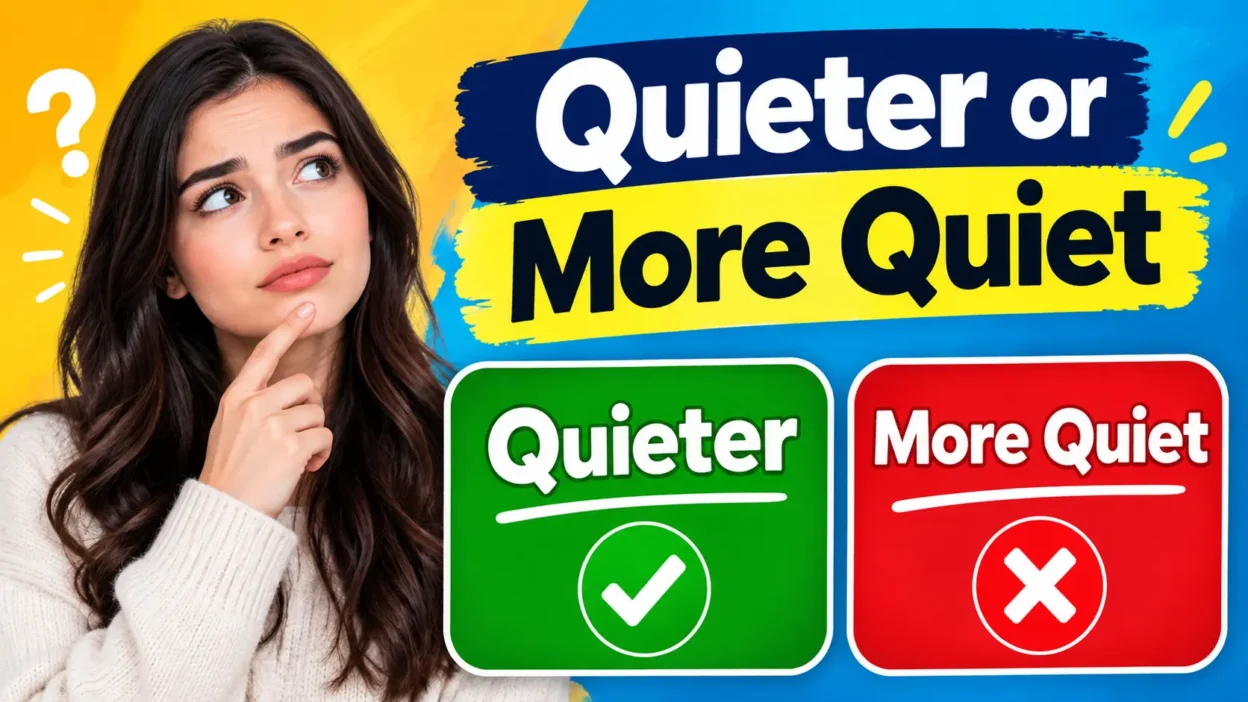
Finding the right comparative form can make your English sound much more natural. “Quieter” and “more quiet” both appear in English, but “quieter” is generally the more common and natural choice when comparing how silent or calm something is. For example, you can say, “This room is quieter than the other one.”
The adjective quiet usually forms its comparative as quieter, following the common pattern of adding -er to short adjectives. However, “more quiet” is also used, particularly when someone wants to emphasize the comparison or when the phrase sounds better in a particular sentence.
If you’re unsure whether to say “quieter or more quiet,” the context can help you choose the most natural option. In this guide, we’ll explain the difference between the two forms, show clear examples, and help you understand when to use each one.
Quieter or More Quiet: Which Is Correct? 🤫
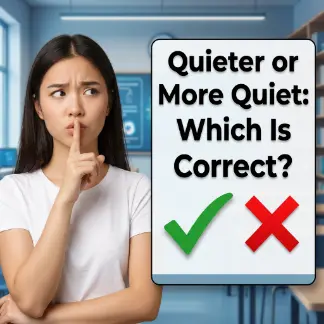
“Quieter” is generally the preferred comparative form of “quiet.” When comparing two people, places, objects, or situations, “quieter” is usually the natural choice.
For example:
- This library is quieter than the cafeteria.
- My new neighborhood is quieter at night.
- Please speak quieter when the baby is sleeping.
- The second classroom is quieter than the first.
“More quiet” is not necessarily incorrect. It can be used in certain contexts, although it sounds less natural to many speakers than “quieter.”
Compare these sentences:
The room is quieter now.
The room is more quiet now.
Both can communicate the same basic idea, but the first sentence is more concise and is normally the better choice.
Quick Answer
If you are unsure which form to use, choose “quieter.”
Quiet → quieter → quietest
This follows the common comparative pattern used with many short adjectives.
What Does “Quiet” Mean? 🤫
The adjective “quiet” describes something that makes little or no noise. It can also describe someone who does not talk much or an environment that feels peaceful and calm.
For example:
- The room is quiet.
- She is a quiet person.
- The street becomes quiet after midnight.
- Please keep the classroom quiet.
The word quiet can describe both physical sound and personal behavior.
When you want to compare one person or thing with another, you need the comparative form.
That gives us:
Quiet → Quieter
For example:
The library is quiet.
When comparing it with another place:
The library is quieter than the coffee shop.
What Does “Quieter” Mean? 🤫
Quieter is the comparative form of quiet. It means that something or someone makes less noise or is less talkative than another person or thing.
For example:
My office is quieter than yours.
This means that your office has less noise than the other office.
Another example:
The street is quieter in the morning.
Here, “quieter” compares the level of noise with another time, usually implying that the street has less noise in the morning.
Examples of “Quieter”
- This room is quieter than the kitchen.
- Can you speak quieter?
- The park is quieter during the winter.
- My new apartment is quieter than my old one.
- The children became quieter after lunch.
- This keyboard is quieter than my old keyboard.
- The neighborhood feels quieter at night.
In most ordinary situations, quieter is the form you should choose.
What Does “More Quiet” Mean? 🤫
More quiet has essentially the same basic meaning as quieter. It indicates a greater degree of quietness.
For example:
This room is more quiet than the other one.
The sentence is understandable, but many speakers would naturally say:
This room is quieter than the other one.
The second version is shorter and more conventional.
However, more quiet can sometimes appear naturally when a writer or speaker wants to give special emphasis to the adjective quiet.
For example:
After everyone left, the house became more quiet and peaceful.
This can work, although quieter would still be a very natural alternative:
After everyone left, the house became quieter and more peaceful.
Quieter vs. More Quiet: Main Difference 🤫
The biggest difference is not really meaning. Both forms can express comparison.
The main difference is usage and naturalness.
| Form | Meaning | Commonness | Example |
| Quiet | Having little noise | Very common | The room is quiet. |
| Quieter | Less noisy than something else | Very common | The room is quieter than before. |
| More quiet | Having a greater degree of quietness | Less common | The room is more quiet now. |
| Quietest | Having the least noise among three or more | Common | This is the quietest room. |
| Most quiet | Alternative superlative form | Less common | This is the most quiet room. |
For normal everyday English, the safest pattern is:
quiet → quieter → quietest
Why Do We Say “Quieter”? 🤫
English has several ways to form comparative adjectives.
For many short adjectives, we add -er.
Examples include:
- tall → taller
- small → smaller
- fast → faster
- slow → slower
- clean → cleaner
- quiet → quieter
Because quiet is a relatively short adjective, quieter is a natural comparative form.
The same pattern appears with many other common adjectives.
For example:
This road is narrower than that road.
Similarly:
This road is quieter than that road.
The structure is straightforward:
adjective + -er + than
So:
quiet + er + than = quieter than
Is “More Quiet” Grammatically Correct? 🤫
Yes, “more quiet” can be grammatically acceptable, but it is usually less common than “quieter.”
The important point is that “more quiet” should not automatically be labeled as wrong.
English allows some adjectives to appear with either -er or more, particularly when different varieties of English or stylistic preferences are involved.
However, if your goal is to write natural, simple, standard English, quieter is usually the better choice.
For example:
Natural:
This library is quieter than the one downtown.
Possible but less usual:
This library is more quiet than the one downtown.
The first sentence is normally preferable.
When Should You Use “Quieter”? 🤫
Use quieter when you are making a straightforward comparison.
It works especially well when the sentence contains than.
Example 1
My bedroom is quieter than the living room.
You are comparing two rooms.
Example 2
The office became quieter than it was in the morning.
You are comparing two situations or times.
Example 3
This street is quieter than the main road.
You are comparing two locations.
Example 4
He became quieter than usual after the meeting.
Here, “quieter” describes a person’s behavior.
Example 5
The second machine is quieter than the first one.
Here, the comparison concerns sound.
When Can “More Quiet” Be Used? 🤫
Although quieter is normally preferred, there are situations where more quiet can work.
One reason is emphasis.
For example:
I want something more quiet and relaxing.
The speaker may be emphasizing the quality of being quiet rather than simply making a direct grammatical comparison.
Another possibility is sentence rhythm.
For example:
The room was more quiet, more comfortable, and more peaceful after the guests left.
A writer may choose “more quiet” to maintain a particular parallel structure.
Even in these cases, however, quieter may still be perfectly natural:
The room was quieter, more comfortable, and more peaceful after the guests left.
Quieter or More Quiet in American English 🤫
In American English, quieter is the normal comparative form.
For example:
Is there a quieter place where we can talk?
This sounds completely natural.
You may also hear:
Can we find somewhere more quiet?
This is understandable and can occur in speech, but quieter is generally the more concise choice.
If you are writing an article, essay, business message, school assignment, or formal document, quieter is usually the safer option.
Quieter or More Quiet in British English 🤫
British English also commonly uses quieter.
For example:
This village is much quieter in the winter.
The form more quiet can still occur, but it is not normally necessary simply because you are using British English.
Therefore, speakers of both American and British English can comfortably use:
quieter
The main rule remains the same.
Quieter vs. Quietest 🤫
One common mistake is confusing the comparative and superlative forms.
Quieter compares two things.
Quietest normally compares three or more things or identifies one thing as having the greatest degree of quietness within a group.
Two things
This room is quieter than that room.
Three or more things
This is the quietest room in the building.
The pattern is:
Quiet → quieter → quietest
Examples:
- quiet
- quieter
- quietest
Do not use quietest when you are simply comparing two things.
More Quiet vs. Most Quiet 🤫
If you choose the more/most structure, the corresponding forms are:
more quiet → most quiet
For example:
This room is more quiet than the other room.
And:
This is the most quiet room in the building.
These sentences can be understood, but quieter and quietest are generally more natural:
This room is quieter than the other room.
This is the quietest room in the building.
So, when in doubt, remember:
Quieter is usually better than more quiet.
Quietest is usually better than most quiet.
Quieter in Everyday Conversations 🤫
You will often hear quieter in everyday speech.
Imagine you are studying in a busy café. You might ask:
Is there somewhere quieter?
That sentence sounds natural and conversational.
You could technically say:
Is there somewhere more quiet?
But most speakers would probably choose:
Is there somewhere quieter?
Similarly, if you are looking for a peaceful neighborhood, you might say:
I want to move somewhere quieter.
That sounds much more natural than:
I want to move somewhere more quiet.
Examples of Quieter in Sentences 🤫
Here are several examples to help you understand how quieter works.
Example 1: Places
The library is quieter than the cafeteria.
Example 2: People
John has become quieter since he started working from home.
Example 3: Machines
This washing machine is quieter than our old one.
Example 4: Neighborhoods
We are looking for a quieter neighborhood.
Example 5: Times
The streets are quieter after midnight.
Example 6: Animals
The cat became quieter after eating.
Example 7: Classrooms
The classroom was much quieter after the teacher arrived.
Example 8: Conversations
We moved to another table because we wanted a quieter place to talk.
Example 9: Technology
These headphones have a quieter background than my old pair.
Example 10: Work
I need a quieter environment to concentrate.
Notice that quieter can appear before a noun or after a linking verb.
“Quieter Than” Correct Usage 🤫
The phrase “quieter than” is especially common when making a direct comparison.
The basic structure is:
Subject + be + quieter + than + comparison
For example:
This room is quieter than the next room.
You can also use other verbs:
The neighborhood became quieter than usual.
Or:
The children grew quieter than before.
More Examples
- My new office is quieter than my old office.
- This fan is quieter than the previous model.
- The city is quieter than I expected.
- She is quieter than her brother.
- The restaurant is quieter than it looks.
- The beach is quieter than the downtown area.
“Much Quieter” and “A Little Quieter” 🤫
You can use words such as much, far, a little, and slightly before “quieter” to show the size of the difference.
For example:
This room is much quieter than the other one.
This means the difference is significant.
You can also say:
This room is a little quieter than the other one.
This means the difference is small.
Other examples include:
- far quieter
- slightly quieter
- considerably quieter
- noticeably quieter
- significantly quieter
- somewhat quieter
For example:
The countryside is considerably quieter than the city.
“Quieter” Before a Noun 🤫
You can place quieter directly before a noun.
Examples:
We need a quieter room.
She moved to a quieter neighborhood.
I bought a quieter fan.
They are searching for a quieter restaurant.
He wants a quieter workplace.
This structure is extremely common.
The adjective tells you that the noun has less noise than another possible option.
“Quieter” After a Linking Verb 🤫
You can also place quieter after verbs such as become, seem, feel, look, and grow.
Examples:
The house became quieter.
The street seems quieter today.
The office feels quieter in the afternoon.
The classroom grew quieter.
The neighborhood looks quieter than before.
These constructions are natural and useful in both conversation and writing.
Common Mistakes With Quieter 🤫
Even though the rule is simple, learners sometimes make mistakes when using quieter.
Mistake 1: Using “more quieter”
One of the most common errors is combining both comparative markers.
Incorrect:
This room is more quieter than that one.
Correct:
This room is quieter than that one.
Do not use more + quieter together.
“Quieter” already contains the comparative ending -er.
Mistake 2: Using “most quieter”
Incorrect:
This is the most quieter room.
Correct:
This is the quietest room.
Again, you should not combine most with the -est form.
Mistake 3: Writing “quietter”
Some learners accidentally double the t.
Incorrect:
quietter
Correct:
quieter
The correct spelling is:
Q-U-I-E-T-E-R
There is only one t.
Mistake 4: Writing “quite” instead of “quiet”
These two words have completely different meanings.
Quiet means having little noise.
Quite can mean fairly, rather, or completely, depending on context.
Compare:
The room is quiet.
The room is quite comfortable.
Do not confuse the two.
Mistake 5: Forgetting the comparison
When you are directly comparing two things, than is often needed.
For example:
My room is quieter than yours.
Not:
My room is quieter yours.
The word than introduces the second part of the comparison.
Spelling Tips for “Quieter” 🤫
The spelling can look slightly unusual because quiet contains several vowels.
The word is:
Q-U-I-E-T
To form the comparative:
Q-U-I-E-T-E-R
So:
quiet + er = quieter
A useful way to remember it is to keep the complete word quiet and simply add -er.
Do not remove the e.
Do not double the t.
Do not write “quiter.”
The correct spelling is always:
quieter
How to Pronounce “Quieter” 🤫
The pronunciation of quieter can sometimes cause confusion.
It is generally pronounced roughly like:
KWY-uh-ter
The word has two syllables for many speakers.
Because the pronunciation can feel slightly awkward, some speakers may choose more quiet in particular contexts. However, that does not make “quieter” incorrect.
For learners, listening to native speakers can help you become comfortable with the sound.
Try saying:
quiet
Then:
quieter
Then:
the quietest
Practicing these forms together can make the pattern easier to remember.
Is “Quieter” Always Better Than “More Quiet”? 🤫
Not necessarily.
It is more accurate to say that quieter is usually preferred.
English is flexible, and more quiet can occur in real usage. Context, rhythm, emphasis, and personal speaking style can affect the choice.
However, if you are taking an English test or writing a sentence and you have to choose between the two, quieter will generally be the expected answer.
For example:
Which sentence sounds more natural?
A. This room is quieter than the other one.
B. This room is more quiet than the other one.
The answer is A for standard everyday usage.
Quieter vs. More Quiet: Examples Side by Side 🤫
| Quieter | More Quiet |
| This room is quieter. | This room is more quiet. |
| I need a quieter place. | I need a more quiet place. |
| The street became quieter. | The street became more quiet. |
| She became quieter. | She became more quiet. |
| We found a quieter restaurant. | We found a more quiet restaurant. |
| The office is quieter today. | The office is more quiet today. |
The examples on the left generally sound more natural and concise.
Which Form Should Students Use? 🤫
Students should generally use quieter when comparing things.
If you are writing an essay, completing a grammar exercise, or answering an English test question, quieter is the safest option.
For example:
The library is quieter than the cafeteria.
This is clear, concise, and grammatically standard.
Students should also learn the complete comparison pattern:
quiet → quieter → quietest
Knowing all three forms makes it easier to avoid common errors.
Which Form Is Better in Formal Writing? 🤫
For formal writing, quieter is usually the better choice because it is concise and standard.
For example:
The new office provides a quieter environment for employees.
This sounds polished and natural.
Compare:
The new office provides a more quiet environment for employees.
The second sentence is understandable, but the first is generally smoother.
When writing reports, academic assignments, professional emails, or website content, prefer the simpler comparative form when it sounds natural.
Is “Quieter” an Adjective? 🤫
Yes. Quieter is a comparative adjective.
The base adjective is quiet.
Its comparative form is quieter.
Its superlative form is quietest.
For example:
The room is quiet.
This room is quieter.
This is the quietest room.
The adjective changes according to the degree of comparison.
Can “Quieter” Describe a Person? 🤫
Yes.
When quiet describes a person, it can mean that the person does not talk much or behaves calmly.
Therefore, quieter can describe a person who talks less than before or less than someone else.
For example:
My brother is quieter than me.
She became quieter after the conversation.
He is quieter around strangers.
Be careful with the meaning, though. Quieter does not automatically mean sad, angry, shy, or unhappy. The context determines what the behavior means.
Can “Quieter” Describe a Place? 🤫
Absolutely.
This is one of the most common uses.
Examples include:
I prefer quieter places.
This neighborhood is quieter than downtown.
We found a quieter café.
The beach is much quieter in the morning.
Here, “quieter” usually refers to the amount of sound or activity.
Can “Quieter” Describe an Object? 🤫
Yes.
Objects that produce sound can be described as quieter.
Examples:
This fan is quieter than the old one.
The new keyboard is quieter.
This car has a quieter engine.
These headphones are designed for quieter operation.
In these cases, quieter means that the object produces less noise.
Can “Quieter” Describe a Situation? 🤫
Yes.
For example:
Things became quieter after the argument.
The meeting was quieter than expected.
The neighborhood feels quieter during the weekend.
The word can describe an overall reduction in noise, activity, or conversation.
“Quieter” Without “Than” 🤫
You do not always need than after quieter.
For example:
The room became quieter.
This is completely correct.
The listener may understand the comparison from context.
Another example:
It is getting quieter outside.
You are describing a change in the level of noise without explicitly naming what you are comparing it with.
Other examples:
- The crowd became quieter.
- The city is quieter at night.
- The baby is finally quieter.
- The office feels quieter today.
- The machine is much quieter now.
“More Quiet” Without “Than” 🤫
The same applies to more quiet.
You might hear:
The room became more quiet.
The sentence can communicate the intended meaning, although many speakers would naturally say:
The room became quieter.
This is another reason quieter is generally the preferred form.
A Simple Rule to Remember 🤫
If you need a quick rule, remember this:
Use “quieter” as the normal comparative form of “quiet.”
The basic pattern is:
Quiet → Quieter → Quietest
Examples:
This room is quiet.
This room is quieter than the other one.
This is the quietest room in the building.
You can remember it just like:
small → smaller → smallest
and
fast → faster → fastest
Quick Grammar Test 🤫
Choose the best word in each sentence.
1. This room is ______ than the kitchen.
A. quiet
B. quieter
C. quietest
Answer: B. quieter
2. This is the ______ room in the house.
A. quieter
B. quiet
C. quietest
Answer: C. quietest
3. I need a ______ place to study.
A. quieter
B. more quieter
C. quietter
Answer: A. quieter
4. The street became ______ after midnight.
A. quieter
B. more quieter
C. quietter
Answer: A. quieter
5. Which spelling is correct?
A. quiter
B. quietter
C. quieter
Answer: C. quieter
These examples show why learning the basic comparative pattern is useful.
Frequently Asked Questions About Quieter or More Quiet 🤫
Is “quieter” grammatically correct?
Yes. Quieter is the standard comparative form of quiet. It is normally used when comparing two people, places, objects, or situations.
Is “more quiet” grammatically correct?
Yes, more quiet can be used, but it is less common than quieter in ordinary English. In most situations, “quieter” sounds more natural.
Which is more correct: quieter or more quiet?
Quieter is generally the preferred choice. It is the standard comparative form and is widely used in everyday and formal English.
Should I say “quieter than” or “more quiet than”?
Usually, say “quieter than.”
For example:
This room is quieter than the other one.
Is “more quieter” correct?
No. In standard English, avoid more quieter because “quieter” already contains the comparative -er ending.
Say:
This room is quieter.
Not:
This room is more quieter.
Is “quietter” the correct spelling?
No. The correct spelling is quieter.
The word does not double the t.
What is the comparative form of quiet?
The usual comparative form is quieter.
The complete pattern is:
quiet → quieter → quietest
What is the superlative form of quiet?
The usual superlative form is quietest.
For example:
This is the quietest room in the house.
Can I use “more quiet” in formal writing?
You can, but quieter is usually the more natural choice. Unless there is a specific stylistic reason to use “more quiet,” “quieter” is generally preferable.
Is “quieter” one word?
Yes. Quieter is written as one word.
Correct:
The library is quieter.
Incorrect:
The library is quiet er.
Why does “quieter” sound unusual?
Some learners find “quieter” difficult to pronounce because of the combination of vowel sounds. This pronunciation issue does not make the word incorrect.
Can I say “much quieter”?
Yes. Much quieter is completely correct.
For example:
The new office is much quieter than the old one.
Can I say “a little quieter”?
Yes.
For example:
Could you speak a little quieter?
In more formal contexts, “Could you speak a little more quietly?” may be preferred because “quietly” is the adverb modifying “speak.”
Is “quieter” an adjective or adverb?
Quieter is normally the comparative form of the adjective quiet.
However, informal speech sometimes uses adjective forms where more formal grammar would use an adverb. For example, “Speak quieter” is common in conversation, while “Speak more quietly” is more traditionally grammatical.
What is the opposite of quieter?
The opposite depends on the context. Common alternatives include louder, noisier, or more active.
For example:
This room is quieter than the other room.
The other room could be described as louder or noisier.
Final Thought:
In conclusion, “quieter” is generally the correct and more natural comparative form of “quiet.” You can use it when comparing two people, places, sounds, or situations. For example, “This room is quieter than the other one” sounds clear and natural.
“More quiet” is also grammatically possible, but it is less common in everyday English and may be used for emphasis or in certain writing styles. In most situations, choosing “quieter” will make your sentence sound smoother and more natural. Understanding this difference can help you communicate more confidently and avoid common grammar mistakes in both spoken and written English.

Emily Parker is a dedicated writer who enjoys creating clear, useful, and easy-to-understand content. She focuses on language, grammar, word meanings, and everyday expressions to help readers find simple and reliable answers.