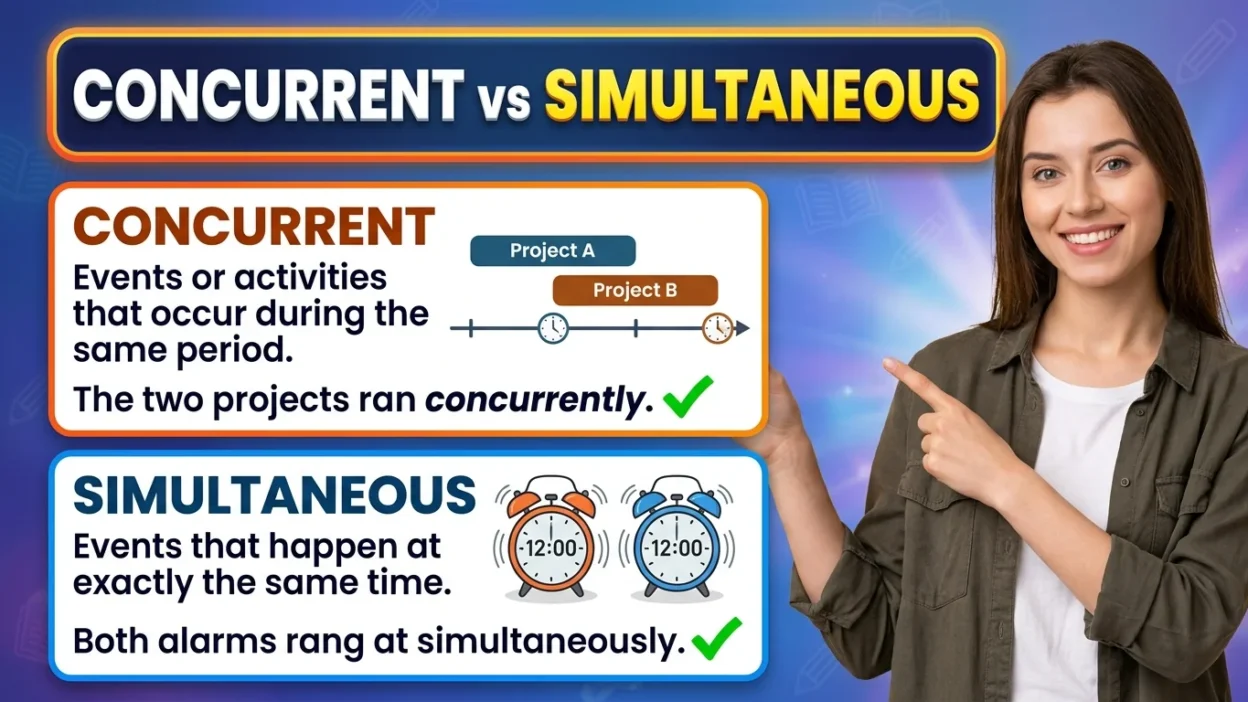
When two or more things happen around the same time, choosing the right word can make your sentence more precise. “Concurrent” and “simultaneous” are often used interchangeably because both describe events that occur at the same time or overlap.
However, they have slightly different shades of meaning, and understanding those differences can help you use them more naturally in academic writing, professional communication, and everyday conversations.
“Concurrent” usually describes events, activities, or processes that occur during the same period, even if they do not begin or end at exactly the same moment.
What Is the Difference Between Concurrent and Simultaneous?
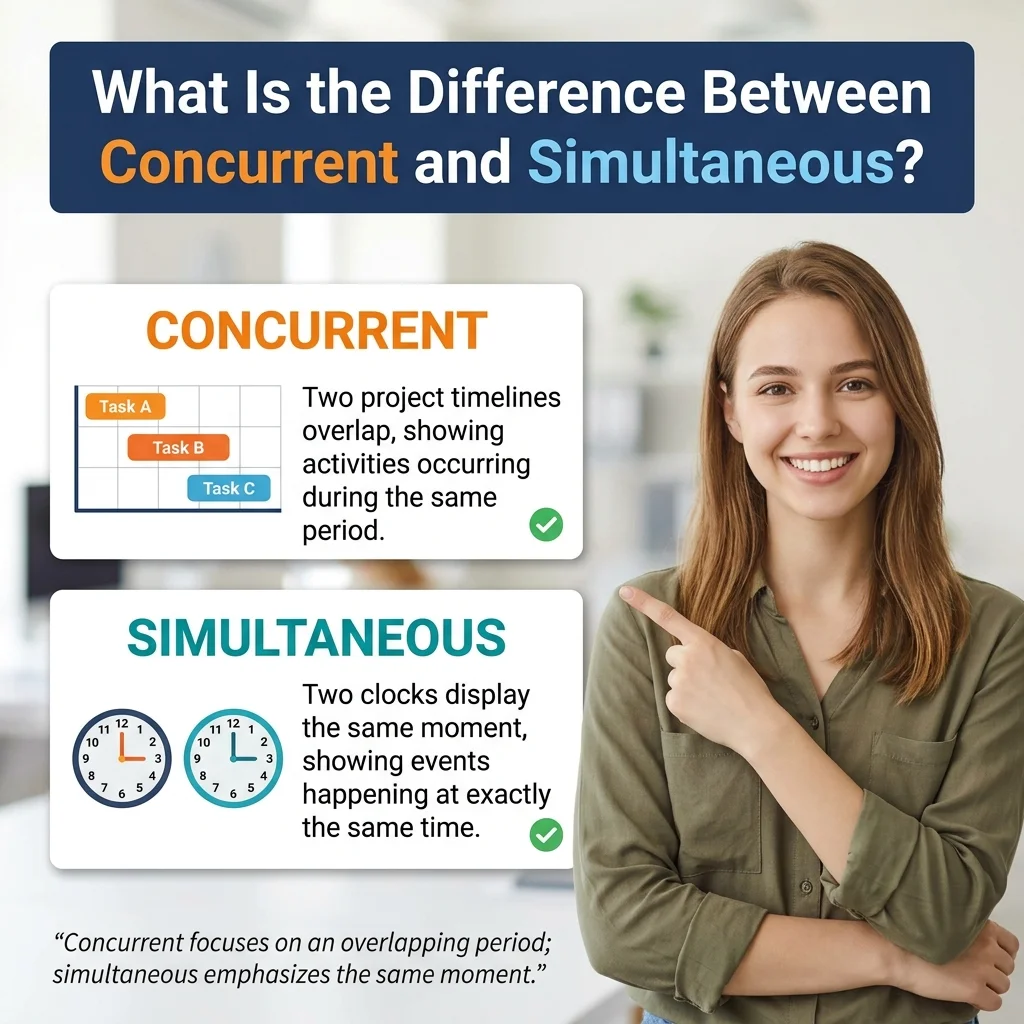
The main difference between concurrent and simultaneous is the way they describe time.
Concurrent means happening during the same period, often with some overlap. The events do not necessarily begin or end at exactly the same moment.
Simultaneous means happening at the same time, especially at precisely the same moment.
For example:
- Concurrent: She attended two concurrent courses during the summer. The courses took place during the same period, but their schedules may not have been identical.
- Simultaneous: The two alarms rang simultaneously. Both alarms rang at the same moment.
In simple terms:
Concurrent = happening during the same period. Simultaneous = happening at the same moment.
This distinction is useful, but context matters. In ordinary conversation, the two words can sometimes be used interchangeably when exact timing is not important.
Concurrent Meaning and Definition
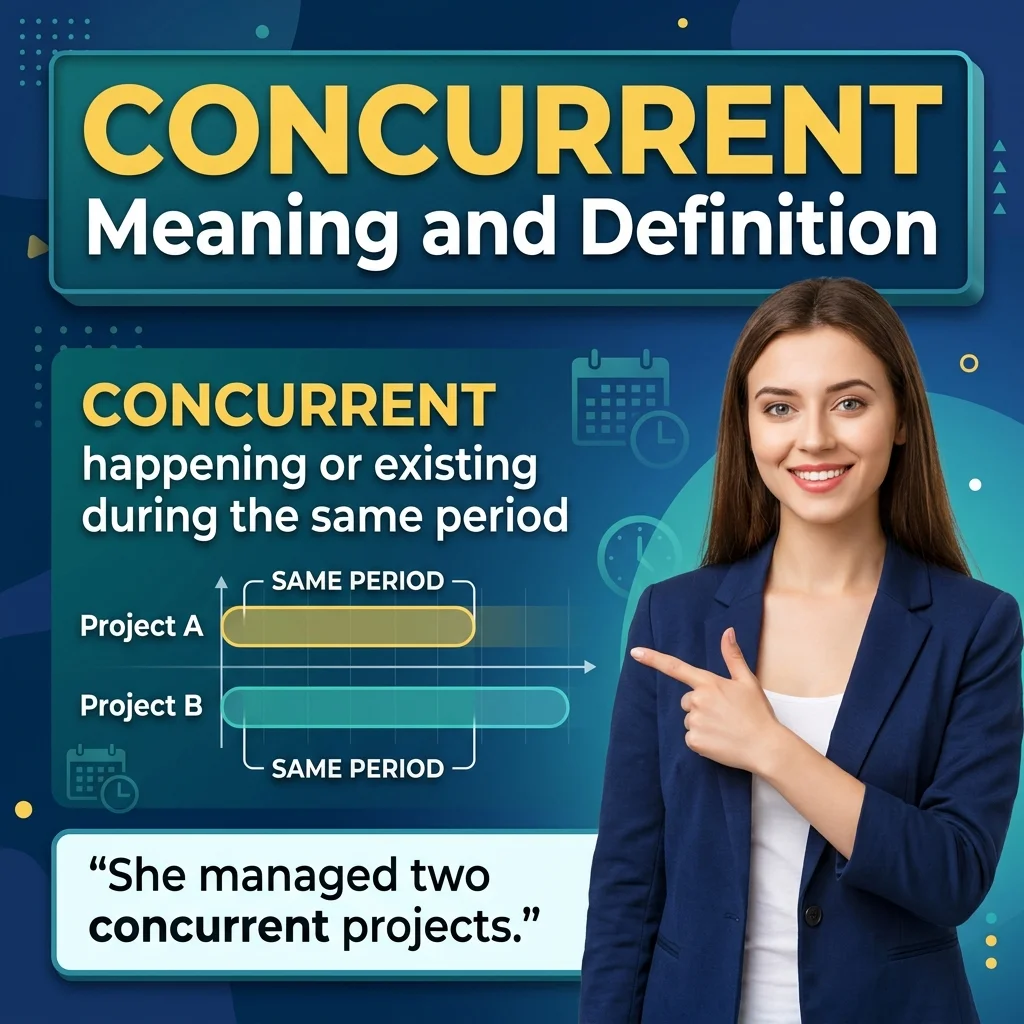
Concurrent is an adjective that describes events, activities, situations, or conditions that exist or happen during the same period.
It often suggests that two or more things overlap in time. They may start together, but they do not have to. They may also finish at different times.
Simple Definition of Concurrent
Concurrent means occurring during the same period or overlapping in time.
Examples of Concurrent
- The company is working on several concurrent projects.
- He held two concurrent positions at different organizations.
- The university offers concurrent courses in business and technology.
- Several investigations are taking place concurrently.
- The two events were concurrent, so it was difficult to attend both.
In each example, the activities happen within the same general period. The word does not necessarily tell us that they happen at exactly the same second.
Concurrent in Everyday English
You can use concurrent when discussing activities, responsibilities, events, or situations that overlap.
Example:
I had two concurrent assignments due during the same week.
This means both assignments were active or due within the same period. It does not necessarily mean they were due at the exact same minute.
Concurrent in Business and Work
The word concurrent is common in professional and business English.
Examples:
- Our team is managing three concurrent campaigns.
- The company launched concurrent projects in different departments.
- She worked on concurrent tasks throughout the afternoon.
- The manager approved two concurrent training sessions.
Here, concurrent emphasizes that the activities are taking place within an overlapping timeframe.
Concurrent in Technology
In computing, concurrent has a more specialized meaning. It often describes multiple tasks making progress during the same period, even if they are not executed at the exact same instant.
For example:
A computer program can handle multiple concurrent tasks.
This means the tasks may overlap in execution. Depending on the system, they may take turns using resources rather than running at precisely the same moment.
Important: In technical contexts, concurrent and parallel are not always identical. Concurrent tasks can overlap in progress, while parallel tasks generally run at the same time using separate processing resources.
Concurrent as a Noun
The noun concurrent is uncommon in everyday English. However, in some specialized contexts, it can refer to something that occurs at the same time as another event.
Most learners should focus on using concurrent as an adjective.
Concurrently Meaning
Concurrently is the adverb form of concurrent. It means during the same period or at the same time.
Examples:
- The two projects are running concurrently.
- She studied and worked concurrently.
- Several meetings were held concurrently.
- The software processes multiple requests concurrently.
Simultaneous Meaning and Definition
Simultaneous is an adjective that describes two or more events happening at the same time, especially at precisely the same moment.
It emphasizes exact timing or actions occurring together.
Simple Definition of Simultaneous
Simultaneous means happening at the same moment or at exactly the same time.
Examples of Simultaneous
- The audience gave a simultaneous round of applause.
- Both players made simultaneous moves.
- The lights turned on simultaneously.
- The two phones rang simultaneously.
- The witnesses reported hearing simultaneous explosions.
In these examples, the focus is on the events occurring together at one moment.
Simultaneous in Everyday English
Use simultaneous when you want to emphasize that actions happen together.
Example:
The children shouted simultaneously.
This means they shouted at the same moment.
Another example:
She received simultaneous messages from three friends.
The messages arrived at approximately the same time, with the emphasis on their shared timing.
Simultaneous in Business and Communication
The word is useful when describing announcements, meetings, broadcasts, or actions that occur at the same time.
Examples:
- The company made simultaneous announcements in several countries.
- The speakers gave simultaneous presentations.
- The two departments held simultaneous meetings.
- The news was broadcast simultaneously across multiple channels.
Simultaneous in Science and Technology
In scientific and technical writing, simultaneous often describes events that occur at the same instant or are intended to occur together.
Examples:
- The experiment measured two variables simultaneously.
- The system received simultaneous signals.
- The cameras captured simultaneous images.
- The device supports simultaneous audio and video recording.
However, in real-world systems, “simultaneous” may sometimes mean “close enough in time to be treated as simultaneous,” depending on the context.
Simultaneously Meaning
Simultaneously is the adverb form of simultaneous. It means at the same time or at the same moment.
Examples:
- The doors opened simultaneously.
- They answered the question simultaneously.
- The two teams started simultaneously.
- She was speaking and writing simultaneously.
Concurrent vs Simultaneous: Key Differences
Although the words are similar, they emphasize different aspects of time.
Concurrent
Focuses on events happening during the same period, often with overlapping durations.
Simultaneous
Focuses on events happening at the same moment, especially when exact timing matters.
Comparison Table: Concurrent vs Simultaneous
| Feature | Concurrent | Simultaneous |
| Part of speech | Adjective | Adjective |
| Main meaning | Happening during the same period | Happening at the same moment |
| Time relationship | Overlapping periods | Exact or near-exact shared timing |
| Emphasis | Duration and overlap | Moment and timing |
| Events must start together? | No | Usually yes, or nearly so |
| Events must end together? | No | Not necessarily |
| Common contexts | Projects, courses, responsibilities, systems | Reactions, movements, signals, announcements |
| Adverb form | Concurrently | Simultaneously |
| Example | Concurrent assignments | Simultaneous movements |
The Easiest Way to Remember
Ask yourself:
Are the events happening during the same period? Use concurrent.
Are the events happening at the same moment? Use simultaneous.
For example:
Two meetings are concurrent if they overlap in schedule.
Two bells ring simultaneously if they ring at exactly the same moment.
Concurrent vs Simultaneous Examples
Understanding the difference becomes easier when you compare examples.
Example 1: Classes
Concurrent:
I am taking two concurrent classes this semester.
The classes occur during the same semester. They may meet at different times.
Simultaneous:
The two classes started simultaneously.
Both classes started at the same moment.
Example 2: Projects
Concurrent:
The company is managing four concurrent projects.
The projects are active during the same period.
Simultaneous:
The company announced four new projects simultaneously.
The announcements happened at the same time.
Example 3: Sounds
Concurrent:
The construction work and road repairs were concurrent.
Both activities took place during an overlapping period.
Simultaneous:
The two alarms sounded simultaneously.
Both alarms sounded at the same moment.
Example 4: Responsibilities
Concurrent:
She had concurrent responsibilities as a teacher and department coordinator.
She performed both roles during the same period.
Simultaneous:
She received two simultaneous phone calls.
Both calls came at the same moment.
Example 5: Technology
Concurrent:
The application supports concurrent users.
Multiple users can use the application during the same period.
Simultaneous:
The system processed two simultaneous requests.
The requests were processed at the same moment or as closely together as the context requires.
Example 6: Events
Concurrent:
Several concurrent events were scheduled throughout the weekend.
The events took place during overlapping periods.
Simultaneous:
The fireworks began simultaneously.
The fireworks began at the same moment.
When Can Concurrent and Simultaneous Be Used Interchangeably?
In some sentences, both words can work because the context does not require a precise distinction.
For example:
The two meetings were concurrent.
The two meetings were simultaneous.
The first sentence usually suggests that the meetings overlapped in time. The second suggests that they happened at the same time, possibly beginning together.
Another example:
The broadcasts were concurrent.
The broadcasts were simultaneous.
Both may be acceptable if the intended meaning is that the broadcasts occurred together. However, simultaneous places more emphasis on exact timing.
Why Context Matters
English words often overlap in meaning. The difference between concurrent and simultaneous is not always absolute.
Consider:
The two events occurred concurrently.
This can mean the events happened during the same period.
The two events occurred simultaneously.
This usually means they happened at the same moment.
If the events lasted several hours and overlapped only briefly, concurrent may be more accurate. If they began together, simultaneous may be the better choice.
Concurrent vs Simultaneous in Different Contexts
In Academic Writing
Concurrent is useful when discussing courses, studies, research projects, or academic responsibilities that overlap.
- The students completed concurrent research projects.
- She enrolled in two concurrent programs.
- The studies were conducted concurrently.
Simultaneous is useful when describing experiments, observations, or actions occurring at the same moment.
- The researchers made simultaneous observations.
- The experiment recorded simultaneous changes in temperature and pressure.
- The students gave simultaneous presentations.
In Business English
Concurrent often describes projects, contracts, duties, or operations that happen during the same period.
- The firm is handling concurrent contracts.
- We are working on concurrent marketing campaigns.
- The manager oversees concurrent operations.
Simultaneous often describes announcements, meetings, launches, or actions happening at the same time.
- The company held simultaneous product launches.
- The departments made simultaneous announcements.
- The teams conducted simultaneous interviews.
In Legal English
Both words may appear in legal contexts, but they have specific uses.
Concurrent can describe sentences, rights, or events that occur during the same period.
- The defendant received concurrent sentences.
- The two legal proceedings were concurrent.
Simultaneous can describe actions or events occurring at the same time.
- The parties submitted simultaneous statements.
- The agreements were signed simultaneously.
In legal writing, always consider the specific meaning intended by the document.
In Technology and Computing
Concurrent is especially common when describing multiple tasks that overlap in progress.
- The server handles concurrent connections.
- The application supports concurrent processing.
- Multiple users can perform concurrent operations.
Simultaneous is more appropriate when emphasizing that events happen at the same instant.
- The device can record simultaneous inputs.
- The sensors detected simultaneous signals.
- Both buttons were pressed simultaneously.
In Everyday Conversation
In casual English, people often use at the same time instead of either word.
For example:
- We arrived at the same time.
- The children spoke at the same time.
- I was studying while my brother was watching television.
This is often clearer and more natural for beginners.
Common Mistakes with Concurrent and Simultaneous
Even though these words are straightforward, learners sometimes use them incorrectly.
Mistake 1: Assuming They Always Mean Exactly the Same Thing
Incorrect assumption:
Concurrent always means exactly the same moment.
Better understanding:
Concurrent usually means overlapping in time. It does not always imply exact timing.
Example:
The two projects were concurrent, but one started a month earlier.
This sentence is perfectly logical because concurrent activities can overlap without starting together.
Mistake 2: Using Simultaneous for Long Overlapping Periods
Less precise:
The two companies ran simultaneous projects for six months.
This may be acceptable, but concurrent projects is often more natural if the focus is on the projects being active during the same period rather than starting at the same moment.
Better:
The two companies ran concurrent projects for six months.
Mistake 3: Confusing Concurrent with Consecutive
These words are not the same.
- Concurrent: happening during the same period.
- Consecutive: following one after another without interruption.
Examples:
She attended two concurrent courses.
The courses overlapped in time.
She worked for five consecutive days.
She worked five days in a row.
Mistake 4: Confusing Simultaneous with Sequential
These words describe opposite timing patterns.
- Simultaneous: happening at the same time.
- Sequential: happening one after another in a particular order.
Examples:
The two machines started simultaneously.
Both started together.
The machines started sequentially.
One started after the other.
Mistake 5: Using “Simultaneously Together”
The phrase simultaneously together is usually redundant because simultaneously already means “at the same time.”
Less natural:
They shouted simultaneously together.
Better:
They shouted simultaneously.
Or:
They shouted together.
Mistake 6: Using “Concurrent at the Same Time”
This is not always grammatically wrong, but it can be repetitive.
Less natural:
The two events happened concurrently at the same time.
Better:
The two events happened concurrently.
Or:
The two events happened at the same time.
Mistake 7: Confusing Concurrent with Continuous
These words have different meanings.
- Concurrent: happening during the same period as something else.
- Continuous: happening without stopping or interruption.
Examples:
The company managed concurrent projects.
Several projects overlapped.
The machine operated continuously for eight hours.
The machine did not stop during that period.
Spelling Tips for Concurrent and Simultaneous
Correct spelling is important, especially in academic and professional writing.
How to Spell Concurrent
Concurrent
Break it into parts:
con + current
A helpful memory tip is to connect it with current, which relates to something happening now.
Common misspellings:
- ❌ Concurent
- ❌ Concurrentt
- ❌ Concurrant
- ✅ Concurrent
How to Spell Simultaneous
Simultaneous
Break it into parts:
si + mul + ta + ne + ous
A useful way to remember it is to focus on the middle:
simul-ta-ne-ous
Common misspellings:
- ❌ Simultanious
- ❌ Simultanous
- ❌ Simulteneous
- ❌ Simultaniously
- ✅ Simultaneous
How to Spell the Adverbs
| Adjective | Adverb |
| Concurrent | Concurrently |
| Simultaneous | Simultaneously |
Examples:
- The tasks were concurrent.
- The tasks happened concurrently.
- The actions were simultaneous.
- The actions happened simultaneously.
Concurrent vs Simultaneous: Grammar and Sentence Structure
Both words are adjectives, so they can describe nouns.
Concurrent + Noun
Common combinations include:
- concurrent projects
- concurrent events
- concurrent courses
- concurrent responsibilities
- concurrent sessions
- concurrent operations
- concurrent users
- concurrent processes
Examples:
The manager is supervising concurrent projects.
The university offers concurrent degree programs.
Simultaneous + Noun
Common combinations include:
- simultaneous events
- simultaneous actions
- simultaneous movements
- simultaneous announcements
- simultaneous signals
- simultaneous changes
- simultaneous reactions
- simultaneous translations
Examples:
The system detected simultaneous signals.
The audience gave simultaneous applause.
Concurrently and Simultaneously in Sentences
Both adverbs describe how actions happen.
Concurrently:
The teams worked concurrently on different parts of the project.
Simultaneously:
The teams presented their results simultaneously.
The first emphasizes overlapping work. The second emphasizes presenting at the same moment.
Synonyms for Concurrent
Depending on the context, you can use several alternatives.
Common Synonyms
- Overlapping
- Coexisting
- Co-occurring
- Coinciding
- Parallel
- Contemporaneous
- Happening together
However, these words are not always perfect replacements.
Example:
The two projects were concurrent.
Possible alternatives:
- The two projects overlapped.
- The two projects were running during the same period.
- The two projects were happening at the same time.
Concurrent vs Parallel
These words are related but not identical.
Concurrent means activities overlap in time.
Parallel often means activities happen alongside each other, sometimes independently or using separate resources.
Example:
The team worked on concurrent tasks.
The tasks overlapped in time.
The team ran parallel development processes.
The processes progressed alongside each other.
In computing, the distinction can be especially important.
Synonyms for Simultaneous
Common synonyms include:
- Synchronous
- Concurrent
- Coincident
- Co-occurring
- At the same time
- Happening together
- In unison
Simultaneous vs Synchronous
These words are often related, but they are not always identical.
Simultaneous focuses on events happening at the same moment.
Synchronous often suggests that events are coordinated, synchronized, or operating according to the same timing.
Examples:
The two lights flashed simultaneously.
The devices operate synchronously.
The first emphasizes a shared moment. The second may emphasize coordination or timing.
How to Choose the Right Word
Use this simple decision guide.
Choose concurrent when…
Two or more activities happen during an overlapping period, even if their start and end times differ.
Example: The company is managing concurrent projects.
Choose simultaneous when…
Two or more events happen at the same moment, or exact shared timing is important.
Example: The two alarms rang simultaneously.
A Quick Test
Complete the sentence:
The activities happened ________ during the same week.
Concurrent is a natural choice because the focus is on the period.
Now complete:
The two lights flashed ________.
Simultaneously is more natural because the focus is on the same moment.
More Examples of Concurrent vs Simultaneous
Concurrent Examples
- The company launched two concurrent advertising campaigns.
- She was responsible for several concurrent tasks.
- The students enrolled in concurrent courses.
- The software can manage concurrent requests.
- The two investigations continued concurrently.
- The organization faced concurrent challenges.
- The teams worked concurrently on separate solutions.
- The projects had concurrent deadlines.
- The city experienced concurrent construction activities.
- He held concurrent roles in two departments.
Simultaneous Examples
- The two clocks struck simultaneously.
- Both doors opened simultaneously.
- The students answered simultaneously.
- The cameras captured simultaneous images.
- The teams made simultaneous announcements.
- The lights flashed simultaneously.
- The athletes crossed the finish line simultaneously.
- The device records simultaneous audio channels.
- The audience laughed simultaneously.
- The two signals arrived simultaneously.
Frequently Asked Questions About Concurrent vs Simultaneous
Is concurrent the same as simultaneous?
Not always. Both words describe events happening at the same time, but concurrent usually emphasizes overlapping periods, while simultaneous emphasizes the same moment.
Which is more precise: concurrent or simultaneous?
Neither word is always more precise. The best choice depends on what you want to emphasize. Use concurrent for overlapping time periods and simultaneous for exact shared timing.
Can I use concurrent and simultaneous interchangeably?
Sometimes, yes. In general conversation, both may communicate that events happen together. However, they can create different meanings when the distinction between overlapping periods and exact timing matters.
What is the difference between concurrent and consecutive?
Concurrent means happening during the same period. Consecutive means following one after another without interruption.
Example:
The students attended concurrent classes.
The classes overlapped.
The students attended classes on three consecutive days.
The classes occurred on three days in a row.
What is the difference between concurrent and continuous?
Concurrent describes events happening alongside one another. Continuous describes something that continues without stopping.
Example:
The company handled concurrent projects.
Several projects overlapped.
The machine ran continuously.
The machine kept running without interruption.
What is the difference between simultaneous and sequential?
Simultaneous means happening at the same time. Sequential means happening one after another in a specific order.
Example:
The two tasks started simultaneously.
The two tasks started sequentially.
Is “concurrently” the same as “simultaneously”?
They can be similar, but concurrently often emphasizes overlapping activity, while simultaneously emphasizes the same moment.
Example:
The teams worked concurrently.
They worked during the same period.
The teams spoke simultaneously.
They spoke at the same moment.
Can concurrent mean “at the same time”?
Yes. In many contexts, concurrent means happening at the same time or during the same period. However, it does not always imply that events begin or end at exactly the same moment.
Is simultaneous an adjective or an adverb?
Simultaneous is an adjective.
Example:
The simultaneous movements surprised everyone.
Simultaneously is the adverb.
Example:
The dancers moved simultaneously.
What is the opposite of simultaneous?
Depending on the context, possible opposites include:
- Sequential
- Successive
- Separate
- Staggered
- At different times
What is the opposite of concurrent?
Possible opposites include:
- Non-overlapping
- Separate
- Sequential
- Consecutive, depending on context
There is no single opposite that works in every sentence.
Which word is better for formal writing?
Both are appropriate for formal writing. Concurrent is common in business, academic, legal, and technical contexts. Simultaneous is useful when exact timing or events occurring together is important.
Is “simultaneously together” correct?
It may be understood, but it is usually redundant. Use simultaneously or together, depending on the sentence.
Can two events be concurrent but not simultaneous?
Yes. For example, two projects can overlap for several weeks but begin on different dates. They are concurrent, but they are not necessarily simultaneous.
Can two events be simultaneous but not concurrent?
In ordinary usage, simultaneous events are also concurrent because they occur during the same period. However, simultaneous emphasizes the exact moment, while concurrent emphasizes the broader overlap.
Final Thoughts
Understanding concurrent vs simultaneous becomes easy when you focus on the timing you want to express. Concurrent describes activities or events that happen during the same period, often with overlapping durations. Simultaneous describes events that happen at the same moment, especially when exact timing matters.
For example, two projects can be concurrent even if they begin on different dates, while two alarms are simultaneous when they ring together. Both words are useful in everyday English, academic writing, business communication, and technical discussions. When you are unsure, ask yourself whether you mean “during the same period” or “at the same moment.”

Emily Parker is a dedicated writer who enjoys creating clear, useful, and easy-to-understand content. She focuses on language, grammar, word meanings, and everyday expressions to help readers find simple and reliable answers.