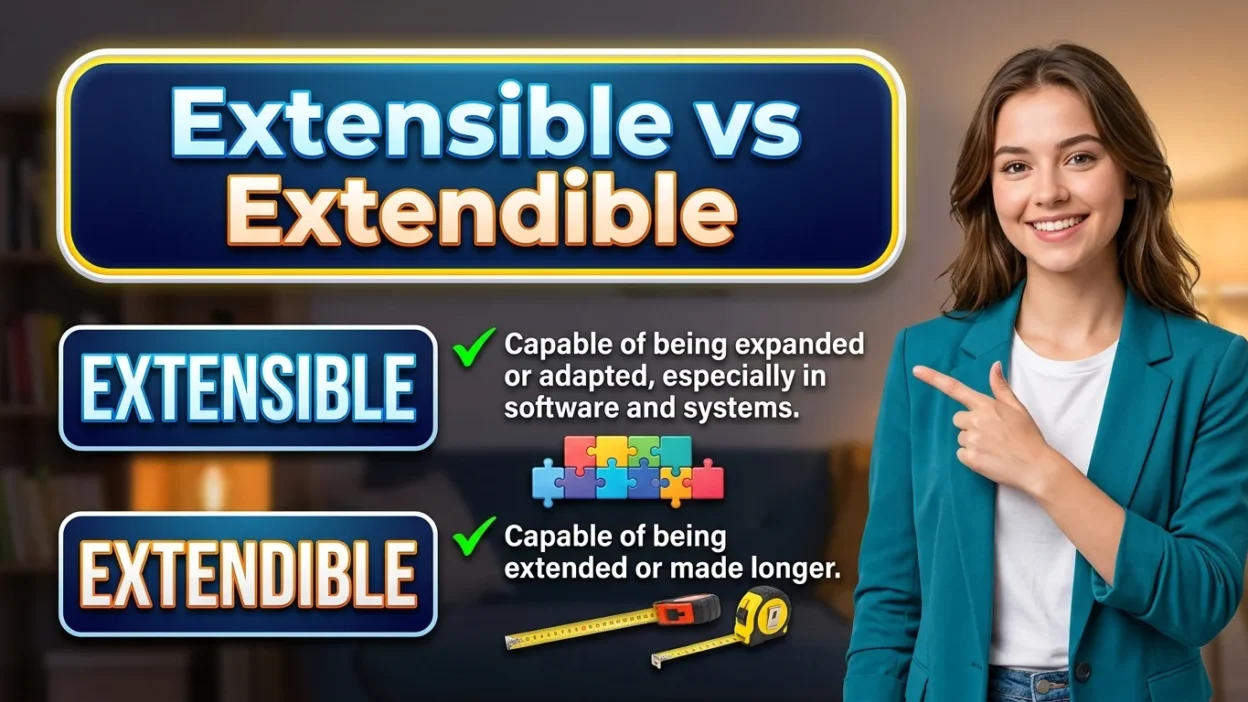
Some English words look almost identical and share similar meanings, making it difficult to know which one fits a sentence best. “Extensible” and “extendible” are two such words.
Both describe something that can be extended, expanded, or made longer, but they often appear in different contexts. Understanding their usage can help you choose the right word in technical writing, everyday communication, and professional documents.
“Extensible” commonly describes something that can be expanded or modified to accommodate additional features or functions. For example, extensible software allows developers to add new capabilities without redesigning the entire system.
Quick Answer :
Extensible and extendible are both adjectives derived from the verb extend. They can describe something capable of being expanded or made longer, but extensible is more common in modern technical and software-related English.
- Extensible: Designed or able to be expanded, especially by adding new features, functions, or components.
- Extendible: Able to be extended in length, duration, range, or scope.
Simple examples
- “The software has an extensible architecture.” → New features can be added to the software.
- “The contract is extendible for another year.” → The contract can be extended in duration.
- “The table is extendible.” → The table can be made longer.
Important: These are general usage patterns, not absolute rules. In some contexts, the two words can be interchangeable.
What Does Extensible Mean?
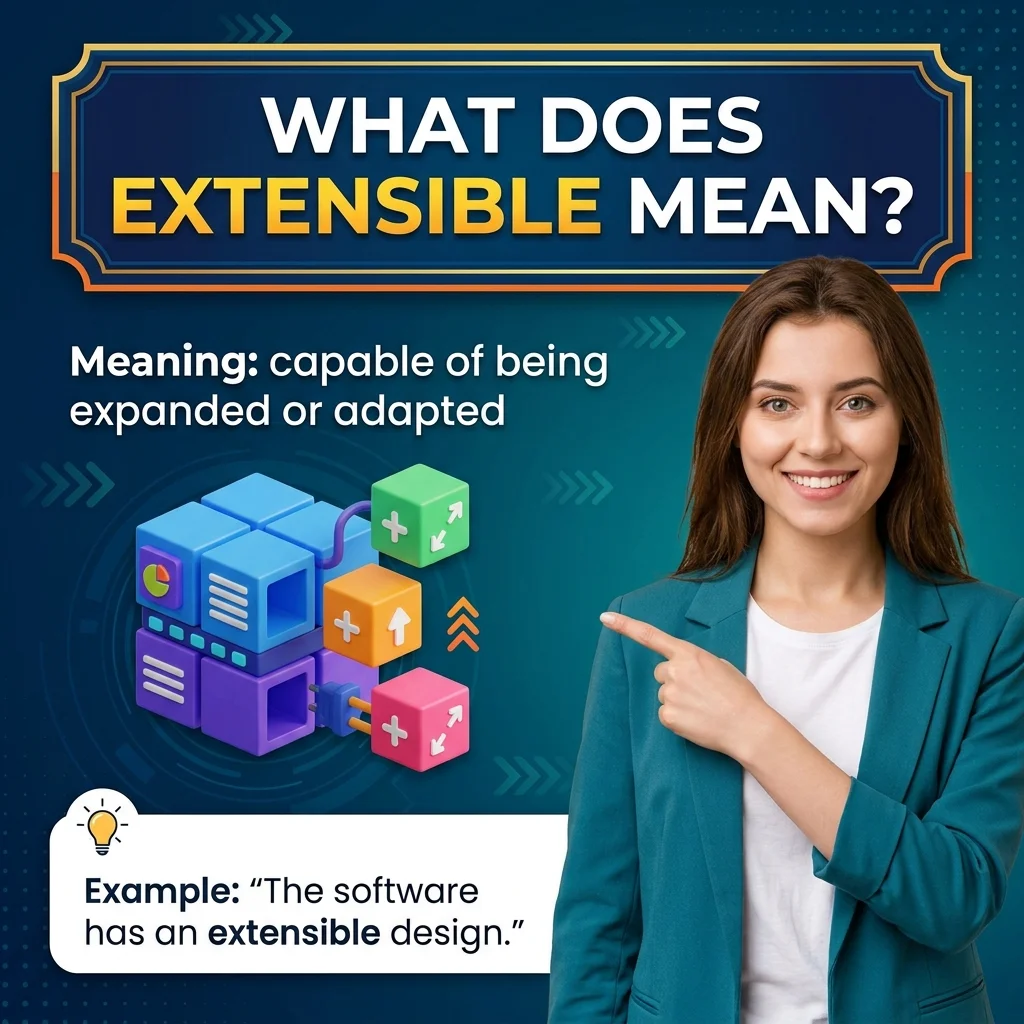
Extensible is an adjective that means capable of being expanded, developed, or enhanced by adding new parts or features.
The word is especially common in:
- Software development
- Computer programming
- System design
- Business platforms
- Product development
- Technical documentation
Extensible meaning in simple English
If a system is extensible, you can add something new to it.
For example, imagine a basic website that allows developers to install plugins. The website is extensible because its capabilities can be expanded through those plugins.
Examples of extensible
- An extensible software platform allows developers to add new tools.
- An extensible programming language can support additional features.
- An extensible framework makes it easier to build new applications.
- An extensible system can grow as user needs change.
- An extensible design allows future improvements.
Extensible in a sentence
“The company chose an extensible platform so it could add new features later.”
What Does Extendible Mean?

Extendible is an adjective that means capable of being extended, lengthened, prolonged, or increased.
It is often used when something can be made:
- Longer
- Larger
- Wider
- More extensive
- Longer-lasting
- Greater in scope
The word can describe physical objects, time periods, agreements, and other things that can be extended.
Extendible meaning in simple English
If something is extendible, you can make it longer or increase its duration or range.
For example, an extendible table can be made longer by adding a section. An extendible contract can continue beyond its original end date.
Examples of extendible
- An extendible table can seat more people.
- An extendible contract can be renewed for another year.
- An extendible deadline can be moved to a later date.
- An extendible warranty can cover a product for a longer period.
- An extendible ladder can reach greater heights.
Extendible in a sentence
“The rental agreement is extendible if both parties agree.”
This means the agreement can continue for a longer period.
Extensible vs Extendible: The Main Difference
The main difference between extensible and extendible is the type of expansion they usually describe.
Extensible focuses on adding capabilities, features, or components. Extendible focuses on making something longer, larger, or more prolonged.
| Feature | Extensible | Extendible |
| Basic meaning | Able to be expanded or enhanced | Able to be extended or made longer |
| Common focus | Features, functions, capabilities | Length, time, range, or scope |
| Common context | Software, systems, platforms | Contracts, tables, ladders, deadlines |
| Example | An extensible application | An extendible contract |
| Common modern usage | Very common in technical writing | Less common, but correct |
| Related verb | Extend | Extend |
Compare these examples
Extensible:
“The application has an extensible plugin system.”
The application can gain new functions through plugins.
Extendible:
“The agreement is extendible for six months.”
The agreement can last longer.
Both words suggest expansion, but the type of expansion is different.
Is Extensible or Extendible More Common?
In modern English, extensible is generally more common, especially in technology and software documentation.
You are likely to see phrases such as:
- Extensible architecture
- Extensible framework
- Extensible markup language
- Extensible platform
- Extensible design
- Extensible plugin system
Extendible is also a valid word, but it appears less frequently.
For example:
- Extendible table
- Extendible ladder
- Extendible contract
- Extendible deadline
- Extendible warranty
However, usage can vary by industry, region, and writing style. Some writers may use extensible in situations where others prefer extendible.
Extensible vs Extendible in Software Development
The word extensible is particularly important in software development.
When developers describe software as extensible, they usually mean that the software allows new functionality to be added without changing its core structure extensively.
What is an extensible system?
An extensible system is designed to support future additions.
For example, a content management system may allow developers to add:
- Payment gateways
- Search tools
- Analytics features
- Design templates
- Security plugins
- User-management tools
This makes the system extensible.
Examples in software
- “The framework is highly extensible.” → Developers can add new features or customize its behavior.
- “We need an extensible API.” → The API should support future functions and integrations.
- “This editor has an extensible plugin system.” → Users can add tools through plugins.
Why extensibility matters
An extensible system can offer several advantages:
- Easier customization
- Better long-term flexibility
- Support for new features
- Reduced need for major redesigns
- Easier integration with other tools
- Greater adaptability to changing needs
For example, a business may start with a simple online store. Later, it may need inventory management, customer loyalty features, and advanced reporting. An extensible platform can make these additions easier.
Extensible vs Extendible in Everyday English
In everyday English, both words can describe something that can be extended. However, extendible may sound more natural when discussing physical length or duration.
Physical objects
- “This is an extendible dining table.”
- “The camera has an extendible lens.”
- “We bought an extendible ladder.”
- “The handle is extendible.”
These examples focus on making something physically longer.
Time and duration
- “The visa is extendible under certain conditions.”
- “The deadline may be extendible.”
- “The subscription is extendible for another month.”
- “The warranty is extendible.”
These examples focus on increasing the length of time.
Systems and capabilities
- “The software is extensible.”
- “The platform has an extensible design.”
- “The framework is extensible through plugins.”
These examples focus on adding functionality.
Can Extensible and Extendible Be Used Interchangeably?
Sometimes, yes. Both words come from the same root and can describe something capable of being extended.
For example, you may see:
“The system is extensible.”
and
“The system is extendible.”
However, extensible is usually the more natural choice in technical contexts.
Similarly, when describing a physical object, extendible may be more common:
“The table is extendible.”
Although “extensible table” is understandable, it may sound less natural to many readers.
A useful rule
Use extensible when you mean:
“New features or capabilities can be added.”
Use extendible when you mean:
This rule will help you choose the right word in most situations.
Extensible vs Extendible: Grammar and Word Forms
Both words are adjectives. They describe nouns and usually appear before a noun or after a linking verb.
Extensible as an adjective
Before a noun:
- An extensible platform
- An extensible framework
- An extensible system
After a linking verb:
- The platform is extensible.
- The software remains extensible.
- The architecture appears extensible.
Extendible as an adjective
Before a noun:
- An extendible table
- An extendible contract
- An extendible deadline
After a linking verb:
- The table is extendible.
- The contract is extendible.
- The deadline may be extendible.
Related words
| Word | Part of speech | Meaning |
| Extend | Verb | To make longer or larger |
| Extension | Noun | An act or result of extending |
| Extensible | Adjective | Capable of being expanded |
| Extendible | Adjective | Capable of being extended |
| Extensibility | Noun | The quality of being extensible |
| Extendibility | Noun | The quality of being extendible |
Examples of related forms
- “We plan to extend the deadline.”
- “The deadline received an extension.”
- “The software is extensible.”
- “The system’s extensibility is important.”
- “The contract is extendible.”
- “The agreement’s extendibility depends on approval.”
Extensibility vs Extendibility
The nouns extensibility and extendibility describe the quality or ability of something to be extended.
What is extensibility?
Extensibility is the ability of a system, product, or design to support additional features or functionality.
Example:
“The extensibility of the platform makes it suitable for growing businesses.”
What is extendibility?
Extendibility is the ability of something to be extended, lengthened, or prolonged.
Example:
“The extendibility of the contract depends on the terms of the agreement.”
Comparison
| Term | Common meaning | Example |
| Extensibility | Ability to add features or capabilities | “The software’s extensibility is excellent.” |
| Extendibility | Ability to increase length or duration | “The extendibility of the lease is limited.” |
In technical writing, extensibility is far more common than extendibility.
Extensible vs Extendible: Pronunciation
The pronunciation of both words is similar because they come from the same root.
Extensible
Pronunciation: ik-STEN-suh-bul
Extendible
Pronunciation: ik-STEN-duh-bul
The exact pronunciation may vary slightly depending on accent and dictionary.
Pronunciation tip
Focus on the beginning:
- Extensible: ex + ten + si + ble
- Extendible: ex + ten + di + ble
The main difference is in the middle sound:
- -sibl- in extensible
- -dibl- in extendible
Common Mistakes When Using Extensible and Extendible
Because these words look and sound similar, writers often confuse them. Here are some common mistakes and how to avoid them.
Mistake 1: Using extendible for software features
Incorrect or less natural:
“We need an extendible software architecture.”
Better:
“We need an extensible software architecture.”
Why? Because the sentence focuses on adding features and capabilities.
Mistake 2: Using extensible for physical length
Less natural:
“This is an extensible dining table.”
More natural:
“This is an extendible dining table.”
Mistake 3: Assuming the words have completely different meanings
Some writers believe that extensible and extendible are always different. That is not correct.
They overlap in meaning, and both can refer to something capable of being extended. The difference is mainly about common usage and context.
Mistake 4: Choosing a word only because it looks technical
A word may sound more technical without being the best choice.
For example:
“The contract is extensible.”
This may be understandable, but extendible is often clearer when discussing a contract’s duration.
Mistake 5: Confusing extensible with extensive
These words are different.
- Extensive: Large, broad, or covering a wide area.
Example:
“The software is extensible.”
“The company conducted extensive research.”
Spelling Tips for Extensible and Extendible
Spelling can be confusing because both words are built from extend.
How to remember extensible
Think:
Extensible = extend + sible
How to remember extendible
Think:
Extendible = extend + ible
The word is commonly associated with length, duration, and physical extension.
Easy memory trick
Extensible → Expand capabilities Extendible → Extend length or time
This is not a strict spelling rule, but it is a useful memory aid.
Important spelling note
Do not confuse either word with:
- Extensive
- Extension
- Extendable
- Expandable
These words are related, but they do not always have the same meaning or usage.
Extensible vs Extendible vs Extendable
Another word that often appears in this discussion is extendable.
Extendable meaning
Extendable means capable of being extended.
Examples:
- An extendable table
- An extendable ladder
- An extendable contract
- An extendable deadline
Comparison table
| Word | Main meaning | Common usage |
| Extensible | Able to be expanded, especially by adding capabilities | Software, systems, platforms |
| Extendible | Able to be extended or made longer | Contracts, tables, duration |
| Extendable | Able to be extended | Everyday English and general descriptions |
Example comparison
- “The software is extensible.” → It can support new features.
- “The contract is extendible.” → It can continue for a longer period.
Extendable is often the most familiar word in everyday conversation, while extensible is especially common in technical writing.
Extensible vs Extendible: Examples in Different Contexts
1. Technology
“The company built an extensible software platform.”
The platform can support new functionality.
“The application’s extensible architecture allows developers to add modules.”
The architecture supports future additions.
2. Business
“The contract is extendible after the initial term.”
The contract can continue for a longer period.
“The warranty is extendible through an additional payment.”
The warranty can cover a longer period.
3. Education
“The learning platform is extensible and can support new courses.”
The platform can gain additional capabilities.
“The assignment deadline may be extendible in special circumstances.”
4. Physical objects
“We purchased an extendible dining table.”
The table can become longer.
“The extendible ladder is useful for reaching high shelves.”
The ladder can increase in length.
5. Design and engineering
“The product has an extensible design that supports future upgrades.”
“The extendible arm can reach different positions.”
More Example Sentences with Extensible
Here are additional examples to help you understand extensible in context:
- The software was designed to be extensible.
- Our platform uses an extensible architecture.
- The framework provides an extensible plugin system.
- An extensible API can support future integrations.
- The application is highly extensible.
- The team created an extensible data model.
- This tool offers an extensible interface.
- The system’s extensible structure makes customization easier.
- The company wants an extensible solution for future growth.
- The platform is extensible without major changes to its core.
What these examples have in common
Each sentence focuses on adding functionality, customization, or future capabilities.
More Example Sentences with Extendible
Here are additional examples using extendible:
- The contract is extendible for another six months.
- We bought an extendible table for the dining room.
- The warranty is extendible under certain conditions.
- The deadline may be extendible with approval.
- The ladder has an extendible design.
- The lease is extendible by mutual agreement.
- The camera has an extendible lens.
- The subscription is extendible for an additional month.
- The handle is extendible to improve reach.
- The agreement includes an extendible renewal period.
What these examples have in common
Each sentence focuses on increasing length, time, range, or duration.
How to Choose the Right Word
When you are unsure which word to use, ask yourself one simple question:
Am I talking about adding capabilities, or am I talking about making something longer?
Choose extensible if:
- You are discussing software.
- You mean adding features.
- You are describing a system that supports plugins.
- You mean future customization.
- You are discussing architecture or design flexibility.
Example:
“The platform needs to be extensible.”
Choose extendible if:
- You are discussing a contract.
- You mean increasing duration.
- You are describing a physical object that becomes longer.
- You are discussing a deadline or warranty.
- You mean increasing range or scope.
Example:
“The contract is extendible for one year.”
Choose extendable if:
- You want a familiar everyday word.
- You are discussing a general extension without a technical focus.
Example:
“This extendable table is perfect for family gatherings.”
Is “Extensible” a Real Word?
Yes, extensible is a standard English adjective.
It is not an incorrect or informal spelling. In fact, it is the preferred term in many technology-related contexts.
Example
“The system is extensible through third-party plugins.”
This is a completely correct sentence.
Is “Extendible” a Real Word?
Yes, extendible is also a standard English adjective. It means capable of being extended.
It is less common than extensible in some contexts, but it is still correct.
Example
“The agreement is extendible for an additional year.”
This sentence is grammatically correct.
Which Word Is Better for SEO and Content Writing?
If you are writing an article, blog post, product description, or technical guide, choose the word that best matches the meaning.
For technology content
Use extensible:
- Extensible software
- Extensible architecture
- Extensible framework
- Extensible platform
- Extensible plugin system
For physical products
Use extendible or extendable:
- Extendible table
- Extendible ladder
- Extendable handle
- Extendible lens
For contracts and time periods
Use extendible or extendable:
- Extendible contract
- Extendible deadline
- Extendable warranty
- Extendible lease
Frequently Asked Questions About Extensible vs Extendible
Is extensible the same as extendible?
They have similar meanings and can sometimes be interchangeable. However, extensible is more commonly used for systems and features, while extendible is often used for length, duration, or range.
Which is correct: extensible or extendible?
Both are correct English words. The better choice depends on the context.
Is extensible more common than extendible?
Yes. Extensible is especially common in software development, programming, and technical documentation. Extendible is less common but remains valid.
What is an extensible system?
An extensible system is designed so that new functionality can be added without requiring a complete redesign of the existing system.
What is an extendible contract?
An extendible contract is an agreement that can continue beyond its original duration, usually under certain conditions or with the approval of the parties involved.
Is “extendable” the same as “extendible”?
They are very similar. Both mean capable of being extended. Extendable is often more familiar in everyday English, while extendible is also correct and may be preferred in certain formal contexts.
Which word should I use for a table?
Extendible or extendable is usually the more natural choice because the table can be made physically longer.
Example:
“We bought an extendible dining table.”
Which word should I use for a software platform?
Extensible is usually the best choice.
Example:
“The company developed an extensible software platform.”
Can I use extensible for a contract?
You can, but extendible or extendable is usually clearer when discussing whether a contract can last longer.
What is the opposite of extensible?
There is no single universal opposite, but words such as inflexible, fixed, or non-extensible may be used depending on the context.
What is the opposite of extendible?
Possible opposites include non-extendible, fixed, or limited, depending on what is being described.
How do I remember the difference?
Remember:
Extensible = expandable capabilities Extendible = extendable length or duration
This simple distinction works in many common situations.
Final Thoughts
The difference between extensible vs extendible is mainly about context and emphasis. Both words describe something that can be extended, but they are commonly used in different ways.
Extensible is the preferred choice when discussing software, systems, frameworks, platforms, and designs that can gain new features or capabilities. Extendible is often more suitable for contracts, deadlines, tables, ladders, warranties, and other things that can become longer or last longer.

Daniel Carter is a passionate writer who creates clear, helpful, and easy-to-understand content. He focuses on language, grammar, word meanings, and everyday expressions, helping readers find simple answers to common questions.