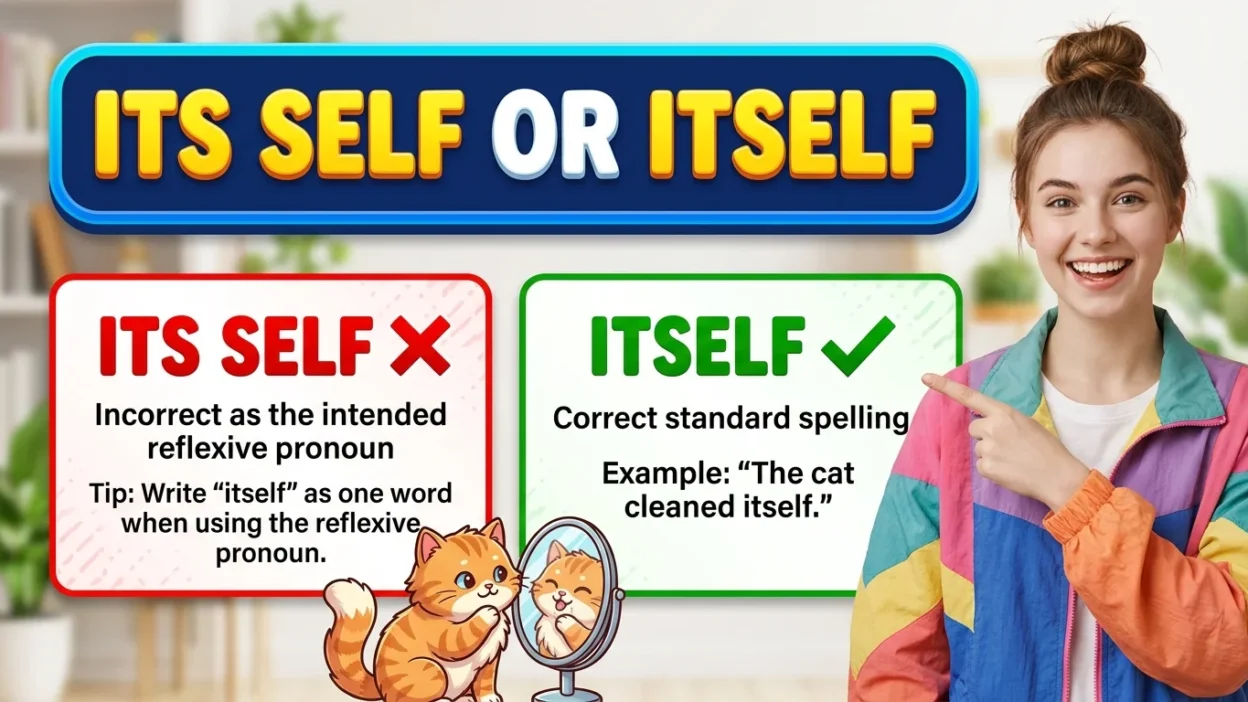
Small spelling differences can change how clear and professional your writing looks. If you have ever wondered whether to write “its self” or “itself,” the answer is usually straightforward: “itself” is the correct spelling when you use the reflexive pronoun to refer back to a thing, animal, or organisation.
For example, “The door closed by itself” means the door closed without anyone directly closing it. The phrase “its self” is uncommon and does not work as a standard substitute for “itself.”
However, “its” is a possessive determiner that shows ownership, as in “The dog wagged its tail.” This difference often causes confusion because “its” and “it’s” also have separate meanings. “It’s” is a contraction of “it is” or “it has,” while “itself” refers back to the subject.
Quick Answer :
Itself is the standard and correct form when you are using a reflexive or emphatic pronoun.
- Correct: The machine turned itself off.
- Correct: The problem itself is not difficult.
- Usually incorrect: The machine turned its self off.
Its self is not normally used as a pronoun. It may appear when “its” is a possessive determiner and “self” is being used as a separate noun, usually in philosophical, psychological, or literary writing.
- Special context: The discussion focused on the animal and its self.
- More natural in ordinary English: The discussion focused on the animal itself.
For everyday English, remember:
Use “itself” as one word.
What Does Itself Mean?
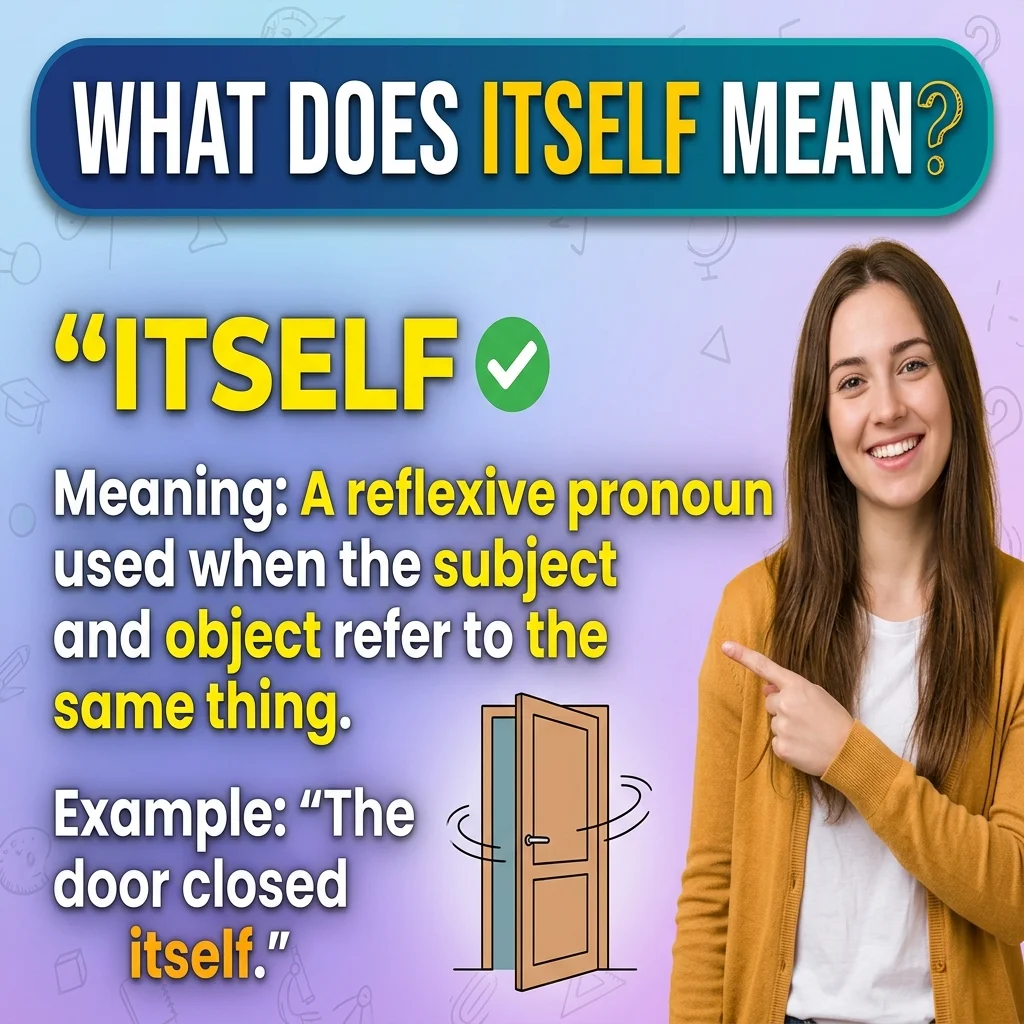
Itself is a reflexive pronoun and an emphatic pronoun. It is used with the pronoun “it” when referring to a thing, animal, situation, or idea.
The word can have two main functions:
- Reflexive use: The action returns to the subject.
- Emphatic use: The word adds emphasis to a noun or pronoun.
Itself as a Reflexive Pronoun
A reflexive pronoun is used when the subject and the object of a sentence refer to the same thing.
For example:
- The cat cleaned itself.
- The door closed itself.
- The computer restarted itself.
In the sentence “The cat cleaned itself,” the cat is both the subject and the receiver of the action. The cat cleaned the cat.
The reflexive pronoun itself prevents the sentence from sounding incomplete or incorrect.
Itself as an Emphatic Pronoun
“Itself” can also emphasize a noun or idea. In this use, it does not receive the action. Instead, it highlights the importance or identity of something.
Examples:
- The building itself is beautiful.
- The idea itself is interesting.
- The phone itself is affordable, but the accessories are expensive.
Here, “itself” means something like “the thing in its own identity” or “the thing specifically.”
What Does Its Mean?
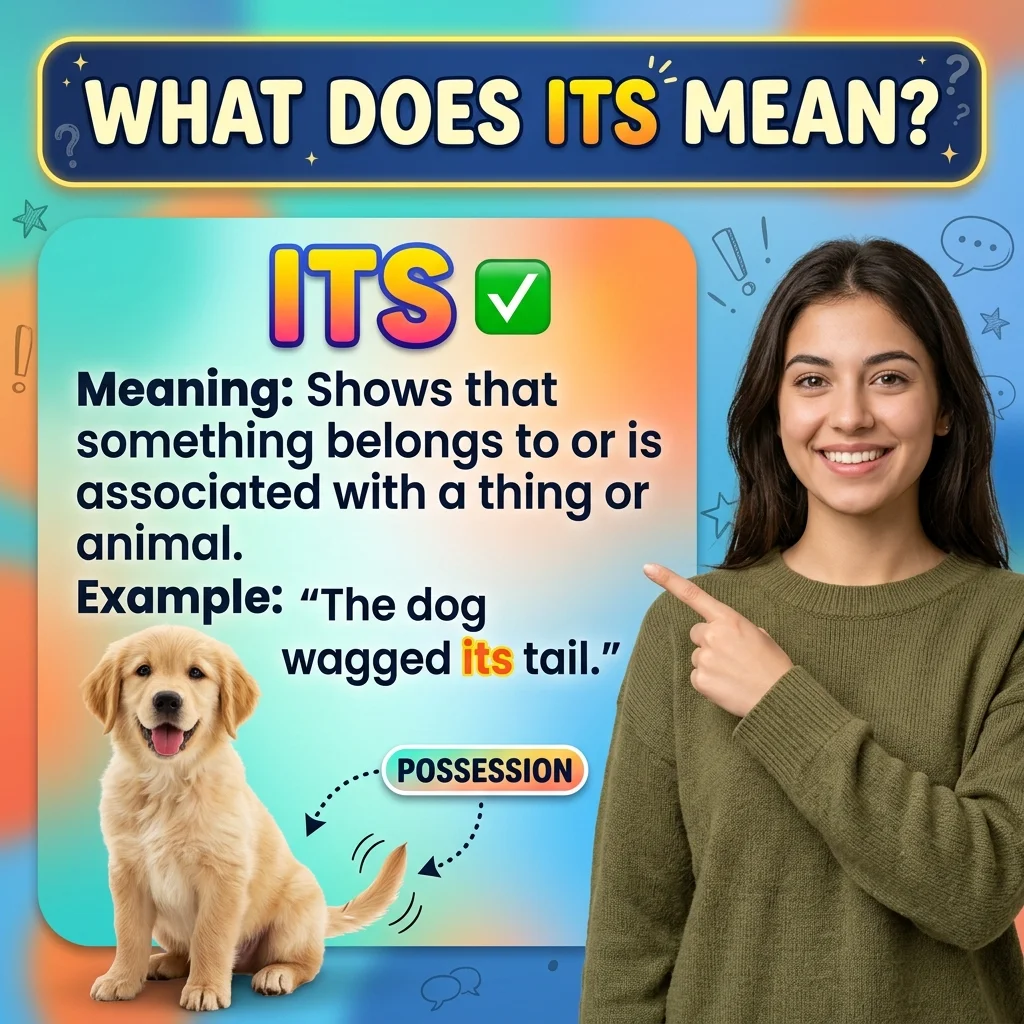
Its is a possessive determiner. It shows that something belongs to, is connected with, or is associated with a thing, animal, organization, or idea.
Examples:
- The dog wagged its tail.
- The company changed its policy.
- The tree lost its leaves.
- The phone has its own charger.
In these sentences, its tells us who or what owns or possesses something.
Its vs. It’s
One of the most common grammar mistakes is confusing its with it’s.
| Word | Meaning | Example |
| Its | Shows possession | The bird spread its wings. |
| It’s | Short form of “it is” or “it has” | It’s raining. |
| Itself | Reflexive or emphatic pronoun | The bird cleaned itself. |
Spelling tip: If you can replace the word with “it is” or “it has,” use “it’s.” Otherwise, if you are showing possession, use “its.”
- It’s a beautiful day. → It is a beautiful day.
- The dog hurt its paw. → The paw belongs to the dog.
- The dog hurt itself. → The dog is both the subject and object.
Its Self or Itself: The Main Difference
The biggest difference is that “itself” is one complete pronoun, while “its self” contains two separate words.
Itself
Standard usage
One word used as a reflexive or emphatic pronoun.
The robot repaired itself.
Its self
Special context
Two separate words: possessive “its” + noun “self.”
The essay explored the creature and its self.
In most normal sentences, itself is the form you need.
When Should You Use Itself?
1. When a Thing Does Something to Itself
Use itself when the subject and object refer to the same thing.
Examples:
- The robot repaired itself.
- The window opened itself.
- The plant supports itself with strong roots.
- The camera adjusted itself automatically.
- The dog scratched itself.
In each sentence, the action comes back to the subject.
2. When You Want to Emphasize a Thing
Use itself to emphasize the noun it follows.
Examples:
- The book itself is easy to understand.
- The test itself was not difficult.
- The city itself is very beautiful.
- The product itself works well.
- The explanation itself was confusing.
Here, itself adds emphasis. It tells the reader that you are talking about the actual thing, not something related to it.
3. After Certain Prepositions
“Itself” can follow a preposition when referring to something.
Examples:
- The box fell by itself.
- The door opened on itself.
- The system works by itself.
- The machine can operate without help from anyone but itself.
The phrase “by itself” is especially common and means alone, independently, or without assistance.
4. In the Phrase “In Itself”
The phrase “in itself” means considered alone or separately from other factors.
Examples:
- The idea is not bad in itself.
- The mistake is minor in itself.
- The rule is simple in itself, but the exceptions can be confusing.
- The job is difficult in itself, even without the extra responsibilities.
This phrase is common in formal and academic writing.
When Can “Its Self” Be Correct?
Although “its self” is unusual in everyday English, it can be grammatically possible when “self” is used as a separate noun.
In this construction:
- Its = possessive determiner
- Self = noun
The phrase may be used when discussing the identity, nature, or inner being of something.
Philosophical or Psychological Writing
In philosophical or psychological contexts, self can refer to identity, consciousness, or inner nature.
Examples:
- The theory examines the machine and its self.
- The writer explores the relationship between the body and its self.
- The discussion considers the organization and its self as separate concepts.
However, these sentences are uncommon and may sound abstract or awkward. In many cases, writers would naturally choose itself instead.
Literary or Creative Writing
A writer may deliberately separate “its” and “self” to create a special meaning or poetic effect.
Example:
- The ancient tree seemed to remember its self from another age.
Here, the writer may be treating self as a distinct noun representing identity or existence.
This is a stylistic choice, not the normal everyday form of the reflexive pronoun.
Why “Its Self” Is Usually Not the Best Choice
In ordinary English, self is not normally treated as a separate noun after its when you simply mean the thing itself.
For example:
- Natural: The machine itself is expensive.
- Unnatural in ordinary English: The machine’s self is expensive.
- Usually incorrect for the intended meaning: The machine its self is expensive.
If your meaning is “the thing itself,” use itself.
Itself in Reflexive Sentences
A reflexive sentence usually has this structure:
Subject + verb + itself
Examples:
- The dog hurt itself.
- The computer shut itself down.
- The door locked itself.
- The toy moves itself.
- The bird dried itself.
Why the Reflexive Form Matters
Compare these sentences:
- The dog hurt itself.
- The dog hurt it.
The first sentence means the dog hurt its own body. The second sentence means the dog hurt another thing previously mentioned.
The reflexive pronoun makes the meaning clear.
More Reflexive Examples
- The kitten washed itself.
- The machine switched itself off.
- The phone updated itself overnight.
- The bird protected itself from the cold.
- The animal found itself trapped.
- The company reorganized itself after the merger.
- The software installed itself automatically.
- The balloon released itself from the branch.
Itself in Emphatic Sentences
An emphatic pronoun adds importance or contrast.
Examples:
- The manager himself approved the plan.
- The machine itself is not the problem.
- The website itself loads quickly.
- The answer itself is correct.
- The organization itself admitted the mistake.
In these sentences, itself can often be removed without making the sentence grammatically incomplete.
Compare:
- The website itself loads quickly.
- The website loads quickly.
Both are grammatical, but the first emphasizes the website specifically.
Reflexive vs. Emphatic Use
| Use | Example | Can “itself” be removed? |
| Reflexive | The cat cleaned itself. | No, not without changing the meaning. |
| Emphatic | The cat itself is harmless. | Yes, usually. |
This is a useful way to identify how itself is functioning.
Itself vs. It: What Is the Difference?
It is a personal pronoun. Itself is a reflexive or emphatic pronoun.
| It | Itself |
| Refers to a thing, animal, or idea | Refers back to the subject or adds emphasis |
| The dog chased it. | The dog chased itself. |
| The phone is new. | The phone itself is new. |
Example 1
- The cat saw it in the mirror. → The cat saw another thing or animal.
- The cat saw itself in the mirror. → The cat saw its own reflection.
Example 2
- The company changed it. → The company changed something else.
- The company changed itself. → The company changed its own structure or operations.
Itself vs. Its: What Is the Difference?
These words have different grammatical jobs.
| Word | Function | Example |
| Its | Possessive determiner | The dog ate its food. |
| Itself | Reflexive pronoun | The dog fed itself. |
Compare These Sentences
- The bird cleaned its feathers. → The feathers belong to the bird.
- The bird cleaned itself. → The bird cleaned its own body.
- The bird spread its wings. → The wings belong to the bird.
- The bird protected itself. → The bird protected its own body or life.
Itself vs. Its Self: Examples
The following examples show the difference clearly.
| Sentence | Correct? | Explanation |
| The robot repaired itself. | Yes | Reflexive pronoun. |
| The robot repaired its self. | No, in ordinary usage | “Itself” should be one word. |
| The building itself is old. | Yes | Emphatic pronoun. |
| The building its self is old. | No | Incorrect separation. |
| The writer explored the creature and its self. | Possible in special writing | “Self” is a separate noun. |
| The writer explored the creature itself. | Yes | Natural emphatic usage. |
Common Mistakes with Its Self and Itself
Mistake 1: Writing “Its Self” Instead of “Itself”
Incorrect: The computer turned its self off.
Correct: The computer turned itself off.
Why? The sentence needs a reflexive pronoun, so itself must be written as one word.
Mistake 2: Confusing Itself with Its
Incorrect: The company changed itself policy.
Correct: The company changed its policy.
Why? The word its shows possession. The policy belongs to the company.
Mistake 3: Confusing Itself with It’s
Incorrect: The dog hurt it’s paw.
Correct: The dog hurt its paw.
Why? The paw belongs to the dog, so use its. “It’s” means “it is” or “it has.”
Mistake 4: Using Itself When You Mean It
Incorrect: I gave the book to itself.
Correct: I gave the book to it.
Why? The book is not receiving an action performed on itself. The pronoun it is the correct object.
Mistake 5: Using Itself Without a Clear Reference
Incorrect: Itself is a good idea.
Correct: The plan itself is a good idea.
Why? “Itself” usually needs a clear noun or pronoun to refer back to.
Mistake 6: Using “Its Self” in Formal Writing Without a Special Meaning
Unnatural: The product’s self is excellent.
Natural: The product itself is excellent.
Why? In ordinary English, itself is the standard emphatic form.
Spelling Tips to Remember Itself
Here are some easy ways to remember the correct spelling:
Tip 1: Think of Itself as One Word
The reflexive pronouns are written as single words:
- myself
- yourself
- himself
- herself
- itself
- ourselves
- yourselves
- themselves
Because itself belongs to this group, it is normally written as one word.
Tip 2: Ask What You Mean
If you mean “the thing itself” or “the thing did something to its own self,” use itself.
- The phone fixed itself.
- The phone itself is expensive.
Tip 3: Check Whether “Self” Is a Real Noun
If you are using self as a separate noun to discuss identity or inner nature, its self may be possible. Otherwise, use itself.
Tip 4: Remember the Apostrophe Rule
- Its = possession
- It’s = it is / it has
- Itself = reflexive or emphatic pronoun
How to Choose the Correct Word
Use this simple decision process:
Are you referring to a thing doing something to its own self?
Yes → Use itself.
No → Continue.
Are you emphasizing the thing?
Yes → Use itself.
No → Continue.
Are you using “self” as a separate noun in a special philosophical or literary context?
Possibly → its self may be appropriate, depending on the meaning.
Practice Examples: Choose Itself or Its Self
Try choosing the correct form in each sentence.
- The machine repaired ______.
- The building ______ is not very old.
- The essay explored the character and ______.
- The dog hurt ______ while running.
- The company changed ______ after the crisis.
Answers
- itself The machine repaired itself.
- itself The building itself is not very old.
- its self Possible if “self” is treated as a separate noun in a special context.
- itself The dog hurt itself while running.
- itself The company changed itself after the crisis.
In everyday writing, most answers will be itself.
More Examples of Itself in Everyday English
Technology
- The app updated itself automatically.
- The computer restarted itself.
- The device can turn itself off.
- The software protects itself from errors.
- The camera adjusts itself in low light.
Animals
- The cat cleaned itself.
- The dog scratched itself.
- The bird dried itself after the rain.
- The snake protected itself from danger.
- The animal found itself alone.
Objects and Machines
- The door opened itself.
- The toy moves itself across the floor.
- The car parked itself.
- The clock corrected itself.
- The machine stopped itself when it overheated.
Ideas and Concepts
- The idea itself is simple.
- The problem itself is not serious.
- The rule itself is easy to follow.
- The situation itself was unusual.
- The question itself is worth asking.
Better Readability
Readers should not have to stop and wonder whether a word is spelled correctly. Using itself properly keeps your sentences smooth and easy to understand.
Stronger Credibility
Grammar mistakes can make an article appear less reliable. Correct usage shows attention to detail and helps readers trust your content.
Natural Keyword Usage
If your article targets the keyword “its self or itself,” you can include it naturally in:
- The title
- The introduction
- Comparison headings
- Examples
- FAQs
- The conclusion
However, avoid repeating the keyword unnecessarily. Helpful explanations are more valuable than keyword stuffing.
AdSense-Friendly Writing
Grammar articles should focus on useful information, clear examples, and a positive reading experience. Avoid misleading claims, excessive repetition, and unnatural keyword placement.
Frequently Asked Questions
Is “its self” correct in English?
“Its self” can be correct in rare contexts when “its” is a possessive determiner and “self” is a separate noun. However, it is not the normal form of the reflexive pronoun. In everyday English, use itself.
Is “itself” one word or two?
Itself is one word. It is the reflexive and emphatic pronoun related to it.
Which is correct: “The machine fixed its self” or “The machine fixed itself”?
The correct sentence is:
The machine fixed itself.
The word itself is used because the machine is both the subject and the object of the action.
What is the difference between “its” and “itself”?
Its shows possession, while itself is a reflexive or emphatic pronoun.
- The cat licked its paw.
- The cat licked itself.
Can “itself” be used for people?
Usually, itself refers to things, animals, or ideas. For people, use himself, herself, or themselves, depending on the context.
- The boy hurt himself.
- The woman introduced herself.
- The students organized themselves.
What does “by itself” mean?
By itself means alone, independently, or without help.
Examples:
- The door opened by itself.
- The child completed the task by itself.
- The machine operates by itself.
Is “itself” a reflexive pronoun?
Yes. Itself is a reflexive pronoun when it refers back to the subject.
Example:
- The dog washed itself.
It can also be an emphatic pronoun when it adds emphasis.
Example:
- The dog itself is harmless.
Why do people write “its self”?
People may write “its self” because they hear the words as separate sounds or confuse itself with its. In ordinary English, this is usually a spelling mistake.
Can “its self” be used in poetry?
Yes. A poet or writer may separate the words intentionally to give self a special meaning related to identity or existence. This is a stylistic choice, not the standard everyday usage.
How can I remember the correct spelling?
Remember that itself belongs to the same group as myself, yourself, himself, herself, ourselves, yourselves, and themselves. These reflexive pronouns are written as single words.
Final Thoughts
The difference between its self and itself is simple once you understand their grammatical roles. Itself is the standard word used as a reflexive or emphatic pronoun. You use it when a thing does something to its own self or when you want to emphasize that thing.
Its self, on the other hand, is a rare construction in which its shows possession and self acts as a separate noun. It may appear in philosophical, psychological, or literary writing, but it is not the normal choice for everyday English.

Daniel Carter is a passionate writer who creates clear, helpful, and easy-to-understand content. He focuses on language, grammar, word meanings, and everyday expressions, helping readers find simple answers to common questions.