Have you ever looked back on a special moment and wondered how the days, months, or even years passed so quickly? When expressing this feeling, choosing the correct phrase matters. The correct expression is “time has flown by,” not “time has flew by.”
The confusion comes from the irregular verb fly, which changes form depending on how it appears in a sentence. “Flew” is the simple past tense, while “flown” is the past participle used with helping verbs such as has, have, and had.
For example, you can say, “Time flew by during our vacation” because the sentence uses the simple past tense. However, you should write, “Time has flown by since we last met” because the present perfect tense requires the past participle.
What Does “Time Has Flown By” Mean?
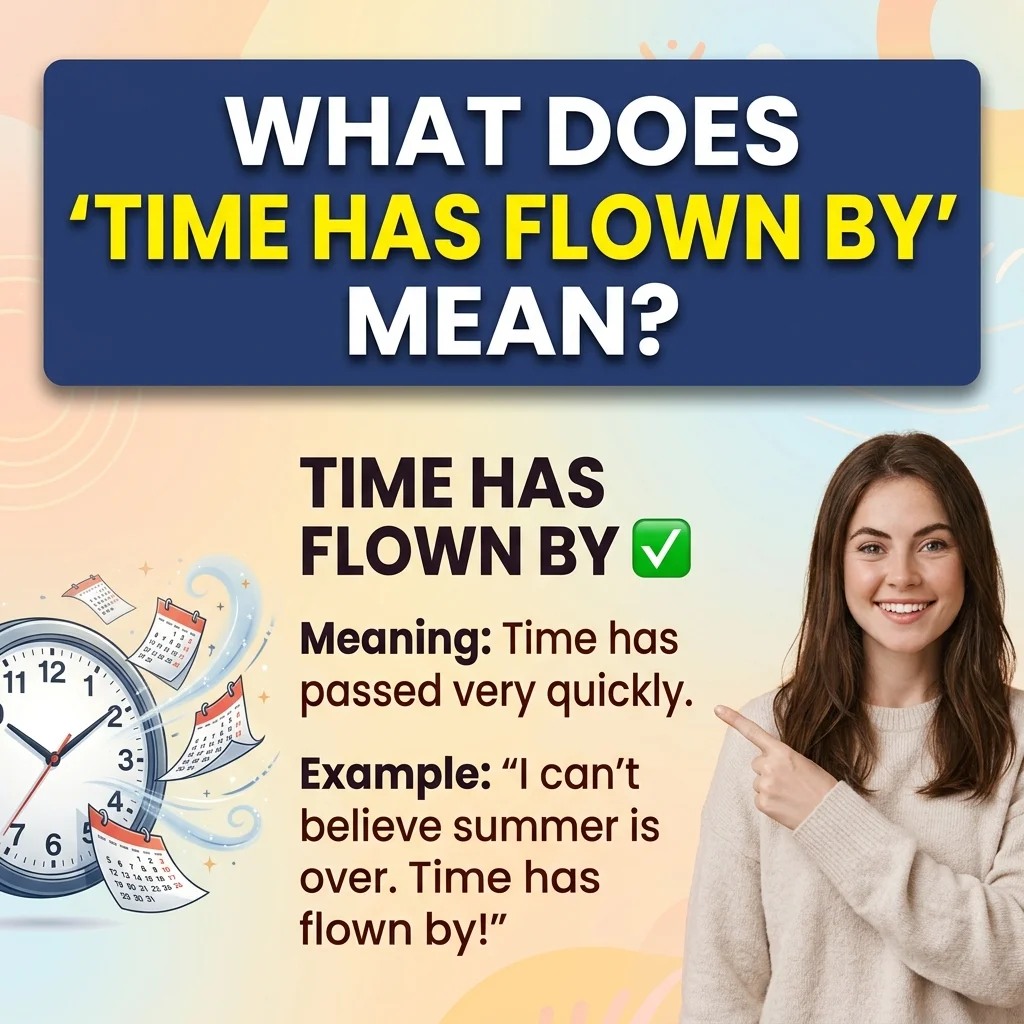
“Time has flown by” is a common English expression used when time seems to have passed very quickly.
The phrase does not literally mean that time has wings and is flying through the air. Instead, flown by is figurative language that describes how quickly time appears to pass.
For example:
“Time has flown by since I started college.”
This means that the speaker feels that their college years have passed very quickly.
Another example is:
“It’s hard to believe that the year is almost over. Time has flown by!”
Here, the speaker is surprised by how quickly the year has passed.
The expression is especially common when talking about:
- Childhood
- Relationships
- Holidays
- School or college
- Work projects
- Special events
- Birthdays
- Years passing
- Life experiences
Why Does Time “Fly”?
English often uses movement-related expressions to describe the passing of time.
We say:
- Time flies.
- Time flew by.
- Time has flown by.
- Time is flying by.
- Time flies when you’re having fun.
These expressions suggest that time moves so quickly that we barely notice it.
For example:
“Time flies when you’re having fun.”
This means that enjoyable experiences can make us feel as though time is passing unusually quickly.
“Time Has Flew By” or “Time Has Flown By”?

The correct phrase is:
“Time has flown by.”
The phrase “time has flew by” is grammatically incorrect in standard English.
The reason is simple: has is a helping verb that requires the past participle of the main verb.
The verb fly has three important forms:
| Verb Form | Word | Example |
| Base form | fly | Birds fly in the sky. |
| Simple past | flew | The bird flew away. |
| Past participle | flown | The bird has flown away. |
Therefore:
- Time flew by. ✅
- Time has flown by. ✅
- Time has flew by. ❌
The key point is that flew is the simple past form, while flown is the past participle.
Why Is “Time Has Flew By” Incorrect?
To understand the mistake, you need to understand how English verb forms work.
The word flew is the simple past form of fly.
You can use flew when talking about something that happened in the past.
For example:
“The bird flew over the house.”
You would not normally say:
“The bird has flew over the house.”
Instead, you should say:
“The bird has flown over the house.”
The same rule applies to the expression about time.
Incorrect:
“Time has flew by.”
Correct:
“Time has flown by.”
The word has creates the present perfect tense, and the present perfect requires the past participle.
The Basic Grammar Pattern
The present perfect tense generally follows this structure:
Subject + has/have + past participle
For example:
- She has gone home.
- He has written a letter.
- They have eaten dinner.
- Time has flown by.
Notice that the third form of the verb is used after has or have.
That is why flown, not flew, belongs in the phrase.
What Is the Difference Between “Flew” and “Flown”?
The main difference is grammatical.
“Flew” Simple Past
Flew is the simple past form of fly.
Use it when describing an action that happened in the past.
Examples:
“The plane flew over the mountains.”
“The bird flew out of the window.”
“Time flew by during our vacation.”
In each example, flew describes something that happened in the past.
“Flown” Past Participle
Flown is the past participle of fly.
It is generally used with helping verbs such as:
- has
- have
- had
Examples:
“The plane has flown across the country.”
“The bird has flown away.”
“Time has flown by.”
So, when you use has, have, or had, you need flown, not flew.
“Time Flew By” vs. “Time Has Flown By”
Both phrases are correct, but they are used slightly differently.
Time Flew By
“Time flew by” uses the simple past tense.
It is appropriate when you are talking about a completed period in the past.
Example:
“Time flew by during our vacation.”
You are describing a past experience.
Another example:
“The three hours at the concert flew by.”
The three hours are presented as a completed period.
Time Has Flown By
“Time has flown by” uses the present perfect tense.
It connects a past experience with the present.
Example:
“Time has flown by since we moved here.”
The speaker is looking at the period from the past until now.
Another example:
“I can’t believe how quickly time has flown by.”
This suggests that the passage of time is relevant to the present moment.
“Time Has Flew By” vs. “Time Has Flown By” Examples
Here are some simple examples to make the difference clear.
Incorrect
“Time has flew by so quickly.”
Correct
“Time has flown by so quickly.”
Incorrect
“I can’t believe how time has flew by.”
Correct
“I can’t believe how time has flown by.”
Incorrect
“The last five years has flew by.”
Correct
“The last five years have flown by.”
There is another grammar point in the last example: five years is plural, so we use have, not has.
Examples of “Time Has Flown By”
Here are several natural examples:
- Time has flown by since we first met.
- I can’t believe how quickly time has flown by.
- Time has flown by since the beginning of the year.
- It feels like yesterday, but ten years have flown by.
- Time has really flown by during this vacation.
- I never expected time to have flown by so quickly.
- The past few months have flown by.
- Time has flown by while we have been working on this project.
- It’s amazing how quickly time has flown by.
- Time has flown by, and now graduation is almost here.
Examples of “Time Flew By”
You can also correctly use flew without has.
Examples include:
- Time flew by during the party.
- The weekend flew by.
- The summer flew by.
- Our vacation flew by.
- The afternoon flew by.
- The school year flew by.
- The meeting flew by.
- The first few months flew by.
- My childhood seemed to fly by.
- The evening flew by.
The important thing to remember is that flew works as the simple past form.
When Should You Use “Flew”?
Use flew when talking about a completed action or period in the past.
For example:
“The weekend flew by.”
This describes a completed weekend.
“Our vacation flew by.”
The vacation has ended, and you are talking about it as a past experience.
“The entire summer flew by.”
The summer is being described as a completed period.
Simple Formula
You can remember:
Past event → flew
Examples:
- Yesterday flew by.
- The weekend flew by.
- The vacation flew by.
- The afternoon flew by.
When Should You Use “Flown”?
Use flown after helping verbs such as has, have, or had.
Examples:
- Time has flown by.
- The years have flown by.
- The months have flown by.
- The days have flown by.
- The summer has flown by.
- The years had flown by before we realized it.
Simple Formula
Has/have/had + flown
Examples:
- has flown
- have flown
- had flown
Never use:
- has flew ❌
- have flew ❌
- had flew ❌
“Time Has Flown By” in Everyday English
“Time has flown by” sounds natural and conversational.
Native English speakers commonly use this expression when they feel surprised by how quickly a period has passed.
For example, imagine someone celebrating a birthday:
“I’m turning 30 already. Time has flown by!”
Or someone reflecting on their children:
“My children are teenagers now. Time has flown by.”
Or after returning from a vacation:
“We’ve been here for two weeks already. Time has flown by!”
The expression often communicates surprise, nostalgia, happiness, or even sadness.
What Does “Time Flies” Mean?
Another common expression is:
“Time flies.”
This is the present simple form.
It means that time seems to pass quickly.
For example:
“Time flies when you’re having fun.”
This is one of the most familiar expressions in English.
You can think of the forms like this:
- Time flies. → General statement
- Time flew by. → Simple past
- Time has flown by. → Present perfect
- Time is flying by. → Happening now
- Time had flown by. → Past perfect
Understanding these forms makes it much easier to choose the correct expression.
“Time Is Flying By” vs. “Time Has Flown By”
These two expressions are also correct, but they have slightly different meanings.
Time Is Flying By
This uses the present continuous tense.
It emphasizes that time is passing quickly right now.
Example:
“Time is flying by while we’re working on this project.”
Time Has Flown By
This uses the present perfect tense.
It emphasizes that a period of time has already passed quickly.
Example:
“Time has flown by since we started this project.”
A simple way to remember the difference is:
Is flying = happening now
Has flown = has already happened up to now
Common Mistakes With “Flew” and “Flown”
English learners often confuse irregular verbs because their past forms do not follow a simple -ed pattern.
Here are some common mistakes.
Mistake 1: Using “Flew” After “Has”
Incorrect:
“Time has flew by.”
Correct:
“Time has flown by.”
Mistake 2: Using “Flew” After “Have”
Incorrect:
“The years have flew by.”
Correct:
“The years have flown by.”
Mistake 3: Using “Flown” Alone as the Past Tense
Incorrect:
“Time flown by yesterday.”
Correct:
“Time flew by yesterday.”
Flown generally needs a helping verb in this type of construction.
Mistake 4: Mixing Verb Forms
Incorrect:
“Time has fly by.”
Correct:
“Time has flown by.”
The base form fly cannot normally be used after has in this construction.
A Quick Spelling and Grammar Tip
One easy way to remember the difference is:
Fly → Flew → Flown
Think of it as three stages:
- Fly = present/base form
- Flew = past
- Flown = past participle
You can memorize a short sentence:
“Yesterday it flew, but today it has flown.”
This helps separate the simple past from the past participle.
Other Common Irregular Verbs Like “Fly”
The confusion between flew and flown is similar to other irregular verbs.
For example:
| Base | Past | Past Participle |
| go | went | gone |
| see | saw | seen |
| write | wrote | written |
| eat | ate | eaten |
| take | took | taken |
| speak | spoke | spoken |
| fly | flew | flown |
For example:
- She went home.
- She has gone home.
Similarly:
- The bird flew away.
- The bird has flown away.
This pattern can help you understand why “time has flown by” is correct.
Is “Time Has Flown By” Grammatically Correct?
Yes.
“Time has flown by” is grammatically correct and natural English.
The structure is:
Time + has + flown + by
Here:
- Time = subject
- has = helping verb
- flown = past participle of fly
- by = adverbial particle forming the phrasal expression “fly by”
The phrase means that time has passed quickly.
Is “Time Has Flew By” Ever Correct?
In standard English grammar, “time has flew by” is considered incorrect.
You should use:
“Time has flown by.”
If you want to use flew, remove has:
“Time flew by.”
Therefore, these are correct:
- Time flew by. ✅
- Time has flown by. ✅
- Time is flying by. ✅
But:
- Time has flew by. ❌
How to Remember the Correct Phrase
If you frequently confuse flew and flown, try this simple rule:
Remember “Has = Flown”
Whenever you see has, think of flown.
For example:
Has + flown
- Time has flown.
- The bird has flown.
- The plane has flown.
- The years have flown by.
And remember:
No helping verb + flew
- The bird flew.
- The plane flew.
- Time flew by.
- The years flew by.
This simple trick can prevent many common grammar mistakes.
“Time Has Flown By” in Different Situations
Talking About Childhood
“I can’t believe how quickly time has flown by. My children are growing up so fast.”
This expresses nostalgia.
Talking About a Relationship
“We’ve been together for five years, and time has flown by.”
This emphasizes how quickly the relationship has progressed.
Talking About Work
“We started this project six months ago, and time has flown by.”
This connects the past with the present.
Talking About a Vacation
“Our vacation is almost over. Time has flown by!”
This expresses surprise that the vacation is ending so quickly.
Talking About School
“My final year has flown by.”
This suggests that the school year passed very quickly.
Synonyms for “Time Has Flown By”
If you want to avoid repeating the same expression, there are several alternatives.
You can say:
- Time has passed quickly.
- Time has gone by quickly.
- Time has passed so fast.
- The days have gone by quickly.
- The months have passed rapidly.
- The years have gone by.
- The years have slipped away.
- Time seems to have disappeared.
- The days have passed before I realized it.
However, “time has flown by” is one of the most natural and familiar expressions in everyday English.
“Time Has Gone By” vs. “Time Has Flown By”
Both are correct.
“Time has gone by” simply means that time has passed.
“Time has flown by” emphasizes that time has passed very quickly.
Compare:
“Five years have gone by.”
This is a neutral statement.
“Five years have flown by.”
This emphasizes how surprisingly fast those five years seem to have passed.
Why Do People Say “Time Has Flown By”?
The expression is based on a metaphor.
Flying is associated with speed and movement. When something flies past you, it can disappear from your view very quickly.
English uses this idea to describe time.
When someone says:
“Time has flown by.”
They are saying that time seems to have moved extremely quickly.
It is not meant literally. It is an example of figurative language.
More Example Sentences
Here are additional examples to help you practice.
Correct Examples With “Has Flown”
- Time has flown by since my first day at work.
- The past year has flown by.
- The last few months have flown by.
- Time has flown by since we moved to this city.
- The weekend has flown by.
- The holidays have flown by.
- My first year at university has flown by.
- The last decade has flown by.
- Time has flown by while we have been busy.
- The afternoon has flown by.
Correct Examples With “Flew”
- The afternoon flew by.
- The weekend flew by.
- Our holiday flew by.
- The school year flew by.
- The meeting flew by.
- The evening flew by.
- The summer flew by.
- The three-hour flight flew by.
- The first few weeks flew by.
- The entire day flew by.
A Simple Practice Exercise
Choose flew or flown in each sentence.
- Time has ______ by.
- The weekend ______ by.
- The years have ______ by.
- Yesterday, time ______ by quickly.
- The past few months have ______ by.
- The summer ______ by last year.
Answers
- flown
- flew
- flown
- flew
- flown
- flew
The rule is simple:
Has/have + flown
Simple past + flew
Frequently Asked Questions
Is “time has flew by” correct?
No. In standard English, “time has flew by” is incorrect. The correct phrase is “time has flown by.”
Is “time has flown by” correct grammar?
Yes. “Time has flown by” is grammatically correct. It uses the present perfect tense: has + flown.
Should I say “time flew by” or “time has flown by”?
Both are correct. Use “time flew by” for a completed past period and “time has flown by” when connecting the past to the present.
What is the past tense of “fly”?
The simple past tense of fly is flew.
Example:
“The bird flew away.”
What is the past participle of “fly”?
The past participle of fly is flown.
Example:
“The bird has flown away.”
Why is “flew” wrong after “has”?
Because has normally requires the past participle in the present perfect tense. The past participle of fly is flown, not flew.
Can I say “time is flying by”?
Yes. “Time is flying by” is completely correct and emphasizes that time is passing quickly right now.
Is “time flies by” correct?
Yes. “Time flies by” is a common expression used for a general observation that time passes quickly.
Is “time has flown so fast” correct?
Yes. You can say:
“Time has flown so fast.”
However, “time has flown by so fast” is also very natural.
What is the easiest way to remember flew vs. flown?
Remember this pattern:
Fly → Flew → Flown
And remember:
Has/have/had + flown
For example:
“Time has flown by.”
Final Thought:
In the comparison of “time has flew by” vs. “time has flown by,” the correct phrase is “time has flown by.” The verb “flown” is the past participle of “fly,” which you need after “has” to form the present perfect tense. Although people sometimes use “time has flew by” in casual conversations, it is grammatically incorrect in standard English.
You can use “time has flown by” when talking about how quickly time seems to pass, whether you are remembering childhood memories, celebrating a special occasion, or reflecting on the past. Remember this simple rule to keep your English clear, natural, and grammatically correct.

Emily Parker is a dedicated writer who enjoys creating clear, useful, and easy-to-understand content. She focuses on language, grammar, word meanings, and everyday expressions to help readers find simple and reliable answers.