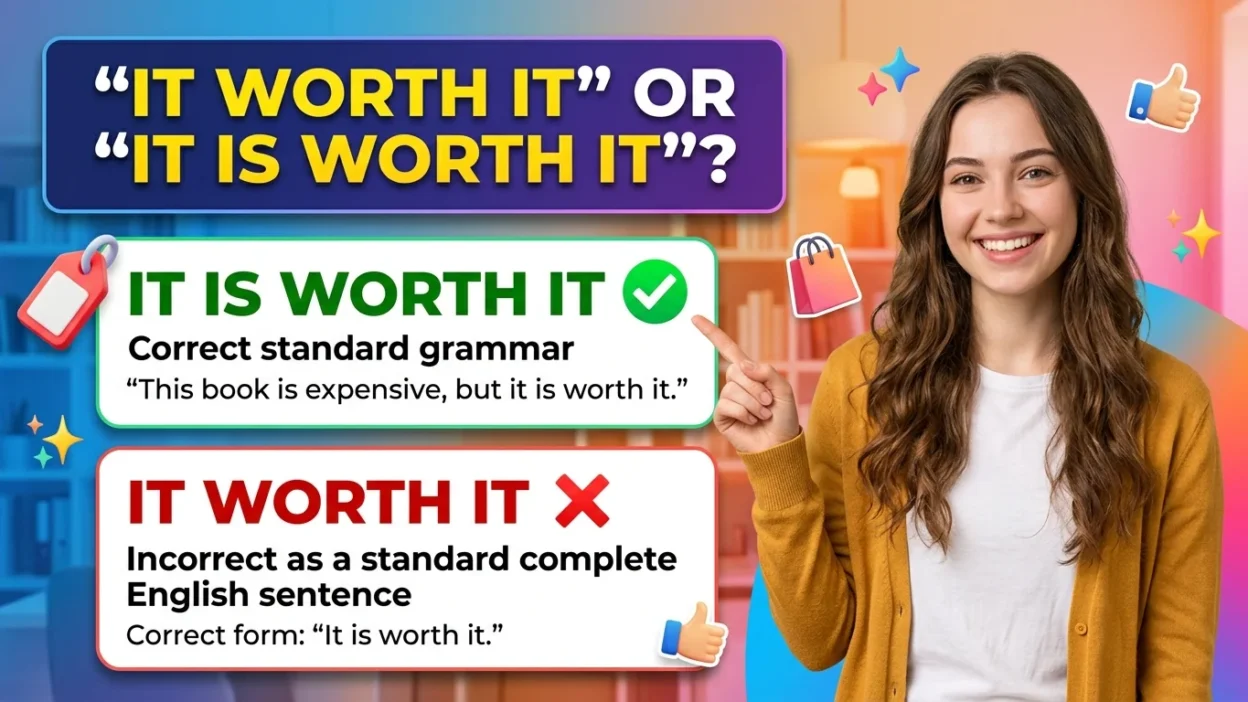
Choosing between “it worth it” and “it is worth it” might seem like a small grammar question, but one phrase is correct in standard English. “It is worth it” is the grammatically correct expression because the sentence needs the linking verb “is” to connect “it” with “worth it.”
You can use this phrase when describing something that deserves the time, effort, money, or attention it requires. For example, you might say, “The trip was expensive, but it is worth it” to explain that the experience justifies the cost.
What Does “It Is Worth It” Mean?
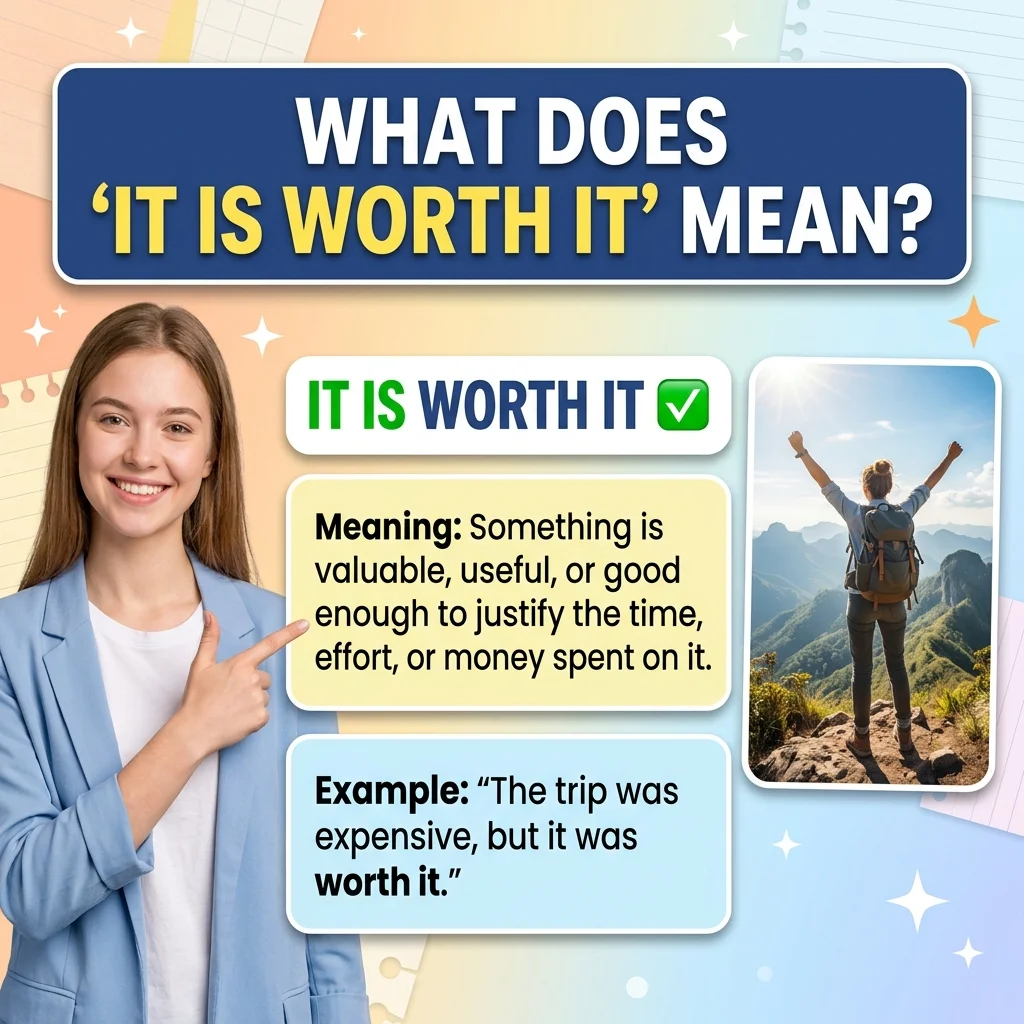
“It is worth it” is the grammatically correct expression.
It means that something has enough value or benefit to justify the cost, effort, time, difficulty, or inconvenience involved.
For example:
- The phone is expensive, but it is worth it.
- Studying every day is difficult, but it is worth it.
- The long trip was tiring, but it was worth it.
- This book takes time to read, but it is worth it.
In each example, the speaker believes that the positive result is greater than the cost or difficulty.
Simple Meaning of “It Is Worth It”
In beginner-friendly English, you can understand “it is worth it” as:
Something is valuable enough to make the effort or cost reasonable.
The “it” at the end usually refers to the cost, effort, trouble, time, or sacrifice involved.
For example:
“This restaurant is expensive, but it is worth it.”
Here, the restaurant costs a lot of money, but the speaker thinks the quality of the food or experience justifies the price.
Is “It Worth It” Correct Grammar?
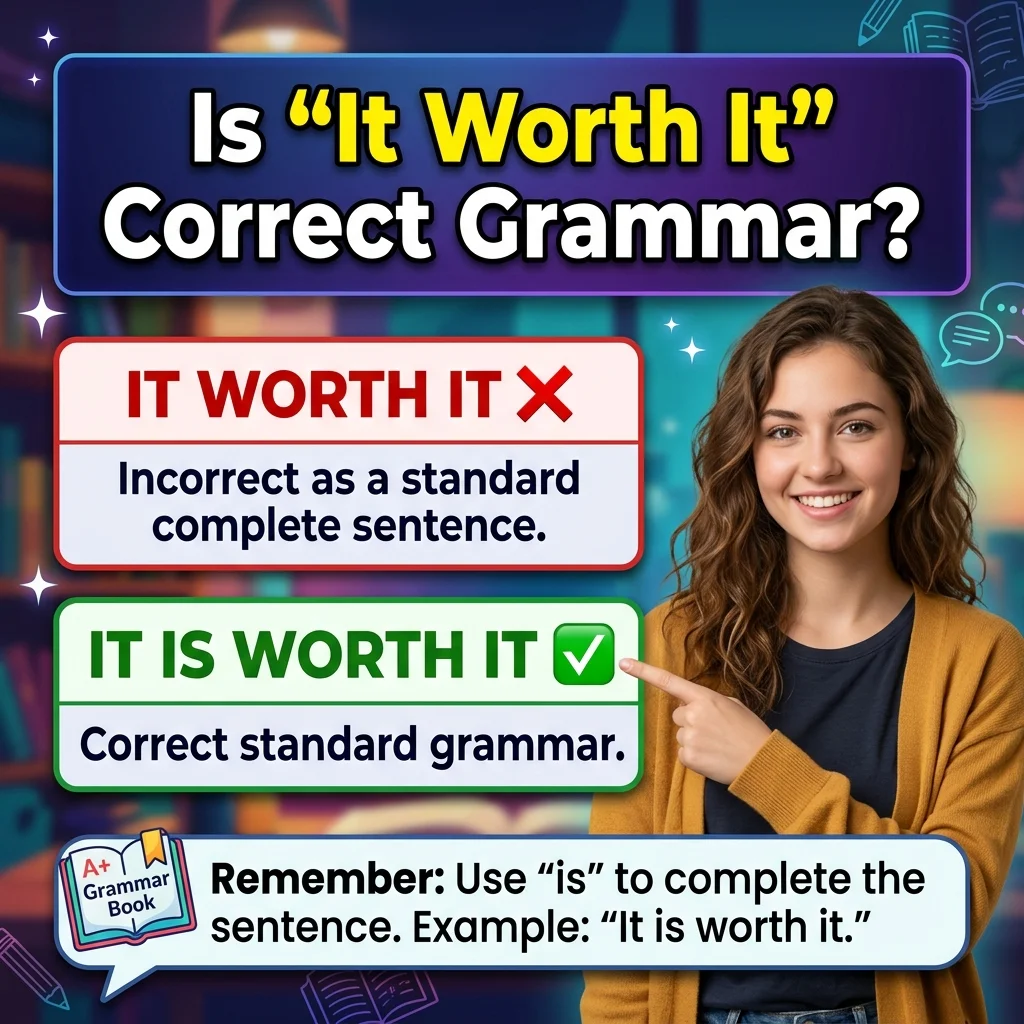
No. “It worth it” is generally grammatically incorrect when used as a complete sentence.
The problem is that “worth” does not function as the main verb in this structure. You need a form of the verb “to be.”
Therefore:
❌ It worth it.
✅ It is worth it.
✅ It’s worth it.
The word “is” acts as the linking verb that connects the subject “it” with the adjective “worth.”
This is an important rule for English learners because sentences using adjectives often require a form of “to be.”
For example:
- It is good.
- It is useful.
- It is expensive.
- It is difficult.
- It is worth it.
Without “is,” these sentences would be incomplete or grammatically incorrect.
“It Worth It” vs. “It Is Worth It”
The main difference is grammatical correctness.
| Expression | Correct? | Explanation |
| It worth it | ❌ No | Missing the verb “is” |
| It is worth it | ✅ Yes | Complete and grammatically correct |
| It’s worth it | ✅ Yes | Contraction of “it is” |
| It was worth it | ✅ Yes | Correct past-tense form |
| It will be worth it | ✅ Yes | Correct future form |
| It has worth it | ❌ No | Incorrect structure |
The safest expression to use is:
“It is worth it.”
In casual conversation, you will often hear:
“It’s worth it.”
Both are correct.
Why Do We Need “Is” in “It Is Worth It”?
English sentences generally need a verb.
In “It is worth it,” the basic structure is:
Subject + linking verb + complement
- It = subject
- is = linking verb
- worth = adjective
- it = object/complement referring to the cost, effort, or sacrifice
The word “is” comes from the verb “to be.”
Compare these sentences:
- It is useful.
- It is expensive.
- It is difficult.
- It is worth it.
Removing “is” makes the sentence incomplete:
- ❌ It useful.
- ❌ It expensive.
- ❌ It difficult.
- ❌ It worth it.
This is why “it is worth it” is the correct grammatical construction.
What Does “Worth” Mean?
The word “worth” describes the value of something.
It can refer to monetary value, usefulness, benefit, importance, or the result of an action.
For example:
“This watch is worth $500.”
This means the watch has a value of approximately $500.
But “worth” can also describe whether something deserves the time or effort spent on it.
For example:
“The movie is worth watching.”
This means watching the movie is a good use of your time.
Similarly:
“The trip was worth the money.”
This means the experience justified the money spent.
What Does “It” Mean in “It Is Worth It”?
The expression contains the word “it” twice, but the two uses can refer to the same general situation from different grammatical positions.
Consider:
“The course is difficult, but it is worth it.”
The first “it” refers to the course.
The second “it” refers to the difficulty, effort, time, or cost involved in completing the course.
The exact meaning depends on context.
For example:
“The tickets cost $300, but they are worth it.”
Here, “it” means the $300 cost or the experience received for that money.
“It Is Worth It” Meaning in Simple English
If you are learning English, remember this simple formula:
It is worth it = The benefits are greater than the cost or effort.
Examples:
- Learning English takes time, but it is worth it.
- The laptop is expensive, but it is worth it.
- The journey was long, but it was worth it.
- Waiting was frustrating, but it was worth it.
The phrase often expresses satisfaction after making an effort or spending money.
“It’s Worth It” Is the Same as “It Is Worth It”
“It’s worth it” is simply the contracted form of “it is worth it.”
Therefore:
It is worth it.
and
It’s worth it.
have the same meaning.
The difference is mainly style.
Formal Writing
In formal writing, you may prefer:
“It is worth it.”
For example:
Although the project requires significant effort, it is worth it because of the long-term benefits.
Casual Conversation
In everyday conversation, “It’s worth it” sounds more natural.
For example:
You should try this restaurant. It’s worth it!
Both forms are grammatically correct.
When Should You Use “It Is Worth It”?
You can use “it is worth it” when talking about whether something deserves the money, time, effort, or inconvenience involved.
Talking About Money
“The camera costs a lot, but it is worth it.”
The camera is expensive, but its quality justifies the price.
Talking About Time
“The course takes six months, but it is worth it.”
The speaker believes the benefits justify the time required.
Talking About Effort
“Learning a new language is challenging, but it is worth it.”
The speaker thinks the benefits justify the effort.
Talking About Difficulty
“The exam is difficult, but passing it is worth it.”
The positive result makes the difficulty worthwhile.
Talking About Travel
“The drive is long, but the destination is worth it.”
The experience makes the long journey worthwhile.
Examples of “It Is Worth It” in Everyday English
Here are several natural examples:
- This laptop is expensive, but it is worth it.
- The wait was long, but it was worth it.
- Learning to code takes time, but it is worth it.
- The restaurant is far away, but it is worth it.
- The course costs $500, but it is worth it.
- Getting up early is difficult, but it is worth it.
- The extra work is tiring, but it is worth it.
- The book is long, but it is worth reading.
- The trip was exhausting, but it was worth it.
- The upgrade costs more, but it is worth it.
These examples show how flexible the phrase can be.
“Was Worth It” vs. “Is Worth It”
The choice between “is” and “was” depends on time.
“Is Worth It”
Use “is worth it” when the situation is currently true or generally true.
Example:
This subscription is expensive, but it is worth it.
The speaker still considers the subscription worthwhile.
“Was Worth It”
Use “was worth it” when talking about something that happened in the past.
Example:
The trip was tiring, but it was worth it.
The trip has already happened.
More examples:
- The long wait was worth it.
- The extra money was worth it.
- Studying all night was worth it.
- The difficult journey was worth it.
“Will Be Worth It” for the Future
When talking about something that will happen in the future, use:
“It will be worth it.”
For example:
Keep working hard. It will be worth it.
This means the speaker believes the future result will justify the current effort.
Other examples:
- The training is difficult now, but it will be worth it.
- Save your money. The new computer will be worth it.
- Keep practicing. Your hard work will be worth it.
- The journey may be tiring, but it will be worth it.
“It Was Worth It” Meaning
“It was worth it” usually expresses satisfaction about something that has already happened.
For example:
I studied for ten hours, but it was worth it because I passed the exam.
The speaker experienced difficulty but received a positive result.
You can also use it after spending money:
I paid more for the better seat, but it was worth it.
Or after making a sacrifice:
I woke up early every morning, and it was worth it.
“Worth It” Without “It Is”
The phrase “worth it” can appear without “it is” when it is part of another grammatical structure.
For example:
“Is it worth it?”
This is completely correct.
You are asking whether something deserves the time, effort, or cost.
Other examples include:
- Was it worth it?
- Will it be worth it?
- Do you think it is worth it?
- I don’t think it is worth it.
- I know it is worth it.
So, the problem is not the phrase “worth it.”
The problem occurs when someone writes “it worth it” as a complete sentence without the required verb.
Is “Is It Worth It?” Correct?
Yes.
“Is it worth it?” is one of the most common ways to use the phrase.
It asks whether something deserves the cost, effort, time, or difficulty involved.
Examples:
Is the new phone worth it?
The question can be answered with:
Yes, it is worth it.
or:
No, it isn’t worth it.
“Is It Worth It?” vs. “Is It Worthwhile?”
Both expressions can ask about value, but they have slightly different styles.
“Is it worth it?” is extremely common in everyday conversation.
“Is it worthwhile?” can sound slightly more formal.
For example:
Is learning another language worth it?
and:
Is learning another language worthwhile?
Both are understandable and grammatically correct.
However, “worth it” is generally more natural in casual English.
Common Mistake: “It Worth It”
One of the most common mistakes is writing:
❌ It worth it.
The correct sentence is:
✅ It is worth it.
Or:
✅ It’s worth it.
The mistake happens because learners sometimes treat “worth” as if it were a normal verb.
For example, they may think:
It worth it.
works like:
It works.
But “worth” does not work that way.
You need the linking verb:
It is worth it.
Common Mistake: “It’s” vs. “Its”
Another important spelling issue is the difference between “it’s” and “its.”
It’s
“It’s” is a contraction of:
it is
or sometimes:
it has
In “It’s worth it,” it means:
“It is worth it.”
Its
“Its” is a possessive word.
Example:
The company changed its policy.
Here, “its” shows possession.
Therefore:
✅ It’s worth it.
❌ Its worth it.
A useful trick is to replace “it’s” with “it is.”
If the sentence still makes sense, “it’s” is probably correct.
For example:
It’s worth it.
→ It is worth it.
That works.
Common Mistake: “It Worths It”
Some learners may incorrectly add -s to “worth.”
❌ It worths it.
This is incorrect.
The correct sentence is:
✅ It is worth it.
“Worth” does not become “worths” in this construction.
Common Mistake: “It Is Worth To It”
Another incorrect structure is:
❌ It is worth to it.
Instead, use:
✅ It is worth it.
Or, depending on what you want to say:
✅ It is worth doing.
For example:
❌ It is worth to buy this phone.
Better:
✅ It is worth buying this phone.
You can also say:
✅ This phone is worth the money.
“Worth It” vs. “Worthwhile”
The words “worth it” and “worthwhile” are closely related but are not always used in exactly the same way.
Worth It
“Worth it” often refers to whether something justifies a particular cost or effort.
The expensive meal was worth it.
Worthwhile
“Worthwhile” describes something that is valuable or beneficial enough to justify the time or effort.
Learning a new skill is worthwhile.
Compare:
The course was expensive, but it was worth it.
The course was worthwhile.
Both suggest value, but the first emphasizes whether the cost or sacrifice was justified.
“Worth It” vs. “Worth the Money”
These expressions are similar.
“Worth it” is broader.
It can refer to:
- Money
- Time
- Effort
- Trouble
- Risk
- Sacrifice
- Difficulty
“Worth the money” specifically focuses on financial value.
For example:
The laptop is worth it.
This could refer to its quality compared with the price.
But:
The laptop is worth the money.
more directly emphasizes the price.
“Worth It” vs. “Worth the Effort”
Again, these phrases are related.
“Worth the effort” specifically emphasizes work or difficulty.
Example:
Learning English is worth the effort.
You can also say:
Learning English is worth it.
The second expression is more general.
How to Use “Worth” Correctly
There are several common patterns involving “worth.”
Worth + Noun
The car is worth $20,000.
Worth + Gerund
The movie is worth watching.
The book is worth reading.
The idea is worth considering.
Worth + It
The trip is worth it.
The effort is worth it.
Worth + Money
This product is worth the money.
Worth + Time
The course is worth your time.
Learning these patterns can help you use “worth” naturally.
Is “It Is Worth It” Formal or Informal?
“It is worth it” can be used in both formal and informal English.
However, the shorter form “It’s worth it” is especially common in conversation.
For professional writing, either can work depending on the overall style.
For example:
The additional investment is substantial, but it is worth it because the system will reduce long-term costs.
In casual conversation:
Trust me, it’s worth it!
Both are natural.
How Native English Speakers Use “Worth It”
Native speakers frequently use “worth it” in short responses.
For example:
Person A: Was the concert good?
Person B: Absolutely. It was worth it.
Or:
Person A: Should I buy the premium version?
Person B: Yes, I think it’s worth it.
Another example:
Person A: The restaurant is expensive.
Person B: I know, but it’s worth it.
This makes the phrase extremely useful for everyday English.
“Worth It” in Questions
Questions using “worth it” are very common.
Is It Worth It?
Is the upgrade worth it?
Was It Worth It?
Was the trip worth it?
Will It Be Worth It?
Will all this effort be worth it?
Do You Think It Was Worth It?
These structures allow you to ask for someone’s opinion about value.
“It Is Not Worth It”
The negative form is:
“It is not worth it.”
The contraction is:
“It isn’t worth it.”
This means the cost, effort, time, or difficulty is greater than the benefit.
Examples:
- The product is too expensive. It isn’t worth it.
- The wait is three hours. It isn’t worth it.
- The repair costs almost as much as a new device, so it isn’t worth it.
- Don’t worry about it. It isn’t worth it.
“It’s Definitely Worth It”
You can use adverbs to strengthen the expression.
For example:
- It’s definitely worth it.
- It’s absolutely worth it.
- It’s probably worth it.
- It’s really worth it.
- It’s totally worth it.
- It may be worth it.
These expressions communicate different levels of confidence.
Definitely
The course is definitely worth it.
Strong confidence.
Probably
The course is probably worth it.
Moderate confidence.
Maybe
It might be worth it.
Uncertainty.
“Totally Worth It” in Casual English
“Totally worth it” is common informal English.
For example:
I waited two hours for the concert, but it was totally worth it!
It means the speaker strongly believes the experience justified the wait.
In formal writing, you may prefer:
The experience was certainly worth the wait.
Tips for Remembering the Correct Form
If you often confuse “it worth it” and “it is worth it,” remember these simple tips.
Tip 1: Remember the Verb
Think:
It + is + worth + it
Not:
It + worth + it
Tip 2: Use “It’s” in Conversation
If you want a shorter version:
It is worth it → It’s worth it
Tip 3: Ask Yourself “Is?”
If you are saying:
It worth it.
Stop and ask:
Does this sentence need “is”?
Yes.
So:
It is worth it.
Tip 4: Remember “Worth” Does Not Need “-s”
Don’t write:
It worths it.
Use:
It is worth it.
Quick Grammar Test
Choose the correct sentence:
A. It worth it.
B. It is worth it.
The answer is:
B. It is worth it.
Now choose:
A. Its worth it.
B. It’s worth it.
The answer is:
B. It’s worth it.
Now:
A. It was worth it.
B. It was worths it.
The answer is:
A. It was worth it.
These simple tests can help reinforce the grammar rule.
Frequently Asked Questions
Is “It worth it” grammatically correct?
No. “It worth it” is not grammatically correct as a complete sentence. The correct form is “It is worth it” or “It’s worth it.”
Is “It is worth it” correct English?
Yes. “It is worth it” is grammatically correct and commonly used to say that something justifies its cost, effort, time, or difficulty.
Is “It’s worth it” correct?
Yes. “It’s worth it” is the contracted form of “It is worth it.” It is especially common in everyday conversation.
What is the difference between “it worth it” and “it is worth it”?
The main difference is grammar. “It worth it” is missing the linking verb “is,” while “it is worth it” contains the complete grammatical structure.
Can I say “It worths it”?
No. “Worth” does not become “worths” in this expression. Say “It is worth it.”
What does “it is worth it” mean?
It means that something provides enough value or benefit to justify the money, time, effort, trouble, or difficulty involved.
What does “it’s worth it” mean in texting?
In texting, “it’s worth it” has the same meaning as in normal English. It usually means that something is valuable enough to justify the cost or effort.
Is “Is it worth it?” correct?
Yes. “Is it worth it?” is a very common and grammatically correct question used to ask whether something deserves the cost, time, or effort.
Is “It was worth it” correct?
Yes. “It was worth it” is used when referring to something in the past.
For example:
The trip was tiring, but it was worth it.
What is the opposite of “it is worth it”?
A common opposite is:
“It is not worth it.”
You can also say:
“It isn’t worth it.”
This means the benefits do not justify the cost, effort, or difficulty.
Should I write “it’s worth it” or “its worth it”?
The correct form is “it’s worth it.”
“It’s” means “it is.”
“Its” is possessive and is used differently.
Can “worth it” be used without “is”?
Yes, depending on the sentence.
For example:
Is it worth it?
or:
It was worth it.
However, a complete statement cannot normally be:
❌ It worth it.
You need an appropriate form of “to be.”
Which is more natural: “It is worth it” or “It’s worth it”?
Both are natural and correct. “It’s worth it” is more common in casual conversation, while “it is worth it” can sound slightly more formal or emphatic.
Final Conclusion
When deciding between “it worth it” and “it is worth it,” the correct choice is clear: “It is worth it” is grammatically correct, while “it worth it” is incorrect as a complete sentence.
You can also use the shorter and very common form “It’s worth it,” which means exactly the same thing. The expression is used when something provides enough value or benefit to justify its cost, time, effort, difficulty, or inconvenience. Remember the basic structure “It + is + worth + it.”

Michael Collins is a skilled writer who creates clear, practical, and reader-friendly content. He focuses on language, grammar, word meanings, and everyday expressions, making complex topics simple to understand.