Have you ever paused while writing because you weren’t sure whether to spell a word “sustain” or “substain”? You’re not alone. Some English words sound similar when spoken quickly, making it easy to mix up their spelling.
However, choosing the correct form helps you write clearly and avoid common spelling mistakes. The correct spelling is “sustain.” The word “substain” is a misspelling and is not accepted as the standard English word.
Sustain is a verb that means to support, maintain, continue, or keep something going over time. For example, you can sustain your energy during a workout, sustain a business through difficult times, or sustain someone’s interest in a conversation.
Is It Sustain or Substain?
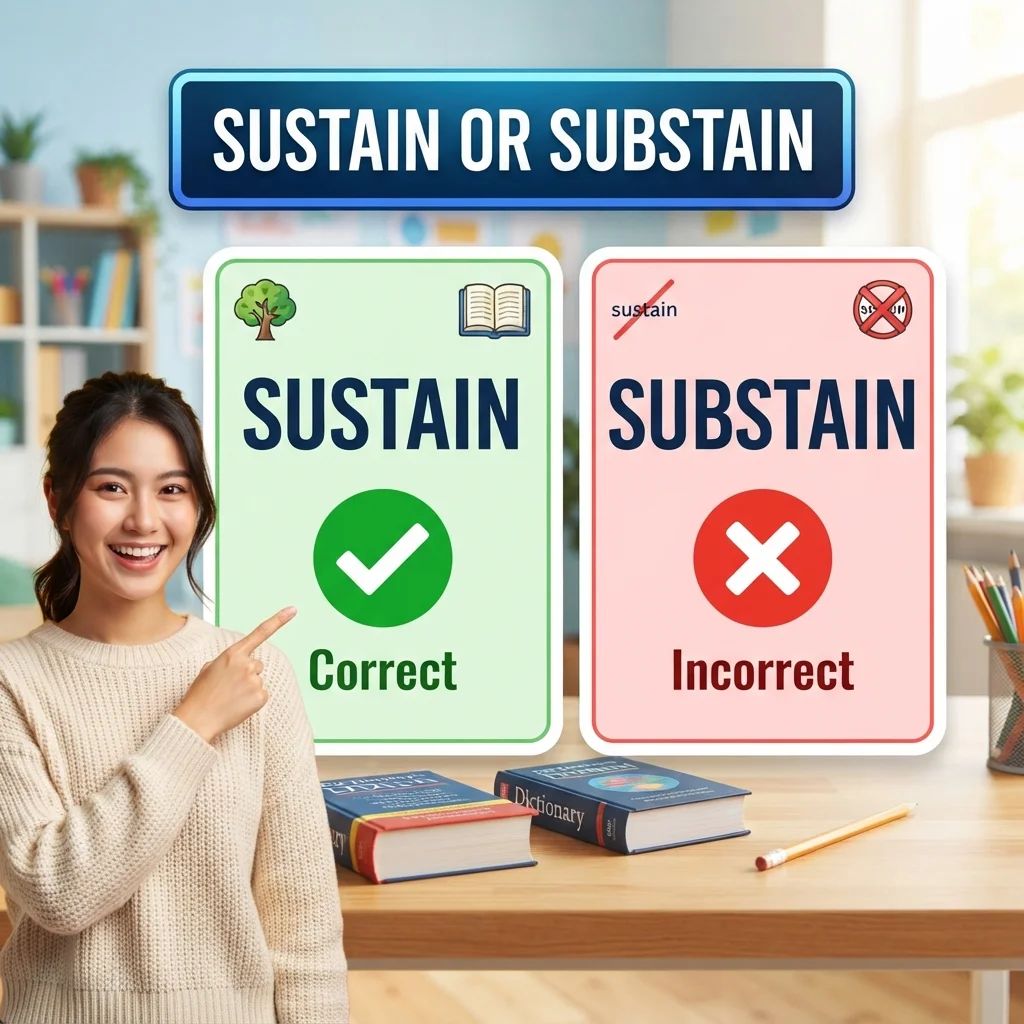
The correct spelling is sustain.
Substain is usually a spelling mistake that occurs when people confuse the sounds or letters in sustain. If you want to express the idea of supporting, maintaining, continuing, or enduring something, use sustain.
| Word | Correct spelling? | Meaning |
| Sustain | ✅ Yes | To support, maintain, continue, or endure |
| Substain | ❌ No, in standard English | Usually a misspelling of sustain |
The Correct Word: Sustain
Sustain is a real English verb with several related meanings. Depending on the sentence, it can mean:
- To support something physically or emotionally
- To keep something going
- To maintain a condition or activity
- To experience or suffer something
- To provide enough food or resources to continue living
Example:
Trees help sustain life by producing oxygen.
The Incorrect Word: Substain
Substain is not the standard spelling of the word you are probably trying to use. In most cases, writing substain is simply a spelling error.
Incorrect: The company wants to substain its growth.
Correct: The company wants to sustain its growth.
What Does Sustain Mean?

The word sustain means to keep something supported, maintained, or continuing over time. It can also describe experiencing an injury, loss, or difficult situation.
The exact meaning depends on the context.
Sustain Meaning: To Support
One common meaning of sustain is to support something so that it does not fall or fail.
Examples:
- Strong pillars sustain the roof.
- The bridge can sustain heavy traffic.
- The foundation sustains the weight of the building.
In these sentences, sustain means to hold up or support something.
Sustain Meaning: To Continue or Maintain
Sustain can also mean to keep something going for a long time.
Examples:
- The organization needs donations to sustain its work.
- Regular practice helps sustain progress.
- The business must sustain its quality to keep customers.
Here, the word suggests maintaining something rather than allowing it to stop or decline.
Sustain Meaning: To Provide Nourishment
Another meaning of sustain is to provide what is necessary for life or continued activity.
Examples:
- Clean water helps sustain human life.
- The food was enough to sustain the travelers.
- Plants need sunlight to sustain healthy growth.
In this context, sustain means to keep alive, healthy, or functioning.
Sustain Meaning: To Experience or Suffer
Sustain can also mean to experience something, especially an injury, damage, or loss.
Examples:
- The player sustained a serious injury.
- The building sustained damage during the storm.
- The company sustained heavy losses.
Here, sustain does not mean “support.” It means to suffer or undergo something.
Why Do People Spell Sustain as Substain?
The confusion between sustain and substain is common because English spelling does not always match pronunciation perfectly.
Similar Sounds
When people hear sustain, they may incorrectly remember the middle sounds as “sub-stain.” This can lead them to add a b after the su.
However, the correct spelling is:
S-U-S-T-A-I-N
Not:
S-U-B-S-T-A-I-N
Confusion With Other Words
People may also confuse sustain with words such as:
- Substitute
- Substance
- Substantial
- Sustainability
These words may look or sound somewhat similar, but they have different spellings and meanings.
Fast Typing and Autocorrect
Typing quickly can also cause spelling mistakes. A person may write substain without noticing the extra letter. Spell-check tools often identify it as an error, but it is still useful to learn the correct spelling.
Sustain vs. Substain: A Simple Comparison
The easiest way to remember the difference is to understand that sustain is the correct word, while substain is generally a misspelling.
| Feature | Sustain | Substain |
| Standard English word | Yes | No, in ordinary modern English |
| Part of speech | Verb | Not normally used as a standard verb |
| Main idea | Support, maintain, continue, or endure | Usually intended to mean sustain |
| Example | We must sustain our efforts. | We must substain our efforts. ❌ |
| Correct usage | Use in formal and informal writing | Avoid it |
Which One Should You Use?
Use sustain whenever you want to describe:
- Supporting something
- Maintaining progress
- Continuing an activity
- Providing nourishment
- Experiencing damage or injury
Example:
The team worked hard to sustain its success.
Do not write:
The team worked hard to substain its success.
How to Pronounce Sustain
The word sustain is commonly pronounced:
suh-STAYN
The second syllable is stressed.
Pronunciation Breakdown
- sus → sounds approximately like “suhs”
- tain → sounds like “stain”
Together:
suh-STAYN
The pronunciation may vary slightly depending on the speaker’s accent, but the spelling remains sustain.
Does Sustain Sound Like Substain?
Not exactly. Some speakers may pronounce the word quickly in a way that makes the sounds seem similar. However, the standard word is still sustain, without the extra b.
Examples of Sustain in Everyday Sentences
Learning through examples is one of the best ways to understand a word.
Examples About Support
- The columns sustain the weight of the building.
- The roots sustain the tree during strong winds.
- The structure was designed to sustain heavy pressure.
- A strong foundation can sustain a large house.
- The bridge must sustain thousands of vehicles each day.
Examples About Continuing Something
- She worked hard to sustain her motivation.
- The business needs new customers to sustain its growth.
- The team struggled to sustain its winning performance.
- Good habits help sustain long-term progress.
- The charity depends on donations to sustain its programs.
About Food and Life
- Fresh vegetables help sustain a healthy body.
- The supplies were enough to sustain the family for a week.
- Water is essential to sustain life.
- The hikers carried food to sustain themselves during the journey.
- The crops help sustain the local community.
Examples About Injuries and Damage
- The athlete sustained a knee injury.
- The house sustained damage during the earthquake.
- The company sustained significant financial losses.
- Several vehicles sustained damage in the accident.
- The patient sustained injuries in the fall.
Sustain in Different Contexts
The meaning of sustain becomes clearer when you see how it works in different situations.
Sustain in Business
In business, sustain often means maintaining growth, quality, performance, or success over time.
Examples:
- The company needs a strong strategy to sustain growth.
- Customer trust helps sustain a successful brand.
- Businesses must sustain quality while managing costs.
- Innovation can help sustain a competitive advantage.
Explanation: In these examples, sustain means keeping something successful or effective over a period of time.
Sustain in Education
In education, sustain can describe maintaining effort, interest, or improvement.
Examples:
- Students must sustain their focus during exams.
- Regular revision helps sustain learning.
- Teachers use activities to sustain students’ interest.
- A study schedule can sustain academic progress.
Sustain in Health and Fitness
In health and fitness, sustain may refer to maintaining energy, supporting life, or experiencing an injury.
Examples:
- A balanced meal can sustain energy throughout the day.
- Regular exercise helps sustain physical health.
- The runner sustained an injury during training.
- Adequate sleep helps sustain concentration.
Sustain in the Environment
In environmental discussions, sustain often means maintaining natural systems or supporting life.
Examples:
- Forests help sustain biodiversity.
- Sustainable farming aims to sustain soil health.
- Clean water is necessary to sustain ecosystems.
- Conservation efforts can sustain wildlife populations.
Sustain in Everyday Conversation
Although sustain is common in formal writing, it can also be used in everyday English.
Examples:
- I cannot sustain this pace for much longer.
- The food should sustain you until dinner.
- Can this battery sustain the device for eight hours?
- The team needs support to sustain its efforts.
Common Mistakes With Sustain
Even when people know the correct spelling, they may use sustain incorrectly. Here are some common mistakes and how to avoid them.
Mistake 1: Writing Substain Instead of Sustain
Incorrect: We need to substain our efforts.
Correct: We need to sustain our efforts.
Tip: Remember that sustain has no b.
Mistake 2: Adding an Extra Letter
Some people write sustaine or sustian.
Incorrect: The company wants to sustian its success.
Correct: The company wants to sustain its success.
Tip: Break the word into two parts: sus + tain.
Mistake 3: Confusing Sustain With Sustainable
Sustain is a verb, while sustainable is an adjective.
Sustain: To maintain or support something.
Sustainable: Able to continue without causing unacceptable harm or using resources too quickly.
Examples:
- We must sustain our efforts.
- We need a sustainable solution.
Mistake 4: Using Sustain When You Mean Substitute
The words sustain and substitute have different meanings.
Sustain: To support or maintain.
Substitute: To use one thing instead of another.
Incorrect meaning: Can you sustain sugar for honey?
Correct: Can you substitute sugar for honey?
Mistake 5: Using Sustain When You Mean Obtain
Sustain does not usually mean “get” or “receive.”
Incorrect: I sustained a new job yesterday.
Correct: I obtained a new job yesterday.
However, you can say:
I sustained an injury during the match.
That means you experienced an injury.
Spelling Tips to Remember Sustain
If you frequently confuse sustain and substain, these simple tips can help.
Tip 1: Remember “Sus + Tain”
Think of the word as:
SUS + TAIN = SUSTAIN
This helps you avoid inserting an unnecessary b.
Tip 2: Associate It With Sustainable
The word sustainable comes from the same word family.
- Sustain
- Sustained
- Sustaining
- Sustainable
- Sustainability
Remembering one word can help you remember the others.
Tip 3: Use a Memory Sentence
We must sustain our success without adding a b.
The phrase “without adding a b” is a simple reminder of the correct spelling.
Tip 4: Check the Word Family
If you know the spelling of sustainability, you can connect it to sustain.
Correct: Sustainability
Correct root: Sustain
Incorrect: Substainability
Tip 5: Read the Word Aloud
Say the word slowly:
suh-STAYN
Then spell it:
S-U-S-T-A-I-N
This connects pronunciation with spelling.
Sustain Word Forms
Understanding the different forms of sustain can improve your grammar and vocabulary.
| Word form | Example |
| Sustain | We must sustain our efforts. |
| Sustains | This system sustains the community. |
| Sustained | The building sustained damage. |
| Sustaining | Sustaining progress requires patience. |
| Sustainability | Sustainability is important for the future. |
| Sustainable | We need a sustainable plan. |
Sustain as a Verb
The base form is sustain.
The organization works to sustain local communities.
Sustains as a Verb
Use sustains with a singular subject in the present tense.
The forest sustains many species.
Sustained as a Verb
Use sustained for the past tense or past participle.
The athlete sustained an injury.
Sustaining as a Verb Form
Use sustaining when describing an ongoing action.
Sustaining motivation can be difficult.
Sustain vs. Sustainable vs. Sustainability
These words are related, but they do not serve the same grammatical purpose.
| Word | Part of speech | Meaning | Example |
| Sustain | Verb | To support or maintain | We must sustain progress. |
| Sustainable | Adjective | Able to continue over time | We need sustainable growth. |
| Sustainability | Noun | The ability to continue without exhausting resources | Sustainability matters to businesses. |
Example Comparison
- The company wants to sustain its success.
- The company wants sustainable success.
- The company is investing in sustainability.
Each sentence is correct, but the grammar and meaning differ slightly.
Synonyms of Sustain
Depending on the context, several words can have a similar meaning to sustain.
When Sustain Means Support
- Support
- Hold up
- Bear
- Carry
- Uphold
Example:
The pillars sustain the roof.
Similar sentence:
The pillars support the roof.
When Sustain Means Maintain
- Maintain
- Continue
- Preserve
- Keep
- Prolong
Example:
The team sustained its effort.
Similar sentence:
The team maintained its effort.
When Sustain Means Nourish
- Feed
- Nourish
- Support
- Keep alive
Example:
Food sustains the body.
Similar sentence:
Food nourishes the body.
When Sustain Means Experience
- Suffer
- Endure
- Undergo
- Experience
Example:
The building sustained damage.
Similar sentence:
The building suffered damage.
Antonyms of Sustain
Antonyms are words with opposite meanings. The best opposite depends on the context.
| Sustain | Possible antonym |
| Support | Undermine |
| Maintain | Abandon |
| Continue | Stop |
| Nourish | Starve |
| Preserve | Destroy |
| Endure | Avoid |
Example:
Regular maintenance sustains the building.
Opposite idea:
Neglect can damage the building.
Is “Substain” Ever Correct?
For ordinary modern English writing, substain should generally be treated as a misspelling. If you see it in a message, comment, or informal post, the writer probably intended to use sustain.
However, unusual spellings may occasionally appear in names, usernames, brand names, or specialized historical references. In those cases, the spelling may be intentional. But when you are writing a normal English sentence, sustain is the correct choice.
How to Correct “Substain” in a Sentence
If you find substain in your writing, replace it with sustain when the intended meaning is support, maintenance, continuation, or endurance.
Incorrect and Correct Examples
Incorrect: The company must substain its reputation.
Correct: The company must sustain its reputation.
Incorrect: Water is necessary to substain life.
Correct: Water is necessary to sustain life.
Incorrect: The player substained an injury.
Correct: The player sustained an injury.
Incorrect: We need to substain our progress.
Correct: We need to sustain our progress.
Incorrect: The bridge can substain heavy loads.
Correct: The bridge can sustain heavy loads.
Practice Exercise: Sustain or Substain?
Choose the correct word in each sentence.
- The organization needs funding to ______ its programs.
- The athlete ______ an injury during the game.
- Trees help ______ life on Earth.
- The company hopes to ______ its growth.
- The bridge was built to ______ heavy loads.
Answers
- Sustain
- Sustained
- Sustain
- Sustain
- Sustain
Why These Answers Are Correct
Each sentence describes support, continuation, nourishment, or experiencing something. These are all meanings associated with sustain.
Frequently Asked Questions
Is it sustain or substain?
The correct spelling is sustain. Substain is generally a misspelling and should be avoided in standard English writing.
What is the meaning of sustain?
Sustain means to support, maintain, continue, nourish, or experience something, depending on the context.
Is substain a real English word?
In ordinary modern English, substain is not a standard word. It is usually a spelling mistake for sustain.
How do you spell sustain correctly?
The correct spelling is:
S-U-S-T-A-I-N
What is an example of sustain?
Regular exercise helps sustain good health.
Here, sustain means to maintain or support.
What is the past tense of sustain?
The past tense is sustained.
Example:
The building sustained damage during the storm.
Is sustain a verb?
Yes. Sustain is a verb.
Example:
The charity works to sustain local communities.
What is the difference between sustain and sustainable?
Sustain is a verb meaning to support or maintain. Sustainable is an adjective describing something that can continue over time.
Example:
We must sustain our efforts to achieve sustainable growth.
Can sustain mean suffer?
Yes. In some contexts, sustain means to experience or suffer something, especially an injury, loss, or damage.
Example:
The player sustained a shoulder injury.
How can I remember the spelling of sustain?
Remember SUS + TAIN. The word does not contain a b.
Is sustain formal or informal?
Sustain is common in both formal and informal English, but it is especially useful in academic, professional, business, and environmental writing.
Can sustain be used for people?
Yes. It can describe supporting people, providing nourishment, or maintaining their health or energy.
Example:
The food was enough to sustain the travelers.
What is the noun form of sustain?
The related noun is sustainability, although the exact noun depends on the intended meaning. For example, sustenance means nourishment or support for life.
What does “sustain an injury” mean?
It means to experience or suffer an injury.
Example:
She sustained an injury while playing football.
What does “sustain growth” mean?
It means to maintain growth over time.
Example:
The business needs innovation to sustain growth.
Final Thoughts:
So, is it sustain or substain? The answer is clear: sustain is the correct spelling. It is a useful English verb that can mean to support, maintain, continue, nourish, or experience something. The word substain is generally a misspelling and should not be used in standard writing.
To remember the correct spelling, think of SUS + TAIN and avoid adding an unnecessary b. Whether you are writing about business growth, environmental protection, physical support, or an injury, sustain is the word you need. Using it correctly will make your English clearer, more accurate, and more professional.

Emily Parker is a dedicated writer who enjoys creating clear, useful, and easy-to-understand content. She focuses on language, grammar, word meanings, and everyday expressions to help readers find simple and reliable answers.