Have you ever agreed with someone in English but wondered whether to say “Me too,” “Me as well,” or “I as well”? These phrases may look similar because they express agreement or show that you share someone’s experience.
However, they don’t always sound equally natural in everyday conversations. Choosing the right phrase can help you speak and write English more confidently.
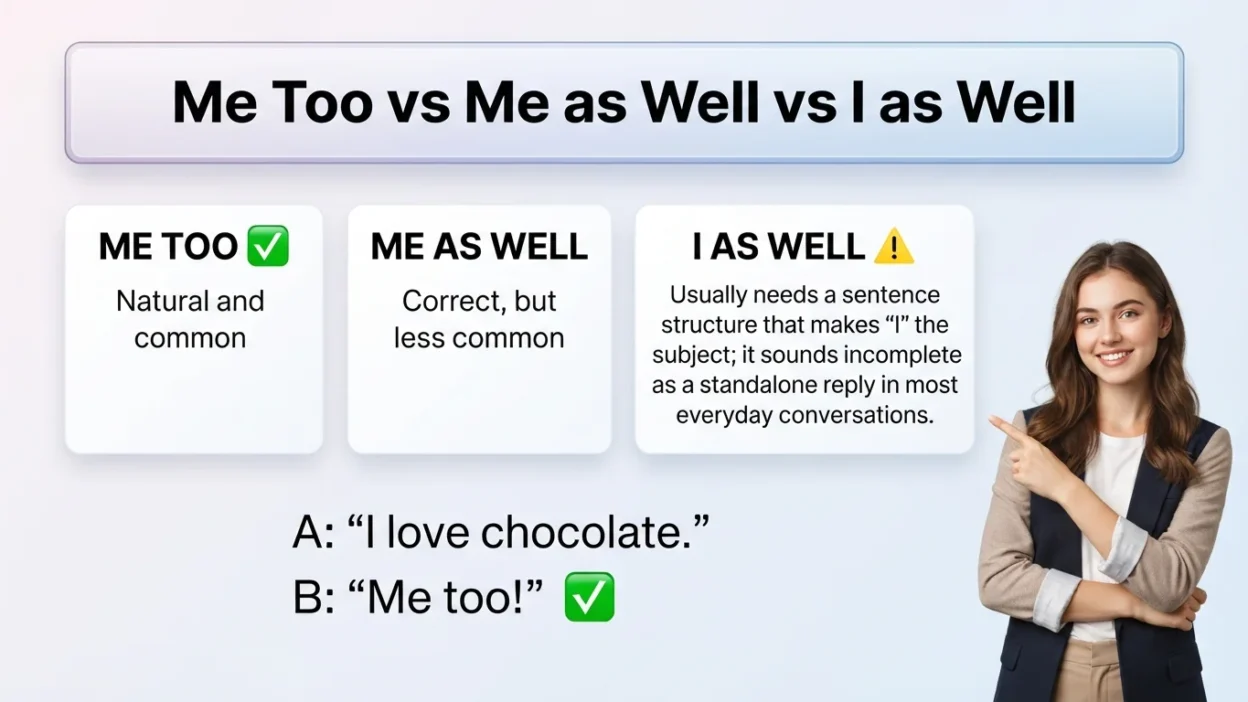
“Me too” is the most common and natural choice in casual conversations. For example, if your friend says, “I love chocolate,” you can simply reply, “Me too!” It sounds friendly, short, and clear.
What Do “Me Too,” “Me as Well,” and “I as Well” Mean?
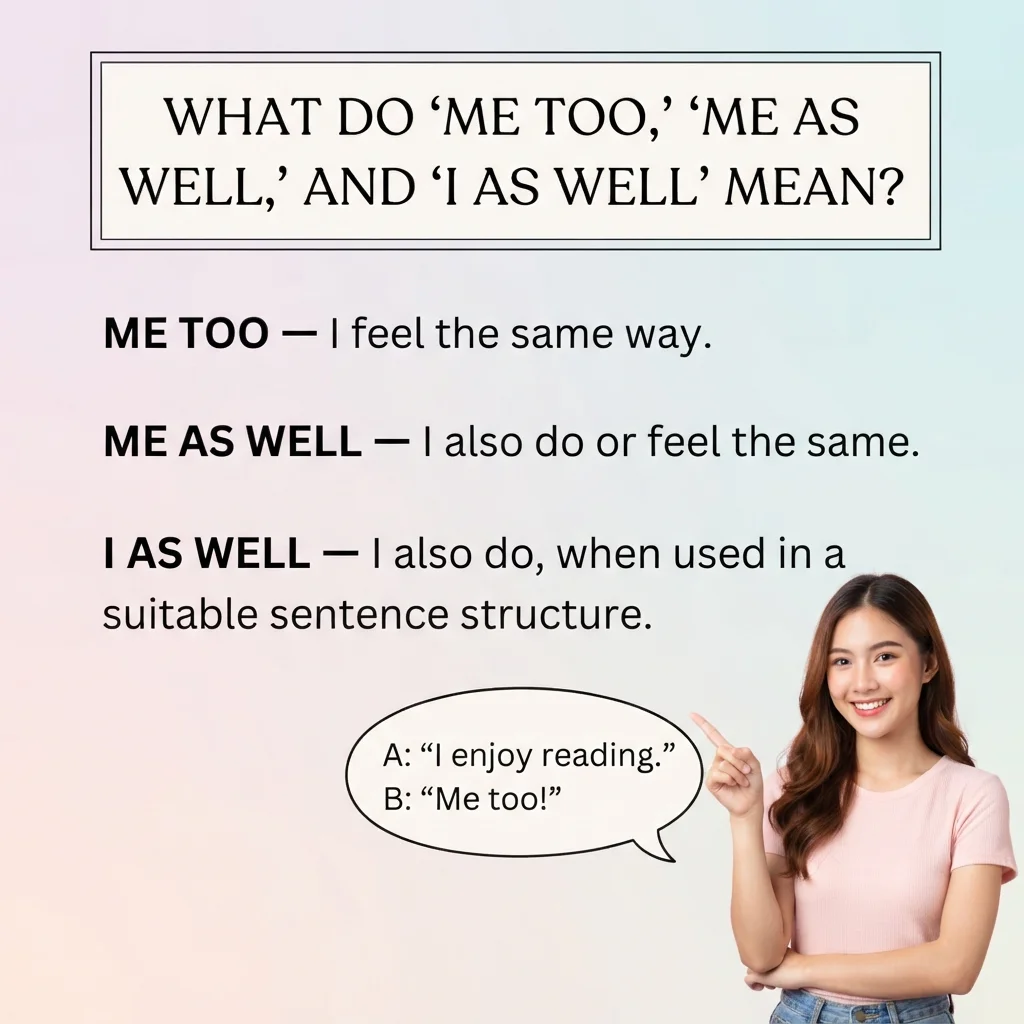
All three expressions can be used to show agreement or similarity. They tell another person that the same statement, feeling, action, or situation applies to you.
For example:
“I enjoy reading.”
You can respond:
- Me too.
- Me as well.
- I do as well.
- I enjoy reading too.
The basic meaning is similar: “I also enjoy reading.”
However, the expressions differ in grammatical structure, naturalness, and context.
“Me too” is by far the most common and natural choice in casual conversation.
“Me as well” can also express agreement and is grammatically acceptable in many conversational situations, although it may sound slightly less common than “me too.”
“I as well” is generally less natural when used alone. It usually works better when it is part of a complete sentence or when the verb is understood from the context.
Understanding this small difference can make your English sound much more natural.
What Does “Me Too” Mean?
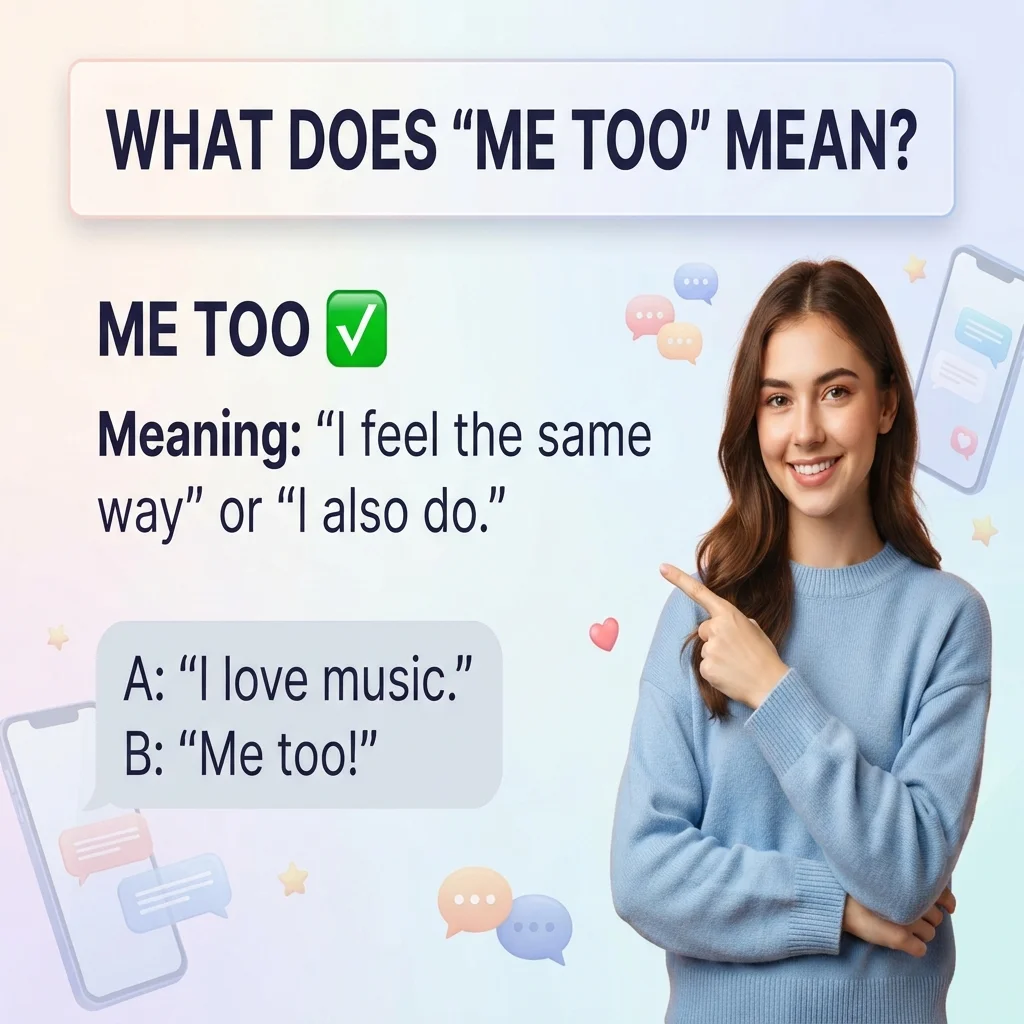
“Me too” means “the same is true for me” or “I also do, feel, like, or experience that.”
It is one of the most common ways to agree with a positive statement.
For example:
“I love pizza.”
“Me too!”
The second speaker means:
“I love pizza too.”
Why Is “Me Too” So Common?
In traditional grammar, “me” is an object pronoun, while “I” is a subject pronoun. So some learners wonder why English speakers say “Me too” instead of “I too.”
The answer is that “Me too” is an established conversational expression. It is an abbreviated form of a longer sentence.
For example:
“I love chocolate.”
“Me too.”
The complete meaning is:
“I love chocolate too.”
The shorter version is extremely natural in everyday spoken English.
Examples of “Me Too”
Here are several examples:
“I like watching movies.”
“Me too.”
“I’m excited about the weekend.”
“Me too!”
“I want to visit London someday.”
“Me too.”
“I enjoy learning English.”
“Me too.”
“I’m tired today.”
“Me too.”
In all these examples, “me too” means that the second person shares the same experience, opinion, feeling, or desire.
When Should You Use “Me Too”?
Use “me too” when you want to agree quickly and naturally with a positive statement.
It is especially common in:
- Casual conversations
- Text messages
- Social media
- Friendly discussions
- Everyday spoken English
- Informal emails and chats
For example:
“I’m hungry.”
“Me too.”
This is short, clear, and completely natural.
“Me Too” With Positive Statements
“Me too” generally follows an affirmative statement.
For example:
“I love dogs.”
“Me too.”
The meaning is:
“I love dogs too.”
Another example:
“I speak Spanish.”
“Me too.”
The meaning is:
“I speak Spanish too.”
Be Careful With Negative Statements
One important point is that “me too” is not always the best response to a negative statement.
For example:
“I don’t like spicy food.”
If you also dislike spicy food, a more precise response is:
“Me neither.”
rather than:
“Me too.”
Although you may occasionally hear “me too” in informal speech, “me neither” is the standard conversational response to a negative statement.
For example:
“I don’t understand this question.”
“Me neither.”
This means:
“I don’t understand it either.”
What Does “Me as Well” Mean?
“Me as well” also means “me too” or “I also do.”
It is used when you want to say that the same thing applies to you.
For example:
“I’m interested in photography.”
“Me as well.”
The meaning is:
“I’m interested in photography too.”
Is “Me as Well” Correct?
Yes, “me as well” can be correct, especially in conversational English.
However, it is generally less common and sometimes sounds slightly more deliberate or formal than “me too.”
Compare:
“I love this song.”
“Me too!”
This sounds very natural and casual.
Now:
“I love this song.”
“Me as well.”
This is understandable and grammatically acceptable in many contexts, but it may sound somewhat more formal or less spontaneous.
Examples of “Me as Well”
“I’m going to the meeting.”
“Me as well.”
“I enjoy reading historical books.”
“Me as well.”
“I’m interested in learning French.”
“Me as well.”
“I think this is a good idea.”
“Me as well.”
The exact level of naturalness depends on the context and the speaker’s style.
What Does “I as Well” Mean?
“I as well” means “I also” or “I do too,” but it is generally not used as a standalone response in ordinary conversation.
For example, if someone says:
“I love swimming.”
You would normally say:
“Me too.”
rather than:
“I as well.”
“I as well” can sound incomplete when it appears by itself.
A more natural construction would be:
“I love swimming as well.”
or:
“I do as well.”
or:
“I also love swimming.”
Why Does “I as Well” Sound Different?
The pronoun “I” normally functions as the subject of a sentence. Because of this, it usually needs a verb or another grammatical element.
For example:
“I like coffee as well.”
Here, “I” is the subject and “like” is the verb.
Another example:
“I am interested in music as well.”
Here, the sentence is complete.
But:
“I as well.”
sounds incomplete in most everyday situations because the listener may expect a verb after “I.”
“I as Well” in Complete Sentences
The phrase becomes natural when it appears inside a complete sentence.
For example:
“I enjoy hiking as well.”
“I want to go as well.”
In these examples, “as well” means “also” or “too.”
“I Also” vs “I as Well”
These two forms can have almost the same meaning:
“I also like coffee.”
“I like coffee as well.”
Both are correct.
However, their sentence structures are different.
Also often appears before the main verb:
“I also like coffee.”
As well often appears at the end:
“I like coffee as well.”
This is a useful pattern for English learners to remember.
Me Too vs Me as Well vs I as Well: The Main Difference
The easiest way to understand these expressions is to focus on conversation vs complete sentences.
| Expression | Meaning | Naturalness | Common Use |
| Me too | I also do/feel/like it | Very natural | Casual conversation |
| Me as well | I also do/feel/like it | Natural but less common | Conversation |
| I as well | I also do/feel/like it | Less natural alone | Usually inside a sentence |
| I also | I also do/feel/like it | Very natural | Speaking and writing |
| I … as well | I also do/feel/like it | Very natural | Complete sentences |
The key point is simple:
Use “me too” for quick, natural agreement.
Use “me as well” when you want another conversational agreement expression.
Me Too vs Me as Well: Which Is More Natural?
In everyday conversation, “me too” is usually the more natural choice.
Consider this conversation:
“I love traveling.”
“Me too!”
This sounds completely natural.
Now:
“I love traveling.”
“Me as well.”
This is also understandable, but it may sound slightly less casual.
There is nothing wrong with using “me as well,” but if your goal is to sound relaxed and conversational, “me too” is usually the safest option.
Me Too vs I as Well
These expressions are structurally different.
Consider:
“I love coffee.”
The most natural short response is:
“Me too.”
You generally would not say:
“I as well.”
Instead, make it a complete sentence:
“I love coffee as well.”
Or:
“I do as well.”
Therefore, if you are answering someone quickly, choose “me too.”
If you are writing a complete sentence, “I … as well” can work very well.
Me as Well vs I as Well
The difference is mainly grammatical structure.
Me as well can work as a short conversational response:
“I’m going to the party.”
“Me as well.”
I as well generally needs more context:
“I’m going to the party as well.”
The second sentence is much more complete and natural.
A useful rule is:
Me as well = short conversational agreement.
I … as well = part of a complete sentence.
Examples in Everyday Conversations
Let’s look at realistic conversations.
Example 1: Favorite Food
Sarah: “I love Italian food.”
Mark: “Me too.”
This is the most natural casual response.
Example 2: Shared Interest
Ali: “I’m interested in photography.”
Hamza: “Me as well.”
This is also acceptable.
Example 3: Complete Sentence
Emma: “I want to learn another language.”
David: “I want to learn another language as well.”
This is grammatically complete and natural.
Example 4: Short Agreement
“I’m tired.”
“Me too.”
This is probably the most common conversational pattern.
Example 5: Formal Writing
“I believe this approach will be useful.”
“I believe this approach will be useful as well.”
This is more appropriate than simply writing “Me too” in a formal context.
How “Too” and “As Well” Work
Both too and as well can mean “also.”
For example:
“I like tea too.”
and:
“I like tea as well.”
Both mean:
“I also like tea.”
The main difference is placement.
“Too” Usually Comes at the End
Examples:
“I like this movie too.”
“She wants to come too.”
“I’m going too.”
“As Well” Usually Comes at the End
Examples:
“I like this movie as well.”
“She wants to come as well.”
“I’m going as well.”
This makes too and as well very similar in many affirmative sentences.
“Also” vs “Too” vs “As Well”
English has several ways to express addition or agreement.
Also
“Also” often appears before the main verb:
“I also like chocolate.”
With the verb “be,” it generally comes after the verb:
“I am also interested.”
Too
“Too” commonly appears at the end:
“I like chocolate too.”
As Well
“As well” commonly appears at the end:
“I like chocolate as well.”
All three can communicate the idea of also.
Common Mistakes With “Me Too”
Mistake 1: Thinking “Me Too” Is Always Grammatically Wrong
Some learners believe:
“Me too.”
is incorrect because “me” is an object pronoun.
In everyday English, this is not a useful way to judge the expression. “Me too” is an established and extremely common conversational phrase.
Mistake 2: Using “Me Too” for Every Negative Statement
Consider:
“I don’t like coffee.”
If you also don’t like coffee, say:
“Me neither.”
rather than automatically saying:
“Me too.”
Mistake 3: Using “I as Well” Alone
For example:
“I love music.”
“I as well.”
This sounds unnatural in most everyday conversations.
Better:
“Me too.”
or:
“I love music as well.”
Mistake 4: Forgetting the Context
A short expression may be natural in conversation but inappropriate in formal writing.
For example:
“I think the proposal is useful.”
In casual conversation:
“Me too.”
In formal writing:
“I also believe the proposal is useful.”
The second version is more appropriate for professional communication.
Common Spelling Mistakes
These expressions are short, but learners sometimes write them incorrectly.
Correct:
- Me too
- Me as well
- I as well
- As well
- I also
- I do too
Incorrect or awkward forms:
- Me to
- Me two
- I too as well
- I aswell
- Me aswell
Remember that “too” is spelled with two “o” letters.
Too = also
For example:
“Me too.”
“Two” is the number 2:
“I have two books.”
“To” is normally used before a verb or for direction:
“I want to go.”
So:
Me too. ✅
not:
Me to. ❌
Is “Me Too” Formal or Informal?
“Me too” is mainly conversational and informal.
It is perfectly normal in:
- Friendly conversations
- Texting
- Social media
- Informal messages
- Casual discussions
For formal writing, consider:
- I also…
- I agree as well.
- I feel the same way.
- I share that view.
- I have the same opinion.
For example:
Casual:
“I love this idea.”
“Me too!”
More formal:
“I also believe this is a valuable idea.”
Is “Me as Well” More Formal Than “Me Too”?
It can sound slightly more formal or deliberate, depending on the speaker and context.
Compare:
“I’m excited!”
“Me too!”
This sounds very casual.
Now:
“I’m excited.”
“Me as well.”
This can sound somewhat more measured.
However, “me as well” is not necessarily formal English. It is still commonly understood as a conversational expression.
Can You Say “I Too”?
Yes, but the structure and tone are different.
For example:
“I too believe that education is important.”
This is grammatically correct.
Here, too means also, and “I” is the subject.
Another example:
“I too want to participate.”
This can sound more formal, literary, or emphatic than:
“Me too.”
In casual conversation, “me too” is generally more natural.
Can “As Well” Start a Sentence?
Usually, “as well” appears at the end of a sentence.
For example:
“I want to go as well.”
This is natural.
Starting a sentence with “as well” is less common when it means “also.” In formal writing, other structures may be clearer.
Instead of:
“As well, I want to attend.”
you would normally write:
“I also want to attend.”
or:
“I want to attend as well.”
What About “Me Neither”?
Understanding “me neither” helps you master agreement expressions.
Use me too for positive statements:
“I love cats.”
“Me too.”
Use me neither for negative statements:
“I don’t like cats.”
“Me neither.”
This distinction is particularly useful for beginners.
Positive Agreement
“I’m happy.”
“Me too.”
Negative Agreement
“I’m not happy.”
“Me neither.”
This is one of the easiest patterns to remember.
When “I Do Too” Is Better
Sometimes the verb in the first statement matters.
For example:
“I love this song.”
You can say:
“I do too.”
This means:
“I love this song too.”
Similarly:
“I understand the problem.”
“I do too.”
This can be slightly more emphatic than “me too.”
However, in everyday conversation:
“Me too.”
is usually shorter and more natural.
When “I Am Too” Is Used
If the original sentence uses be, you may hear:
“I’m tired.”
“I am too.”
This means:
“I’m tired too.”
But there is an important difference between “I am too” and “I am as well.”
Both can express agreement:
“I’m tired.”
“I am too.”
or:
“I’m tired.”
“I am as well.”
However, “me too” remains the simplest everyday response.
Me Too vs Me as Well vs I as Well: Quick Rules
Here are the easiest rules to remember.
Rule 1: Use “Me Too” for Casual Agreement
“I love music.”
“Me too.”
Rule 2: “Me as Well” Can Also Express Agreement
“I’m going to the event.”
“Me as well.”
Rule 3: Use “I … as Well” in Complete Sentences
“I’m going to the event as well.”
Rule 4: Use “I Also” in Complete Sentences
“I also want to go.”
Rule 5: Use “Me Neither” for Negative Agreement
“I don’t like it.”
“Me neither.”
Practice: Choose the Correct Expression
Try these examples.
Question 1
“I love chocolate.”
Best casual response:
Me too.
Question 2
“I want to join the class.”
Natural response:
Me too.
You could also say:
Me as well.
Question 3
Complete the sentence:
“I enjoy reading ______.”
Correct options:
too or as well
So:
“I enjoy reading too.”
or:
“I enjoy reading as well.”
Question 4
“I don’t like noisy places.”
Natural agreement:
Me neither.
Question 5
Complete the sentence:
“I ______ enjoy traveling.”
Possible answers:
also
“I also enjoy traveling.”
or:
“I enjoy traveling as well.”
Frequently Asked Questions
Is “Me Too” grammatically correct?
Yes. “Me too” is a standard and extremely common conversational expression used to show agreement or shared feelings. It is an abbreviated conversational construction rather than a complete formal sentence.
Is “Me as Well” correct English?
Yes. “Me as well” can be used to express agreement or similarity. It is understandable and natural in many conversations, although “me too” is generally more common in casual English.
Is “I as Well” grammatically correct?
“I as well” can be grammatical when used within an appropriate sentence, but it usually sounds incomplete when used alone. For example, “I like coffee as well” is natural.
Which is more natural: “Me too” or “Me as well”?
“Me too” is generally more natural in casual conversation. “Me as well” is also possible but may sound slightly more formal or less spontaneous.
Can I use “Me Too” in formal writing?
You can, but it may sound too conversational. In formal writing, alternatives such as “I also,” “I agree as well,” or “I share the same view” are often more appropriate.
Can I say “I too”?
Yes. “I too” is grammatically correct and can sound formal or emphatic.
For example:
“I too believe that practice is important.”
What is the difference between “too” and “as well”?
Both can mean “also.”
For example:
“I like tea too.”
“I like tea as well.”
The meaning is essentially the same.
Should I say “Me too” or “Me neither”?
Use “me too” after an affirmative statement.
“I like pizza.”
“Me too.”
Use “me neither” after a negative statement.
“I don’t like pizza.”
“Me neither.”
Is “Me aswell” correct?
No. “As well” is written as two separate words.
Correct:
“Me as well.”
Incorrect:
“Me aswell.”
Is “Me to” correct?
No, not when you mean “also.”
The correct expression is:
Me too.
Can “as well” mean “also”?
Yes. For example:
“I want to come as well.”
means:
“I also want to come.”
Final Comparison
If you want the simplest way to remember the difference between me too vs me as well vs I as well, think about the situation.
Me too is your best choice for quick, natural, everyday agreement.
“I love this movie.”
“Me too.”
Me as well can also be used as a short agreement response.
“I’m interested in art.”
“Me as well.”
I as well is generally better when it forms part of a complete sentence.
“I’m interested in art as well.”
If you are unsure which one to choose in a casual conversation, “me too” is usually the safest and most natural option.
The most important thing is not to memorize every rule separately. Instead, notice how native and fluent English speakers use these expressions in real conversations. With regular practice, choosing between me too, me as well, I also, and I … as well will become much easier.
Conclusion
Understanding me too vs me as well vs I as well is a small but useful step toward more natural English communication. “Me too” is the most common casual expression for agreeing with a positive statement.
“Me as well” can communicate the same idea and is grammatically acceptable in many conversational contexts. “I as well” is usually more natural when it appears as part of a complete sentence, such as “I like it as well.”

Daniel Carter is a passionate writer who creates clear, helpful, and easy-to-understand content. He focuses on language, grammar, word meanings, and everyday expressions, helping readers find simple answers to common questions.