Choosing between “there is no” and “there are no” can feel confusing when you are trying to write a grammatically correct sentence. Both expressions are correct, but they serve different purposes.
The main difference comes down to whether the noun you are talking about is singular, uncountable, or plural. Once you understand this simple rule, you can choose the right expression confidently in everyday conversations, emails, school assignments, and professional writing.
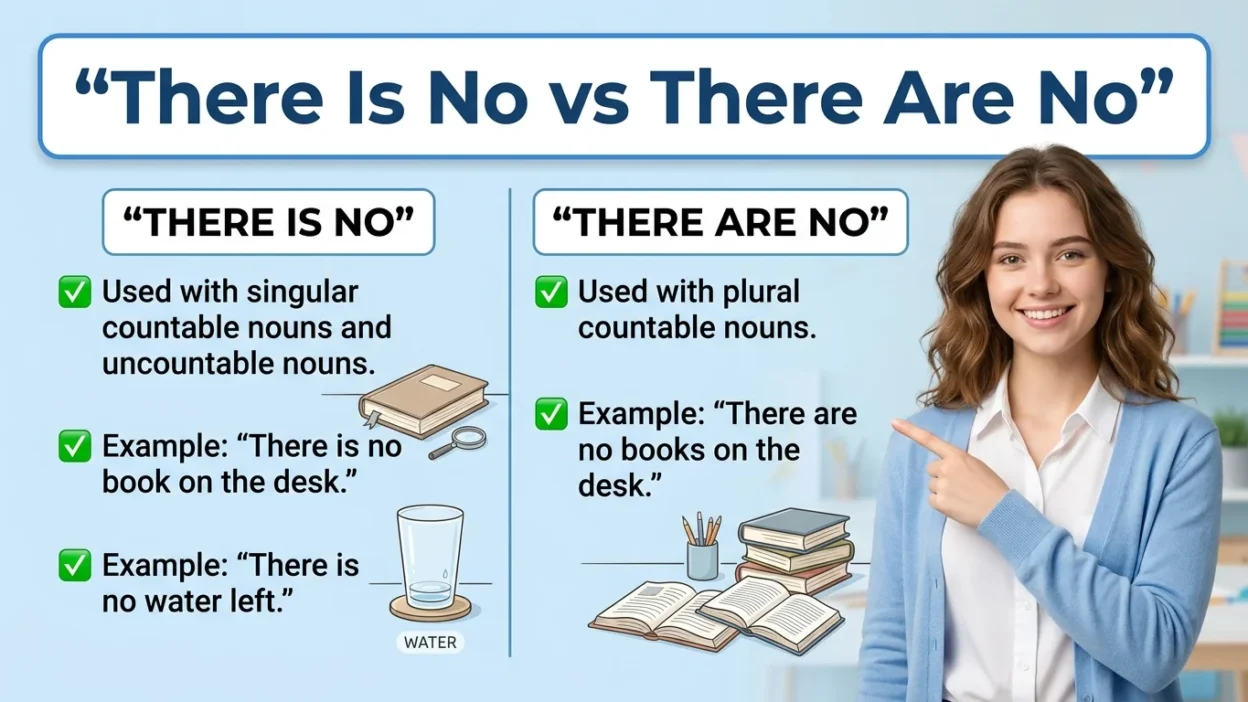
Use “there is no” with singular countable nouns and uncountable nouns. For example, you would say, “There is no reason to worry” or “There is no water in the bottle.” In contrast, use “there are no” with plural countable nouns.
What Does “There Is No” Mean?
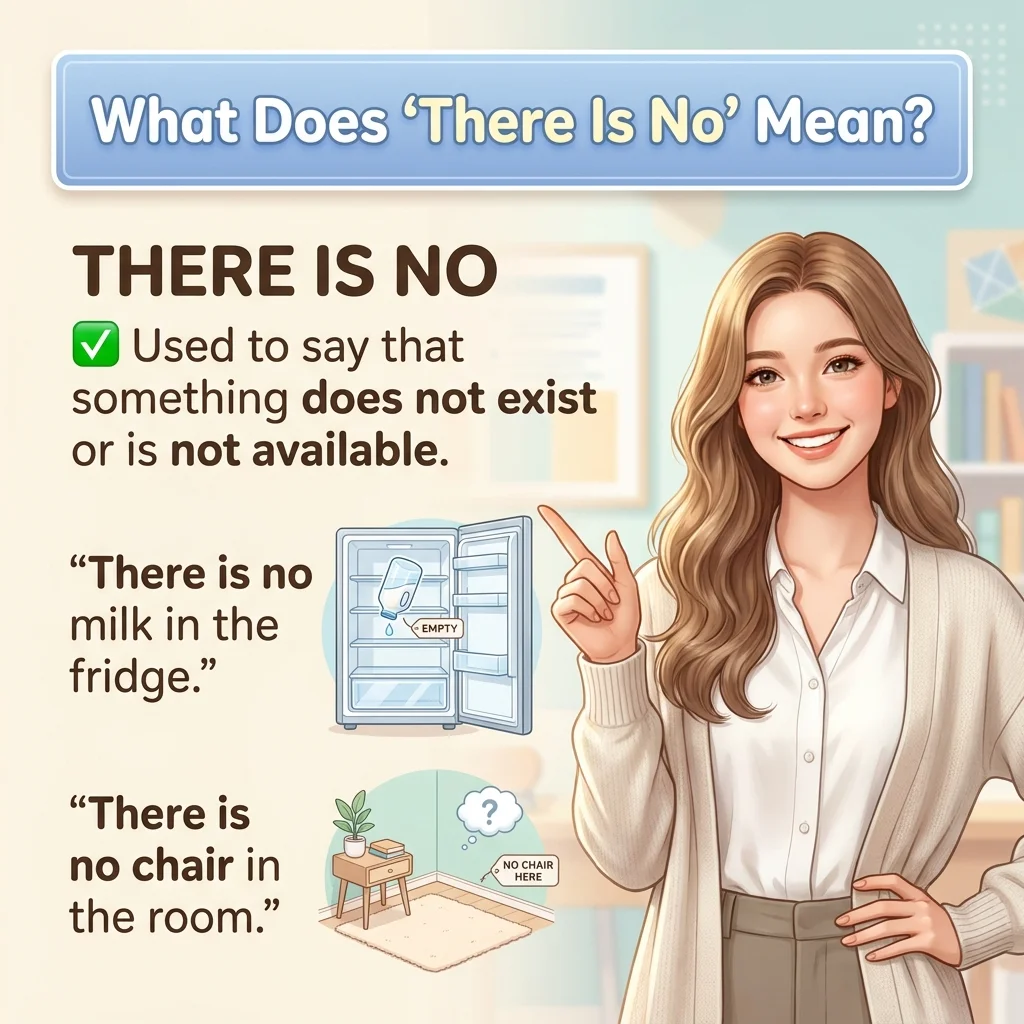
“There is no” is used to say that something does not exist, is unavailable, or is not present. It is generally followed by a singular countable noun or an uncountable noun.
The basic structure is:
There is no + singular noun / uncountable noun
Examples of “There Is No”
- There is no reason to panic.
- There is no book on the desk.
- There is no water in the bottle.
- There is no solution to this problem.
- There is no information available.
- There is no need to hurry.
In each example, the expression tells us that something is absent or does not exist in the situation being discussed.
“There Is No” With Singular Countable Nouns
A singular countable noun refers to one person, place, thing, or idea that can be counted.
Examples include:
- a book
- a car
- a reason
- a problem
- a solution
- a student
When using “there is no,” the noun remains singular.
| Correct | Incorrect |
| There is no book here. | There is no books here. |
| There is no problem. | There is no problems. |
| There is no reason to leave. | There is no reasons to leave. |
| There is no student in the room. | There is no students in the room. |
Important: “No” replaces an article such as a or an. We say “There is no book,” not “There is no a book.”
“There Is No” With Uncountable Nouns
Uncountable nouns describe things that are not usually counted as separate individual units. They often refer to substances, materials, information, or abstract ideas.
Common uncountable nouns include:
- water
- money
- advice
- information
- furniture
- traffic
- time
- patience
- progress
- knowledge
Examples:
- There is no water in the glass.
- There is no money in my wallet.
- There is no advice that can solve every problem.
- There is no information about the event.
- There is no furniture in the empty room.
- There is no time left.
These nouns are treated as singular for grammar purposes, so “there is no” is the correct choice.
What Does “There Are No” Mean?
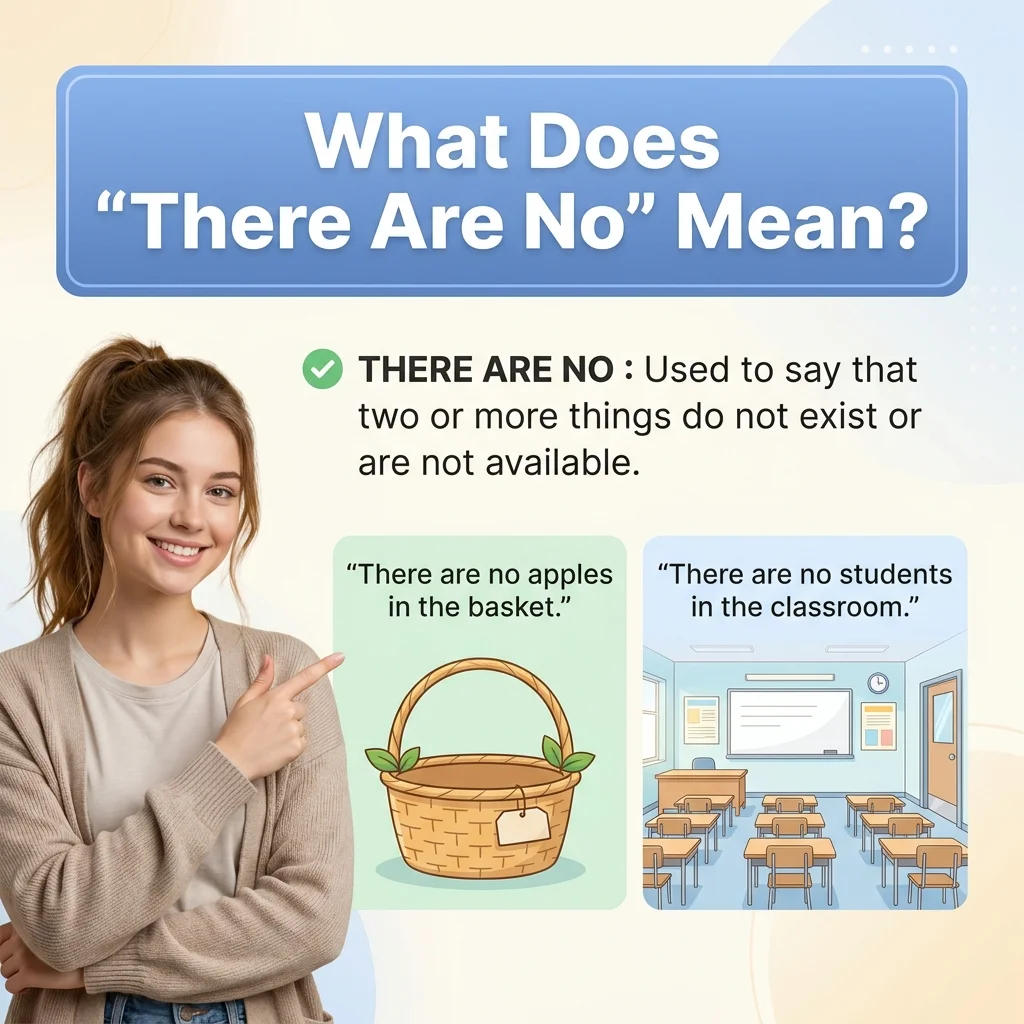
“There are no” is used to say that two or more people, places, things, or ideas do not exist, are unavailable, or are not present.
The basic structure is:
There are no + plural countable noun
Examples of “There Are No”
- There are no books on the shelf.
- There are no students in the classroom.
- There are no cars in the parking lot.
- There are no reasons to worry.
- There are no tickets left.
- There are no mistakes in this sentence.
The noun after “there are no” must normally be plural.
“There Are No” With Plural Countable Nouns
Plural countable nouns refer to two or more things that can be counted.
Examples include:
- books
- cars
- students
- problems
- reasons
- ideas
- questions
Examples in sentences:
- There are no chairs in the room.
- There are no shops open today.
- There are no answers to these questions.
- There are no children in the playground.
- There are no clouds in the sky.
Because the nouns are plural, “there are” is the correct form.
There Is No vs There Are No: The Main Difference
The main difference is the number and type of noun that follows the expression.
| Expression | Used With | Example |
| There is no | Singular countable nouns | There is no chair. |
| There is no | Uncountable nouns | There is no milk. |
| There are no | Plural countable nouns | There are no chairs. |
Compare These Sentences
Singular:
There is no apple in the basket.
Plural:
There are no apples in the basket.
The first sentence refers to the absence of one apple. The second refers to the absence of multiple apples.
Another example:
Singular:
There is no student in the classroom.
Plural:
There are no students in the classroom.
The meaning is similar, but the noun determines the verb.
The Grammar Rule Behind “There Is No” and “There Are No”
The words “there is” and “there are” are forms of the verb to be. They agree with the noun that follows them.
- There is → singular or uncountable noun
- There are → plural noun
The word “no” expresses absence or zero quantity.
Basic Grammar Formula
There is no
Singular countable noun or uncountable noun
There is no problem.
There are no
Plural countable noun
There are no problems.
There are no bottles.
Why Does the Verb Change?
The verb changes because English grammar requires subject–verb agreement.
Consider these examples:
- There is a problem.
- There are two problems.
- There is some information.
- There are several questions.
Even though “there” appears at the beginning, the noun after the verb determines whether we use is or are.
When to Use “There Is No”
Use “there is no” in the following situations.
1. When One Thing Is Missing
Use it when you are talking about one singular countable noun.
- There is no key in the drawer.
- There is no bus at the stop.
- There is no answer to this question.
- There is no restaurant nearby.
- There is no message from him.
2. When an Uncountable Noun Is Missing
Use it with uncountable nouns.
- There is no sugar in the tea.
- There is no electricity in the building.
- There is no evidence of fraud.
- There is no information on the website.
- There is no progress in the project.
3. When Saying Something Is Unnecessary
“There’s no” is often used in everyday English to say that something is unnecessary.
- There is no need to apologize.
- There is no need to worry.
- There is no reason to argue.
- There is no point in waiting.
- There is no hurry.
Here, need, reason, point, and hurry are singular or uncountable nouns.
4. When Expressing a General Absence
- There is no hope of success without effort.
- There is no guarantee that it will work.
- There is no easy way to learn every language.
- There is no perfect solution.
- There is no doubt about his honesty.
When to Use “There Are No”
Use “there are no” when the noun is plural and countable.
1. When Multiple Things Are Missing
- There are no keys in the drawer.
- There are no buses at the stop.
- There are no answers to these questions.
- There are no restaurants nearby.
- There are no messages from him.
2. When Talking About Zero People
- There are no students in the classroom.
- There are no doctors available right now.
- There are no children in the park.
- There are no guests at the hotel.
- There are no employees in the office.
3. When Talking About Multiple Objects
- There are no chairs in the room.
- There are no windows on this wall.
- There are no computers in the lab.
- There are no books on the table.
- There are no flowers in the garden.
4. When Referring to Several Ideas or Reasons
- There are no reasons to cancel the meeting.
- There are no easy answers to these questions.
- There are no clear instructions.
- There are no serious problems.
- There are no better options available.
“There Is No” vs “There Are No” Examples
The easiest way to understand the difference is to compare singular and plural forms.
| Singular or Uncountable | Plural |
| There is no apple. | There are no apples. |
| There is no chair. | There are no chairs. |
| There is no student. | There are no students. |
| There is no problem. | There are no problems. |
| There is no water. | There is no water. |
| There is no information. | There is no information. |
| There is no reason. | There are no reasons. |
| There is no ticket. | There are no tickets. |
| There is no car. | There are no cars. |
| There is no question. | There are no questions. |
Notice that uncountable nouns do not become plural simply because the quantity is zero.
There Is No vs There Are No in Questions
Although both expressions are usually used in statements, they can also appear in questions.
Questions With “Is There No?”
Use “Is there no…?” when asking whether something singular or uncountable is absent.
Examples:
- Is there no solution to this problem?
- Is there no water left?
- Is there no way to fix this?
- Is there no reason to continue?
- Is there no information available?
These questions can express surprise, concern, or doubt.
Questions With “Are There No?”
Use “Are there no…?” when asking about plural nouns.
Examples:
- Are there no buses today?
- Are there no seats available?
- Are there no other options?
- Are there no students in the class?
- Are there no tickets left?
Everyday Alternatives
In casual conversation, people often use “Isn’t there…” or “Aren’t there…” instead.
- Isn’t there a solution?
- Aren’t there any seats available?
- Isn’t there any water left?
- Aren’t there any other options?
These forms are often more natural when asking for confirmation.
There Is No vs There Are No in Negative Sentences
Both expressions are already negative because “no” means zero or none.
Correct Examples
- There is no milk.
- There are no eggs.
- There is no reason to complain.
- There are no reasons to complain.
- There is no information available.
- There are no details available.
Avoid Double Negatives
In standard English, avoid using another negative word with “no” when you mean a simple absence.
Incorrect:
There isn’t no milk.
Correct:
There is no milk.
Or:
There isn’t any milk.
Both “There is no milk” and “There isn’t any milk” are correct.
“There Is No” vs “There Isn’t Any”
These expressions often have the same meaning, but their structures are different.
| Expression | Example |
| There is no + noun | There is no water. |
| There isn’t any + noun | There isn’t any water. |
| There are no + plural noun | There are no books. |
| There aren’t any + plural noun | There aren’t any books. |
Compare the Meaning
- There is no coffee.
- There isn’t any coffee.
Both mean that no coffee is available.
- There are no chairs.
- There aren’t any chairs.
Both mean that zero chairs are present.
The choice often depends on style and emphasis. “There is no” and “there are no” are direct and commonly used.
Common Mistakes With “There Is No” and “There Are No”
Many English learners make mistakes because they focus on the word “there” instead of the noun that follows.
Mistake 1: Using “There Is No” With a Plural Noun
Incorrect:
There is no books on the table.
Correct:
There are no books on the table.
Why? Books is plural, so it requires there are.
Mistake 2: Using “There Are No” With an Uncountable Noun
Incorrect:
There are no information about the event.
Correct:
There is no information about the event.
Why? Information is uncountable and is treated as singular.
Mistake 3: Adding “A” After “No”
Incorrect:
There is no a problem.
Correct:
There is no problem.
Why? No already replaces a/an.
Mistake 4: Making Uncountable Nouns Plural
Incorrect:
There are no advices.
Correct:
There is no advice.
Or:
There are no pieces of advice.
Why? Advice is uncountable. To count it, use a phrase such as pieces of advice.
Mistake 5: Confusing “No” and “Not”
Incorrect:
There is not books here.
Correct:
There are no books here.
Or:
There aren’t any books here.
Why? Use no before a noun without an article. Use not with a verb or in the structure not any.
Mistake 6: Using “There Is No” With “People”
Incorrect:
There is no people in the park.
Correct:
There are no people in the park.
Why? People is plural, even though it does not end in -s.
Mistake 7: Confusing “There” and “Their”
Incorrect:
Their are no cars outside.
Correct:
There are no cars outside.
Why?
- There refers to existence or location.
- Their shows possession.
Spelling Tips for “There Is No” and “There Are No”
The expressions are easy to spell, but contractions can sometimes cause confusion.
“There Is” and “There’s”
There is can be shortened to there’s.
- There is no problem.
- There’s no problem.
Both are correct.
However, there’s is generally more common in casual speech and informal writing.
“There Are” and Contractions
In standard English, there are is not normally shortened to “there’re” in writing. Use the full form:
- There are no tickets left.
- There are no mistakes here.
In casual speech, “there are” may sound reduced, but it is still written as two words.
“No” vs “Know”
These words sound alike but have different meanings.
- No = zero or not any There is no water.
- Know = to understand or be aware of something I know the answer.
A useful spelling tip is to remember that no is connected with none and not any.
Countable and Uncountable Nouns: The Key to Choosing Correctly
Understanding countable and uncountable nouns makes this grammar rule much easier.
Countable Nouns
Countable nouns can be counted individually.
Examples:
- one book, two books
- one chair, three chairs
- one student, five students
- one idea, several ideas
Use:
- There is no book.
- There are no books.
Uncountable Nouns
Uncountable nouns are not usually counted as separate units.
Examples:
- water
- advice
- information
- money
- furniture
- traffic
- equipment
Use:
- There is no water.
- There is no advice.
- There is no information.
- There is no money.
- There is no furniture.
A Quick Test
Ask yourself:
Can I count the noun as one, two, three?
If yes, it is probably countable.
- One chair → two chairs → There are no chairs.
If no, it may be uncountable.
- Water → not usually “one water, two waters” → There is no water.
Special Cases and Tricky Nouns
Some nouns can confuse learners because their forms do not follow simple rules.
“People”
People is plural.
- There are no people in the room.
The singular form is person.
- There is no person in the room.
“Children”
Children is plural.
- There are no children outside.
The singular form is child.
- There is no child outside.
“News”
News ends in -s, but it is uncountable and takes a singular verb.
- There is no news today.
Not:
- There are no news today.
However, you can say:
- There are no news reports today.
“Furniture”
Furniture is uncountable.
- There is no furniture in the apartment.
Not:
- There are no furnitures.
To count furniture, say:
- There are no pieces of furniture in the room.
“Advice”
Advice is uncountable.
- There is no advice available.
To count it:
- There are no useful pieces of advice in the book.
“Information”
Information is uncountable.
- There is no information about the meeting.
To count it:
- There are no details about the meeting.
There Is No vs There Are No in Different Situations
The following examples show how the expressions work in everyday contexts.
Home
- There is no milk in the fridge.
- There are no eggs in the kitchen.
- There is no electricity in the house.
- There are no clean plates.
- There is no furniture in the new room.
School
- There is no teacher in the classroom.
- There are no students in the hall.
- There is no homework today.
- There are no books on the desk.
- There is no information about the exam.
Work
- There is no meeting today.
- There are no employees in the office.
- There is no time to waste.
- There are no available computers.
- There is no progress on the project.
While Traveling
- There is no bus at the station.
- There are no taxis outside.
- There is no hotel nearby.
- There are no seats left.
- There is no information about the next train.
In Everyday Conversation
- There is no need to worry.
- There are no reasons to be upset.
- There is no problem with that.
- There are no other options.
- There is no point in arguing.
How to Choose the Correct Expression Quickly
When you are unsure, follow these three steps.
1
Look at the noun
Find the noun that comes after “no.”
2
Decide if it is singular, plural, or uncountable
Ask whether you are talking about one thing, several things, or an uncountable idea or substance.
3
Choose “is” or “are”
Use “is” for singular and uncountable nouns. Use “are” for plural nouns.
Quick Examples
- No + book → There is no book.
- No + books → There are no books.
- No + money → There is no money.
- No + questions → There are no questions.
- No + advice → There is no advice.
Practice: Choose “There Is No” or “There Are No”
Try completing these sentences.
- ________ water in the bottle.
- ________ students in the classroom.
- ________ reason to be afraid.
- ________ chairs in the room.
- ________ information about the event.
- ________ cars in the parking lot.
- ________ money left.
- ________ problems with the computer.
Answers
- There is no water in the bottle.
- There are no students in the classroom.
- There is no reason to be afraid.
- There are no chairs in the room.
- There is no information about the event.
- There are no cars in the parking lot.
- There is no money left.
- There are no problems with the computer.
Common Questions About “There Is No” vs “There Are No”
Is “There Is No” Grammatically Correct?
Yes, “there is no” is grammatically correct. Use it with singular countable nouns and uncountable nouns.
Examples:
- There is no problem.
- There is no water.
- There is no reason to worry.
Is “There Are No” Grammatically Correct?
Yes, “there are no” is grammatically correct. Use it with plural countable nouns.
Examples:
- There are no problems.
- There are no books.
- There are no reasons to worry.
Which Is Correct: “There Is No Problem” or “There Are No Problems”?
Both are correct, but they have slightly different meanings.
- There is no problem refers to a problem in the singular or means that everything is fine.
- There are no problems refers to multiple problems or says that none exist.
Can I Use “There Is No” With Uncountable Nouns?
Yes. This is one of the most important rules.
Examples:
- There is no water.
- There is no money.
- There is no advice.
- There is no information.
Can I Say “There Are No Information”?
No, not in standard English. Information is uncountable, so say:
There is no information.
If you want a plural noun, use details or pieces of information:
There are no details available.
Is “There Is No Any” Correct?
No. Do not combine no and any in this structure.
Incorrect:
There is no any milk.
Correct:
There is no milk.
Or:
There isn’t any milk.
Is “There Are No Any Books” Correct?
No.
Incorrect:
There are no any books.
Correct:
There are no books.
Or:
There aren’t any books.
Is “There Is No Reason” Correct?
Yes. Reason is a singular countable noun.
- There is no reason to worry.
- There is no reason to complain.
Is “There Are No Reasons” Correct?
Yes. Reasons is plural.
- There are no reasons to cancel the event.
- There are no reasons to doubt her.
Can “There Is No” Be Used in Formal Writing?
Yes. It is suitable for both formal and informal English.
Examples:
- There is no evidence to support the claim.
- There is no significant difference between the results.
- There are no additional requirements.
Can “There Is No” and “There Are No” Be Used in Questions?
Yes.
- Is there no alternative?
- Are there no other options?
These forms are grammatically correct, although everyday English often uses “Isn’t there…?” or “Aren’t there…?”
Final Summary:
The difference between “there is no” and “there are no” is simple once you understand noun types. Remember that “no” means zero or not any, and the verb must agree with the noun that follows. If the noun is singular or uncountable, choose is. If it is plural, choose are.
With regular practice, this rule will become automatic. Whether you are writing an email, creating an article, or speaking in everyday conversation, choosing the correct expression will make your English more natural and grammatically accurate.

Emily Parker is a dedicated writer who enjoys creating clear, useful, and easy-to-understand content. She focuses on language, grammar, word meanings, and everyday expressions to help readers find simple and reliable answers.