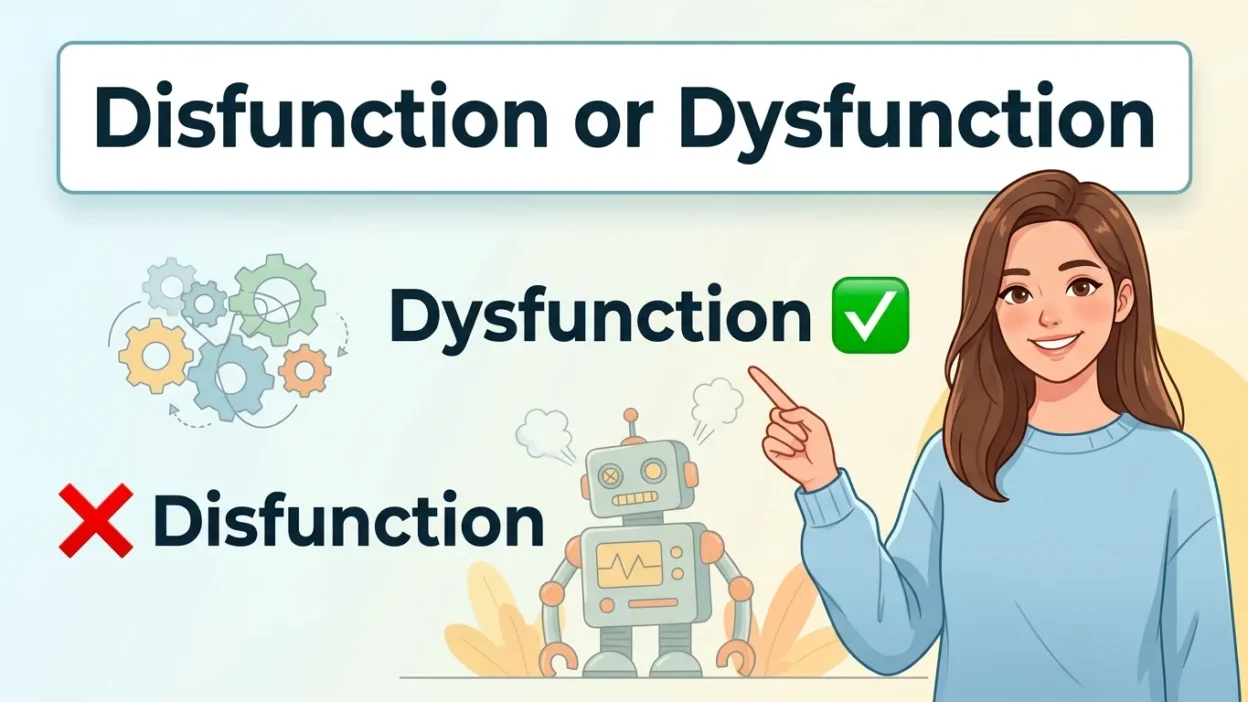
Have you ever wondered whether “disfunction” or “dysfunction” is the correct spelling? These two forms can look almost identical, but choosing the standard spelling matters when you want your writing to sound accurate and professional.
Dysfunction is the accepted and widely used spelling in modern English. The word dysfunction describes something that does not work or operate normally. It can refer to a machine, system, organization, body part, or relationship.
For example, you might say “The team suffers from dysfunction” or “The device has a dysfunction.” The spelling “disfunction” is uncommon and is generally considered a nonstandard or incorrect form in most modern writing.
Quick Answer: Disfunction or Dysfunction?
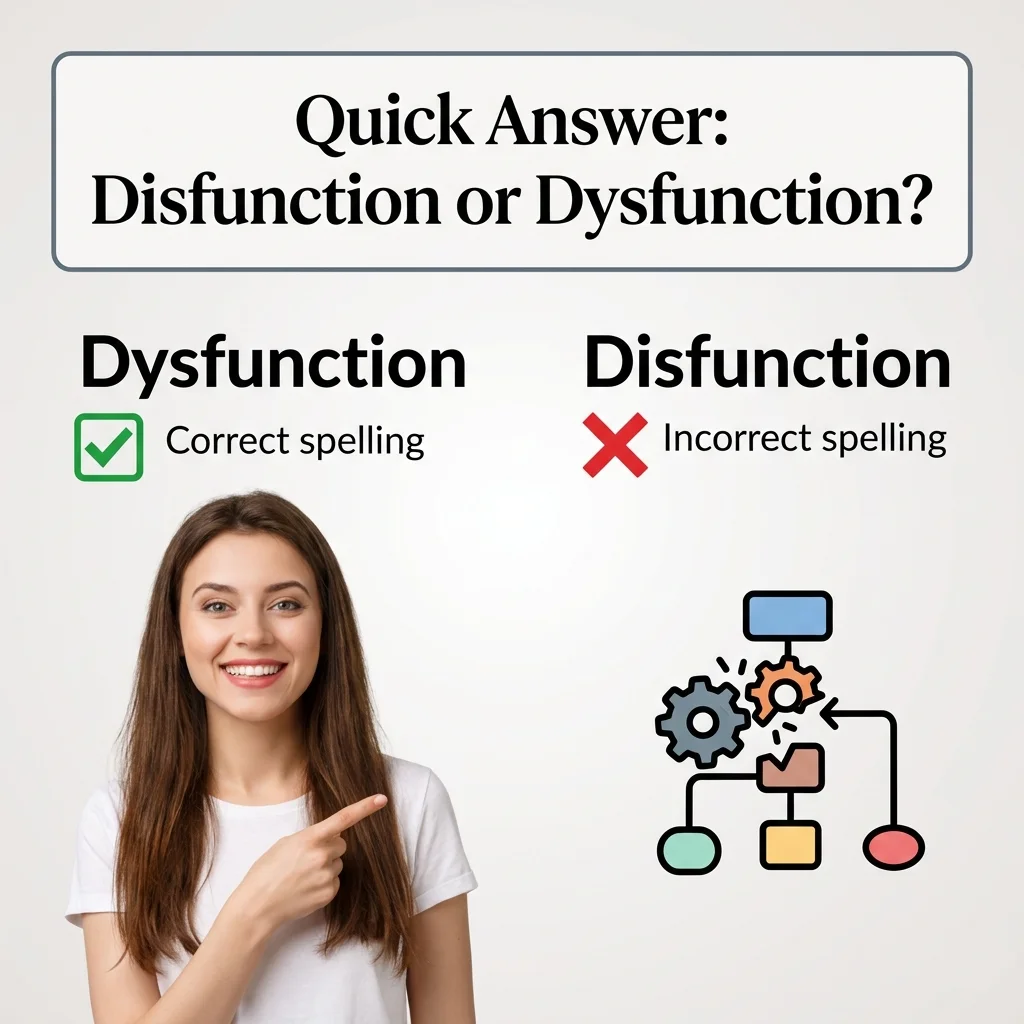
Dysfunction is the standard and commonly accepted spelling in modern English.
Use dysfunction when you are talking about something that does not work, operate, or function normally.
For example:
- The machine has a dysfunction that needs to be repaired.
- The doctor identified a dysfunction in the patient’s nervous system.
- Poor communication can create dysfunction within a team.
- The therapist discussed family dysfunction with the patient.
Disfunction is a much less common spelling and is generally not the word you should use in ordinary modern English.
The simple rule
Use “dysfunction” for the normal modern spelling.
If you are writing an essay, article, email, report, website, or academic paper, dysfunction is the safer and standard choice.
What Does “Dysfunction” Mean?
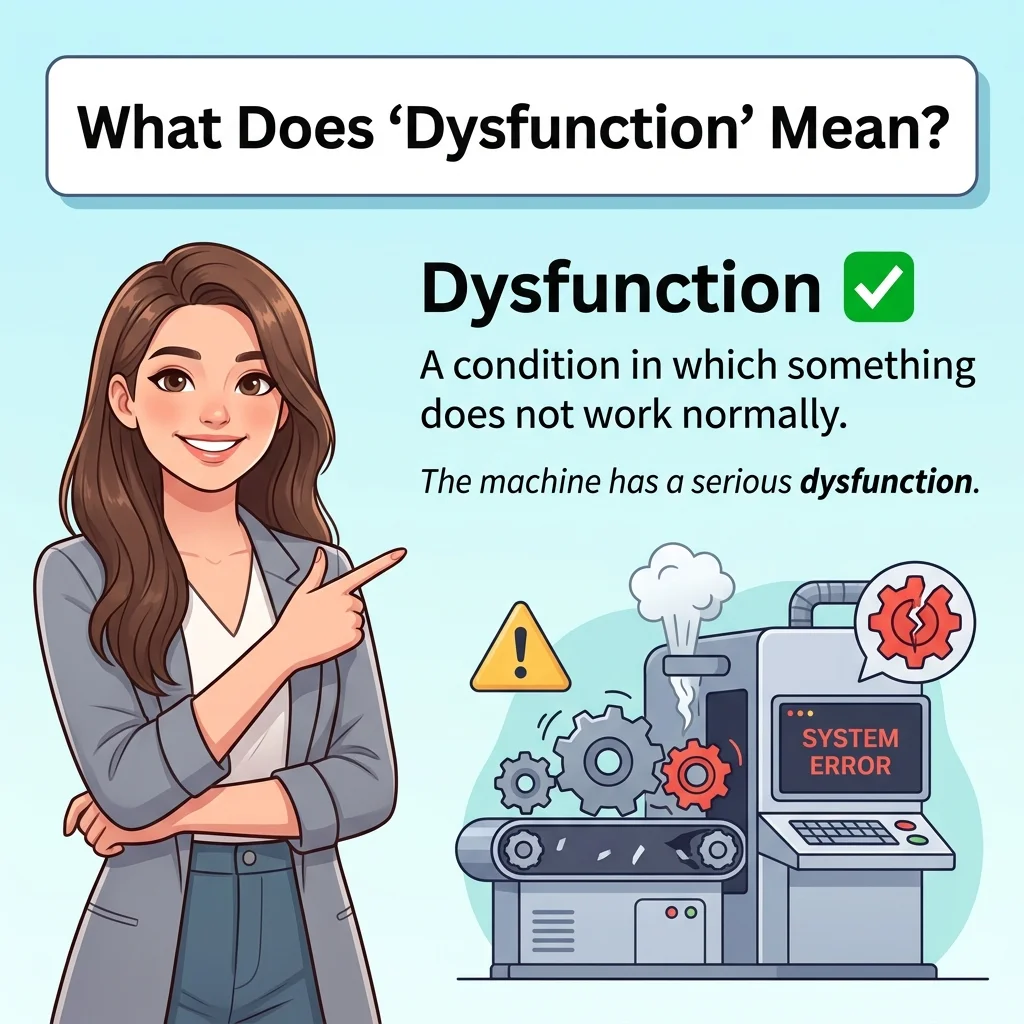
The noun dysfunction refers to a situation in which something does not work or operate normally.
The word can describe a problem with:
- A body part
- A biological system
- A machine or device
- A relationship
- A family
- A workplace
- An organization
- A social system
- A psychological process
The exact meaning depends on the context.
For example, when talking about the human body, dysfunction usually means that an organ or system is not working normally.
Example:
The patient was experiencing kidney dysfunction.
Here, dysfunction means that the kidneys were not performing their normal function properly.
The word can also describe problems in groups or organizations.
Example:
The company suffered from serious communication dysfunction.
In this sentence, the company does not necessarily have a physical problem. Instead, the communication process within the organization is not working effectively.
What Does “Disfunction” Mean?
Disfunction is a rare variant spelling that has appeared in English, but it is not the standard spelling normally used in contemporary English.
Most modern writers should use dysfunction instead.
The confusion happens because English has many words beginning with dis-, such as:
- Disagree
- Disconnect
- Disappear
- Disapprove
- Discomfort
- Disrespect
Because of this pattern, people sometimes assume that disfunction must be the correct spelling.
However, dysfunction follows a different word formation pattern. The prefix dys- comes from Greek and generally indicates something abnormal, impaired, difficult, or faulty.
So:
dys + function = dysfunction
The spelling may look unusual at first, but it is the established modern form.
Disfunction vs. Dysfunction: The Main Difference
The biggest difference is not really between two common meanings. It is mainly a difference in spelling and modern usage.
| Word | Modern standard usage | Meaning | Example |
| Dysfunction | Common and standard | Abnormal or impaired functioning | The system has a dysfunction. |
| Disfunction | Rare/nonstandard in ordinary modern usage | Usually intended to mean dysfunction | Avoid this spelling in most writing. |
If you are unsure which one to use, choose dysfunction.
Why Is “Dysfunction” Correct?
The word dysfunction comes from the combination of dys- and function.
The prefix dys- is used in English to indicate something that is difficult, abnormal, impaired, or faulty.
The word function refers to the normal activity or purpose of something.
Therefore, dysfunction describes impaired or abnormal functioning.
For example:
Muscle dysfunction can affect movement.
Here, dysfunction means that the muscles are not functioning normally.
Why Do People Spell It “Disfunction”?
There are several reasons people make this spelling mistake.
It Looks Like Other “Dis-” Words
English contains many familiar words beginning with dis-, so writers may naturally assume that disfunction follows the same pattern.
For example:
- Disagree
- Dislike
- Disconnect
- Disable
- Discontinue
This makes disfunction look reasonable, even though dysfunction is the standard spelling.
“Dys-” Is Less Familiar
The prefix dys- appears in many specialized words, but some learners encounter it less often.
Examples include:
- Dyslexia
- Dysfunction
- Dysplasia
- Dysphagia
- Dysregulation
- Dystopia
Because dys- is less familiar to some English learners, disfunction can feel more natural.
Pronunciation Can Add to the Confusion
In normal speech, the difference between the spellings may not be obvious. If you hear the word rather than see it written, you may not know whether it contains dis- or dys-.
That is why remembering the spelling visually can help.
Is “Disfunction” a Correct Word?
Disfunction has been used in English, particularly historically, and it can be found in some dictionaries or older sources. However, it is not the usual modern spelling of the word meaning impaired or abnormal functioning.
For contemporary writing, dysfunction is the appropriate choice.
This distinction is important because a word can exist in historical usage without being the preferred spelling in modern standard English.
If you are writing:
- A school assignment
- A university paper
- A professional report
- A blog post
- A medical article
- A business document
- An email
- A formal essay
use dysfunction.
Is “Dysfunction” a Noun?
Yes. Dysfunction is primarily used as a noun.
A noun names a person, place, thing, or idea. In this case, dysfunction describes a condition or state of abnormal functioning.
Examples of “Dysfunction” as a Noun
The doctor noticed a dysfunction in the patient’s nervous system.
The team experienced dysfunction after several employees left.
Family dysfunction can affect communication.
The machine stopped because of a mechanical dysfunction.
The report examines dysfunction within the organization.
In each example, dysfunction names a problem or condition.
Is “Dysfunctional” a Word?
Yes. Dysfunctional is the adjective related to dysfunction.
It describes something that does not work or operate normally.
Compare these two sentences:
The company has dysfunction.
The company has a dysfunctional management system.
The first sentence uses the noun dysfunction.
The second uses the adjective dysfunctional to describe the management system.
Examples of “Dysfunctional”
- A dysfunctional family
- A dysfunctional relationship
- A dysfunctional organization
- A dysfunctional system
- A dysfunctional machine
- A dysfunctional government agency
For example:
The team became dysfunctional because its members could not communicate effectively.
Dysfunction vs. Dysfunctional
These words are closely related, but they perform different grammatical jobs.
| Word | Part of speech | Meaning | Example |
| Dysfunction | Noun | Abnormal functioning or a problem | The organization has dysfunction. |
| Dysfunctional | Adjective | Not functioning normally | The organization is dysfunctional. |
A simple way to remember this is:
Dysfunction = the problem
Dysfunctional = describes something with the problem
Compare the Sentences
The company has dysfunction.
The company is dysfunctional.
Both sentences communicate a similar general idea, but their grammar is different.
Common Uses of “Dysfunction”
The word dysfunction can appear in many areas of English.
Medical Use
In medical contexts, dysfunction often refers to an organ, system, or body process that is not working normally.
Examples:
The test showed liver dysfunction.
The patient developed thyroid dysfunction.
The doctor investigated possible neurological dysfunction.
Medical writing frequently uses dysfunction because it provides a general description of impaired functioning.
Psychological Use
The word can also describe difficulties involving psychological processes or behavior.
Examples:
The study examined emotional dysfunction.
The therapist discussed patterns of family dysfunction.
The condition may affect social functioning.
The meaning depends on the specific context.
Relationship Use
You may also hear dysfunction when people discuss unhealthy or ineffective patterns within relationships.
For example:
Their relationship was affected by poor communication and dysfunction.
The counselor helped the couple identify patterns of dysfunction.
The word does not automatically mean that every person involved is bad. It describes a pattern or situation that is not functioning effectively.
Family Use
Family dysfunction is a common phrase.
It refers broadly to unhealthy or ineffective patterns within a family.
For example:
The novel explores themes of family dysfunction.
The therapist works with families experiencing communication problems.
Workplace Use
Dysfunction can describe problems inside a company or team.
For example:
Poor leadership created dysfunction within the department.
The team struggled with workplace dysfunction.
Communication problems contributed to organizational dysfunction.
Technical Use
Engineers and scientists may use dysfunction to describe abnormal operation in systems or equipment.
For example:
The technician identified a dysfunction in the control system.
The software experienced a temporary functional problem.
In highly technical writing, a more specific word such as failure, malfunction, or defect may sometimes be more appropriate.
Dysfunction vs. Malfunction
These words are related but not identical.
Dysfunction usually means that something is not functioning normally.
Malfunction often suggests that a machine, device, or system has failed to operate correctly.
Compare:
The patient has kidney dysfunction.
You would not normally say:
The patient has kidney malfunction.
On the other hand:
The washing machine has a malfunction.
This is natural because a machine can malfunction.
Quick Comparison
| Word | Common meaning | Typical contexts |
| Dysfunction | Abnormal or impaired functioning | Medical, psychological, social, organizational |
| Malfunction | Failure to work correctly | Machines, devices, equipment, technology |
Dysfunction vs. Disfunction: Spelling Tip
The easiest spelling trick is to remember:
Dysfunction has “dys,” not “dis.”
Break it into two parts:
Dys + function
Think of the first part as D-Y-S.
A Simple Memory Trick
You can remember:
“Dys” means something is not working normally.
So:
DYS + FUNCTION = DYSFUNCTION
This can help you avoid writing disfunction by accident.
Common Mistakes With “Dysfunction”
Even when people know the correct spelling, they can make other mistakes.
Mistake 1: Writing “Disfunction”
Incorrect or generally nonstandard in modern usage:
The organization has serious disfunction.
Better:
The organization has serious dysfunction.
Mistake 2: Confusing “Dysfunction” With “Dysfunctional”
Incorrect:
The company is dysfunction.
Correct:
The company is dysfunctional.
Or:
The company has dysfunction.
Remember that dysfunction is a noun, while dysfunctional is an adjective.
Mistake 3: Using “Dysfunction” When “Malfunction” Is Better
Consider:
My computer has dysfunction.
This is understandable, but malfunction or a problem may sound more natural when talking about a computer.
Better:
My computer has a malfunction.
Or:
My computer is malfunctioning.
The best word depends on the subject and context.
Mistake 4: Assuming Every Problem Is a Dysfunction
Not every small mistake should be called dysfunction.
For example:
I forgot my password.
This is simply a mistake or inconvenience.
Calling it dysfunction would sound unnecessarily formal.
The word usually works better when discussing a broader problem with how something operates.
More Examples of “Dysfunction” in Sentences
Here are several examples from different contexts.
Everyday Examples
The team suffered from communication dysfunction.
The project was delayed because of organizational dysfunction.
Their constant arguments created dysfunction at home.
The meeting revealed serious dysfunction within the department.
The system developed a temporary dysfunction.
Medical Examples
The doctor was concerned about liver dysfunction.
The test was designed to identify possible kidney dysfunction.
The patient was evaluated for hormonal dysfunction.
The condition can lead to muscle dysfunction.
Workplace Examples
Poor communication can cause dysfunction in a workplace.
The manager tried to address the team’s dysfunction.
The department experienced organizational dysfunction after the restructuring.
The report identified several causes of workplace dysfunction.
Academic Examples
The research explores dysfunction in social institutions.
The study examined family dysfunction and communication patterns.
Researchers investigated how dysfunction affects group performance.
The article discusses dysfunction within complex systems.
When Should You Use “Dysfunction”?
Use dysfunction when you want to describe abnormal, impaired, or ineffective functioning.
It works particularly well when discussing a system rather than one simple mistake.
For example:
The organization has serious communication dysfunction.
This suggests an ongoing problem in how communication works.
Compare it with:
John sent the email to the wrong person.
The second sentence describes a specific mistake, not necessarily a broader dysfunction.
When Should You Avoid “Dysfunction”?
Although dysfunction is correct, it can sometimes sound too formal.
In casual conversation, simpler words may communicate the idea more naturally.
Instead of:
There is dysfunction in our scheduling process.
You might simply say:
Our scheduling process isn’t working properly.
Both can be correct, but the second is more conversational.
Good writing is not only about choosing a grammatically correct word. It is also about choosing a word that fits your audience and situation.
“Dysfunction” in Formal and Informal English
The word is more common in formal or specialized writing than in casual conversation.
Formal
The investigation identified significant organizational dysfunction.
Less Formal
The organization has some serious problems.
Formal
The study examined cognitive dysfunction.
Everyday
The condition affected how the person thought and processed information.
Both styles can work. Your choice depends on the context.
Can “Dysfunction” Be Plural?
Yes. The plural form is dysfunctions.
For example:
The report identified several dysfunctions within the system.
However, in some contexts, writers may prefer to describe different forms of dysfunction rather than use the plural.
For example:
The researchers identified several forms of dysfunction.
This can sound more natural when discussing categories or types of problems.
Can You Say “Dysfunctions”?
Yes, but use it naturally.
Examples:
Several dysfunctions were identified during the evaluation.
The study examines different social dysfunctions.
Multiple dysfunctions affected the system.
The singular dysfunction is often more common when referring to the general condition.
The Prefix “Dys-” Explained
Understanding dys- can make the spelling easier to remember.
The prefix dys- is used in English words to suggest something abnormal, difficult, impaired, or faulty.
Examples include:
Dyslexia
A condition involving difficulties with reading and language processing.
Dysfunction
Abnormal or impaired functioning.
Dysphagia
Difficulty swallowing.
Dysregulation
Poor or abnormal regulation of a process.
Dystopia
A fictional society characterized by severe problems or oppression.
You do not need to memorize the origins of every word. However, recognizing the pattern can help you understand why dysfunction uses dys- rather than dis-.
Is “Disfunction” Ever Used in English?
Yes, you may encounter disfunction in historical writing, older texts, or occasional modern usage. That does not mean it is the preferred spelling for contemporary standard English.
Language changes over time, and some words have variant spellings or historical forms.
If your goal is clear modern English, especially in professional or educational writing, choose:
Dysfunction
This is particularly important for SEO content because users are much more likely to expect and search for the standard spelling dysfunction.
“Dysfunction” in American and British English
The spelling dysfunction is standard in both American English and British English.
There is no major US-versus-UK spelling difference here.
For example:
American English:
The doctor identified a neurological dysfunction.
British English:
The doctor identified a neurological dysfunction.
The spelling remains the same.
This makes the word relatively easy for international English learners.
“Dysfunction” vs. “Dysfunctional” vs. “Dysfunctionality”
These related words can be confusing.
| Word | Type | Example |
| Dysfunction | Noun | The team has dysfunction. |
| Dysfunctional | Adjective | The team is dysfunctional. |
| Dysfunctionality | Noun | The study examines organizational dysfunctionality. |
Dysfunction is by far the more common choice in ordinary writing.
Dysfunctional is useful when describing something.
Dysfunctionality is much more specialized and can often be replaced with the simpler dysfunction.
For example:
The study examines organizational dysfunction.
This is usually clearer than:
The study examines organizational dysfunctionality.
How to Remember the Correct Spelling
Here are three easy methods.
Remember “DYS + FUNCTION”
Break the word into:
DYS + FUNCTION
Then spell it:
D-Y-S-F-U-N-C-T-I-O-N
Connect “Dys” With “Abnormal”
When you see dys-, think:
Something is not working normally.
Therefore:
DYS + FUNCTION = abnormal functioning
Watch for the “Y”
The most common spelling mistake is replacing the y with i.
Train yourself to notice:
❌ Disfunction
✅ Dysfunction
The Y is the key.
Quick Spelling Practice
Choose the correct word in each sentence.
- The doctor diagnosed kidney ________.
- The team suffered from communication ________.
- The machine developed a serious ________.
- The study examines family ________.
- The organization has become ________.
The best answers are:
- dysfunction
- dysfunction
- malfunction or dysfunction, depending on context
- dysfunction
- dysfunctional
This shows why context matters as well as spelling.
Common Questions About “Disfunction” and “Dysfunction”
Is “disfunction” or “dysfunction” correct?
Dysfunction is the standard modern spelling. Disfunction is rare and is generally not the spelling to use in contemporary standard English.
Is “disfunction” a misspelling?
In most modern contexts, yes. If you intend to describe abnormal or impaired functioning, dysfunction is the standard spelling.
What is the meaning of dysfunction?
Dysfunction means abnormal, impaired, or ineffective functioning. It can refer to a body system, organization, relationship, machine, or other system.
What is the difference between dysfunction and dysfunctional?
Dysfunction is a noun, while dysfunctional is an adjective.
The team has dysfunction.
The team is dysfunctional.
Is dysfunction a negative word?
It generally describes a problem or abnormal condition, so it often has a negative meaning. However, the word itself is descriptive rather than a judgment about a person.
Can dysfunction describe a family?
Yes. Family dysfunction is a common expression for unhealthy or ineffective patterns within a family.
Can dysfunction describe a workplace?
Yes. You can use phrases such as workplace dysfunction, team dysfunction, and organizational dysfunction.
Is dysfunction a medical term?
Yes. It is widely used in medical and scientific contexts to describe impaired or abnormal functioning.
Is dysfunction the same as failure?
Not always. Dysfunction can mean that something is working abnormally or inadequately, while failure can imply that it has stopped working or cannot perform its intended function.
Is dysfunction the same as malfunction?
Not exactly. Malfunction is especially common for machines and equipment, while dysfunction has a much broader range of uses.
What is the opposite of dysfunction?
Depending on the context, possible opposites include normal functioning, proper functioning, functionality, or effective operation.
How do you pronounce dysfunction?
It is commonly pronounced roughly like “dis-FUNK-shun.”
The pronunciation can help you recognize the word when you hear it, but it does not tell you whether to spell the first part with i or y. That spelling must be learned.
Is dysfunction one word?
Yes. Dysfunction is written as one word.
What is the adjective form of dysfunction?
The common adjective is dysfunctional.
For example:
The system is dysfunctional.
What is the plural of dysfunction?
The plural is dysfunctions.
For example:
The researchers identified several dysfunctions.
Final Thought
The confusion between disfunction and dysfunction is understandable because the words look almost identical. The important thing to remember is that dysfunction is the established standard spelling in modern English.
Use dysfunction when you mean abnormal, impaired, or ineffective functioning. Use dysfunctional when you need an adjective to describe something that does not function normally.

Daniel Carter is a passionate writer who creates clear, helpful, and easy-to-understand content. He focuses on language, grammar, word meanings, and everyday expressions, helping readers find simple answers to common questions.