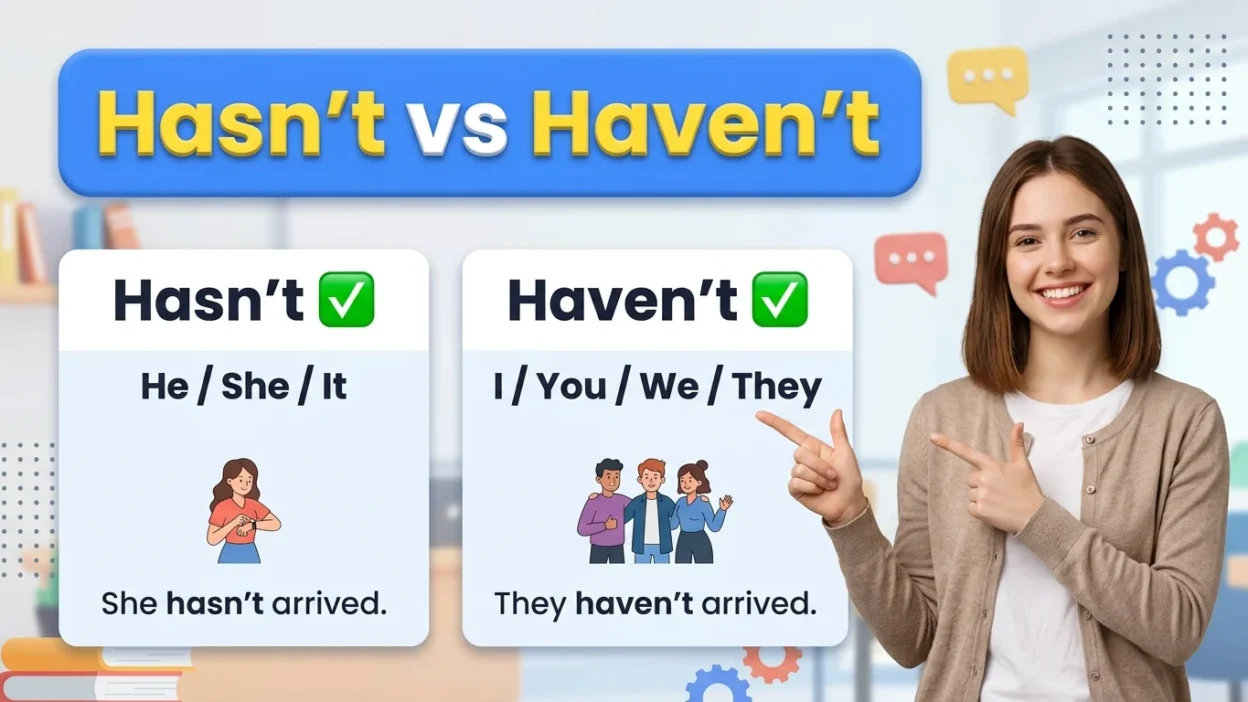
When learning English grammar, small differences between words can sometimes create big confusion. Hasn’t vs Haven’t is a common example, especially when you’re trying to form negative sentences correctly.
Although both are contractions of “has not” and “have not,” they are used with different subjects. Understanding this simple rule can help you speak and write English more naturally and confidently.
In this guide, you’ll learn when to use hasn’t and when to use haven’t, with clear examples that make the difference easy to remember. We’ll also look at common mistakes, sentence patterns, and everyday situations where these words appear.
What Does Hasn’t Mean?
Hasn’t is the contracted form of has not.
It is mainly used with third-person singular subjects such as:
- He
- She
- It
- A singular person
- A singular thing
- A singular noun
Hasn’t Meaning
Hasn’t = has not
It shows that something has not happened, has not been completed, or has not been true up to a particular time.
For example:
- He hasn’t arrived yet.
- She hasn’t called me.
- It hasn’t stopped raining.
- Daniel hasn’t finished his work.
- The computer hasn’t started.
In these examples, hasn’t tells us that an action or situation has not happened.
Hasn’t in Full Form
The full form of hasn’t is has not.
Both forms are grammatically correct:
She hasn’t finished her homework.
She has not finished her homework.
The contracted version sounds more natural in casual conversations, while the full form can be used for emphasis or in more formal writing.
What Does Haven’t Mean?
Haven’t is the contracted form of have not.
It is generally used with:
- I
- You
- We
- They
- Plural nouns
Haven’t Meaning
Haven’t = have not
It is used to say that something has not happened, has not been completed, or has not been experienced.
For example:
- I haven’t eaten yet.
- You haven’t answered my question.
- We haven’t finished the project.
- They haven’t arrived.
- The students haven’t completed the test.
The important point is that haven’t normally goes with subjects that take have rather than has.
Haven’t in Full Form
The full form is have not.
For example:
I haven’t seen that movie.
can also be written as:
I have not seen that movie.
Both are correct. The contraction is simply shorter and more common in everyday speech.
Hasn’t vs Haven’t: The Main Difference

The biggest difference between hasn’t and haven’t is the subject they follow.
| Subject | Correct Form | Example |
| I | haven’t | I haven’t finished. |
| You | haven’t | You haven’t called. |
| He | hasn’t | He hasn’t arrived. |
| She | hasn’t | She hasn’t eaten. |
| It | hasn’t | It hasn’t started. |
| We | haven’t | We haven’t decided. |
| They | haven’t | They haven’t replied. |
| Singular noun | hasn’t | Sarah hasn’t arrived. |
| Plural noun | haven’t | The boys haven’t arrived. |
A quick rule to remember is:
He, she, it → hasn’t
I, you, we, they → haven’t
This rule covers most everyday situations.
Hasn’t vs Haven’t in the Present Perfect Tense
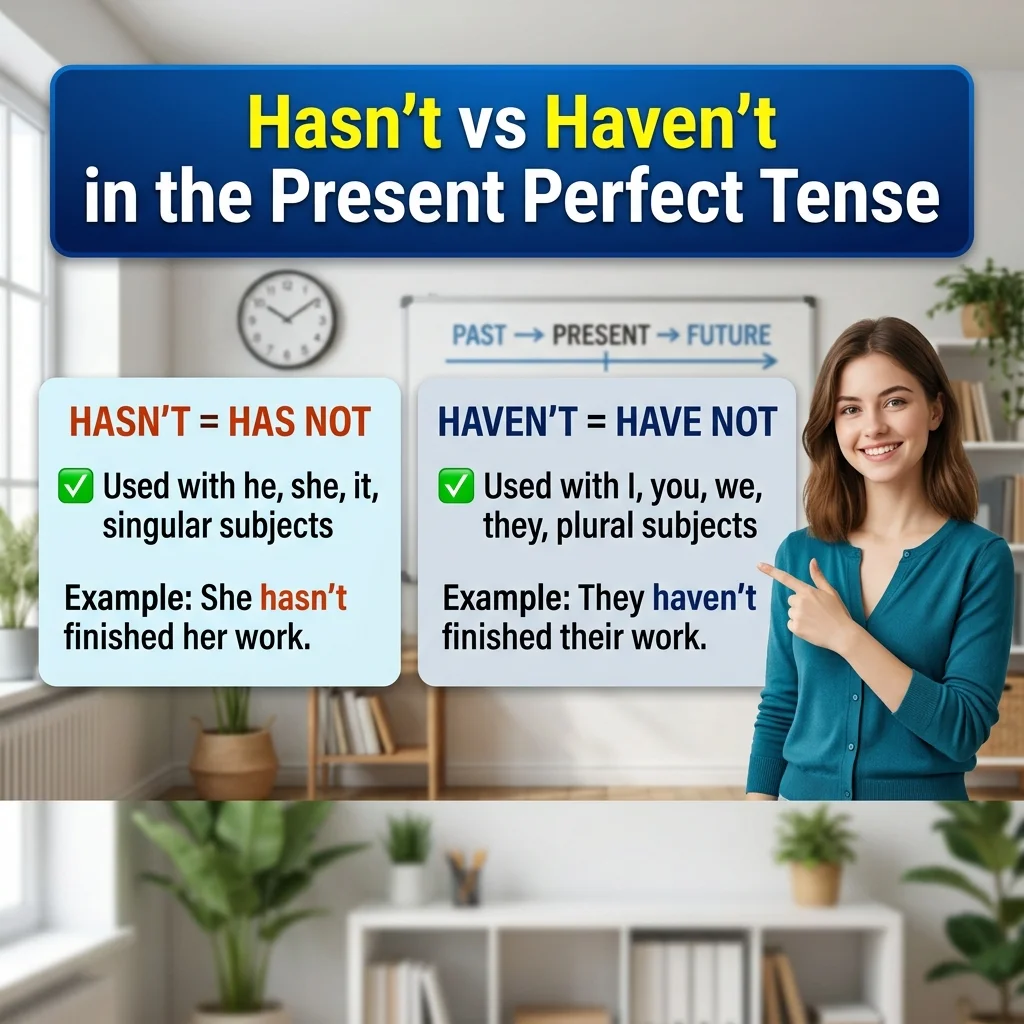
One of the most common uses of hasn’t and haven’t is the present perfect tense.
The present perfect is formed with:
Subject + has/have + past participle
For negative sentences, we use:
Subject + hasn’t/haven’t + past participle
Hasn’t in Present Perfect
Use hasn’t with third-person singular subjects.
Examples:
- She hasn’t finished her work.
- He hasn’t called me.
- It hasn’t stopped raining.
- The teacher hasn’t arrived.
- My brother hasn’t eaten breakfast.
Notice that the main verb is usually in its past participle form.
For example:
- finish → finished
- call → called
- eat → eaten
- write → written
- see → seen
Haven’t in Present Perfect
Use haven’t with I, you, we, they, and plural nouns.
Examples:
- I haven’t finished my work.
- You haven’t called me.
- We haven’t eaten yet.
- They haven’t arrived.
- The students haven’t completed the assignment.
The structure stays the same. Only hasn’t or haven’t changes according to the subject.
When Should You Use Hasn’t?
Use hasn’t when the subject is singular and takes has.
With He
Use hasn’t with he.
Examples:
- He hasn’t arrived yet.
- He hasn’t finished his work.
- He hasn’t called me.
- He hasn’t seen the message.
- He hasn’t learned the answer.
Incorrect:
- He haven’t arrived.
Correct:
- He hasn’t arrived.
With She
Use hasn’t with she.
Examples:
- She hasn’t finished her homework.
- She hasn’t replied to my message.
- She hasn’t eaten lunch.
- She hasn’t visited London.
- She hasn’t told me the truth.
Incorrect:
- She haven’t replied.
Correct:
- She hasn’t replied.
With It
Use hasn’t with it.
Examples:
- It hasn’t stopped raining.
- It hasn’t started yet.
- It hasn’t changed.
- It hasn’t worked properly.
- It hasn’t happened before.
Here, it is singular, so hasn’t is required.
With Singular Nouns
A singular noun normally takes hasn’t.
Examples:
- My phone hasn’t charged.
- The dog hasn’t eaten.
- Sarah hasn’t arrived.
- The car hasn’t started.
- The baby hasn’t slept.
A useful trick is to replace the singular noun with he, she, or it. If that works, hasn’t is usually the correct choice.
When Should You Use Haven’t?
Use haven’t with I, you, we, they, and plural nouns.
With I
Use haven’t with I.
Examples:
- I haven’t finished yet.
- I haven’t seen him.
- I haven’t eaten breakfast.
- I haven’t received your email.
- I haven’t decided what to do.
Do not say:
- I hasn’t finished.
Say:
- I haven’t finished.
With You
Use haven’t with you.
Examples:
- You haven’t answered my question.
- You haven’t finished your work.
- You haven’t told me anything.
- You haven’t changed at all.
- You haven’t seen this movie.
This applies whether you refers to one person or multiple people.
With We
Use haven’t with we.
Examples:
- We haven’t started yet.
- We haven’t finished the project.
- We haven’t decided.
- We haven’t visited that place.
- We haven’t talked about it.
With They
Use haven’t with they.
Examples:
- They haven’t arrived yet.
- They haven’t replied.
- They haven’t finished the work.
- They haven’t paid the bill.
- They haven’t seen the results.
With Plural Nouns
Plural nouns normally take haven’t.
Examples:
- The students haven’t finished the test.
- My friends haven’t arrived.
- The children haven’t eaten yet.
- The workers haven’t completed the job.
- The cars haven’t been repaired.
Hasn’t vs Haven’t Examples
Looking at pairs of examples can make the difference easier to understand.
Singular vs Plural
The boy hasn’t arrived.
The boys haven’t arrived.
The first subject, boy, is singular, so we use hasn’t. The second subject, boys, is plural, so we use haven’t.
She vs They
She hasn’t finished her work.
They haven’t finished their work.
The subject changes from she to they, so the helping verb changes from hasn’t to haven’t.
He vs We
He hasn’t seen the movie.
We haven’t seen the movie.
“He” is third-person singular, while “we” takes “have.”
Singular Noun vs Plural Noun
The teacher hasn’t arrived.
The teachers haven’t arrived.
The singular noun teacher takes hasn’t, while the plural noun teachers takes haven’t.
Hasn’t vs Haven’t in Questions
Although hasn’t and haven’t commonly appear in statements, they can also appear in questions.
Examples with hasn’t:
- Hasn’t he arrived yet?
- Hasn’t she finished?
- Hasn’t the movie started?
- Hasn’t your brother called?
Examples with haven’t:
- Haven’t you finished?
- Haven’t they arrived?
- Haven’t we met before?
- Haven’t you seen this?
These questions can sometimes express surprise or expectation.
For example:
Haven’t you finished your homework?
This may suggest that the speaker expected the homework to be finished already.
Hasn’t vs Haven’t With “Yet”
Both forms commonly appear with yet.
Use hasn’t + past participle + yet with singular third-person subjects:
- She hasn’t arrived yet.
- He hasn’t called yet.
- The bus hasn’t arrived yet.
- The movie hasn’t started yet.
Use haven’t + past participle + yet with I, you, we, they, and plural subjects:
- I haven’t finished yet.
- You haven’t answered yet.
- We haven’t decided yet.
- They haven’t arrived yet.
- The students haven’t finished yet.
Hasn’t vs Haven’t With “Ever”
Both can also be used with ever.
Examples:
- He hasn’t ever visited Paris.
- She hasn’t ever tried sushi.
- I haven’t ever seen that show.
- We haven’t ever discussed this issue.
- They haven’t ever traveled abroad.
However, in many situations, native speakers may use never instead:
- He has never visited Paris.
- I have never seen that show.
Both structures can be grammatically correct, depending on the intended meaning and context.
Hasn’t vs Haven’t With “Been”
The words hasn’t and haven’t are frequently used before been.
Examples with hasn’t:
- He hasn’t been here before.
- She hasn’t been feeling well.
- It hasn’t been easy.
- The car hasn’t been repaired.
Examples with haven’t:
- I haven’t been there.
- We haven’t been informed.
- They haven’t been invited.
- You haven’t been honest with me.
Remember that been is the past participle of be.
Hasn’t vs Haven’t With “Got”
In British English, have got is commonly used to talk about possession.
For example:
- He hasn’t got a car.
- She hasn’t got enough money.
- They haven’t got any time.
- We haven’t got a problem.
In American English, speakers often use doesn’t have instead:
- He doesn’t have a car.
- She doesn’t have enough money.
Both patterns are normal in their respective varieties of English.
Common Mistakes With Hasn’t and Haven’t
Understanding common errors can help you avoid them.
Mistake 1: Using Haven’t With He
Incorrect:
He haven’t finished his work.
Correct:
He hasn’t finished his work.
Why? He is a third-person singular subject, so it takes hasn’t.
Mistake 2: Using Hasn’t With I
Incorrect:
I hasn’t seen her.
Correct:
I haven’t seen her.
The pronoun I takes have, not has.
Mistake 3: Using Hasn’t With They
Incorrect:
They hasn’t arrived.
Correct:
They haven’t arrived.
“They” takes have.
Mistake 4: Using Haven’t With a Singular Noun
Incorrect:
My brother haven’t called.
Correct:
My brother hasn’t called.
“Brother” is singular, so it takes hasn’t.
Mistake 5: Using Hasn’t With a Plural Noun
Incorrect:
My friends hasn’t arrived.
Correct:
My friends haven’t arrived.
“Friends” is plural, so use haven’t.
Mistake 6: Forgetting the Past Participle
Incorrect:
She hasn’t finish her work.
Correct:
She hasn’t finished her work.
After hasn’t or haven’t in the present perfect, use the past participle.
More examples:
- hasn’t gone
- haven’t seen
- hasn’t written
- haven’t eaten
- hasn’t finished
Hasn’t vs Haven’t Spelling Tips
The spelling is easy once you remember the original forms.
Hasn’t = has + not
Haven’t = have + not
The apostrophe replaces the missing letters in not.
Hasn’t
The word hasn’t contains an apostrophe between has and nt.
Correct:
hasn’t
Incorrect:
hasnt
Haven’t
The word haven’t contains an apostrophe between have and nt.
Correct:
haven’t
Incorrect:
havent
The apostrophe is important in standard written English.
A Simple Memory Trick
Try this simple pattern:
He → has → hasn’t
She → has → hasn’t
It → has → hasn’t
Then:
I → have → haven’t
You → have → haven’t
We → have → haven’t
They → have → haven’t
You can remember it as:
He, she, it = has
I, you, we, they = have
Then simply add not:
has + not = hasn’t
have + not = haven’t
Hasn’t vs Haven’t: Quick Comparison
| Feature | Hasn’t | Haven’t |
| Full form | Has not | Have not |
| Main use | Singular third person | I, you, we, they, plural |
| Used with he | Yes | No |
| Used with she | Yes | No |
| Used with it | Yes | No |
| Used with I | No | Yes |
| Used with you | No | Yes |
| Used with we | No | Yes |
| Used with they | No | Yes |
| Singular nouns | Yes | Usually no |
| Plural nouns | Usually no | Yes |
| Example | She hasn’t called. | They haven’t called. |
Hasn’t vs Haven’t in Everyday Conversation
Both forms are extremely common in everyday English.
You might hear conversations like:
“Has Sarah arrived?”
“No, she hasn’t.”
Or:
“Have the guests arrived?”
“No, they haven’t.”
Notice how the answer changes according to the subject.
Example Conversation 1
A: Has John finished the report?
B: No, he hasn’t.
Example Conversation 2
A: Have the students finished the test?
B: No, they haven’t.
Example Conversation 3
A: Have you eaten?
B: No, I haven’t.
Example Conversation 4
A: Has your sister called?
B: No, she hasn’t.
These short answers are natural and very common.
Hasn’t vs Haven’t in Formal Writing
Both contractions are grammatically correct, but formal writing sometimes prefers the full forms has not and have not.
For example, a formal report might say:
The company has not completed the investigation.
A casual message might say:
The company hasn’t finished the investigation.
Likewise:
We have not received your application.
is more formal than:
We haven’t received your application.
This does not mean contractions are always inappropriate in formal writing. The best choice depends on the style and purpose of the writing.
Hasn’t vs Haven’t vs Didn’t
Another common source of confusion is the difference between hasn’t/haven’t and didn’t.
Hasn’t and haven’t are commonly used with the present perfect.
Didn’t is the contraction of did not and is used with the simple past.
Compare:
She hasn’t finished her homework.
This means the homework remains unfinished up to now.
She didn’t finish her homework yesterday.
This refers to a particular past situation.
Another example:
They haven’t arrived yet.
They didn’t arrive yesterday.
The first focuses on the situation up to the present. The second refers to a completed past time.
Hasn’t vs Haven’t vs Doesn’t
Hasn’t and haven’t can also be confused with doesn’t.
Compare:
He hasn’t eaten breakfast.
He doesn’t eat breakfast.
The first uses the present perfect and refers to a specific situation or period leading up to now. The second describes a habit or general situation.
Another example:
She hasn’t called me.
She doesn’t call me.
The meanings are different, even though both sentences are negative.
Hasn’t vs Haven’t: Practice Sentences
Choose hasn’t or haven’t in each sentence.
- She ______ finished her homework.
- They ______ arrived yet.
- I ______ seen that movie.
- He ______ called me.
- We ______ decided yet.
- The dog ______ eaten its food.
- You ______ answered my question.
- The children ______ gone outside.
- My brother ______ returned home.
- It ______ stopped raining.
Answers
- She hasn’t finished her homework.
- They haven’t arrived yet.
- I haven’t seen that movie.
- He hasn’t called me.
- We haven’t decided yet.
- The dog hasn’t eaten its food.
- You haven’t answered my question.
- The children haven’t gone outside.
- My brother hasn’t returned home.
- It hasn’t stopped raining.
A Fast Way to Choose Between Hasn’t and Haven’t
When you are unsure, look at the subject first.
Step 1: Find the subject
Ask: Who or what is doing the action?
For example:
Sarah hasn’t arrived.
The subject is Sarah.
Step 2: Decide whether it is singular or plural
Sarah is one person, so she is singular.
Step 3: Choose has or have
A singular third-person subject takes has.
Therefore:
Sarah hasn’t arrived.
Now consider:
Sarah and Tom haven’t arrived.
The subject contains two people, so it is plural.
Therefore:
Sarah and Tom haven’t arrived.
This three-step method can help you choose correctly even when the sentence is complicated.
Hasn’t vs Haven’t With Names
Names can sometimes make the rule easier to understand.
A single person’s name normally takes hasn’t:
- David hasn’t arrived.
- Emma hasn’t called.
- James hasn’t finished.
- Maria hasn’t replied.
Two or more names take haven’t:
- David and Emma haven’t arrived.
- James and Maria haven’t called.
- Tom and Sarah haven’t finished.
The same rule applies to other singular and plural nouns.
Hasn’t vs Haven’t in British and American English
The basic distinction between hasn’t and haven’t is the same in both British and American English.
For example:
British English:
She hasn’t finished yet.
American English:
She hasn’t finished yet.
Likewise:
British English:
They haven’t arrived.
American English:
They haven’t arrived.
The subject agreement does not change between the two varieties.
There can be differences in other uses of have, especially when discussing possession, but the basic hasn’t/haven’t rule remains the same.
Is Hasn’t or Haven’t More Correct?
Neither word is generally “more correct.” They are both correct contractions, but they are used with different subjects.
Use hasn’t when the subject requires has.
Use haven’t when the subject requires have.
For example:
He hasn’t finished.
and:
They haven’t finished.
Both sentences are grammatically correct.
The important thing is matching the helping verb to the subject.
Frequently Asked Questions About Hasn’t vs Haven’t
Is “hasn’t” the same as “has not”?
Yes. Hasn’t is the contraction of has not.
For example:
She hasn’t arrived.
means:
She has not arrived.
Is “haven’t” the same as “have not”?
Yes. Haven’t is the contraction of have not.
For example:
They haven’t arrived.
means:
They have not arrived.
Do I use hasn’t with he?
Yes. He hasn’t is correct.
Example:
He hasn’t finished his work.
Do I use haven’t with they?
Yes. They haven’t is correct.
Example:
They haven’t finished their work.
Do I say “I hasn’t” or “I haven’t”?
The correct form is I haven’t.
Example:
I haven’t seen him.
Do I say “she hasn’t” or “she haven’t”?
The correct form is she hasn’t.
Example:
She hasn’t called me.
Do I use hasn’t with a singular noun?
Yes, normally.
For example:
The teacher hasn’t arrived.
“The teacher” is singular, so hasn’t is appropriate.
Do I use haven’t with plural nouns?
Yes.
For example:
The teachers haven’t arrived.
“Teachers” is plural, so haven’t is correct.
Is “hasn’t” formal or informal?
Hasn’t is a normal English contraction. It is especially common in conversation and informal writing. In some formal contexts, writers may prefer has not.
Is “haven’t” formal or informal?
Haven’t is also a normal contraction. It is very common in everyday English. More formal writing may sometimes use have not instead.
Can hasn’t and haven’t be used in questions?
Yes.
Examples:
Hasn’t she arrived?
Haven’t they arrived?
They are especially common when the speaker expected something to happen.
What is the easiest way to remember hasn’t vs haven’t?
Remember:
He, she, it → hasn’t
I, you, we, they → haven’t
Then apply the same pattern to nouns:
Singular noun → hasn’t
Plural noun → haven’t
Final Takeaway: Hasn’t vs Haven’t
The difference between hasn’t and haven’t is mainly about subject agreement.
Use hasn’t as the contraction of has not with he, she, it, and most singular nouns.
Use haven’t as the contraction of have not with I, you, we, they, and plural nouns.
The easiest rule is:
He, she, it = hasn’t
I, you, we, they = haven’t
For example:
She hasn’t finished her work.
They haven’t finished their work.
Once you identify the subject, the correct choice becomes much easier. Pay attention to whether the subject is singular or plural, and remember that the present perfect normally requires a past participle after hasn’t or haven’t. With a little practice, you will be able to use both forms naturally and accurately.

Daniel Carter is a passionate writer who creates clear, helpful, and easy-to-understand content. He focuses on language, grammar, word meanings, and everyday expressions, helping readers find simple answers to common questions.