Have you ever wondered why “How can I” sounds natural in a question, while “How I can” often appears in the middle of a sentence? These phrases contain the same words, but their order changes how they work in English.
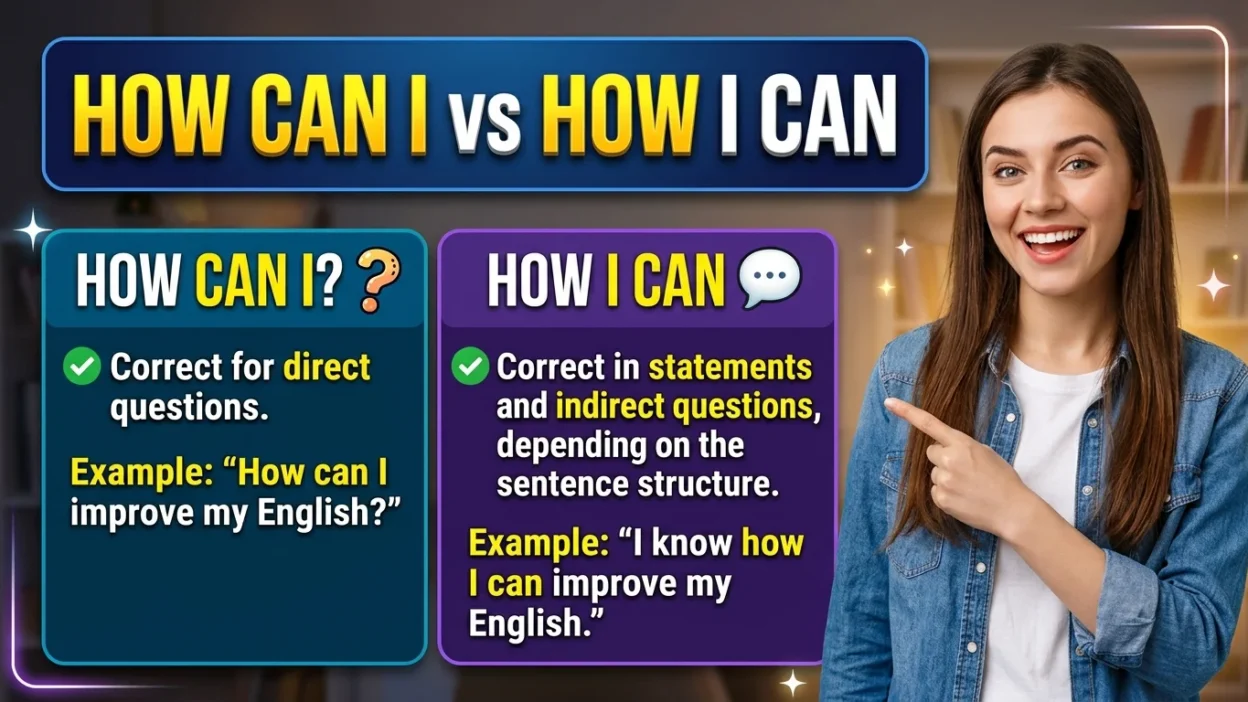
Understanding How Can I vs How I Can is essential for forming correct questions and expressing your thoughts clearly. “How can I” is commonly used to ask questions about ability, possibility, or the best way to do something.
For example, “How can I improve my English?” asks for advice or a solution. In contrast, “how I can” usually appears in statements or indirect questions, such as “Can you explain how I can improve my English?” Once you understand this simple difference in word order, you’ll find it easier to write naturally and avoid common grammar mistakes.
What Is the Difference Between “How Can I” and “How I Can”?
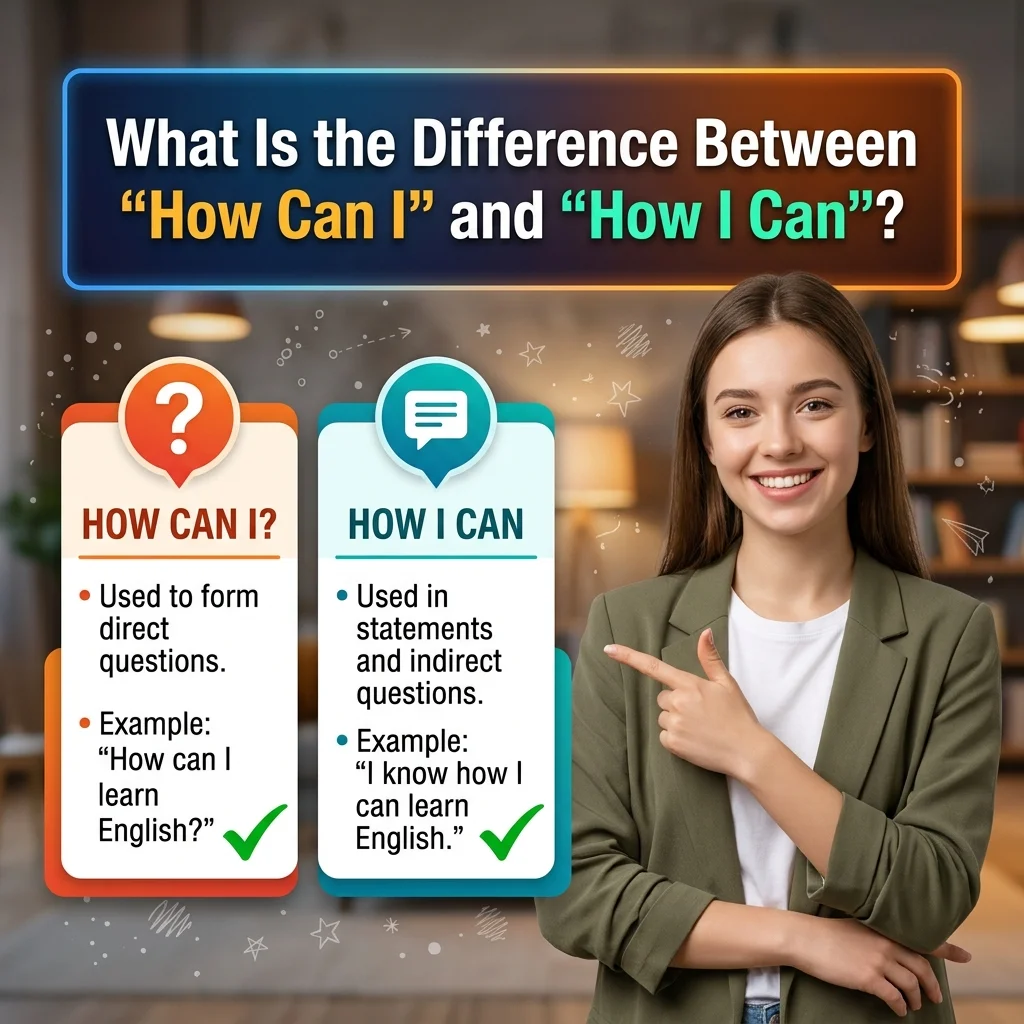
The main difference between “How can I” and “how I can” is their position in a sentence and the type of question or statement they create.
- How can I is normally used at the beginning of a direct question.
- How I can is normally used inside a sentence, especially after expressions such as I want to know, Can you explain, or She asked.
The two expressions contain the same words, but their word order changes because English uses different structures for direct and indirect questions.
Quick Comparison
| Expression | Main use | Example |
| How can I | Direct questions | How can I improve my English? |
| How I can | Indirect questions or statements | I want to know how I can improve my English. |
| How can I | Asking for instructions or help | How can I open this file? |
| How I can | Explaining a possible method | This is how I can solve the problem. |
A simple way to remember the difference is:
Direct question: How can I…? Inside a sentence: …how I can…
Both forms are grammatically correct when used in the right structure.
What Does “How Can I” Mean?

“How can I” is a question phrase used to ask about a method, possibility, ability, or way to do something. It is one of the most common structures in everyday English.
When someone says “How can I…?”, they usually want to know:
- What steps should I follow?
- What is the best way to do something?
- Is it possible for me to do it?
- What can I do in a particular situation?
- How can I improve or solve something?
The Grammar Structure of “How Can I”
The basic structure is:
How + can + subject + base verb + …?
For example:
- How can I learn English?
- How can I fix this problem?
- How can I contact you?
- How can I become more confident?
- How can I save money?
Here, can is a modal verb, I is the subject, and the main verb remains in its base form.
Why Does “Can” Come Before “I”?
In a direct question, English usually places the modal verb before the subject.
Statement:
I can improve my writing.
Direct question:
How can I improve my writing?
The word order changes because the sentence becomes a question.
This is similar to other questions:
- I can help you. → Can I help you?
- I can finish it. → How can I finish it?
- I can learn this. → How can I learn this?
Examples of “How Can I” in Everyday English
Asking for help
How can I solve this problem?
Asking about learning
How can I improve my pronunciation?
Asking about a method
How can I get to the station?
What Does “How I Can” Mean?
“How I can” is usually used as part of a longer sentence. It introduces an indirect question, an explanation, or a statement about a method.
Unlike a direct question, an indirect question keeps the normal statement word order:
How + subject + can + base verb
For example:
I want to know how I can improve my English.
The phrase “how I can improve my English” is not a direct question by itself. It is part of the larger sentence “I want to know…”
The Grammar Structure of “How I Can”
The basic structure is:
Main clause + how + subject + can + base verb + …
Examples:
- I want to know how I can improve.
- She explained how I can apply.
- Can you tell me how I can register?
- This guide shows how I can create an account.
- I am thinking about how I can save more money.
Notice that I comes before can because the phrase follows normal statement word order.
Why Is “How I Can” Correct in an Indirect Question?
Compare these two sentences:
Direct question:
How can I learn English?
Indirect question:
I want to know how I can learn English.
The meaning is almost the same, but the grammar is different.
In the direct question, can comes before I.
In the indirect question, I comes before can.
This is called subject–auxiliary inversion in direct questions. In indirect questions, that inversion usually disappears.
Examples of “How I Can” in Longer Sentences
- I am trying to understand how I can improve my writing.
- She asked how I can help with the project.
- Can you explain how I can use this tool?
- I need to find out how I can change my password.
- He showed me how I can organize my notes.
- I wonder how I can become better at speaking English.
In each example, “how I can” is part of a larger sentence.
How Can I vs How I Can: The Main Grammar Rule
The most important rule is simple:
Use “How can I” for a direct question. Use “how I can” when the phrase is inside another sentence.
Direct Questions Use “How Can I”
A direct question asks something directly and usually ends with a question mark.
Examples:
- How can I improve my vocabulary?
- How can I start a blog?
- How can I make this sentence clearer?
- How can I remember new words?
- How can I contact the support team?
These questions begin with how, followed by can, then the subject I.
Indirect Questions Use “How I Can”
An indirect question is included inside a longer sentence. It often follows phrases such as:
- I want to know…
- Can you tell me…
- I wonder…
- I need to find out…
- She asked…
- He explained…
- Do you know…
Examples:
- I want to know how I can improve my vocabulary.
- Can you tell me how I can start a blog?
- I wonder how I can make this sentence clearer.
- I need to find out how I can remember new words.
- She asked how I can contact the support team.
Side-by-Side Examples
| Direct question | Indirect question |
| How can I learn faster? | I want to know how I can learn faster. |
| How can I fix this? | Can you explain how I can fix this? |
| How can I apply? | She asked how I can apply. |
| How can I save time? | I wonder how I can save time. |
| How can I improve? | He explained how I can improve. |
The meaning stays similar, but the sentence structure changes.
How to Use “How Can I” Correctly
1. Use It to Ask for Instructions
One of the most common uses of “How can I” is asking someone to explain the steps needed to do something.
Examples:
- How can I install this app?
- How can I open a bank account?
- How can I submit my assignment?
- How can I change my email address?
- How can I create a strong password?
These questions ask for a method or process.
Example conversation:
A: How can I register for the course? B: You can register through the official website.
2. Use It to Ask About Possibilities
“Can” can also express possibility.
Examples:
- How can I finish this work today?
- How can I reach the airport before noon?
- How can I solve this problem without help?
- How can I make this plan work?
These questions ask what is possible or what options are available.
3. Use It to Ask for Advice
You can use “How can I” when asking for suggestions about improving a skill or handling a situation.
Examples:
- How can I become more confident?
- How can I improve my grammar?
- How can I manage my time better?
- How can I speak English more naturally?
- How can I prepare for an interview?
4. Use It in Polite Requests
“How can I” can sound polite and helpful when asking about services or support.
Examples:
- How can I help you?
- How can I assist you today?
- How can I contact customer support?
- How can I request a refund?
- How can I get more information?
“How can I help you?” is especially common in customer service and everyday conversations.
5. Use It to Ask About Personal Actions
The subject I means the speaker is asking what they themselves can do.
Examples:
- How can I help my friend?
- How can I improve my health habits?
- How can I prepare for tomorrow?
- How can I make a good impression?
- How can I learn this topic?
How to Use “How I Can” Correctly
1. Use It After “I Want to Know”
This is one of the easiest patterns to remember.
Structure:
I want to know + how I can + verb
Examples:
- I want to know how I can improve my English.
- I want to know how I can apply for the job.
- I want to know how I can solve this issue.
- I want to know how I can become a better writer.
2. Use It After “Can You Tell Me”
When asking someone indirectly, use normal statement word order after how.
Examples:
- Can you tell me how I can register?
- Can you tell me how I can contact the manager?
- Can you tell me how I can improve my pronunciation?
- Can you tell me how I can access the document?
Incorrect direct-question order inside the indirect clause:
Can you tell me how can I register?
Correct:
Can you tell me how I can register?
3. Use It After “I Wonder”
“I wonder” introduces an indirect question or thought.
Examples:
- I wonder how I can improve my writing.
- I wonder how I can make this work.
- I wonder how I can reach her.
- I wonder how I can learn this skill quickly.
4. Use It After “She Asked” or “He Asked”
When reporting a question, use indirect-question word order.
Direct question:
“How can I apply?”
Reported question:
She asked how she could apply.
If you are reporting the original speaker’s exact words using I, you might say:
She asked how I can apply.
However, the meaning depends on who I refers to. More commonly, if the person asked about their own action, the sentence would be:
She asked how she could apply.
5. Use It to Explain a Method
Sometimes “how I can” is not a question at all. It can explain a possible method or plan.
Examples:
- This tutorial explains how I can create a website.
- I am thinking about how I can organize my schedule.
- The guide shows how I can use the software.
- I have learned how I can write better introductions.
In these sentences, “how I can” introduces information about a method.
Direct Questions vs Indirect Questions
Understanding direct and indirect questions is the key to mastering this topic.
What Is a Direct Question?
A direct question is asked directly. It normally uses question word order and ends with a question mark.
Examples:
- How can I improve my English?
- Where can I find the book?
- When can I start?
- Why can I not access the account?
The auxiliary or modal verb often comes before the subject.
What Is an Indirect Question?
An indirect question is included inside another sentence. It is often more polite or less direct.
Examples:
- I want to know how I can improve my English.
- Can you tell me where I can find the book?
- She asked when she could start.
- I wonder why I cannot access the account.
The embedded question usually follows statement word order.
Important Rule: No Inversion in Indirect Questions
In a direct question:
How can I solve it?
In an indirect question:
I want to know how I can solve it.
The phrase “how I can” is correct because the subject comes before the modal verb.
More Direct and Indirect Examples
| Direct question | Indirect question |
| How can I get there? | Do you know how I can get there? |
| How can I use this? | Can you explain how I can use this? |
| How can I improve? | I want to know how I can improve. |
| How can I join? | She asked how she could join. |
| How can I make it better? | He wondered how he could make it better. |
How Can I vs How I Can: Detailed Comparison
Word Order
How can I follows question word order:
How + can + I + verb
How I can follows statement word order:
How + I + can + verb
This is the most important grammatical difference.
Sentence Position
How can I usually appears at the beginning of a direct question.
How can I learn this?
How I can usually appears in the middle of a sentence.
I know how I can learn this.
Punctuation
Direct questions normally end with a question mark.
How can I improve my writing?
Indirect questions do not always end with a question mark. The punctuation depends on the whole sentence.
I want to know how I can improve my writing.
However, if the entire sentence is a question, it can end with a question mark:
Can you tell me how I can improve my writing?
Meaning
Both expressions often refer to the same general idea: finding a way to do something.
But the speaker uses them differently:
- How can I…? → Directly asking.
- …how I can… → Referring to the question or method inside a larger sentence.
Formality
Both forms are natural and correct. “How can I” is common in everyday speech, while “how I can” is often used in more complete or formal sentence structures.
Neither expression is automatically more formal than the other.
Common Mistakes with “How Can I” and “How I Can”
Mistake 1: Using “How Can I” Inside an Indirect Question
Incorrect:
I want to know how can I improve my English.
Correct:
I want to know how I can improve my English.
Why? The phrase is an indirect question, so it uses statement word order.
Mistake 2: Using “How I Can” as a Direct Question
Incorrect:
How I can improve my English?
Correct:
How can I improve my English?
Why? A direct question requires the modal verb can before the subject I.
Mistake 3: Forgetting the Base Verb After “Can”
After can, use the base form of the verb.
Correct:
- How can I learn?
- How can I write?
- How can I improve?
- How can I solve?
Incorrect:
- How can I learning?
- How can I to learn?
- How can I improved?
The modal verb can is followed by the base form of the main verb.
Mistake 4: Adding “Do” After “Can”
Incorrect:
How can I do improve my English?
Correct:
How can I improve my English?
The word can already functions as the auxiliary verb in this question. You do not need do before the main verb.
Mistake 5: Confusing “How Can I” with “How Could I”
Both can be correct, but could often sounds more tentative, polite, or hypothetical.
- How can I help you? → Asking what help is possible.
- How could I help you? → Asking in a more tentative or thoughtful way.
The same word-order rule applies:
- Direct: How could I help?
- Indirect: I wonder how I could help.
Mistake 6: Using “How I Can” Without a Larger Sentence
“How I can” usually needs a main clause or context.
Unnatural as a standalone question:
How I can improve?
Natural:
How can I improve?
Or:
I want to know how I can improve.
How Can I vs How I Can in Different Situations
Asking a Teacher
Direct question:
How can I improve my grammar?
Indirect question:
I want to know how I can improve my grammar.
Asking Customer Support
Direct question:
How can I reset my password?
Indirect question:
Can you tell me how I can reset my password?
Asking a Friend
Direct question:
How can I help you?
Indirect question:
I am wondering how I can help you.
Talking About a Plan
Direct question:
How can I finish this project?
Indirect statement:
I am thinking about how I can finish this project.
Asking About Learning
Direct question:
How can I learn new vocabulary?
Indirect question:
I want to know how I can learn new vocabulary.
30 Examples of “How Can I”
Here are several natural examples of “How can I” in direct questions.
- How can I improve my English?
- How can I learn new words?
- How can I speak more confidently?
- How can I write a better introduction?
- How can I remember grammar rules?
- How can I solve this problem?
- How can I open this document?
- How can I change my password?
- How can I contact your team?
- How can I apply for this position?
- How can I register for the course?
- How can I save more money?
- How can I manage my time?
- How can I prepare for the exam?
- How can I improve my pronunciation?
- How can I make this sentence clearer?
- How can I become a better writer?
- How can I learn to use this software?
- How can I find the right information?
- How can I avoid common mistakes?
- How can I make my website faster?
- How can I organize my notes?
- How can I start a new project?
- How can I understand this lesson?
- How can I remember what I read?
- How can I ask this question politely?
- How can I improve my listening skills?
- How can I write a professional email?
- How can I make my writing more natural?
- How can I practice English every day?
30 Examples of “How I Can”
Here are several natural examples of “how I can” in indirect questions and statements.
- I want to know how I can improve my English.
- Can you tell me how I can learn new words?
- I wonder how I can speak more confidently.
- She explained how I can write a better introduction.
- I am trying to understand how I can remember grammar rules.
- I need to find out how I can solve this problem.
- He showed me how I can open this document.
- I want to know how I can change my password.
- Can you explain how I can contact your team?
- I am learning how I can apply for this position.
- She told me how I can register for the course.
- I am thinking about how I can save more money.
- I want to understand how I can manage my time.
- He explained how I can prepare for the exam.
- I am practicing how I can improve my pronunciation.
- Can you show me how I can make this sentence clearer?
- I want to learn how I can become a better writer.
- The tutorial explains how I can use this software.
- I need to discover how I can find the right information.
- I am trying to learn how I can avoid common mistakes.
- This guide shows how I can make my website faster.
- I am thinking about how I can organize my notes.
- She explained how I can start a new project.
- I want to know how I can understand this lesson.
- I am learning how I can remember what I read.
- Can you tell me how I can ask this question politely?
- I want to understand how I can improve my listening skills.
- He showed me how I can write a professional email.
- I am trying to discover how I can make my writing more natural.
- I want to know how I can practice English every day.
How to Change “How Can I” into “How I Can”
Changing a direct question into an indirect question is a useful grammar exercise.
Step 1: Start with the Direct Question
How can I improve my English?
Step 2: Add an Introductory Phrase
Choose a phrase such as:
- I want to know…
- Can you tell me…
- I wonder…
- I need to find out…
- She asked…
Step 3: Change the Word Order
Move the subject I before can.
How can I improve…?
becomes:
…how I can improve…
Step 4: Remove the Question Mark if Appropriate
If the new sentence is a statement, use a period.
Direct:
How can I improve my English?
Indirect:
I want to know how I can improve my English.
More Transformation Examples
| Direct question | Indirect version |
| How can I open the file? | Can you tell me how I can open the file? |
| How can I learn faster? | I wonder how I can learn faster. |
| How can I apply? | I want to know how I can apply. |
| How can I solve this? | She explained how I can solve this. |
| How can I improve? | I need to find out how I can improve. |
How Can I vs How I Can: A Simple Memory Trick
Remember this pattern:
Direct Question = Question Word Order
How + can + I + verb?
How can I learn?
Indirect Question = Statement Word Order
How + I + can + verb
I want to know how I can learn.
A useful memory sentence is:
When I ask directly, “How can I?” When I include the question, “how I can.”
This simple rule works in most everyday situations.
Can “How I Can” Start a Sentence?
Yes, “how I can” can appear at the beginning of a sentence when it is part of a larger structure. However, it usually needs additional words to form a complete sentence.
Examples:
- How I can improve my English is something I want to understand.
- How I can solve the problem depends on the information available.
- How I can help is the question we need to answer.
In these examples, “how I can” introduces a clause that functions as part of the sentence.
But if you simply want to ask a direct question, use:
How can I improve my English?
Can “How Can I” Be Used in a Statement?
Yes, but it usually appears as part of a quotation or a question being discussed.
Examples:
- The question is, “How can I improve my English?”
- I was thinking, “How can I solve this problem?”
- She asked, “How can I apply?”
In these examples, “How can I” remains correct because it is a direct question inside quotation marks.
How Can I vs How I Can in Formal Writing
Both expressions are useful in formal writing, but they serve different purposes.
Direct Questions in Formal Writing
Direct questions can be used in headings, interviews, guides, and instructional content.
Examples:
- How can I improve my writing?
- How can I prepare for an exam?
- How can I use this information effectively?
Indirect Questions in Formal Writing
Indirect questions often sound more integrated into a paragraph.
Examples:
- This article explains how I can improve my writing.
- The report discusses how I can prepare for an exam.
- The guide describes how I can use this information effectively.
In formal writing, indirect questions can help connect ideas smoothly, but direct questions are also completely acceptable.
“How Can I” vs “How I Can” in SEO Content
For SEO content, both phrases can be useful because they match different search intents.
When to Use “How Can I”
Use “How can I” when writing a direct question that matches a user’s search query.
Examples:
- How can I improve my English grammar?
- How can I write better sentences?
- How can I learn English faster?
These questions are useful for headings, FAQs, and conversational content.
When to Use “How I Can”
Use “how I can” naturally inside explanatory sentences.
Examples:
- This guide explains how I can improve my English grammar.
- Readers can learn how I can write better sentences.
- The article shows how I can practice English more effectively.
The key is to use each phrase according to its grammatical role rather than forcing a keyword into a sentence.
Frequently Asked Questions About “How Can I” vs “How I Can”
Is “How can I” grammatically correct?
Yes. “How can I” is grammatically correct and is normally used to begin a direct question.
Example: How can I improve my English?
Is “How I can” grammatically correct?
Yes. “How I can” is grammatically correct when used inside a larger sentence or clause.
Example: I want to know how I can improve my English.
Which is correct: “How can I” or “How I can”?
Both are correct, but they are used differently.
- How can I…? → Direct question.
- …how I can… → Indirect question or statement.
Can I say “How I can improve my English?”
Not usually as a standalone direct question. The natural direct question is:
How can I improve my English?
But “How I can improve my English” can be part of a longer sentence:
I want to know how I can improve my English.
Why is “How can I” correct but “How I can” also correct?
English uses different word orders for direct and indirect questions. Direct questions often place the modal verb before the subject, while indirect questions use normal statement order.
Is “How can I” more formal than “How I can”?
Neither is automatically more formal. “How can I” is a direct question, while “how I can” is usually part of a longer sentence.
Can “How can I” be used in an indirect question?
Usually, no. In standard English, an indirect question normally uses statement word order.
Correct: Can you tell me how I can apply? Incorrect: Can you tell me how can I apply?
Can “How I can” be used in a direct question?
Not normally. A direct question should use:
How can I…?
What comes after “can” in these sentences?
A base-form verb comes after can.
Examples:
- How can I learn?
- How I can learn.
- How can I write?
- How I can write.
Is “How can I help you?” correct?
Yes. “How can I help you?” is a very common and polite question used in customer service, workplaces, and everyday conversations.
Is “Can you tell me how can I help you?” correct?
No, not in standard indirect-question grammar.
Correct:
Can you tell me how I can help you?
Is “How I can do this?” correct?
No, not as a direct question.
Correct:
How can I do this?
Or:
I want to know how I can do this.
What is the easiest way to remember the difference?
Remember:
Direct: How can I…? Indirect: …how I can…
This rule will help you choose the correct word order in most situations.
Final Tips for Using “How Can I” and “How I Can”
Before choosing between these expressions, ask yourself one simple question:
Am I asking the question directly, or am I including it inside another sentence?
If you are asking directly, use “How can I.”
- How can I improve?
- How can I start?
- How can I solve this?
If you are including the question inside another sentence, use “how I can.”
- I want to know how I can improve.
- Can you tell me how I can start?
- I wonder how I can solve this.
Also remember these important grammar points:
- Use can + base verb.
- Do not use “how can I” inside a normal indirect question.
- Do not use “how I can” as a standalone direct question.
- Check the word order carefully.
- Practice by changing direct questions into indirect questions.
- Focus on sentence structure rather than memorizing isolated phrases.
Conclusion
The difference between “How can I” and “How I can” is mainly about word order and sentence structure. “How can I” is used for direct questions, such as “How can I improve my English?” On the other hand, “how I can” is used inside longer sentences, such as “I want to know how I can improve my English.”
Once you understand this difference, you can use both expressions confidently in conversations, emails, academic writing, and everyday English. With a little practice, choosing the correct form will become natural.

Emily Parker is a dedicated writer who enjoys creating clear, useful, and easy-to-understand content. She focuses on language, grammar, word meanings, and everyday expressions to help readers find simple and reliable answers.